 |
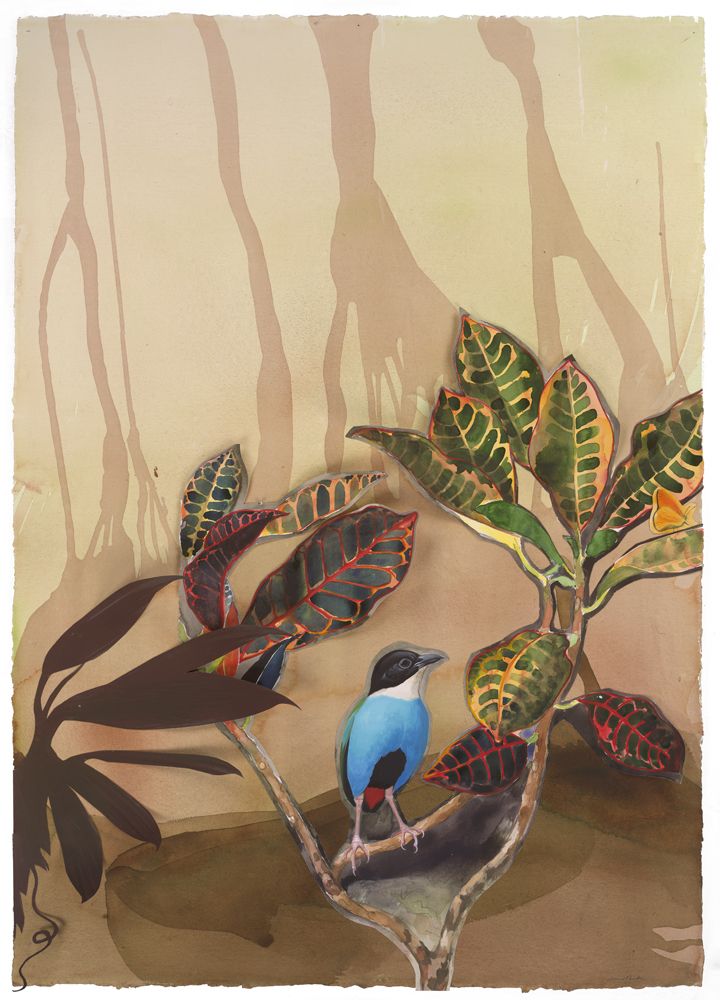
| David Tomb "Azure-breasted Pitta" 2012 Painted papers with mixed media and partially pasted and or completely pasted on paper with mixed media 42 x 30 inches |

Showing posts with label snakes. Show all posts
Showing posts with label snakes. Show all posts
Wednesday, October 17, 2012
David Tomb's "Grand Birds"

Saturday, October 29, 2011
AIRIE Residency: Update #5
This update is associated with my 2-week-long Artists In Residence In the Everglades (AIRIE) writing and art residency.

AIRIE Housing; Everglades National Park; October 2011
Notes from Days 12, 13, & 14:
- I had the privilege of joining Florida International University Honors College professors Peter Machonis and Devon Graham as they led their "Everglades: From beginning to end?" seminar class on a slough slog. Before we waded into the river of grass, I presented a short lecture on my artwork, the importance of biodiversity, and the Endangered Species Print Project (ESPP).
I wrapped up the talk by highlighting the Endangered Species Condom project, an ESPP collaboration with the Center for Biological Diversity that aims to raise public awareness of the environmental impact of a burgeoning human population on natural resources, habitats, and thousands of critically endangered species around the world...and, of course, I distributed the Endangered Species Condoms to all in attendance.
The real fun started about an hour later, when we stepped into the water. As regular readers of HH know, I've seen plenty of flora and fauna from the roads and trails in my two weeks in Everglades National Park, but sloshing through sawgrass marshes and into two bald cypress stands provided another, more sensual prespective. We met countless spiders (all species unidentified, unfortunately), diminutive American green tree frogs, and Halloween pennant dragonflies (as well as other, unidentified dragonfly species) on our way to the cypress dome.
Once inside the dome's shaded, cooler, and humid environment, most of the students found seats on a hurricane-felled tree and the rest of us took up positions nearby. We ate lunch while the class described some of what they'd seen during our slog to the cypress stand. Afterwards, Peter led a discussion of Their Eyes Were Watching God, the novel by Zora Neale Hurston, which the class recently read. As students offered their insights, a curious, juvenile American alligator swam close to our group, provoking some "ooo"s and "aww"s (admittedly, tyke gators are cute).
I kept my eyes peeled for the flow of a Burmese python through the water. The python population in the Everglades is one of the most celebrated invasive species concerns in the United States. The week before I arrived, rangers caught a python crossing Anhinga Trail, a popular park destination. The rangers killed and dissected the large reptile to learn what it had been preying on. The pythons aren't picky eaters and they grow to nearly 20 feet in length; the recent capture had only birds and water rats in its belly, but these invaders have been known to feed on fish, raccoons, river otters, bobcats, deer, and even the occasional alligator. One ranger remarked to me that he rarely sees small mammals in the park anymore. A decade ago, he told me, visitors were guaranteed to see marsh rabbits, Eastern cottontail rabbits, Eastern grey squirrels, and nine-banded armadillos along the park's roads, but I haven't seen even one of these animals during my two weeks here.
"Do you think the pythons are responsible?," I asked the ranger. He shrugged and said, "Well, it could be a coincidence. Rabbits have population boom-and-bust cycles." "What about the armadillos?," I asked. He raised his eyebrows and shrugged. "I'm not really sure about their populations. We can't prove anything yet." Some researchers now estimate that the established, breeding population of Burmese pythons in the Everglades is in the thousands.
Highlights of the slog (besides talking with some of the students and the professors) included seeing 2 American bitterns, a bird that I'm particularly fond of, and watching (and feeling) the mandibles of a grasshopper (unidentified as of yet) work on the the upper layer of my index finger's skin, scraping away little flecks of it, which the insect appeared to eat. It didn't hurt; it felt like a cross between being tickled and rubbed with a small piece of sandpaper. Had it been a larger grasshopper, I may not have been so obliging, but I enjoyed watching the insect at work.
Finally, I tip my hat to the aims of Peter and Devon. Their class curriculum is designed to introduce students to Everglades' natural history and "the political nature of local and regional environmental issues," but also to "read critically, to understand the interconnectedness of art, literature, and other disciplines." Amen! Its exactly the sort of generalist class I'd like to take....and the type of class I hope to one day teach. I hope that most of the students realize how fortunate they are to be a part of it.
- During the early days of my stay in the park, I didn't hear any cicadas. Now that the rain has become infrequent, however, I hear their clicking whine all day long. It reminds me of the Eastern Shore of Virginia, my home ground.

Tricolored Heron and Anhinga; Anhinga Trail; Everglades National Park; October 2011
- While I watched, a male anhinga caught a bluegill in the flooded borrow pit by Anhinga Trail. The fish was at least 3 inches in length, and the anhinga decided that he'd better not attempt to eat the fish while still in the water. Unlike most fish-eating birds, anhingas have to throw the fish they catch up into the air, open their beak wide, and swallow the fish as it descends. It's quite a trick to see, especially when the fish, as in the case of this bluegill, is of a fair size. The anhinga waddled (like penguins, anhingas are evolved for diving and swimming, and they're graceless on land) up the grass slope at the borrow pit's edge, his catch held tight in his bill. He moved onto the paved trail and, surrounded by a small group of excited German tourists (and me), pulled off the fish tossing feat with aplomb.

Common Snapping Turtle; Main Road; Everglades National Park; October 2011
- I stopped for 2 more common snapping turtles crossing park roads. One of these was an especially fine model. I also rescued a Florida box turtle from harassment by two American crows. Whether the crows would have eventually gotten past the turtle's shell defense, I don't know, but corvids are clever birds and, though I'm very fond of them, I opted to spoil their fun and potential meal by moving the turtle off the road and into the undergrowth at the forest's edge. The crows clucked and rattled at me in disapproval.

Florida Box Turtle with American Crows; Everglades National Park; October 2011
- I had an on-the-move photo shoot with another road-crosser, an Eastern diamondback rattlesnake. As it continued to move across the road and through the grass on the far side, it kept its head and one s-curve of its body angled toward me, prepared to strike were I to molest it. The encounter was a treat; I've long wanted to meet an Eastern diamondback outside of an enclosure and now I have! Like the cottonmouth I met earlier in my visit, this is a snake that I have no inclination to handle and examine more closely, so I don't know it's gender.

Eastern Diamondback Rattlesnake; Everglades National Park; October 2011
- Sadly, not far from where I came upon the rattler, I found a dead, partially crushed and ant-consumed rough green snake, a beautiful species that, when alive, is a radiant emerald; even dead, they are pretty snakes. Not counting insects or the dead dog wasting away on the roadside outside of park land (there are many dogs with apparently negligent owners living near the park), this is the 3rd dead-on-road (DOR) critter I've found. A red-shouldered hawk and a great blue heron also lost their lives to cars during my time here. There are almost certainly others that I didn't happen to discover.

DOR Rough Green Snake; Everglades National Park; October 2011
Photo credits: all photos, Hungry Hyaena (Christopher Reiger), 2011
Related post: "ESPP and an Everglades Slough Slog," at The Endangered Species Print Project Blog
Notes from Days 12, 13, & 14:
- I had the privilege of joining Florida International University Honors College professors Peter Machonis and Devon Graham as they led their "Everglades: From beginning to end?" seminar class on a slough slog. Before we waded into the river of grass, I presented a short lecture on my artwork, the importance of biodiversity, and the Endangered Species Print Project (ESPP).
I wrapped up the talk by highlighting the Endangered Species Condom project, an ESPP collaboration with the Center for Biological Diversity that aims to raise public awareness of the environmental impact of a burgeoning human population on natural resources, habitats, and thousands of critically endangered species around the world...and, of course, I distributed the Endangered Species Condoms to all in attendance.

The real fun started about an hour later, when we stepped into the water. As regular readers of HH know, I've seen plenty of flora and fauna from the roads and trails in my two weeks in Everglades National Park, but sloshing through sawgrass marshes and into two bald cypress stands provided another, more sensual prespective. We met countless spiders (all species unidentified, unfortunately), diminutive American green tree frogs, and Halloween pennant dragonflies (as well as other, unidentified dragonfly species) on our way to the cypress dome.
Once inside the dome's shaded, cooler, and humid environment, most of the students found seats on a hurricane-felled tree and the rest of us took up positions nearby. We ate lunch while the class described some of what they'd seen during our slog to the cypress stand. Afterwards, Peter led a discussion of Their Eyes Were Watching God, the novel by Zora Neale Hurston, which the class recently read. As students offered their insights, a curious, juvenile American alligator swam close to our group, provoking some "ooo"s and "aww"s (admittedly, tyke gators are cute).
I kept my eyes peeled for the flow of a Burmese python through the water. The python population in the Everglades is one of the most celebrated invasive species concerns in the United States. The week before I arrived, rangers caught a python crossing Anhinga Trail, a popular park destination. The rangers killed and dissected the large reptile to learn what it had been preying on. The pythons aren't picky eaters and they grow to nearly 20 feet in length; the recent capture had only birds and water rats in its belly, but these invaders have been known to feed on fish, raccoons, river otters, bobcats, deer, and even the occasional alligator. One ranger remarked to me that he rarely sees small mammals in the park anymore. A decade ago, he told me, visitors were guaranteed to see marsh rabbits, Eastern cottontail rabbits, Eastern grey squirrels, and nine-banded armadillos along the park's roads, but I haven't seen even one of these animals during my two weeks here.
"Do you think the pythons are responsible?," I asked the ranger. He shrugged and said, "Well, it could be a coincidence. Rabbits have population boom-and-bust cycles." "What about the armadillos?," I asked. He raised his eyebrows and shrugged. "I'm not really sure about their populations. We can't prove anything yet." Some researchers now estimate that the established, breeding population of Burmese pythons in the Everglades is in the thousands.
Highlights of the slog (besides talking with some of the students and the professors) included seeing 2 American bitterns, a bird that I'm particularly fond of, and watching (and feeling) the mandibles of a grasshopper (unidentified as of yet) work on the the upper layer of my index finger's skin, scraping away little flecks of it, which the insect appeared to eat. It didn't hurt; it felt like a cross between being tickled and rubbed with a small piece of sandpaper. Had it been a larger grasshopper, I may not have been so obliging, but I enjoyed watching the insect at work.
Finally, I tip my hat to the aims of Peter and Devon. Their class curriculum is designed to introduce students to Everglades' natural history and "the political nature of local and regional environmental issues," but also to "read critically, to understand the interconnectedness of art, literature, and other disciplines." Amen! Its exactly the sort of generalist class I'd like to take....and the type of class I hope to one day teach. I hope that most of the students realize how fortunate they are to be a part of it.
- During the early days of my stay in the park, I didn't hear any cicadas. Now that the rain has become infrequent, however, I hear their clicking whine all day long. It reminds me of the Eastern Shore of Virginia, my home ground.
- While I watched, a male anhinga caught a bluegill in the flooded borrow pit by Anhinga Trail. The fish was at least 3 inches in length, and the anhinga decided that he'd better not attempt to eat the fish while still in the water. Unlike most fish-eating birds, anhingas have to throw the fish they catch up into the air, open their beak wide, and swallow the fish as it descends. It's quite a trick to see, especially when the fish, as in the case of this bluegill, is of a fair size. The anhinga waddled (like penguins, anhingas are evolved for diving and swimming, and they're graceless on land) up the grass slope at the borrow pit's edge, his catch held tight in his bill. He moved onto the paved trail and, surrounded by a small group of excited German tourists (and me), pulled off the fish tossing feat with aplomb.
- I stopped for 2 more common snapping turtles crossing park roads. One of these was an especially fine model. I also rescued a Florida box turtle from harassment by two American crows. Whether the crows would have eventually gotten past the turtle's shell defense, I don't know, but corvids are clever birds and, though I'm very fond of them, I opted to spoil their fun and potential meal by moving the turtle off the road and into the undergrowth at the forest's edge. The crows clucked and rattled at me in disapproval.
- I had an on-the-move photo shoot with another road-crosser, an Eastern diamondback rattlesnake. As it continued to move across the road and through the grass on the far side, it kept its head and one s-curve of its body angled toward me, prepared to strike were I to molest it. The encounter was a treat; I've long wanted to meet an Eastern diamondback outside of an enclosure and now I have! Like the cottonmouth I met earlier in my visit, this is a snake that I have no inclination to handle and examine more closely, so I don't know it's gender.
- Sadly, not far from where I came upon the rattler, I found a dead, partially crushed and ant-consumed rough green snake, a beautiful species that, when alive, is a radiant emerald; even dead, they are pretty snakes. Not counting insects or the dead dog wasting away on the roadside outside of park land (there are many dogs with apparently negligent owners living near the park), this is the 3rd dead-on-road (DOR) critter I've found. A red-shouldered hawk and a great blue heron also lost their lives to cars during my time here. There are almost certainly others that I didn't happen to discover.
Photo credits: all photos, Hungry Hyaena (Christopher Reiger), 2011
Related post: "ESPP and an Everglades Slough Slog," at The Endangered Species Print Project Blog
Monday, October 24, 2011
AIRIE Residency: Update #3

This update is associated with my 2-week-long Artists In Residence In the Everglades (AIRIE) writing and art residency.
Notes from Days 6, 7, & 8:
- Before this residency, I knew that the Everglades is a birder's paradise. I didn't really know this until I found myself excitedly fumbling with my binoculars as I threw the car into reverse, craned my neck out the window, and attempted to drive-by identify a fast-moving raptor...only to realize that there were also two curious-looking warblers in the pineland understory to my immediate right (and what IS that bizarre call I'm hearing)?!
To stay sane, you learn to focus on one bird (or flock) at a time. That means, of course, that you have to let many birds go unidentified, but the primary pleasure is watching, not cataloging.

Still, every bird watching enthusiast suffers from some degree of census pathology. I've inherited my father's disdain for "ticket punchers," birders who prioritize a day- or lifelist over observation and the experience itself. By no means, however, am I immune to the compulsion. I scold myself when I catch myself frantically estimating numbers in a faraway flock -- "Is it 52 or 53? Damn it! I can't &@^$% tell for sure!" -- or fretting over the unidentified animal that may have been a notable rarity. (On a related note, I haven't seen "The Big Year" yet, but I'm looking forward to it.)
Since my last update, some of the avian highlights include 3 snail kites, wood storks aplenty, a solitary sandpiper, 2 groups of American avocets, and a great white heron (a bird that is cause of much ornithological debate: is it a species, subspecies, or simple color morph?).

- And my herpetophilia -- I use this term in a decidedly non-sexual sense! -- has been sated, too. At the western edge of the park's pinelands, I came upon a handsome cottonmouth basking on the warmth of the main road.
The Agkistrodon genus is among my favorites and, in my excitement, I took disappointing photos of the snake's shockingly white mouth lining, its namesake, which the species displays as a defensive threat. Not all of the photos were unusable, however; above, you can see the cottonmouth moments after it flashed me a warning. I enjoy handling snakes, but I harbor no impulse to pick up cottonmouths; their hemotoxic venom attacks tissue and can lead to necrosis at the bite site.

An Eastern racer, on the other hand, I'll want to catch, sex (i.e., determine its gender), and inspect for parasites. I found a racer hunting anoles in the vegetation surrounding the Flamingo Eco Pond, but moments after I crouched and pushed my way into the bushes, I was forced to abort my mission by a mosquito assault the likes of which I haven't before contended with.
- The below photo, taken at the Flamingo Ranger Station, explains why I was so impressed by the mosquitoes. Hysterical, indeed! The ranger stationed there told me to avoid a number of the trails I'd intended to explore. She suggested I instead cruise the campground roads in my rental car.


- Perhaps all that driving was partly responsible for the tire blow-out on Day 8? I was driving west on Tamiami Trail, heading to Naples to visit a high school classmate and go on a hike in the Corkscrew Swamp Sanctuary, when the tire gave out. A female red-bellied woodpecker tapped out some consolation as I changed the tire.
A pleasant highway patrol officer pulled over to check on me. I'm grateful that he did. The spare I'd put on was one of the mini tires that you don't want to limp along on for more than a few hours, and the policeman told me where the closest two tire shops open on a Sunday were located. I appreciated his advice to go to the farther of the two (in the suburbs of Miami) because it would be considerably cheaper, but his word choice -- "Don't go to the shop on the Indian reservation. They'll rape you." -- was, at best, poor.

Photo credits: all photos, Hungry Hyaena (Christopher Reiger), 2011
Tuesday, July 11, 2006
Thinking Like A Mountain?

Erik Reece's eloquent essay, "Death Of A Mountain: Radical Strip Mining and the Leveling of Appalachia," was included in the April 2005 issue of Harper's Magazine. The piece examines and responds to environmentally devastating coal mining practices in eastern Kentucky. Appropriately enough, I read the work while standing in an abominably long line at the World Expo, in Aichi, Japan, the first World's Fair dedicated to "green" thinking or, as the Japanese organizers dubbed it, "Nature's Wisdom."
Every pavilion in the Aichi Expo was sponsored by either a nation or a corporation (a sign o' the times), and they all forecast a happy, healthy, and sustainable future for humanity and for the planet. Reece's melancholy report provided a sobering counterpoint. A "green future" is tenable only if the necessary changes in technology and lifestyle generate an altogether different kind of green: cash money. As the wife of a Kentucky coal miner asks Reece, "What use are the mountains to us other than coal? When are you going to start thinking about us instead of the environment?" Until alternative energy cheerleaders assuage the concerns of those citizens dependent on income provided by companies like Leslie Resources Inc., one of the mining outfits indicted in Reece's article, America's hard-working, blue-collar folks will remain united in opposition to the relatively privileged mouthpieces of environmentalism.
In "Death of a Mountain," Reece describes the minutes of a Kentucky hearing addressing an Environmental Impact Statement on mountaintop removal, the principal method of tapping into buried coal seams. The local coalfield citizens in attendance, many of them employed by the region's energy companies, reacted against "outsiders" telling them what was best for them and for their land. They even hinted "at a conspiracy afoot by the rest of the state to keep eastern Kentucky poor." Not surprisingly, such vehement antagonism to "greening" measures were not highlighted at the Aichi Expo. Likewise, they receive scant attention in environmental publications, even those produced by more thoughtful organizations,including The Sierra Club, Natural Resources Defense Council and EarthJustice. It's clear that most environmentalists don't consider the lives of those people displaced by expanding parkland or laid off by companies under siege from environmental legislation. It's little wonder that "Third World" countries and blue-collar workers like the Kentucky miners or the fishermen of the Galapagos islands object to what they consider do-gooder meddling.
In Aichi, I looked up from the magazine and noticed a Japanese teenager in line not far behind me. He was wilting under a sun umbrella, wearing a t-shirt emblazoned with a picture of the popular American hip-hop duo, Outkast. Fond of connecting seemingly unrelated strands, I thought of the Outkast song, "Return of the G." The lyrics of the song begin, "Every time I try to get peace of mind, niggas try to get a piece of mine, so I gotta grab my piece." The song concisely describes an ugly, myopic cycle, but how much easier for me to characterize it as such when I can afford a plane ticket to Japan and enough over-priced, organic vegetables to fill my canvas grocery sacks?
As a proponent of conservation and environmental protection, I'm necessarily guilty of prioritizing the sustainable long-view over the millions of people vying to put food on their plate. I considered this distressing reality as I entered the air-conditioned Hitachi Pavilion in Aichi to watch an animated feature about the catastrophic - nay, apocalyptic - events brought on by humanity's cavalier approach to natural resource consumption.

Similar considerations were on my mind this past week, when I traveled to the Monongahela National Forest, in eastern West Virginia, for some camping, hiking, and herping. I know very little about West Virginia, despite having spent several summers at Camp Greenbrier, situated just outside Alderson, in the southern part of the state. During those summers I learned about kayaking, archery, riflery, rock climbing, and the cruel conduct of boys left unsupervised, but I was too young - just nine or ten years of age - to absorb much about the region save the scenic beauty.
Following those camp years, John Denver's song "Country Roads," a particular favorite of my mother, acquired new significance for me. "West Virginia, mountain momma...take me home," Denver sings. Having appreciated the lush splendor of the Appalachian range for myself, Denver's lyrics imparted an aesthetic association as well as the allusion to a mother's buxom embrace. But Denver's paean doesn't only acknowledge West Virginia's awesome landscape. He refers to the state as the "miner's lady...dark and dusty." Even the state's coat of arms, central on the state flag, pictures a miner, pickaxe slung over his shoulder, standing alongside a farmer. But modern miners have largely abandoned the pickaxe in favor of cranes and bulldozers, and evidence of mountain top removal can be seen from the state's highways. Treeless plateaus neighbor intact peaks and, although geologic time will see these scars support trees and other vegetation anew, one can not help but wonder what has become of the once healthy water supply fed by the decapitated mountain streams.


Happily - some might even say selfishly - I was able to avoid despair during my time in Monongahela. Unlike so much of the state, the mountains of the National Forest have been spared extensive surgery. All the same, the park map is peppered with mine sites, demarcated by a pick and shovel. The stream water I drank - after an iodine pill dosing - seemed safe enough (I didn't get sick), but I couldn't quite shake worries about mercury or heavy metal content. Encouragingly, we found plenty of amphibians in the streams, and this suggests that the water is clean.

Amphibians: We identified four species of salamander; one example of each is pictured below.

The Mountain Dusky Salamander (Desmognathus ochrophaeus) was the most common, at least according to our crude census. They seemed to flourish alongside streams, under partially submerged rocks, and on the mountain's face, under woodland detritus - bits of rotten limbs or clumps of moss. The coloration of this species is wide-ranging. Some of the individuals we came upon could have passed for the unrelated redback (Plethodon cinereus), while others appeared more yellow, tan, or even chocolate. Fortunately, one of my companions is an avid herper and he was readily able to distinguish the two species by examining the head and nostrils. When in doubt, I defer to his expertise.

Comparatively scarce was the redback salamander and, if I'm recalling accurately, we only discovered this species near woodland vernal ponds. Unfortunately, all my photographs of the species turned out poorly. The models, this one included, didn't much take to posing, forcing me to hurry the shots.

The most unusual discovery of the trip was a Spotted Dusky Salamander (Desmognathus fuscus conanti). The species is not known to live in the region - according to field guide range maps, anyway - but, nevertheless, we encountered this individual under a flat rock in an insignificant stream and spent some time confirming the ID. Proof, once again, that nature is always throwing curve balls, particularly in this time of accelerating climate change. The patterned salamander was strikingly colored and appeared almost translucent, it's distinctive markings discernible beneath a superficial layer of clear skin.

Just up the hill from the Spotted Dusky discovery, we noticed a Red-spotted Newt (Notophthalmus viridescens viridescens) in a puddle of standing water. I was thrilled to see one up close, as it had been the better part of a decade since I last admired this species in person. As it turned out, almost anywhere water pooled in Monongahela, the newts were present. By the time we departed, we'd seen close to a hundred.
Before transitioning into its principally aquatic adulthood, however, the newt spends time on land, as the terrestrial red eft. These attractive little amphibians are perhaps the most charismatic of salamanders. Their stunning outfit is complimented by their not being as retiring as other species. If you find yourself in prime habitat, a keen eye will spot the efts crawling on logs or over leaves, seemingly unperturbed by exposure.

Tadpoles, like the newts, could be found in almost every pond or puddle. Although we could not ID the species with certainty, we believe most to be the aquatic larvae of the wood frog (Rana sylvatica), though we did notice a few American bullfrog (Rana catesbeiana) tadpoles. The bullfrog is something of a bully, infamous for out-competing other amphibians and adapting to a wide range of habitats. Biologists designate such a species a trophic generalist. Despite the potential threat to biodiversity, a piece of me admires the pluck of the bullfrog, just as I grudgingly take my hat off to the European starling (Sturnis vulgaris) and the raccoon (Procyon lotor).
Although we saw countless tadpoles, we saw only three adult frogs. One bullfrog, one wood frog, and one upland chorus frog (Pseudacris triseriata feriarum). The upland chorus frog is closely related to, but distinct from, the eastern (or New Jersey) chorus frog (Pseudacris ferairum kalmi), with which I am familiar from my childhood on the Eastern Shore of Virginia.

Reptiles: Our snake hunting forays proved less successful. We shined flashlights into crevices and carefully examined sun-lit leaf litter in hopes of revealing a timber rattlesnake (Crotalus horridus) or a northern copperhead (Agkistrodon contortrix), but neither species graced us with an appearance. I was discouraged, but not surprised. Snake hunting is usually a kettle watching exercise and the animals seem to materialize only once you cease searching.
We found two snakes in Monongahela. Sadly, one of these was a DOR (dead on road) eastern garter snake (Thamnophis sirtalis sirtalis), a victim of the automobile. Given the infrequent use of this remote forest road, I decided the unfortunate snake must have accrued some very shitty karma. At least an unidentified land snail was feeding on the dead snake, a welcome reminder of our shared mortality and interdependence.
The identity of the other snake we observed remains in question, but I'm almost certain it was a juvenile eastern milk snake (Lampropeltis triangulum triangulum). It was a very slender snake, not even pencil-thick, wearing alternating bands of red and white. We noticed the snake on the bottom of a shallow, water-filled ditch. It was attempting to feed on small tadpoles. When we clumsily hurried over for a closer look, it retreated into submerged grasses lining the ditch. After a wait of about fifteen minutes, it emerged from hiding and I attempted to ID it as it zigged and zagged across the bottom. I failed, unfortunately, and we did not see the little reptile again. According to field guides, eastern milk snakes are no stranger to stream bottoms. This knowledge, combined with the distinctive markings, leaves me with little doubt of the species, but, as I say, the verdict it still out.

Mammals: I hoped to see a black bear (Ursus americanus) or two, but I had to settle for a smattering of tracks. Because we arrived in Monongahela at the tail end of a long wet spell, the trails and back country were muddy and soft. Although the rain made the first night miserable - we rigged a tarp and pitched the tents after dark, in hard rain - the saturation made spotting animal tracks easy, although in some cases the ground was so wet that fresh prints were already partially obscured. White-tailed deer (Odocoileus virgianus) tracks were plentiful, but we saw more deer in the backyards of the houses fringing the National Forest than we did in Monongahela proper. This isn't surprising, as deer are harder to spot in dense forest and, what's more, they thrive in and around human settlement, as so many suburbanites know. Also abundant was the bouncy eastern chipmunk (Tamias striatus).
Birds: We were ill-prepared for bird watching. Although we were careful to pack everything needed for a camping trip - right down to the campfire utensil sets - we somehow neglected to include binoculars. I'm not sure how this oversight occurred, but none of us had a pair in hand, making anything beyond guessing difficult, especially since most of Monongahela's bird species are relatively small. In the shadowed forests, identification is all but hopeless without ocular assistance. Fortunately, one of my friends has a competent ear and some species were identified by their call.
Slate-colored juncos (Junco hyemalis) were innumerable. It seems spring comes late to the upper elevations, as the rhododendrons had yet to bloom and, on the final afternoon, we were scolded by two adult juncos as we hustled past a fledgling perched on a low-hanging branch. The prize for Most Handsome Bird goes to the Blackburnian warbler (Dendroica fusca), a fire-headed fellow with a striking voice. We thought we heard this bird's song in the woods, and our supposition was verified when an individual landed just above us, in the branches of a spruce tree.
Most exciting for me, however, was the family of American woodcock (Philohela minor) that we startled into awkward flight. I'm used to the jump, flutter, and glide behavior of the woodcock in the open, flat fields of coastal Virginia, but in the mountain woods of Monongahela, the woodcocks' comical eruption from among the leaves and ferns betrayed the provenance of the species nickname, the timber doodle. The first bird to take off flapped and jerked and reared and leaned as it moved all of twenty feet in the air, before pitching hard and vanishing into a mess of fallen limbs. Realizing we had disturbed a family group, we made our way downhill at a good clip, so as to allow the birds to regroup.
Plenty of common ravens (Corvus corvax) and cedar waxwings (Bombycilla cedrorum) were about, but we saw only one American blue jay (Cyanocitta cristata) and one turkey vulture (Cathartes aura), species I certainly expected to see more of. Had we been properly equipped (read: not forgotten the $@*&%!! binoculars), I would have more to report, but I was all too happy to concentrate on reptiles and amphibians, as they are particularly exciting to me.
Rising with dawn's birdsong on the final morning, we quickly packed our gear, lowered the bear bag, and began the five hour drive to Washington, D.C., where I was to catch the Chinatown Bus back to New York City. As we headed east, I slouched in the cramped back seat and admired the mountains of West Virginia, even as I again noted signs of resource extraction. My thoughts returned to Reece's "Death of a Mountain" and I made a mental note to reread it upon returning to New York.
Near the end of the article, Reece quotes Aldo Leopold, the famous American ecologist and conservationist. Leopold bemoaned the fact that "one of the penalties of an ecological education is that one lives alone in a world of wounds." I'm not sure that this is still the case. Those of us who are environmentally conscious do not live alone, even if we do remain surrounded by wounds. More than ever before, "green" sentiments are also popular sentiments; many folks share a penchant for preservation. Leopold would argue, however, that most contemporary environmentalists remain blissfully ignorant of ecological pragmatism. He was a conservationist, not a preservationist, and he understood that protectionism alone rarely leads to long-term sustainability.
Keeping this conservation/preservation dynamic in mind, I think it noteworthy that my companions in the forests of Monongahela were a biology professor and a writer. For our purposes here, the biologist might be characterized as a biological determinist and the writer, as a moral idealist. Though these two characterizations are by no means mutually exclusive, it makes for an interesting contrast in perspective, even though both appreciate the outdoors equally. Rereading "Death of a Mountain," I was surprised to find this divide touched on in the closing paragraphs.
"If our species is to make it through [the 21st] century, the forces of science and technology must be tempered by two other forces - ethics and aesthetics. All ethical philosophies, from Aristotle on down, are based on this ecological principle as stated by Leopold: 'The individual is a member of a community of interdependent parts.' And as the cave art at Lascaux makes brilliantly clear, we are a species that has evolved to find beauty in the natural world. This trait serves - or should serve - an evolutionary purpose: we love what we find beautiful, and we do not destroy what we love. A strip job is more than a moral failure; it is a failure of the imagination. It is time we stopped thinking like those who conquer a mountain and started thinking like the mountain itself."A strip job, as Reece writes, is a moral and imaginative failure, but what does it mean to think like a mountain? It would seem to me that to think like a mountain requires us to abandon morality and imagination, both exceptional human virtues. Is my ambivalence concerning invasive species control an example of mountainous thinking? Moral ambivalence - that is, amorality - is Nature's way. But isn't ambivalence, too, problematic? Is it not cousin to apathy? Humans, at their best, are moral animals; morality necessitates choice and action. Strict environmental controls, then, are moral, pragmatic, and rational, flailing efforts in our human time scale not at all like the geologic contemplation of a mountain. We humans consider a skewed equation and strive to balance it. This calculus comes at some cost. For the sensitive aesthete, slavishly devoted to what Reece calls beauty, the dualistic thinking of a moral pragmatist - right or wrong, good or evil - can seem an ugly, even unnecessary evolutionary holdover. Where, then, can the conscientious among us stand? It's an impossible question, really, more of a koan than a query, but it nags nonetheless.
Something approaching an answer is wrapped up in the lyrics of Denver's "Country Roads," in the fight bruised arms of young boys, in the remarkable persistence of trophic generalists, in the determined antagonism of the coal miner's wife, in the scarred plateaus, and in the slurried bear tracks. Thankfully, when I'm painting, or when I'm appreciating back country settings like Monongahela, I'm reminded that contentment, for me, requires acceptance of a messy, mongrel truth. For my part, it's both necessary and natural to be both an idealistic aesthete and a moralistic number cruncher.

Photo credit: all photos, Hungry Hyaena, 2006
Wednesday, May 18, 2005
Predators in Penang...and elsewhere

The short missive below was brought to my attention by HerpDigest, an email newsletter devoted to herpetology. Originally, the article was published in a newspaper printed in Penang, Malaysia (pictured above). I can find no link to the article, so I've pasted the text below.
“Breeding Ground For Snakes”Such situations are not uncommon in Southeast Asia, but the last sentence of this article set it apart. I’ve never been a big fan of Joni Mitchell’s song, “Big Yellow Taxi,” in which she suggests we will "pave over paradise to put up a parking lot," but the explicit parallel is jarring. (I prefer a more contemporary damning tribute to sprawl, Modest Mouse’s “Convenient Parking,” off their 1997 EP, Lonesome Crowded West.) What does an increasingly urban demographic mean for green space in our larger cities and towns? More to the point, what does such green space mean for the city's inhabitants, human and otherwise?
Monday, May 09, 2005, Penang, Malaysia
A vacant piece of land in Penang has turned into a breeding ground for pythons and cobras, endangering people's lives.
The site, at the junction of Perak Road and Macalister Road, is now covered with bushes and weeds and the residents nearby are now living in fear. Resident Teh Boon Seng, 42, said the owner who used to come yearly to clear the weeds failed to do so this time around. He said he had seen pythons and cobras in the area.
“Recently, I called the Fire and Rescue Services department to catch a huge python which crawled out from the site,” he said. “A few days ago, a cobra crawled into my house. We are now having sleepless nights,” he said at a press conference arranged by Komtar state assemblyman Lim Goon Soon recently. Lim said he had told the landowner four years ago to put up proper enclosures at the site, adding that the vacant land was once a haven for drug addicts.
“We want the landowner to clear up the mess fast before the snakes bite people,” he said.
There were at least 35 parcels of idle land in his constituency, he said. He urged the owners to rent out the land as parking lots.
Yesterday, I received in the mail a plea for support from The Trust for Public Land. An attached questionnaire was comprised of questions designed to provoke ‘Yes’ replies, thereby encouraging you to pledge money. “Do you appreciate our national park system and wildlife refuges?” “Do you think it important to have wilderness areas in which you and your family can recreate?” “Do you feel our cities and towns should include more public parks and greenways?”
For the past three years, I have considered myself a champion of the wildlife corridor concept, a worldwide conservation measure trumpeted by the so-called “deep ecology” groups; the terrific Wildlands Project is an example. The “deep ecology” movement, and the wildlife corridor push with it, is often dismissed as a pipe dream but, as I see it, the only valid critique is one which focuses on the “inordinate” amount of time needed to construct this “network of networks.” Protecting and connecting all the ecosystems of the United States, much less the world at large, is an undertaking which promises to take years – perhaps centuries – of ugly courtroom battles and litigation. As Stephen Meyer writes in his excellent article, “The End of the Wild,”
“In theory this strategy could reduce the slide of ghosts and relics into oblivion if it could be implemented immediately and universally. It would be a form of global ecological zoning that would significantly lessen the influence of human selection in the excluded regions. Wildlands would enable species and populations to adapt to climate change. As an ecologically centered strategy it is most likely the only approach that could truly reduce the scale and scope of the biotic collapse that is already underway.There is a more specific and more interesting question, however. Where the towns and cities “touch” the wildlife corridors, how much connection is to be allowed? For example, if species are able to make their way from a designated wildland to a city park, we suddenly face potential threats from unknown invasive species and a surplus of prey species “hiding out” downtown.
Yet the notion that upwards of seven billion people could live hobbit-like with nature is hard to accept. With the right social framework we might have been able to do it modestly in 1304, but not in 2004 and certainly not in 2104. Global society is moving rapidly and inexorably in the opposite direction.
To be fair, advocates of wildlands acknowledge that, owing to enormous social, political, and economic hurdles, their vision would be at minimum a 100-year undertaking. The problem, of course, is that the end of the wild will already be complete.”
I turn here to Reed F. Noss, a biologist closely associated with The Wildlands Project. The following excerpt is taken from his paper, “Can Urban Areas Have Ecological Integrity?” (I can no longer locate this paper online, but it was published in conjunction with the 4th International Symposium on Urban Wildlife.)
"There are 2 potential problems with this 'network of networks' design. One, corridors leading from the more developed zones of the network might funnel exotics and other opportunistic, weedy species into wildland areas. We know that roads and roadsides, for example, are frequent avenues for the invasion of these pests. I predict, however, that the wildlife corridor network is unlikely to facilitate weedy species invasion of wildlands beyond that already facilitated by roads. In fact, well-designed corridors, especially if wide, may provide habitat for predators of these weedy species. In addition, corridor bottlenecks could be used to trap weedy species and possibly reduce their spread.And so, at long last, I come back to the Lim Goon Soon comment about the need for more parking lots in Penang. Though Malaysian cities are not surrounded by anything resembling the wildlife corridors advocated by the deep ecology movement, the rural and the urban do butt up against one another in a more explicit fashion than they generally do in the western world. The boundaries blurred, predators passing through a town or city are that much more likely to take up residence in the vacant lots.
A potentially more serious concern is that of corridors connected to wildlands or rural areas funneling problematic large mammals into suburban and urban areas. This is already a problem with deer....Following the deer into suburban areas, however, may be a natural predator of deer - mountain lions. Unfortunately, these predators sometimes also attack joggers and other people. Wildlife corridors have been implicated in bringing both deer and lions into Boulder, Colorado which has created some problems."
So what is to be done? Is their a solution that allows for all parties to be represented or must we “pave over paradise” to quell our fears? For my part, I feel that predators (whether lions, bears, or cobras), living in close proximity to humans need not be a problem. If people were more willing to live alongside other species – a tolerance developed over several generations – safety precautions and sensible behavior would result in less conflict between man and beast. If a mountain lion (Puma concolor) has been frequenting your backyard, bring your dog indoors at night rather than allowing Buster to romp unattended. If a large Great White shark (Carcharodon carcharias) has been repeatedly spotted just beyond the breakers, don’t paddle your board out. Unfortunately, less conflict doesn’t mean a cessation of mawlings or snakebites and so the primal fear of predators will remain an issue for many more generations of man. When and if it does vanish, odds are there will no longer be any predators remaining. Modern man continues to repeat the mistakes of the preceding generations: pave it, mine it, milk it, and propagate, propagate, propagate. The recent boom and bust seizures of the economy are merely a time-lapse film of human history.
Photo credit: Penang, Malaysia, Copyright Chris Rouch. 1999-2005
Wednesday, May 04, 2005
A Rattlesnake Suitcase Under My Arm, An' Honey You Can make My Motor Run

There are some situations and places I hope to never find myself in, not because they are particularly dangerous but because I worry about my own actions or well-being in the context. If I were to score such situations on a scale of 1 to 10, Las Vegas is a 4, an evangelical “megachurch” is a 7, and a rattlesnake round-up is a 9. (Most of the 10s I can think of involve witnessing violent, criminal acts.)
I have already passed through Las Vegas once; I hope to avoid it in the future. For me, it represents all that is wrong with contemporary American culture. Whether looking down from the airplane on approach or out of a city bus cruising down the strip, the sprawling wasteland of vulgar displays and unforgivable consumption made me uneasy and even angry. Fortunately, for me Vegas was but a pit stop on my way to Arizona for a rafting trip on the Colorado River. Still, I pledged to never again enter city limits unless I couldn't avoid doing so.
I have never been present at an evangelical rally and, despite a sick curiosity about such gatherings, I do not plan to attend any in the future. The core values espoused in most religions are positive, but any variety of religious fundamentalism causes me to cringe. A stadium or “mega-church” full of devout, born-again Christians has few equals among my nightmares.
Yet even a Las Vegas mega-church could not provoke me as thoroughly as a rattlesnake round-up. Just reading about these barbaric events makes me flush with anger. I am deeply troubled by the reckless, excessive collection of the animals and I react badly to snakeskin wallets, boots, belts, and so on, but it is the attitudes of the “wranglers” that I most detest. Public fear not withstanding, there is little respect, if any, shown the reptiles. Whether pouring gasoline into snake dens, roughly throwing them into canvas sacks, or kicking the more “aggressive” reptiles in the head, rattlesnake round-up participants are not out to educate. These events are celebrations of human dominion (a word I’m hearing more often these days) and ignorance. In one corner we have white-hatted man and, in the other, the evil, fork-tongued serpent.
Anyway, this Los Angeles Times article by Ann Japenga doesn’t tell me anything I didn’t already know, but she does a nice job of describing the 33rd Annual National Rattlesnake Sacking Championships. I’ve excerpted a few “highlights” below.
“As more hunters arrive in pickups, drag out coolers and release their squirming wares, it becomes obvious that a rattlesnake is hardly a demon. When a handler's attention strays and a snake is momentarily free, it lies still or tries to crawl away. Throughout the event, the men strive to make the snakes look menacing while the snakes mostly try to escape.No, Mr. Garrett, they aren't. Your literalist interpretation of the Bible is thoughtless, offensive, and embarrassing. You and your "wrangler" buddies should be ashamed of your fearful, prejudiced, and ignorant behavior. May your grandchildren feel similarly to me.
[...]
The air smells of popcorn and beer, and a wet-dog stink emanates from a booth where vendors sell snakeskins. The stage is enclosed with Plexiglas and elevated so that spectators can watch the show from the snakes' point of view. Some 80 diamondbacks skulk in the corners. A few shimmy up the walls trying to escape, but most — even the huge ones with heads the size of a man's fist — try to crawl to the bottom of the pile, away from kids rapping on the side of the pen.
As many as four or five men stand around the snake pit. They wear starched jeans and high boots to protect themselves from ankle strikes, and they kick back into place any snakes that venture from the corners. Coiled snakes skate across the polished floor like hockey pucks. To incite strikes, the handlers wave a boot inches over the huddled snakes. The snakes that spring out are rewarded with a kick to the head. As the tension mounts, the rattling sounds like steady rain.
[...]
[Ken] Garrett claims to be something of a snake whisperer, handling the snakes before a competition to sense their temperament and trying to calm them rather than rile them. ‘I'm a hunter,’ he says. ‘I believe in man's dominion over all animals. The snakes are there for the use of man.’”
Photo credit: Thad Allender/Journal-World Photo
Tuesday, April 19, 2005
Friends & Neighbors

Spring is here and, for many people living in the warmer regions of the United States, the changing weather means reptile encounters. I subscribe to several email newsgroups that deal with reptile and amphibian conservation. I'm regularly directed to articles, most published in local newspapers, describing “dangerous” meetings of man and cold-blooded beast. Sadly these encounters do not represent an increase in reptile populations, but rather further encroachment into reptile rich habitat by our own species. Each year, as the warmth draws the randy, hungry reptiles out of brumation (cold-blooded animals' period of dormancy), humans encounter them in garages and houses…even, Heaven forbid!, in our gated communities.
This morning, two articles. First, a blurb from southern Florida’s Sun-Sentinel tells of a US Fish & Wildlife agent bitten by an American alligator (Alligator mississippiensis) while trying to capture the animal in a Pompano Beach neighborhood. Two weeks ago, I read an article in the same paper (unfortunately, the article is too old to be accessed online) telling of another aggressive alligator caught in Weston, Florida. This hungry gator killed and consumed a dog in a “posh Weston community.” Below, I’ve excerpted some of the text from the article. (“Dog-killing Gator Caught,” by Andrew Ryan, 03/30/2005)
“Once the animal is under control, the hunter takes it to a processing plant where it is killed and turned into gator nuggets, wallets and other products. Officials say if they were to release the animal in the middle of the Everglades it might simply come back…As development pushes further into the Everglades, clashes with gators have increased. Since the state began keeping statistics in 1948, there have been 342 alligator attacks, killing 15 people…Wildlife officers field 15,000 calls about nuisance alligators each year, and Weston, on the edge of the Everglades, is a hot spot.”On the edge of the Everglades? Hmmm… It seems to me folks who want to live in such locales should consider their own transgressions and come to terms with their neighbors. Of course this is rarely the case. Whether dealing with wildlife and human settlement conflicts or the gentrification of minority neighborhoods in urban areas, development usually wins out over balance or integration. The one encouraging spot in Ryan’s Sun-Sentinel piece was a sensible comment made by Florida wildlife commission spokesman Jorge Pino. "We are standing in an area that used to be Everglades. We have to find a happy medium." Are we ready to do so?
The second article is pulled from the Desert Dispatch, in southern California. It describes a similar problem in the town of Victorville. Instead of alligators, though, the locals are plagued by snakes, Mojave rattlesnakes (Crotalus scutulatus scutulatus), in particular. Alligators may stumble into settlement on occasion, but snakes are often attracted to development as they follow their keen smell to an abundance of prey. This winter, good rains have contributed to a banner year for vegetation and, in turn, rodents and lizards. Complicating matters, Victorville is experiencing a development boom. "Within the next year there will be 15,000 new homes up here, and when they are breaking ground they are breaking habitat and the snakes are coming out," said Vicki Telford, an amateur herpetologist.
Unfortunately, wildlife/human conflicts are not restricted to warm regions and cold-blooded creatures. Our continued sprawl forces suburbanites into close proximity with mountain lions (Puma concolor), black bears (Ursus americanus), grey wolves (Canis lupus), and many other predatory species looking for an easy meal at the fringe of human settlement.
This brings me to this article (“The Cat Came Back: Alpha predators and the New Wilderness,” by Peter Canby, Harper’s Magazine, March 2005), which I have been meaning to post for some time. Ostensibly a book review, the piece does more than offer straightforward critique. It pries intelligently into the contradictions and blind Romanticism of “wilderness” concepts, while simultaneously raising fair questions about our own exuberance.
Though I find myself more in David Quammen’s camp – his book, Monster of God, is reviewed – than in David Baron’s, both arguments are valid. Baron, in his book, The Beast in the Garden, focuses on contemporary humanity’s misunderstanding of Nature, suggesting we need to become a keystone species once again, taking responsibility for the lands we occupy. While I agree with this assessment, I find Baron patronizes conservation-minded individuals. Canby seems similarly irked by Baron and turns, as I do myself, to a better, more thoughtful proponent of meaningful re-integration, Bill Cronon.
“The theme of the artificiality of the wilderness around Boulder runs throughout The Beast in the Garden, as does the idea that by romanticizing this artificial wilderness and its supposed ‘naturalness,’ Boulder's citizens were shirking their responsibility to manage it properly and were refusing to understand their role in creating the conditions that had led to the return of cougars. But Baron seems so intent on maintaining his contrarian tone, so intent on gaining points at the expense of Boulder's ‘stuck in the sixties’ lifestyle, that the reader is advised to turn to William Cronon, one of Baron's sources, where these ideas are better developed.”As I have mentioned in the past, I have a great deal of respect for Dr. Cronon’s writing and conservation philosophy. Throwing grenades at mountain lions, beheading snakes, and shooting alligators that approach homes are temporary solutions that ignore the root cause of the conflict. As Cronon has repeatedly made clear, it is high-time we re-examine our priorities and consider what best balances the equation. Increasingly, zones of concentrated human settlement – urban, not suburban – and zones of well-managed, connected “wildlands” seem the best solution.
Photo credit: A. Yanosky
Sunday, April 03, 2005
In Brief: Taxonomy, Natural Selection, "Pets"
Chris, at Organic Matter, offers this thoughtful post about taxonomy, one of my favorite messes. The current debate over species organization is concerned with two possible modes of classification. The Biological Species Concept (BSC) is based on breeding potential (that is, if duck A can make a duckling with Duck B, the two birds are the same species). The BSC results in fewer distinct species, but some biologists insist that it is overly simplified. The Phenetic and Phylogenetic Species Concept (PSC) are based on distinct characteristics, both genetic or physiological; it makes for many more distinct species, but requires an extensive overhaul of the current arrangement. Still other biologists call for a unitary, web-based alternative, a kind of Wiki-taxa open to all users, but designed and funded by an international committee of serious taxonomists. Whatever system biology opts for, confusion is likely to remain constant for a long while. What will such biological debates mean for conservation biology at large? Politicians love simple answers to complex questions; taxonomy, like most sciences, has few simple answers...unless, of course, we fudge the science. (See also Dave Roberts' post at Gristmill.)
+++++
Observable instances of natural selection don't get much better than this. In the November 29, 2004 issue of PNAS (Proceeding of the National Academy of Sciences), Ben Phillips and Richard Shine published this study (unfortunately, you can only read the abstract) on the effect of cane toads (Bufo marinus), an introduced species, on native Australian snake populations. Because the toads are large and toxic when full grown, snakes capable of swallowing the adult cane toad are more likely to be poisoned. Since the introduction of the cane toad in 1935, snake head sizes have been gradually shrinking relative to body size. You gotta love this stuff! Those folks dunderheaded enough to still decry evolutionary theory are also missing out on the fun!
+++++
Are you into exotic pets? If so, you're not alone. With nearly 7,000 tigers kept as pets and only 2,500 remaining in the wild, it's clear that more and more people are bringing wild animals into their homes. As a keeper of multiple pythons and, at various times throughout my life, Northern flying squirrels, European starlings, Eastern box turtles, snapping turtles, and several species of snake, frog, and toad, I understand the desire to keep wild animals in captivity. One can learn a lot about animal behavior and develop a life long love of other species. But I think it cruel in all but the most exceptional cases and, although I'd like to keep a starling or crow again, I view these animals less as pets than as creatures in my care. (Reptiles and amphibians, if reasonably sized, do fairly well in captivity, but I get very upset when I see a reptile owner being careless with temperature/humidity control or mishandling the animal.) Their needs are often specific and unusual and I fear most people purchasing a caracal or kinkajou don't think about long-term commitment; these animals are impulse buys.
I'm reminded of the "Mr. Show" "Sulu the Iguana" skit in which David Cross gets angry at his "pet" iguana for knocking over his bong, beats it to death with an encyclopedia, and then sobs over the reptile's body. Undaunted in his quest to be the most "original" pet owner, however, David buys a "real, live albino boy" to replace the iguana. Funny though it may be, it accurately depicts the selfish impetus of many exotic pet owners.
+++++
Observable instances of natural selection don't get much better than this. In the November 29, 2004 issue of PNAS (Proceeding of the National Academy of Sciences), Ben Phillips and Richard Shine published this study (unfortunately, you can only read the abstract) on the effect of cane toads (Bufo marinus), an introduced species, on native Australian snake populations. Because the toads are large and toxic when full grown, snakes capable of swallowing the adult cane toad are more likely to be poisoned. Since the introduction of the cane toad in 1935, snake head sizes have been gradually shrinking relative to body size. You gotta love this stuff! Those folks dunderheaded enough to still decry evolutionary theory are also missing out on the fun!
+++++
Are you into exotic pets? If so, you're not alone. With nearly 7,000 tigers kept as pets and only 2,500 remaining in the wild, it's clear that more and more people are bringing wild animals into their homes. As a keeper of multiple pythons and, at various times throughout my life, Northern flying squirrels, European starlings, Eastern box turtles, snapping turtles, and several species of snake, frog, and toad, I understand the desire to keep wild animals in captivity. One can learn a lot about animal behavior and develop a life long love of other species. But I think it cruel in all but the most exceptional cases and, although I'd like to keep a starling or crow again, I view these animals less as pets than as creatures in my care. (Reptiles and amphibians, if reasonably sized, do fairly well in captivity, but I get very upset when I see a reptile owner being careless with temperature/humidity control or mishandling the animal.) Their needs are often specific and unusual and I fear most people purchasing a caracal or kinkajou don't think about long-term commitment; these animals are impulse buys.
I'm reminded of the "Mr. Show" "Sulu the Iguana" skit in which David Cross gets angry at his "pet" iguana for knocking over his bong, beats it to death with an encyclopedia, and then sobs over the reptile's body. Undaunted in his quest to be the most "original" pet owner, however, David buys a "real, live albino boy" to replace the iguana. Funny though it may be, it accurately depicts the selfish impetus of many exotic pet owners.
Monday, March 14, 2005
Got Venom?

As I’ve mentioned previously, I’ve long been fascinated by snakes. Opisthoglyphous or “rear-fanged” snakes are of particular interest to me. The mangrove snake (Boiga dendrophila), the boomslang (Dispholidus typus), and the eastern hognose snake (Heterodon platyrhinos) are all opisthoglyphous snakes, so described because of their venom delivery system, consisting of two long, grooved teeth at the back of their upper jaw. When prey is bitten, venom pours down the grooves into the wounds made by the snake’s teeth.
Though I often talk of these species’ beauty, I think a great deal of my affection for these reptiles has to do with their reputation as inoffensive, harmless snakes. Some herpetologists raise questions about the safety of handling any opisthoglyphous species, but such considerations are generally ignored. Through the mid 1990s, only the boomslang and the twig snakes (Thelotornis sp.) were considered truly dangerous. By contrast, the eastern hognose was considered a pushover (when threatened, this species prefers to "play dead"), and the western hognose (Heterodon nasicus) remains a popular hobby animal in the worldwide pet trade.
Sunday, March 13, 2005
Make Me A Mutt

Every blogger with an interest in sustainability and conservation will certainly be making some reference to Nicholas Kristof’s March 12th op-ed piece in the New York Times. I’m no exception.
Kristof’s conclusion that Michael Shellenberger and Ted Nordhaus, co-authors of “The Death of Environmentalism,” are right, that “modern environmentalism…must die so that something new can live,” is bound to provoke vitriolic response from many folks with “greening” on their mind. (Dave Roberts, the usually thoughtful assistant editor of Grist Magazine, calls Kristof’s article a “lazy, risible piece of sh*t.”)
I’m electing to take the middle road on this one. For every informed environmentalist, there are at least three ignorant screamers. Both sides (if the situation must be reduced to such black-and-white perspectives) know this to be true, and, more importantly, we have all been one of these screamers at some point, no matter how informed we may be otherwise.
Allow me to use myself as an example. I used to rant about the urgent need for blanket prohibitions on the importation of any wild-caught exotic reptiles and amphibians. Further, I insisted that states should require permits, obtained upon completion of a basic training course, for private reptile or amphibian ownership. My reasons were valid: I had grown tired of seeing “pet” reptiles and amphibians improperly cared for and exotic introduction (consider the Burmese pythons currently thriving in Florida’s Everglades) is more likely when dealing with “fad” herp owners, those that think a snake or lizard will be a “cool pet” but soon become bored by a relatively sedentary animal.
Yet, after considering the issue for several years, I no longer think prohibition a wise idea. Economic incentives overseas, in the form of local breeder farms and conservation projects in heavily pressured areas, and restricted foreign breeder partnerships seem a more sound response to the problems caused by the burgeoning interest in herpetoculture. (Of course, this won't prevent a negligent owner from releasing an exotic locally and I still favor a permit system for large or venomous herp ownership.)
So I changed my mind; I still want the same end result, but the means I now think best are notably different. This wouldn’t be a problem if I hadn’t been so eager to hop on the soapbox when I was calling for prohibition. Now, despite my current attitudes being more nuanced and informed, I am what some dub a “flip-flopper.” But flip-flopping is not always bad. It proves one is engaged and considerate. Unfortunately, it can also be cited as a weakness.
What does my flip-flopping have to do with Kristof’s criticism of the environmental movement? In his editorial, Kristof writes,
“The fundamental problem, as I see it, is that environmental groups are too often alarmists. They have an awful track record, so they've lost credibility with the public. Some do great work, but others can be the left's equivalents of the neo-cons: brimming with moral clarity and ideological zeal, but empty of nuance.”He is right. Too often we opt to bang the table and throw a tantrum, presumably operating on the maxim, “Make enough noise, and they will come.” Jared Diamond, a contemporary hero of mine, correctly suggests that being an alarmist is better than not alerting others to the burning building, but the fact remains, alarmists are annoying. Taking the extreme position - the championing of wind power and denial of related criticism, for example – virtually guarantees you will be deemed wrong in the end. If you tell someone that drunk driving will surely result in their death and they drive off a bridge and nearly drown, they’ve proved you wrong by surviving the terrible accident. Your ultimate point, that drunk driving is stupid, dangerous, and wrongheaded, is true...but, technically, um, you said he would die.
Don’t think for a minute that the “other side” won’t hold us to our word. “Global cooling” is still pilloried by the neo-cons and energy industry spokesmen. If you try to explain that “global cooling” and “global warming” are essentially descriptions of the same phenomenon, you’ll get nowhere fast. The dire forecasts made by meteorologists in the 1970s didn’t materialize. Neither did Paul Ehrlich’s population predictions. Now Kristof cites these as examples of environmentalists crying wolf. Technically, he is correct, but global climate change and population pressures remain serious threats to the health of society and biodiversity.
The challenge that the environmental movement faces now, just as it did thirty years ago, is one of image. The Pew Research Center statistic Kristof cites is encouraging; 3/4 of Americans polled agree that environmental protection is vital. With that sizable majority in mind, it may not be necessary to throw tantrums. Reasonable, determined methods will serve the movement well. In environmentalism, like anything else, contradictions abound. Rather than dogmatically championing every device or idea that comes out of the green camp, we should fully consider each and push for thoughtful action as a diplomat would.
As Garret Keizer writes in his recent essay, “Life Everlasting,”
“We can dare to walk on this ground of dubious footing, because we are holding one another up as best we can, and because it is we ourselves and not some deterministic logic that writes our civil laws…We can sniff out our options and pick and choose among them, a birthright generally less appreciated by a dogmatist than by a dog.”Photo credit: Superdog Inc, copyright 2003
Friday, March 11, 2005
Striking Back At Snake Snare

Were I not burdened with the painting curse, I would have pursued a degree in wildlife biology. My focus would have been herpetological. Ever since a young black rat snake (formerly Elaphe obsoleta obsoleta, now Pantherophis obsoletus; ain't taxonomy fun?) fell from a tree branch and landed squarely on the head of a young boy, I have been fascinated by reptiles and amphibians.
So it is with much frustration that I view products like the Snake Snare. The device is designed to decapitate snakes "cleanly," whether you are trying to "remove snakes from golf courses, public areas, camping sites, mobile home parks, [or] trailer parks."
Until recently, herpetologists encouraged people to relocate unwanted snakes, but we now know that the majority of these animals will try to return to their home range. The snakes are often so focused on reaching their destination that they will starve to death or, more frequently, end up under car tires in the process. So, in one sense, I suppose decapitation is logical. "If it's just gonna come back or die trying, why not kill it now and make sure it doesn't bother me again?" I can’t argue with that reasoning, but what if people instead realized that a snake left alone is rather inoffensive and, in most cases, beneficial?
What bothers me most, though, is that the real market for this product isn't golf course groundskeepers, but yahoos. And, keeping this primary consumer in mind, I'm sure some of the snakes captured will not be "instantly" decapitated. Some damn fool out there will think it fun to do the job "real slow like," while he has a good laugh. Also, the manufacturers of Snake Snare are deluding themselves if they really believe, as they posit on the website, that most users will "check your local hunting laws for open seasons and bag limits and be aware that some snakes are protected species and may not be hunted or handled."
I am providing a link to a petition that aims to shut down the Snake Snare business and the domain register. Personally, I don't feel I can sign the petition. Despite my outrage at the notion of such a product, I am generally leery of prohibition of any kind and removing this one mom-and-pop manufacturer doesn't save many snake lives – though it might save them from Snake Snare death, almost as many animals will be killed using other, more traditional methods – but, if successful, it will surely provoke more vocal criticism of the environmental meddler, that much caricatured blue state litigator ready to arrest or sue in the name of progressive policy. At a time when environmentalism is making strides, it seems unwise to stir the pot unless you're cooking big game.
Photo credit: Snake Snare/Zenutech, copyright 2004
Subscribe to:
Posts (Atom)