Showing posts with label eudaimonia. Show all posts

Wednesday, June 26, 2013

Sci Foo On My Mind

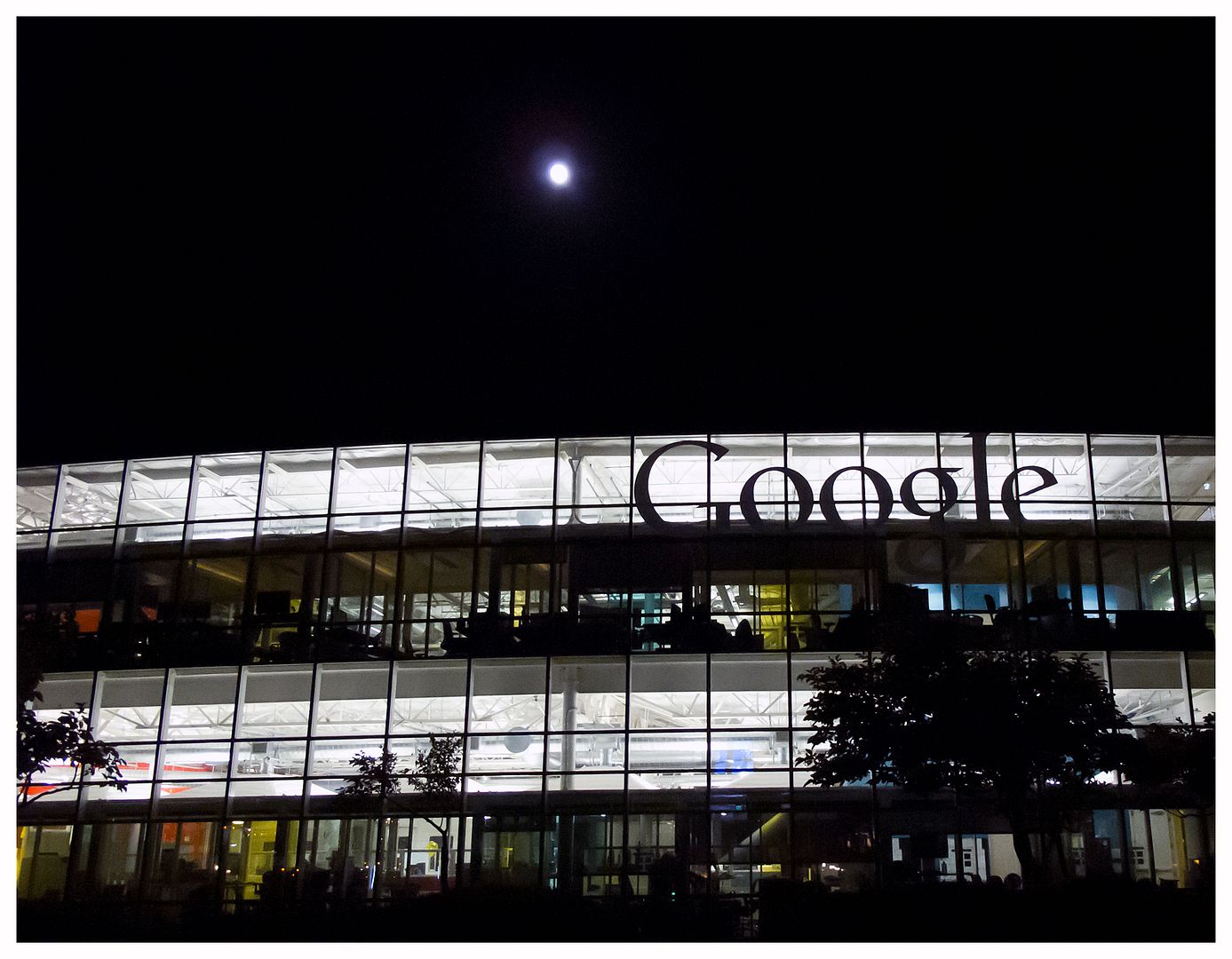
Summer solstice moon over the Googleplex; Mountain View, CA; June 2013

My father-in-law is a glass-half-full kinda guy. In the midst of any conversation about science, medicine, or technology, it's not uncommon for him to proclaim, "This is an exciting time to be alive." Indeed, it is. But when I fell into bed early on Sunday morning, my head giddy with ideas from the first full day of Sci Foo Camp, my father-in-law's optimism seemed understated. Spend 48 hours with -- to list just a few of the approximately 250 participants -- a computer scientist studying machine learning and music, a theoretical physicist turning the idea of gravity on its head, a marine biologist eager to solve the mysteries of whale sharks, a genomic epidemiologist intent on elucidating outbreak transmission dynamics, and a national security strategist currently implementing the White House's terrorism-related information sharing priorities and...well, you come away with much to ruminate on and a lot of notes to parse. In short, Sci Foo Camp made for an extraordinary weekend!

Monday, December 31, 2012

A Rainbow at Milestone 35

On January 1, 2008, five years ago tomorrow, I posted "A(nother) New Year," a short meditation on my 30th birthday and the passage of time. The piece closes with the following paragraph.
"It's a rare, curious thing when one's perception of life transitions from the regular line of past, present, and future to an ambiguous cycle of individual moments. This mode is necessarily fleeting, so difficult is it to reconcile with contemporary life. We flip through scrapbooks and retell stories of our youth; the ball drops, the clock counts down and the crowd's vague, anticipatory energy crescendos; a mark is made, the number changed; the owl falls on the quivering chaff. Ring in the year of the brown rat. I'll also ring in another decade."

Monday, January 02, 2012

Keep the Flame Alive In 2012


2011 will be best remembered as a year of popular dissatisfaction and uprisings. Lacking a crystal ball, such instability -- especially the prospective political transitions from despotism to democracy in Egypt and Libya -- can cause acute anxiety.

As we enter 2012, it's useful to keep in mind that democracy is a pendulum that forever swings from equilibrium to imbalance and back. The uncertainty and tensions associated with the political and ideological landscape of today's Middle East are also endemic to established democracies. Lewis Lapham described the workings of a democratic government in "Democracy 101," an essay published in the April 2011 issue of Harper's Magazine.
"Democracy is a dangerous business; it allies itself with change, which engenders movement, which induces friction, which implies unhappiness, which assumes conflict not only as the normal but also as the necessary condition of its existence. The idea collapses unless countervailing stresses oppose one another with competing weight - unless enough people stand willing to sustain the argument between the governing and the governed, between city and town, capital and labor, men and women, matter and mind. [...It] is the freedoms of thought that rescue a democracy from its stupidities and crimes, the courage of its dissenting citizens that protects it against the despotism of wealth and power backed up with platitudes and billy clubs and subprime loans."
This description should ignite fire in the belly of all United States citizens, wherever they place themselves on the political spectrum.

In late January 2009, I wrote an essay titled "Eudamonia." The piece explored the possible causes of a "bout of optimism [that] seemed remarkable in both duration and degree." That optimism is tempered today, but it still burns, despite the growth of "triumphant pessimism" among our populace. I remain optimistic because I believe in long term improvement, in two steps forward for one step back.

Let us all be devoted, active citizens in 2012, realistic, but not cynical, hopeful, but not naive, critical, but not destructive.

Image credit: uncredited photograph ripped from Care2 Make A Difference website

Friday, November 04, 2011

Announcing BAASICS

I'm very excited to announce that artist-curator Selene Foster and I have received a Southern Exposure Alternative Exposure Grant award for our Bay Area Art & Science Interdisciplinary Collaborative Sessions (BAASICS) proposal! BAASICS is a series of San Francisco-based evening programs that bring together local visual artists, choreographers, composers, scientists, and interdisciplinary thinkers to present engaging, multi-media lectures and performances that consider a given theme. The programs are free and open to the public.

In conjunction with A Live Animal, a group exhibition that Selene and I co-curated at Root Division in July 2011, we assembled 4 visual artists, 3 scientists, and 1 choreographer in San Francisco's ODC Theater to further explore the exhibition's theme in a program of TED Talk-like lectures and performances. The evening was a terrific success, drawing a capacity crowd and generating excited conversation during the reception that followed. Many of the attendees enthusiastically requested more such events.

With BAASICS, Selene and I hope to foment creative exchange and even long-term, mutually beneficial relationships between artists and scientists. Despite much talk of commonality between the disciplines, there is little substantive dialogue. Laudably, there are an increasing number of efforts to cultivate interdisciplinary, art-science projects; unfortunately, the lion's share of these result in vaguely "sciency" artworks or analyses of aesthetics rooted in cognitive neuroscience or sociobiology.

BAASICS isn't goal or project oriented; after all, there are many important differences between art and science, but one undeniable likeness is that the best discoveries are often stumbled upon, not planned for. We hope that BAASICS will provide a forum for artists and scientists to come together to share the ideas and practices that animate their lives and work. A principal aspiration of BAASICS is that we will learn from and be inspired by one another.

Even more important than facilitating relationships and the sharing of ideas, however, is the possibility of engaging a general audience. In the United States, the contemporary fine arts and sciences are generally set apart from popular discourse. Because BAASICS programs are free and open to the public, we hope to make the fine and performing arts and sciences less esoteric, inspiring guests to think about how art and science relate to one another and to society at large.

FYI: The theme of the second BAASIC event -- albeit the first associated with the name -- will be technology and notions of "the future." The roster of presenters hasn't been determined (it will take place in May or early June 2012), but speakers and performers might ponder, for example, robotics, artificial intelligence, medical advances and human nature, how our globalizing culture will shape technology, or dystopian versus utopian prospects. If HH readers know of Bay Area visual artists, composers, choreographers, scientists, or general smarty-pants who are engaging technology in some way and might be interested in participating, please put them in touch with me. Selene and I want to review as large a pool of applicants as possible.

Friday, August 26, 2011

Gregory Ito's "Point of Vision"

Gregory Ito
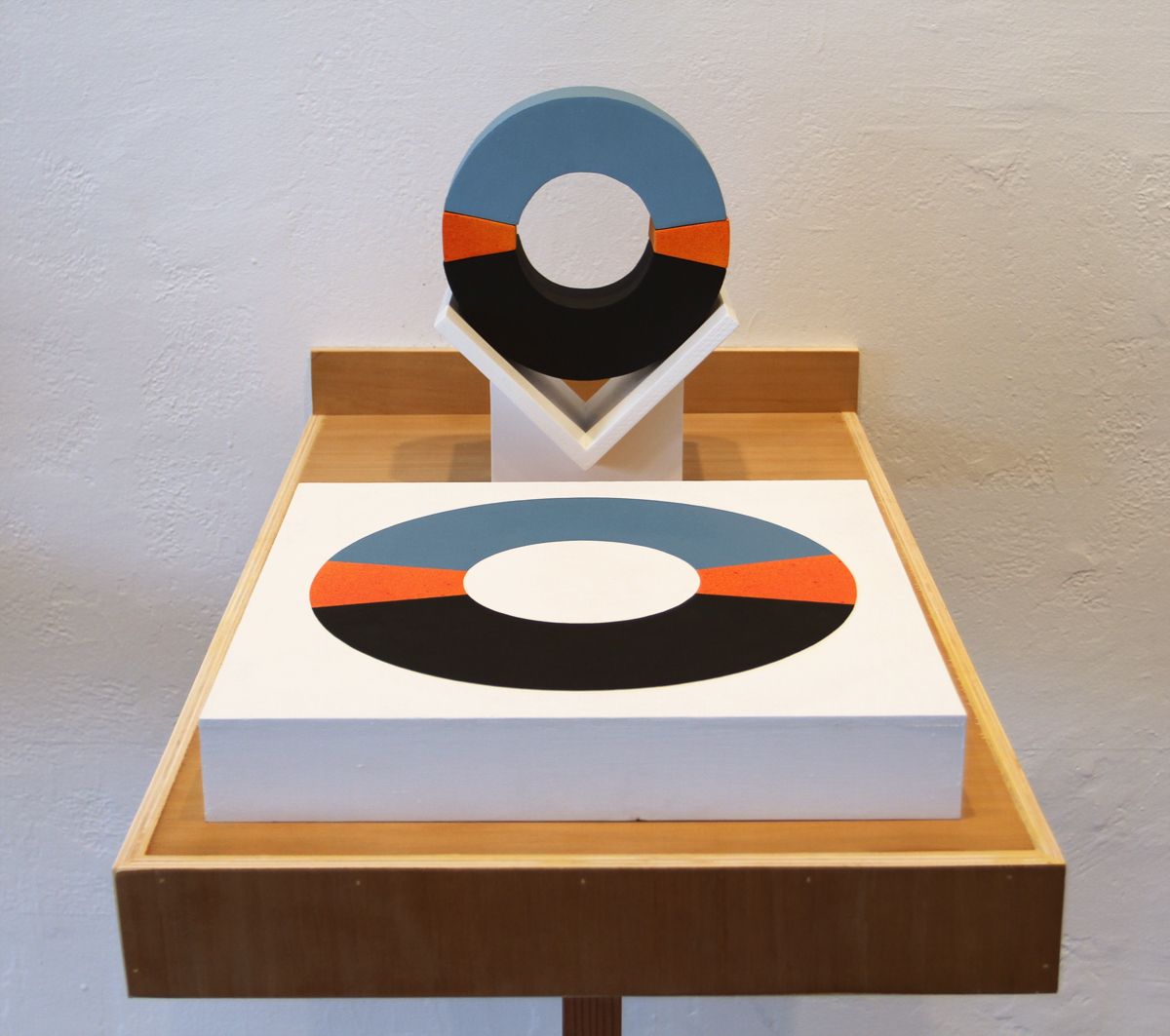
"Untitled (Time Diagram Set B)"
2011
Acrylic and gouache on wood panel, acrylic on handmade wood object, and table

Like it or not, context informs our experience and interpretation of artworks. We generally think of context as a work's physical situation (e.g., how and where it is installed) or its social and art historical framework, but most important is the context provided by an individual viewer. What is the viewer's profession? What book is she reading? Who was she talking to an hour ago, and what about? Of course, artists can't control for these subjective factors, and many craft artist statements that provide viewers with what the artists believe is appropriate context for the artwork. Too often, though, these statements tell viewers what the "take away" should be, thereby forfeiting the most vital and collaborative element of the artistic enterprise, the creation of meaning by the viewer.

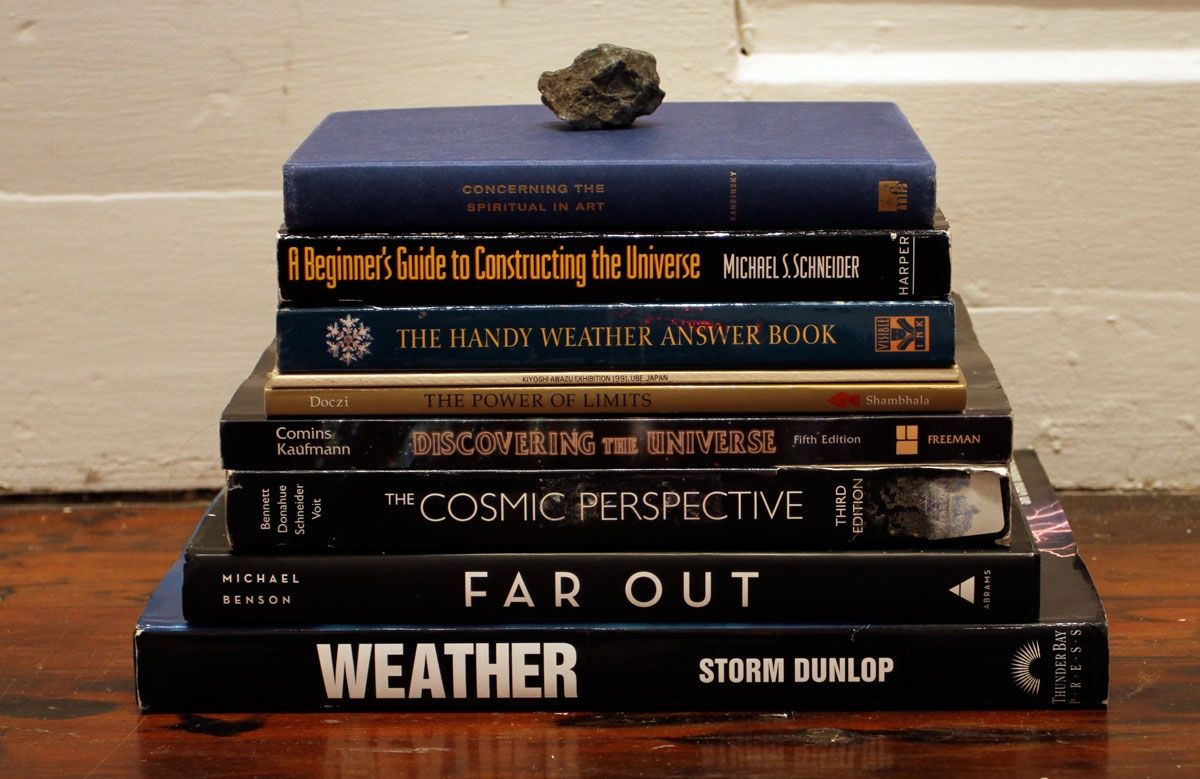
How refreshing, then, to find Gregory Ito's healthy twist on the artist statement in his terrific "Point of Vision" exhibition at Gallery Hijinks. While the artist and gallery provide a press release (usually an artist statement reworked and edited by the gallery staff), Ito also includes "Sources," a tidy stack of books on the floor, spines out so that the titles are easily read. Is "Sources" intended as a found object sculpture? Kinda sorta (after all, it's titled, is situated among Ito's other work, and is included on the exhibition price list, albeit "NFS"), but its principal valuable is as an alternative to the formal statement. It provides viewers with context without bullying them into a particular conclusion.

Gregory Ito
"Sources"
2011
Book collection

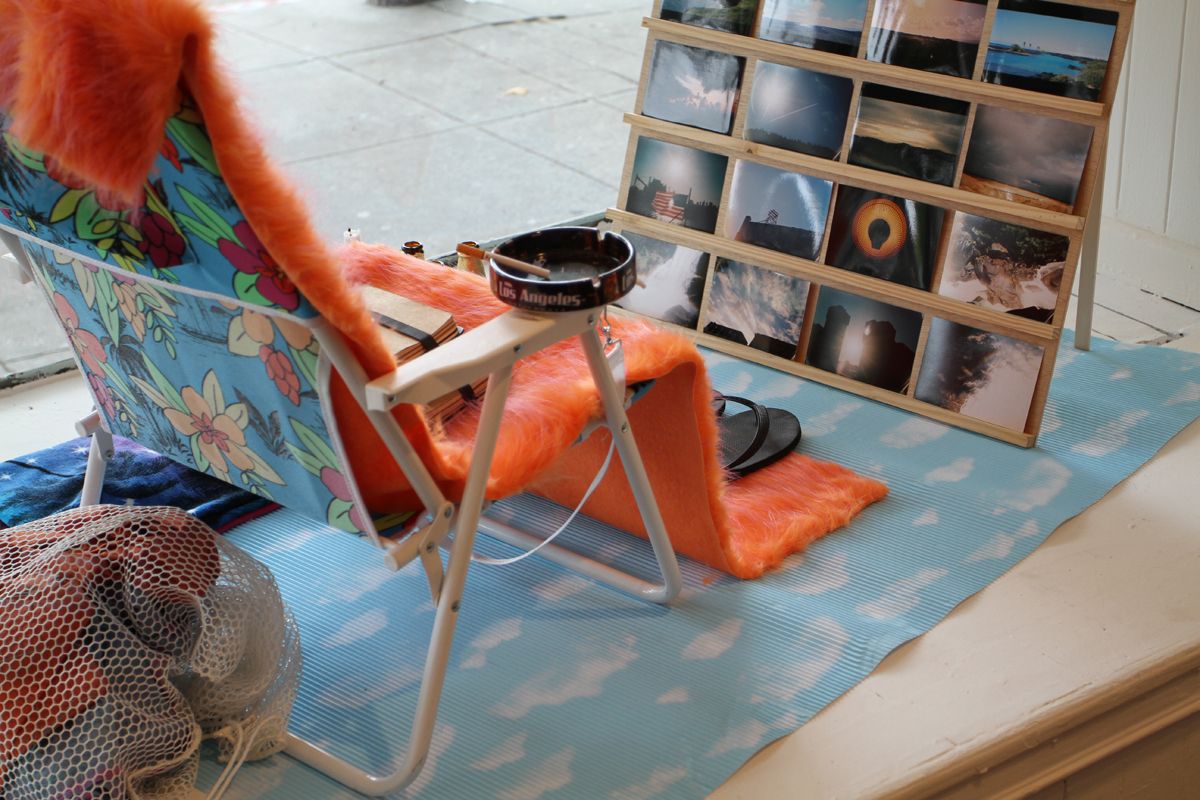
"Sources" is something of a companion piece to "Self Portrait (Object Collage)." Installed in one of the gallery windows, "Self Portrait" includes a beach chair, flip flops, a towel, a pile of diary-like journals, an ashtray, empty beer bottles, a candle, and 28 snapshots mounted on a board that faces the chair. One imagines the artist in his chair, sipping beer and smoking as he contemplates his collection of isolated observations. The photographs are mostly of clouds and sun-soaked skies, but there are also landscapes, some abstract imagery, a rainbow, and an illuminated light fixture. These pictures complement Ito's reading list. A Beginner's Guide to Constructing the Universe, by Michael Schneider, Concerning the Spiritual In Art, by Wassily Kandinsky, The Cosmic Perspective, Third Edition, by Bennett, Donahue, Schneider, and Voit, The Handy Weather Answer Book, and other titles included in Ito's book pile suggest that the artist is preoccupied with sublime, existential mysteries and celebrating our species' impulse to solve them.

Gregory Ito
"Self Portrait (Object Collage)"
2011
Window installation with 28 photographs and wood display

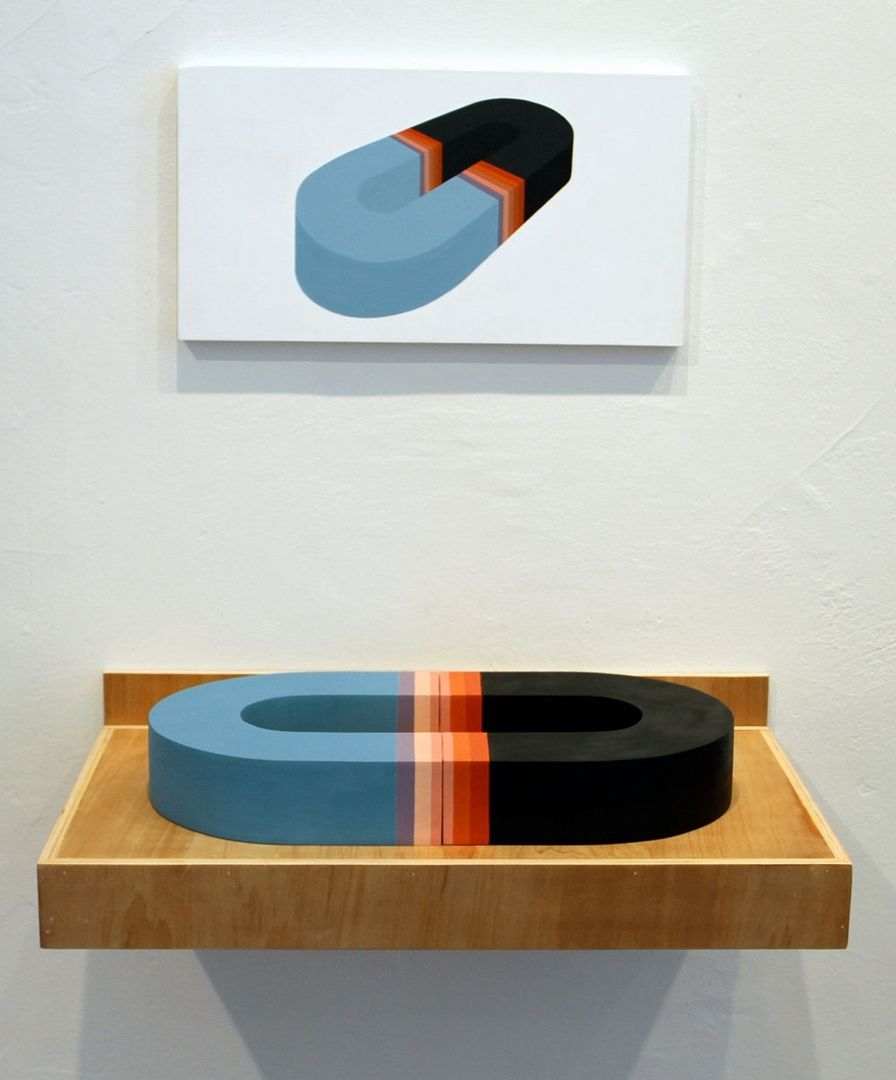
Ito's sculptures, paintings, and installations reflect this focus. Especially in the gallery's "white cube" setting, they read as speculative objects and diagrams as much as they do aesthetic entities. The artist is well aware of this; he titles the two most compelling installations on view, "Untitled (Time Diagram Set A)" and "Untitled (Time Diagram Set B)." He pairs a painting with a sculpture in each. The paintings are straightforward illustrations of the sculptures, but, displayed in the gallery setting with the three-dimensional objects they depict, the images read as icons, potent stand-ins for the "real" or "true" object. Curiously, by virtue of having been depicted, the sculptures also gain in significance. The meaning of these pictures and objects remains somewhat esoteric. I infer, based on the works' titles and Ito's "Sources," that these are representations of space-time's nature or shape, but that's a rather general interpretation. Still, the sculptures resonate as totems and the paintings as their icons. This reciprocal dynamic is compelling, and serves as an oblique reminder that all artwork exists in relationship to the world and ideas outside of the gallery and studio, a fact too often overlooked since the advent of modernism.

Gregory Ito
"Untitled (Time Diagram Set A)"
2011
Acrylic on wood panel, acrylic on handmade wood object, and shelf

In other works, Ito more directly highlights what I've elsewhere described as "the wonder current." In "Human Euphoria," a disembodied ceramic head of a girl in a big-brimmed, yellow hat rests on top of a block of adobe clay, apparently gazing at an ocean sunset. The piece is a winking, contemporary tribute to Caspar David Friedrich's Romantic masterpiece, "Wanderer above the Sea of Fog," but Ito's head is better-suited to contemplation than the vigorous morning constitutionals of Friedrich's dapper hero. Is this a comment on the continued dominance of conceptual concerns over aesthetic and material considerations in contemporary art? Perhaps; perhaps not. Ito's better pieces excel precisely because they can be interpreted as "art for art's sake" or, taking a hint from his "Sources," as art about the stupefying magnificence of being.

Gregory Ito
"The Embrace Installation"
2011
Acrylic and gouache on wood panel, found book with handmade page holders, and petrified object on shelf

Image credits: all images, courtesy Gallery Hijinks and Gregory Ito, 2011

Wednesday, September 22, 2010

The RSA's "21st Century Enlightenment"


Sure, the video is 11 minutes long, well over the too-long-to-watch mark for readers casually trolling the blogosphere, but it's worth bookmarking and saving for later. (In fact, I encourage you to watch it on YouTube or the RSA website, as the resolution is better than that of the above embed.)

The ideas articulated are vital and might provide some solace for those of you who, like so many of my friends, suffer from political apocalypse syndrome! Moreover, the animation is terrific and the narrator, like the Royal Society for the Encouragement of the Arts (RSA), is British, satisfying the Anglophile in all of us.

Enjoy.

(Thanks to Michael McDevitt for turning me on to this RSA video.)

Friday, May 21, 2010

Changes


View of Empire State Building; Manhattan, NYC; May 2009

As I prepare to move from New York City, my home for over a decade, to San Francisco, my home for at least a few years, I find myself viewing NYC through the eyes of a man in limbo. I'm still living in Queens, but my attention is already on the road.


Vacant lot; East Village, Manhattan; May 2008

A decade of NYC living makes me, by at least one standard, an official "New Yorker." How does that define me? New York, like all conurbations, is ever in flux. On my watch, it's changed in remarkable ways. What changes will come after I'm no longer a resident? Likewise, what changes are yet in store for me, a similarly adaptable organism?


Samuel Cohen Son graffiti; East Village, NYC; April 2010

I moved to New York City in October 1999, not long after I graduated from The College of William & Mary. I was then an ambitious twenty-one year old with a deeply cynical streak and an abiding love of beer and partying. My paintings and drawings featured naked people interacting in various ways with other animals, medical instruments, fossils, and, on occasion, Teletubbies. (If a reader knows what became of the big Tinky Winky sex painting, I'd love to see a photo of it!) Despite my apparent enthusiasm, I was steeped in melancholy. I spent hours each week brooding over "I," my pet novel project, a 1990s East Village vampire update of Hermann Hesse's Steppenwolf. I viewed humanity as a noxious species, religion as the most noxious of human inventions, and I not so secretly looked forward to our inevitable extinction.

Today, I'm an ambitious thirty-two year old who reacts against cynicism, drinks much less, and generally dislikes partying. Naked people sometimes appear in my paintings, but there aren't any Teletubbies. I'm a stubborn optimist. Each morning, I take twenty minutes to humbly celebrate a new day; if I wake in a funk, I fight through the fog to see anew just how marvelous life is. I recall my earlier character with some embarrassment. What was wrong with the arrogant kid who labored on a novel that painted such an ugly picture of humanity and religion? Perhaps he just needed to be more intellectually rigorous, and to open his eyes to the awesome fact of being? Or maybe that twenty-one year old also needed a good hug, which is no small thing?


Greenpoint, Brooklyn; May 2009

My time in New York City has seen me metamorphize from a hardened and cynical adolescent into an optimistic, joyful adult. The direction of this evolution runs counter to the standard assumption made about the effect of NYC living. As the columnist Mary Schmich warned (and director Baz Luhrmann popularized with his song "Everybody's Free (To Wear Sunscreen)"),
"Live in New York City once, but leave before it makes you hard; live in Northern California once, but leave before it makes you soft."
In my experience, however, NYC living sanded smooth the hard edges.


Wollman Rink; Central Park; Manhattan; June 2008

Perhaps, too, the mournful and nostalgic wails of NYC residents (myself included) are misguided? We should accept that "what will come, will come" without falling victim to fatalistic impotence. New York City (and Manhattan, in particular) is one of the most sustainable, environmentally responsible cities in the world, and its educated, informed residents should work with New York State and City representatives to make sure the city continues apace on that front. They should also do all they can to ensure that it remains a mecca for tolerance, the arts, and cultural pluralism. In what ways I can, I'll do the same from the Left coast; New York City is a part of me, and I will always feel a part of New York City.

Love and peace to all of my friends here. Thank you for everything. I'll be in touch. I'll visit. I hope that you'll visit me.


Upper New York Bay from Staten Island; May 2008

Image credits: all photography, Hungry Hyaena

Sunday, May 16, 2010

Susan Silas' Heroic Living


Susan Silas
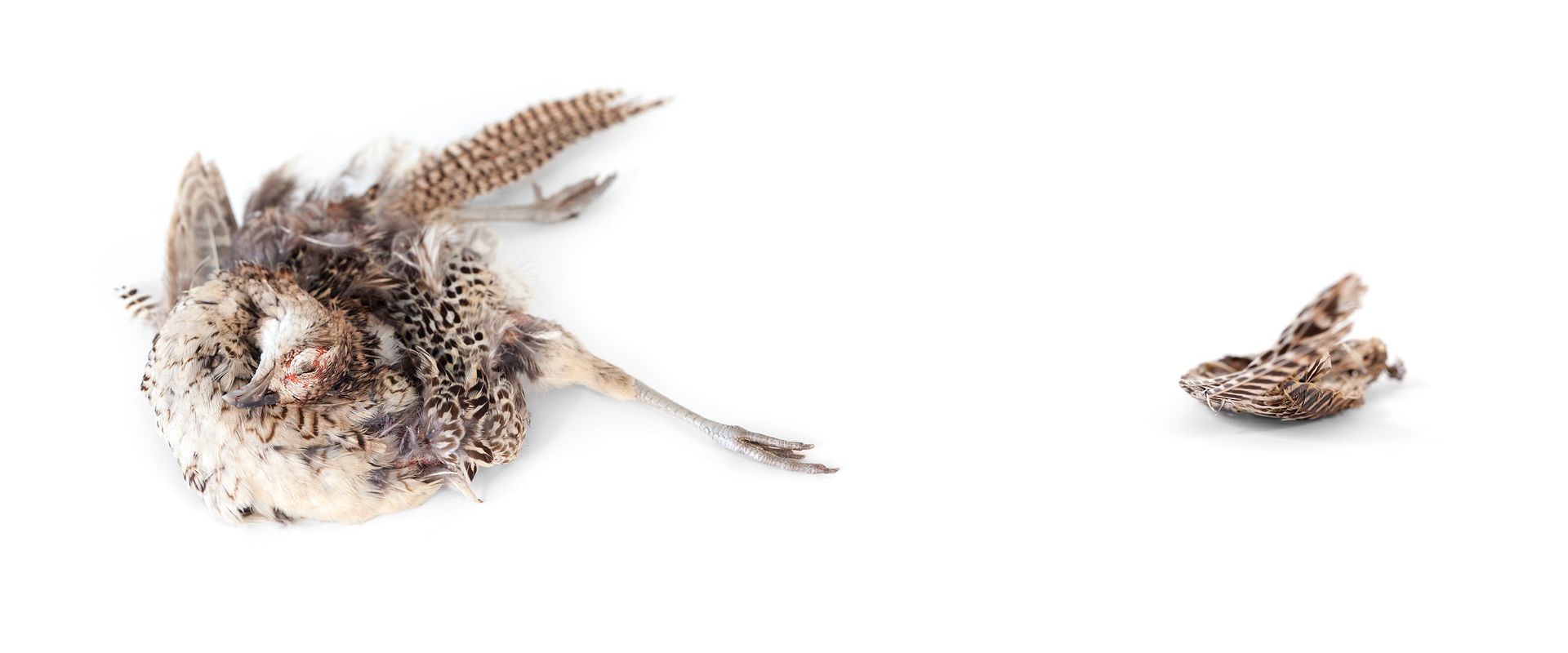
"found birds; 2000 - the present"
(Image 17 of 23 from the portfolio "eyes wide shut")
2010
Archival ink jet prints on HahnemĂĽhle photo rag paper
22 x 17 inches

Until recently, I was unfamiliar with Susan Silas' artwork. She is perhaps best known for projects memorializing the Shoah, but it wasn't an awareness of her Holocaust work that led me to "Helmbrecht's Walk, 1998-2003." Instead, it was a photograph of a dead American kestrel that Silas emailed me in March.

I have only an inkling of what essay or artwork of mine inspired the artist to send me the image, but I'm grateful that she did. I shamelessly admit to being the sort who finds soulful beauty in images of death, and I was touched by the striking and contemplative photograph. A month after I received the picture, I visited Silas in her Brooklyn home, to look at prints from her "found birds" series. Still pondering her work a week after that visit, I headed to Hebrew Union College's Jewish Institute of Religion Museum, eager to compare what I saw and sensed in "found birds" to Susan's more easily classifiable (though by no means "easy") Shoah work.


Susan Silas
"found birds; 2000 - the present"
(Image 3 of 11 from the portfolio "what remains")
2010
Archival ink jet prints on HahnemĂĽhle photo rag paper
20 x 48 inches

The HUC press release for "Helmbrecht's Walk" describes the project succinctly.
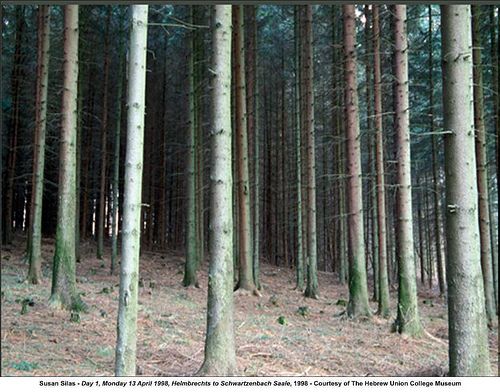
"On April 13, 1945, more than 700 women were forced to march 225 miles in 22 days from the Helmbrecht's Labor Camp, a small satellite unit of the Flossenburg Concentration Camp in Germany, to the Czech city of Volary. [...] During the course of this forced march the women were ill fed, inadequately clothed, denied shelter, and capriciously beaten. On the sixth day of the march, the non-Jewish prisoners were separated from the group, leaving the remaining 580 Jewish women to continue until May of 1945.

With determination and sensitivity, Silas traced the march in 1998 on the 53rd anniversary of the event by walking along the same path as the Helmbrecht's women for 22 days in Germany and the Czech Republic. She documented her journey in Helmbrecht's Walk, a collection of 48 archival color prints presented as an unbound book. [...] The images contextualized by Silas' daily commentary of her own experiences are coupled with news reports of event occurring elsewhere in the world on that same day in 1998. This juxtaposition, she says, functions 'to heighten our awareness of the fact that we are all presently witnesses to unspeakable events and extreme suffering for which we take no more responsibility than did many witnesses to the Holocaust.'"
Silas' project addresses the complicated relationship between place and time or, as cultural critic and historian Simon Schama's consideration of the topic framed it, "landscape and memory." When Silas conceived of the Helmbrecht's project, she believed (or maybe hoped) that walking the same path that the Helmbrecht's women had would allow her some intimate experience of or insight into the terrible march. In fact, this didn't prove so. Silas describes her walk as "relatively mundane and unexceptional." She continues, "My feet hurt. I get tired. [...] I found it more, rather than less difficult to understand how these women made this journey once I was out on the road."


Susan Silas
"Helmbrecht's Walk, 1998 - 2003"
(Day 1, Monday 13 April 1998, Helmbrechts to Schwartzenbach Saale, 1998)
Archival ink jet prints on HahnemĂĽhle photo rag paper

Yet many of the captions she includes with the photographs reference artists and thinkers such as Werner Herzog, who understand "walking as a sacrament." Such language calls to mind the Australian Aborigines' songlines, mnemonic stories that are spoken or sung as the Aborigine walks over the referenced terrain. In his marvelous book Spell of the Sensuous, David Abram relates a striking, relevant anecdote.
"A similar tale is told by [Bruce] Chatwin. He was traveling in a Land Cruiser with several friends, including an Aboriginal man nicknamed Limpy whom they were driving to a particular place on his songline. Limpy, whose clan Ancestor was the Native Cat, or tjipla (a small marsupial with a long, banded tail), had never been to this place along the Native Cat songline, yet he now wished to go there in order to see some distant relatives who were dying there. During the course of seven hours driving through the back country, bumping across shallow rivers and under gum trees, the Aboriginal man sat motionless in the front seat, squeezed between the driver, Arkady, and another passenger, except for a short burst of action when the truck crossed part of his songline. Later,
'[w]e came to the confluence of two streams: that is, we met the stream we had crossed higher up on the main road. This lesser stream was the route of Tjilpa Men, and we were joining it at right angles. As Arkady turned the wheel to the left, Limpy bounced into action. Again he shoved his head through both windows. His eyes rolled wildly over the rocks, the cliffs, the palms, the water. His lips moved at the speed of a ventriloquist's and, though them, came a rustle: the sound of wind through branches.

Arkady knew at once what was happening. Limpy had learnt his Native Cat couplets for walking pace, at four miles an hour, and we were traveling at twenty-five. Arkady shifted into bottom gear, and we crawled along no faster than a walker. Instantly, Limpy matched his tempo to the new speed. He was smiling. His head swayed to and fro. The sound became a lovely melodious swishing; and you knew that, as far as he was concerned, he was the Native Cat.'"
I believe that what was missing for Silas was a story line, the narrative informed by the landscape (and vice versa) that, among indigenous groups such as the dwindling Aboriginal population of Australia, is traditionally passed from generation to generation. In some respects, "Helmbrecht's Walk" is an attempt to locate such a story, an earnest effort to discover in the landscape the marks of what happened decades before. In our postmodern, peripatetic culture, nations and traditions do not generally fare well. In some respects, this is a positive development, as our tribal perspectives and prejudices erode into some variety of tentative, liberal pluralism. On the other hand, it's ever more difficult to feel confident about one's identity and how it relates to landscape, vocation, and nation.

My time with "Helmbrecht's Walk" confirmed my supposition, however, that Susan's art is not primarily interested in cultural identity or particular histories. Instead, she is most concerned with "the big questions." To one degree or another, all art wrestles with or reacts to these existential imponderables, but Susan's exploration is more focused and urgent than most. Fortunately, even though her work is preoccupied with mortality and meaning, she manages to avoid the pitfalls of such terrain; her work is neither macabre nor aestheticized to the point of anesthetization.


Susan Silas
"found birds; 2000 - the present"
(Image 1 of 21 from the portfolio "blackbird")
2010
Archival ink jet prints on HahnemĂĽhle photo rag paper
22 x 17 inches

Two days after I visited "Helmbrecht's Walk," I read "Eudaimonia, existentialism, and the practice of medicine," an essay by Dr. Andrew Radu included in the Spring 2010 issue of The Pharos of Alpha Omega Alpha Honor Medical Society. In his essay, Dr. Radu describes the existentialist ideal of tragic optimism. He writes of it, "even in the face of imminent death, we have the ability to reevaluate life." He goes on:
"A crucial concept held by many existentialist philosophers is that of heroic living. All humans have the ultimate freedom to live boldly in the face of tragedy. Living with this concept makes attaining a goal of eudaimonia less important than simply striving to do so. [...] The concept of tragic optimism proposes that in a life that can be circumscribed by pain, guilt, and death, one should say 'yes to life in spite of everything.'"
Indeed, as I wrote in "Eudaimonia," a January 2009 essay that explored my then nascent optimism,
"Acknowledging our species' precarious position is not defeatist; on the contrary, accepting the inevitable nourishes the individual's desire to contribute. Faced with an impossibly difficult prospect, only individual effort can sustain us. As Albert Camus concluded in The Myth of Sisyphus, 'The struggle itself is enough to fill a man's heart. One must imagine Sisyphus happy.'"
The Shoah is bleak history, a subject watered by the blood of millions, and it is fertile soil for such "big questions." Silas' "found birds" remind us that so, too, is the striving and passing of a blackbird. The artist's reckoning with death is her own form of "heroic living."

Image credits: all artwork, courtesy Susan Silas

Friday, April 23, 2010

My Favorite Things


While I agree that "raindrops on roses and whiskers on kittens" are wondrous, it is the "bright copper" Voyager 1 disc and Antikythera mechanism that I count among my favorite things, each a hopeful and beautiful item that manifests our species' exceptional capacity.

In January 2009, I wrote here that I'd been possessed of a curious "bout of optimism [that] seemed remarkable in both duration and degree." Over a year later, that eudaimonia hasn't let up. I'm beginning to believe that I've simply grown into an incredibly upbeat man. That, too, is a wondrous, happy thing, worthy of making my short list.

So here's hoping that, even in this era of relentless, up-to-the-minute news from around the globe (much of it depressing), we can keep our eye on the ball, so to speak. The possibilities are beyond reckoning. It isn't naive to think so; rather, it's naive to think otherwise.

Image credit: Antikythera mechanism image ripped from the New York Times, but was produced by the School of Physics and Astronomy, Cardiff University

Sunday, September 13, 2009

Kimmel Harding Nelson Residency: Day 7


The Ten Commandments on the front lawn of Otoe County Courthouse; Nebraska City

Attunement on a Sunday Morning

I'm a generalist. As such, I'm inclined to connect the dots between purportedly distinct realms of inquiry. It's impossible, of course, to conduct a truly holistic survey, but my crude efforts have led me to conceive of life - what we know of it, at least - as a component part of a vast, even infinite superorganism. I freely admit to finding value in mysticism, and this superorganism notion is readily dismissed by some scientists and scholars as mystical metaphysics, but science itself speaks to an integrity beyond human comprehension.

As Loren Eiseley describes it,
"[This is] one of life's strangest qualities - it's eternal dissatisfaction with what is, its persistent habit of reaching out into new environments and, by degrees, adapting itself to the most fantastic circumstances."
Eiseley was an anthropologist, and he claimed to be a man of "no religion." That may be so, but Eiseley's writing offers humility, wonder, gratitude, and communion in abundance. As I see it, those are the four pillars of religious practice. The fourth of these vital practices, communion, is alluded to by the very word "religion," from the Latin religare, meaning "to bind" or "to tie." Religious action aims to bind the individual to society and, in turn, to the greater whole.

For a decade, I proudly identified as an atheist and, by the measure of most religious people, my cosmology and metaphysics still qualify me as such. It occurs to me, on this Sunday morning, with Nebraska City's church parking lots at capacity, that many of this town's good Christians would reject my claim of religiosity, and not only because my practice rests on a Jewish foundation. My doctrine-less faith appreciates the stories of the Hebrew Tanakh, the Christian New Testament, and the Muslim Koran as parables, poetry, and anthropological artifacts. I read these books in the same way that I do the Tao Te Ching or Herakleitos; they are annotated, analyzed, interpreted, digested, then, in the fullness of time, returned to for a new understanding. But these collections are not my sacred texts. In the eyes of most religious believers, that disqualifies me from tribal membership. Thank G-d.


First Baptist Church; Nebraska City; September 2009
Sign reads, "Faith Removes Mountains Or Tunnels Through"

Still, I am a religious believer, in my way. My holy books are written by biologists and physicists, naturalist poets and essayists, as well as rabbis, ministers, and theologians. None of them is the word of an interventionist, judging god, even though all of them are necessarily part of a greater, unknowable whole, the aforementioned superorganism.

It doesn't matter what you call this organism. As essayist and literature professor Doug Thorpe writes in Rapture of the Deep, "Call it the sublime, call it the Tao, Om, or I AM; still the names don't hold." I most often call it The All, The No-thing, or Hashem, literally "The Name." In the Tanakh, when Moses asks the name of the Presence he has discovered in the burning bush, It replies, "Ehyeh asher ehyeh." "I will be who I will be," or "I will be that I will be." You can call It whatever you will, for It is you. It is also me. It is the sidewalk; It is the grass of the Otoe County courthouse lawn, on which Nebraska City authorities have installed a carved monument to the Ten Commandments, an act that approaches violation of Thomas Jefferson's shrewd "separation of Church and State"; and It is the ether connecting all of these.


Lutheran Church facade; Nebraska City; September2009

If the faith that has grown in me is dogmatic in some way, it is in its insistence on universalism. Literally translated, "universe" means "one turning." Our universe is just that, one breath, one round, one cycle. All that we know and all that we don't know, everything that we can imagine, is but an infinitesimal sliver of The All, one note of an eternal symphony. Even Herakleitos, ancient proponent of reason and science, turned to poetics when he contemplated ultimate meaning; "Nature loves to hide," he wrote. Interestingly, the Hebrew word for universe is olam, a derivative of alam, meaning "to conceal." Jewish mystics, like many of their Hindu, Sufi, and Christian counterparts, believe that God is hidden in the universe, an ineffable force that pervades every dimension, known and unknown.

Theoretical astrophysicists
now suggest that our universe is but one component part of a multiverse, requiring of us another Copernican shift; yet again, the superorganism is re-conceived. In that stretch of the mind are humility, wonder, gratitude, and communion. Science and philosophy, it seems, can also be religious.


Water tower; Nebraska City

So, yes, I'm a religious believer. Paintings, sculptures, and other hand-crafted objects are among my adored icons, but I find occasion for worship in every place, in every form, in every moment. The Monarch butterfly that flapped yoyo-like this morning in front of the KHN Center's kitchen window is worthy of exaltation. I recognize that, for some other viewer, the insect may be ignorable or irrelevant. For others, it is an idol. So, too, might the weathered brick of a downtown Nebraska City building be deemed a clay calf by unimaginative or close-minded "believers." Placing my palm on this brick today, though, my thoughts range through eons of geologic time to consider the primeval mud from which, eventually, we emerged as a gasping fish thing.

Doubtless some of the folks singing inside the walls of the Lutheran, Episcopalian, Catholic, Baptist, Presbyterian, and Methodist churches this morning don't share my enthusiasm for our scaley ancestors. But I'm not concerned with their narrow definition of religion or their selfish understanding of "truth." Although I no longer consider myself a materialist, I'm an unremitting idolater. To those that would condemn that impulse as sacrilegious, I offer Eiseley's reaction.
"People have occasionally written me harsh letters and castigated me for a lack of faith in man when I have ventured to speak of [..] some greater unity that lay incalculably beyond us. [...] They distrust, it would seem, all shapes and thoughts but their own. They would bring God into the compass of a shopkeeper's understanding and confine Him to those limits, lest He proceed to some unimaginable and shocking act - create perhaps as a casual afterthought, a being more beautiful than man. As for me, I believe nature capable of this, and having been part of the flow of the river, I feel no envy."
And I feel no envy, either. There is only dumbfounding, smiling celebration.

Love is, I think, a bit like religion. Humility, wonder, gratitude, and communion are requisite in both, and, as Thorpe puts it, love "demands of us a new way of being in our old world." Religion might be construed as a love affair with The All. It's not always easy, but religious attunement can turn each day, each hour, or each instant, into "a new way of being." Every step is a psalm, every directed gaze is a prayer. Truly, on the streets of Nebraska City this morning, I am an exuberant, enthusiastic mystic.

Photo credits: all photos, Hungry Hyaena, 2009

Thursday, September 10, 2009

Kimmel Harding Nelson Residency: Day 4


Oregon Trail Marker; Nebraska City

Manifest Destiny

On the eastern edge of Nebraska City's Central Avenue stands a simple cairn with a plaque, a monument to the Oregon Trail. The plaque reads, in part,
"Official Oregon Trail Marker: [...] overlaid branch of the Oregon Trail, 1849, from the steamboat landing thousands started westward to Pike's Peak, Salt Lake, California and Oregon."
My gaze drifts from this humble memorial to Central Avenue, Nebraska City's main thoroughfare. Today, automobiles move east and west on the two-laned, paved drag. 160 years ago, families traveling by covered wagon set west on a dirt path, intent on making a better life for themselves.

Just think of it; that was 160 years ago! The territories of the western United States were then largely unsettled by immigrants of European extraction. The notion of Manifest Destiny, the Providential assumption that all of North America belonged to a white, male God and, in turn, to His European sons and daughters, was only introduced in 1845. At the time, the American Civil War had yet to be fought, electricity had yet to be harnessed as a popular power source, and human flight was only a hopeful diagram in a sketchbook. 160 years is just three human lifetimes, a drop in history's bucket, a nearly invisible mark on the geologic timeline.


Nebraska City, circa 1860

As I scribble down these thoughts, a small slug moves over the concrete by my left foot. 300 million years ago, our human face was not so dissimilar from the slug's. As Loren Eiseley describes it in The Immense Journey, the steady march of time, whether surveying a span of 300 million or 160 years, is "life reaching out, [...] that magnificent and agelong groping [...] still in progress. [...] Content is a word unknown to life; it is also a word unknown to man."


Oregon Trail Marker and Central Avenue view; Nebraska City

The Windmill Shop

Early this morning, fellow KHN resident Manya Fox and I were granted access to the now closed Kregel Windmill Company shop, located on Central Avenue. For the most part, the shop's interior is just as the employees left it, a time capsule testament to the labor and ingenuity that allowed for the settling of the American west. As our gracious host put it with a grin, "Some people say the six gun settled the west, but it was really the windmill."

Early explorers, Lewis and Clark included, characterized the land that would become the Nebraska Territory as the "Great American Desert," an area unfit for human habitation. But, because of windmills, the plains would soon become some of the most fertile farming land in the United States. Homesteaders needed water to survive, of course, and the windmill was the only efficient way to draw water up from wells 100 feet deep. Wood and, later, metal blades were cut, shaped, and hammered in the Nebraska City shop, an outfit run by the "taskmaster" Kregel brothers, immigrants from Germany.

The brothers are dead now, the Windmill Company is closed and in need of preservation, and water-pumping windmills have, in most places, been replaced by electric pumps. Technology and livelihoods gone with, as it were, the wind.


Accounting desk; Kregel Windmill Company; Nebraska City

Or are they? Today, towering windmills of steel and aluminum, better known as turbines, are being erected the world over. These turbines are an effective means of energy collection that also offer promise of a thriving, low impact industry. In the windmill shop, as I admired a lathe built in the early 1860s, Eiseley's words echoed; the "magnificent and agelong groping" continues.

Beyond Manifest Destiny

Nebraska City's Morton-James Public Library has a small NASA exhibition on display now. As I shuffled around the library gallery this morning, I marveled that the Space Shuttle Orbiter, the "vehicle that carries the crew and payloads to and from Earth orbit," must reenter Earth's atmosphere and land without power. It "glides back to Earth and lands on a runway. [...] Careful guidance control is needed to assure that it is properly positioned to reach the desired landing site." This astonishing feat of engineering and science is made that much more impressive if we consider that it was first realized just 130 years after the homesteaders and pioneers disembarked from Nebraska City's steamboat landing.

To those individuals who emphasize humanity's bloody excesses and potentially catastrophic exuberance above all else, I can only express my bafflement. Truly, to study evolution and the progress of history and science is to be necessarily possessed by eudaimonia. What great feats are forthcoming? The sun is shining; the crickets and katydids are singing; the world is electric with possibility.


Refurbished blades; Kregel Windmill Company; Nebraska City

Photo credits: all photos, Hungry Hyaena, 2009; Nebraska City illustration, ripped from Richard Gehling's "The Pike's Peak Gold Rush"

Thursday, July 02, 2009

Repairing America (and beyond)


Micanopy, Florida


While visiting central Florida last month, an acquaintance told me that all of her Gainesville co-workers are fans of Rush Limbaugh's radio punditry. On the highways around the small city, I saw countless pro-life billboards and a good number of "NObama" bumper stickers on passing pickup trucks. Although the city's populace supported Obama in the 2008 presidential election (as did the state), it was very clear that the city represents a blue dot in a red region.

Contemplating this red state mentality, I recalled Thomas Frank's "Lie Down for America," an excellent, if depressing article published in the April 2004 issue of Harper's Magazine. Frank dissected, in his words, "how the Republican Party sows ruin on the Great Plains."
"Whereas earlier forms of conservatism emphasized fiscal sobriety, the backlash mobilizes voters with explosive social issues - summoning public outrage over everything from busing to un-Christian art - which it then marries to pro-business economic policies. Cultural anger is marshaled to achieve economic ends.

[...] 'Rural America is pissed,' a small-town Pennsylvania man told a reporter from Newsweek. Explaining why he and his neighbors voted for George Bush, he said: 'These people are tired of moral decay. They're tired of everything being wonderful on Wall Street and terrible on Main Street.'"
The same Wall Street-Main Street dichotomy was trotted out by campaigning Republicans four years later, in 2008, to cast the GOP as the party of the people. But did the tactic really work? After all, Obama won the 2008 election. Aren't rural and Middle America coming around, realizing that the Republican party doesn't have their best interests in mind, even in those cases where the social issues of the Right more closely align with their values?

I hope so, but I wouldn't bet on it. Middle America will jab an angry finger at someone, and faithful Rush can't be the enemy. Our country is already waging a war against Islam, so we know that the Muslims are "against us," but they're not pulling America's economic strings. And, as a general rule, black folks don't have too much power, Obama not withstanding. But, wait a second...aren't there a lot of socialist Jews whispering in Obama's ear? Hell, isn't he related to a rabbi!?

The July 2009 issue of Harper's includes two disturbing poll results.
Chance that an American thinks 'the Jews' were moderately or very much to blame for the financial crisis: 1 in 4

Chance he or she thinks they were 'a little' to blame: 1 in 7
This is a shocking statistic! I wonder what percentage of Americans believe that "the Jews" are no more culpable than any other ethnic or religious group?

Oh, but that's a silly question! After all, "the Jews" are the denizens of Wall Street, and Main Street folk like Dubya and Rush don't like that sinful, unAmerican place. It should be clear to me that the current recession - when should we start calling it a depression? - is not the result of the unsustainable, myopic economic policies of the last sixty years (amped up by Ronald Reagan, but embraced by both Democrat and Republican administrations). It's instead the vast Zionist conspiracy! The socialist Jews have teamed up with the capitalist Jews to forge an unholy alliance, and they're running the global economy into the ground!

Would that I could laugh off such frightening ignorance. Unfortunately, the bigotry is not evidenced only on the Right. In fact, the same study cited in Harper's showed that the registered Democrat respondents were 12% more likely than responding Republicans to blame "the Jews" at moderate or higher levels. There is a time-tested, inverse relationship between economic performance and anti-Semitism, and this correlation isn't affected, evidently, by political affiliation.

The New York Times reports today that "U.S. Job Losses Rise and Unemployment Reaches 9.5%."
"The American economy lost 467,000 jobs in June [2009] and the unemployment rate edged up to 9.5 percent in a sobering indication that the most painful downturn since the Great Depression has yet to release its hold."
Things are going to get a lot worse for Middle America. Finger pointing does none of us any good (and certainly not the tiny Jewish minority in the United States).

Still, I remain optimistic. As I wrote in January,
"Call it Obamatism, call it naive idealism, call it what you will...but it's time to participate, to put aside our generation's infantilism and get to Aristotle's happy work. [...] We will pass through our challenging stage of human social development but, fraught as it is, the need for an active and immediate commitment to bettering our world's future is great."
Jews call that tikkun olam, repairing the world. Get to it, people!


Photo credit: Hungry Hyaena, 2009

Thursday, May 14, 2009
A Thursday in the Holocene


Over dinner this Tuesday evening, a friend and I discussed our species' more homogeneous future. I suggested that miscegenation and intercultural activity will lead to future generations comprised of individuals that look and act more alike. In turn, violent conflict between human groups will decrease; in this world of mutts, superficial differences such as race and custom will be less visible and therefore less contentious.

My friend shares my hopeful outlook, but expressed skepticism. Citing the Rwandan genocide and the fractious political situation within Israel, he contended that greater physiological and sociological similarity are just as likely to increase conflict. Humans will always find some reason to fight, he believes, and superficial similarity will lead not to a peaceable kingdom, but instead to the exacerbation of subtle differences or the outright invention of philosophical or genetic justifications for the vilification of "the other." I can't dismiss his forecast, but if Homo sapiens sapiens survives long enough to witness that homogeneous era, our species will have learned a great deal more about cooperation. This, I feel, bodes well for the less violent prospect.

But what-if suppositions about the far distant future are of little practical value to the here-and-now. I have faith in teleological eudaimonia, but the lot of Earth's inhabitants won't gradually improve unless our policies and actions are informed principally by consideration of a more immediate future...say, one or two generations. And, although it will be a thousand years, at least, before miscegenation makes all humans mocha, our planet's ecology is right now undergoing drastic changes.

Burkhard Bilger's "Swamp Things" (The New Yorker, April 20, 2009) highlights the explosion of "invasive" species in Florida. Bilger focuses particularly on the success of the Burmese python (Python molurus bivittatus) in the Florida Everglades, but notes that a great variety of exotic species have gained toeholds in the state.
"Florida now has more exotic lizard species than there are natives in the entire [American] Southeast. On a single tree you could conceivably find plants and animals from six continents, including parrots from South America, mynah birds and Old World climbing ferns from Asia, vervet monkeys from Africa, ladybird beetles from Australia, and feral cats from Europe, via Africa and Asia. In some cases, the recent immigrants would be more genetically diverse than their cousins back home. The state's ecology is a kind of urban legend come true -- the old alligator-flushed-down-the-toilet story repeated a thousand times with a thousand species.

Some find all this thrilling. Florida has become an open-air zoo, richer in species than ever before. To others, it's the harbinger of a new and depressingly undifferentiated age, when the old biological borders begin to fade and every place starts to look like every other. Ecologists have even given it a name: the Homogecene."
Indeed, the Homogecene may soon overtake the Holocene.

Note: The post's title is a nod to Christopher Cokinos's terrific essay, "The Consolations of Extinction" (Orion Magazine, May/June 2007). In it, Cokinos
"[suggests] that our PalmPilots and DayMinders and Nature Conservancy calendars show not only year, month, date, and day of the week but also geologic epoch. It’s a Tuesday in the Holocene."
Photo credit: Burmese python and American alligator, copyright 2008, Lori Oberhofer, National Park Service

Sunday, March 22, 2009
Tree of Life


I learned of artist Tania Kovats' "TREE" project via RSA Arts & Ecology. Kovat's installation was commissioned by the British Natural History Museum to honor Charles Darwin's bicentenary. Her "cross section" of a 200-year-old oak tree was installed on an angled ceiling inside the museum. The work appears quite impressive.

Particularly magical, however, is Kovats' inspiration, Darwin's famous phylogenetic tree diagram, an early representation of the "tree of life" included in one of his notebooks. Just above the sketch, Darwin wrote, "I think." Given the cultural and scientific ramifications of Darwin's grand idea, the page would have the aura of sacred scripture even without the text, but the hastily written "I think" suggests, as Kovats puts it, "a moment of conception...an exchange between thought and the mark that [he] made." Thus, the moment of revolutionary conception is recorded, caught for contemplation.

Darwin's notebook page is, like the Voyager 1 record, both an artifact and a profoundly moving work of art, testament to the promise of humanity and Aristotle's eudamonia.

Photo credit: ripped from RSA Arts & Ecology

Saturday, January 31, 2009

Eudaimonia

This past Saturday morning, I rode the N train into downtown Manhattan. Sitting across from me, a tired-looking father played with his young sons. Lowering my magazine for a minute, I watched the three of them. Although the boys' antics disturbed some of our fellow passengers, the father was unflappable, and cheerfully committed to the childrens' exuberance. He responded as he needed to, reining in a stray arm, hushing a piercing squeal, but also participating in the boys' adventure, pointing out curious subway details and posing fun questions about this, that and the other. When the father's eyes caught my considerate gaze, I smiled and slightly bowed my head in greeting. The man looked at me for an instant, then returned his attention to the boys. "Ours is the next stop, guys, so I want to see how you high you can jump as we get off." Each child grabbed one of their father's hands and, when the subway doors opened, they shrieked with delight as the father stepped out of the subway car and raised his arms up and out, lifting the young boys several feet off the ground. The doors closed behind them.

Monday, February 11, 2008

Bjorn Schulke at bitforms


Bjorn Schulke
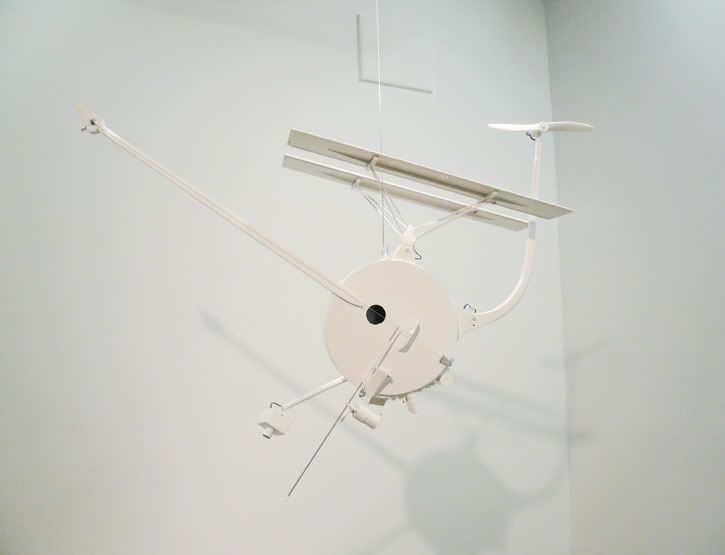
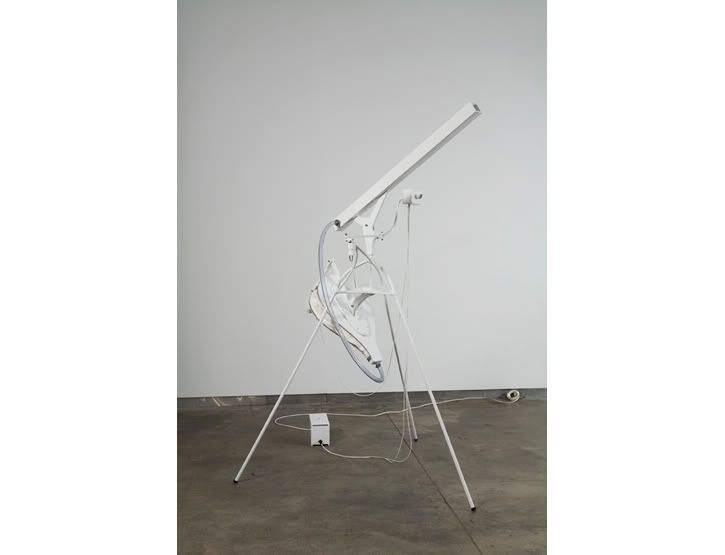
"Luftgitarre #3"
2008
Fiberglass, aluminum, wood, circuits, automotive paint, solar cells, motors, sensors
Approx. 50 x 35 x 12 inches


A friend recently observed that bitforms, a gallery dedicated to exhibiting work produced at the confluence of art and technology, doesn't get much critical due. In an art world preoccupied with "new media," such a venue should act as a critical lightning rod, but the "new media" most curators and editors have in mind is limited to unpolished video and digitally manipulated photography.

Somewhat cynically, I believe bitforms is overlooked because the art world remains leery of competent craft; the engineer-artist hybrids that bitforms promotes are nothing if not master craftsmen. Bjorn Schulke's current show of "absurd machines" is an excellent case in point.

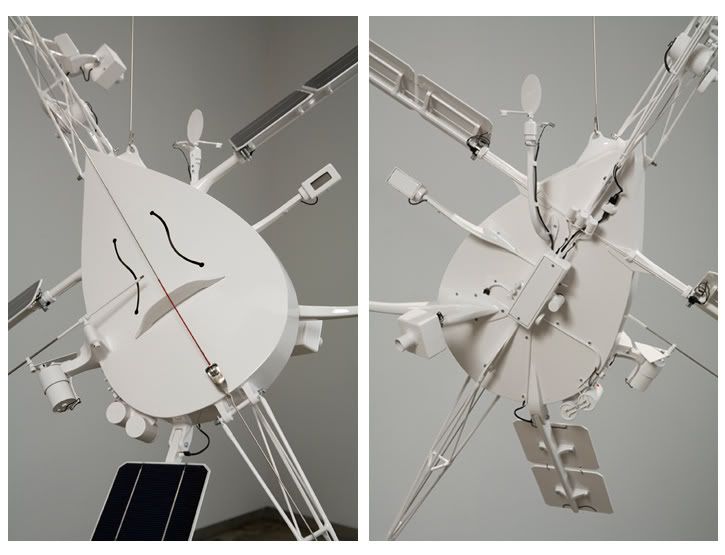
The five machine-sculptures included in "uberschall" - the title translates as "supersonic" - all incorporate sound and react to the proximity and movement of the viewer. The three satellite-like works suspended from the gallery ceiling are elegant descendants of Alexander Calder's mobiles. Each references a different instrument: a banjo, violin and contrabass. Schulke smartly dubs the satellites Luftgitarres ("air guitars"). Motion detectors, photo-voltaic panels, propellers and antennae extend from each satellite-instrument's core and, depending on the viewer's location and distance, a mechanized rod occasionally plucks a steel wire on the face. The single, sounded note reverberates in the small gallery and, because the note is produced by so refined and esoteric an object, the tone seems downright otherworldly. The Luftgitarres' easy movement heightens this effect; when the silent propellers crank into gear, the satellite-instruments slowly rotate, each as lovely as it is disconcerting.


Bjorn Schulke
"Aerophon #2"
2003
Fiberglass, aluminum, plywood, plastic, steel, wire, paint
63 x 47 x 39 inches


Schulke includes two other machine-sculptures: "Supersonic," a wall-mounted fish-zeppelin that emits an impressive range of low-frequency sounds, and "Aerophone #2," a telescope-bagpipe. These contrivances are even more mysterious than the Luftgitarres, rivaling Jean Tingueley's eccentric creations. "Supersonic" is particularly cryptic. It does not move - though, like the other works, it responds to the movement and proximity of the viewer - but rests on wheels, suggestively. The sounds it produces, a cross between whale song and digital chatter, mirror its form. (It can be seen and listened to on the artist's website. Click here.)

Admiring Schulke's pointless inventions, I think of Carl Sagan and Ann Druyan's 1977 Voyager 1 disc (or golden record). As I wrote previously, I believe that disc to be "the culmination of modern art," "a gesture of hopeful optimism and naive hubris." Schulke's machine-sculptures can not equal that achievement in profoundity, nor are they intended to, but they are complementary...and remarkably beautiful works of art.


Bjorn Schulke
"Luftgitarre #1" (front/back details)
2008
Fiberglass, aluminum, wood, circuits, automotive paint, solar cells, motors, sensors
Approx. 66 x 62 x 30 inches


Photo credits: Schulke images ripped from bitforms website

Monday, October 15, 2007

Signals

"...it seems that something new is emerging on our planet. It is true that technical progress in modern times has linked men together like a complex nervous system. The means of travel are numerous and communication is instantaneous - We are joined together materially like the cells of a single body, but this body has as yet no soul. This organism is not yet aware of its unity as a whole. The hand does not yet know that it is one with the eye."

-Antoine de Saint-Exupéry, pilot and author of The Little Prince
Photo credit: Hungry Hyaena, 2007