Showing posts with label humanities. Show all posts

Thursday, February 16, 2012

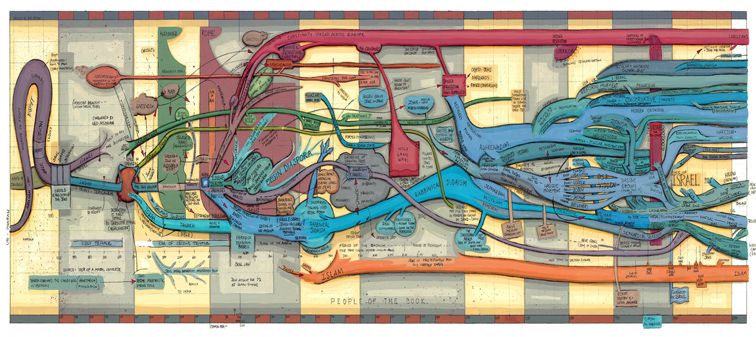
"Unreliable Narrator": Ward Shelley at Pierogi

Ward Shelley
"People of the Book"
2012
Oil and toner on mylar
36 x 75.5 inches
Writing about Ward Shelley's 2009 Pierogi Gallery exhibition, "Who Invented the Avant Garde - and other half-truths," I compared his colorful schematic paintings to taxonomic trees.
"[Shelley's] striking [...] paintings anatomize the development of intellectual and social streams within the humanities. The artist describes them as 'attempts to use real information to depict our understandings of how things evolve and relate to one another, and how this develops over time.'

In spirit as well as in appearance, then, Shelley's paintings are cousin to phylogenetic trees, the taxonomic diagrams that biologists use to denote evolutionary relationships among species. But, though Shelley's genealogies look like mappings of biological exuberance, the subjects of his brightly colored, illustrative works are not so scientific: Frank Zappa; Beat Generation writers; nodes of postmodern philosophy; modern art movements."
Aesthetically speaking, I liked every piece in the show, but the most edifying works were those that considered "significant, sweeping lineages," and I concluded the write-up with the hope that Shelley's lens would broaden.

Friday, November 04, 2011

Announcing BAASICS

I'm very excited to announce that artist-curator Selene Foster and I have received a Southern Exposure Alternative Exposure Grant award for our Bay Area Art & Science Interdisciplinary Collaborative Sessions (BAASICS) proposal! BAASICS is a series of San Francisco-based evening programs that bring together local visual artists, choreographers, composers, scientists, and interdisciplinary thinkers to present engaging, multi-media lectures and performances that consider a given theme. The programs are free and open to the public.

In conjunction with A Live Animal, a group exhibition that Selene and I co-curated at Root Division in July 2011, we assembled 4 visual artists, 3 scientists, and 1 choreographer in San Francisco's ODC Theater to further explore the exhibition's theme in a program of TED Talk-like lectures and performances. The evening was a terrific success, drawing a capacity crowd and generating excited conversation during the reception that followed. Many of the attendees enthusiastically requested more such events.

With BAASICS, Selene and I hope to foment creative exchange and even long-term, mutually beneficial relationships between artists and scientists. Despite much talk of commonality between the disciplines, there is little substantive dialogue. Laudably, there are an increasing number of efforts to cultivate interdisciplinary, art-science projects; unfortunately, the lion's share of these result in vaguely "sciency" artworks or analyses of aesthetics rooted in cognitive neuroscience or sociobiology.

BAASICS isn't goal or project oriented; after all, there are many important differences between art and science, but one undeniable likeness is that the best discoveries are often stumbled upon, not planned for. We hope that BAASICS will provide a forum for artists and scientists to come together to share the ideas and practices that animate their lives and work. A principal aspiration of BAASICS is that we will learn from and be inspired by one another.

Even more important than facilitating relationships and the sharing of ideas, however, is the possibility of engaging a general audience. In the United States, the contemporary fine arts and sciences are generally set apart from popular discourse. Because BAASICS programs are free and open to the public, we hope to make the fine and performing arts and sciences less esoteric, inspiring guests to think about how art and science relate to one another and to society at large.

FYI: The theme of the second BAASIC event -- albeit the first associated with the name -- will be technology and notions of "the future." The roster of presenters hasn't been determined (it will take place in May or early June 2012), but speakers and performers might ponder, for example, robotics, artificial intelligence, medical advances and human nature, how our globalizing culture will shape technology, or dystopian versus utopian prospects. If HH readers know of Bay Area visual artists, composers, choreographers, scientists, or general smarty-pants who are engaging technology in some way and might be interested in participating, please put them in touch with me. Selene and I want to review as large a pool of applicants as possible.

Friday, August 19, 2011

Making More "Live Animals"


Two weeks ago, I presented a lecture at the Art College Center of Design, in Pasadena, California, titled "Aesthetics, Ethics, and Experience." It was my first attempt to respond to the question of how contemporary artists might connect the "fine arts" to society at large, and I drew from an array of sources, classical (Heraclitus; Aristotle) and contemporary (Dave Hickey; David Milch; Erik Reece), to constellate what I'd like to think Aristotle would have described as a virtuous way of being in the world (as an artist). After the lecture, one of the students remarked that it was the "most liberal arts style" approach she'd come across in art school. I appreciated her compliment, but it reminded me of the urgent need for more generalism in arts education.

As I often insist, there is a lot of beautiful and compelling artwork produced and exhibited today, but it generally lives apart from popular culture. We -- that is, those of us active in the fine arts -- are complicit in this ghettoization because we're content to carry on a conversation among ourselves. Moreover, because we've come to preference our tribe's voices over others, there is a surplus of insider commentary and critique passed off as art. Almost all of this work and wordiness is irrelevant to the world outside the ghetto walls and, because young artists are educated in this context, with little or no pedagogical emphasis on disciplines other than art theory, the art and commentary become, over time, increasingly provincial. The wellspring of this contemporary predicament is as old as modernism.

On the heels of co-curating "A Live Animal" with Selene Foster, I've been rereading John Dewey's brilliant Art & Experience essays (1934). Dewey writes, and I quote him at length because he articulates the crux of the problem so eloquently:
" [Art is today] isolated from the human conditions under which it was brought into being and from the human consequences it engenders in actual life experience. [...] Art is remitted to a separate realm, where it is cut off from that association with the materials and aims of every other form of human effort, undergoing, and achievement. A primary task is thus imposed upon one who undertakes to write upon the philosophy of the arts. This task is to restore continuity between the refined and intensified forms of experience which are works of art and everyday events, doings, and sufferings that are universally recognized to constitute experience.

[...] So extensive and subtly pervasive are the ideas that set Art upon a remote pedestal, that many a person would be repelled rather than pleased if told that he enjoyed his casual recreations, in part at least, because of their esthetic quality. The arts which today have most vitality for the average person are things he does not take to be arts: for instance, the movie, jazzed music, the comic strip, and, too frequently, newspaper accounts of love-nests, murders, and exploits of bandits. For, when what he knows as art is relegated to the museum and gallery, the unconquerable impulse towards experiences enjoyable in themselves finds such outlet as the daily environment provides.

[...] For the popular notion comes from a separation of art from the objects and scenes of ordinary experience that many theorists and critics pride themselves upon holding and even elaborating. The times when select and distinguished objects are closely connected with the products of usual vocations are the times when appreciation of the former is most rife and most keen. [...] Theory can start with and from acknowledged works of art only when the esthetic is already compartmentalized, or only when works of art are set in a niche apart instead of being celebrations, recognized as such, of the things of ordinary experience. Even a crude experience, if authentically an experience, if more fit to give a clue to the intrinsic nature of esthetic experience than is an object already set apart from any other mode of experience. [...The] trouble with existing theories is that they start from a ready-made compartmentalization, or from a conception of art that 'spiritualizes' it out of connection with the objects of concrete experience. The alternative, however, to such spiritualization is not a degrading and Philistinish materialization of works of fine art, but a conception that discloses the way in which these works idealize qualities found in common experience. Were works of art placed in a directly human context in popular esteem, they would have a much wider appeal than they can have when pigeon-hole theories of art win general acceptance.

[...] The sources of art in human experience will be learned by him who sees how the tense grace of the ball-player infects the onlooking crowd; who notes the delight of the housewife in tending her plants, and the intent of her goodman in tending the patch of green in front of the house; the zest of the spectator in poking the wood burning on the hearth and in watching the darting flames and crumbling coals."
Amen, Mr. Dewey...though I'd add that the "primary task" to "restore continuity between" works of art and the everyday is not only the obligation of the art writer; it is also incumbent upon the conscientious artist. Artists need to make art that connects to common human experience, and both artists and art writers need to communicate more effectively with the general audience.


I thought of Dewey's argument when watching a video of Scottish cyclist Danny MacAskill that was recently shared by a friend on Facebook. The video offers a more visceral (and therefore meaningful) aesthetic experience than most of the contemporary art I've viewed in the last weeks. An acrobat with his bike, Macaskill is Dewey's "live animal," "fully present, all there" because of he has honed his craft and is, as we often hear athletes put it, "in the zone."

Can contemporary fine art inspire people to exclaim, as one person did in the comments under my friend's Facebook posting of the Macaskill video, "That's crazy & beautiful!"? Can artists again enthuse the general audience?

I believe that we can, and I hope that I can one day have an opportunity to design (or help to design) an undergraduate or graduate art curriculum that prioritizes generalism and social responsibility.

Photo credit: photo of Danny MacAskill ripped from CyclePath Magazine

Saturday, January 09, 2010

The Art Community and Common Sense


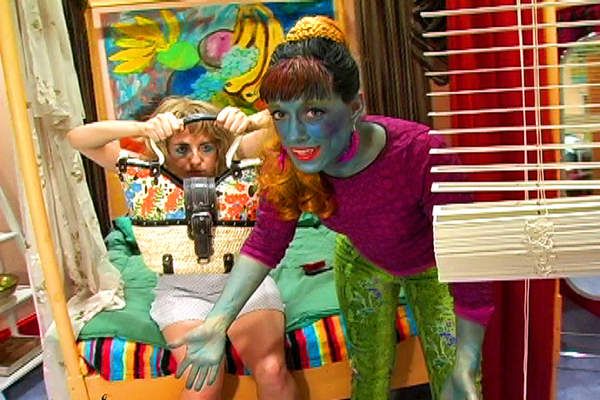
Ryan Trecartin
"I-BE AREA"
2007
"Everybody gets so much information all day long that they lose their common sense."

- Gertrude Stein
We're a week-and-a-half into 2010, and I'm hoping that the din produced by so much fin-de-decade media will soon die down. It's no secret that we citizens of the United States (and all other essentially "Americanized" peoples) are principally defined by our consumption. What's more, after decades of adaptation to the consumer role, we've become so fond of the talk surrounding our consumer products that the consumer reviews themselves have become another kind of consumable. Regrettably, this is no less true in the arts.

I've made a contrarian effort this year to avoid most of the "Top" lists and their Op-Ed equivalents, but I've not been totally chaste. The diviners of social, political, or cultural trends have been working furiously to meet their deadlines, and the surplus of art-related stock-taking is in large part responsible for the dearth of new HH content. Anything that I write here will only add to the pervasive and stupefying hubbub; it is further distraction from the business of life well-lived.

And yet, here I sit, writing this post. Like all the other commentators, I'm guilty of editorializing and contextualizing that which is better meditated upon individually or mulled over with our loved ones. And I'm guilty of adding one more perspective to the countless millions already vocalized, furthering the unfortunate and wrong-headed belief that subjectivity reigns. What I'm engaging in, then, is dangerous. While post-modern notions of relativism are valid and philosophically valuable, our globalized culture must strive to sort, such that we can, the wheat from the chaff. That is to say, in a time of increasing cross-cultural interaction, the need for some consensus, some agreed upon hierarchy of moral, ethical, and aesthetic value, is acute. It is a dangerous and exciting era; as such, it is a good time to be a artist.

I agree with Roberta Smith's contention that "the years 2000 to 2009 saw the emergence of a tremendous number of really good, interesting, promising artists." My list of "really good" artists, however, is very different from hers, and Ryan Trecartin, one of the artists that the New York Times' critic celebrates in her recent article, "Make Room for Video, Performance and Paint," is definitely not on it. I don't know Trecartin personally, and he may be a well-meaning, pleasant enough person, but his artwork is poisonously self-absorbed. In this respect, at least, Smith is right to assert that he is an important representative of the decade past. The art world, and especially that of New York City, the community to which I'm most attached, has seen an explosion of navel gazing.

To be fair, most artists engage in some level of narcissism. At the end of the 1990s, when I was in my early twenties, I had puerile aspirations to produce "art videos" of my ejaculating penis (paging Sterling Ruby), and my paintings were dominated by angst-ridden self-portraits and hyper-sexualized imagery. The few paintings of that period that survive are today stacked in my parents' Virginia garage, partly covered by a plastic tarpaulin and years of accumulated mouse shit and winter-killed wasp corpses. Such is the fate of personal history. Serpent-like, we periodically shed our skins and move on, hopefully a little more wise. Some of us, however, put our sheddings and bruises on display, mistaking personal exposure for bravery. Indeed, in some contexts it is brave, but when the sharing is marshalled in service of a cult of personality, it is a celebration of individual dysfunction. And when such exhibitionism is mistaken for art, it is an indication of critical and cultural dysfunction.

Believing that art is fundamental to humanity, and that it is transformative and sacred, I don't accept Freud's famous contention that the artist is a neurotic who seeks to attenuate or postpone confrontation of his or her mature psyche. In fact, for most of our species' tenure, the role of the artist was precisely the opposite; we were called upon to ground our brethren is real experience, be it material or metaphysical. Yet Freud's categorization accurately describes much of the juvenalia that passes for contemporary art. Certainly, we artists should be embarrassed by this trend, but you can't kill the messenger, as the saying has it; Trecartin and others creating hysterical or megalomaniacal artworks are reflections of the dominant (and apparently yet ascendant) iCulture. It is instead the critics and the gallerists, the purveyors of taste, that should be most ashamed of themselves.

Essayist, critic, and philosopher George Steiner is far more intelligent and incisive than I, so I include a pastiche of pertinent excerpts from his 1989 book, Real Presences.
"The usages and values predominant in the consumer societies of the West today [are] the secondary and the parasitic[...]. Literate humanity is solicited daily by millions of words, printed, broadcast, screened, about books which it will never open, music it will not hear, works of art it will never set eyes on. A perpetual hum of aesthetic commentary, of on-the-minute judgments, of pre-packaged pontifications, crowds the air. Presumably, the greater part of art-talk or literary reportage, of music reviews or ballet criticism, is skimmed rather than read, heard but not listened to. None the less, the effect is antithetical to that visceral, personal encounter[...]. There is little 'ingestion'; it is the 'digest' that prevails.

[...]

The journalistic vision sharpens to the point of maximum impact every event, every individual and social configuration; but the honing is uniform. Political enormity and the circus, the leaps of science and those of the athlete, apocalypse and indigestion, are given the same edge. Paradoxically, this monotone of graphic urgency anaesthetizes. The utmost beauty or terror are shredded at close of day. We are made whole again, and expectant, in time for the morning edition.

[...]

Two principal impulses energize the American spirit: immanence and egalitarianism. The crux of American time is now. The past matters in direct reference to its usability in and by the present. [...] No other culture has so dignified the immanent. [...] Poets, novelists, choreographers, painters of the most derivative or passing interest, are made the object of seminars and dissertations, of undergraduate lectures and post-doctoral research. The axioms of the transcendent in the arts of understanding and of judgment [...] are invested in the overnight."
Steiner, I presume, frowns on the Top Ten lists and "best of the decade" summaries as much as I do. I also believe that he would dismiss as "derivative or [of] passing interest" most (though not all) of the artists that Smith praises in her article. The cultural longevity of most on Smith's list is questionable, certainly alongside the likes of Alec Soth, Bill Viola, Matthew Day Jackson, Omer Fast, or Tom Uttech, all contemporary artists crafting intelligent and soulful artworks.

Smith writes, at the article's close, "In all, we are confronted with the distinct possibility that quantity and quality may not be so mutually exclusive after all. More means more better." That's very true. But more also means more bad, of course, which is why we today have an urgent need for critics, curators, and gallerists who, like Steiner and Donald Kuspit, are willing to reside outside the community, to avoid political entanglements, and to judge, sometimes harshly. To those critics, artists, and gallerists already plugged in, let's begin this decade, this arbitrary but useful marker in our human journey, with a renewed commitment (a resolution, if you prefer) to be more rigorous, contemplative, and socially committed. The art world, like the world at large, needs fixing, and responsible action is the only thing for it.

Happy Twenty-Ten. Here's hoping that it's healthy and auspicious.

Image credit: Ryan Trecartin, 2007

Tuesday, May 26, 2009

Ward Shelley at Pierogi


Ward Shelley
"Autonomous Art, ver.1"
2007 - 2009
Oil and toner on mylar
24 1/4 x 36 inches


"Who Invented the Avant Garde - and other half-truths," Ward Shelley's recent solo exhibition at Pierogi, is comprised of striking schematic paintings that anatomize the development of intellectual and social streams within the humanities. The artist describes them as "attempts to use real information to depict our understandings of how things evolve and relate to one another, and how this develops over time."

In spirit as well as in appearance, then, Shelley's paintings are cousin to phylogenetic trees, the taxonomic diagrams that biologists use to denote evolutionary relationships among species. But, though Shelley's genealogies look like mappings of biological exuberance, the subjects of his brightly colored, illustrative works are not so scientific: Frank Zappa; Beat Generation writers; nodes of postmodern philosophy; modern art movements.

Importantly, even as Shelley strives to elucidate these cultural begats (whether a seed that becomes a trunk or an ill-fated offshoot), the artist acknowledges that a subjective filtering of "the facts" is central to his paintings. He writes,
"[...] We know this content is mediated in a thousand ways before it takes shape in our awareness. Moreover, content is also shaped by the receiving mind which, as a pre-existing form itself, exerts a strong shaping influence."
Unfortunately, although Shelley's project is intelligent and the stylized diagrams he produces are visually remarkable, his subject matter will appeal to a narrow band of viewers. The afternoon that I visited the Pierogi space, a thirty-something couple contemplated each of the works at length, earnestly discussing an array of topics including the career trajectories of obscure members of Andy Warhol's entourage, Francois Truffaut's filmography, and Nixon-administration flunkies. Their exchange was more a trivial cataloging than a conversation and, in style and substance, they struck me as a sendup of the well-educated hipsters that populate Williamsburg, Brooklyn.

There are far more interesting things to discuss than the 20th century's pop-political canon and Shelley's most rewarding pieces - "Autonomous Art, ver.1" and "Counter Culture, ver.1," for example - consider significant, sweeping lineages. I hope that his lens continues to broaden.


Ward Shelley
"Autonomous Art, ver.1"
2007 - 2009
Oil and toner on mylar
24 1/4 x 36 inches


Image credits: copyright, Ward Shelley

Tuesday, April 21, 2009

Bring out your dead!


Walking to work this morning, I noticed for the first time that the Department of Sanitation New York City (DSNYC) logo features the caduceus, a symbol that depicts two snakes entwined about a staff. The DSNYC website explains that the caduceus, "the traditional medical symbol," is incorporated "to promote the idea that sanitation can affect the health of the City."

Indeed, sanitation is one of the most revolutionary inventions of mankind, but somebody at the DSNYC didn't do their homework. The "traditional medical symbol" is not the caduceus, but the rod of Aesculapius, an image that features just one snake wrapped around a staff or branch.

As I wrote here (almost exactly) four years ago,
"No bastardization of a symbol, however, is so glaring as the misuse of the caduceus by medical professionals. The familiar image of two snakes entwined about a winged staff is used by a slight majority of medical practitioners and groups. The caduceus, though, has nothing to do with medicine! It is the staff of Hermes.

'…Hermes was also considered to be the god of commerce and wealth, which in turn implies a sense of personal self-interest along with the possibility of stretching the truth to meet one’s own needs. Hermes was known as the patron god of thieves due to his many tricks and lies. The quality of dishonesty is not one that most people want to see in their physician, therefore a symbol that is traced back to representing trickery and deceit should not be used to represent a profession as highly regarded in trust as medicine. Additionally, Hermes is also said to have used his caduceus staff to lead the souls of those who passed away to the underworld, which is the opposite idea than that stated in the Hippocratic Oath that a physician is charged with.'

The symbol of medicine is actually Aesculapius’s staff...Aesculapius, appropriately, was the God of Medicine.

'The son of Apollo, god of health, Aesculapius is said to have been pulled from the womb as his mortal mother was dying, which came to symbolize a physician’s ability to turn death into life. Throughout his life, Aesculapius used medicinal herbs and surgical procedures to heal the sick and dying, with his culmination of the art being the ability to bring the dead back to life. In one episode of mythology, Aesculapius was said to have been inside a temple when a serpent came to him and wound itself up and around his walking staff. He killed the serpent, only to have a second slither in and use an herb to bring its dead comrade back to life. This brings forth the explanation for the revered symbol of Aesculapius’s staff, with this herb being the major discovery of his life. The snake was seen as a servant to Aesculapius in his healing, and was worshiped as such.'

Clearly, the two symbols became confused at some point. Kim Scott wrote a short history of the confusion, 'The History and Confusion of the Caduceus symbol and the Staff of Aesculapius in Medicine,' from which the above selections [in italics] are drawn. Scott dates the initial mix-up to circa 1500. Apparently, the symbolic SNAFU led to twentieth century medical [professionals regularly using the wrong staff.]"
And the DSNYC, too, made the same mistake.

But perhaps I'm too quick to condemn the DSNYC decision to adopt the caduceus? Maybe the folks behind the logo intended to reference the popular maxim, "One man's trash is another man's treasure." With that in mind, the DSNYC workers might be understood as Hermetic treasure thieves. Or, if that's too much of a stretch, we can consider Hermes' role as a conveyor of the dead to Hades. NYC's trashmen, then, can be thought of as leading the souls of the discarded to the Underworld. The latter interpretation gets my vote!

Wednesday, March 18, 2009

Cooperation through opposition

"Joints are and are not parts of the body. They cooperate through opposition, and make a harmony of separate forces. Wholeness arises from distinct particulars; distinct particulars occur in wholeness."

- Herakleitos, circa 500 B.C.E.
I announced last week that biologist, writer and artist Jessica Palmer contributed a short essay about one of my 2008 drawings to SEED Magazine's Culture Section. In her article, "Seeing Antlers, Feeling Dendrites," Palmer asserts that good art acts as a vehicle of consilience.

Palmer has a more recent, related post on her tremendous blog Bioephemera. In it, she riffs on the complementary relationship of art and science.
"Basically, I think that good art prompts the viewer to find meaningful connections between things that seem unrelated, to draw parallels that previously went unnoticed. Art can be a springboard to insight. Science, which can so easily become insular and near-sighted, needs that springboard, even if - like a shared birthday - it's just a hook to get the story started.

It's worth noting that Darwin was a great scientist precisely because he could make meticulous, minute observations of a single species - he wrote a whole book about earthworm digestion, for heaven's sake! - while also seeing the grand, universal, far-reaching forces that shape finch beaks, beetle shells, poodles and pigeons. It's not easy to make those linkages, in history or in science; sometimes art, literature, or music can give the roving mind a nudge in the right direction. As Gopnik notes in his book, 'there is no struggle between science and art': both are ways of understanding the world, and their strengths are complementary."
I agree heartily, though I would widen the scope of such "linkages" further.

There need not be struggle between science and any of the humanities, including - and this is the controversial inclusion - imaginative theology. The x-factor in these relationships is dogmatism. A rigid mindset stultifies ideology, and when science, philosophy or religion become dogmatic, they retard the human imagination and, with it, possibility.

Wednesday, January 17, 2007

Creative Restraint and Responsibility

Artists, Documentarians and Copyright

"The kernel, the soul - let us go further and say the substance, the bulk, the actual and valuable material of all human utterances - is plagiarism. For substantially all ideas are secondhand, consciously and unconsciously drawn from a million outside sources, and daily used by the garnerer with a pride and satisfaction born of the superstition that he originated them."

-Mark Twain (via Jonathan Lethem's essay, "The Ecstasy of Influence")
For a third time I've allowed all of my art magazine subscriptions to lapse. I'm forever waffling: one year, I feel that I should receive journals like ARTFORUM and Art in America in order to stay abreast of all art world goings-on; the next, I elect to save money by dropping the magazines and relying instead on Internet art resources, galleries and museums. These latter venues allow me to focus on the artwork without the burden of confounding commentary.

As an artist, writer and compulsive reader, I fancy myself the ideal subscriber, but I struggle to rationalize financial support of the sort of writing that Richard Dawkins describes as the "vacuous rhetoric of mountebanks and charlatans."(1) Dawkins was attacking the language of postmodern philosophy - the likes of Deleuze, Guttari and Lacan - but his critique of their obscurantism is also applicable to contemporary art writing. Most art-related articles, reviews, press releases and books are chock-a-block with esoteric nonsense.(2)

So, once again, I'm left with subscriptions to just two magazines: The New Yorker and Harper's. The articles published in The New Yorker are first-class - clear, intelligent and well crafted - and, even though the magazine is published weekly, it rarely disappoints. Harper's is less consistent and more ideologically biased, but when the magazine is on, it's incomparable.

The most recent issue of Harper's (February 2007) is exemplary; two related articles are of particular interest to contemporary artists. "The Ecstasy of Influence: A Plagiarism," by the novelist Jonathan Lethem(3), follows a perspective piece, "On the Rights of Molotov Man," written by the artist (and fellow art blogger), Joy Garnett, and the acclaimed photographer, Susan Meiselas.
"Most artists are brought to their vocation when their own nascent gifts are awakened by the work of a master. That is to say, most artists are converted to art by art itself...Invention, it must be humbly admitted, does not consist in creating out of void but out of chaos."

-Jonathan Lethem, cutting-and-pasting from the pages of Lewis Hyde's "The Gift" and Mary Shelley's "Frankenstein"
Two quotations spring to mind whenever I consider copyright, originality or the avant garde. The first is so familiar as to seem trite while the second is indebted to sources uncredited by Bono, the lead singer and songwriter for the popular rock band, U2.
"There is nothing new under the sun."
-Ecclesiastes 1:9

"Every artist is a cannibal, every poet is a thief.
All kill their inspiration and sing about the grief."
- lyrics from "The Fly," written by U2
Indeed, we are all borrowers and collagists. The honest among us could read the Mark Twain passage that prefaces this post, nod in agreement and leave it there...but for the law. Technology drives the evolution of copyright legislation. The Fifteenth century invention of the printing press necessitated consideration of an author's right to reproduction and the ideas contained within any text. Whereas reproduction rights are principally attached to capital (How does the author get paid for the dissemination of his or her ideas?), intellectual rights are attached to ego. Enlightenment thinking has it that ego drives invention as much as (if not more than) necessity. By granting innovative thinkers and craftsmen control of their respective inventions - be it a painting, a novel or a microscope - through patents and copyrights, lawmakers believed they were encouraging progress. And so they were, but today, living in the era of memes, emergence and the Internet, it comes as no surprise that there is renewed debate regarding intellectual property rights.

Undeniably, all "career artists" are ego driven beasts. As Emily Nussbaum writes in The New York Times Book Review, "For so many artists, the act of creativity is intended as a Napoleonic imposition of one's uniqueness upon the universe." As a result, many artists are loath to own up to influence and are fiercely protective of their product. My father, a freelance writer and author, stressed to me the importance of copyright law before I was old enough to comprehend it. As Lethem writes in "The Ecstasy of Influence,"
"...copyright is revered by most established writers and artists as a birthright and bulwark, the source of nurture for their infinitely fragile practices in a rapacious world. Plagiarism and piracy, after all, are the monsters we working artists are taught to dread, as they roam the woods surrounding our tiny preserves of regard and remuneration."
Indeed, but the times they are a'changin'.(4)

Increasingly, artists working in all mediums and crafts - writers, musicians, filmmakers, painters - embrace influence and sampling with the same enthusiasm that jazz musicians and open source code advocates always have. Three factors contribute to the changing attitude: globalization, leaps in communications technology, and the expansion of corporate hegemony. The first two make the world seem smaller, allowing for accelerated cultural exchange. The Internet savvy among us have grown accustomed to speaking a language of pastiche - blog hyperlinks, Ctl-X/Ctl-V, YouTube - and we're exposed to a cornucopia of outside influence.

Unfortunately, and somewhat paradoxically, the shrinking world is no more comprehensible; in fact, each subsequent generation seems more anxious and confused than the last. The corporate fist, meanwhile, has engendered dissent, making reactionaries of every file sharer (soon to be, if not already, the majority of young people). The arguments from both sides - the prosecutors and the copyright violators - tend to be extreme. Again turning to Lethem:
"If I were to tell you that pirating DVDs or downloading music is in no way different from loaning a friend a book, my own arguments would be as ethically bankrupt as [those of the litigious corporations]. The truth lies somewhere in the vast gray area between these two overstated positions. For a car or a handbag, once stolen, no longer is available to its owner, while the appropriation of an article of 'intellectual property' leaves the original untouched. As [Thomas] Jefferson wrote, 'He who receives an idea from me, receives instruction himself without lessening mine; as he who lights his taper at mine, receives light without darkening me.'"
That passage is a brilliant summation of the issue at large, but things get complicated when considering specifics...and consider them we must.


Joy Garnett
"Molotov"
2003
Oil on canvas
70 x 60 inches
Collection of Nick Debs, NYC


The subtitle of "On the Rights of Molotov Man," the piece preceding Lethem's essay, is "Appropriation and the art of context." Indeed, the latter half of this subtitle is central to the dispute between Joy Garnett and Susan Meiselas. Garnett trolled the web for "images of figures in extreme emotional or physical states." One of the many .jpegs she saved showed a man hurling a Molotov cocktail. Garnett was interested in the act pictured, not the provenance. In fact, the .jpeg was a cropped section of a Meiselas photograph, originally published in the photographer's 1981 book, "Nicaragua." Garnett produced an oil painting based on the detail she had downloaded and, after the painting was displayed in a New York art gallery (and was featured on the exhibition's announcement), Garnett received a letter from Meiselas's lawyer informing the painter that she was "sailing under the flag of piracy." Taken aback and a little shaken up, Garnett turned to an online "new media" community, Rhizome.org, for advice. Aware of the legal cloud, however, she was careful not to "name names or post a link to Susan's photograph." Her situation drew a lot of attention, eventually leading to an international agitprop campaign dubbed Joywar. (The details are very interesting, but, in the interest of space, I'll simply recommend the following links: the full Harper's article; a relevant video lecture; an archive of all things JoyWar; a related photo set). Suffice it to say, although no lawsuit was brought, Garnett and Meiselas have very different perspectives on the matter.

Reading Meiselas's half of "On the Rights of Molotov Man," one realizes that copyright is less important to her than context. In other words, Garnett's unsanctioned use of the image is less troublesome to the photographer than the generalization of the image's content. There is an important distinction to be made here. The artist - Garnett, in this case - speaks the language of the universal. Hers is "a project born of frustration and anger" and the .jpeg of the anonymous rebel was "emblematic of the series." This is true of all the works that comprise Garnett's "Riot" series. Her inspiration was specific - the United States invasion of Iraq in 2003 - but her paintings of "shouting demonstrators, angry skinheads, an Air Force pilot and his girl in an emotional embrace, frat boys jumping over bonfires, screaming punk rockers" are archetypes of the anxiety and anger we feel when powers outside our sphere of influence affect us adversely, especially when they steer the region (or world) toward further conflict. These misgivings are essentially equivalent, irrespective of culture, place or time.

By contrast, the photographs Susan Meiselas shot in Nicaragua are intended as documents of a particular place, during a particular conflict, in this case, the fighting between the Sandinistas and the ruling Somoza family. Although this conflict continues today in a different incarnation, the photograph in question represents the final hours before the Somoza family fled the country in July of 1979.

Meiselas's interest is specific and historical; she is a documentarian. Not all photographers are documentarians, but Meiselas makes clear her goals in the Harper's article. "Indeed, it seems to me that if history is working against context, then we must, as artists, work all the harder to reclaim that context." The Enlightenment thinker in me is inclined to agree with her, but most contemporary artists are not interested in reclaiming specificity. Rather, we are in the business of erasing it, sanding the hard edges of "fact" to reduce friction. Lethem, cribbing from David Foster Wallace's essay, "E Unibus Pluram":
"Today, when we can eat Tex-Mex with chopsticks while listening to reggae and watching a YouTube rebroadcast of the Berlin Wall's fall - i.e., when damn near everything presents itself as familiar - it's not a surprise that some of today's most ambitious art is going about trying to make the familiar strange....[by] paradoxically trying to restore what's taken for 'real' to three whole dimensions, to reconstruct a univocally round world out of disparate streams of flat sights."
In other words, we're learning to cope with the constant stream of information by boiling it down to an essential skeleton, be it celebrity gossip, dispatches from Iraq, undergraduate lectures on aesthetics or what have you. This process is more easily described than done. We've recognized for centuries that the historical record is ever growing, but recently the number of pages in our encyclopedias (and wikis) grows exponentially. Our circuitry is overloaded. Most of us turn away from the information glut or choose to concentrate on only a few areas - say sports, celebrities and the stock market or literature and fashion. Worse yet, many of us withdraw into one specialty and trust that boring ever downward in a given spot will prove more valuable to the whole than a wide, shallow excavation. Exceptional cases not withstanding, that trust is misguided.

Artists are rightly reluctant to relinquish an integrated worldview. As Lethem suggests above, artists are turning to the symbolic and the approximate in an effort to render experience again comprehensible. Certainly this is an important, even vital process, but it amounts to reductionism and, as such, there is great risk involved. What's lost in an abridged reality?

For a rather trivial example, consider Hollywood's botching of natural history. The vast majority of movies produced feature animal species or animal calls that don't occur in the depicted region. For most folks, it's no big deal, but a movie is ruined for me when I see an elk (Cervus canadensis) in North Carolina or hear a common loon (Gavia immer) calling in the tropical rain forest of South America. Hey, it's a movie, you're thinking, and a bird is a bird is a bird. Perhaps, but such generalization is indicative of our having lost interest (and knowledge) of the world we inhabit, the world that supports us. In case it seems that I'm making a mountain of a molehill, let's consider another example.

Of late, word mavens fuss about "the bastardization" of English more than ever. Often the critics are referring to the adoption of slang, be it from "the streets" or the world of technology. Unfortunately, some of their complaints are fueled by xenophobia. Two hundred years ago, the English rolled and howled in reaction to the crude American dialect, going so far as to suggest that Noah Webster's proposed American Dictionary of the English Language was an absurdity, as American English was a mockery of the mother tongue. To this day, the yearly dictionary additions generate more scoffs than agreeable nods. The human brain evolved to be skeptical of change and foreign influence but, the fact remains, language is ever evolving, like culture at large.
"[T]he commons of a language: altered by every contributor, expanded by even the most passive user. That a language is a commons doesn't mean that the community owns it; rather it belongs between people, possessed by no one, not even by society as a whole."

-Lethem, borrowing from Michael Newton, The London Review of Books
No one possesses language or art, but everyone impacts them. Pessimists will draw attention to the "tragedy of the commons," the notion that any property, object or resource shared by all tends to be exploited and debased, be it forests, rivers, oceans, or language. There's little doubt that the vocabulary comprehension of young Westerners is on the decline. Accusatory fingers can be pointed at computer instruction, instant messaging, struggling school systems and any number of phantom menaces but, whatever the "real" reason(s), language - communication, really - is becoming simpler. Some evolutionary biologists might argue that this is a good thing, that we are seeing a streamlining of an overdeveloped adaptation. (Is it really necessary to call Julia Roberts "loquacious" when we could go with "talkative"?) There is an argument to be made there, but, again, isn't something lost? Can't evolution, in some cases, be a degradation? When high school students hand in essays written with IM shorthand, the essential skeleton is looking a little thin. Language isn't merely being sanded down; we're whittling away and risk being left only with splinters and dust.


Susan Meiselas
untitled (Sandinistas at the walls of the Esteli National Guard headquarters)
1979
Color photograph
Size variable
Magnum Photos


The same is true of history. We struggle to learn the lessons of the past because we suffer from historical amnesia. A generation ago, many college graduates could relate the events leading up to World War I or roughly describe the Hellenistic period. Without access to the Internet, I struggle to do either. Some technophiles argue that the Internet is a communal database that alleviates the need for memorization and "old-fashioned" learning. All the information is at our fingertips, right? Sure, but we tend to use online resources on a "need to know" basis. What did the guy who plays "House" say at the Golden Globes last night? Who was Cleopatra involved with? Does the Clash lyric "rock the Casbah" have anything to do with Algiers? Those hyperlinks will help provide an answer, but will you remember what you read there a month from now, or a year?

I doubt it. I recall only a small percentage of what I "learn" online and I grew up studying the old school way, in libraries with piles of books, card catalogs and reams of notes. What about students today, who research everything online? It's difficult to apply the lessons of history if we don't connect the dots, and no number of hyperlinks can replace the coded pathways in our skull PCs. The "new" knowledge is comparatively transitory, relatively soft.

So what does all of this have to do with artists and documentarians? Garnett asks, "Does the author of a documentary photograph - a document whose mission is, in part, to provide the public with a record of events of social and historical value - have the right to control the content of this document for all time?" Of course not. But we are all responsible, as citizens of the world, for the commons, be it that of language, ecosystems, or the historical canon. Lethem writes, "Honoring the commons is not a matter of moral exhortation. It is a practical necessity." We have to decipher the signs with care and the reading mustn't stop at approximation. As important as our attempts to frame events in comprehensible terms are, we must not plead ignorance to create a happy fiction of distressing reality.

"Who owns the rights to this man's struggle?," a blogger named nmazca asked, referring to the Sandinista rebel photographed by Meiselas and, in turn, painted by Garnett. We all do. I see no reason why he can not be both Pablo Arauz, a one time rebel photographed by Meiselas in 1979, who now has a family and "a pretty good job delivering lumber," and the anonymous, existential Molotov Man. It is, however, our responsibility to honor both incarnations. As it exists now, copyright law is a "gag order," as Garnett puts it, to global conversation, but as it erodes (and erode it will, like language and history), we will become responsible for the context. Are we ready to be vigilant in an open source world?

(1) From the essay "Postmodernism Disrobed," included in the essay collection, A Devil's Chaplain.

(2) There are, of course, exceptions. I'm partial to the art writing published in the pages of The Village Voice, The New York Times and other papers. For broadsheet (here loosely applied to The Voice) critics, apparently, clarity remains a virtue.

(3) It is works like Lethem's "The Ecstasy of Influence" that make Harper's so outstanding. The essay does a remarkable job of communicating the writer's attitude - and, indeed, that of the oft cited "founding fathers" - regarding copyright law, but it is a "collage text," an essay assembled from "extensive interlaced quotations" interspersed with Lethem's own material. Following the essay, Lethem includes a lengthy key that credits each source. I read through the key with glee, thrilled by the success of Lethem's little experiment. He stresses that the "collage text" is not an original notion; Lethem's approach here has predecessors, most notably "Walter Benjamin's incomplete Arcades Project."

(4) "Dylan's originality and his appropriation are as one." (Jonathan Lethem, "The Ecstasy of Influence")

Photo credit: Mickey copyright graphic ripped from Python.net (image by David Goodger); "Molotov" courtesy the artist; original Meiselas photograph ripped from The San Francisco Chronicle

Wednesday, June 29, 2005

Jack Beatty's terrific "Markets Gone Wild: American history and the myth of free trade," included in the June 2005 issue of Harper's Magazine, should be of interest to anyone curious about economic philosophy and American history.

Beatty portrays the contemporary American socio-political and socio-economic landscapes with more originality than I did in my recent post "Absolutely Relative,", though he, too, turns to Alexis de Tocqueville for then-and-now perspective. de Tocqueville offers readers a wealth of valuable material, but I hadn't before read anything as prescient as the below.
"Ideology - everything will work out for the best in the long run - sustains inevitability. But mass trances cannot be counted on to hold. The spell of inevitability has been broken before."

"Should Americans lose their capacity for self interest, Tocqueville feared, American individualism would produce a society of post-political strangers who stay 'enclosed in their own hearts,' beyond collective anger, and laiable to pacification by the 'immense tutelary power' of a soft despotism."
Only a devoted scholar of history and culture could have so accurately predicted our current American condition...over 160 years ago! de Tocqueville's observations stand as a challenge to those bottom-line thinkers that deny the vitality of the humanities or the importance of a grounding in history. A world of specialists is a world of "post-political strangers."

Wednesday, April 20, 2005

You Say Caduceus, I Say Aesculapius


I value symbols and language highly and, though I don't deny that both are subject to evolution, I do feel there should be a reasonable limit to the degree of abstraction or change. If anything goes, a great deal of the so-called evolution is instead de-evolution.

No one, to use a far-fetched example, would accept the word “sun” being used to denote the moon. The two celestial bodies are not opposites, but they are nonetheless distinct; the earth orbits the sun while the moon orbits the earth. If a lover were to gesture at the pale orb above and proclaim, “What a beautiful night.! The sun is full and the stars are bright,” you'd likely balk.

Some language picadillos are specific to our field or area of expertise. Few of my friends are galled by the catch-all term “seagull.” But birders and wildlife biologists recognize that there are 27 known species of gull in North America alone, and many of these gulls have little association with the “sea.” An equivalent misnomer, then, would be our calling all humans “watermen,” though only a small minority of Homo sapiens still eke out a living from the ocean.

Some vocabulary hang-ups of mine are, like "ATM machine," shared by many other people. Examples are the recently popular “irregardless” and the New York City MTA's “momentarily”/”in a moment” confusion. More extreme than I, my father has raged against the use of the word “bathroom” for years. He points out that most public restrooms contain no bath. He prefers “toilet,” “water closet” or “head.” Because I so frequently use the word “restroom,” he chides me by asking if I intend to sleep or lie down on the tile floor. Perhaps, then, a late night of drinking makes the term "restroom" accurate?

The meaning or significance of a symbol is more steadfast. A change in attributed meaning is most often due to outright misuse. Some hipsters wear East German military insignia as an ironic or “hip” gesture but, despite the changed context, the marking still retains its original meaning. Or does it? Typically, the teenagers and twenty-somethings that don military decoration do not know what the medals mean. Even Hollywood costume designers treat these medals and ribbons as general signifiers of military do-gooding. Rarely do they take the time to learn what each medal represents. As a result, Hollywood often presents audiences with an Army officer whose chest is covered in Navy and Air Force ribbons! To a certain segment of the movie-going audience, this is a major "Whoops!"

No bastardization of a symbol, however, is so glaring as the misuse of the caduceus by medical professionals. The familiar image of two snakes entwined about a winged staff is used by a slight majority of medical practitioners and groups. The caduceus, though, has nothing to do with medicine! It is the staff of Hermes.
“…Hermes was also considered to be the god of commerce and wealth, which in turn implies a sense of personal self-interest along with the possibility of stretching the truth to meet one’s own needs. Hermes was known as the patron god of thieves due to his many tricks and lies. The quality of dishonesty is not one that most people want to see in their physician, therefore a symbol that is traced back to representing trickery and deceit should not be used to represent a profession as highly regarded in trust as medicine. Additionally, Hermes is also said to have used his caduceus staff to lead the souls of those who passed away to the underworld, which is the opposite idea than that stated in the Hippocratic Oath that a physician is charged with.”
The symbol of medicine is actually Aesculapius’s staff, which features ONE snake curled around a rod. Aesculapius, appropriately, was the God of Medicine.
“The son of Apollo, god of health, Aesculapius is said to have been pulled from the womb as his mortal mother was dying, which came to symbolize a physician’s ability to turn death into life. Throughout his life, Aesculapius used medicinal herbs and surgical procedures to heal the sick and dying, with his culmination of the art being the ability to bring the dead back to life. In one episode of mythology, Aesculapius was said to have been inside a temple when a serpent came to him and wound itself up and around his walking staff. He killed the serpent, only to have a second slither in and use an herb to bring its dead comrade back to life. This brings forth the explanation for the revered symbol of Aesculapius’s staff, with this herb being the major discovery of his life. The snake was seen as a servant to Aesculapius in his healing, and was worshiped as such.”
Clearly, the two symbols became confused at some point. Kim Scott wrote a short history of the confusion, "The History and Confusion of the Caduceus symbol and the Staff of Aesculapius in Medicine," from which the above selections are drawn. Scott dates the initial mix-up to circa 1500. Apparently, the symbolic SNAFU led to twentieth century medical newsletters using the word caduceus in their titles!

The conservative commentator in me feels that our educational system is in need of a visit from Aesculapius, too.