Showing posts with label Donald Kuspit. Show all posts

Saturday, January 09, 2010

The Art Community and Common Sense


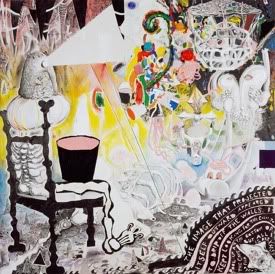
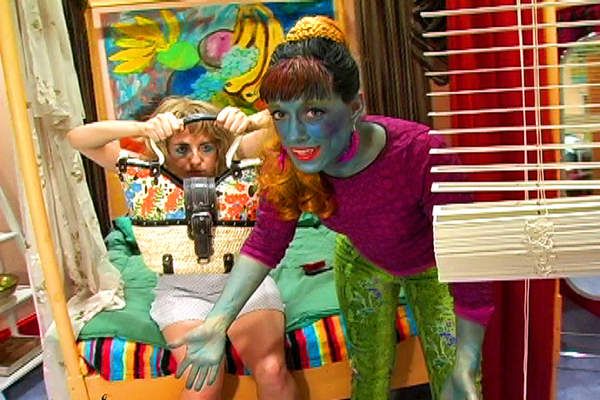
Ryan Trecartin
"I-BE AREA"
2007
"Everybody gets so much information all day long that they lose their common sense."

- Gertrude Stein
We're a week-and-a-half into 2010, and I'm hoping that the din produced by so much fin-de-decade media will soon die down. It's no secret that we citizens of the United States (and all other essentially "Americanized" peoples) are principally defined by our consumption. What's more, after decades of adaptation to the consumer role, we've become so fond of the talk surrounding our consumer products that the consumer reviews themselves have become another kind of consumable. Regrettably, this is no less true in the arts.

I've made a contrarian effort this year to avoid most of the "Top" lists and their Op-Ed equivalents, but I've not been totally chaste. The diviners of social, political, or cultural trends have been working furiously to meet their deadlines, and the surplus of art-related stock-taking is in large part responsible for the dearth of new HH content. Anything that I write here will only add to the pervasive and stupefying hubbub; it is further distraction from the business of life well-lived.

And yet, here I sit, writing this post. Like all the other commentators, I'm guilty of editorializing and contextualizing that which is better meditated upon individually or mulled over with our loved ones. And I'm guilty of adding one more perspective to the countless millions already vocalized, furthering the unfortunate and wrong-headed belief that subjectivity reigns. What I'm engaging in, then, is dangerous. While post-modern notions of relativism are valid and philosophically valuable, our globalized culture must strive to sort, such that we can, the wheat from the chaff. That is to say, in a time of increasing cross-cultural interaction, the need for some consensus, some agreed upon hierarchy of moral, ethical, and aesthetic value, is acute. It is a dangerous and exciting era; as such, it is a good time to be a artist.

I agree with Roberta Smith's contention that "the years 2000 to 2009 saw the emergence of a tremendous number of really good, interesting, promising artists." My list of "really good" artists, however, is very different from hers, and Ryan Trecartin, one of the artists that the New York Times' critic celebrates in her recent article, "Make Room for Video, Performance and Paint," is definitely not on it. I don't know Trecartin personally, and he may be a well-meaning, pleasant enough person, but his artwork is poisonously self-absorbed. In this respect, at least, Smith is right to assert that he is an important representative of the decade past. The art world, and especially that of New York City, the community to which I'm most attached, has seen an explosion of navel gazing.

To be fair, most artists engage in some level of narcissism. At the end of the 1990s, when I was in my early twenties, I had puerile aspirations to produce "art videos" of my ejaculating penis (paging Sterling Ruby), and my paintings were dominated by angst-ridden self-portraits and hyper-sexualized imagery. The few paintings of that period that survive are today stacked in my parents' Virginia garage, partly covered by a plastic tarpaulin and years of accumulated mouse shit and winter-killed wasp corpses. Such is the fate of personal history. Serpent-like, we periodically shed our skins and move on, hopefully a little more wise. Some of us, however, put our sheddings and bruises on display, mistaking personal exposure for bravery. Indeed, in some contexts it is brave, but when the sharing is marshalled in service of a cult of personality, it is a celebration of individual dysfunction. And when such exhibitionism is mistaken for art, it is an indication of critical and cultural dysfunction.

Believing that art is fundamental to humanity, and that it is transformative and sacred, I don't accept Freud's famous contention that the artist is a neurotic who seeks to attenuate or postpone confrontation of his or her mature psyche. In fact, for most of our species' tenure, the role of the artist was precisely the opposite; we were called upon to ground our brethren is real experience, be it material or metaphysical. Yet Freud's categorization accurately describes much of the juvenalia that passes for contemporary art. Certainly, we artists should be embarrassed by this trend, but you can't kill the messenger, as the saying has it; Trecartin and others creating hysterical or megalomaniacal artworks are reflections of the dominant (and apparently yet ascendant) iCulture. It is instead the critics and the gallerists, the purveyors of taste, that should be most ashamed of themselves.

Essayist, critic, and philosopher George Steiner is far more intelligent and incisive than I, so I include a pastiche of pertinent excerpts from his 1989 book, Real Presences.
"The usages and values predominant in the consumer societies of the West today [are] the secondary and the parasitic[...]. Literate humanity is solicited daily by millions of words, printed, broadcast, screened, about books which it will never open, music it will not hear, works of art it will never set eyes on. A perpetual hum of aesthetic commentary, of on-the-minute judgments, of pre-packaged pontifications, crowds the air. Presumably, the greater part of art-talk or literary reportage, of music reviews or ballet criticism, is skimmed rather than read, heard but not listened to. None the less, the effect is antithetical to that visceral, personal encounter[...]. There is little 'ingestion'; it is the 'digest' that prevails.

[...]

The journalistic vision sharpens to the point of maximum impact every event, every individual and social configuration; but the honing is uniform. Political enormity and the circus, the leaps of science and those of the athlete, apocalypse and indigestion, are given the same edge. Paradoxically, this monotone of graphic urgency anaesthetizes. The utmost beauty or terror are shredded at close of day. We are made whole again, and expectant, in time for the morning edition.

[...]

Two principal impulses energize the American spirit: immanence and egalitarianism. The crux of American time is now. The past matters in direct reference to its usability in and by the present. [...] No other culture has so dignified the immanent. [...] Poets, novelists, choreographers, painters of the most derivative or passing interest, are made the object of seminars and dissertations, of undergraduate lectures and post-doctoral research. The axioms of the transcendent in the arts of understanding and of judgment [...] are invested in the overnight."
Steiner, I presume, frowns on the Top Ten lists and "best of the decade" summaries as much as I do. I also believe that he would dismiss as "derivative or [of] passing interest" most (though not all) of the artists that Smith praises in her article. The cultural longevity of most on Smith's list is questionable, certainly alongside the likes of Alec Soth, Bill Viola, Matthew Day Jackson, Omer Fast, or Tom Uttech, all contemporary artists crafting intelligent and soulful artworks.

Smith writes, at the article's close, "In all, we are confronted with the distinct possibility that quantity and quality may not be so mutually exclusive after all. More means more better." That's very true. But more also means more bad, of course, which is why we today have an urgent need for critics, curators, and gallerists who, like Steiner and Donald Kuspit, are willing to reside outside the community, to avoid political entanglements, and to judge, sometimes harshly. To those critics, artists, and gallerists already plugged in, let's begin this decade, this arbitrary but useful marker in our human journey, with a renewed commitment (a resolution, if you prefer) to be more rigorous, contemplative, and socially committed. The art world, like the world at large, needs fixing, and responsible action is the only thing for it.

Happy Twenty-Ten. Here's hoping that it's healthy and auspicious.

Image credit: Ryan Trecartin, 2007

Saturday, April 29, 2006

Progeny


Trenton Doyle Hancock
"Las Luces, Looses, and Losses"
2005
Mixed media on canvas
60 3/4 X 60 3/4 X 4 inches

An inordinate amount of Trenton Doyle Hancock buzz was generated and disseminated this February and March. Hoping the coverage would die down and/or that my recollection of it would dim, I put off a visit to Hancock’s recent solo effort, "In The Blestian Room," at James Cohan Gallery, for as long as I could. Galleries aren't in the business of humoring persnickety calendar demands, however, and I found myself studying Hancock's handiwork with the hoopla still on my mind.(1)


Trenton Doyle Hancock
"In The Blesstian Room"
2005
Mixed media on canvas
90 x 108 x 6 inches

Clearly, I’m a biased viewer, but I found "In The Blestian Room" disappointing. My dissatisfaction is rooted in suspicion of motive, not, as one might assume, in aesthetics. That is to say, while some of Hancock's decisions - attaching studio detritus to the paintings, for example - seem self-conscious, fraught denotations of race, attitude, or spontaneous process, I was more disturbed by the sense that Hancock is dangerously close to becoming an art world personality. That is to say, his work seems calculated, more akin to Warhol than Darger or Dubuffet. Hancock turns his uncouthness into a commodity. As Donald Kuspit writes, "The artist outsider is well rewarded in our society - so long as he is an insider in art society."(2)


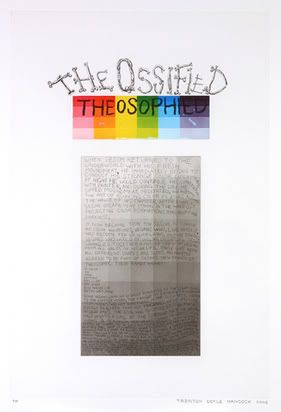
Trenton Doyle Hancock
“The Ossified Theosophied, (Title Page)”
2005
Color etching, Edition of 35
19 1/2 X 25 inches

Hancock's use of narrative scaffolding seems more like a marketing tactic than an essential ingredient in the artist's process. While it is not uncommon for contemporary artists to invent a cosmology on which to base a body of work - Matthew Ritchie is a notable example - most keep the details of their created worlds largely private. Hancock, by contrast, not only cooked up the Mounds saga, a picaresque epic with vaguely religious resonance, he also makes sure viewers know about it. “In The Blestian Room” includes a limited edition print (see above) that amounts to little more than a sloppy, hand-written chapter of the chronicle. Hancock is making up the story as he goes along – this, at least, is how it is presented to the viewer – giving it the appeal of a zany soap opera. (What is Sesom up to now? Come find out! What will he get into next? What crazy characters will he meet tomorrow? Will we witness a great war between the Mounds and the Vegans? You'll have to wait until the next installment/exhibition! Don’t miss it, ‘cuz the art world doesn’t do Tivo!)

Before I continue, it should be noted that I cheer for those making art away from established cultural centers; I enjoy comic books, graphic novels, and cartoons(3); I hold dear much fantasy and myth, from Kipling's "Just So Stories" and Aesop's Fables to The Lord of the Rings; I am fascinated by religious narrative and the clever weaving of historical "fact" with spiritual rendering in such tellings. Given this laundry list of likes, I expected to find a confederate in James Cohan Gallery. What I discovered instead was calculation.


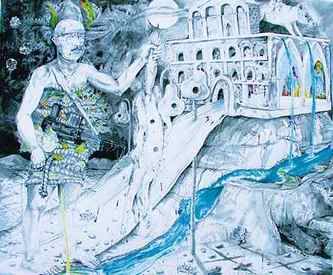
Lee Baxter Davis
"Family Tree"
2005
Ink, watercolor & collage
36 x 44 inches

What's more, Hancock’s still unrecognized debt to the artist who spawned him, Lee Baxter Davis, raises eyebrows. If I were not already an admirer of Davis, I very much doubt I would know of their relationship. The CUE Art Foundation recently exhibited about twenty of Davis’s drawings and paintings. Long overdue, the show was the artist’s first in New York. Early in the associated press release, the writer draws attention to Davis' influential role.
“A regional icon, Davis’ thirty-years of teaching printmaking and drawing at East Texas State University (now called Texas A & M, Commerce) has influenced the careers of some of his very prized students including exhibition curator, Gary Panter, along with Whitney Biennial artists Trenton Doyle Hancock, Robyn O’Neil, and Christian Schumann, among others.”
An Internet search for “Lee Baxter Davis” turns up little, whereas “Trenton Doyle Hancock” nets many relevant articles and websites. In pieces about Hancock, the names William Blake, Hieronymus Bosch, Philip Guston, Max Ernst, and Gary Panter are repeatedly cited as influences, but Davis is nowhere credited. This is a curious oversight, the result of Davis' being a relative unknown in the New York art world. Closer to home - his home - he looms large.
"In the 1970s, The Lizard Cult was a vaguely derogatory term applied to East Texas State University (as it was known then)'s Art Professor Lee Baxter Davis and many of his most talented students. It was called that because so much of their work closely approximated his - rife with comic sensibility, lush textures and lurid details....Once viewed with condescension, The Lizard Cult has not only grown up, many of Davis' students have prospered and become regionally and nationally prominent." (J R Compton, "Lee Baxter Davis and The Lizard Cult Grows Up," Dallas Arts Review)
With the exception of Gary Panter, Davis' celebrated proteges are all much younger (by thirty or more years, typically) and, therefore, more attractive (for the moment) to the youth-obsessed art market. Furthermore, whereas Davis is a retired art professor now working as an assistant pastor of St. William the Confessor Catholic Church in Greenville, Texas, his former students manage to bridge the divide between "living and working" in Texas and, well, living in Texas. In other words, though Hancock and O'Neil still live in the state (Paris and Houston, respectively), they have attached themselves to the larger art world in a way that Davis has not. Why, one wonders, have so many of Davis' students achieved art world success while he remains a regional icon? In part, the answer lies with the man himself, with a desire to remain unrecognized, but I can't shake the sense that a more perverse process is also at work.


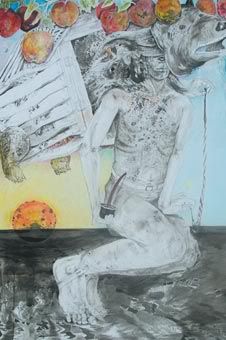
Lee Baxter Davis
"Big Bear"
2005
Pen, ink, watercolor & collage
21" x 29 inches

In his recent indictment of postmodern art, The End of Art, Kuspit describes two artist archetypes. The first is a "reclusive alchemist struggling to purify the dross of everyday reality," and the second, an "entertainer representing a mass audience's everyday wishes." Although Kuspit argues that the monkish model is exclusively modern and, today, extinct, this is not the case; both are alive and well. As a general rule, however, it is the second type, those interested in "having an audience that will make them popular, giving them the celebrity and charisma they believe they are entitled to as artists," that finds success in the art world.

Lee Baxter Davis is the very picture of Kuspit's reclusive alchemist. Not only are his paintings alchemical, but his lifestyle and approach to art-making fit the bill, too.
"Like a hermit practicing his art in millennia past, Davis is isolated. He has chosen to separate himself from society, locating his studio, home and family life far from the hustle and bustle of Dallas, Houston, San Antonio, or Austin. Davis finds peace and purity of existence in the quietude of a rural existence. Instead of reaping and sowing the land for its hearty edibles, he reaps and sows the earth for intellectual nourishment. It is a type of sustenance that could only come from the coupling of separation and deliberation - from self-willed banishment to the silent wilds of a life found deep in the nowhere lands of Texas." (Charissa N. Terranova, "Alchemist of Imagination," ARTL!ES, Issue 43)
Furthermore, Davis is as invested in (or consumed by) his contemplation of philosophy, religion, and pop culture as he is the local environment.
"Growing up in the small towns of Texas, Davis' boyish pursuits included immersing himself within the complex sagas told by great Southern writers, the harrowing poems of Edgar Allen Poe, and a dizzying array of post WWII popular comic books and newspaper strips such as BlackHawk, Pogo Possum, and Mad Magazine. Largely raised by his Methodist minister grandfather, and having read the bible since childhood, Davis has long harbored a deep-rooted fascination with the more mysterious elements of faith...Believing laughter and prayer to be close to the same thing, he creates illusions whose idiosyncrasies harbor nervous fits of laughter as buffers against existential angst."(Gary Panter, "Lee Baxter Davis," CUE Art Foundation press release)


Davis' layered pastiche is, for him, a metaphysical search, one that ties vulgar realities to marvelous visions, the profane to the sacred. Viewers - western viewers, in particular - will recognize many of the embedded symbols, but they must interpret the work subjectively, nurturing their own hybrid narrative. Thus, something approaching the intrinsic alchemy of the making - Davis' journey - is experienced by the viewer. To an extent this is true of all visual art, but Davis' symbolic content elevates the exchange.

Hancock's Mounds fiction, on the other hand, is altogether different. Viewers must learn about the Mounds before the narrative becomes meaningful. We are given a choice: disregard the mythology and treat the work as illustrative reverie, or become an initiate of Hancock, learning the magic words, the symbols, and the gestures. In essence, Hancock offers viewers a cult of personality. Davis allows us a subjective experience by drawing on shared myth; Hancock gives us an opportunity to participate in his manufactured, flimsy one.

Yet the son has surpassed the father, at least in terms of renown. Hancock is more savvy than Davis. Whether by virtue of his nature or the waving of an agent's wand, he presents us with the "high art" version of an "outsider"/low-brow aesthetic. His awareness of the supposed division between these two orbits is clear. For many, this makes the work more easy to digest, but also more intelligent and contemporary. For others, myself included, that awareness results in self-conscious painting, work that excels at distraction and affirmation, but fails to address universal experience. Many critics (many friends) disagree, arguing that Hancock melds rich narrative, magic, superstition, faith, and popular culture to produce an original experience, a distinct and contemporary remix. But the father's artwork suggests that same union is less an artistic assertion of individuality than a way of life, an approach allowing us to cope with and consider deeply disturbing axioms.


Lee Baxter Davis
"Sideshow"
2005
Pen, ink & collage
28" x 20 inches

(1) Museum exhibitions have a longer lifespan, allowing the details of the 2006 Whitney Biennial coverage, for example, to fade before I finally visit (in late May).

(2) Donald Kuspit, The End of Art, Cambridge University Press, 2004

(3) In fact, I feel Hancock is better served when he sticks to comics - there were some strong pages on display in the rear gallery - and the like. His book, "Me A Mound," is a far more interesting artifact that his paintings or prints, though it, too, suffers for a certain amount of ostentation.

Photo credits: All images ripped from James Cohan Gallery and CUE Art Foundation websites

Thursday, October 27, 2005

Considering Excavations


On Tuesday night I attended a cocktail reception at Mixed Greens' new Chelsea digs, a nice, contemporary space with a comfortable flow. The reception was billed as a private affair and there were only twenty to thirty people in attendance, making art viewing and navigation easy.

The affair was pleasant enough; I sipped white wine and shuffled about the room, chatting with an artist friend of mine who had spent the day studying for the Graduate Record Exam (GRE). When I applied to art graduate programs in 1999, no schools requested GRE scores, so I was surprised to learn that Stanford, a program on my friend's list, does so. In most respects, I feel that the requirement is a good one; too many artists lack a liberal arts grounding. My friend, however, but pointed out that the GRE isn't a reliable measure of general knowledge, even if it does provide review committees with some sense of an applicant's aptitude. We moved to the bar area, refilled our empty plastic cups and the conversation moved in some other direction.

Still, this is a concern that I return to regularly. Many contemporary artists, despite the impressive sums they (or their family) have spend on graduate schooling, are un(der)educated, ignorant especially of literature, science, and history. This cultural and intellectual illiteracy compromises their work. Little wonder so many artists draw only on their immediate experience or the events of the day without regard to context beyond art world borders!

Some of the onus for this failure must be placed on the art world itself. When applying to art graduate programs, prospective students have a better chance of being accepted if they are familiar with "the system." Attending an undergraduate program with a "fine arts" focus, rather than a general liberal arts college with multi-disciplinary requirements, makes the applicant more art world savvy. These fine arts undergrad programs are essentially high-priced trade schools; the young artist is an apprentice. Their time in these stepping stone institutions prepares them well for many aspects of the art world - whether graduate school applications, grant writing, or mastery of art speak - but it leaves them unable to discuss the similarity between Shakespeare and H. L. Mencken or the political factors which led to the twentieth century's European nationalism. In fact, some of the artists I know deride such knowledge as esoteric (or "nerdy") and conversations about these subjects as self-consciously "heady." (Last week's "The Significance of Pluto to the Waterboy" essay addresses this anti-intellectual posturing.)

But what serious artist wouldn't want to learn as much as possible and, more importantly, apply it? T.H. White's Merlin, in "The Once and Future King," puts it well.
“You may grow old and trembling in your anatomies, you may lie awake at night listening to the disorder of your veins, you may miss your only love, you may see the world about you devastated by evil lunatics, or know your honour trampled in the sewers of baser minds. There is only one thing for it then—to learn. Learn why the world wags and what wags it. That is the only thing that the mind can never exhaust, never alienate, never be tortured by, never fear or distrust, and never dream of regretting.”
Personally, I agree with the wizard's prescription, but it doesn't apply universally. A great many ignorant people are perfectly happy! Still, the work of even the happiest, un(der)educated artist risks cultural irrelevance because it is too tied to art world insularity.

The celebrated art critic Donald Kuspit insists that most contemporary art "reifies innovation into novelty and upsets the balance, leaving a disspirited intellectuality in its wake." Indeed, the art world's decision to prioritize innovation is an imaginative failure. Moreover, the work produced in the quest for novelty is usually (and paradoxically) unoriginal, overly indebted to art world and auction house trade winds.

The variety of art world artist that I'm critiquing might be characterized as Archilochus's hedgehog, the creature that knows only one "big thing." The hedgehog is a specialist, in the context of the art world, shaped by trade school and the market. The fox, according the Archilochus, is a generalist, an animal that knows many things, but nothing so well as the hedgehog knows his or her one. Not surprisingly, I gravitate toward artwork made by foxes whose excavations are broad, even if their digs are more shallow. Digging deeply in just one spot will eventually make your work irrelevant to all but those who share your particular focus.

Bear in mind that, compared to most contemporary artists, I'm an intellectual conservative. I might even be labelled something of a traditionalist. Although I champion cultural relativism, I detest postmodern approaches to philosophy or morality; I'm as much a realistic pragmatist as I am a progressive dreamer, and I'm often out of step with contemporary aesthetic thinking. When I find a work of art frivolous, cloying or stupid, it's likely that other artists and critics will agree that it is superior, possibly even historically important!

Alvin Lustig, the twentieth century designer, believed that
"modernism reflected larger social goals of integrating art and life, blurring the boundaries that had separated high art and utilitarian object. As he put it, 'If I seem to place a heavy mantle of responsibility on the shoulders of those who are really only expected to make nice shapes and colors, it is because history demands it. Every act that allows productive facilities to serve only itself, contributes inevitably to the threat of destruction that already looms on the horizon.'"
That a work engages the intellect or is truly utilitarian is important to me. Lustig may have considered only architecture and graphic design capable of fulfilling these requirements, but I feel strongly that the best contemporary painting, drawing and sculpture can communicate in as vital a way as the walls of Lascaux. Centuries have complicated our interpretation of images, and necessitated that we process a great deal more information than our forebears, but we remain the essential ape.

Photo credit: ripped from mathscareers.org