Showing posts with label invasive species. Show all posts

Saturday, October 29, 2011

AIRIE Residency: Update #5

This update is associated with my 2-week-long Artists In Residence In the Everglades (AIRIE) writing and art residency.


AIRIE Housing; Everglades National Park; October 2011

Notes from Days 12, 13, & 14:
- I had the privilege of joining Florida International University Honors College professors Peter Machonis and Devon Graham as they led their "Everglades: From beginning to end?" seminar class on a slough slog. Before we waded into the river of grass, I presented a short lecture on my artwork, the importance of biodiversity, and the Endangered Species Print Project (ESPP).

I wrapped up the talk by highlighting the Endangered Species Condom project, an ESPP collaboration with the Center for Biological Diversity that aims to raise public awareness of the environmental impact of a burgeoning human population on natural resources, habitats, and thousands of critically endangered species around the world...and, of course, I distributed the Endangered Species Condoms to all in attendance.

The real fun started about an hour later, when we stepped into the water. As regular readers of HH know, I've seen plenty of flora and fauna from the roads and trails in my two weeks in Everglades National Park, but sloshing through sawgrass marshes and into two bald cypress stands provided another, more sensual prespective. We met countless spiders (all species unidentified, unfortunately), diminutive American green tree frogs, and Halloween pennant dragonflies (as well as other, unidentified dragonfly species) on our way to the cypress dome.

Once inside the dome's shaded, cooler, and humid environment, most of the students found seats on a hurricane-felled tree and the rest of us took up positions nearby. We ate lunch while the class described some of what they'd seen during our slog to the cypress stand. Afterwards, Peter led a discussion of Their Eyes Were Watching God, the novel by Zora Neale Hurston, which the class recently read. As students offered their insights, a curious, juvenile American alligator swam close to our group, provoking some "ooo"s and "aww"s (admittedly, tyke gators are cute).

I kept my eyes peeled for the flow of a Burmese python through the water. The python population in the Everglades is one of the most celebrated invasive species concerns in the United States. The week before I arrived, rangers caught a python crossing Anhinga Trail, a popular park destination. The rangers killed and dissected the large reptile to learn what it had been preying on. The pythons aren't picky eaters and they grow to nearly 20 feet in length; the recent capture had only birds and water rats in its belly, but these invaders have been known to feed on fish, raccoons, river otters, bobcats, deer, and even the occasional alligator. One ranger remarked to me that he rarely sees small mammals in the park anymore. A decade ago, he told me, visitors were guaranteed to see marsh rabbits, Eastern cottontail rabbits, Eastern grey squirrels, and nine-banded armadillos along the park's roads, but I haven't seen even one of these animals during my two weeks here.

"Do you think the pythons are responsible?," I asked the ranger. He shrugged and said, "Well, it could be a coincidence. Rabbits have population boom-and-bust cycles." "What about the armadillos?," I asked. He raised his eyebrows and shrugged. "I'm not really sure about their populations. We can't prove anything yet." Some researchers now estimate that the established, breeding population of Burmese pythons in the Everglades is in the thousands.

Highlights of the slog (besides talking with some of the students and the professors) included seeing 2 American bitterns, a bird that I'm particularly fond of, and watching (and feeling) the mandibles of a grasshopper (unidentified as of yet) work on the the upper layer of my index finger's skin, scraping away little flecks of it, which the insect appeared to eat. It didn't hurt; it felt like a cross between being tickled and rubbed with a small piece of sandpaper. Had it been a larger grasshopper, I may not have been so obliging, but I enjoyed watching the insect at work.

Finally, I tip my hat to the aims of Peter and Devon. Their class curriculum is designed to introduce students to Everglades' natural history and "the political nature of local and regional environmental issues," but also to "read critically, to understand the interconnectedness of art, literature, and other disciplines." Amen! Its exactly the sort of generalist class I'd like to take....and the type of class I hope to one day teach. I hope that most of the students realize how fortunate they are to be a part of it.

- During the early days of my stay in the park, I didn't hear any cicadas. Now that the rain has become infrequent, however, I hear their clicking whine all day long. It reminds me of the Eastern Shore of Virginia, my home ground.


Tricolored Heron and Anhinga; Anhinga Trail; Everglades National Park; October 2011

- While I watched, a male anhinga caught a bluegill in the flooded borrow pit by Anhinga Trail. The fish was at least 3 inches in length, and the anhinga decided that he'd better not attempt to eat the fish while still in the water. Unlike most fish-eating birds, anhingas have to throw the fish they catch up into the air, open their beak wide, and swallow the fish as it descends. It's quite a trick to see, especially when the fish, as in the case of this bluegill, is of a fair size. The anhinga waddled (like penguins, anhingas are evolved for diving and swimming, and they're graceless on land) up the grass slope at the borrow pit's edge, his catch held tight in his bill. He moved onto the paved trail and, surrounded by a small group of excited German tourists (and me), pulled off the fish tossing feat with aplomb.


Common Snapping Turtle; Main Road; Everglades National Park; October 2011

- I stopped for 2 more common snapping turtles crossing park roads. One of these was an especially fine model. I also rescued a Florida box turtle from harassment by two American crows. Whether the crows would have eventually gotten past the turtle's shell defense, I don't know, but corvids are clever birds and, though I'm very fond of them, I opted to spoil their fun and potential meal by moving the turtle off the road and into the undergrowth at the forest's edge. The crows clucked and rattled at me in disapproval.


Florida Box Turtle with American Crows; Everglades National Park; October 2011

- I had an on-the-move photo shoot with another road-crosser, an Eastern diamondback rattlesnake. As it continued to move across the road and through the grass on the far side, it kept its head and one s-curve of its body angled toward me, prepared to strike were I to molest it. The encounter was a treat; I've long wanted to meet an Eastern diamondback outside of an enclosure and now I have! Like the cottonmouth I met earlier in my visit, this is a snake that I have no inclination to handle and examine more closely, so I don't know it's gender.


Eastern Diamondback Rattlesnake; Everglades National Park; October 2011

- Sadly, not far from where I came upon the rattler, I found a dead, partially crushed and ant-consumed rough green snake, a beautiful species that, when alive, is a radiant emerald; even dead, they are pretty snakes. Not counting insects or the dead dog wasting away on the roadside outside of park land (there are many dogs with apparently negligent owners living near the park), this is the 3rd dead-on-road (DOR) critter I've found. A red-shouldered hawk and a great blue heron also lost their lives to cars during my time here. There are almost certainly others that I didn't happen to discover.


DOR Rough Green Snake; Everglades National Park; October 2011

Photo credits: all photos, Hungry Hyaena (Christopher Reiger), 2011

Related post: "ESPP and an Everglades Slough Slog," at The Endangered Species Print Project Blog

Thursday, January 20, 2011

Surprise! Cats kill!


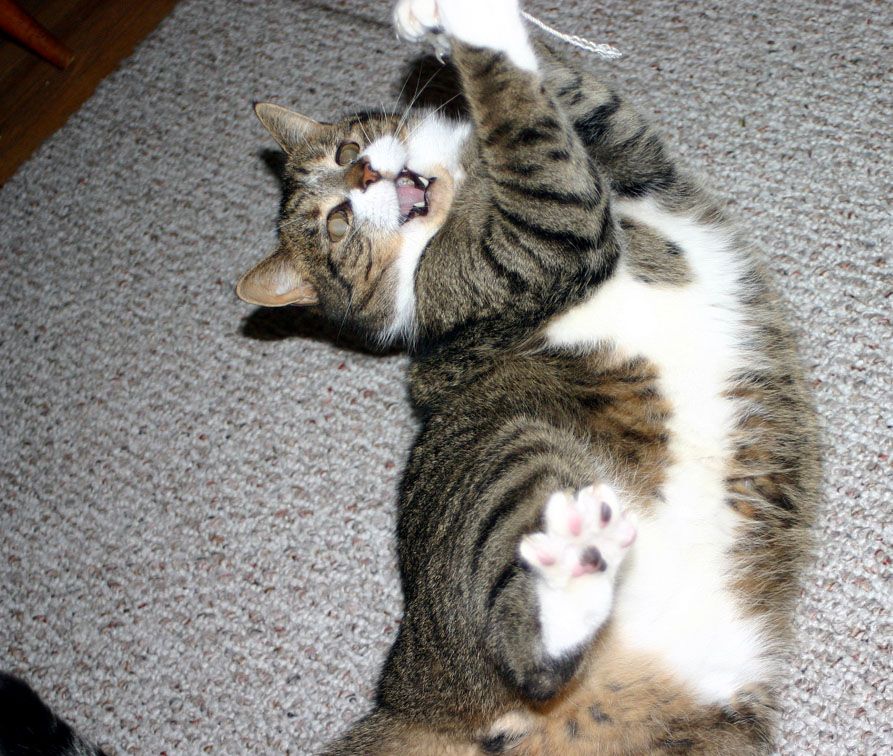
My cat, Mr. Misi, displays his inner killer

"Conspiracies Don't Kill Birds. People, However, Do.," the title of a recent piece in the New York Times declares. The article reports that US Fish & Wildlife research shows that "some of the biggest death traps" for songbirds in the United States are the jaws and claws of domestic and feral cats. The author dubs the USFWS finding "surprising," but it shouldn't be. Folks surprised by this report are either innocently ignorant of wildlife (and of the wild within the lives we've tenuously domesticated) or they willfully deny the ambivalent violence that animates so much life, cat, bird, and human included.

Read the NY Times piece, then revisit "i taut i taw a putty tat," an HH post from April 13, 2005, in which I discuss some of the realities of cat predation and make it clear that, though I'm a cat lover par excellence, our nation's songbirds, small mammals, and reptiles need us to stop playing favorites.

Photo credit: Hungry Hyaena, 2004

Thursday, May 14, 2009

A Thursday in the Holocene


Over dinner this Tuesday evening, a friend and I discussed our species' more homogeneous future. I suggested that miscegenation and intercultural activity will lead to future generations comprised of individuals that look and act more alike. In turn, violent conflict between human groups will decrease; in this world of mutts, superficial differences such as race and custom will be less visible and therefore less contentious.

My friend shares my hopeful outlook, but expressed skepticism. Citing the Rwandan genocide and the fractious political situation within Israel, he contended that greater physiological and sociological similarity are just as likely to increase conflict. Humans will always find some reason to fight, he believes, and superficial similarity will lead not to a peaceable kingdom, but instead to the exacerbation of subtle differences or the outright invention of philosophical or genetic justifications for the vilification of "the other." I can't dismiss his forecast, but if Homo sapiens sapiens survives long enough to witness that homogeneous era, our species will have learned a great deal more about cooperation. This, I feel, bodes well for the less violent prospect.

But what-if suppositions about the far distant future are of little practical value to the here-and-now. I have faith in teleological eudaimonia, but the lot of Earth's inhabitants won't gradually improve unless our policies and actions are informed principally by consideration of a more immediate future...say, one or two generations. And, although it will be a thousand years, at least, before miscegenation makes all humans mocha, our planet's ecology is right now undergoing drastic changes.

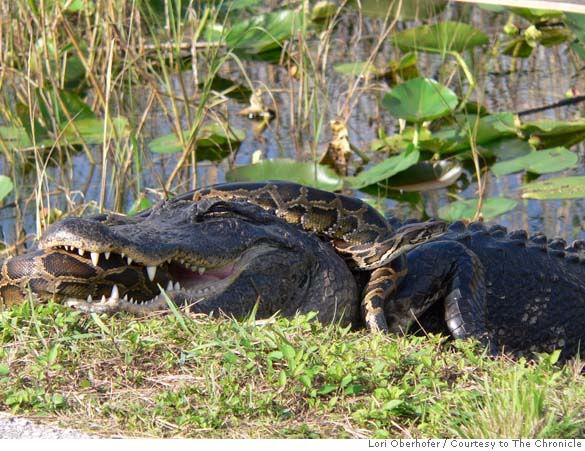
Burkhard Bilger's "Swamp Things" (The New Yorker, April 20, 2009) highlights the explosion of "invasive" species in Florida. Bilger focuses particularly on the success of the Burmese python (Python molurus bivittatus) in the Florida Everglades, but notes that a great variety of exotic species have gained toeholds in the state.
"Florida now has more exotic lizard species than there are natives in the entire [American] Southeast. On a single tree you could conceivably find plants and animals from six continents, including parrots from South America, mynah birds and Old World climbing ferns from Asia, vervet monkeys from Africa, ladybird beetles from Australia, and feral cats from Europe, via Africa and Asia. In some cases, the recent immigrants would be more genetically diverse than their cousins back home. The state's ecology is a kind of urban legend come true -- the old alligator-flushed-down-the-toilet story repeated a thousand times with a thousand species.

Some find all this thrilling. Florida has become an open-air zoo, richer in species than ever before. To others, it's the harbinger of a new and depressingly undifferentiated age, when the old biological borders begin to fade and every place starts to look like every other. Ecologists have even given it a name: the Homogecene."
Indeed, the Homogecene may soon overtake the Holocene.

Note: The post's title is a nod to Christopher Cokinos's terrific essay, "The Consolations of Extinction" (Orion Magazine, May/June 2007). In it, Cokinos
"[suggests] that our PalmPilots and DayMinders and Nature Conservancy calendars show not only year, month, date, and day of the week but also geologic epoch. It’s a Tuesday in the Holocene."
Photo credit: Burmese python and American alligator, copyright 2008, Lori Oberhofer, National Park Service

Thursday, October 30, 2008

A morning in Athens Square Park


I claim a slat bench in the northwest corner of Athens Square Park, place binoculars in my lap, and enjoy a sip of coffee, purchased at a nearby 7-Eleven. The Japanese-owned chain convenience store was introduced to New York City just three years ago and, despite its suburban associations, has quickly spread throughout Manhattan and the boroughs. The neighborhood bodegas must learn to compete, or they will soon go the way of the dodo.

Another "invasive" colonizes Athens Park. House sparrows (Passer domesticus) chitter tirelessly in the lower branches of the park's London Planetrees (Platanus x acerifolia). Like most Americans, these birds trace their origins to the Old World. The species was introduced to the United States from Britain in the mid-19th century. Also called English sparrows, the adaptable and hearty birds are now abundant over most of the globe, particularly in urban locales.

Saturday, October 20, 2007

Gallery Report: October 17th, 2007

Jill Greenberg at ClampArt


Jill Greenberg
"Untitled #7"
2006
Archival pigment print
Edition of 7
80 x 43 inches

ClampArt: Few animals possess more totemic significance than the bear. For many hunter-gatherer peoples, the bear was the supreme incarnation of Nature. But today our encounters with members of family Ursidae are contrived: we watch polar bears dully divert themselves in a zoo compound; our circuses doll up black bears in tutus and fezzes; we place cuddly, stuffed teddies in our infant's crib. Contemporary humans have enervated the animal, but the power of an enraged bear and her long, annual slumber are no less awesome or mysterious.

With "Ursine," Jill Greenberg gives these proud animals the celebrity treatment - the photographer specializes in the sort of hi-contrast, saturated images we see on billboards or in advertisement-thick glossies - but her photographs capture a range of expression in the faces and (pardon the pun) bearing of her subjects. The grizzly bear pictured in "Untitled #7" the strongest photograph in the exhibition, rears up his hind legs and lets loose a growl from a gaping, intimidating maw. Admiring those yellowed teeth, the moistened, fleshy lips, and the mottled tongue, I can almost smell the stench of being. No tutus for this fellow; this is the bear restored, a benevolent monster of the human unconscious.


Jill Greenberg
"Untitled #4"
2006
Archival pigment print
Edition of 7
43 x 50 inches

+++++

Patte Loper at Lyons Wier Ortt Gallery


Patte Loper
"We Had Pierced the Veneer of Outside Things and Scattered into a Diaspora of the Amazing"
2007
Oil on paper
80 1/2 x 58 inches

Lyons Wier Ortt Gallery: The paintings and drawings in Patte Loper's exhibition, "A New Way North," are technically commendable but lack emotional or intellectual substance. The flat, photographic color and ugly architecture featured in some works - "Glorious Predators of the Natural World," for example - are objectionable. To be fair, this may be the artist's intention. The press release informs readers that "Loper explores the pictorial and cultural intersection of glamour, modernism, cold war paranoia, and alienation." But Loper's work remains too indebted to the source material; no new life is breathed into these spaces or events through Loper's "appropriation and reproduction."

One painting, however, is exempt from such criticism. In fact, the strength of the exhibition's centerpiece, "We Had Pierced the Veneer of Outside Things and Scattered into a Diaspora of the Amazing," is what compels me to so harshly critique the other works Loper includes. "We Had Pierced..." outshines its siblings, much to their detriment.

In the painting, a large white-tailed deer (Odocoileus virginianus) rests atop a dark, Antarctic outcropping. In a glacial valley beyond, we see a partially snow-covered geodesic dome, presumably occupied (or once occupied) by human researchers. The title of the painting and the dome's construction call to mind the scientific optimism of the mid-20th century and the promise of the future. We now hold that promise in low regard and the optimism has evolved into unrestrained globalization, bringing with it the accelerated transport of contagions and so-called "invasive species," those creatures transplanted in new lands that are able to find a foothold, often displacing native niche specialists in the process.

The deer appears in all of Loper's works, included, according to the artist, "to interrupt narrative expectations," but in the case of "We Had Pierced..." the deer's presence raises questions about the work of the scientists below. Whoever lives (or lived) inside the dome "belongs" to this remote place now, as does the deer. This wasn't always so. The humans and the deer have come to this location (or were brought), and so the landscape is altered, but to what end? The slow groan of geology cradles the new inhabitants. All remains in flux. Loper's painting is a tribute to Nature's awesome compass and to our species' relative insignificance (both physical and temporal). It is as celebratory as it is ambivalent.

+++++

Keith Tyson at Pace Wildenstein


Keith Tyson
Detail of "Large Field Array"
2006 - 2007
Mixed media
Dimensions variable

Pace Wildenstein: Keith Tyson's "Large Field Array" is an exceptional work, deserving of many return visits. Though I have thought about the installation a great deal these last two days, everything I write fails to convey the work's dynamism.


Keith Tyson
Detail of "Large Field Array"
2006 - 2007
Mixed media
Dimensions variable

For all of its color, its scale, and its varied concepts, the viewing experience is a quiet, internalized one. "Large Field Array" is a polymath's revery, a virtually inexhaustible field of potential poetic connections. Tyson's worthy raison d'etre, the "joyful exploration of how everything in the world is connected," has impelled him to oversee a project that is much more than he could have hoped for. The European curator Hendrik Driessen is quoted in the gallery's press release, saying "it is a truly generous work of art." Indeed it is. In a more comprehensible, less globalized world, the work would be considered a masterpiece.

+++++

Photo credits: Jill Greenberg images courtesy ClampArt, New York City; Patte Loper image courtesy Lyons Wier Ortt; Keith Tyson images, Hungry Hyaena, 2007

Wednesday, December 07, 2005

Banging My Head Against The Wall

This Sphere post provides yet another example of animal rights proponents getting their science wrong and, in doing so, giving their legitimate concerns a bad name.

Monk parakeets (Myiopsitta monachus) are not native to Long Island and, though I have some reservations about our war on alien/introduced animal species, any respectable wildlife biologist will tell you that the birds represent a threat to Long Island's biodiversity. Apparently, Friends of Animals doesn't care about the other species that may be adversely affected.

But even if you excuse the wrong-headed scientific stance of the group, their leader's absurd claim of "victory" is a classic example of dumb-dumb under-achievement.

Just click on over to be baffled.

Monday, July 18, 2005

Long Island


I spent this past weekend in Northport, Long Island, visiting friends. It was a pleasant getaway. Like my recent trip to Washington, D.C., however, this weekend escape made my dissatisfaction with New York City living more acute.

My father spent a good deal of his youth on Long Island. In the 1940s and 1950s, when the island peninsula's many small towns were buffered by undeveloped land, he would break down his shotgun, place it in his bike basket and pedal his way to the local landing. He hunted ducks in the tidal marshes and fished in the sound.

Today, little of Long Island remains undisturbed and few residents are philosophically or professionally attached to the land. Like northern New Jersey and southwestern Connecticut, suburban sprawl has claimed much of the island. The effects of sprawl extend beyond habitat destruction, perverting the perspective of everyone who grows up among the 7-11s, subdivisions and cinema multiplexes.

My friends and I crashed a party comprised mostly of born-and-bred Long Islanders. Several of the guests talked excitedly about real estate, property taxes, SUVs and Florida retirement. I felt as though I'd walked into a Todd Solondz film.

When I commented to the host that the view from her second story patio, surrounded on three sides by tall trees, was pleasant, she replied, “I hate nature. Pave it all over and the world will be a better place.” I smiled at her and waited for a knowing wink or some other signal that she was joking. None came. After some long seconds she resumed the cheerleading conversation she was having with an old friend. “Be Aggressive! B-E-Aggressive!,” they shouted between laughs. Shocked into a brooding, drunken silence, I excused myself. “Material Girl” was playing on the stereo and the host’s sleepy five-year old daughter was half-watching ”Finding Nemo” on the television.


Fortunately, suburban ugliness has not claimed everything on Long Island. I enjoyed my visits to area parks. On Saturday morning, my friend Philip and I wandered around a salt water estuary near King’s Park. I was happy to see great egrets (Casmerodius albus), snowy egrets (Egretta thula), herring gulls (Larus argentatus), killdeer (Charadrius vociferous) and bank swallows (Riparia riparia). Even the invasive mute swans (Cygnus olor) were a welcome sight (though I still advocate extensive control measures given their destructive tendencies). A striper (Morone saxatilis) fisherman crossed over a small island as he waded to shore, sending several unidentifiable plovers scurrying. On a nearby mudflat, clams and mussels betrayed their location by shooting geysers of water high into the air as they burrowed beneath the surface to feed. Taking all this in, I felt good about life.

After an hour spent walking the beach, Philip and I moved inland and entered King’s Park, proper. This park was, until 1996, a psychiatric facility. Wandering the abandoned grounds is eerie but pleasant. There is a strict prohibition on photography (made explicit by a grounds keeper), but Philip and I did peek through some broken windows to study the buildings’ interiors. One can’t help but imagine these decaying rooms as they once were, filled with patients, many of them shell-shocked members of the “greatest generation."

In a few years, these buildings will all be destroyed and King’s Park turned into a luxury condominium development. No longer will area teenagers slip into the abandoned buildings at night to drop acid, smoke pot and spray-paint “Get Blunted” on the walls. Such is progress.


Cinnabar-red Chanterelle (Cantharellus cinnabarinus);
identified by Garrett Herth


Sunday morning, walking on a trail closer to my friends’ apartment, we came across some grape vines that were infected by two different types of parasite. One parasite I later identified as grape phylloxera (Daktulosphaira vitifoliae), a common parasite that leaves circular, whitish-green galls, a type of sore or growth, on the leaves, but only rarely does serious damage to the plant. The other parasite is pictured below. It was later identified [by Garrett Herth in February 2008] as a Grape Tube Gallmaker (Cecidomyia viticola).


On the Long Island Rail Road return trip, I had the misfortune of sitting in a car with a screaming baby. The mother was determined to ignore the baby's wails, a technique I usually advocate, but after five minutes of uninterrupted howling, I began wishing that she'd adopt a new tactic. Fifteen minutes later, I abandoned my efforts to read and instead studied the passing towns, each of them indistinguishable from the last excepting the name on the water tower.

I recalled the spike-like parasite on the grape leaf. How remarkable the evolution and success of such creatures! How admirable, if disturbing, is the lifecycle of a nematode or tick! The baby continued to cry. As we neared New York City the buildings grew taller and the advertisements larger.

Photo credit: all images, Hungry Hyaena, 2005

Wednesday, May 18, 2005

Predators in Penang...and elsewhere


The short missive below was brought to my attention by HerpDigest, an email newsletter devoted to herpetology. Originally, the article was published in a newspaper printed in Penang, Malaysia (pictured above). I can find no link to the article, so I've pasted the text below.
“Breeding Ground For Snakes”
Monday, May 09, 2005, Penang, Malaysia

A vacant piece of land in Penang has turned into a breeding ground for pythons and cobras, endangering people's lives.

The site, at the junction of Perak Road and Macalister Road, is now covered with bushes and weeds and the residents nearby are now living in fear. Resident Teh Boon Seng, 42, said the owner who used to come yearly to clear the weeds failed to do so this time around. He said he had seen pythons and cobras in the area.

“Recently, I called the Fire and Rescue Services department to catch a huge python which crawled out from the site,” he said. “A few days ago, a cobra crawled into my house. We are now having sleepless nights,” he said at a press conference arranged by Komtar state assemblyman Lim Goon Soon recently. Lim said he had told the landowner four years ago to put up proper enclosures at the site, adding that the vacant land was once a haven for drug addicts.

“We want the landowner to clear up the mess fast before the snakes bite people,” he said.

There were at least 35 parcels of idle land in his constituency, he said. He urged the owners to rent out the land as parking lots.
Such situations are not uncommon in Southeast Asia, but the last sentence of this article set it apart. I’ve never been a big fan of Joni Mitchell’s song, “Big Yellow Taxi,” in which she suggests we will "pave over paradise to put up a parking lot," but the explicit parallel is jarring. (I prefer a more contemporary damning tribute to sprawl, Modest Mouse’s “Convenient Parking,” off their 1997 EP, Lonesome Crowded West.) What does an increasingly urban demographic mean for green space in our larger cities and towns? More to the point, what does such green space mean for the city's inhabitants, human and otherwise?

Yesterday, I received in the mail a plea for support from The Trust for Public Land. An attached questionnaire was comprised of questions designed to provoke ‘Yes’ replies, thereby encouraging you to pledge money. “Do you appreciate our national park system and wildlife refuges?” “Do you think it important to have wilderness areas in which you and your family can recreate?” “Do you feel our cities and towns should include more public parks and greenways?”

For the past three years, I have considered myself a champion of the wildlife corridor concept, a worldwide conservation measure trumpeted by the so-called “deep ecology” groups; the terrific Wildlands Project is an example. The “deep ecology” movement, and the wildlife corridor push with it, is often dismissed as a pipe dream but, as I see it, the only valid critique is one which focuses on the “inordinate” amount of time needed to construct this “network of networks.” Protecting and connecting all the ecosystems of the United States, much less the world at large, is an undertaking which promises to take years – perhaps centuries – of ugly courtroom battles and litigation. As Stephen Meyer writes in his excellent article, “The End of the Wild,”
“In theory this strategy could reduce the slide of ghosts and relics into oblivion if it could be implemented immediately and universally. It would be a form of global ecological zoning that would significantly lessen the influence of human selection in the excluded regions. Wildlands would enable species and populations to adapt to climate change. As an ecologically centered strategy it is most likely the only approach that could truly reduce the scale and scope of the biotic collapse that is already underway.

Yet the notion that upwards of seven billion people could live hobbit-like with nature is hard to accept. With the right social framework we might have been able to do it modestly in 1304, but not in 2004 and certainly not in 2104. Global society is moving rapidly and inexorably in the opposite direction.

To be fair, advocates of wildlands acknowledge that, owing to enormous social, political, and economic hurdles, their vision would be at minimum a 100-year undertaking. The problem, of course, is that the end of the wild will already be complete.”
There is a more specific and more interesting question, however. Where the towns and cities “touch” the wildlife corridors, how much connection is to be allowed? For example, if species are able to make their way from a designated wildland to a city park, we suddenly face potential threats from unknown invasive species and a surplus of prey species “hiding out” downtown.

I turn here to Reed F. Noss, a biologist closely associated with The Wildlands Project. The following excerpt is taken from his paper, “Can Urban Areas Have Ecological Integrity?” (I can no longer locate this paper online, but it was published in conjunction with the 4th International Symposium on Urban Wildlife.)
"There are 2 potential problems with this 'network of networks' design. One, corridors leading from the more developed zones of the network might funnel exotics and other opportunistic, weedy species into wildland areas. We know that roads and roadsides, for example, are frequent avenues for the invasion of these pests. I predict, however, that the wildlife corridor network is unlikely to facilitate weedy species invasion of wildlands beyond that already facilitated by roads. In fact, well-designed corridors, especially if wide, may provide habitat for predators of these weedy species. In addition, corridor bottlenecks could be used to trap weedy species and possibly reduce their spread.

A potentially more serious concern is that of corridors connected to wildlands or rural areas funneling problematic large mammals into suburban and urban areas. This is already a problem with deer....Following the deer into suburban areas, however, may be a natural predator of deer - mountain lions. Unfortunately, these predators sometimes also attack joggers and other people. Wildlife corridors have been implicated in bringing both deer and lions into Boulder, Colorado which has created some problems."
And so, at long last, I come back to the Lim Goon Soon comment about the need for more parking lots in Penang. Though Malaysian cities are not surrounded by anything resembling the wildlife corridors advocated by the deep ecology movement, the rural and the urban do butt up against one another in a more explicit fashion than they generally do in the western world. The boundaries blurred, predators passing through a town or city are that much more likely to take up residence in the vacant lots.

So what is to be done? Is their a solution that allows for all parties to be represented or must we “pave over paradise” to quell our fears? For my part, I feel that predators (whether lions, bears, or cobras), living in close proximity to humans need not be a problem. If people were more willing to live alongside other species – a tolerance developed over several generations – safety precautions and sensible behavior would result in less conflict between man and beast. If a mountain lion (Puma concolor) has been frequenting your backyard, bring your dog indoors at night rather than allowing Buster to romp unattended. If a large Great White shark (Carcharodon carcharias) has been repeatedly spotted just beyond the breakers, don’t paddle your board out. Unfortunately, less conflict doesn’t mean a cessation of mawlings or snakebites and so the primal fear of predators will remain an issue for many more generations of man. When and if it does vanish, odds are there will no longer be any predators remaining. Modern man continues to repeat the mistakes of the preceding generations: pave it, mine it, milk it, and propagate, propagate, propagate. The recent boom and bust seizures of the economy are merely a time-lapse film of human history.

Photo credit: Penang, Malaysia, Copyright Chris Rouch. 1999-2005

Wednesday, April 13, 2005

i taut i taw a putty tat


This Duluth News Tribune article was published in early March, but was only recently brought to my attention. Apparently a Wisconsin fire-fighter and hunter, Mark Smith, proposed that the state classify free-roaming domestic cats (also called “feral” cats) as an “unprotected” species. If the state were to do so, Felis catus could be legally killed by any hunter in possession of a small-game license.

Smith states, “I get up in the morning and if there’s new snow, there’s cat tracks under my bird feeder…I look at them as an invasive species, plain and simple.”

He's correct. In the United States alone, domestic cats are responsible for the death of hundreds of millions of birds, billions of small mammals and millions of reptiles and amphibians each year. Many wildlife biologists contend that cats are responsible for more extinctions worldwide than any other cause, with the exception of habitat destruction.

Yet my cat-loving friends contest these facts, pointing out that the numbers are “just estimates.” Or they will highlight my willingness to damn the domestic cat when I don’t condemn other superb predators such as mountain lions (Puma concolor) or red foxes (Vulpes vulpes). Estimates are often useful tools but, more importantly, there is a substantial difference between a native predator and the introduced variety. (Conservation-minded Puerto Ricans do not appreciate the mongoose (Herpestes javanicus) presence and few folks on Guam find the brown tree snake (Boiga irregularis) praiseworthy. Other than our association with house cats as just that, there is no difference between it and other feral, introduced species.)

Compounding matters is the protection and attention offered Felis catus. What other predator species has access to a dependable source of food and protection from disease? Also, unlike many other predators, the domestic cat does not demonstrate a marked decrease in hunting desire when already sated. Felis catus is a killer that enjoys the killing.

I grew up on a farm where any cat spotted without a collar fell victim to a .22 rifle. Most of these animals were large, filthy tomcats that had been living feral for months or years, but a few were groomed and well-fed. No matter. On a 300-acre farm designed to attract and protect wildlife, the appearance of an “unattached” cat meant dead or threatened wildlife.

The concept of predator control troubles many people, myself included. The balance is delicate; not every raccoon (Procyon lotor) or fox that a land owner or refuge manager spots should be killed, especially if the animal will not be utilized - eaten, worn - in a respectful manner. But when discussing an “invasive” species, the choice becomes more clear-cut. Why then, does Mark Smith’s Wisconsin proposal engender such an angry response all over the United States, especially when Minnesota and South Dakota already allow such kitty culling?

When I Google the topic, I find a link to this hateful blog. The author writes,
“So Mr. Mike Smith lets make a deal, we will allow open cat season just for you as long as you allow us to have an open season to hunt your ass down."
He also points out, astutely, that "birds can fly away from a bird" (one assumes he meant to write 'cat') whereas a cat has no chance against a 12-gauge shotgun. The writer clearly knows nothing about firearms or the hunting prowess of a cat. No individual seriously trying to kill a feral cat would use a shotgun unless they were confident in their ability to stalk within range, a difficult feat for even seasoned scouts. And, even outfited with a collar bell, a cat will learn to stalk so as not to let the bell ring, until the pounce...and bye-bye, birdy.

On another website discussing the issue, post after post bemoans Mark Smith’s proposal, suggesting we pursue “more humane” ways of controlling the cat population. The most often proposed alternative is a three-step process: live trapping, neutering, and release. Proponents of this approach argue that, within several generations, the feral cat population would plummet as a result. While true, what may be more humane for the cat does not afford other animal species much help – with an estimated 12% of the world’s bird species in danger of extinction this century, such measures do little to help sustain biodiversity – but, more pragmatically, tax payers aren’t very willing to foot the hefty bill for such birth control programs. As a result, The Humane Society of the United States and PETA have been encouraging cat owners to spay/neuter their pets and keep them indoors for years now, but many, if not most, cat owners continue to ignore this advice. On the one hand, then, pet owners are unwilling to take responsiblity for their pets and, on the other, they are unwilling to pay taxes which will help alleviate the problems their negligence contributes to. That's the attitude, America!

The only sound alternative to legalized hunting of cats, as I see it, involves trapping the cats, offering them up for adoption at a shelter (to be spayed/neutered at the client’s expense) and euthanizing them if they are not claimed within a given time. This method is undoubtedly more humane than shooting, as the needle will less often “miss its mark,” and it doesn't put the "murderers back out on the streets," but again we are faced with an intimidating price tag. I'm willing to add a few hundred dollars to my yearly tax burden to help alleviate Felis catus pressure. Are you? (Based on my informal poll at the office today, most people aren't. In fact, my much beloved co-worker tells me her parents' cats, which only come into the house at night, don't kill other animals but more than once every two years. Unfortunately, living in denial doesn't help biodiversity.)

In an ideal world, the hunters interested in shooting the cats would be steady marksman and the country’s biodiversity could be done a great service in a relatively humane fashion – a bullet through the brain or heart is only marginally less humane than a lethal injection. On the other hand, in a truly ideal world, pet owners would take responsibility for the creatures they choose to purchase or adopt, keeping cats indoors and dogs closely monitored while taking care to spay or neuter the animals. In this ideal scenario, we would also learn how to take better care of our own fellow man and approach human population, land use, and economic growth with some degree of thoughtfulness. Oh, wait...those continue to seem like unrealistic short-term goals? Well, then, lock-and-load, because the cat problem is far more pressing than the more socially acceptable white-tailed deer (Odocoileus virginianus) "scourge."

Do not misunderstand. I adore house cats and cherish the good times I have spent with my own (pictured above). Discovered on the side of the road as a kitten, Mr. Misi had not yet opened his eyes when I adopted him. He had to be fed warm milk from a baby bottle and, for those first months, he slept on my pillow, curled in the crook of my neck and shoulder. Would I weep were Misi shot by a hunter? Of course. Would I understand why? Yes. For that reason, Misi is not allowed outside and he was neutered years ago. When he visits a rural area, I put a collar around his neck, making him easily identifiable as a “pet” if he should manage to slip outside.

Note: As of this afternoon, I learn that the Wisconsin public has given the go-ahead for the cat hunting. It will be taken to the state legislature next.

Photo credit: Hungry Hyaena, 2004

Tuesday, April 05, 2005

A Long, But Worthwhile Read

Last Wednesday, I posted "Protect Native Species...Or Die!," after reading about the Native Fish Conservancy's Exotic Fishing Tournament. In that post, I briefly describe my ambivalence about the "invasive" species issue. Chris Clarke, at Creek Running North, read the post and linked to the quoted essay by Timothy Burke. His response is rich with side-tracks - Clarke's brief discussion of the preservationists' "balance of nature" is pointed and fine - and will give you a lot to chew on. Clarke's conclusion regarding "invasives," if you really don't have time to read it, is:
"Not all exotic species are invasive. Origin of the species isn't the issue; behavior is. And though the language some use to describe invasive species is redolent with horrible memory, that doesn't mean we ought to fall into the trap of metaphor. People coming from other places increase diversity, while invasive species decrease it."
And he offers a tidy one-liner regarding the "balance of nature":
"Nature no more 'seeks balance' than a slinky seeks the stair tread on which it happens to stop."

Sunday, April 03, 2005

In Brief: Taxonomy, Natural Selection, "Pets"

Chris, at Organic Matter, offers this thoughtful post about taxonomy, one of my favorite messes. The current debate over species organization is concerned with two possible modes of classification. The Biological Species Concept (BSC) is based on breeding potential (that is, if duck A can make a duckling with Duck B, the two birds are the same species). The BSC results in fewer distinct species, but some biologists insist that it is overly simplified. The Phenetic and Phylogenetic Species Concept (PSC) are based on distinct characteristics, both genetic or physiological; it makes for many more distinct species, but requires an extensive overhaul of the current arrangement. Still other biologists call for a unitary, web-based alternative, a kind of Wiki-taxa open to all users, but designed and funded by an international committee of serious taxonomists. Whatever system biology opts for, confusion is likely to remain constant for a long while. What will such biological debates mean for conservation biology at large? Politicians love simple answers to complex questions; taxonomy, like most sciences, has few simple answers...unless, of course, we fudge the science. (See also Dave Roberts' post at Gristmill.)

+++++

Observable instances of natural selection don't get much better than this. In the November 29, 2004 issue of PNAS (Proceeding of the National Academy of Sciences), Ben Phillips and Richard Shine published this study (unfortunately, you can only read the abstract) on the effect of cane toads (Bufo marinus), an introduced species, on native Australian snake populations. Because the toads are large and toxic when full grown, snakes capable of swallowing the adult cane toad are more likely to be poisoned. Since the introduction of the cane toad in 1935, snake head sizes have been gradually shrinking relative to body size. You gotta love this stuff! Those folks dunderheaded enough to still decry evolutionary theory are also missing out on the fun!

+++++

Are you into exotic pets? If so, you're not alone. With nearly 7,000 tigers kept as pets and only 2,500 remaining in the wild, it's clear that more and more people are bringing wild animals into their homes. As a keeper of multiple pythons and, at various times throughout my life, Northern flying squirrels, European starlings, Eastern box turtles, snapping turtles, and several species of snake, frog, and toad, I understand the desire to keep wild animals in captivity. One can learn a lot about animal behavior and develop a life long love of other species. But I think it cruel in all but the most exceptional cases and, although I'd like to keep a starling or crow again, I view these animals less as pets than as creatures in my care. (Reptiles and amphibians, if reasonably sized, do fairly well in captivity, but I get very upset when I see a reptile owner being careless with temperature/humidity control or mishandling the animal.) Their needs are often specific and unusual and I fear most people purchasing a caracal or kinkajou don't think about long-term commitment; these animals are impulse buys.

I'm reminded of the "Mr. Show" "Sulu the Iguana" skit in which David Cross gets angry at his "pet" iguana for knocking over his bong, beats it to death with an encyclopedia, and then sobs over the reptile's body. Undaunted in his quest to be the most "original" pet owner, however, David buys a "real, live albino boy" to replace the iguana. Funny though it may be, it accurately depicts the selfish impetus of many exotic pet owners.

Wednesday, March 30, 2005

Protect Native Species...Or Die!


“Once caught never returned” is the motto of the Exotic Fishing Tournament hosted by the Native Fish Conservancy (NFC). Participating anglers are encouraged to keep all the "invasive" fish species they catch. The team with the greatest number of exotics wins the $200.00 grand prize. How the angler opts to use the fish is of no interest to the NFC. The organization's press release reads,
“We encourage everyone to treat exotics with reckless, fishing exuberance. If you catch exotics, aquarium-keep them, grill them, feed them to your pets, turn them into fertilizer. Do anything except return them to their former homes.”
Wow.

I believe that the human contribution to the contemporary, epic loss of biodiversity is a sin (of a decidedly secular variety). Fewer species translates into less genetic, dietary and behavioral variety, making it that much more difficult for Nature to adapt in the future.

Nevertheless, when I first read about the Exotic Fishing Tournament, I cast nervous glances at my fellow subway commuters, worried that they might notice the, um, "material" in my hands.

As Timothy Burke (Easily Distracted) writes,
“I do wonder about that attitude a bit, not just in the context of fishing, but as a whole. When I read some of the material on the dangers of invasive species, its rhetoric and tropes sometimes seem uncannily familiar, reminding me very much of ideas about race, miscegenation and nativism in modern colonialism, in post-colonial nationalism, and in identity politics. There’s some similar desire to stop the forward motion of change, to fix environments (human or natural) in their tracks, the same suspicion of dynamism. What is particularly striking to me is that the arguments against 'invasive species' even from scientists sometimes seem not so much technical or scientific (when they are, they usually rest on the relatively weak assertion that there is a burning necessity for general biodiversity that trumps all other possible principles of ecological stewardship) but mostly aesthetic.”
Excepting my belief that greater biodiversity does make for a healthier ecosystem, I am in total agreement. Strangely, I do not find it uncomfortable to occupy such an ambivalent position. I argue stridently for both sides of the coin, perfectly content in my hypocrisy. To better explain myself, I turn to the conclusion of an old artist statement.
“My own opinions and arguments are flawed, of course. Nature is not a comprehensible entity; she is indifferent to humanity. Given the burgeoning world population and our reluctance to consider serious action, it is naïve of me to think it possible for humanity to live in a truly sustainable fashion. Simply because an ideal is unattainable, however, one need not abandon it. In fact, acknowledging contradiction can better serve the individual; in a world increasingly consumed by ambivalence and captivated by cleverly marketed distractions, we must accept some degree of contradiction in order to further progress. We can aim for sustainability only if we accept the complexity of the task. In essence, this is the stuff of art – a flawed platform with no up or down, no east or west, on which to build the self and, in turn, shape objects to explain the proposed self. Art reveals the private obsessions of the psyche and better expresses the individual’s inner fragmentation, a consequence of the ideal being at odds with the real.”
As the quote suggests, the flawed platform is as applicable to conservation as it is to art making. Some degree of relativism is necessary when considering invasive species. For example, zebra mussels (Dreissena polymorph) and European carp (Cyprinus carpio) are greater threats to biodiversity than multiflora rose (Rosa multiflora). All three are exotic/invasive species, but we need not raise an uproar about the latter species.

I hope many of the anglers participating in the Exotic Fishing Tournament treat their quarry with respect. Throwing away or otherwise mistreating fish of any species is wrong but, given the nature of this affair, the celebrated waste would be that much more unsettling.

Photo credit: WorldWar2History.info

Thursday, March 17, 2005

Moth Eaten Science

It seems like some biologists still haven't learned their lesson. Fighting one invasive species by introducing another almost always results in some unforeseen problem.

In the coming year, the U.S. Department of Agriculture's Invasive Plants Research Laboratory in Fort Lauderdale, Florida plans to release 20,000 Austromuscotima camptonozale moths. This species is native to Australia and the caterpillar stage of the moth feeds primarily on the Old World climbing fern (Lygodium microphyllum). This fern, native to southeast Asia, is thriving in Florida, "explosively spreading" through "suburban backyards to remote locations in the Everglades." The USDA biologists believe the caterpillars will keep the fern under control and insist that the moth "doesn’t have a similar appetite for the native U.S. plants it might encounter in Florida and nearby states."

Even if this wishful thinking should prove true, what of the effect that the moths, sure to thrive given Florida's climate and food supply, will have on predators in the region? Bats, lizards, and small mammals are sure to be affected by the introduction. Something tells me all the possibilities weren't considered. Hell, even if a conscientious USDA white coat did try to think of every possible variable, it is nearly impossible to do so.

Again, if you have the Science News subscription, check here. Unfortunately, I could find no other links to this story.

Wednesday, March 16, 2005

A Eats B, Increasing C

In a recent issue of Science News, S. Milius reports on an "indirect effect" observed in many California bays. An invading species, the European green crab (Carcinus maenas), has decimated two native shellfish populations (both Nutricola sp.). The Nutricola crash means less competition for the eastern gem clam (Gemma gemma), a marginal invader that has lived in the bays for decades.

The gem clam arrived in California a century ago, transported there by the oyster shipping industry. Although an exotic species, eastern gem clams were considered harmless in San Francisco Bay. Now, however, with the Nutricola population crash, gem clam populations are exploding.

Froom the article:
"[Edwin Grosholz (Univ. of California, Davis)] found that the gem clams grew only half as fast in crowds of native clams as they did in dense colonies of their own."

"This isn't the first example of a new invader triggering a population boom in a previous invader, says Dan Simberloff of the University of Tennessee in Knoxville. 'But this was a particularly nice one.'"
If you happen to subscribe to Science News, you can access this link.
If you want more details on the west coast invasion by the European green crab, click here.

Sunday, March 13, 2005

Make Me A Mutt


Every blogger with an interest in sustainability and conservation will certainly be making some reference to Nicholas Kristof’s March 12th op-ed piece in the New York Times. I’m no exception.

Kristof’s conclusion that Michael Shellenberger and Ted Nordhaus, co-authors of “The Death of Environmentalism,” are right, that “modern environmentalism…must die so that something new can live,” is bound to provoke vitriolic response from many folks with “greening” on their mind. (Dave Roberts, the usually thoughtful assistant editor of Grist Magazine, calls Kristof’s article a “lazy, risible piece of sh*t.”)

I’m electing to take the middle road on this one. For every informed environmentalist, there are at least three ignorant screamers. Both sides (if the situation must be reduced to such black-and-white perspectives) know this to be true, and, more importantly, we have all been one of these screamers at some point, no matter how informed we may be otherwise.

Allow me to use myself as an example. I used to rant about the urgent need for blanket prohibitions on the importation of any wild-caught exotic reptiles and amphibians. Further, I insisted that states should require permits, obtained upon completion of a basic training course, for private reptile or amphibian ownership. My reasons were valid: I had grown tired of seeing “pet” reptiles and amphibians improperly cared for and exotic introduction (consider the Burmese pythons currently thriving in Florida’s Everglades) is more likely when dealing with “fad” herp owners, those that think a snake or lizard will be a “cool pet” but soon become bored by a relatively sedentary animal.

Yet, after considering the issue for several years, I no longer think prohibition a wise idea. Economic incentives overseas, in the form of local breeder farms and conservation projects in heavily pressured areas, and restricted foreign breeder partnerships seem a more sound response to the problems caused by the burgeoning interest in herpetoculture. (Of course, this won't prevent a negligent owner from releasing an exotic locally and I still favor a permit system for large or venomous herp ownership.)

So I changed my mind; I still want the same end result, but the means I now think best are notably different. This wouldn’t be a problem if I hadn’t been so eager to hop on the soapbox when I was calling for prohibition. Now, despite my current attitudes being more nuanced and informed, I am what some dub a “flip-flopper.” But flip-flopping is not always bad. It proves one is engaged and considerate. Unfortunately, it can also be cited as a weakness.

What does my flip-flopping have to do with Kristof’s criticism of the environmental movement? In his editorial, Kristof writes,
“The fundamental problem, as I see it, is that environmental groups are too often alarmists. They have an awful track record, so they've lost credibility with the public. Some do great work, but others can be the left's equivalents of the neo-cons: brimming with moral clarity and ideological zeal, but empty of nuance.”
He is right. Too often we opt to bang the table and throw a tantrum, presumably operating on the maxim, “Make enough noise, and they will come.” Jared Diamond, a contemporary hero of mine, correctly suggests that being an alarmist is better than not alerting others to the burning building, but the fact remains, alarmists are annoying. Taking the extreme position - the championing of wind power and denial of related criticism, for example – virtually guarantees you will be deemed wrong in the end. If you tell someone that drunk driving will surely result in their death and they drive off a bridge and nearly drown, they’ve proved you wrong by surviving the terrible accident. Your ultimate point, that drunk driving is stupid, dangerous, and wrongheaded, is true...but, technically, um, you said he would die.

Don’t think for a minute that the “other side” won’t hold us to our word. “Global cooling” is still pilloried by the neo-cons and energy industry spokesmen. If you try to explain that “global cooling” and “global warming” are essentially descriptions of the same phenomenon, you’ll get nowhere fast. The dire forecasts made by meteorologists in the 1970s didn’t materialize. Neither did Paul Ehrlich’s population predictions. Now Kristof cites these as examples of environmentalists crying wolf. Technically, he is correct, but global climate change and population pressures remain serious threats to the health of society and biodiversity.

The challenge that the environmental movement faces now, just as it did thirty years ago, is one of image. The Pew Research Center statistic Kristof cites is encouraging; 3/4 of Americans polled agree that environmental protection is vital. With that sizable majority in mind, it may not be necessary to throw tantrums. Reasonable, determined methods will serve the movement well. In environmentalism, like anything else, contradictions abound. Rather than dogmatically championing every device or idea that comes out of the green camp, we should fully consider each and push for thoughtful action as a diplomat would.

As Garret Keizer writes in his recent essay, “Life Everlasting,”
“We can dare to walk on this ground of dubious footing, because we are holding one another up as best we can, and because it is we ourselves and not some deterministic logic that writes our civil laws…We can sniff out our options and pick and choose among them, a birthright generally less appreciated by a dogmatist than by a dog.”
Photo credit: Superdog Inc, copyright 2003

Tuesday, March 01, 2005

Edward Hoagland, invasive species and a beginning


On my commute to work this morning, I finished reading Edward Hoagland's Tigers & Ice. I admire Hoagland for his beautiful prose and life well-led, and the collection of essays was a pleasure to read.

Hoagland bridges the divide between conservation and preservation. He begrudgingly accepts change and understands that the sustainability movement must strive to ensure environmental health without neglecting the human animal. Like most of us, though, he is loathe to see the landscapes he cherishes fade or vanish.

The preservationist urge is rooted in nostalgia and fear. These feelings are natural, but not entirely wholesome. The current furor over invasive species is a good example. Although introduced or "alien" species often wreak havoc in their adoptive ecosystems, every species qualifies, at one time or another, as an "exotic." When the northwestern islands of Hawaii first rose from the ocean floor five million years ago, they were barren, volcanic rock. Every species that we now consider "native" to Hawaii migrated to the island chain, or else was carried there by currents and happenstance.

Like humans, most species appear in one locale and, if successful, radiate outward over time. With this in mind, it seems rather xenophobic to patrol our borders and wage war against "the invaders." On the other hand, biologists rank the worldwide invasive species problem second only to habitat loss in terms of negative environmental impact. (In terms of biodiversity, it may be even more destructive; exotics are often trophic generalists, allowing them to displace the trophic specialists.)

At any rate, I'm sure there will be much more written about invasive species in future HH posts. The subject is one of many contemporary conservation concerns I would like to mull over in this forum.

I am an artist, so readers can also expect to see regular art postings.