Showing posts with label religion. Show all posts

Wednesday, September 18, 2013

Snapshots From Home Ground Chapbook

Snapshots From Home Ground Chapbook, 2013

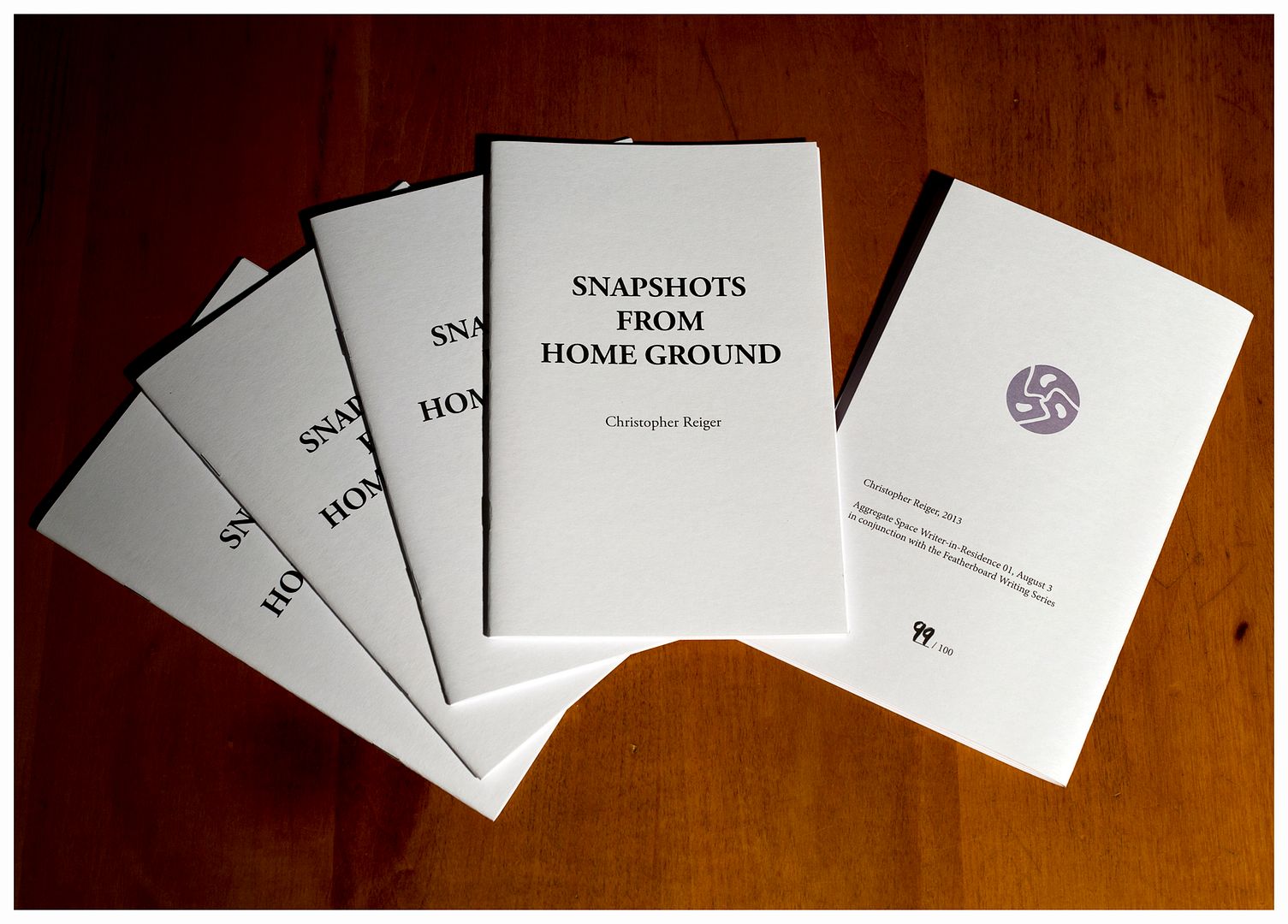
Snapshots From Home Ground, the limited edition chapbook I produced in conjunction with the Aggregate Space Writer-in-Residence and Featherboard Writing Series, was released in early August 2013. A meditation on my rural upbringing on the Eastern Shore of Virginia, the book is comprised of eight vignettes and a selection of photographs taken by either me or my father.

Copies are available through both Aggregate Space and Featherboard. (I also plan to release a free e-chapbook version later this year.)

Below, I've published "Good Boy," the chapbook's opening sketch, and also include a number of "snapshots" of book spreads.

Thursday, September 12, 2013

The Sin of Being Realistic

In conjunction with the Jewish new year, I read a litany of "sins" we Jews must repent for on Yom Kippur. One of them had special resonance, both personally and universally.
"For the sin of being 'realistic' when our tradition calls upon us to transform reality."
I like the formulation, even if the "realist" in me balks at what remains unaddressed. After all, while it's certainly true that realism too often begets apathy and the maintenance of the status quo, it's also true that idealism sometimes begets rigid ideology and violence. Perhaps, then, tempered idealism is the best proposition, a virtue that will allow us to continue to struggle toward the horizon (and beyond)?

Whatever religion, philosophy, or ethic you subscribe to (or react against), our collective human aspiration calls on us to improve the lot of the whole. Here's to our keeping on keeping on, together.
View of Little Diamond Rim; Tonto National Forest; Arizona; August 2013

Photo credit: Christopher Reiger, 2013

Tuesday, October 02, 2012

Picturing Awe

Frame from "Wind Map"
Martin Wattenberg and Fernanda Viegas

Last night, I attended the second presentation in this season's Art, Technology, and Culture Colloquium series at UC Berkeley. Martin Wattenberg and Fernanda Viegas, artists and researchers who often work as a team, presented "Visualization and the Joy of Revelation," an engaging survey of their greatest hits (to date) supplemented by tidbits about their process and working philosophy.

From the ATC listing:
"Fernanda Viegas and Martin Wattenberg explore the joy of revelation: the special electricity of seeing a city from the air, of hearing a secret, of watching a lover undress. Their medium is data visualization, a technology developed by computer scientists to extract insights from raw numbers. They'll show what happens when this technology is aimed at data sets that range from tropical storms to social networks, from arguments on Wikipedia to expressions of carnal desire."

Thursday, February 16, 2012

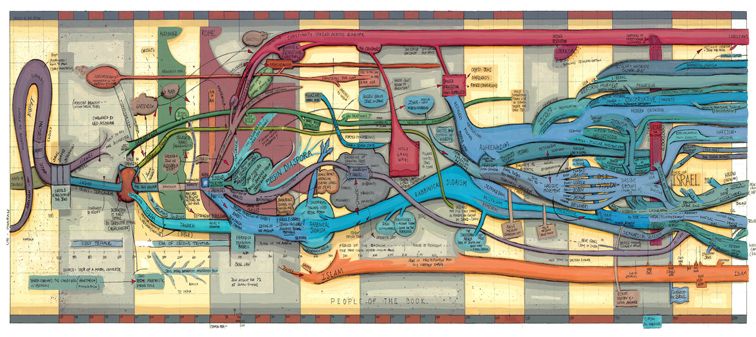
"Unreliable Narrator": Ward Shelley at Pierogi

Ward Shelley
"People of the Book"
2012
Oil and toner on mylar
36 x 75.5 inches
Writing about Ward Shelley's 2009 Pierogi Gallery exhibition, "Who Invented the Avant Garde - and other half-truths," I compared his colorful schematic paintings to taxonomic trees.
"[Shelley's] striking [...] paintings anatomize the development of intellectual and social streams within the humanities. The artist describes them as 'attempts to use real information to depict our understandings of how things evolve and relate to one another, and how this develops over time.'

In spirit as well as in appearance, then, Shelley's paintings are cousin to phylogenetic trees, the taxonomic diagrams that biologists use to denote evolutionary relationships among species. But, though Shelley's genealogies look like mappings of biological exuberance, the subjects of his brightly colored, illustrative works are not so scientific: Frank Zappa; Beat Generation writers; nodes of postmodern philosophy; modern art movements."
Aesthetically speaking, I liked every piece in the show, but the most edifying works were those that considered "significant, sweeping lineages," and I concluded the write-up with the hope that Shelley's lens would broaden.

Wednesday, December 14, 2011

Chesterton's Dragons


Brad Carroway
"Smaug the Magnificent"
“Fairy tales are more than true; not because they tell us that dragons exist, but because they tell us that dragons can be beaten.”

- G.K. Chesteron
I admire the English writer G.K. Chesterton's intellect and curiosity. Today, he's best known for his proverbs, but I appreciate his generalism no less. As his Wikipedia entry details, "[Chesterton's] prolific and diverse output included philosophy, ontology, poetry, plays, journalism, public lectures, and debates, literary and art criticism, biography, Christian apologetics, and fiction, including fantasy and detective fiction." (And I thought I had a catholic disposition!)

Chesterton was independent-minded enough to turn his incisive critique to any subject, including those he held dear, and thoughtful enough to engage in courteous debate with his antagonists (a trait today's intellectual leaders typically lack or deny).

Still, he wasn't perfect; some of his writing is flavored with antisemitism and, by many accounts, his strengthening religious convictions dulled his later criticism. Chesterton was right about the value of fairy tales, but too many brave knights ride off in search of dragons to slay, unmindful of the beasts within.

Image credit: ripped from Fine Art America

Tuesday, September 27, 2011

Finding Unicorns


someguy
"9 Unicorns"
2011
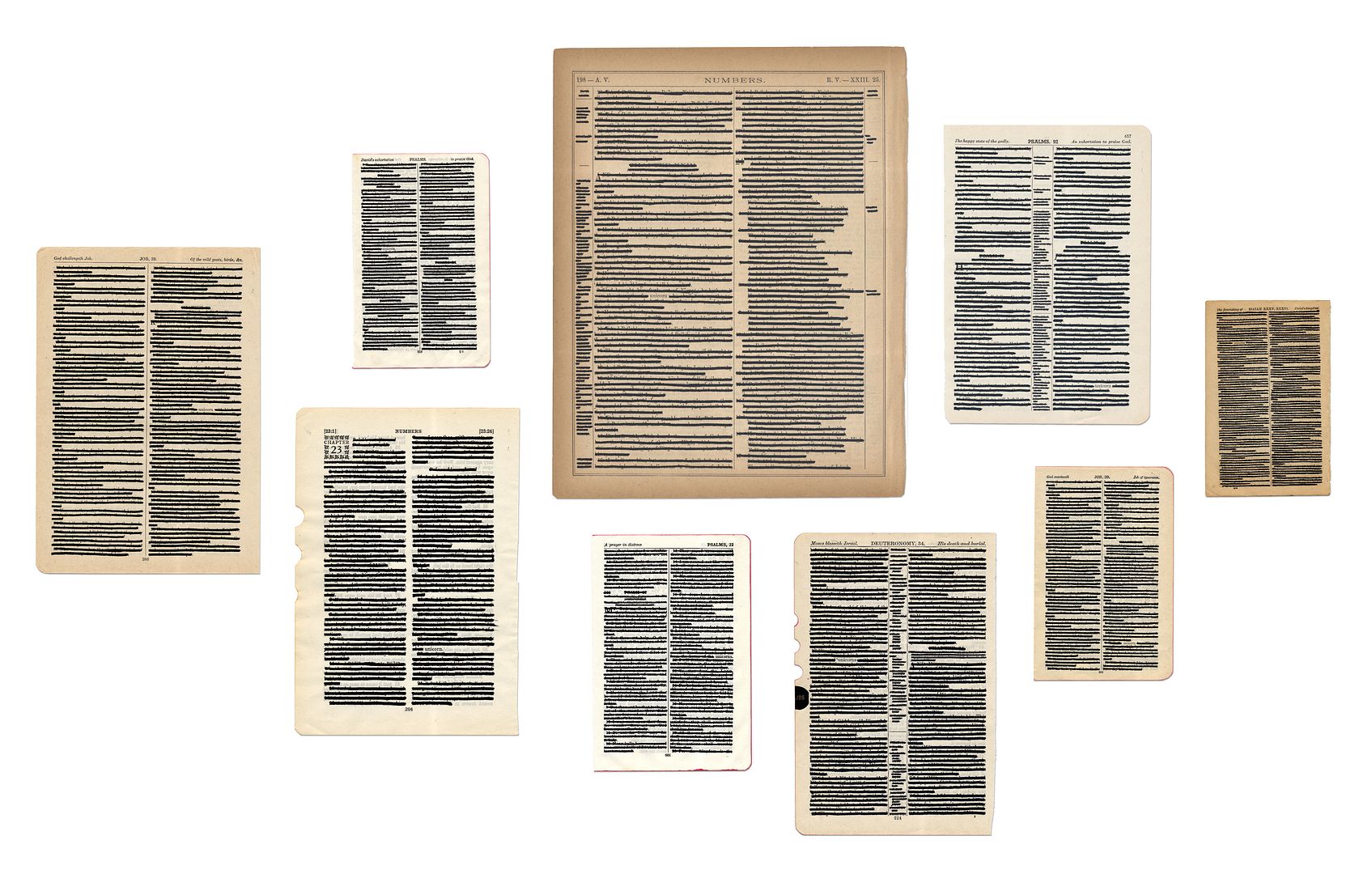
Individual vintage bible pages

Large, juried shows are usually confused affairs. "Proof," the latest rendition of Southern Exposure's annual "entry-fee free juried exhibition of Northern California artists," is no exception. Of the 47 artworks (by as many artists), 5 pieces stand out: Kelly Falzone Inouye's "Tagging Sequence 1"; Robert Larkin's "Original Art"; Summer Mei Ling Lee's "Les preuves fatiguent la verite"; Kate Nartker's "West Main 1984"; and Someguy's "9 Unicorns."

"9 Unicorns," in particular, provided much to mull over. Someguy displays 9 pages from vintage Bibles; on each of these, all text except for the page heading and the word "unicorn" is blacked out. On his website, the artist states, "it's not commonly known, but the Bible mentions unicorns 9 times." I suspect that Someguy intends his handsomely presented editing job as a winking critique of religious literalism. By highlighting the occurrence of the word, the artist reminds viewers that mythological creatures populate the tome that literalists insist is non-fiction and most U.S. president-elects place their hands upon when they're sworn into office. Little girls notwithstanding, most of us are informed and sensible enough to dismiss unicorns as harmless hokum. Why, then, doesn't an overwhelming majority also view the Abrahamic narrative as an epic myth (i.e., fiction)?

Religious apologists point out that the Hebrew Bible makes no mention of unicorns. Instead, readers will find an ox, auroch, rhinoceros, or bison, depending on the edition. These more mundane creatures are indicated by the ancient Hebrew term re'em. The word was first translated as "unicorn" by the Greeks who, between 250 BCE and 100 CE, crafted the immensely important Septuagint, bringing the Hebrew scriptures to the Western world. Still, lest we too hastily ascribe an elevated rationality to the Jews of antiquity, scholars believe that re'em was not meant to describe an ordinary animal. The oral traditions of the Israelites and early Jews spoke of a powerful, monstrous auroch, a creature of gargantuan proportion, large enough to be mistaken for a mountain. Because they were unfamiliar with this monster bull, it's only sensible that the Greek translators and editors of the Septuagint substituted another fanciful creature, one better known to their audience; enter the unicorn.

Point being, the Bible, no matter the translation, is chock-a-block with fantasy. Most epic stories (and especially those with the staying power to warrant inclusion in a sacred narrative) are tall tales. Fictional or exaggerated narrative often pushes reality out of popular memory. The rhinoceros becomes a unicorn and the large crocodile becomes a dragon in the same way that the angler's fish grows through successive tellings; generations after the big mackerel was caught, it's Leviathan. But knowing how unicorns came to appear in some translations of the Bible doesn't justify easy dismissal of the sacred canon. Even for secular culture, the ancient stories are the closest approximation of universal myths, and they have much to offer readers with a critical bent -- much more, in fact, than they afford literalists.


someguy
Detail of "9 Unicorns"
2011
Individual vintage bible pages

But "9 Unicorns" isn't just about the relationship between religious texts and fairy tales; it's also a critique of our postmodern malady. Today, technology and globalization expose us to a heretofore unprecedented quantity of information. As a result, it's progressively more difficult to wrest fact from fiction. As the late Senator Daniel Patrick Moynihan quipped, "Everyone is entitled to their own opinions, but not their own facts." Disappointingly, most of us reject Moynihan's gospel, instead opting to go at our texts with a Sharpie, making of them whatever we wish. This willful shirking of intellectual responsibility is amply on display in the fractious debate about the meaning of the United States Constitution and the legacy of our "founding fathers." Benjamin Franklin, one of those very prophets, smartly observed, "so convenient a thing it is to be a reasonable creature, since it enables one to find or make a reason for everything one has a mind to do."

Someguy's "9 Unicorns" evidences our species' taste for selective reading, subjective "truths," and rationalizations. Ever more interconnected, such an unhealthy disposition can become dangerous. Someguy's piece is a visual fable of sorts, cautioning us to master our appetites.


someguy
Detail of "9 Unicorns"
2011
Individual vintage bible pages


Image credits: all someguy images, courtesy the artist

Thursday, September 15, 2011

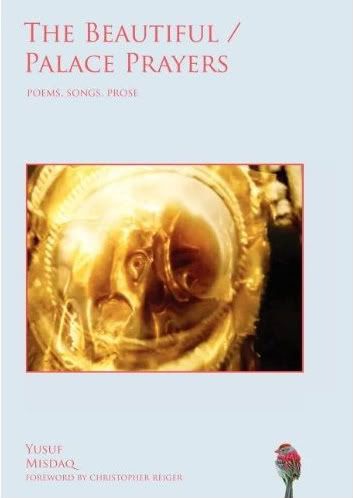
The Beautiful / Palace Prayers

OLD MOONS

Old moons now are dried and crusty
Brittle and as uninteresting as history is
To my fingers and lips.

And yet also, it cannot be denied
That each man
King of his home-throne
Misses something of eternity
When he chomps down on lamb chops
(Which are his reward
For winning the bread)

Each of us misplace the universe
And lose the word
When we get our desires
On plates before us.

There is a grain of rice on the table.
Around it, oil has bled
And spreads

In this way does our egodeath
Halo around us
  And puncture the beauty
    Of clouds
- Yusuf Misdaq

Two years ago this month, I highlighted the poet, musician, artist, and author Yusuf Misdaq's Palace Prayers project. August 21st - September 19th, 2009, was Ramadhan, and Misdaq, a practicing Muslim who, as I noted at the time, "shares my universalistic mystical inclination," created a new work of art for every day of the month-long fast and period of Muslim introspection.

Some months later, Misdaq invited me to contribute a forward to a book of his poetry, prose, and lyrics. That book, The Beautiful / Palace Prayers, was published this year. Visit Misdaq's website for more information.

+++++

"Dissolution Is The Whole Show"

When Yusuf invited me to contribute a foreword to The Beautiful / Palace Prayers, I was at first surprised. Although I enjoy reading poetry, my education in literature is wanting, and my tastes run to work that most "serious" critics and scholars deem pedestrian. Who am I to comment on this young artist's latest collection? With characteristic enthusiasm, however, Yusuf's invitation quelled my self-doubt, insisting that The Beautiful is made up of poems "for normal people who do not normally read poetry." Well, in that case, it is a privilege and a joy for this normal person to introduce a collection of poems, verse, and prose written "for normal people"!

        They are a good species.
        Clean and caring;
        Made mostly of water and forgiveness
              - from "The Beautiful"

Normal people are very much in need of poetry, and perhaps especially so today, when the art is generally neglected. Words are powerful entities, every one an invocation, yet we too often use them carelessly. Poetry, like prayer, can serve as a corrective, reminding us that words conjure meaning and that they have a felt, physical component. As critic and philosopher George Steiner writes, "the meanings of poetry and the music of those meanings...are also of the human body." Appropriately, Yusuf refers to the italicized and apparently random words that he includes in some of his poems as "body echoes." "Carbunkle. Crellis. / Pulse-if. peaces." or "Que Que" are not intelligible formulations but, when read aloud, they aren’t exactly jibberish either. They supply somatic meaning, as do the poems’ rhythms. Yusuf's strongest poetry or verse has a perceptible pulse; in some cases, I notice my head slowly bobbing as I read. This is not insignificant. Beat and rhythm are primal properties, manifestations of the infinite, unfathomable being within which we reside and of which we are composed.

        Echoes
        of the original
        Voice
        From the original
        Breath
              - from "Ramadhan 26"

Ludwig Wittgenstein insisted that earnest philosophers should "descend into primeval chaos and feel at home there" if they expect to produce worthy work. I extend the same requisite to artists. Yusuf draws pictures, makes films, and writes poems, novels, and songs, but he is, above all, a mystic. And mysticism, in its quest to directly experience elemental truths, necessitates Wittgenstein's appreciation of the primeval and the chaotic; ancient disorder is at the root of everything. In most cases, the mystical perspective is merely an uncommon one; mystics survey and respond to the same earthly, material realm that the rest of us do. But they disregard accepted classifications and train themselves to mindfully observe and reinterpret their surroundings. They locate the extraordinary in the mundane. As Henry David Thoreau, a 19th century mystic, lamented, "All this [splendor] is perfectly distinct to an observant eye and yet could easily pass unnoticed by most." Mystics reawaken their capacity for reflective wonder and, in doing so, experience a kind of rebirth into a vaster dimension of human experience.

        On perfect Spring mornings
        God puts a clear blue sky in our pockets
        Pats us a few times and says
        'On your way!'
              - from "The Merciful Cheerful"

So reborn into sublime beauty, mystics strive toward the transcendent. Both Wittgenstein and Thoreau can be described as transcendentalists; Yusuf qualifies, too. Like the two philosophers, he finds in his observations of the world cause for a fundamental optimism. Unlike them, his writing is generally informal and devoid of pretension. His poems give readers the impression of a devout Sufi Muslim happy at play in our waking, sensual dream. In the collection's title poem, Yusuf writes "Awake in this dream / Where abstract clouds calmly keep us. / Where birds secretly make love in public and / Give voice to the current of joy which / Slices through us in a day." Again, in "Back Amongst Men (Drowned)," he references this dreamed life: "Or as I have also interpreted it / .God is a laughing dream." No doubt, the poems’ author, laughing, singing, eyes wide and sparkling, would appear mad to many of his fellows. This is to their discredit. They have forgotten (or failed to learn) how to look. Mystics, like many philosophers and artists, are too easily dismissed as lunatic or eccentric. Yusuf's ability to see through the veil of our cultural forgetfulness informs his aesthetic imagination and invigorates his art.

        Silk veils, dark and weightless
        Are being removed from her countenance
        Time after Time

        Each day I ready myself to know her better
        Each day, closer
              - from "Wahad"

But not all that Yusuf observes is felicitous. The most biting poem included in The Beautiful, "Ramadhan 23: Only To Be With You And No-one Else," is a reaction against the politicization of Islam and a celebration of his intimate relationship with Allah. After rejecting the "bloody bridge builders / Shmoozers or politicians" and others who "come to the Mosque smiling in your suit," Yusuf writes, "I wish to be alone / And serious / And deeper in love / With the only one who ever matters." The striking seriousness of his personal communion with G-d is important; discipline is one of the central currents running through the poems included in The Beautiful. In “Waiting (A Song for Guitar),” Yusuf writes, “I do believe in magic but first you gotta work at it.” Hope and love, he reminds readers, are nurtured through dedicated ritual and practice.

        Understand, thee
        That tenderness comes not of softness
        But of a firmness
        And of a discipline

        Understand that of discipline
        -Say, the discipline of prayer-
        Comes an enjoyment of that same thing.
        Discipline to run breeds a love for running
        Discipline to practice ones instrument brings forth a love
        for playing it
        Discipline to speak good breeds a love of horses
        And love of all refined things
        Whatever you may find them to be.
              - from "Ramadhan 12: The Vows Revolve"

A visual artist, I appreciate the centrality of discipline in a life committed to aesthetics. Like Yusuf, though, I am also mystically inclined. Paintings, sculptures, and other hand-crafted objects are among my adored icons but, if I work at it, I can find occasion for worship in every place, in every form, in every moment. The European starling that paraded on the sidewalk in front of me this morning warranted exaltation. In his iridescent dream coat and brilliant yellow bill, I see cause for startling, smiling celebration. For some other pedestrians, the bird, a representative of a despised species, may be ignorable or irrelevant. For others, my viewing the starling as a manifestation of the Divine amounts to idolatry. So, too, might the dirty, discolored Queens sidewalk be deemed a cement calf by unimaginative or close-minded "believers." Yet, striding on such a sidewalk today, my thoughts range through eons of geologic time to consider the ancient rock and mud, precursors to and components of the concrete that I now tread upon, from which our kind eventually emerged on crude limbs as a gasping, fish-reptile thing.

        The salt-pepper sugar mills on this table look like planets.
        I want to know the word for planet in as many different
        languages as possible.
              - from "Celestial"

Doubtless some of those who consider themselves religious don't share my enthusiasm for our scaled, long-snouted ancestors. But I'm not concerned with narrow definitions of religion. I believe that humility, wonder, gratitude, and communion are the four pillars of genuine religious practice, and the mental stretching engendered by the work of scientists, philosophers, and artists is an integral part of any intellectually rigorous, honest religious life. And, love, too, is a bit like religion. The same four pillars are fundamental to it. As Douglas Thorpe writes, "[love] demands of us a new way of being in our old world." Religious mysticism is a love affair with The All. It's not always easy, but religious attunement can turn each day, each hour, or each instant, into "a new way of being." Reading Yusuf's poetry, I'm reminded that every step is a psalm, every directed gaze is a prayer.

        Dot-Dot-Purple and Palaces
        Says the starling in approximate translation.
        Star-Star-Chandeliers and
        Bread on the wind-ind-ind.
              - from "The Beautiful"

I'm also reminded that we both enjoy watching starlings.

- Christopher Reiger, May 1, 2010

Friday, May 21, 2010

Changes


View of Empire State Building; Manhattan, NYC; May 2009

As I prepare to move from New York City, my home for over a decade, to San Francisco, my home for at least a few years, I find myself viewing NYC through the eyes of a man in limbo. I'm still living in Queens, but my attention is already on the road.


Vacant lot; East Village, Manhattan; May 2008

A decade of NYC living makes me, by at least one standard, an official "New Yorker." How does that define me? New York, like all conurbations, is ever in flux. On my watch, it's changed in remarkable ways. What changes will come after I'm no longer a resident? Likewise, what changes are yet in store for me, a similarly adaptable organism?


Samuel Cohen Son graffiti; East Village, NYC; April 2010

I moved to New York City in October 1999, not long after I graduated from The College of William & Mary. I was then an ambitious twenty-one year old with a deeply cynical streak and an abiding love of beer and partying. My paintings and drawings featured naked people interacting in various ways with other animals, medical instruments, fossils, and, on occasion, Teletubbies. (If a reader knows what became of the big Tinky Winky sex painting, I'd love to see a photo of it!) Despite my apparent enthusiasm, I was steeped in melancholy. I spent hours each week brooding over "I," my pet novel project, a 1990s East Village vampire update of Hermann Hesse's Steppenwolf. I viewed humanity as a noxious species, religion as the most noxious of human inventions, and I not so secretly looked forward to our inevitable extinction.

Today, I'm an ambitious thirty-two year old who reacts against cynicism, drinks much less, and generally dislikes partying. Naked people sometimes appear in my paintings, but there aren't any Teletubbies. I'm a stubborn optimist. Each morning, I take twenty minutes to humbly celebrate a new day; if I wake in a funk, I fight through the fog to see anew just how marvelous life is. I recall my earlier character with some embarrassment. What was wrong with the arrogant kid who labored on a novel that painted such an ugly picture of humanity and religion? Perhaps he just needed to be more intellectually rigorous, and to open his eyes to the awesome fact of being? Or maybe that twenty-one year old also needed a good hug, which is no small thing?


Greenpoint, Brooklyn; May 2009

My time in New York City has seen me metamorphize from a hardened and cynical adolescent into an optimistic, joyful adult. The direction of this evolution runs counter to the standard assumption made about the effect of NYC living. As the columnist Mary Schmich warned (and director Baz Luhrmann popularized with his song "Everybody's Free (To Wear Sunscreen)"),
"Live in New York City once, but leave before it makes you hard; live in Northern California once, but leave before it makes you soft."
In my experience, however, NYC living sanded smooth the hard edges.


Wollman Rink; Central Park; Manhattan; June 2008

Perhaps, too, the mournful and nostalgic wails of NYC residents (myself included) are misguided? We should accept that "what will come, will come" without falling victim to fatalistic impotence. New York City (and Manhattan, in particular) is one of the most sustainable, environmentally responsible cities in the world, and its educated, informed residents should work with New York State and City representatives to make sure the city continues apace on that front. They should also do all they can to ensure that it remains a mecca for tolerance, the arts, and cultural pluralism. In what ways I can, I'll do the same from the Left coast; New York City is a part of me, and I will always feel a part of New York City.

Love and peace to all of my friends here. Thank you for everything. I'll be in touch. I'll visit. I hope that you'll visit me.


Upper New York Bay from Staten Island; May 2008

Image credits: all photography, Hungry Hyaena

Wednesday, April 28, 2010

Revisiting the Steady State Economy

On the heels of not one, not two, but three Republican blockades of financial regulatory legislation in the U.S. Senate this week, I thought it worth reposting the below essay on the concept of a Steady State Economy. The essay was originally posted on HH in April 2005; five years later, there's only that much more reason for thoughtful, comprehensive reform.

+++


Environmentalism is becoming something of a religion. Those who subscribe to most or all of the tenants of the environmentalist doctrine are among the movement’s acolytes, composting and recycling, canvas bagging it and buying organic, living what they consider “healthier,” less “impactful” lives. A thoughtful environmentalist should recognize these actions to be sacraments grounded in a hybrid moral code. “I am doing my part to rectify the mess made by the sinners around me.” How persuasive is this feeling of self-worth and moral superiority? Like all religious conviction, it is undeniably powerful and fulfilling, but it comes at a cost. Too often this fetal “religion” ignores fact in favor of that which is deemed morally superior. For example, radical environmentalists demand a wilderness without humans, ignoring the fact that management (stewardship) is now an unfortunate necessity given our exuberant use of natural resources and our continued sprawl. Reason must enter into the equation. Thoughtful environmentalism of the secular variety is possible, as long as we don’t allow ourselves to become vain.

This brings me to the concept of the Steady State Economy.

I first heard wind of Brian Czech’s Center for the Advancement of the Steady State Economy (CASSE) project a year ago. My initial reaction was positive, though I feared support for the concept would be relegated to left-wing environmental groups of the “religious” variety. Surprisingly, I am hearing the term used with more frequency these days, sometimes by folks with little interest in preserving biodiversity or encouraging ecological sustainability.

I am a proponent of the philosophy (read this .pdf for an excellent summary). The front page of the CASSE website states:
“Economic growth is an increase in the production and consumption of goods and services. It entails increasing population, per capita consumption, or both. Economic growth leaves a larger ecological footprint, causing civil strife and bringing nations into conflict.”
This simplifies, for the sake of dramatic impact, the arguments made by the economists behind the SSE. For me, the heart of the matter is touched on in the following selection.
“…Wildlife biologists know that a wide variety of social structures may produce stable populations. The same holds true for a steady state economy. For example, a steady state economy with long human life spans entails low birth and death rates. In our opinion this is preferable, within reason, to a steady state economy with short life spans, high birth rates, and high death rates. The same concept applies to capital and durable goods such as automobiles. We opine that a relatively slow flow of high-quality, long-lasting goods is preferable to a fast flow of low-quality, short-lived goods.”
The SSE will not take hold in the United States anytime soon, but in more socially-minded democracies, like Sweden or England, the approach is not so alien. The truth is, however, such a transition from market-driven capitalism to stability-driven capitalism is unlikely to occur unless the populous desires as much. In the United States, our stock market would require overhaul, making it “less of a casino,” by decreasing its volatility and demand for liquidity. This seems unlikely, especially in the immediate future. In fact, were the transition to begin today, the market would likely hemorrhage. Making things even more unattractive for the “powers that be,” implementation of the Steady State Economy requires, for countries like the United States, a marked decrease in Gross Domestic Product. As a result, I believe the SSE can not become a concrete reality in the foreseeable future, but that we should strive for it no less.

As the selection below suggests, there is much to be gained from the sustainable lifestyle.
“Nor would any cultural stagnation result from a steady state economy. John Stuart Mill (1806-1873), one of the greatest economists and political philosophers in history, emphasized that an economy in which physical growth was no longer the goal would be more conducive to political, ethical, and spiritual improvements.”
Ah, yes, ethical and spiritual improvement… So we’re back to individual action and lifestyle choices, rubbing shoulders with the “religious” environmentalists. Where do I sign up to feel superior to the rest of the heathens? I already recycle, canvas bag it, and eat only meat that I have caught or killed myself. I’m a few sacraments shy of donning a robe and shuffling off to the commune. Why shouldn’t I begin buying everything carefully and, in my own way, push for the adoption of the SSE at a local level?

Well, the truth is I should.

I self-consciously poke fun at the problematic aspects of environmentalism only because it is so close to my heart. I am not a religious man in the popular or traditional understanding of the word. Biology, anthropology, paleontology, history: these are my holy tomes. Yet I firmly believe that through careful consideration, research, and political pressure we can arrive at a more complete conservation ethic, one which addresses not only biodiversity and “wilderness” (my principal areas of interest), but also global poverty and human rights.

Photo credit: ripped from the World Food Programme website

Thursday, April 15, 2010

ESPP interview posted

In conjunction with the release of my Endangered Species Print Project Javan Rhinoceros print, ESPP co-founder Molly Schafer interviewed me this past weekend.

We chat about rhinos (of course), Albrecht Durer, wildlife illustrator Keith Brockie, and the religion-science relationship. I also share a Botswana lion story.

The interview is now posted on the ESPP blog. Read it here.

Saturday, April 03, 2010

"Ouroboros" at ISE Cultural Foundation


I'm intrigued by the many positive reviews of "Ouroborus: The History of the Universe," a six-screen, 3-D video installation by biochemist, philosopher, and video artist Ali Hossaini and the collaborative duo of Blake Shaw and Bruno Levy, aka SWEATSHOPPE, currently on view at the ISE Cultural Foundation. Many write-ups of the exhibition describe the installation as meditative, and excitedly relate the artists' intent to "[tell] the history of cosmic evolution - from the Big Bang to Lady Gaga - by animating over 30,000 images."

In fact, although "historical spiritual illustrations of the cosmos, from vedic yantras, buddhist mandalas, and sacred geometry," are prominently featured on three of the installation's six screens, the effect is less mindful (and certainly not meditative) than it is visually assaultive and superficial. And, though the triptypch "cosmic evolution" might incorporate over 30,000 images, it is best described as a pastiche of generally significant forms rendered insignificant in presentation. As a gallery companion remarked to me, "This isn't communicating anything; it's just a 'Clockwork Orange' brainwashing machine." It's a shame that's true, as Hossaini's accompanying artist statement is insightful and important. I include the full text of his statement below.
"Nowhere is the fragmentation of the human psyche more evident than in how we treat the environment. We know we're pillaging our habitat, but we can't make the leap from knowledge to right action. I attribute this disconnect, and many others, to the factionalizing of culture that began with modern science, industry and art.
I'm not saying we should turn our backs on the Enlightenment. But neither should we take it as dogma - we need to rethink its foundation, integrating our psyche into the cosmos in a way that builds on premodern wisdoms as well as modern science. The Enlightenment freed physics, astronomy and eventually art - think 'art for art's sake' - from tradition, spawning remarkable advances along with deep alienation.

It's time to produce culture in a more holistic, organic way. For now science, art and religion - and I use 'religion' here to mean a generalized psychology - lie in private tracks, each requiring extensive knowledge for appreciation let alone practice. How can these disciplines work together more effectively?

The answer doesn't lie in the rejecting, merging or reconciling science and spirit. Instead we need to create a framework for integrating our experiences of these different realms, and this is precisely what artists can do. Art needs to step out of its self-referential confines, the safe house of galleries, museums and markets. It needs to be Saturday night and Sunday morning, be the new church, and it needs to invade pop culture. Mass appeal is critical.

Most of all art needs to rejoin itself to science. Both embody urges to explore, understand and create, and both have become specialized, mechanized and self-absorbed, given to destructive irony. Art cannot be science, but it can convey the sense of wonder that drives scientists. It can visualize the worlds of science while honoring our sense of self as beings that transcend the mundane.

Our experiences of spirit and matter cannot be reconciled, but they can be represented. And they can be represented in a way that sheds light on the complexities and responsibilities of being self-aware. Artists can rise above the dilemmas of modern life: they can comprehend the contradictions, integrating them into new levels of experience where knowledge, desire and energy meet the limits of human freedom."
I agree completely, but Hossaini's collaboration with SWEATSHOPPE has neither shed "light on the complexities and responsibilities of being self-aware" nor integrated contradictions into new levels of experience. Their intent is laudable, but their effort lacking.

Yet Hossaini's statement resonates and, as I left the ISE Cultural Foundation, I recalled Ron Fricke's tremendous film "Baraka." Hossaini and SWEATSHOPPE have inspired me to revisit Fricke's beautiful, moving tribute to transcendent oneness, and to eagerly await the long-awaited sequel, "Samsara." It's hopeful to recognize that sometimes art does step outside "its self-referential confines."

Tuesday, March 30, 2010

Revisiting Gould's NOMA


On the heels of my exchange with Peter Gabel about the relationship of science and religion, Tikkun Daily intern Sarah Ackley has written an excellent summation of the late evolutionary biologist Stephen Jay Gould's non-overlapping magisteria (NOMA) model, one bolstered by insights from Catholic theologian Hans Kung.

Ackley points out that Gould insisted that "the two magisteria bump right up against each other, interdigitating in wondrously complex ways along their joint border." This observation is of particular interest to me because, until now, I'd mistakingly believed that Gould felt there was no exchange between the two, non-overlapping realms.

As I wrote in "Matthew Day Jackson's Wonderful Artifacts," in October 2008,
"Whereas Gould posits that the magisteria of religion and science are nonoverlapping, I would argue that, where their circles meet, the membrane is permeable. This bleeding of one into the other represents the pinnacle of art and philosophy.”
It's clear to me now that Gould and I were on the same page all along (or, more accurately, I was on Gould's page)!

Read Ackley's TD piece here. Above, I've included a NOMA diagram that I created for the essay on Matthew Day Jackson.

Monday, March 15, 2010

The 'Raw Stuff'...Discussed

I submitted a version of "Different Takes on the Raw Stuff," my posted response to Peter Gabel's "A Call For Sacred Biologists," to Tikkun Magazine, and I'm pleased to report that my comments engendered an edifying conversation with the article's author.

The editors of Tikkun have posted an abridged version of my correspondence with Peter on Tikkun's blog, Tikkun Daily. I encourage folks to check it out, but I've also included two excerpts of Peter's "voice" below.
"If I could sum it up in a phrase, I would say that Christopher is committed to the idea that science and religion are both valid ways of knowing but they are separate ways, whereas I believe we have to move towards a unified approach to knowledge (the nature of which I’ll take up in a forthcoming issue of the magazine). I was happy to have such a reasonable conversation about a topic that arouses such passion."

"It seems that [Christopher has] two selves and two worlds, the mystic and the materialist, side by side, each in its domain. I’m very much in agreement that [his] stand on this is possible; nothing about science excludes a mystical and religious reality within which material reality and scientific knowledge of that material reality unfolds.

However, for me there is only one world, the spiritual-material, spirit enlivening material form. To take this world as an object therefore is to act on it and impoverish it, although sometimes for a noble and valuable purpose (western medicine!). But ultimately I am for reuniting knowledge with spirit as manifested in form, including restoring meaning/desire/intention to evolution (but not some perfect intelligent design)."
When it comes down to it, then, I don't think that Peter and I are in stark disagreement. To a large extent, I share his belief that my "two selves" are actually of a piece (i.e., the division of logos and mythos, or rational and irrational, is artificial), but I also contend that there are different ways of knowing or approaching the Whole (the Everything), and that these distinct ways of knowing can and should coexist, each bringing to the conversation their unique perspective.

Read the full exchange here. The Tikkun Daily post also features two recent drawings that aren't yet on my website.

Thursday, March 11, 2010

Different Takes on the Raw Stuff


Christopher Reiger
"submerged in his erotic mystification"
2009
Watercolor, gouache, sumi ink and marker on Arches paper
32 x 32 inches

I'm pleased to announce that one of my 2009 paintings, "submerged in his erotic mystification," is reproduced in the March/April 2010 issue of Tikkun Magazine. If you're unfamiliar with Tikkun, it's a west coast-based magazine founded by Rabbi Michael Lerner and dedicated to exploring the intersection of politics, spirituality, and culture. While it has Jewish roots (hence the magazine's name), it is an inter-faith publication with a diverse group of secular and religious contributors. The March/April issue includes a special section entitled "God and the 21st Century," featuring articles by seventeen writers, including the esteemed Rabbi Arthur Green, a scholar whose stripe of mystical panentheism resonates with my theological convictions.

My artwork accompanies one of the many articles included in "God and the 21st Century." Respected law critic Peter Gabel's "A Call For Sacred Biologists" explores the gulf between a strictly rational, scientific world view and that of, for lack of a better description, holistic panentheism. I allude to this same schism in my artist statement.
"[I]ncidentally, we've realized that the divide between the imagination and reason is unnatural. The English poet and critic, John Ruskin, alluded to this schism when he wrote of 'the broken harmonies of fact and fancy, thought and feeling, and truth and faith.' Indeed, although we today learn an increasing number of facts about Nature, we understand ourselves to be apart from it, and our experience of it is therefore less complete. My artwork is born of this apparent opposition."
Gabel's subject is near and dear to me, but his language unfortunately suggests that he has a deep-seated mistrust of, as he puts it, "the so-called 'scientific method'." (Italics mine.)

In the myopic, yet much ballyhooed skirmish between science and religion, I reside in the middle, as frustrated by the rabidly anti-religious as I am disturbed by and opposed to religious literalists and fundamentalists. Gabel, while not a religious literalist, uses language that apparently misunderstands scientific endeavor. For example, he insists that we need evolutionary biologists "who connect the sacred within themselves to the sacred dimension of what they observe." If he means that we need more leading scientists to openly discuss the awe and wonder they experience through their observation of the material world, he needn't worry. Many scientists are more than happy to wax poetic about the wonders of life and the universe; stand outs include Loren Eiseley, Carl Sagan, E.O. Wilson, Thomas Eisner, and Janna Levin. If, however, Gabel is suggesting that evolutionary biologists should champion mysticism, orthogenesis (1), or notions of "a master plan," he is expressing an essentially irrational and anti-scientific bias. Biologists must be vigilant to not allow spirituality to cloud their work. By all means, biologists can be deeply religious or spiritual people, but, for science to remain legitimate, the method and its language must be materialist and reductionist. (If scientific endeavor is mixed with mysticism, it becomes pseudo-science or, put another way, bunk.)

At the article's close, Gabel writes that "the theory of evolution [must] align itself with the truth that spirit and matter form an indissoluble unity." To the contrary, the theory of evolution needn't make any attempt to "align itself" with spirituality; it is its own truth, a scientific truth. As Rabbi Green writes in the same special section,
"I recognize fully and without regret that theology is an art, not a science. We people of faith have nothing we can prove; attempts to do so only diminish what we have to offer. We can only testify, but never prove."
Exactly right!

As I wrote on this blog in late 2008, in an essay about the artwork of Matthew Day Jackson,
"At their respective best, both science and religion (re)awaken or invigorate our capacity for wonder. Each makes use of a different approach, but they are complementary. As Albert Einstein famously said, 'Science without religion is lame. Religion without science is blind.' The late evolutionary biologist Stephen Jay Gould called the two 'non-overlapping magisteria' because good science trades in facts to explain material phenomena, whereas religion traffics in the unverifiable and the unobservable. Where science seeks to demystify, and to build on each subsequent revelation to learn more, religion aims to make sacred that which is taken for granted, to make the ordinary again extraordinary. Both, however, offer frameworks of engaging our astonishing existence and experience. Both are compelled by curiosity and wonder. As Gotthold Ephraim Lessing, the Enlightenment writer-philosopher, argued, if God held in one hand the Entire Truth and in the other the Eternal Pursuit of Truth, a good man will choose the latter. The same is true of authentic scientists and religious thinkers. The methodology and particulars may differ, but both science and religion are realms of the question. Although the popular conception of the scientist is the white-coated statistician ready to provide any and all answers, the caricature is misleading. It is 'normative in science to be not sure,' as Jessica Palmer put it doing the ScienceBlogs panel. Science, like religion, is a matryoshka doll, a series of questions nested within questions.

Gould considered art and philosophy magisteria unto themselves, but, unlike religion and science, each overlaps the other. Where these two overlapping sections meet, we find ourselves in the realm of what the artist-writer Paul Laffoley calls the mesoteric. In Laffoley's cosmology, the circle of religion, dealing as it does with questions of ultimate meaning, is dubbed the esoteric realm. The circle of science, focused on material truths and the observable world, he labels the exoteric realm. The mesoteric realms. art and philosophy, bridge the esoteric and exoteric. Whereas Gould posits that the magisteria of religion and science are nonoverlapping, I would argue that, where their circles meet, the membrane is permeable. This bleeding of one into the other represents the pinnacle of art and philosophy."
Rather than demand that science couch its truths in the language of the sacred or demand that religion dress its Truth in the language of scientist, why not understand each as complementary, distinct practice of awe? In a recent post on NPR's "Cosmos and Culture" blog, astrophysicist Adam Frank writes,
"I believe it is possible, and necessary, to see science and human spiritual endeavor through an alternative perspective. That perspective would acknowledge the truths each can reveal and avoid jealous comparison of those truths. [...] Our elemental encounter with the world, the raw stuff of experience, was just as vivid and strange to our ancestors as it is to us now if we are willing to pay attention. They felt awe and wonder beneath the dark weight of the night sky, in the deep quiet at the forest's edge or in the shock of infant's birth wail. Those experiences drove our ancestors, as [they drive] us, to an all important aspiration, a desire to draw closer to the source of that tremendous awe. That aspiration - what I call the Constant Fire - contains the original and braided roots of science and religion. [...] That aspiration is, for me, a road less traveled in the discussions of science and religion. If we were to follow it and to ask what is common, not in results about the world but in the deeply felt response to it, who knows where we might be led?"
Beautifully stated, Dr. Frank!

My rather particular problems with Gabel's article aside, the March/April issue of Tikkun includes excellent pieces by Rabbi Arthur Green, David Loy, Shaul Magid, and others.

(1) Like Gabel, I'm warm to Pierre Teilhard de Chardin's concept of orthogenesis, the "hypothesis that life has an innate tendency to move in a unilinear fashion," increasing in complexity. When people speak of "the universe becoming aware of itself," they are expressing an essentially teleological sentiment and, while many contemporary scientists will acknowledge that such a notion is possible, it is wholly unquantifiable and therefore not legitimate science. It is best classified as theology. It is important to note, however, that de Chardin was a Jesuit priest as well as a serious paleontologist and geologist. He did not believe the scientific method to be at odds with a sense of belonging, wonder, or, in his words, "the within of things." Rather, de Chardin recognized science as kin to the arts, philosophy, and theology; it is another tool for our species' exploration of the evolving universe we inhabit.

Wednesday, February 17, 2010

Evolution Weekend


This past weekend, countless couples the world over celebrated Valentine's Day. Far fewer, however, marked Evolution Weekend 2010 on our calendars. I did not participate in any Evolution Weekend events this year; I hope to rectify that oversight next year, as the goals of the project are worthy and important.

From the project's website:
"Evolution Weekend is an opportunity for serious discussion and reflection on the relationship between religion and science. One important goal is to elevate the quality of the discussion on this critical topic - to move beyond sound bites. A second critical goal is to demonstrate that religious people from many faiths and locations understand that evolution is sound science and poses no problems for their faith. Finally, [...] Evolution Weekend makes it clear that those claiming that people must choose between religion and science are creating a false dichotomy. Through sermons, discussion groups, meaningful conversations and seminars, the leaders [of this effort] will show that religion and science are not adversaries."
To date, roughly 13,000 American Christian, Jewish, and Unitarian Universalist clergy have signed letters stating that evolution and religion are compatible. To some of us, this compatibility is a no-brainer, but for many intractable anti-religionists and literal-minded religious Americans, there can be no comfortable cohabitation. Both extremes are guilty of arrogance, thoughtlessness, or both.

Yet those of us in the middle might do well to take a lesson from the activist extremes. As Rabbi Robert Barr, of Congregation Beth Adam in Loveland, Ohio, said recently,
"It is amazing and disturbing that biblical literalists have been able to successfully challenge the concept of evolution and in doing so change how science is taught in school and [require] congregations and clergy to stand up and endorse an idea that is 150 years old. [...] Perhaps what has made the anti-evolution crowd most successful is their passion. While I disagree with them, I appreciate their energy and their commitment, and I want those of us who embrace science, modernity, and religion to be equally committed to our beliefs."
It's not enough to know that there needn't be conflict between the material and metaphysical. We must also speak truth to bigotry and ignorance.

Image credit: ripped from C95 FM website

Monday, January 18, 2010

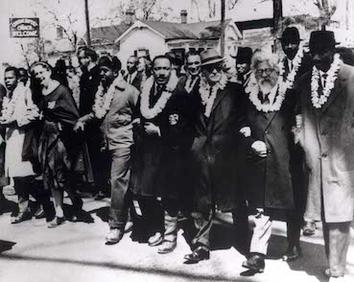
MLK Jr. Day: Prayer As Action


In March 1965, after marching alongside Reverend Martin Luther King, Jr. in Selma, Alabama, the celebrated theologian and rabbi Abraham Joshua Heschel wrote, "When I marched in Selma, my feet were praying."

Heschel's formulation explicitly equates righteous action (or activism) with prayer. In this time of increased fundamentalist agitation and violence, Heschel's notion is vital to both contemporary religion and secular humanism; that is to say, it is vital to every human being.

It seems very appropriate, then, that King, Jr. Day is observed by many in the United States as the King Day of Service, a day in which we honor the message and aspirations of Martin Luther King, Jr. by volunteering our time and effort for humanitarian causes (or, as I've also done this year, signing up for forthcoming volunteer projects and donating money to important aid efforts).

It is also a day, of course, to remember the man and the many he inspired to act or speak out against prejudice and oppression. May there be many more such prophets.

Saturday, December 12, 2009

Sunset, Sunrise


Heron Hope sunset; November 2009

"Our destiny, our being's heart and home,
Is with infinitude, and only there;
With hope it is, hope that can never die,
Effort and expectation, and desire,
And something evermore about to be."

- William Wordsworth, The Prelude


"Indeed, from within the murkiness of human knowledge and experience, we rightly wonder, is there any room for theology as such - or has it gone the way of all heavenly things? Perhaps all that remains is some mode of natural piety, such as the shudder before the mortal mysteries (with Goethe), or the felt ecstasies of springtime (with Wordsworth). Surely this is a lot, and unsettles the mind from its human habitudes. But is there more?

[...] Like all matters human, theology must be grounded in earthly experience and understood from within its forms. The phenomenal world is all that we have. This is the sphere that lies before us in our everyday existence; it conditions the products of aesthetic perception; and it provides the sphere for theological experience and reflection.

[...] As natural beings we are, in the most elemental sense, coextensive with this realm: our bodies are composed of it, our stomachs take in and digest its matter, and we traffic with this world all our days until we die and are decomposed into its elements. [...] To more properly sense [the] unfolding of the Godhead into world-being, so to speak, or to perceive or intuit its penetrations therein, we must first return to our ordinary experiences."

- Michael Fishbane, Sacred Attunement: A Jewish Theology


Sunrise at Heron Hope; November 2009

Happy Hanukkah, folks.

Photo credits: Hungry Hyaena, 2009

Tuesday, November 10, 2009

Falling Down


In the wake of last Thursday's tragic shooting at Fort Hood, the American media have made much of Major Nidal Malik Hasan's religious affiliation and, more specifically, of his connection to a radical Muslim cleric based in Yemen.

Many voices on the right have touted Hasan's heinous actions as the latest evidence of Islam's corrupt and violent core. Most of the commentators on the left, by contrast, insist that Major Hasan was a victim of circumstance, and that his murderous rampage was precipitated by external pressures. Considering the left's reasoning, Michael Douglas's defense contractor turned urban vigilante in the 1993 film "Falling Down" comes to mind. At the time of that film's release, critic Roger Ebert wrote of it,
"What is fascinating about the Douglas character, as written and played, is the core of sadness in his soul. [...] There is no exhilaration in his rampage, no release. He seems weary and confused, and in his actions he unconsciously follows scripts that he may have learned from the movies, or on the news, where other frustrated misfits vent their rage on innocent bystanders."
There is salient insight in the left's response, but generally assessments on both the political left and right are ideological and reductionistic. Media pundits are involved in a fraught game of Pin the Tail on the Donkey. While the right-wing strives to pin the tail on Islam, left-wing pundits do what they can to prevent that stigma from sticking. Precious intellectual and creative energy is expended in the process; these commentators could instead provide a full accounting of what causes people to turn to religious extremism, or to extremism of any sort.

I especially appreciated, then, Dave Belden's "How Do We Understand Major Hasan?," an OpEd-style post at Tikkun Daily. I encourage folks to read it. Belden writes,
"Given that in all of our lives personal pain intersects with cultural narratives, then it is surely no surprise that for the killers it’s rarely ever a simple question of either a sick individual or a follower of extremist ideas. Timothy McVeigh was surely both when he bombed the Oklahoma Federal Building. To mention his personal pain is not to excuse him, but should give pause to all those who demonize others."
In response, I wrote in the comment section of Belden's post,
"In the media frenzy that passes for much contemporary news and politics, the humane aspects of most events or socio-political dynamics are generally overlooked. So, too, are the individuals involved reduced to caricatures and concepts. I wish I had some ideas as to how we, as a community, might address this ugly, dangerous spin. Alas…

As for David Brooks and [those to his right], I frequently marvel at their incomplete assertion that Muslim extremism is the culprit (at Fort Hood, in particular, but globally, too). Why not continue the diagnosis, revealing the imbalanced, immoral global system that produces extreme poverty, social and political disenfranchisement, and national/ethnic resentment/competition as the source of the tsoris that drives so many young men and women to embrace extremism (or, at least, adds to the appeal of a black-and-white, reductionist world view)?

Certainly religious extremism should be condemned and confronted, but addressing the root cause (which is also to address social justice globally) seems more sensible. But, were the conservative commentators to finger that root, they would implicitly condemn their own condemnation, as it, too, is born of a naive, black-hat-versus-white-hat construction of our volatile, shrinking world."
Photo credit: image ripped from Voice of America News

Saturday, September 19, 2009

Again, into the gloaming

The spiral of time has come round on itself, slightly displaced from this point a year gone.

It is Rosh Hashanah today, the Jewish New Year, and I'm in a pensive mode. Below, I repost a selection from "Almost Twilight," last year's musing on autumn's advent, creative inspiration, twilight, crepuscular animals, hallucinogens, and reflection.

But, first, I'd like to highlight two projects relevant to the season.

- Yusuf Misdaq is an artist, poet, and musician who shares my universalistic mystical inclination. Almost a month ago, he began Palace Prayers, "the aim [of which] is to create a new work of art for every day of Ramadhan, 2009."

A blog-like site presents each day's original work. I encourage readers to visit. You can also listen to a National Public Radio interview with Yusuf here.

- New Yorker editor Ben Greenman has co-organized, with writer Nicola Behrman and Reboot's Amelia Klein, 10Q, a Yamim Noraim project for people of all faith (or lack of faith) backgrounds. From the website:
"10Q was inspired by the traditional ten days of reflection that occur between the Jewish holidays of Rosh Hashanah and Yom Kippur, a period of time that’s long been considered an opportunity to look at where you're at, where you've come from, and where you're heading. Whether you're Jewish or not, though, 10Q is a great way for anyone to look back at the year that’s past, look ahead at the year to come, and take stock. That’s a beautiful thing in any language."
Sign up here.

Shana tova!

+++++


"Darkness within darkness.
The gateway to all understanding."
-Lao tzu, "Tao Te Ching"

In New York, recent mornings have greeted us with a pleasant chilliness. Fall is almost here, and winter is just around the corner. For most folks, the prospect is daunting. Not so for me. Each year at this time, a bounce finds my step and I'm happily overwhelmed by a spate of ideas. I know, however, that the creative juices will before long transmute into keen brooding. Late fall and winter nurture a pensive mind.

When the afternoons darken and the mercury dips, I like to take bundled winter strolls through the streets of Manhattan or Queens. Other pedestrians hustle about, intent on achieving their respective indoor destinations, but I find my thoughts best served by a steady pace, one forgiving of some intentioned aimlessness. I spend these walks looking up to where the melancholic sky meets the buildings that scrape it, admiring the resilience of foraging House sparrows, taking note of the way traffic lights glow more brightly in crisp, cold air and marveling over the many lives that move around me. I like to think of this mindful meandering as a form of prayer, or perhaps a communion, and I treasure the insights that are sometimes happened upon.


Curious about the rites, beliefs, and texts of various religions (and particularly those of Judaism), I've been thinking this week about the coming high holy days. Next Monday is Rosh Hashanah, the first of Judaism's ten "days of awe," or Yamim Noraim. Like my winter walks, the Yamim Noraim are given over to contemplation. During the ten high holy days, an observant Jew should meditate on the actions of his last twelve months and, then, on Yom Kippur, the last of the "days of awe," fast and repent for any wrongdoing. In other words, a conscientious Jew begins the new year by reckoning with his past. Although Rosh Hashanah is only one of four Jewish New Years, each attached to a specific set of guidelines and meaning, I find the holiday's position with regard to the seasons of particular interest.

Considered the New Year for humans, animals, calendar calculation, and contracts, Rosh Hashanah arrives with the ploughing of summer into fall. If one considers fall equivalent to dusk and winter to night, then the Jewish New Year, like the Jewish day, begins at twilight in the northern hemisphere. The notion of a day extending from sunset to sunset runs slightly counter to the popular conception of morning time as a birthing, or spring, with the hours moving through summer at mid-day, fall in the evening, and finally into winter, night and death. But the Judeo-Christian tradition is pastoral, founded on an agricultural reckoning. It makes sense, then, that the day should end when the sun falls away. The new day begins with night; the beginning is darkness, a time when all man can do is rest and await the return of the sun's workable hours. In rural farming communities, this pattern holds today, though the blue glow of television has altered habits in even the most rustic counties. Still, the consummate urbanite Oscar Wilde's quip that "people in the country get up early because there's so much to do, [and] they go to bed early, because there's nothing to talk about" remains generally accurate.


Growing up in such a community, I learned early that if twilight is a conclusion for the farmer, it is a commencement for many other creatures. A patient hunter who remains in his deerstand as the final light retreats might see bats dart and dip in aerial pursuit of insects. He may also see an opossum, fox, raccoon, skunk, or even his intended quarry, deer, though it is not legal to shoot after the sun sets. Driving or biking on "backroads," these animals reveal themselves by reflecting light from a car's headlights or a bike's front beam. The tapetum lucidum, a layer of tissue behind the retina of crepuscular and nocturnal species, allows the animal to see better in near or total darkness, but this layer also produces eyeshine that discloses the creature's presence to human torch bearers. Depending on the species and the angle of approach, we can identify the animal by the color of its eyeshine: the white-yellow lights at knee height belong to the red fox; the orange orbs in the low branches of a tree are an opossum; the yellow beams tall over the road are white-tailed deer; the brilliant white spots that appear so near the ground expose a resting whippoorwill.

Imagine the shock of the early humans when they first noticed the glowing embers that moved just outside the reach of their warm firelight. The agricultural tribes that would become the people of the Torah, having abandoned much of their nomadic, hunter-gatherer roots, were particularly afraid of the dark, creeping world outside that circle of light. To be caught in the gloaming, away from a human settlement or encampment, was surely a terrifying possibility.

Indeed, the dark months, like those black, antediluvian nights, remain an ordeal for many people . But they can also be understood as a gateway opportunity. It is fitting, I think, that Jews begin their new year by taking stock, a formidable task if undertaken with thoroughness and honesty. I approached my experiences with hallucinogenic drugs in an analogous way; what most people would call a "bad trip," I viewed as an opportunity for introspection. 'Why has my brain created this awful idea?,' I asked myself. 'What does that tell me about my relationship to x or y, or about my fear of a, b, or c?' The cold, gloomy months, like bad trips, nightfall, and deep melancholy, can be challenging, even endangering, but in an increasingly mediated and accelerated world culture, the difficult passages are of premium value.


But whatever religious label I eventually pin to my lapel (or discard), periods of solemn self-examination are likely to remain a critical part of my identity and annual experience, and these have so far coincided with winter and come on the heels of a fall surge in the creative impulse. Although modernity misunderstands fall to be the beginning of an end, it is only another beginning. Shana tova umetukah, folks. My favorite season is moving in, and our shadows grow longer.

Photo credits: "Athens Park, Astoria," "Central Park, Manhattan," "Heron's Foot Moon, Virginia," "Branches," all by Christopher Reiger, 2007 and 2008

Thursday, September 17, 2009

Kimmel Harding Nelson: Day 11

As I began jotting down notes this morning, it occurred to me that many of the ideas I've been ruminating on during my time in Nebraska City were nicely tied together in an essay almost a year old. "Eric Beltz and 'The Good Land'," a response to artist Eric Beltz's Fall 2008 solo exhibition at Morgan Lehman Gallery, in New York City, raises questions of American exceptionalism, conservation, religion, and human conceptions of "wilderness."

I subscribe to the notion that every artist or academic has just one big idea that, over a career, appears in a variety of forms or expressions. Why not, then, revisit the Beltz essay in the context of the writing I've done at the KHN residency? It follows nicely on yesterday's post, and connects our American ecological dilemma to the arts, or at least to two artists' considerations of the dilemma, namely Beltz's and my own.

+++++


Eric Beltz
"By this Axe I Rule"
2008
Graphite on Bristol
27 1/2 x 23 inches

"All conservation of wildness is self-defeating, for to cherish we must see and fondle, and when enough have seen and fondled, there is no wilderness left to cherish."
-Aldo Leopold

The exquisitely rendered graphite drawings included in "The Good Land," Eric Beltz's recent exhibition at Morgan Lehman Gallery, are sophisticated responses to our American folkways and myths. As darkly funny as they are disarmingly earnest, the graphic works are both exhortations and critiques of our nation's inborn exceptionalism and romanticism.

Of particular interest to Beltz is our American relationship to landscape. In "By This Axe I Rule," a contemplative outdoorsman sits on a tree stump, ax in hand. The bodies of a white-tailed deer, a moose, an opossum, a raccoon and other animals are partially concealed by snow drifts at his feet; a turkey vulture is perched above, wings spread. The man bears a striking resemblance to renowned ecologist Aldo Leopold. The likeness may be coincidental, but is nonetheless pertinent. 2008 is the 60th anniversary of Leopold's death. Like Henry David Thoreau and John Muir, Leopold is a lodestar for many contemporary environmentalists. His "A Sand County Almanac," published posthumously in 1949, remains a critical conservation text.

Unlike Rachel Carson's "Silent Spring," the 1962 bestseller that catalyzed the modern environmental movement, Leopold's "Almanac" is not a call for corporate and federal responsibility. Although Leopold would surely support such measures, his book is principally concerned with our reforging an intimate connection to the landscape we inhabit. "We can be ethical only in relation to something we can see, feel, understand, love, or otherwise have faith in," he wrote.

It's noteworthy that Leopold's faith is not of the starry-eyed variety; his "land ethic" includes hunting, controlled burns, and other practices typically condemned by preservationists. Contrary to the romantic conception of wilderness, Leopold's ethic acknowledges that the tools invented by humans (the saws, shovels, axes, picks, and pitchforks that figure prominently in Beltz's drawings) are not simply cruel agents of mastery. Humans are animals and, as such, we are not apart, but rather a part of a complicated, messy ecology. No matter how we manipulate our environment, dominion remains a comforting delusion.

Yet most of us do not conceive of Nature in this way. Just as we distinguish between the self and the group, so too do we draw a hard-line distinction between humanity and the “natural world.” William Cronon, a respected, if controversial environmental historian, argues that we must alienate ourselves from Nature before it can be understood as something pristine, virgin, or more wild than ourselves. In his celebrated 1983 book, “Changes in the Land”, Cronon reveals the quixotic quality of preservationist impulse.
"If the nature of Concord [Massachusetts] in the 1850s - a nature which many Americans now romanticize as the idyllic world of Thoreau's own Walden - was as 'maimed' and 'imperfect' as he said, what are we to make of the wholeness and perfection which he thought preceded it? It is tempting to believe that when the Europeans arrived in the New World they confronted Virgin Land, the Forest Primeval, a wilderness which had existed for eons uninfluenced by human hands. Nothing could be further from the truth....the land was less virgin than it was widowed. Indians had lived on the continent for thousands of years, and had to a significant extent modified the environment to their purposes…The choice is not between two landscapes, one with and one without a human influence; it is between two human ways of living, two ways of belonging to an ecosystem."
The preservationists' dualistic attitude (i.e., Humanity vs. Nature) provides only simple answers to our complex questions. By contrast, Beltz’s allegorical drawings shirk simplistic moralizing in favor of contradiction, ambivalence and multiplicity. His scenes speak to an active communion with Nature, albeit one that includes suffering, death and a melancholy nod to the essential absurdity of existence. By turns, Beltz eulogizes, champions and satirizes Thoreau's self-sufficiency and Andrew Wyeth's rural romanticism.


Eric Beltz
"Hysteria"
2008
Graphite on paper
17 x 13 3/4 inches

Beltz critiques America's religious and economic landscape, as well. Four of his drawings comprise a series entitled “Back to Eden.” In each, a headless body clothed in overalls, workman boots ,and a shirt with rolled up sleeves – the uniform of the outdoorsman-farmer - is slumped in or alongside a pile of cut logs and other vegetation. Above each of these tableaus, Beltz has written one word, in cursive: Asthma; Hysteria; Cancer; Delirium.

Considering the series, I recall Adam Smith’s ignored admonition concerning the dangers of loosely regulated capitalism. Smith, the 18th century Scottish philosopher best known for his influential treatise "The Wealth of Nations," is canonized by contemporary capitalists for laying down the principals of free market economics, but he entertained doubts about and acknowledged the shadows cast by such a system.

"Power and riches," Smith wrote, "are immense fabrics, which it requires the labor of a life to raise, which threaten every moment to overwhelm the person that dwells in them, and which, while they stand, can protect him from none of the severer inclemencies of the season. They keep off the summer shower, not the winter storm, but leave him always as much and sometimes more exposed than before to anxiety, to fear and to sorrow, to diseases, to danger and to death." Smith’s misgivings were warranted. Contemporary life is rife with social ailments and, in combination with our alienation from Nature, secular capitalism is a principal causative factor.

Curiously, free market capitalism is close kin to Manifest Destiny, the divine doctrine of conquest and consumption. Capitalism is exported with no less zeal than our cruel spread west from the colonies. Harriet Beecher Stowe, the 19th century novelist best remembered as an outspoken proponent of abolition, wrote that America is "a nation specifically raised up by God to advance a cause of liberty and religion." She did not say “liberty of religion.” America was founded by Protestant fundamentalists fleeing religious persecution in Europe. Arriving on these contested shores, they took names like Ezekiel, Jacob, and Issac, and likened their journey to the Jewish Exodus from Egypt. These religious settlers are the forebears of a great many contemporary Americans.

Appropriately, Beltz’s drawings incorporate Biblical texts and his subjects are recognizable as America's founding fathers and God-fearing, anonymous farmers. But Beltz draws from a peculiarly American well, the proverbial melting pot. Each drawing is suffused with currents of Eastern philosophy and shamanism. His farmers and historical figures are also mystics. American philosophy is more plural than we care to admit, and Beltz's admixture of East and West, allegory and history, supernatural and natural is a fair reckoning. (American transcendentalism, for example, the philosophy so vital to Thoreau and Ralph Waldo Emerson, was a hybrid of Protestant Unitarianism, Romanticism, Hinduism, and European intellectualism.)


Eric Beltz
"Tree of the Evil Eagle"
2008
Graphite on paper
40 x 30 inches

Still, the Bible is the first book of the United States, and many Americans regard the Constitution and founding fathers with astonishing reverence (to the extent that, in some circles, the former is sacrosanct). But documents and philosophies are of a particular time. Guarded by strict interpreters, the Constitution of the United States can become as regressively dogmatic as any primary religious text. Without thoughtful interpretation of Constitutional scripture, the significance and relevance of the founding fathers' enterprise will wane.

But most Americans (politicians and citizens alike) are in the business of denying the inevitable, be it the death of a loved one, an unregulated economy, or an ideology. Rather than confront our heavy history (and with it our future), the United States cloaks itself in exceptionalism. We remove ourselves from a fact-based historical narrative so that the road to future success is understood as an unyielding continuation of the present, divinely-ordained course. Like the empires that rose and fell before us, America's clarity of vision is obscured by global power and a history that privileges mythic glory over fact. Because we make history, many of our leaders feel strongly that we don't need to know it. Moreover, the history we make is irreproachable because it is consecrated.

Yet the secular capitalist world view strives to replace religion and the supernatural with consumerism. Manifest Destiny Version 3.0 is not ordained by God so much as by the Almighty dollar. And the replacement worked, more or less. The secular capitalist model is today the global standard. But sociologists, anthropologists, and, now, some neuroscientists agree that the substitution is inadequate. This deficiency is most apparent in a religious nation like the United States, where fundamentalism and cultism, reactionary responses to the secular world, are thriving. Despite our founding fathers' dismissal of the New Testament's Book of Revelation (Thomas Jefferson described it as "the ravings of a maniac"), a 2002 CNN/Time magazine poll found that 59 percent of Americans believe the prophecies therein are real and that the gruesome judgment of the Second Coming is imminent. James Watt, former President Reagan's Secretary of the Interior, is among that majority. He famously stated that protecting our nation's natural resources was not a priority because Jesus Christ would return only "after the last tree is felled."

Yet some evangelical fundamentalists are more fair-minded. They focus instead on the Bible's call for stewardship, and argue that the success or failure of the environmental movement depends on which interpretation gains the upper hand. Will we embrace a dominionist or stewardship theology?

The crux of that question is the American notion of wilderness. Cronon writes, "the flight from history that is very nearly the core of wilderness represents the false hope of an escape from responsibility, the illusion that we can somehow wipe clean the slate...and return to the tabula rasa that supposedly existed before we began to leave our marks on the world...Non-use is not an option: to live in nature is to use and change it by our presence. The choice we face is not to leave no marks - that is impossible - but rather to decide what kinds of marks we wish to leave."


Eric Beltz
"The Good Land"
2008
Graphite on paper
30 x 40 inches

Beltz's meticulously rendered works don't offer any answers, but neither do they shrug off the dilemma. With a richly ironic sensibility and a sensitivity to the complexities of our national character and (natural) history, Beltz embraces our clusterfuck approach even as he skewers it. "The Good Land" is sublimely ambivalent.

Photo credit: all images ripped from the artist's website