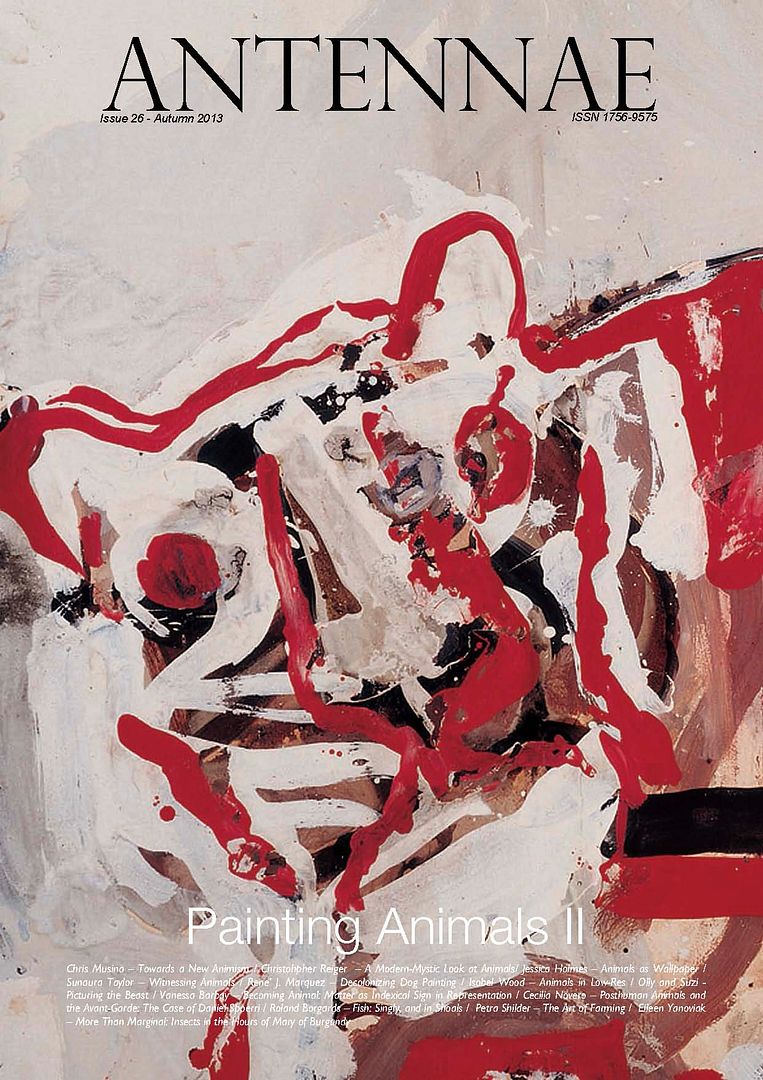
I'm pleased to announce that several of my paintings and drawings are featured in Issue #26 (Autumn 2013) of Antennae: The Journal of Nature In Visual Culture. Accompanying the images, the editors printed a statement I wrote about the featured body of work.
While I'm not currently working on that series -- my attention is more focused on the hybrid project I described in April -- I'm delighted to have my work appear in Antennae, a journal that, as an artist and writer preoccupied by all things "nature," I've long been a fan of.
Image credits:: Antennae, copyright 2013
Showing posts with label animal. Show all posts
Wednesday, September 25, 2013
Thursday, October 25, 2012
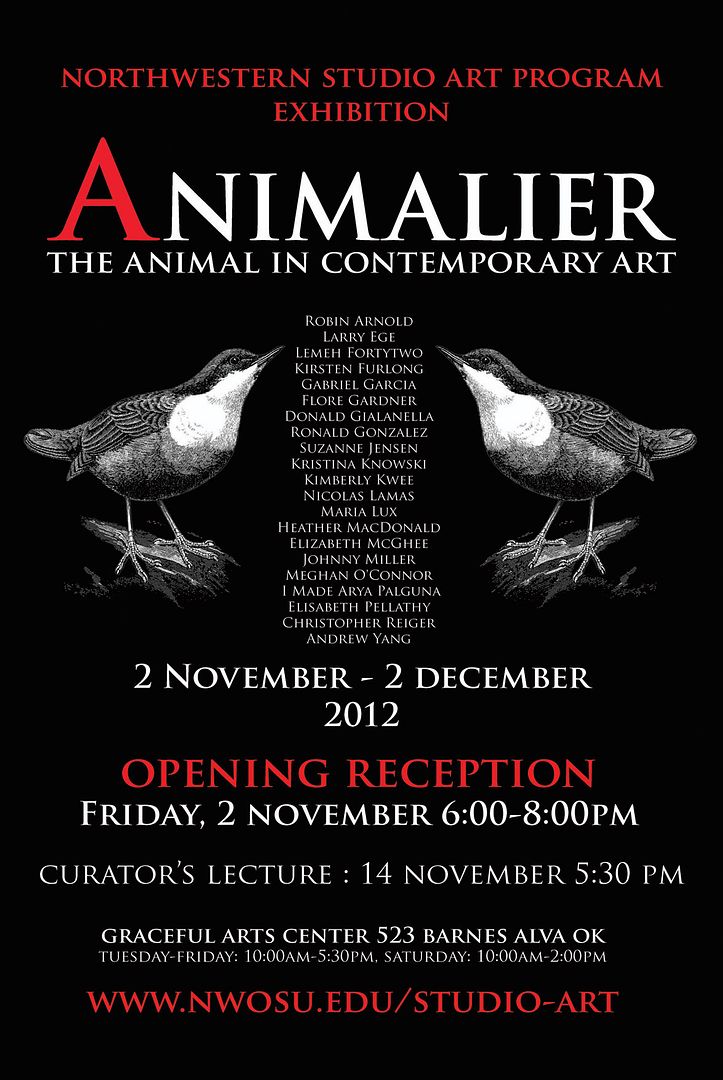
Announcing "Animalier" Exhibition
While I know most of Hungry Hyaena's readership resides on the US coasts, if you happen to find yourself near Alva, Oklahoma, in November, please check out the exhibition!
Thursday, October 13, 2011
ROA's Ark
2010
East Village, New York City
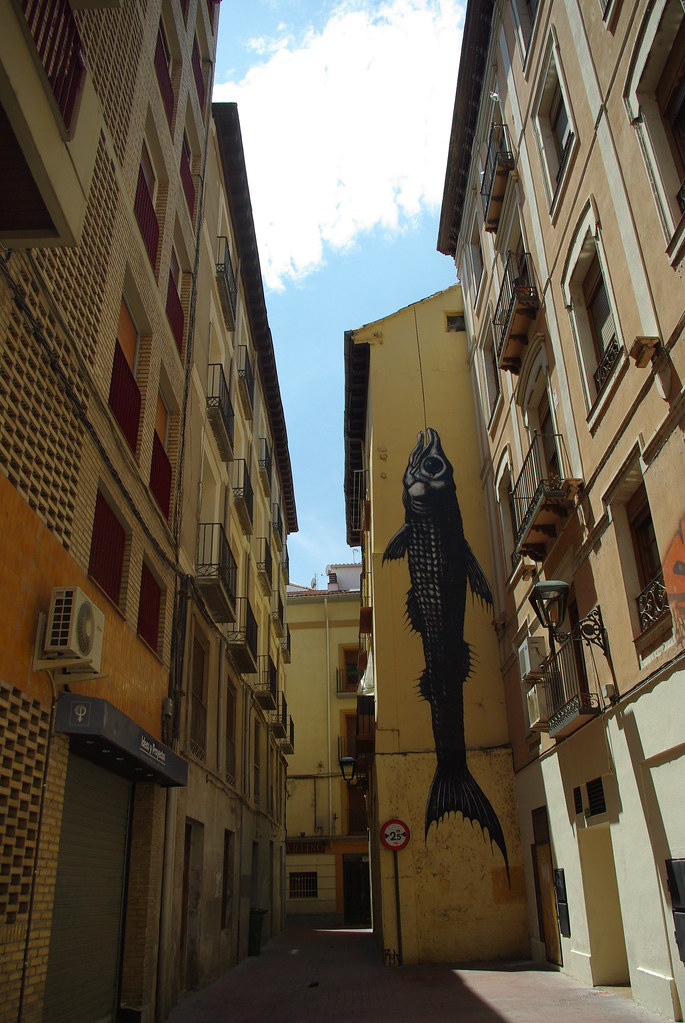
I admire skillful street art, but I rarely feel compelled to photograph it. In early 2010, however, when I came upon the starling mural pictured above, I immediately reached for my camera. At the time, I didn't know anything about the artist; months later, I recognized the muralist's hand in an image I came across online. ROA, a Belgian artist whose animals adorn structures on four continents, is a rising star among street art aficionados.
2010
London, England
Admittedly, my love of natural history and enthusiasm for animal imagery predispose me to ROA fandom, but the artist's bold, black-and-white technique is distinct and compelling, and most of his mural projects exhibit a clever site-specificity. This attention to location is most often compositional -- for example, the neck of a Limpkin-like bird passes between two windows on a building in Brooklyn, New York, with the bird's body below and the head above -- but ROA's strongest pieces are also conceptually playful: in Ancona, Italy, he painted a disheveled cormorant, a type of water bird, on the side of a large boat; elsewhere, a mole emerges from a pile of bricks; and a desiccated fish is painted on the side of a trailer near California's Salton Sea, a large salt lake in which most fish species are unable to survive. An enthusiastic amateur naturalist, I appreciate the context-appropriate nature of these works.
2010
Zaragoza, Spain
Unfortunately, ROA doesn't always paint his creatures in or near their natural habitat. I love his giant anteater, pictured trotting along the side of a single-story building in the Mexican state of Guanajuato, but I wonder if the artist realizes that the species is extirpated north of Honduras. Still, because giant anteater fossils have been found in northern Mexico, let's give the artist the benefit of the doubt and interpret this piece as an observation about ecological change. A stylized blue whale rising from a sea of grass outside an abandoned factory in Moscow, Russia, however, is too far from an ocean to be rationalized. Its incongruity is amusing and the image is beautifully crafted, but the piece lacks the impact of ROA's more considerate efforts. No worries. ROA's terrific Virginia opossum in downtown Los Angeles, its prehensile tail wrapped around a stretch of the building's brickwork, more than makes up for the misplaced whale!
While my fondness for natural history makes me an unusually nit-picky viewer, it also means that I'm especially excited by the urban and exurban placement of ROA's rats, squirrels, starlings, herons, raccoons, cormorants, and skunks. These animals are hardy and adaptable, and have proven able to thrive in ecosystems dominated by human habitation. Many people dismiss these creatures as pests, but their presence in our lives is of significant value. As we become an evermore urban species, they are our most immediate connection to the undomesticated, non-human world. In this respect, ROA's murals are portraits of our closest neighbors.
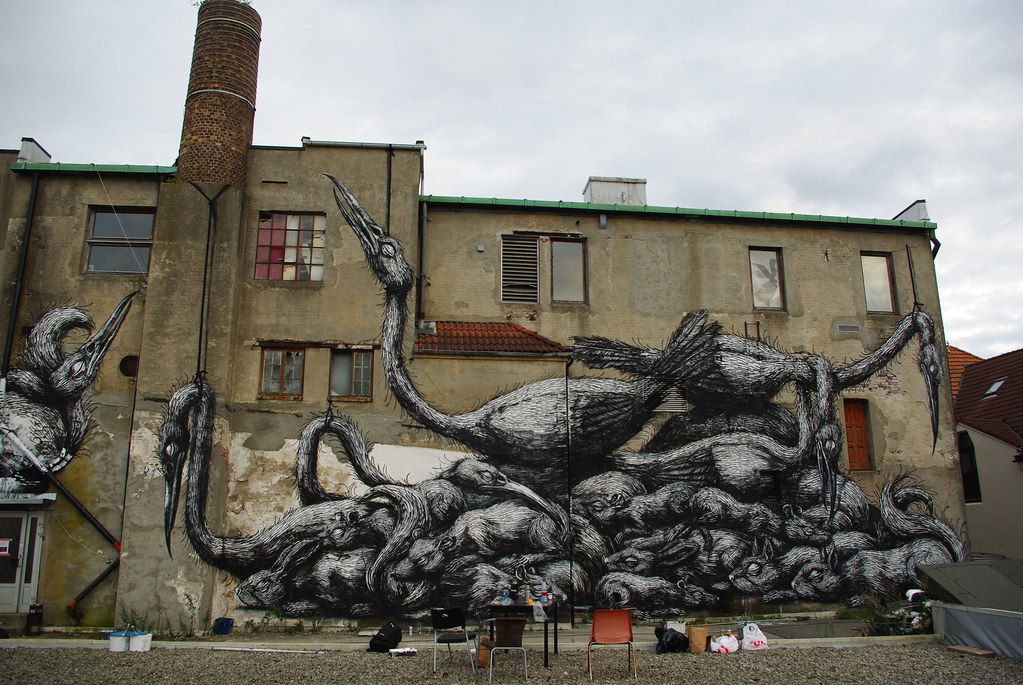
From the "NUART Landmark Series"
2010
Stavanger, Norway
Some of ROA's more elaborate murals depict great piles of dead animals. These call to mind the tables laden with rotting fruit, hunted game, and skulls that appear in many 15th century Northern European vanitas ("emptiness"), memento mori ("remember your mortality"), and ars moriendi ("art of dying") still life paintings. As their names suggest, all of these allegorical works were created as nods to death's inevitability. It seems these themes preoccupy ROA, too. One of his best memento mori works is located in Stavanger, Norway. Lifeless squirrels, rats, rabbits, and herons are heaped at the foot of an old warehouse, with the limp necks of the herons apparently tied to cords on the wall's face (should we call this reverse trompe l'oeil?) In Mexico City, ROA adds a raccoon, armadillo, and skunk.
2011
Mexico City, Mexico
These murals will seem grotesque and bleak to some viewers, but they aim to inspire by reminding us that life is transitory. The sentiment was expressed well by Steve Jobs during his 2005 Stanford University commencement address, a speech that, in the wake of Jobs' untimely death from cancer, has been making Internet rounds. Jobs said,
"Remembering that I'll be dead soon is the most important tool I've ever encountered to help me make the big choices in life. Because almost everything — all external expectations, all pride, all fear of embarrassment or failure - these things just fall away in the face of death, leaving only what is truly important. Remembering that you are going to die is the best way I know to avoid the trap of thinking you have something to lose."In many respects, ROA's works are the less refined kin of Walton Ford's paintings. Both artists address mortality and the relationship of humanity to other animal species with humor and finesse, but ROA's pictures are less layered with art historical and natural history references; as a result, they're more accessible and immediately gratifying.
Based on the images he shares on his Flickr photostream, the talented 30-something has at least five murals in San Francisco. Let's hope that he returns to the Bay Area and contributes more of his handiwork to our landscape.
Monday, July 04, 2011
"Wicked Little Critter"
"the banks of solitude"
2006
Watercolor, gouache, sumi ink, and marker on Arches paper
27 x 22 inches
My 2006 painting, "the banks of solitude," is included in the group exhibition, "Wicked Little Critter," at Kristi Engle Gallery in Los Angeles.
Coincidentally, "Wicked Little Critter" opens July 9th, the same date as "A Live Animal," the San Francisco exhibition that I co-curated with artist Selene Foster. Moreover, it also deals with similar subject matter.
From the exhibition's press release:
"Wicked Little Critter, curated by Anne Hars, brings together the work of 12 artists who address the human/animal relationship. Non-human critters in art, be they wild, house-pets, zoo residents, farm animals, or fable characters reflect ethical attitudes of privilege over our dominion. These works reveal among other things, how clearly we comprehend the minds of critters, and how much we project ourselves onto them. This show is dedicated to those wicked ones that continue to play a part in what it means to be human."I won't be in LA for the reception, but I'll visit the show in early August, when I'll fly south to lecture at the Art Center College of Design in Pasadena.
Kristi Engle Gallery
5002 York Ave.
Highland Park, CA 90042
Exhibition dates: July 9 - August 12, 2011
Reception: Saturday, July 9, 7-10pm
Monday, June 27, 2011
Announcing "A Live Animal" Exhibition, Catalog, and Program
It's a thrill to announce that "A Live Animal," a large group exhibition that artist Selene Foster and I are co-curating, will be on view at San Francisco's Root Division in July 2011.
In addition to the opening reception for the exhibition (July 9), we will host an Evening of Presentation and Performance (July 19) in the new ODC Theater space, located just next door to Root Division. The EoPP features presentations relevant to the theme of "A Live Animal" by some of the participating artists, as well as scientists, dancers, and others.
I'm biased, of course, but "A.L.A." is a very strong show, and the sort of cross-disciplinary fare that I believe the art world needs more of. If you're in the Bay Area, please visit!
+++++

Detail of "Sharks," by Maria Lux
"A Live Animal" explores the relationship(s) between contemporary man and other animals, with a particular focus on the different lenses, be they mystical, scientific, or philosophical, through which we view other species.
ARTISTS:
Brandon Ballengee, Jeremiah Barber*, Joianne Bittle, Bethany Carlson, Karl Cronin, Donald Farnsworth, Todd Forsgren, Dana Harel, Nicole Jean Hill, Michael Kerbow, Anne Klint, Maria Lux, Jon Rappleye, Shelley Reed, Steven Rubin, Susan Silas, Deborah Simon, Sarah A. Smith, Kate Stirr*, Youngsuk Suh, Ryan Thompson, James Wendell, Gail Wight, and work from the Endangered Species Print Project
*Root Division Resident Artist
Opening Reception: Saturday, July 9, 7 to 10 pm
Exhibition Dates: July 7 - 30, 2011
Gallery Hours: Wednesdays - Saturdays, 2-6 pm (or by appointment)
AN EVENING OF PRESENTATION AND PERFORMANCE:
July 19, 2011, 7:30-9:30PM
ODC Theater, 3153 17th Street, SF, CA
EoPP PRESENTERS:
Chris Black: "Extinction Burst (last dance, last chance): A reanimation of lost movement"
Karl Cronin: "Kinetic Empathy"
Jeremiah Jenkins: "The Hunt"
Brian Null, Ph.D., "Examination of Animals, Examination of Self"
Georgeann O'Brien, Ph.D.: "Direct observation of sensory neuron regeneration in live zebrafish"
Christopher Reiger: "Introducing the Endangered Spcies Print Project"
Philip Ross: "Eating Bugs for Fun and For Profit"
Jon Sack, Ph.D.: "Bioelectric Venom"
Gail Wight: "Animal Animosity"
For more information about the "A Live Animal" EoPP, click here.
We're also producing a full-color exhibition catalog that includes original essays by Selene, me, and artist/writer Michael McDevitt.
In addition to the opening reception for the exhibition (July 9), we will host an Evening of Presentation and Performance (July 19) in the new ODC Theater space, located just next door to Root Division. The EoPP features presentations relevant to the theme of "A Live Animal" by some of the participating artists, as well as scientists, dancers, and others.
I'm biased, of course, but "A.L.A." is a very strong show, and the sort of cross-disciplinary fare that I believe the art world needs more of. If you're in the Bay Area, please visit!
+++++
"A Live Animal" explores the relationship(s) between contemporary man and other animals, with a particular focus on the different lenses, be they mystical, scientific, or philosophical, through which we view other species.
ARTISTS:
Brandon Ballengee, Jeremiah Barber*, Joianne Bittle, Bethany Carlson, Karl Cronin, Donald Farnsworth, Todd Forsgren, Dana Harel, Nicole Jean Hill, Michael Kerbow, Anne Klint, Maria Lux, Jon Rappleye, Shelley Reed, Steven Rubin, Susan Silas, Deborah Simon, Sarah A. Smith, Kate Stirr*, Youngsuk Suh, Ryan Thompson, James Wendell, Gail Wight, and work from the Endangered Species Print Project
*Root Division Resident Artist
Opening Reception: Saturday, July 9, 7 to 10 pm
Exhibition Dates: July 7 - 30, 2011
Gallery Hours: Wednesdays - Saturdays, 2-6 pm (or by appointment)
AN EVENING OF PRESENTATION AND PERFORMANCE:
July 19, 2011, 7:30-9:30PM
ODC Theater, 3153 17th Street, SF, CA
EoPP PRESENTERS:
Chris Black: "Extinction Burst (last dance, last chance): A reanimation of lost movement"
Karl Cronin: "Kinetic Empathy"
Jeremiah Jenkins: "The Hunt"
Brian Null, Ph.D., "Examination of Animals, Examination of Self"
Georgeann O'Brien, Ph.D.: "Direct observation of sensory neuron regeneration in live zebrafish"
Christopher Reiger: "Introducing the Endangered Spcies Print Project"
Philip Ross: "Eating Bugs for Fun and For Profit"
Jon Sack, Ph.D.: "Bioelectric Venom"
Gail Wight: "Animal Animosity"
For more information about the "A Live Animal" EoPP, click here.
We're also producing a full-color exhibition catalog that includes original essays by Selene, me, and artist/writer Michael McDevitt.
Wednesday, February 09, 2011
"Scavenged Image (Remixed)"
"The price which man had to pay for his culture and civilization was the severing of this bond which had to be torn to give him his specific freedom of will. But our infinite longing for paradise lost is nothing else than a half-conscious yearning for our ruptured ties.”I enjoy using Adobe Photoshop's basic tools to tweak JPEGs that I've collected online. Occasionally, my tinkering provides inspiration for a drawing. More often, the crude experiments are saved to my hard-drive on the off chance that I might later find some happy use for them.
-Konrad Lorenz, King Solomon’s Ring
A couple of weeks ago, while pondering a quick collage of a young man wearing a howling-wolf-with-moon t-shirt, I realized that my Photoshop amusements more plainly evidence the humor implicit in the ideas and questions that preoccupy me. Very few people comment on this aspect of my drawings and paintings; if they do, they assume the humor is unintended.
I believe this is partly a function of the artist's character informing the viewer's read of his or her art; people who don't know me well usually describe me as earnest, pensive, and not a kidder. Compounding matters, the pictures' principal mediums, watercolor and gouache, are considered the province of the Sunday painter. For many viewers, then, the drawings and paintings are either too heady or too precious.
By contrast, the Photoshop works are unpretentious "one-noters" that demand little from the viewer, yet still speak to some of the same existential questions that my works on paper do. What is our relationship to the rest of the animal kingdom and to nature, at large? How does our cataloging impulse inform those relationships? How do we reconcile imaginative myth with science, or our base animal with our spiritual aspirations?
But the Photoshop works also ask questions that my drawings and paintings do not. In what ways have we turned other species into commodities? What are the contemporary totem animals for an increasingly urban humanity? More profoundly, is the contemporary human condition one of contradiction? Although self-consciousness, advanced socialization, and technology make us exceptional and allow for the creation of culture and civilization, is it not those very developments that our inner animal rages against? Might many of our contemporary behaviors be analogues of the displacement exhibited by animals living in zoo enclosures?
Because these are related, but different questions and because the Photoshop works are more playful and wry, I've decided to present them on Hungry Hyaena. The first picture in my "Scavenged Image (Remixed)" series will follow this post. I will add more regularly.
Note: A thank you to Joy Garnett; her ongoing "Found Art/Unmonumental" series, posted on her long-running and consistently excellent blog, NEWSGrist, is, in some respects, cousin to this project.
Thursday, January 20, 2011
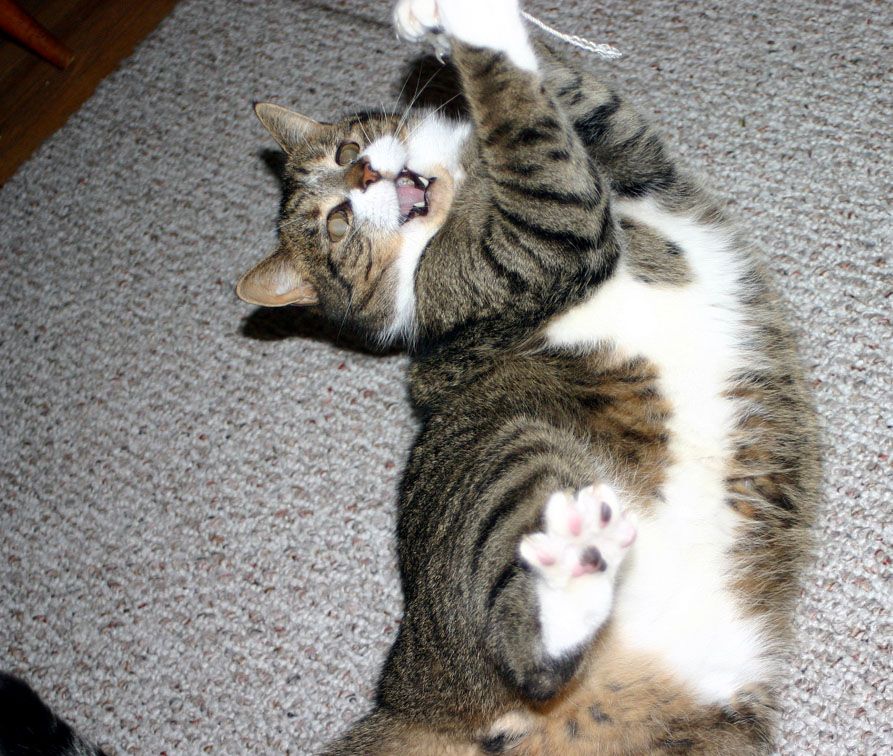
Surprise! Cats kill!
"Conspiracies Don't Kill Birds. People, However, Do.," the title of a recent piece in the New York Times declares. The article reports that US Fish & Wildlife research shows that "some of the biggest death traps" for songbirds in the United States are the jaws and claws of domestic and feral cats. The author dubs the USFWS finding "surprising," but it shouldn't be. Folks surprised by this report are either innocently ignorant of wildlife (and of the wild within the lives we've tenuously domesticated) or they willfully deny the ambivalent violence that animates so much life, cat, bird, and human included.
Read the NY Times piece, then revisit "i taut i taw a putty tat," an HH post from April 13, 2005, in which I discuss some of the realities of cat predation and make it clear that, though I'm a cat lover par excellence, our nation's songbirds, small mammals, and reptiles need us to stop playing favorites.
Photo credit: Hungry Hyaena, 2004
Monday, January 03, 2011
Karl Cronin's Experiencing Forms
"Populus tremuloides (Aspen)"
2009
In late November, I visited "Ecoarchive: Meditations on Time and Nature," a group show on view at Intersection for the Arts 5M, in San Francisco. All of the work included in the exhibition (on view through January 22, 2011) is intelligent and commendable, but I most appreciated Matthew Moore's video, "Lifecycles," Sam Easterson's video, "The Museum of Animal Perspectives," and Karl Cronin's video sampler of his "Somatic Natural History Archive."
I spent most of my time with Cronin's project. For his "Somatic Natural History Archive," Cronin aims to "document with his own body representational expressions of 10,000 U.S. plants and animals," an undertaking that the artist estimates will take 50 years to complete. To date, Cronin has made "expeditions" to Nashville (TN), Santa Fe (NM), Yosemite (CA), Raleigh (NC), Plainfield (MA), and the Grand Canyon, and he's earned the well-deserved support of the Santa Fe Art Institute, Movement Research, and the Puffin Foundation. The documents of his "representational expressions" are archived in the SNHA Catalogue, each labeled with the observed species' Latin name and common name (e.g., "Populus tremuloides (Aspen)").
"Awaiting identification"
2009
With so very many plants and animals to imitate (only 66 of the 10,000 have so far been cataloged online), it's not surprising that Cronin's earnest attempts are uneven; generally, I find his embodiment of plants more intriguing and successful than his animals, but even the less-realized "expressions" made me smile, giddily impressed by the artist's wonderfully quixotic efforts.
Importantly, however, Cronin's endeavor is not mere whimsy. The project may seem simple enough, but I'm certain that it provides the artist with a fundamentally new understanding of (and relationship with) the creatures he studies. Cronin first observes the plant or animal subject, then he perceives it physically, with his body. Watching the artist sway and lean with the breeze in a stand of a grass (an as yet unidentified species, perhaps related to switchgrass), it occurred to me that Cronin is something of a latter-day shaman. "Shaman" is a term abused by new-age prophets and their ranks of well-intentioned, but ill-informed followers, but the philosopher and cultural ecologist David Abram is one of a handful of writers who have given shamanism the thoughtful consideration that it deserves. As I watched Cronin channel a heron, Abram's definition of magic came to mind.
"We are human only in contact, and conviviality, with what is not human. [..] Magic is participating in a world of multiple intelligences with the intuition that every form one perceives - from the swallow swooping overhead to the fly on a blade of grass, and indeed the blade of grass itself - is an experiencing form, an entity with its own predilections and sensations that are very different from our own."In essence, magic is empathy with other "experiencing forms"; it's communion with other facets of the animate world. Happily, by documenting his work with video, Cronin allows the viewer to participate in the magic. I'm grateful for that.
"Caelifera sp. (Grasshopper)"
2009
Note: As a proud natural history geek, I was disappointed that Cronin titled the last of the three videos above "Caelifera sp. (Grasshopper)." In fact, the insect that Cronin imitates in this video is actually a katydid, a species more closely related to crickets than to grasshoppers. Still, while I presume Cronin will make the correction when he adds this video to the SNHA Catalogue, I don't envy him the task of trying to secure a definitive ID on many of the species he works with. Without the help of a entomology expert, he'll be hard pressed to determine the species of katydid in the video above.)
Image/artwork credit: all videos, courtesy Karl Cronin
Sunday, October 10, 2010
Winner Take All?
My father recently sent me a clipping from the Hampton Roads Daily Press that highlighted some curious research presented at my alma mater, the College of William & Mary.
Biologists have determined that "the maximum length of a duck's penis depends not on genetics but rather [on] the males he keeps company with." Dr. Maydianne Andrade, of the University of Toronto Scarborough, explained that ducks "are essentially engineering their own phallus in response to social challenges." This is fascinating evolutionary biology, to be sure, but I find it remarkable that ducks have penises at all, given that most birds do not. (Apparently, a cloaca just won't cut it in duck world!) Dr. Patricia Brennan, of Yale University, believes that the heightened intensity of male-male competition among waterfowl has resulted in the development and size fluctuation of their sex organs.
The evolving duck penis battle came to mind when I read Ashley Mears' article about Coco Rocha, the popular fashion model. Early in his piece, Mears summed up the competitive dynamics of creative industries revealingly.
"Rocha is what economists would call a winner in a 'winner-take-all market,' prevalent in culture industries like art and music, where a handful of people reap very lucrative and visible rewards while the bulk of contestants scrape together meager livings before they fade into more stable and far less glamorous careers."As with the bulk of would-be daddy (or uncle) ducks, most artists, designers, musicians, writers, and other creatives will not be prolific and celebrated. There are many intangibles in play, of course, but, like the drake duck whose penis twists to extraordinary lengths to impregnate a hen, "winning" in a creative industry often depends on who you're keeping company with.
Once vetted, however, the successful creative becomes, like Coco Rocha, a known label; his or her career is likely to be a fruitful one. That label is what the blog "Is It Art or Fart?" trades on. As the blog's co-founders explain,
"The blog began as a conversation between two friends living on opposite coasts who shared an undying passion for contemporary art. Both friends have the habit of seeing as much contemporary art as they possibly can, and this habit has uncontrollably spilled over into the recognition of 'fart'--coincidental moments in everyday life that, when isolated and [attached to the name of an] artist, bear uncanny resemblance to art seen in museums and galleries around the globe. Back and forth the two friends would point to the 'fart' that seemed to be just about everywhere. Now the humor of their findings is for all to enjoy. Remember, the world is your readymade!"Part of the humor of their project is that the "fart" is often as good as or better than the "art" it might be confused with. Unfortunately, for the "fart," as for many drake ducks and coulda-been-a-contender creatives, it's a winner-take-all world.
Image credit: Scrooge McDuck, copyright Walt Disney Company
Friday, June 11, 2010
Rescuing Hokget and Everybody Else
Several months ago, I read "The Problem With Human Compassion," an excerpt from Shankar Vedantam's book The Hidden Brain, printed in the February 19th issue of The Week. I include a lengthy selection here.
"On March 13, 2002, a fire broke out in the engine room of an oil tanker about 800 miles south of Hawaii. The fire moved so fast that the Taiwanese crew did not have time to radio for help. Eleven survivors and the captain’s dog, a terrier named Hokget, retreated to the tanker’s forward quarters with supplies of food and water.Vedantam and Singer are correct; we humans act more compassionately when we are able to put a face to a cause, yet too many faces dull our response.
[...] Drawn by wind and currents, the Insiko got within 220 miles of Hawaii. It was spotted by a cruise ship, which rescued the crew. But as the cruise ship pulled away, a few passengers heard the sound of barking.
The captain’s dog had been left behind on the tanker. A passenger who heard the barking dog called the Hawaiian Humane Society in Honolulu. [...] The Society alerted fishing boats about the lost tanker and soon media reports began appearing about Hokget.
[...] Money poured in to fund a rescue. Donations eventually arrived from 39 states and four foreign countries. One check was for $5,000. 'It was just about a dog,' Pamela Burns, president of the Hawaiian Humane Society, told me. 'This was an opportunity for people to feel good about rescuing a dog. People poured out their support. A handful of people were incensed. These people said, ‘You should be giving money to the homeless.’' But Burns thought the great thing about America was that people were free to give money to whatever cause they cared about, and people cared about Hokget.
The problem with a rescue was that no one knew where the Insiko was. The U.S. Coast Guard estimated it could be anywhere in an area measuring 360,000 square miles. Two Humane Society officers set off into the Pacific on a tugboat. The Society paid $48,000 to a private company called American Marine to look for the ship.
[...] The U.S. Coast Guard had said it could not use taxpayer money to save the dog, but under the guise of training exercises, the called the U.S. Navy began quietly hunting for the Insiko.
[...] Human beings from around the world came together to try to save a dog. The vast majority of people who sent in money would never personally see Hokget. It was, as Pamela Burns suggested to me, an act of pure altruism and a marker of the remarkable capacity human beings have to empathize with the plight of others.
There are a series of disturbing questions, however: Eight years before the Hokget saga began, the same world that showed extraordinary compassion for a dog sat on its hands as hundreds of thousands of human beings were killed in the Rwandan genocide.
The philosopher Peter Singer once devised a dilemma that highlights a central contradiction in our moral reasoning. If you see a child drowning in a pond—and you would ruin a fine pair of shoes worth $200 if you jumped into the water—would you save the child or save your shoes? Most people react incredulously to the question; obviously, a child’s life is worth more than a pair of shoes. But if this is the case, Singer asked, why do large numbers of people hesitate to write checks for $200 to a reputable charity that could save the life of a child halfway around the world—when there are millions of children who need our help?
The answer is that our moral responsibilities feel different in these situations; one situation feels visceral, the other abstract. We feel personally responsible for one child, whereas the other is one of millions who need help - there are many people who could write that check.
[...] The brain is simply not very good at grasping the implications of mass suffering. Americans would be far more likely to step forward if only a few people were suffering or a single person were in pain. Hokget did not draw our sympathies because we care more about dogs than people; she drew our sympathies because she was a single dog lost on the biggest ocean in the world. [...] We are best able to respond when we are focused on a single victim."
I've noticed such a benumbing in myself recently, an unexpected consequence of my transitioning from New York City to San Francisco. Both cities have substantial homeless populations, but panhandling in San Francisco is far more common. My street charity policy, modeled on the approach of a rabbi I heard lecture, is simple enough: I give change to any panhandler who says that he or she will use the money for food (or cites hunger as their reason for begging). I don't give change to those individuals requesting money for any other reason. In New York City, confronted with a few beggars each day, I typically gave change two or three times every week. In San Francisco, however, beggars ask for handouts on every other block, and a good number of them say that they're hungry. If I hold to my standard, I'll give change two or three times a day, if not more often! Shamefully, I've noticed that I've almost ceased giving during my visits to San Francisco.
This is a personal failure that I must address. Each of those many faces is an individual, a single person in need, despite the fact that their larger numbers and concentration counter-intuitively make them relatively anonymous or invisible. The rabbi's rule should be no less applicable in San Francisco than it is in New York. I'm confronted, then, with more need, and I must respond in kind; a hungry person is a hungry person.
But what about a hungry dog? Is Vedantam right to suggest that the thousands of people who contributed money to the Hokget search did not "care more about dogs than people"? Not exactly.
Our species' evolved, inborn behaviors haven't made our adaptation to the globalized world easy. In fact, it seems that contemporary humans are increasingly suspicious of other humans, especially of those outside our respective tribe, whereas animals (and perhaps especially dogs) are seen as uncomprehending innocents. I don't mean to suggest that no one cares about miners trapped in a coal mine, but it's clear that the little girl trapped in a well sells more newspapers, and that the little dog trapped on an abandoned tanker not only sells newpapers, but also inspires a flood of unsolicited donations and generates public outcry.
"Facing intense public pressure to save Hokget, government officials concluded that asking the Navy to sink the tanker—750 miles from Hawaii and drifting away from the distant U.S. mainland—posed unacceptable environmental risks. The Coast Guard finally agreed to access $250,000 in U.S. taxpayer funds to recover the Insiko. It wasn’t officially called an animal-rescue effort. Instead it was authorized under the Oil Spill Liability Trust Fund, based on the argument that if the aimless Insiko managed to drift westward for 250 straight miles, it might run aground on Johnston Atoll and harm marine life.What a marvelously strange species we are!? I applaud our ability to extend compassion to other animals (we're one of handful of species that have demonstrated such empathic ability), but I wonder at our brains' curious moral calculus.
[...] On April 26, nearly a month and a half after the dog’s ordeal began, the tugboat’s crew found the Insiko and boarded the tanker. Hokget was still alive, hiding in a pile of tires. [...] Hokget arrived in Honolulu on May 2 and was greeted by crowds of spectators, a news conference, banners welcoming her to America, and a red Hawaiian lei."
I suppose all I can do is begin with myself, and humbly pledge to keep my pockets filled with coins.
Image credit: ripped from Corbis Images
Wednesday, April 07, 2010
"Coyote Pursues" Capital
At the risk of turning HH into a platform for promoting friends' KickStarter fundraising efforts, I must draw readers' attention to Deborah Simon's terrific puppetry project. Like Olympia Lambert did last month (and so many creative people are doing every day now), Deborah and her collaborator, Matt Reeck, turned to KickStarter with hopes of generating the funds necessary to produce "Coyote Pursues," a multi-media puppet and video performance to be presented at St. Ann's Warehouse Puppet Lab this June. I dare you to look at those coyote faces and tell me that you can't contribute a little something!
After you've helped out Deborah and Matt, visit her website to view her paintings and drawings, or read the essay I wrote about her work some time ago.
Image credit: courtesy Deborah Simon
Tuesday, February 16, 2010
Endangered Species Condom Project
I'm happy to help spread word about The Center for Biological Diversity's terrific Endangered Species Condom Project. The organization is addressing human overpopulation in a novel, fun way.
Such approaches are vital to opening a floor for further discussion. Even though our species' population is a clear-and-present threat to hundreds of thousands of other species (as well as to the Earth's limited natural resources), population control remains a fiercely debated and sensitive subject.
From the CBD's press release:
"At 6.8 billion people, the human race is not only the most populous large mammal on Earth but the most populous large mammal that has ever existed. Providing for the needs and wants of this many people — especially those in high-consumption, first-world nations — has pushed Homo sapiens to absorb 50 percent of the planet’s freshwater and develop 50 percent of its landmass. As a result, other species are running out of places to live.I'm certainly no fan of the tribalistic and despicable practices of groups like Quiverfull, but the general population needs to be better educated about the dangers of overpopulation, too. I'll be distributing the condoms around New York City during the next two weeks.
To help people understand the impact of overpopulation on other species, and to give them a chance to take action in their own life, the Center is distributing free packets of Endangered Species Condoms depicting six separate species: the polar bear, snail darter, spotted owl, American burying beetle, jaguar, and coquí guajón rock frog.
The beautifully designed packages, featuring clever slogans, are being distributed by a network of 3,000 volunteers ranging from ministers to grandmothers to healthcare providers to college students and biologists. The condoms will be handed out at concerts, bars, universities, spiritual groups, local events, and farmer’s markets. Along with two condoms, each package contains original artwork and information on the species, facts about overpopulation and the extinction crisis, and suggestions on how the human population can be stabilized."
If you know me, be sure to ask for one of the handsome packages, each of which is adorned with artwork by Molly Schafer or Jenny Kendler, of Endangered Species Print Project renown.
For more information on the Endangered Species Condom Project, please visit the website.
Tuesday, November 24, 2009
Close Encounters
Three and a half months ago, I heralded the launch of The Endangered Species Print Project. Since then, the ESPP website has undergone a dramatic face lift and two new prints have been released.
Molly Schafer and Jenny Kendler, the project's founders, have also set up an ESPP blog. One of their recent ESPP blog posts intensified my already robust sense of wonder and reverence.
I'm fascinated by leopard seals (Hydrurga leptonyx). They're charismatic creatures, and beautiful, too. They are also brutal and fearsome. Their power, underwater grace, and remarkable jaws make them one of the world's supremely adapted predators. Watching documentary footage of a leopard seal hunting penguins, it's impossible not to marvel at the bloody ballet, even if you quietly mourn the death of the seal's popular and plump prey.
My "experience" of the leopard seal is all secondhand and mediated, yet I'm stricken with a quiet awe when I contemplate a film of the seal shadowing through its submarine realm. Imagine, then, how National Geographic photographer Paul Nicklen felt during his remarkable Antarctic encounter (and ensuing relationship) with a seal whose "head is twice as wide as a grizzly bear's head."
>
Please watch the video.
Oh, and think about investing in some ESPP prints for the holidays! If you do so, you'll be giving two gifts: a limited edition print to a happy recipient, and a financial boost to one of the worthy non-profit organizations working to protect endangered species and critical habitat.
Molly Schafer and Jenny Kendler, the project's founders, have also set up an ESPP blog. One of their recent ESPP blog posts intensified my already robust sense of wonder and reverence.
I'm fascinated by leopard seals (Hydrurga leptonyx). They're charismatic creatures, and beautiful, too. They are also brutal and fearsome. Their power, underwater grace, and remarkable jaws make them one of the world's supremely adapted predators. Watching documentary footage of a leopard seal hunting penguins, it's impossible not to marvel at the bloody ballet, even if you quietly mourn the death of the seal's popular and plump prey.
My "experience" of the leopard seal is all secondhand and mediated, yet I'm stricken with a quiet awe when I contemplate a film of the seal shadowing through its submarine realm. Imagine, then, how National Geographic photographer Paul Nicklen felt during his remarkable Antarctic encounter (and ensuing relationship) with a seal whose "head is twice as wide as a grizzly bear's head."
>
Please watch the video.
Oh, and think about investing in some ESPP prints for the holidays! If you do so, you'll be giving two gifts: a limited edition print to a happy recipient, and a financial boost to one of the worthy non-profit organizations working to protect endangered species and critical habitat.
Monday, October 19, 2009
Beth Cavener Stichter's "On Tender Hooks"
"your eyes have their silence"
2009
Stoneware, sticks, whiskers
13 x 12 x 8 inches
In December 2006, I reviewed Beth Cavener Stichter's New York City solo exhibition "A Modest Proposal."
"There isn't anything extraordinary or even distinguished about Stichter's subject matter; she presents us with animals cowering, lounging, squirming, fucking, scowling. [...] Stichter's sculptures are strong because she is confident enough to tiptoe in cliche. As Wallace Stegner writes in his novel, All The Little Live Things, 'it's only the literary, hot for novelty, who fear cliche, and I am no longer of that tribe'; his point being that, unfashionable though they may be, cliches are usually more evocative than so much 'original' content.
Stichter's menagerie is familiar because it is family. We know these animals (and their foibles) because we know ourselves. Until we stop scratching the itch, then, the honest animals (rare among the self-styled avant garde) will continue to respond to work of this ilk. I look forward to following Stichter's work for years to come."
"Bolt"
2009
Stoneware, cast iron bolt, and washer
32 x 11 x 6 inches
Not surprisingly, then, I'm looking forward to Stichter's upcoming New York solo outing, "On Tender Hooks." The exhibition opens this Thursday, October 22nd, at Claire Oliver Gallery.
"Render"
2009
Stoneware, wooden peg
21 x 18 x 8 inches
Image credits: courtesy Beth Cavener Stichter
Sunday, June 28, 2009
Back from Florida
My trip to central Florida was terrific. Two friends and I spent our days exploring some wonderful state parks and preserves around the city of Gainesville, in the Ocala National Forest, and around the town of Lake Placid. Disposed toward more temperate or even cool climates, I'm certain that I sweat off a few pounds in the damp Florida swelter, but the abundant tropical wildlife made up for the mild discomfort.
Among the trip's wildlife highlights were two gopher tortoises (Gopherus polyphemus), one Florida cottonmouth (Agkistrodon piscivorus conanti), one yellow rat snake (Elaphe obsoleta quadrivittata), a Great crested flycatcher (Myiarchus crinitus), a Mississippi kite (Ictinia mississippiensis), a Northern parula (Parula americana), a number of Black-bellied whistling ducks (Dendrocygna autumnalis), two Summer tanagers (Piranga rubra), and a pair of Florida scrub jays (Aphelocoma coerulescens).
I've included four "critter" photographs below. More pictures from the trip can be viewed in my Florida 2009 Flickr set.
Photo credit: Hungry Hyaena, 2009
Tuesday, March 11, 2008
Elephant art?
No, I'm not referring to art incorporating elephant dung.
Bioephemera considers the claim that some animal species - elephants, chimpanzees, and others - are producing artwork. Her perspective is well presented, but the verdict is open to interpretation; like most "arty" debates, this one is fuzzy.
A few floaters:
What distinguishes the trained elephant from the trained violinist (performing a composer's opus)? Elephant X might use a more fluid stroke than Elephant Y; is that the makings of style? And what, really, is the role of ego in art? Is self-consciousness the fulcrum in this conversation?
Read the post here.
Bioephemera considers the claim that some animal species - elephants, chimpanzees, and others - are producing artwork. Her perspective is well presented, but the verdict is open to interpretation; like most "arty" debates, this one is fuzzy.
A few floaters:
What distinguishes the trained elephant from the trained violinist (performing a composer's opus)? Elephant X might use a more fluid stroke than Elephant Y; is that the makings of style? And what, really, is the role of ego in art? Is self-consciousness the fulcrum in this conversation?
Read the post here.
Sunday, January 06, 2008
Nina Katchadourian and Pieter Hugo
I discuss two recent exhibitions, Nina Katchadourian's "Enrichment," at Sara Meltzer Gallery, and Pieter Hugo's "The Hyena and Other Men," at Yossi Milo, over at ArtCal Zine. (Click here to read.)
Friday, January 04, 2008
Field To Table
I killed and ate one duck during my annual winter trip to the Eastern Shore. It's become a tradition...though "ritual" is perhaps a better word for it.
A vegetarian otherwise, my days of frequent hunting and fishing outings are gone, but the process of killing, preparing and consuming fish, fowl or flesh remains important to me. Once familiar to all, the steps involved are now considered foreign (even low) by the majority of contemporary meat eaters.
I have written on this subject several times before; rather than reiterate the same ideas, I thought I'd post some pictures of the process.
+++++

Lucy, a yellow Labrador Retriever, carries the fallen duck back to the blind.
+++++

Dead hen American black duck (Anas rubripes), on the left, and a hen mallard (Anas platyrhynchos), shot by a hunting companion, laid on the dock before the cleaning begins.
(My father and I make every effort to avoid shooting black ducks. The species experienced a gradual population decline in recent decades. Fortunately they are now rebounding in the Atlantic Flyway. Still, I would prefer to kill a mallard, but on this particular morning I failed to correctly identify the species as it winged past. It wasn't until Lucy retrieved the bird that I realized my mistake with a groan. Sadly, most duck hunters don't pick-and-choose species at all. Indeed, many hunters are no better at distinguishing species "on the wing" than your average urbanite.)
+++++

Ducks after plucking.
+++++

Ducks following gutting. The heads, wings and innards have been removed, and the heart of the black duck saved (on pan). The heart of the mallard had been mostly destroyed by the shot and could not be saved.
(When I was young, the duck liver could also be saved and eaten, but environmental pollutants have led biologists to discourage the consumption of internal organs.)
+++++

My hand following the gutting, a shockingly beautiful reminder of what meat consumption entails. I'm baffled by people who find such images disturbing yet continue to eat meat. They are the very definition of unreasonable and irresponsible.
(This isn't to suggest that I condemn contradiction. Indeed, I embrace it, but logic wins out in this case. If you find an act (any act) reprehensible or grotesque, how can you, with a clear conscience, ask it of someone else?)
+++++

Cleaned birds on pan, readied for rinsing and final preparations. Note how much more fat the mallard (bird on bottom) has than the black duck.
(Anas rubripes is considered a "wilder" or "gamier" species and, in my estimation, the meat tastes better for it.)
+++++

Me, cleaning and picking off remaining pin feathers.
+++++

The two ducks are now ready to be cooked. I ate the black duck that same evening. It was delicious.
+++++
My irreverent father sometimes says, half jokingly, "Make sure you finish everything on your plate. It died for your sins." In the days of environmental footprint quizzes, carbon trading programs, and hybrid automobiles, most western eating habits could fairly be deemed hedonistic. My annual kill, then, is sacramental. I "sin," if you will, so that I might reconfirm my decision, five years ago, to stop eating meat unless I am personally responsible for the killing involved in bringing meat to the table.
I'm not a true moralist, however. I realize that there is no universal code of ethics - only that which we, as individuals or societies, project onto others - but I do wish more people would consider their individual impact on the lives and environment of the animals we share this planet with, and depend upon for physical and emotional sustenance.
Photo credit: All images, Hungry Hyaena, 2007
A vegetarian otherwise, my days of frequent hunting and fishing outings are gone, but the process of killing, preparing and consuming fish, fowl or flesh remains important to me. Once familiar to all, the steps involved are now considered foreign (even low) by the majority of contemporary meat eaters.
I have written on this subject several times before; rather than reiterate the same ideas, I thought I'd post some pictures of the process.
Lucy, a yellow Labrador Retriever, carries the fallen duck back to the blind.
Dead hen American black duck (Anas rubripes), on the left, and a hen mallard (Anas platyrhynchos), shot by a hunting companion, laid on the dock before the cleaning begins.
(My father and I make every effort to avoid shooting black ducks. The species experienced a gradual population decline in recent decades. Fortunately they are now rebounding in the Atlantic Flyway. Still, I would prefer to kill a mallard, but on this particular morning I failed to correctly identify the species as it winged past. It wasn't until Lucy retrieved the bird that I realized my mistake with a groan. Sadly, most duck hunters don't pick-and-choose species at all. Indeed, many hunters are no better at distinguishing species "on the wing" than your average urbanite.)
Ducks after plucking.
Ducks following gutting. The heads, wings and innards have been removed, and the heart of the black duck saved (on pan). The heart of the mallard had been mostly destroyed by the shot and could not be saved.
(When I was young, the duck liver could also be saved and eaten, but environmental pollutants have led biologists to discourage the consumption of internal organs.)
My hand following the gutting, a shockingly beautiful reminder of what meat consumption entails. I'm baffled by people who find such images disturbing yet continue to eat meat. They are the very definition of unreasonable and irresponsible.
(This isn't to suggest that I condemn contradiction. Indeed, I embrace it, but logic wins out in this case. If you find an act (any act) reprehensible or grotesque, how can you, with a clear conscience, ask it of someone else?)
Cleaned birds on pan, readied for rinsing and final preparations. Note how much more fat the mallard (bird on bottom) has than the black duck.
(Anas rubripes is considered a "wilder" or "gamier" species and, in my estimation, the meat tastes better for it.)
Me, cleaning and picking off remaining pin feathers.
The two ducks are now ready to be cooked. I ate the black duck that same evening. It was delicious.
My irreverent father sometimes says, half jokingly, "Make sure you finish everything on your plate. It died for your sins." In the days of environmental footprint quizzes, carbon trading programs, and hybrid automobiles, most western eating habits could fairly be deemed hedonistic. My annual kill, then, is sacramental. I "sin," if you will, so that I might reconfirm my decision, five years ago, to stop eating meat unless I am personally responsible for the killing involved in bringing meat to the table.
I'm not a true moralist, however. I realize that there is no universal code of ethics - only that which we, as individuals or societies, project onto others - but I do wish more people would consider their individual impact on the lives and environment of the animals we share this planet with, and depend upon for physical and emotional sustenance.
Photo credit: All images, Hungry Hyaena, 2007
Tuesday, January 01, 2008
A(nother) New Year
Born shortly after the northern hemisphere's winter solstice, on one of the year's darkest days, I'm accustomed to quiet, contemplative birthdays, and my thirtieth was no exception.
After waking, I drove a short distance from my parents' house to a place where I'd several days before noticed a deer carcass dumped in a roadside ditch. My choice of subject intrigued the few motorists that passed. Their cars slowed to a crawl as they peered through rain-streaked windows, concerned eyes moving from the rotting mass of flesh, fur and bone to me, hunched over my camera in the cold drizzle. Hoping to allay any misgiving, I smiled cheerfully and waved.
Later, in fading afternoon light, I stood on the Heron Hope dock and surveyed the marsh and estuary while my father plucked and gutted three mourning dove he shot in a friend's field. The air was humid and chilly. I held open a bag and my father deposited the cleaned bodies of the little birds, one after the other. Some crows called from the southwest, and an impressive flight of black ducks passed overhead on squeaky wings.
After nightfall I shared a meal with my parents and a friend. We discussed presidential candidates, the increasing surreality of American elections, San Francisco's changing neighborhoods, and the ahistorical silliness of transplanting sports franchises without changing the team name. We bled two bottles of merlot before I switched to beer and watched some Dave Chapelle stand-up on television.
Pleasantly buzzed and heavy with holiday treats, I eventually lay down on the couch, another year older, but more happy than I've been in years.
It's a rare, curious thing when one's perception of life transitions from the regular line of past, present and future to an ambiguous cycle of individual moments. This mode is necessarily fleeting, so difficult is it to reconcile with contemporary life. We flip through scrapbooks and retell stories of our youth; the ball drops, the clock counts down and the crowd's vague, anticipatory energy crescendos; a mark is made, the number changed; the owl falls on the quivering chaff.
Ring in the year of the brown rat. I'll also ring in another decade.
Photo credit: Hungry Hyaena, 2007
Saturday, October 20, 2007
Gallery Report: October 17th, 2007
Jill Greenberg at ClampArt

Jill Greenberg
"Untitled #7"
2006
Archival pigment print
Edition of 7
80 x 43 inches
ClampArt: Few animals possess more totemic significance than the bear. For many hunter-gatherer peoples, the bear was the supreme incarnation of Nature. But today our encounters with members of family Ursidae are contrived: we watch polar bears dully divert themselves in a zoo compound; our circuses doll up black bears in tutus and fezzes; we place cuddly, stuffed teddies in our infant's crib. Contemporary humans have enervated the animal, but the power of an enraged bear and her long, annual slumber are no less awesome or mysterious.
With "Ursine," Jill Greenberg gives these proud animals the celebrity treatment - the photographer specializes in the sort of hi-contrast, saturated images we see on billboards or in advertisement-thick glossies - but her photographs capture a range of expression in the faces and (pardon the pun) bearing of her subjects. The grizzly bear pictured in "Untitled #7" the strongest photograph in the exhibition, rears up his hind legs and lets loose a growl from a gaping, intimidating maw. Admiring those yellowed teeth, the moistened, fleshy lips, and the mottled tongue, I can almost smell the stench of being. No tutus for this fellow; this is the bear restored, a benevolent monster of the human unconscious.

Jill Greenberg
"Untitled #4"
2006
Archival pigment print
Edition of 7
43 x 50 inches
+++++
Patte Loper at Lyons Wier Ortt Gallery

Patte Loper
"We Had Pierced the Veneer of Outside Things and Scattered into a Diaspora of the Amazing"
2007
Oil on paper
80 1/2 x 58 inches
Lyons Wier Ortt Gallery: The paintings and drawings in Patte Loper's exhibition, "A New Way North," are technically commendable but lack emotional or intellectual substance. The flat, photographic color and ugly architecture featured in some works - "Glorious Predators of the Natural World," for example - are objectionable. To be fair, this may be the artist's intention. The press release informs readers that "Loper explores the pictorial and cultural intersection of glamour, modernism, cold war paranoia, and alienation." But Loper's work remains too indebted to the source material; no new life is breathed into these spaces or events through Loper's "appropriation and reproduction."
One painting, however, is exempt from such criticism. In fact, the strength of the exhibition's centerpiece, "We Had Pierced the Veneer of Outside Things and Scattered into a Diaspora of the Amazing," is what compels me to so harshly critique the other works Loper includes. "We Had Pierced..." outshines its siblings, much to their detriment.
In the painting, a large white-tailed deer (Odocoileus virginianus) rests atop a dark, Antarctic outcropping. In a glacial valley beyond, we see a partially snow-covered geodesic dome, presumably occupied (or once occupied) by human researchers. The title of the painting and the dome's construction call to mind the scientific optimism of the mid-20th century and the promise of the future. We now hold that promise in low regard and the optimism has evolved into unrestrained globalization, bringing with it the accelerated transport of contagions and so-called "invasive species," those creatures transplanted in new lands that are able to find a foothold, often displacing native niche specialists in the process.
The deer appears in all of Loper's works, included, according to the artist, "to interrupt narrative expectations," but in the case of "We Had Pierced..." the deer's presence raises questions about the work of the scientists below. Whoever lives (or lived) inside the dome "belongs" to this remote place now, as does the deer. This wasn't always so. The humans and the deer have come to this location (or were brought), and so the landscape is altered, but to what end? The slow groan of geology cradles the new inhabitants. All remains in flux. Loper's painting is a tribute to Nature's awesome compass and to our species' relative insignificance (both physical and temporal). It is as celebratory as it is ambivalent.
+++++
Keith Tyson at Pace Wildenstein

Keith Tyson
Detail of "Large Field Array"
2006 - 2007
Mixed media
Dimensions variable
Pace Wildenstein: Keith Tyson's "Large Field Array" is an exceptional work, deserving of many return visits. Though I have thought about the installation a great deal these last two days, everything I write fails to convey the work's dynamism.

Keith Tyson
Detail of "Large Field Array"
2006 - 2007
Mixed media
Dimensions variable
For all of its color, its scale, and its varied concepts, the viewing experience is a quiet, internalized one. "Large Field Array" is a polymath's revery, a virtually inexhaustible field of potential poetic connections. Tyson's worthy raison d'etre, the "joyful exploration of how everything in the world is connected," has impelled him to oversee a project that is much more than he could have hoped for. The European curator Hendrik Driessen is quoted in the gallery's press release, saying "it is a truly generous work of art." Indeed it is. In a more comprehensible, less globalized world, the work would be considered a masterpiece.
+++++
Photo credits: Jill Greenberg images courtesy ClampArt, New York City; Patte Loper image courtesy Lyons Wier Ortt; Keith Tyson images, Hungry Hyaena, 2007
Jill Greenberg
"Untitled #7"
2006
Archival pigment print
Edition of 7
80 x 43 inches
ClampArt: Few animals possess more totemic significance than the bear. For many hunter-gatherer peoples, the bear was the supreme incarnation of Nature. But today our encounters with members of family Ursidae are contrived: we watch polar bears dully divert themselves in a zoo compound; our circuses doll up black bears in tutus and fezzes; we place cuddly, stuffed teddies in our infant's crib. Contemporary humans have enervated the animal, but the power of an enraged bear and her long, annual slumber are no less awesome or mysterious.
With "Ursine," Jill Greenberg gives these proud animals the celebrity treatment - the photographer specializes in the sort of hi-contrast, saturated images we see on billboards or in advertisement-thick glossies - but her photographs capture a range of expression in the faces and (pardon the pun) bearing of her subjects. The grizzly bear pictured in "Untitled #7" the strongest photograph in the exhibition, rears up his hind legs and lets loose a growl from a gaping, intimidating maw. Admiring those yellowed teeth, the moistened, fleshy lips, and the mottled tongue, I can almost smell the stench of being. No tutus for this fellow; this is the bear restored, a benevolent monster of the human unconscious.
Jill Greenberg
"Untitled #4"
2006
Archival pigment print
Edition of 7
43 x 50 inches
+++++
Patte Loper at Lyons Wier Ortt Gallery
Patte Loper
"We Had Pierced the Veneer of Outside Things and Scattered into a Diaspora of the Amazing"
2007
Oil on paper
80 1/2 x 58 inches
Lyons Wier Ortt Gallery: The paintings and drawings in Patte Loper's exhibition, "A New Way North," are technically commendable but lack emotional or intellectual substance. The flat, photographic color and ugly architecture featured in some works - "Glorious Predators of the Natural World," for example - are objectionable. To be fair, this may be the artist's intention. The press release informs readers that "Loper explores the pictorial and cultural intersection of glamour, modernism, cold war paranoia, and alienation." But Loper's work remains too indebted to the source material; no new life is breathed into these spaces or events through Loper's "appropriation and reproduction."
One painting, however, is exempt from such criticism. In fact, the strength of the exhibition's centerpiece, "We Had Pierced the Veneer of Outside Things and Scattered into a Diaspora of the Amazing," is what compels me to so harshly critique the other works Loper includes. "We Had Pierced..." outshines its siblings, much to their detriment.
In the painting, a large white-tailed deer (Odocoileus virginianus) rests atop a dark, Antarctic outcropping. In a glacial valley beyond, we see a partially snow-covered geodesic dome, presumably occupied (or once occupied) by human researchers. The title of the painting and the dome's construction call to mind the scientific optimism of the mid-20th century and the promise of the future. We now hold that promise in low regard and the optimism has evolved into unrestrained globalization, bringing with it the accelerated transport of contagions and so-called "invasive species," those creatures transplanted in new lands that are able to find a foothold, often displacing native niche specialists in the process.
The deer appears in all of Loper's works, included, according to the artist, "to interrupt narrative expectations," but in the case of "We Had Pierced..." the deer's presence raises questions about the work of the scientists below. Whoever lives (or lived) inside the dome "belongs" to this remote place now, as does the deer. This wasn't always so. The humans and the deer have come to this location (or were brought), and so the landscape is altered, but to what end? The slow groan of geology cradles the new inhabitants. All remains in flux. Loper's painting is a tribute to Nature's awesome compass and to our species' relative insignificance (both physical and temporal). It is as celebratory as it is ambivalent.
+++++
Keith Tyson at Pace Wildenstein
Keith Tyson
Detail of "Large Field Array"
2006 - 2007
Mixed media
Dimensions variable
Pace Wildenstein: Keith Tyson's "Large Field Array" is an exceptional work, deserving of many return visits. Though I have thought about the installation a great deal these last two days, everything I write fails to convey the work's dynamism.
Keith Tyson
Detail of "Large Field Array"
2006 - 2007
Mixed media
Dimensions variable
For all of its color, its scale, and its varied concepts, the viewing experience is a quiet, internalized one. "Large Field Array" is a polymath's revery, a virtually inexhaustible field of potential poetic connections. Tyson's worthy raison d'etre, the "joyful exploration of how everything in the world is connected," has impelled him to oversee a project that is much more than he could have hoped for. The European curator Hendrik Driessen is quoted in the gallery's press release, saying "it is a truly generous work of art." Indeed it is. In a more comprehensible, less globalized world, the work would be considered a masterpiece.
+++++
Photo credits: Jill Greenberg images courtesy ClampArt, New York City; Patte Loper image courtesy Lyons Wier Ortt; Keith Tyson images, Hungry Hyaena, 2007
Subscribe to:
Posts (Atom)