"It's a rare, curious thing when one's perception of life transitions from the regular line of past, present, and future to an ambiguous cycle of individual moments. This mode is necessarily fleeting, so difficult is it to reconcile with contemporary life. We flip through scrapbooks and retell stories of our youth; the ball drops, the clock counts down and the crowd's vague, anticipatory energy crescendos; a mark is made, the number changed; the owl falls on the quivering chaff. Ring in the year of the brown rat. I'll also ring in another decade."

Showing posts with label mortality. Show all posts
Showing posts with label mortality. Show all posts
Monday, December 31, 2012
A Rainbow at Milestone 35
On January 1, 2008, five years ago tomorrow, I posted "A(nother) New Year," a short meditation on my 30th birthday and the passage of time. The piece closes with the following paragraph.

Wednesday, July 25, 2012
Platte Clove Residency: Some Remove
 |
| Plattekill Falls; Platte Clove Nature Preserve; Catskills; NY; July 2012 |
On the first afternoon of my residency at Platte Clove, after settling into the cabin and familiarizing myself with local trail maps, I decided to explore a short path that begins a few steps from the cabin's porch and winds its way down one of the valley's uppermost gorges to Plattekill Falls. It was a lovely reintroduction to the Catskills. Late afternoon sunlight filtered through the mixed forest's overstory, unevenly illuminating a floor decorated with eastern hemlock cones. Hidden from view in the canopy above, red-eyed vireos ceaselessly repeated their lilting questions.
Thursday, October 13, 2011
ROA's Ark

2010
East Village, New York City
I admire skillful street art, but I rarely feel compelled to photograph it. In early 2010, however, when I came upon the starling mural pictured above, I immediately reached for my camera. At the time, I didn't know anything about the artist; months later, I recognized the muralist's hand in an image I came across online. ROA, a Belgian artist whose animals adorn structures on four continents, is a rising star among street art aficionados.

2010
London, England
Admittedly, my love of natural history and enthusiasm for animal imagery predispose me to ROA fandom, but the artist's bold, black-and-white technique is distinct and compelling, and most of his mural projects exhibit a clever site-specificity. This attention to location is most often compositional -- for example, the neck of a Limpkin-like bird passes between two windows on a building in Brooklyn, New York, with the bird's body below and the head above -- but ROA's strongest pieces are also conceptually playful: in Ancona, Italy, he painted a disheveled cormorant, a type of water bird, on the side of a large boat; elsewhere, a mole emerges from a pile of bricks; and a desiccated fish is painted on the side of a trailer near California's Salton Sea, a large salt lake in which most fish species are unable to survive. An enthusiastic amateur naturalist, I appreciate the context-appropriate nature of these works.
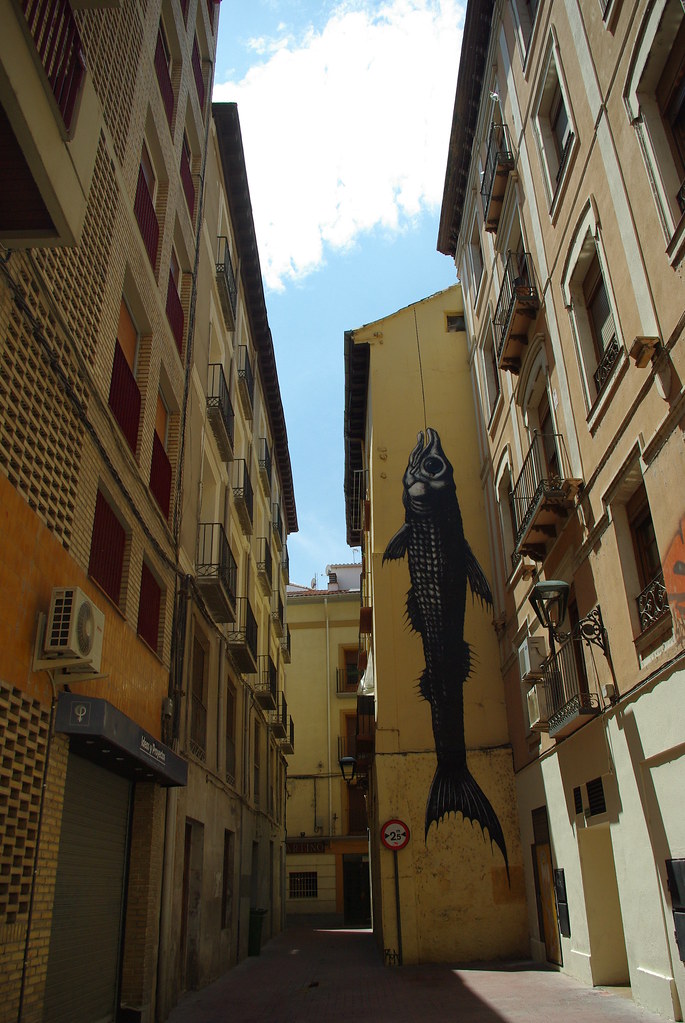
2010
Zaragoza, Spain
Unfortunately, ROA doesn't always paint his creatures in or near their natural habitat. I love his giant anteater, pictured trotting along the side of a single-story building in the Mexican state of Guanajuato, but I wonder if the artist realizes that the species is extirpated north of Honduras. Still, because giant anteater fossils have been found in northern Mexico, let's give the artist the benefit of the doubt and interpret this piece as an observation about ecological change. A stylized blue whale rising from a sea of grass outside an abandoned factory in Moscow, Russia, however, is too far from an ocean to be rationalized. Its incongruity is amusing and the image is beautifully crafted, but the piece lacks the impact of ROA's more considerate efforts. No worries. ROA's terrific Virginia opossum in downtown Los Angeles, its prehensile tail wrapped around a stretch of the building's brickwork, more than makes up for the misplaced whale!
While my fondness for natural history makes me an unusually nit-picky viewer, it also means that I'm especially excited by the urban and exurban placement of ROA's rats, squirrels, starlings, herons, raccoons, cormorants, and skunks. These animals are hardy and adaptable, and have proven able to thrive in ecosystems dominated by human habitation. Many people dismiss these creatures as pests, but their presence in our lives is of significant value. As we become an evermore urban species, they are our most immediate connection to the undomesticated, non-human world. In this respect, ROA's murals are portraits of our closest neighbors.
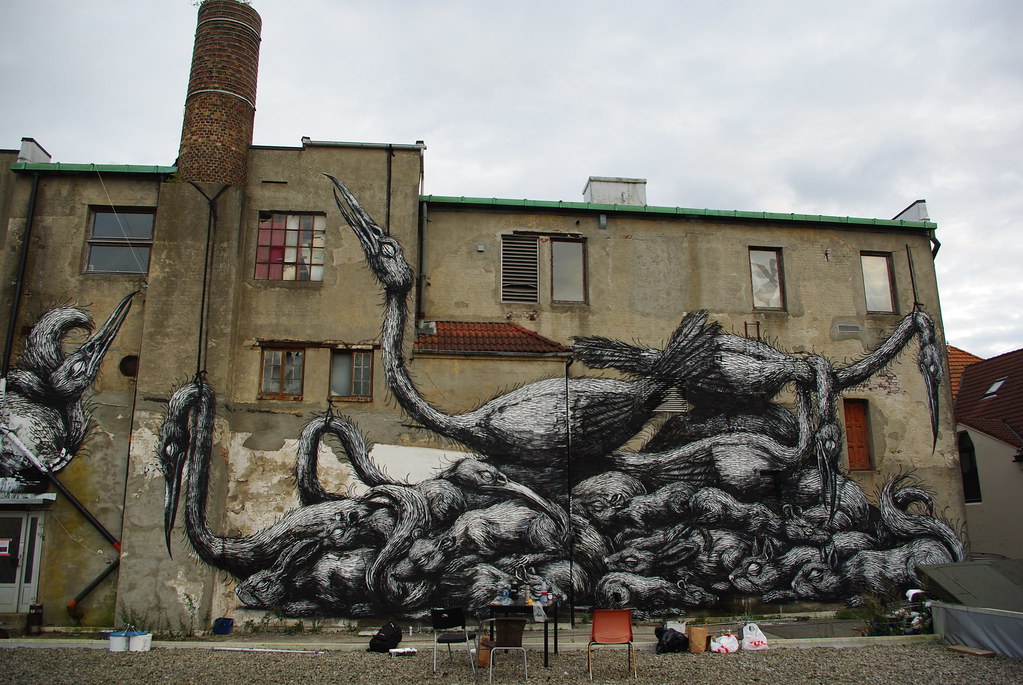
From the "NUART Landmark Series"
2010
Stavanger, Norway
Some of ROA's more elaborate murals depict great piles of dead animals. These call to mind the tables laden with rotting fruit, hunted game, and skulls that appear in many 15th century Northern European vanitas ("emptiness"), memento mori ("remember your mortality"), and ars moriendi ("art of dying") still life paintings. As their names suggest, all of these allegorical works were created as nods to death's inevitability. It seems these themes preoccupy ROA, too. One of his best memento mori works is located in Stavanger, Norway. Lifeless squirrels, rats, rabbits, and herons are heaped at the foot of an old warehouse, with the limp necks of the herons apparently tied to cords on the wall's face (should we call this reverse trompe l'oeil?) In Mexico City, ROA adds a raccoon, armadillo, and skunk.

2011
Mexico City, Mexico
These murals will seem grotesque and bleak to some viewers, but they aim to inspire by reminding us that life is transitory. The sentiment was expressed well by Steve Jobs during his 2005 Stanford University commencement address, a speech that, in the wake of Jobs' untimely death from cancer, has been making Internet rounds. Jobs said,
"Remembering that I'll be dead soon is the most important tool I've ever encountered to help me make the big choices in life. Because almost everything — all external expectations, all pride, all fear of embarrassment or failure - these things just fall away in the face of death, leaving only what is truly important. Remembering that you are going to die is the best way I know to avoid the trap of thinking you have something to lose."In many respects, ROA's works are the less refined kin of Walton Ford's paintings. Both artists address mortality and the relationship of humanity to other animal species with humor and finesse, but ROA's pictures are less layered with art historical and natural history references; as a result, they're more accessible and immediately gratifying.
Based on the images he shares on his Flickr photostream, the talented 30-something has at least five murals in San Francisco. Let's hope that he returns to the Bay Area and contributes more of his handiwork to our landscape.
Sunday, September 26, 2010
Update: Jane Hammond's "Fallen"

"Fallen"
2010
Dimensions variable
In January 2006, I wrote a short post about Jane Hammond's mixed-media, evolving sculpture "Fallen," a melancholy and beautiful tribute to the lives lost during the (now sort-of-but-not-really-over) Iraq War.
When it was exhibited in 2005, the work consisted of 1,500 paper leaves, each meticulously crafted by the artist and inscribed with the name of an American soldier who met his or her end during the invasion or occupation of Iraq. At the time of my post, I wondered if Hammond had continued to add leaves to the work.
A couple of weeks ago, four-and-a-half years after I wrote about "Fallen," the artist sent me an email telling me more about the life of the sculpture. I share the bulk of her update below, along with some images of the piece as it was in 2005 (below) and as it looks more recently (above, and detail below).
"I make the leaves by hand and each is based on a real leaf which I gather and digitally scan, then there is cutting, hand-painting, a little fiberglassing and more hand-painting, then they are signed by me with sumi ink and a brush pen and molded into a three-dimensional form.
[...A]ll the leaves in the piece you saw at Lelong were from upstate Connecticut, gathered in the Fall of 2004—I have now gathered leaves in Hawaii. Washington State, California, Colorado, Texas, Arkansas, Missouri, Michigan, Mississippi, Alabama, Virginia, Maryland, Massachussetts, Vermont, New Hampshire, Maine and Rhode Island. And adding to the original group from 2004, I have gathered in the Autumns of 2005, 2006, 2007, 2008, 2009. And I am sure I will gather some in 2010 this Fall.
[...]This Fall, ["Fallen"] will [...] be shown at the Taubman Museum in Roanoke, Virginia from September 23rd until January 10th, 2011. It will open with 4,390 leaves."

"Fallen" detail
2010
Dimensions variable
Sadly, she does have more leaves yet to add.

"Fallen"
2005
Dimensions variable
Image credits: courtesy Jane Hammond
Sunday, May 16, 2010
Susan Silas' Heroic Living

"found birds; 2000 - the present"
(Image 17 of 23 from the portfolio "eyes wide shut")
2010
Archival ink jet prints on Hahnemühle photo rag paper
22 x 17 inches
Until recently, I was unfamiliar with Susan Silas' artwork. She is perhaps best known for projects memorializing the Shoah, but it wasn't an awareness of her Holocaust work that led me to "Helmbrecht's Walk, 1998-2003." Instead, it was a photograph of a dead American kestrel that Silas emailed me in March.
I have only an inkling of what essay or artwork of mine inspired the artist to send me the image, but I'm grateful that she did. I shamelessly admit to being the sort who finds soulful beauty in images of death, and I was touched by the striking and contemplative photograph. A month after I received the picture, I visited Silas in her Brooklyn home, to look at prints from her "found birds" series. Still pondering her work a week after that visit, I headed to Hebrew Union College's Jewish Institute of Religion Museum, eager to compare what I saw and sensed in "found birds" to Susan's more easily classifiable (though by no means "easy") Shoah work.
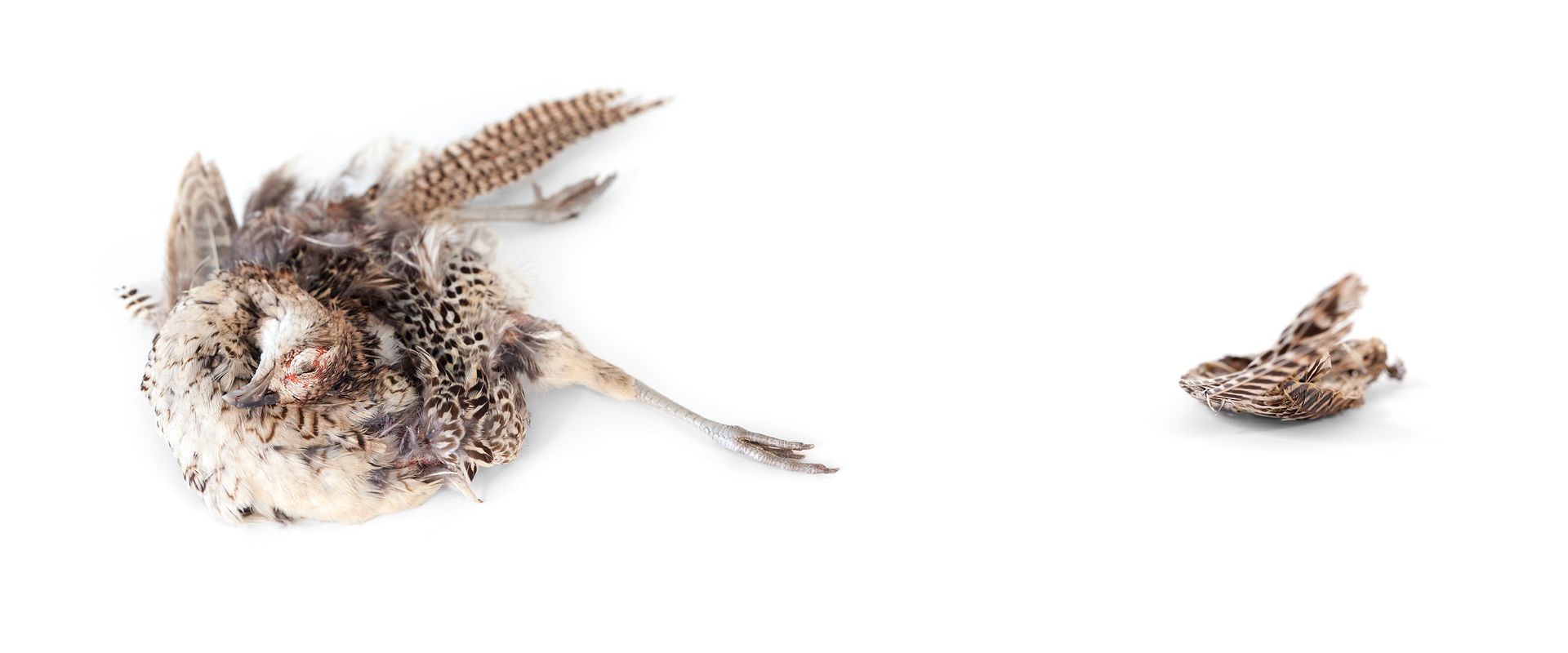
"found birds; 2000 - the present"
(Image 3 of 11 from the portfolio "what remains")
2010
Archival ink jet prints on Hahnemühle photo rag paper
20 x 48 inches
The HUC press release for "Helmbrecht's Walk" describes the project succinctly.
"On April 13, 1945, more than 700 women were forced to march 225 miles in 22 days from the Helmbrecht's Labor Camp, a small satellite unit of the Flossenburg Concentration Camp in Germany, to the Czech city of Volary. [...] During the course of this forced march the women were ill fed, inadequately clothed, denied shelter, and capriciously beaten. On the sixth day of the march, the non-Jewish prisoners were separated from the group, leaving the remaining 580 Jewish women to continue until May of 1945.Silas' project addresses the complicated relationship between place and time or, as cultural critic and historian Simon Schama's consideration of the topic framed it, "landscape and memory." When Silas conceived of the Helmbrecht's project, she believed (or maybe hoped) that walking the same path that the Helmbrecht's women had would allow her some intimate experience of or insight into the terrible march. In fact, this didn't prove so. Silas describes her walk as "relatively mundane and unexceptional." She continues, "My feet hurt. I get tired. [...] I found it more, rather than less difficult to understand how these women made this journey once I was out on the road."
With determination and sensitivity, Silas traced the march in 1998 on the 53rd anniversary of the event by walking along the same path as the Helmbrecht's women for 22 days in Germany and the Czech Republic. She documented her journey in Helmbrecht's Walk, a collection of 48 archival color prints presented as an unbound book. [...] The images contextualized by Silas' daily commentary of her own experiences are coupled with news reports of event occurring elsewhere in the world on that same day in 1998. This juxtaposition, she says, functions 'to heighten our awareness of the fact that we are all presently witnesses to unspeakable events and extreme suffering for which we take no more responsibility than did many witnesses to the Holocaust.'"
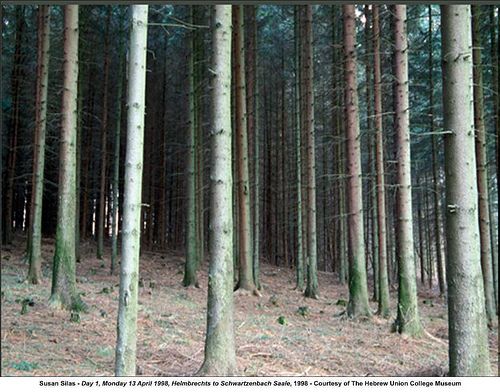
"Helmbrecht's Walk, 1998 - 2003"
(Day 1, Monday 13 April 1998, Helmbrechts to Schwartzenbach Saale, 1998)
Archival ink jet prints on Hahnemühle photo rag paper
Yet many of the captions she includes with the photographs reference artists and thinkers such as Werner Herzog, who understand "walking as a sacrament." Such language calls to mind the Australian Aborigines' songlines, mnemonic stories that are spoken or sung as the Aborigine walks over the referenced terrain. In his marvelous book Spell of the Sensuous, David Abram relates a striking, relevant anecdote.
"A similar tale is told by [Bruce] Chatwin. He was traveling in a Land Cruiser with several friends, including an Aboriginal man nicknamed Limpy whom they were driving to a particular place on his songline. Limpy, whose clan Ancestor was the Native Cat, or tjipla (a small marsupial with a long, banded tail), had never been to this place along the Native Cat songline, yet he now wished to go there in order to see some distant relatives who were dying there. During the course of seven hours driving through the back country, bumping across shallow rivers and under gum trees, the Aboriginal man sat motionless in the front seat, squeezed between the driver, Arkady, and another passenger, except for a short burst of action when the truck crossed part of his songline. Later,I believe that what was missing for Silas was a story line, the narrative informed by the landscape (and vice versa) that, among indigenous groups such as the dwindling Aboriginal population of Australia, is traditionally passed from generation to generation. In some respects, "Helmbrecht's Walk" is an attempt to locate such a story, an earnest effort to discover in the landscape the marks of what happened decades before. In our postmodern, peripatetic culture, nations and traditions do not generally fare well. In some respects, this is a positive development, as our tribal perspectives and prejudices erode into some variety of tentative, liberal pluralism. On the other hand, it's ever more difficult to feel confident about one's identity and how it relates to landscape, vocation, and nation.'[w]e came to the confluence of two streams: that is, we met the stream we had crossed higher up on the main road. This lesser stream was the route of Tjilpa Men, and we were joining it at right angles. As Arkady turned the wheel to the left, Limpy bounced into action. Again he shoved his head through both windows. His eyes rolled wildly over the rocks, the cliffs, the palms, the water. His lips moved at the speed of a ventriloquist's and, though them, came a rustle: the sound of wind through branches.
Arkady knew at once what was happening. Limpy had learnt his Native Cat couplets for walking pace, at four miles an hour, and we were traveling at twenty-five. Arkady shifted into bottom gear, and we crawled along no faster than a walker. Instantly, Limpy matched his tempo to the new speed. He was smiling. His head swayed to and fro. The sound became a lovely melodious swishing; and you knew that, as far as he was concerned, he was the Native Cat.'"
My time with "Helmbrecht's Walk" confirmed my supposition, however, that Susan's art is not primarily interested in cultural identity or particular histories. Instead, she is most concerned with "the big questions." To one degree or another, all art wrestles with or reacts to these existential imponderables, but Susan's exploration is more focused and urgent than most. Fortunately, even though her work is preoccupied with mortality and meaning, she manages to avoid the pitfalls of such terrain; her work is neither macabre nor aestheticized to the point of anesthetization.

"found birds; 2000 - the present"
(Image 1 of 21 from the portfolio "blackbird")
2010
Archival ink jet prints on Hahnemühle photo rag paper
22 x 17 inches
Two days after I visited "Helmbrecht's Walk," I read "Eudaimonia, existentialism, and the practice of medicine," an essay by Dr. Andrew Radu included in the Spring 2010 issue of The Pharos of Alpha Omega Alpha Honor Medical Society. In his essay, Dr. Radu describes the existentialist ideal of tragic optimism. He writes of it, "even in the face of imminent death, we have the ability to reevaluate life." He goes on:
"A crucial concept held by many existentialist philosophers is that of heroic living. All humans have the ultimate freedom to live boldly in the face of tragedy. Living with this concept makes attaining a goal of eudaimonia less important than simply striving to do so. [...] The concept of tragic optimism proposes that in a life that can be circumscribed by pain, guilt, and death, one should say 'yes to life in spite of everything.'"Indeed, as I wrote in "Eudaimonia," a January 2009 essay that explored my then nascent optimism,
"Acknowledging our species' precarious position is not defeatist; on the contrary, accepting the inevitable nourishes the individual's desire to contribute. Faced with an impossibly difficult prospect, only individual effort can sustain us. As Albert Camus concluded in The Myth of Sisyphus, 'The struggle itself is enough to fill a man's heart. One must imagine Sisyphus happy.'"The Shoah is bleak history, a subject watered by the blood of millions, and it is fertile soil for such "big questions." Silas' "found birds" remind us that so, too, is the striving and passing of a blackbird. The artist's reckoning with death is her own form of "heroic living."
Image credits: all artwork, courtesy Susan Silas
Monday, February 08, 2010
Nathan Abels' "Natural Causes"
I wrote the following short essay for the exhibition catalog that accompanies Nathan Abels' "Natural Causes," currently on display at Rule Gallery, in Denver, Colorado.
+++++

Nathan Abels
"Sullen Roar"
Acrylic on panel
36 x 48 inches
2009
At the extent of the campfire's reach, we glimpse a shadowed form. Then it is gone. What is it that we saw there, at the light's limit? In that instant of vague apprehension, before our mind has had time to interpret the stimulus, we are John Dewey's "live animal," a creature "fully present, all there, in all of its actions: in its wary glances, its sharp sniffings, its abrupt cocking of ears." The "live animal" mode is often awakened by an alarming sight or sound, but it can also be brought on by a rush of emotion or any substantial sensual experience. If we remain attuned, "fully present," our nurtured sense of self may be blurred, even surrendered, and the scrim of conventional, acculturated understanding is ruptured. We recognize that transcendental mysteries and primordial presences are located in ordinary experience, and that our mundane perception of the material world is incomplete. We see the world anew, boundless and beautiful.
Nathan Abels' artwork is concerned with such transformative breakthroughs. Many of his works juxtapose the primeval with the temporal. "Wildfire" pictures the moon, our planet's celestial companion, serene above a raging forest fire, a violent agent of ecological transformation, both destructive and renewing. In "Sullen Roar," the lights of human infrastructure glow like our aforementioned campfire, but the riverside outpost is surrounded by an opaque darkness. Abels reminds us that the hum and pulse of human civilization amounts only to a footnote when considered within a more holistic context. Other works, such as "Passage" or "Half-Seeing," picture moments of potential rupture, opportunities for personal transfiguration. In "Passage," a spelunker slides on his back through a narrow section of cave. His headlamp illuminates the low ceiling. The confined space would make even the least claustrophobic among us uncomfortable, and the viewer senses the spelunker's powerlessness. Such an experience, like the wildfire, can be at once annihilative and regenerative. It is a subjugation of the self, a recognition of the infinitesimal reach of our individual vision, yet also an expansion of our vision to include the infinite variety and scope of being.

Nathan Abels
"Half-Seeing"
Acrylic on panel
36 x 48 inches
2010
Abels refers to his paintings and drawings as "visual pauses" in an otherwise "persistent turbulence." To be sure, our contemporary landscape is a turbulent one: industrialized, globalized, and digitized for maximal efficiency and consumption. We are so burdened by stimulation as to be deadened to the underlying reality of each moment and every place. Abels' "visual pauses" are a response to our routine mindlessness; the artist provides the viewer with opportunities to regain focus, to intuit the unfathomable in the worldly. His drawings and paintings are pictures of transitional experiences at the edge of known and unknown.

Nathan Abels
"Denouement"
Acrylic on panel
36 x 48 inches
2009
Image credits: courtesy the artist
+++++

"Sullen Roar"
Acrylic on panel
36 x 48 inches
2009
At the extent of the campfire's reach, we glimpse a shadowed form. Then it is gone. What is it that we saw there, at the light's limit? In that instant of vague apprehension, before our mind has had time to interpret the stimulus, we are John Dewey's "live animal," a creature "fully present, all there, in all of its actions: in its wary glances, its sharp sniffings, its abrupt cocking of ears." The "live animal" mode is often awakened by an alarming sight or sound, but it can also be brought on by a rush of emotion or any substantial sensual experience. If we remain attuned, "fully present," our nurtured sense of self may be blurred, even surrendered, and the scrim of conventional, acculturated understanding is ruptured. We recognize that transcendental mysteries and primordial presences are located in ordinary experience, and that our mundane perception of the material world is incomplete. We see the world anew, boundless and beautiful.
Nathan Abels' artwork is concerned with such transformative breakthroughs. Many of his works juxtapose the primeval with the temporal. "Wildfire" pictures the moon, our planet's celestial companion, serene above a raging forest fire, a violent agent of ecological transformation, both destructive and renewing. In "Sullen Roar," the lights of human infrastructure glow like our aforementioned campfire, but the riverside outpost is surrounded by an opaque darkness. Abels reminds us that the hum and pulse of human civilization amounts only to a footnote when considered within a more holistic context. Other works, such as "Passage" or "Half-Seeing," picture moments of potential rupture, opportunities for personal transfiguration. In "Passage," a spelunker slides on his back through a narrow section of cave. His headlamp illuminates the low ceiling. The confined space would make even the least claustrophobic among us uncomfortable, and the viewer senses the spelunker's powerlessness. Such an experience, like the wildfire, can be at once annihilative and regenerative. It is a subjugation of the self, a recognition of the infinitesimal reach of our individual vision, yet also an expansion of our vision to include the infinite variety and scope of being.

"Half-Seeing"
Acrylic on panel
36 x 48 inches
2010
Abels refers to his paintings and drawings as "visual pauses" in an otherwise "persistent turbulence." To be sure, our contemporary landscape is a turbulent one: industrialized, globalized, and digitized for maximal efficiency and consumption. We are so burdened by stimulation as to be deadened to the underlying reality of each moment and every place. Abels' "visual pauses" are a response to our routine mindlessness; the artist provides the viewer with opportunities to regain focus, to intuit the unfathomable in the worldly. His drawings and paintings are pictures of transitional experiences at the edge of known and unknown.

"Denouement"
Acrylic on panel
36 x 48 inches
2009
Image credits: courtesy the artist
Saturday, December 12, 2009
Sunset, Sunrise

"Our destiny, our being's heart and home,
Is with infinitude, and only there;
With hope it is, hope that can never die,
Effort and expectation, and desire,
And something evermore about to be."
- William Wordsworth, The Prelude
"Indeed, from within the murkiness of human knowledge and experience, we rightly wonder, is there any room for theology as such - or has it gone the way of all heavenly things? Perhaps all that remains is some mode of natural piety, such as the shudder before the mortal mysteries (with Goethe), or the felt ecstasies of springtime (with Wordsworth). Surely this is a lot, and unsettles the mind from its human habitudes. But is there more?
[...] Like all matters human, theology must be grounded in earthly experience and understood from within its forms. The phenomenal world is all that we have. This is the sphere that lies before us in our everyday existence; it conditions the products of aesthetic perception; and it provides the sphere for theological experience and reflection.
[...] As natural beings we are, in the most elemental sense, coextensive with this realm: our bodies are composed of it, our stomachs take in and digest its matter, and we traffic with this world all our days until we die and are decomposed into its elements. [...] To more properly sense [the] unfolding of the Godhead into world-being, so to speak, or to perceive or intuit its penetrations therein, we must first return to our ordinary experiences."
- Michael Fishbane, Sacred Attunement: A Jewish Theology

Happy Hanukkah, folks.
Photo credits: Hungry Hyaena, 2009
Sunday, November 29, 2009
Picturing Alternative Futures

From the "Feral Houses" series
Last week, Flavorpill's Flavorwire newsletter introduced me to James Griffioen's photography. "Feral Houses," the series featured by Flavorpill, focuses on abandoned houses in Detroit, Michigan. Griffioen writes,
"For a few beautiful months every summer, some of the tens of thousands of abandoned houses become feral in every sense: they disappear behind ivy or the untended shrubs and trees planted generations ago to decorate their yards. As the city of Detroit disappears, nature is flourishing."Considered as a whole, the "Feral Houses" series is a record of our complicated relationship with the land upon which we live and depend, as well as of our ailing community roots.

From the "Feral Houses" series
Detroit's Rust Belt era history is generally bleak. Today, much of the city is classified as a food desert. Sitting down for a hearty meal with friends and family this Thanksgiving evening, I recalled Rebecca Solnit's inspiring Harper's Magazine article, "Detroit Arcadia" (July 2007). Solnit writes,
"Detroit is a cautionary tale about one-industry towns: it shrank the way the old boomtowns of the gold and silver rushes did, as though it had been mining automobiles and the veins ran dry, but most of those mining towns were meant to be ephemeral. People thought Detroit would go on forever. [...] I took many pictures on my visits to Detroit, but back home they just looked like snapshots of abandoned Nebraska farmhouses or small towns farther west on the Great Plains. Sometimes a burned-out house would stand next to a carefully tended twin, a monument to random fate; sometimes the rectilinear nature of city planning was barely perceptible, just the slightest traces of a grid fading into grassy fields accented with the occasional fire hydrant. One day after a brief thunderstorm, when the rain had cleared away and chunky white clouds dotted the sky, I wandered into a neighborhood, or rather a former neighborhood, of at least a dozen square blocks where trees of heaven waved their branches in the balmy air. Approximately one tattered charred house still stood per block. I could hear the buzzing of crickets or cicadas, and I felt as if I had traveled a thousand years into the future."Yet the central focus of Solnit's essay are the heroic, local reclamations of Detroit's abandoned lots for community gardens or small-scale farming enterprises.
"I also saw the lush three-acre Earth Works Garden, launched by Capuchin monks in 1999 and now growing organic produce for a local soup kitchen. I saw a 4-H garden in a fairly ravaged east-side neighborhood, and amid the utter abandonment of the west side, I saw the handsome tiled buildings of the Catherine Ferguson Academy for Young Women, a school for teenage mothers that opens on to a working farm, complete with apple orchard, horses, ducks, long rows of cauliflower and broccoli, and a red barn the girls built themselves. I met Ashley Atkinson, the young project manager for The Greening of Detroit, and heard about the hundred community gardens they support, and the thousands more food gardens that are not part of any network. The food they produce, Atkinson told me, provides food security for many Detroiters. 'Urban farming, dollar for dollar, is the most effective change agent you can ever have in a community,' she said. Everywhere I went, I saw the rich soil of Detroit and the hard work of the gardeners bringing forth an abundant harvest any organic farmer would envy."Similar projects are gaining momentum in American cities that aren't suffering as acutely as Detroit. Community garden and farmer's market movements are thriving in many urban centers, and urbanite hunters are no longer unheard of. Last week, the New York Times reported on the growing number of locavores taking up hunting, but, unlike Charlottesville, Virginia's "Deer Hunting for Locavores" class and San Francisco's Bull Moose Hunting Society, ventures made possible by relative privilege and foresight, Detroit's repurposing and enterprise is born of pressing need.

From the "Feral Houses" series
Contemplating Griffioen's handsome photographs, it's impossible not to think of Detroit's economic and health struggles. Still, his subjects, the "feral houses" themselves, don't strike this Eastern Shore boy as that unusual. All regions marked by poverty offer up monuments to the ceaseless action of Nature and time. Recent studies show that Accomack, the Virginia county that I was raised in and that my parents call home, is "the fattest" county in the state. It is also one of the poorest. Abandoned houses and overgrown automobiles figure as prominently in my mental portrait of the Shore as do salt marshes and the rich smell of freshly turned earth.
Unlike the citizens of Detroit's urban environment, Eastern Shore folks are not strangers to hunting, fishing, or farming. One might therefore assume that food desertification and obesity are unlikely. Unfortunately, access to fresh, healthy foods doesn't mean that locals won't instead opt for fast food! Furthermore, community ties might be even weaker on the Shore than they are in Detroit, eroded in part by an epidemic reliance on the automobile and big-box stores.
What does the future portend for Detroit and Virginia's Eastern Shore? Taking the long view, I'm optimistic. A decade hence, Detroit might well provide a more sustainable model for beleaguered urban communities. The Eastern Shore, however, is a different type of community, and one still on the decline; recovery will come more slowly.

House on White's Neck Road; Parksley, Virginia
Like Griffioen's pictures, Don Amadeo's photographs of the Eastern Shore remind us of the slow creep of geologic time, the long long view. Human communities may rise and fall and rise again, but all eventually succumb. So, too, with species. There is an ambivalent beauty in overgrown ruins; they celebrate the wonder of life's eternal striving even as they proclaim mortality.

Ole Rusty; Parksley, Virginia
Photo credit: "Feral Houses" photographs, courtesy James Griffioen; ShoreRebel photographs, courtesy Don Amadeo
Wednesday, September 09, 2009
Kimmel Harding Nelson Residency: Day 3

Soundtrack
It's a treat to recognize voices that were once familiar enough to be taken for granted. After years of city living, my ears hunger for the soundtrack I knew in childhood.
Yesterday morning, the staccato lament of a mourning dove (Zenaida macroura) greeted me as I dressed. Later, standing beside an overgrown lot, I listened to the rasp-rattle-click of grasshoppers in the tall grass. Nearby, on the same block, the up-and-down whine of cicadas reverberated within me. At mid-day, as I explored the grassy fringes of a grain elevator operation on the western bank of the Missouri River, my progress scattered noisy grasshoppers, large and small, in every direction.
As I type this post, a male field cricket's (Gryllus pennsylvanicus) insistent plea sounds from a dark corner of the studio. I locate and playback a recording of the call on my laptop, hoping that the sound of another male suitor might draw the cricket out of the shadows for some Orthoptera fisticuffs. The aural lure fails, but I'm made happy by the attempt; the cricket cries for a mate and, with a keyboard click, I call back.
Life, I'm reminded by the persistent call of this cricket, and by the grasshoppers, the mourning dove, and the cicadas, is fleeting, yet rich and good. As Nebraska native, anthropologist, and author Loren Eiseley writes of "endlessly reiterated" frog calls,
"I suspect that to some greater ear than ours, man's optimistic pronouncements about his role and destiny may make a similar little ringing sound that travels a small way into the night."Every creature's song is at once insignificant and grand. The middle school marching band is passing by my studio now, and the cricket and I are quiet.

A Kettle of Vultures
Appropriately enough, as I walked past a mortuary two doors west of the KHN Center, I noticed seven turkey vultures circling low above the town. The night before, I'd read Lia Purpura's poetic essay "On Coming Back as a Buzzard" in the September/October issue of Orion. Given my dual love of natural history and language, I'm embarrassed to admit that, before reading Purpura's piece, I didn't realize that a group of vultures on the ground is called a "venue," and a group of vultures in flight is called a "kettle."
Watching the peaceful, unchoreographed aerial dance of this Nebraska City kettle, I recalled Mary Oliver's beautiful poem, "Vultures," as well as some of Purpura's essay, written from the perspective of a vulture.
"As a buzzard, I’d know the end of a thing is precisely not that. Things go on, in their way. My presence making the end a beginning, reinterpreting the idea of abundance, allowing for the ever-giving nature of Nature—I’d know these not as religious thoughts. It’s rather that, apportioned rightly, there’s always enough, more than enough. 'Nothing but gifts on this poor, poor earth,' says Milosz, who understood perfectly the resemblance between dissolve and increase. Rain scours and sun burns away excesses of form. And rain also seeds, and sun urges forth fuses of green.""On Coming Back as a Buzzard" is a paean to reconstitution. How smart and satisfying to embrace the natural end as another corporeal beginning! I pray that my dead body will be saved from the poisonous excesses of a mortuary, that it will instead be wrapped in a simple cloth, laid in a simple wooden box, and buried without the insult of preserving chemicals and concealing makeup. I pray that the worms and the soil will consume me, will leech me and take me, so that my matter will become energy for other forms. I utter this prayer in silence as I look up at the dark birds.

Elsewhere, Purpura writes,
"I'd love best the movement of stages and increments, to repeat 'this bank and shoal of time' while below me banks and shoals of a body went on welling/receding, rising and dropping. I'd be perched on a wire, waiting, ticking off not the meat reducing, but how what's left, like a dune, shifts and reconstitutes."Even when alive, our bodies are forever in flux, forever "shift[ing] and reconstitut[ing]." After death, though, a profound reinterpretation and recycling of "self" takes place.
The biologists, writers, painters, and physicists who worship Nature are enthused by reconstitution because it is plain, profound truth. As the poet Galway Kinnell describes it in his terrific poem, "The Quick and the Dead," "the crawling of new life out of the old, which is what we have for eternity on earth."

First Episcopal church in Nebraska; Founded 1857
But most folks, many of them good, kind people, don't share this enthusiasm for reconstitution. I presume, perhaps wrongly, that Nebraska City is home to many such individuals. On what grounds do I make this presumption? Firstly, it's a safe speculation anywhere in the world. Most humans prefer a supernatural view of afterlife. Secondly, Nebraska City is home to a good number of churches (nineteen, by my present count), and I make assumptions (sometimes wrong) about the stripe of belief held by the majority of American Christians. No doubt there are exceptions to the rule, but most of the religious Christians I know frown upon materialistic interpretations of life everlasting. Some go so far as to reject my panentheistic or panendeistic conceptions of morality and material being as heretical nonsense.
No matter; live and let die. I find the Christian notions of ascension and self-conscious afterlife ridiculous, and most Christians find my cherished reconstitution as a bit of larvae, a bit of root, a bit of this and that, grotesque and even offensive. Neither conception, though, prevents the individual from acting ethically, and that is, above all, what matters. As Purpura puts it,
"[The vulture] gets to reorder your thoughts about troves, to prove the spilled and shoveled-aside to be treasure. To reconfer notions of milk and honey, and how to approach the unbidden."Put more explicitly, one man's materialistic mess is another man's milk and honey.
Photo credits: all photos, Hungry Hyaena, 2008, 2009
Saturday, July 25, 2009
At Dawn I Have Birds
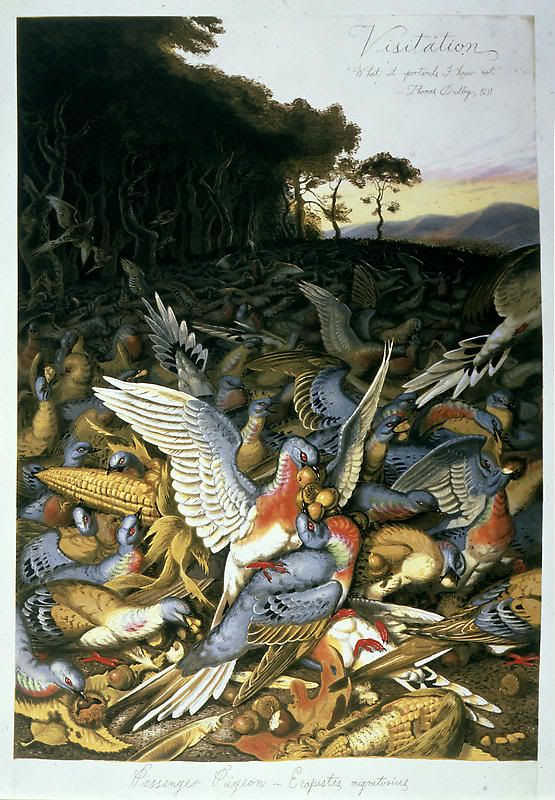
"Visitation"
2004
Six color hardground and softground etching, aquatint, spit-bite aquatint, drypoint on Somerset Satin paper
44 x 30 7/8 inches
"Often, lately, the night is a cold maw
and stars the scattered white teeth of the gods,
which spare none of us. At dawn I have birds,
clearly divine messengers that I don't understand
yet day by day feel the grace of their intentions."
— from "Age Sixty-nine," by Jim Harrison
Image credit: ripped from the Paul Kasmin Gallery website
Monday, April 13, 2009
Being Prey
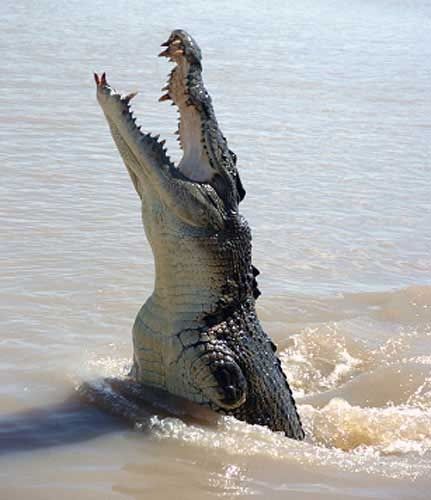
"The bank now presented a high, steep face of slippery mud. The only obvious avenue of escape was a paper bark tree near the muddy bank wall. I made the split second decision to leap into its lower branches and climb to safety. I steered [the canoe] to the tree and stood up to jump. At the same instant, the crocodile rushed up alongside the canoe, and its beautiful, flecked golden eyes looked straight into mine.Val Plumwood, an Australian feminist and environmental activist who died last year, describes a nearly fatal attack by a saltwater crocodile (Crocodylus porosus) in her 2000 essay "Being Prey."
Perhaps I could bluff it, drive it away, as I had read of British tiger hunters doing. I waved my arms and shouted, 'Go away!' The golden eyes glinted with interest. I tensed for the jump and leapt. Before my foot even tripped the first branch, I had a blurred, incredulous vision of great toothed jaws bursting from the water. Then I was seized between the legs in a red-hot pincer grip and whirled into the suffocating wet darkness."
In 1985, in Australia's Kakadu National Park, Plumwood's canoe was repeatedly struck by the crocodile until, capsize imminent, she attempted escape into an overhanging tree. Her attempt failed; the croc took Plumwood underwater and "death rolled" her three times. Incredibly, Plumwood survived the attack. Once she'd managed to surmount the steep bank, her injuries forced her to crawl almost two miles before a park ranger found her.
The terrifying experience inspired Plumwood to ponder the frayed relationship between humanity and the rest of the animal kingdom. In the course of doing so, she questioned the usual motivation for adopting a vegetarian diet.
"Although I had been a vegetarian for some ten years before the encounter with the crocodile and remain one today, this knowledge makes me wary of the kind of uncontextualized foundation for vegetarianism that suggests that predation is either a negligible anomaly or an unredeemable ethical deficiency in the ecosystem. The presentation of the food chain as a (potentially) peaceful order ideally subject to nonviolent reconfiguration leads ultimately toward the thoroughly anti-ecological position that the earth is ethically improved by the elimination of predation."I couldn't agree more. Similar thinking inspired me, five years ago, to become a vegetarian unless I kill or catch the animal myself. Predation is natural, even when we are the prey.
Photo credit: ripped from Virgin Media
Monday, September 29, 2008
"Implant" at UBS Art Gallery

Michael Pollan working his garden
Curator Jodie Vicenta Jacobson cites Michael Pollan's The Botany of Desire as inspiration for "Implant," a Horticultural Society of New York exhibition sponsored and hosted by the international financial firm UBS. Jacobson is especially interested in Pollan's assertion that plants "use us" to further their evolutionary objectives. Although the notion that "plants control humans" is simplistic spin on what is in fact a complex web of interdependence, I smile on attempts to shake up (or down) the Judeo-Christian scalae naturae and so was predisposed to Jacobson's conceptualization of "Implant."
Unfortunately, most of the work Jacobson includes is only tangentially relevant to Pollan's thesis. Perhaps she believes that a curator should avoid intellectual illustration, that it is better for viewers to ruminate on the art with a loose curatorial contention in mind. Even if this is her stance, however, the selections seem arbitrary. In an accompanying brochure, she states that "the personal artist/subject bond is forged within a larger context of each individual's intrinsic understanding of his/her place in nature." The statement is valid (if vague) but, even though all the paintings, drawings, sculptures and videos in "Implant" include floral or botanical imagery, with few exceptions they are not about flowers or vegetation. Considered as a whole, "Implant" reflects, at worst, an intrinsic misunderstanding of our place in nature and, at best, a disinterested remove from the rest of life. One senses that many of these artists do think seriously about the so-called natural world, but have little firsthand experience with it.

Ann Craven
Studio view, December 2003
What, really, do such "art about art" works as Simon Starling's flowery chaise lounge and Karen Kilimnik's photographs of her still-life paintings have to do with the show's conceit? Or Carol Bove's bookshelf and Ann Craven's stacked watercolors? Certainly, Craven paints pretty canaries and orchids, but she is less concerned with the behavior or anthropological significance of Serinus and Orchidaceae than she is with questions of reproduction and commodification. The critical insistence that Craven's paintings "undercut Disney-esque references" and "raise questions about domestication...[of] once wild species"(1) is a stretch. The paintings don't communicate these ideas, and a viewer should not take a leap of faith that the paintings do not themselves impel (no matter what the accompanying wall text prompts).
One of the volumes included in Bove's bookshelf arrangement is propped open to a lovely botanical illustration; Bove's other books are placed spine-out, so that their titles can be easily read. The viewer is meant to ponder the connections between the artist's selections, but when I scan the books included, I don't find myself thinking on horticulture or the human/plant relationship; the work is principally concerned with 1960s soul searching.
What are these works doing here? Did Jacobson cherry-pick artists she likes and then try to find a connection between their work and the notion that plants control humans? That's a bass-akwards way to curate, but Jacobson herself lends credence to the charge in a brochure accompanying "Implant." A section called "Artist Focus: Felix Gonzalez-Torres" begins,
"I have been thinking about the 'Implant' exhibition in relation to Felix Gonzalez-Torres from its very inception. I consider him a keystone artist, not only for this exhibition, but for my entire curatorial program, and moreover in the world view of contemporary art. Contemplating Gonzalez-Torres' work in relationship to this specific exhibition has led me to various ends, both specific and open. The context of the exhibition is determined by the relationship between the artists involved, who, like Gonzalez-Torres, are not artists that primarily work with plants, but artists that have in a sense collaborated with plants to further a more specific idea. Therefore, 'Implant' is not narrowly themed, but quite open..."It seems as though Jacobson admits that her primary aim is to assemble a terrific group of artists in one exhibition, so why hem them in with an unsuitable theme? I suppose only Jacobson could answer the question (and I invite her to), but it's a shame that so many horticulture enthusiasts and botanists who visit the show will be at turns irritated and baffled by Ms. Jacobson's curation.
Granted, I'm more of a stickler for lucid curation than most. I assume that my grumbling about "Implant" will be shrugged off by many readers. Perhaps that's fair, but Jacobson's curatorial missteps might be more easily overlooked if they weren't a front-and-center distraction.

Tacita Dean
"Baobab III"
2001
Black & white photograph on fibre paper
26 1/2 x 41 inches
The exhibition overview ignored, many of the works in "Implant" are good to excellent: Darren Almond's long exposure photographs are meditative and beautiful; Zach Harris's otherworldly paintings descend from Charles Burchfield and Buddhist mandalas; Nick Cave's frantic flower tower mannequin is a playful delight; Tacita Dean's handsome photographs present the curious baobab tree, a species whose branches evoke neuronal dendrites. Yet none of these four artists contribute works that seem, as Jacobson put it, "rooted in a radical concept offered by horticultural author(2) Michael Pollan."
Curiously, it is often the more traditional work in "Implant" that best conveys her assertion that plants "choose" the artists to immortalize them. Carol Woodin's luminous watercolor on vellum paintings might even be dismissed as antique by contemporary art viewers. The works are more or less straightforward botanical undertakings, celebrating their subjects through careful observation, but they also reveal nature's amoral underbelly. Woodin's orchids all but drip with exotic sex, appealing to the voluptuary in each of us. Furthermore, Woodin's fine handling, unorthodox cropping and recessed presentation choices create an almost sacred experience for the viewer. In doing so, Woodin makes strange and wonderful that which we too often take for granted.(3)

Peter Coffin
"Untitled (Greenhouse)"
2002
Greenhouse, plants, speakers, instruments
96 x 96 x 120 inches
Peter Coffin's whimsical "Untitled (Greenhouse)" is a far cry from Woodin's work, but it is also succeeds with regard to Jacobson's theme. A small greenhouse is stocked with a variety of plants, but also with a drum kit, keyboard, guitars, microphones and amplifiers. Interested in musician-plant communication, Coffin booked several bands to play inside "Untitled (Greenhouse)" during the exhibition reception, and apparently intended that a soundtrack play whenever musicians were not performing. Distressingly, the greenhouse was quiet on the Friday morning of my visit. Not wanting the plants to go without aural stimulation, I entered the low-ceilinged structure to tap out a beat on the snare. (The plants, I'm sure, forgave my inadequacy.)
The feyness of Coffin's project makes it easy to like, but the artist is also riffing on the notion of pneuma, breath as vivifying force. As William Gass writes, "Language is born in the lungs and is shaped by the lips, palate, teeth, and tongue out of spent breath - that is, from carbon dioxide. That is why plants like being spoken to." Literally, our voice gives the plants breath. Taking this one step further, we can ask Proust's question of musical communication: "[Might music] not be the unique example of what might have been - if the invention of language had not intervened - the means of communication between souls?" If, as I mentioned earlier, Jacobson aims to make room for open-ended riffing on the part of the viewer, Coffin's greenhouse is her best pick.
By contrast, a photograph taken by Felix Gonzalez-Torres, the work (and artist) Jacobson had in mind since the inception of "Implant," is conceptually relevant, but aesthetically weak. The picture, "Untitled (Alice B. Toklas' & Gertrude Stein's Grave, Paris)," shows flowers planted and placed on the graves named in the title. The picture includes attractive flowers, but the photograph itself is unremarkable; it is not, as Jacobson contends, "a beautiful picture of flowers." Value is attributed by the viewer's knowing the specifics, namely that she is looking at flowers on the graves of two notables. Gonzalez-Torres is surely moved by the contemplation of displaced energy or reconstitution, by the realization that the flowers in a sense (and, in some respects, literally) feed on the break down of Toklas' and Stein's corpses. Although I share his appreciation for the contrast between individual mortality and communal integrity (or immortality), a poetic observation alone does not qualify as a work of visual art. Furthermore, the photograph highlights how very detached the industrialized imagination is from the natural world that shaped us. Though Gonzalez-Torres likely realized this, his picture reminds me that the mystical and holistic properties of plants, as part of an integrated worldview, are largely lost, the frame of reference fractured, secularized and compartamentalized. Plants placed atop a grave are mere signifiers of memorial; they no longer possess mana.
Yet I am hopeful. We are beginning to reconsider our relationship to the world around us. It is a good sign that, despite having very little practical experience with or knowledge of the outdoors, many of the artists included in "Implant" are inspired to incorporate floral imagery or ideas loosely connected to the plant world. Michael Pollan's is but one voice in a growing chorus encouraging urbanites and suburbanites to reconnect with the food chain by participating in community supported agriculture (CSA), reconsidering their usually negative opinion of hunting, and simply spending more time outdoors. Most importantly, however, plants are regaining a little of their mana among modern man.
As I departed the UBS building, I thought of a photograph published in a magazine some years ago. When I returned to my apartment, I dug through my files and scrap books until I found it.
Man, meet plant!
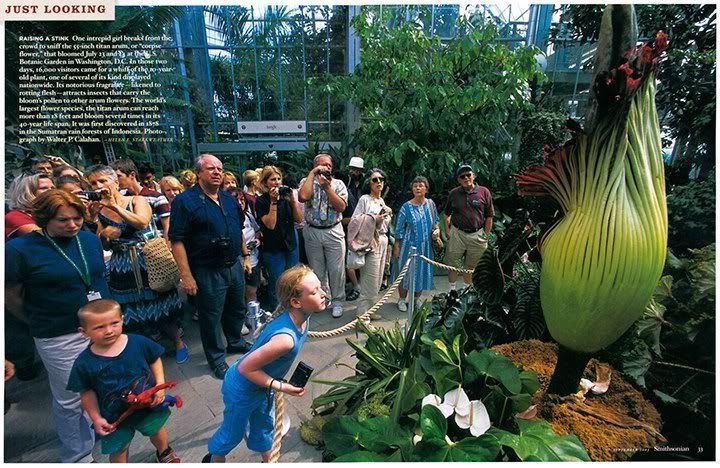
Walter P. Calahan
2003
C-print for Smithsonian Magazine
(1) Jane Kallir, "The Animal in Contemporary Art"
(2) Horticultural author? Pollan is a now influential journalist and professor whose writing explores a range of issues related to moral and ethical stewardship and consumption, sustainability, anthropology, and psychology. Why pigeonhole him?
(3) Admiring her paintings, I recalled the experience of anticipatory wanting with Julia Randall's works at Jeff Bailey Gallery.
Photo credits: Michael Pollan working in his garden, ripped from The Sydney Morning Herald(via The New York Times); Ann Craven studio image, ripped from the artist's website; "Baobab III," ripped from Frith Street Gallery website; "Untitled (Greenhouse)," ripped from Phil Moore's Flickr collection; Corpse flower image ripped from Walter P. Calahan's website
Tuesday, January 01, 2008
A(nother) New Year

Born shortly after the northern hemisphere's winter solstice, on one of the year's darkest days, I'm accustomed to quiet, contemplative birthdays, and my thirtieth was no exception.
After waking, I drove a short distance from my parents' house to a place where I'd several days before noticed a deer carcass dumped in a roadside ditch. My choice of subject intrigued the few motorists that passed. Their cars slowed to a crawl as they peered through rain-streaked windows, concerned eyes moving from the rotting mass of flesh, fur and bone to me, hunched over my camera in the cold drizzle. Hoping to allay any misgiving, I smiled cheerfully and waved.
Later, in fading afternoon light, I stood on the Heron Hope dock and surveyed the marsh and estuary while my father plucked and gutted three mourning dove he shot in a friend's field. The air was humid and chilly. I held open a bag and my father deposited the cleaned bodies of the little birds, one after the other. Some crows called from the southwest, and an impressive flight of black ducks passed overhead on squeaky wings.
After nightfall I shared a meal with my parents and a friend. We discussed presidential candidates, the increasing surreality of American elections, San Francisco's changing neighborhoods, and the ahistorical silliness of transplanting sports franchises without changing the team name. We bled two bottles of merlot before I switched to beer and watched some Dave Chapelle stand-up on television.
Pleasantly buzzed and heavy with holiday treats, I eventually lay down on the couch, another year older, but more happy than I've been in years.
It's a rare, curious thing when one's perception of life transitions from the regular line of past, present and future to an ambiguous cycle of individual moments. This mode is necessarily fleeting, so difficult is it to reconcile with contemporary life. We flip through scrapbooks and retell stories of our youth; the ball drops, the clock counts down and the crowd's vague, anticipatory energy crescendos; a mark is made, the number changed; the owl falls on the quivering chaff.
Ring in the year of the brown rat. I'll also ring in another decade.
Photo credit: Hungry Hyaena, 2007
Friday, November 30, 2007
Snapshots From Home Ground

"Home ground is the place where, since before you had words for such knowledge, you have known the smells, the seasons, the birds and beasts, the human voices, the houses, the ways of working, the lay of the land and the quality of the light. It is the landscape you learn before you retreat inside the illusion of your skin. You may love the place if you flourished there, or hate the place if you suffered there. But love it or hate it, you cannot shake free. Even if you move to the antipodes, even if you become intimate with new landscapes, you still bear the impression of that first ground."Like so many other Americans, I traveled home for Thanksgiving. Or rather, I headed to my childhood home, the Eastern Shore of Virginia. My parents still live in the small, seaside village where they raised me and, although the large farm I knew in my youth was sold some years past, my father continues to steward Heron's Foot, 35 acres of marsh, field and forest that fall away into a tidal branch of Floyd's Bay, a large salt water estuary separated from the Atlantic by impermanent barrier islands.
-Scott Russell Sanders, Townships
My bond to this land is renewed of late. Heron's Foot is once again an active presence in my life, and I am glad for it.

November Clamming:
It's a sorry admission for a Shore boy to make: before last week, just one month shy of my 30th birthday, I'd never been clamming. I'd found clams by chance, wading with rolled-up pant legs in the Chesapeake Bay, but I'd never gone about it legitimately or gathered enough for a proper meal.
When my father suggested that we try to collect some littlenecks(1) the afternoon before Thanksgiving, I was eager to do so. I attribute my enthusiasm to natural inquisitiveness and a relish for sea foods. My dietary restrictions - I eat no meat or fish unless I catch and kill it myself - have kept fish and shellfish safe from these jaws for over three years. (I usually eat a duck following a Christmastime hunt, and I ate halibut and salmon I caught in Alaska in 2004, but my diet has been strictly vegetarian otherwise. You'll understand, then, why my father's mention of clams caused me to salivate.)
The water was cool, but the afternoon unseasonably warm. The mercury climbed to 75 degrees Fahrenheit by mid-afternoon. My father and I waded into Floyd's Bay at low tide, carrying a woven wire bucket and two clam rakes. Clam rakes come in a variety of shapes and sizes; some have a built-in "clam catcher" behind the tines, while a clam hoe resembles a bent pitchfork. The rakes my father and I used that afternoon were primitive - just two pug-nosed tines set on a sturdy, weathered pole - but perfectly designed for the task at hand.


The seasoned veteran, my father turned up a dozen clams in the first ten minutes. I raked, prodded, shuffled my feet, and pushed my hand deep into the clay-like, black marl or bay mud, but failed to produce anything other than oyster shell shards and dense, slag-like mud chunks. The mud, at least, was compelling. I am curious about its sculptural potential, and might try to work with it over the Christmas holidays. Composed of decaying organic matter, it is rich with life and energy, yet this full-bodied mud is the same stuff that provokes complaints of "stink" from tourists to tidal areas. Having grown up with the smell, however, I find it nourishing.
As the tide began to move back in, my fortune changed. In the space of fifteen minutes, I turned up twenty clams, some of these good-sized. With each subsequent clam, I became more attuned to the practice. Drawing the rake toward me, I felt a bump distinct from the grab of oyster shell or other buried obstruction. The rake's action creates swirls of opaque silt and mud so that, once a clam is detected, you are unable to see the bottom. You must gauge where the rake struck the clam, then sink your arm into the mud to retrieve the startled mollusc.
My father told me that where one clam is found, there is sure to be another nearby. His assertion proved accurate in every instance. Why, I wonder, do these clams bury themselves as a pair, within inches of one another? Is one clam male and the other female, thereby increasing the probability of successful reproduction? If this is the case, why wouldn't the clams congregate in large beds, as do oysters? (If you have an answer to these questions, please let me know.)
That evening my mother, father and I shared a meal of clams, yams and salad. Thanks in part to the writing of Michael Pollan, literate urbanites and country folk alike know about the rewards of a meal comprised of food not purchased in a supermarket, especially foods that you bring to the table yourself. Indeed, it was a treat.
(1) The clam species my father and I harvested has many common names, including little-neck, quahog and hard clam. To clear up any confusion, one can opt to use the scientific name, Mercenaria mercenaria.

Riotous Colors and the Cabin at Heron's Foot:
Generally speaking, low-lying, humid areas offer less in the way of dramatic seasonal change than do more elevated regions. This is a principal reason that New England and the Northwest are renowned for their autumnal explosion of yellows, oranges and reds whereas the deciduous trees of the southeastern United States often bypass the colorful phase.
As a child on the Eastern Shore, I was accustomed to snowless winters, muggy summers and drab autumns. This fall, however, the peninsula was ablaze with color. Locals thank the unusually dry summer months for the leaves' display but, understandably, few area farmers are grateful. A summer drought, I'm told, results in superior fall color, but I am unable to adequately explain the biological rationale for this cause-and-effect. One could argue that the air is less humid during a drought, and the Shore's climate therefore more comparable to elevated regions, but I have also read that summer drought should dull autumnal color. Whatever the reason, the peninsula was beautifully ornamented.
At Heron's Foot, in front of one such vibrant backdrop at the western edge of a clover patch, a newly constructed cabin sits on old railroad ties. Roughly twelve by ten feet and with windows on three sides, it makes an ideal wildlife blind. Along with an aluminum table and two wooden-backed chairs, the cabin's only furniture is a low-backed armchair, in which my father spent several fall evenings watching groups of white-tailed deer feed in the clover. Although he keeps two deer decoys stored inside the cabin, he has not hunted Heron's Foot this season and, as far as I know, has no intention to.
I will not return to the Shore to live, but my parents know that I will keep Heron's Foot. I plan to visit the property regularly, until I am no longer able and, then, legal restrictions willing, I will be buried there, naked in the bay mud. Until it is time for that final sleep, the cabin is a place I can lay my head at night.

Remembering Amanda:
This morning on Chincoteague IslandThe poem above, entitled "Snow Geese," was written by a high school classmate of mine who, in the summer between our sophomore and junior years, was killed in a car crash. She was my first "almost girlfriend." I remember the awkward exchange all too well, and better still what followed. I trotted haltingly away until I was out of sight, then broke into a run, flush with the rage and shame of rejection.
I watched
as hundreds of white snow geese
lifted themselves all in one, swift motion.
It made me think of death.
The white bodies were like souls -
moving on.
And I know the hunters pay no attention to this,
this purity and this unity,
but what about my soul?
When I slowly begin to rise
and think of freedom
is there one that can separate me
from my state
and my being?"
I also recall with clarity the evening, nearly two years later, that I received a phone call from another classmate. "Reiger, you'll never guess what happened!," he said, giggling oddly. I didn't understand why the caller was giggling or why he proceeded to describe Amanda's death as "fucked up." "Fucked up," in our parlance, was a bad grade on a term paper or a malicious prank played on a friend; a tragic death was not equivalent. But we were fifteen and sixteen years old; what seemed to me an unacceptably cavalier reaction to the death of a peer was displacement behavior, a way for my friend to cope with the awful news.
And I was guilty of no less. Several months later, during Amanda's memorial service, "Snow Geese" was read by one of her parents. I stood in a chapel filled with mourning friends, family, teachers and other students, yet I obsessed over Amanda's assertion that "hunters pay no attention to" the symbolic and aesthetic significance of snow geese. What did Amanda know about hunters?, I thought bitterly. This is a bad poem. Why are all these people treating it as something profound? Looking at the mourners' faces, I felt contemptuous and disconnected. We were assembled in a church, yet an interventionist God, the deity all those good Episcopalians claimed to believe in, would have granted Amanda a long life, time for her poetry to flourish and for me to tell her, in person, that some hunters do understand.
I thought of that service this Saturday morning past, just before sunrise. My father and I walked down a path bracketed by pine groves, the grass underfoot blue-white under the startling Beaver Moon. As we approached the Heron's Foot impoundment pond we heard the quiet mutter and chatter of snows, but we were unprepared for the sight that confronted us when we emerged from the trees.
Several hundred snow geese stood in the shallow, partially frozen pond, feeding and conversing. Their white bodies glowed electric, reflecting so much moonlight that my father and I stopped short. The birds were a pearl mass surrounded by an orchid darkness.
After our pupils contracted and we resumed walking, the geese nearest us showed signs of alarm. They craned their long necks and their voices rose in volume and pitch. At fifteen yards, a quarter of the flock took wing, clamoring into the crisp morning sky.
"Jesus, that's beautiful," my father whispered.
I exhaled.
I think of Amanda when I watch snows take flight, and what better circumstance than under a full November moon, minutes before the sun cracks purple over the marsh cedars?
Armed only with a camera, I was not hunting that morning, but I lay my father's side-by-side and shells on the roof of the blind and passed him the burlap decoy sacks. We waded into the impoundment to set the rig. Snow goose down floated on the surface like cotton.

Photo credits: All photographs, Hungry Hyaena, 2007
For more pictures visit the Flickr set.
Monday, January 01, 2007
Happy (warm) new year!
I'm a cold weather man. Winter days and nights possess an obscure magic that buoys my spirit and heartens my constitution. I'm particularly sensitive to this variety of dark enchantment when I'm alone in winter woods. We humans have grown complacent in our throne atop the food chain, and I enjoy my body's reaction to harsh conditions as I also appreciate occasional haunting by the specter of predation. Both are humbling, gratifying reminders of what we've come from, and of what we are.
But this winter has been unseasonably warm. As always, I traveled south to Virginia to visit my parents. The temperature on the morning of my birthday, December 29th, was 52 degrees Fahrenheit; by late afternoon, it was over 60. Yet still the talking heads on the local news speak of global warming as if it may be a fiction! Skepticism serves its purpose in science, and shouldn't be dismissed offhand, but whether we're attributing warming to human activity or to natural fluctuations, an examination of the data shows that the general trend is all too apparent.

A flock of about 800 snows departs the estuary in search of morning food
Because of the warm temperatures, the travels of migratory species are unusual this year. Last Thanksgiving, I watched four or five thousand snow geese (Chen caerulescens) pitch into the salt water estuary alongside my parents' house. The birds arrive in last light to roost, and they depart just after dawn, moving on to feed in the fields of winter wheat.
This year, by contrast, the late December roosts were limited to one thousand birds, give or take a couple hundred. The weather is warm enough that the geese, heading south from their Arctic breeding grounds, don't need to fly so far to find food and refuge. The spectacular flocks that I watched in the fall of 2005 probably took up winter residence this year in Delaware and New Jersey, or points farther north.
+++++

Photo of the heron's feet; monofilament already cut away
Walking my Virginia prpoerty two days before my birthday, my father and I came upon the decapitated body of a great blue heron (Ardea herodias). The beheading was likely the work of a fox or raccoon, but the predator was not responsible for the bird's death. The heron's legs and feet were knotted with monofilament fishing line. Two "toes" on the right foot were tied together. More serious was the mass of line that bound the left leg to the knot on the right foot. The bird had eked out a living by hop hunting. This is handicap enough for any animal, but, for a heron, a creature that specializes in water stalking, hopping surely cost the bird a great many meals.
Apparently this individual was tough. Just as a tree grows around a collar left on too long, so had the heron's flesh swollen around the fishing line as the bird continued to grow. I'm not knowledgeable enough to estimate the heron's age with any accuracy, but, by the looks of it, the line had bound the bird for at least a year. My father cut the monofilament away and we placed the heron's body in the middle of a trail, hoping that the vultures already circling above would descend once the two humans moved on.
Oddly, when I returned to check on the progress the following afternoon, the heron's body remained untouched. No raccoon or fox had returned to finish what they began, and the vultures had apprently elected to pass up this meal in favor of more filling options. (This winter's warm weather has left scavengers at ease and relatively heavy-bellied. As a result, they are less thorough in their clean-up efforts.)

Photo of heron's left foot w/ my hand, for scale
I examined the heron again, this time photographing the bird's marvelous feet. As far as I'm concerned, anyone familiar with both reptiles and birds must accept their common ancestry. The great blue's long toes and legs share much with those of some lizard species. As a friend remarked upon seeing the bird, "It reminds me of an alligator." Indeed. Ain't evolution wondrous?

Photo of heron's left foot w/ my hand, for scale
Photo credits: all by Hungry Hyaena
Monday, June 05, 2006
Reading Mary's Vultures
When I'm in the midst of a studio surge, essay ideas often gestate for months. Jotted notes and fragmented Word documents evidence my intention to write, but I find it difficult to commit. Reading, by contrast, remains an essential activity during these periods and, curiously, poetry often trumps prose, perhaps because it is more like visual art, more open and sensuous.
I've recently been enjoying collections of Mary Oliver and Czeslaw Milosz. Much of Oliver's work compliments my own. Reading her poems, I feel a reciprocated embrace; she often channels a wonderful existential experience. Frankly, if I could get away with submitting "Vultures" as my artist statement, I'd happily do so!
Photo credit: "Soaring," painted by Andrew Wyeth (photograph by Ken Burris, for Shelburne Museum)
I've recently been enjoying collections of Mary Oliver and Czeslaw Milosz. Much of Oliver's work compliments my own. Reading her poems, I feel a reciprocated embrace; she often channels a wonderful existential experience. Frankly, if I could get away with submitting "Vultures" as my artist statement, I'd happily do so!
VulturesDeceptively straight-forward, the poem will open, for readers of a certain disposition, to complex interpretation. For me, "Vultures" is an insightful tracing of a complicated relationship with religion and a paean to the contemplation of death and awesomeness of the universe's messy abundance.
Like large dark
lazy
butterflies they sweep over
the glades looking
for death,
to eat it,
to make it vanish,
to make of it the miracle:
resurrection. No one
knows how many
they are who daily
minister so to the grassy
miles, no one
counts how many bodies
they discover
and descend to, demonstrating
each time the earth’s
appetite, the unending
waterfalls of change.
No one
moreover,
wants to ponder it,
how it will be
to feel the blood cool,
shapeliness dissolve.
Locked into
the blaze of our own bodies
we watch them
wheeling and drifting, we
honor them and we
loathe them,
however wise the doctrine,
however magnificent the cycles,
however ultimately sweet
the huddle of death to fuel
those powerful wings.
Photo credit: "Soaring," painted by Andrew Wyeth (photograph by Ken Burris, for Shelburne Museum)
Thursday, April 20, 2006
Undoing The Gordian Knot
Michael Pollan, Hunting, and The Rest Of It


Before I continue, however, let me provide some background explanation of why Pollan's piece strikes a chord. As I wrote in my March 2005 essay, "Hunting JFK,"
All contemporary omnivores - the vast majority of humans - are necessarily implicated in the grisly business of meat "manufacture." The pork chop on the plate is more than a tasty entree; it was recently a living animal. After stunning, assuming that process goes smoothly, the pig's throat is slit by machine (or man) and the viscera is spilt before meat preparation begins. Every pig-eater who prefers to cast such realities from her mind is afraid of more than blood and gore or even the potential for undue suffering on the part of the animal. She is, above all else, afraid of confronting her own mortality. If, on the other hand, you know what it's like to kill a fellow creature, you consume flesh with full knowledge of what brings the food to the table: execution. Pollan suspects as much, even if he remains suspicious of the "ecstatic" language used by the likes of Ortega y Gasset and Hemingway.(1)
Pollan's account of the boar hunt makes for good reading, but his consideration of the aftermath is especially excellent. He struggles with his confused, intense reaction to the shooting and dressing, a polite term for gutting, of the large animal.
One sometimes hears hunters - the more literary among them, anyway - say, "I kill to have hunted; I do not hunt to kill." This hackneyed comment refers principally to the heightened sense of immediacy and awareness alluded to earlier. Pollan likens this sense to a marijuana high; in fact, it is merely our inborn predatory instinct at work. But while there is certainly much to be said for the act of hunting itself, it is the killing that for me remains the essential existential experience. The hunt allows us to access our rarely used programming, to make full use of our special abilities, but the kill is like a Zen koan, a Gordian knot undone only by willful ignorance or reliance on moral certitude.
As Pollan suggests, avoiding the animal gaze "must take some doing." To approach a fallen animal, a creature you have just killed, is difficult but transfiguring. In the glazing eyes of the dead beast, you confront your own mortality. Terrifying though this may seem, I associate these moments with a profound sense of oneness with the natural world. In accepting responsibility for the brutal deed and recognizing my connection to the slain animal, my ego is reduced. There is an exhalation of the isolated, confused experience of contemporary life, and an inhalation of the universal(3). Dr. Morris Berman's analogy is pertinent: the experience removes the respectful hunter from the vertical, hierarchical world view and allows him to reside as part of the horizontal stretch, if only for a spell.
Unfortunately, I'm no stranger to the so-called "hero shot," the photograph of a hunter standing or kneeling behind a freshly killed animal. (In the case of smaller game, like rabbit or duck, the hunter proudly displays the creature in his hands.) It's a simple enough composition, dull and undistinguished: hunter, weapon, and prey. Usually the hunter smiles broadly. Open any contemporary "hooks-and-bullets" magazine and you'll find these images on most every page. I've never cared for these photos but, because my father is an outdoor writer, I've grown accustomed to his requests for such pictures. These days, article sales depend on the quality of the accompanying photographs as much as they do the writing, so I dutifully pose and do my best to muster a smile. Judging by my father's regular appeal - "C'mon, Christopher. Let's see a happy face. Look like you're enjoying yourself." - I don't often succeed. Why should I smile? I've just killed an animal. I'm spacey and contemplative. I'd prefer to be left alone, given adequate time to commune with the creature I have killed, minus the backslapping and the misdirected camaraderie. The experience is special, certainly, but not celebratory or joyous.

Apparently, most hunters do not suffer such brooding thoughts. Even Pollan, despite describing his emotions in the first moments after killing his boar as "surging and confused," admits to feeling proud and "unambiguously happy." It isn't until he sees the photograph of himself "kneeling on the ground behind a pig the side of whose head has erupted in blood," "one proprietary hand" placed "on the dead animal's flank," that he realizes how strange his happiness is.
And that brings me to an obvious distinction; Michael Pollan and I are not typical hunters. In fact, the more used to the predominantly vegetarian diet I become - it's been several years since I ate meat regularly - the less often I will hunt or fish in the future; maybe one day I will stop altogether, instead concentrating on a backyard vegetable garden. I am familiar already with the gravity of killing and the associated ego erasure. Given the power of that experience, it will always inform my art making, my writing, and the way I live my life. The insight may, like a tattoo, fade with time, but it will not disappear. Pollan, too, is unsure if he will hunt again, despite only having done so once. I am sympathetic, even if I feel he should try other forms of hunting before abandoning the practice altogether. We - and I mean all of us, not just hunters - need more voices like his, voices that challenge the intellectual hegemony of dullardism, on both the Left and Right. There are no simple answers to complex questions, and there are only so many times the Gordian knot can be cleaved by ignorance or denail.
For more, visit this interview with Michael Pollan.
Photo credits: Gordian Knot image ripped from homepage of Matthew Cadwallader; boar hunt photos ripped from Southeastern Outdoors and Suwannee River Ranch websites
+++++
(1) "I recognize this kind of prose: hunter porn. And whenever I've read it in the past, in Hemingway and Ortega y Gasset and all those hard-bitten, big-bearded American wilderness writers who still pine for the Pleistocene, it never failed to roll my eyes. I never could stomach the straight-faced reveling in primitivism, the barely concealed bloodlust, the whole macho conceit that the most authentic encounter with nature is the one that comes through the sight of a gun and ends with a large mammal dead on the ground..." ("The Modern Hunter-Gatherer," The New York Times Magazine, March 26, 2006)
(2) "Nothing in my experience has prepared me for the quality of this attention. I notice how the day's first breezes comb the needles in the pines, producing a sotto voce whistle and an undulation in the pattern of light and shadow tattooing the tree trunks and the ground. I notice the specific density of the air. But this is not a passive or aesthetic attention; it is a hungry attention, reaching out into its surroundings like fingers, or nerves. My eyes venture deep into thickets my body could never penetrate, picking their way among the tangled branches, sliding over rocks and around stumps to bring back the slenderest hint of movement. In the places too deeply shadowed to admit my eyes, my ears roam at will, returning with the report of a branch cracking at the bottom of a ravine, or the snuffling of a. . .wait: what was that? Just a bird. Everything is amplified. Even my skin is alert, so that when the shadow launched by the sudden ascent of a turkey vulture passes overhead I swear I can feel the temperature momentarily fall." ("The Modern Hunter-Gatherer," The New York Times Magazine, March 26, 2006)
(3)Although some friends tell me they have achieved a similar sensation while practicing yoga, I have not. There have been instances of immediacy, moments when, while in the midst of a yoga session, I feel a vital connection to the world around me, but these experiences are exceptional and, what's more, absent any sense of mortality. Yoga has granted me a connection, but it hasn't erased all sense of self.
(4)"I've looked at Angelo's pictures again, trying to figure out why they should have shamed me so. I realize it isn't the killing it records that I felt ashamed of, not exactly, but the manifest joy I seemed to be feeling about what I'd done. This for many people is what is most offensive about hunting - to some, disgusting: that it encourages, or allows, us not only to kill but also to take a certain pleasure in killing. It's not as if the rest of us don't countenance the killing of tens of millions of animals every year. Yet for some reason we feel more comfortable with the mechanical killing practices, out of view and without emotion, by industrial agriculture." ("The Modern Hunter-Gatherer," The New York Times Magazine, March 26, 2006)
"The fact that you cannot come out of hunting feeling unambiguously good about it is perhaps what should commend the practice to us....If I've learned anything about hunting and eating meat, it's that it's even messier than the moralist thinks. Having killed a pig and...now looking forward (if that's the word) to eating that pig, I have to say there is a part of me that envies the moral clarity of the vegetarian, the blamelessness of the tofu eater. Yet part of me pities him too. Dreams of innocence are just that; they usually depend on a denial of reality that can be its own form of hubris."I'm always pleased when I come across an article that clearly conveys a concept I have been striving to articulate with limited success, so I'm indebted to a co-worker for bringing to my attention Michael Pollan's (relatively) recent essay, "The Modern Hunter-Gatherer," in The New York Times Magazine (March 26, 2006). Pollan, the author of The Botany of Desire, Second Nature, and, most recently, The Omnivore's Dilemma, is a sensitive, thoughtful proponent of hunting. But whereas most writers who wax poetic about the hunt are guilty of romanticizing and simplifying what is, in fact, quite messy(1), Pollan argues that the hunter can not be a moralist. Rather "the grown-up hunter, the uneasy hunter...recognizes the truth" that resides in contradiction, or, as Robert Kimber put it in his excellent Living Wild & Domestic, "the uncompromising romantic has to compromise with the realist."
-Michael Pollan, "The Modern Hunter-Gatherer"
Before I continue, however, let me provide some background explanation of why Pollan's piece strikes a chord. As I wrote in my March 2005 essay, "Hunting JFK,"
"I consider myself a conscientious hunter. I eat no meat, including fish, unless I catch it or kill it myself. I kill only a few animals a year and catch only ten or so fish. I live on a vegetarian diet otherwise, aiming to minimize my contribution to the environmental degradation wrought by the meat [and fishing] industr[ies]. I will hunt only those species biologists deem to have 'surplus' populations, such as white-tailed deer (does only), mallard ducks (drakes only), cottontail rabbits."Environmental degradation was not Pollan's principal motivation, but his reasons for picking up a rifle and heading into the woods of northern California to stalk and kill a feral pig (Sus scrofa), an introduced species descended from the European wild hog, are no less significant. The son of "one of the world's great indoorsmen," Pollan had never hunted. He "had long felt that, as a meat eater, [he] should, at least once, take responsibility for the killing that eating meat entails. [He] wanted, for once in [his] life, to pay the full karmic price of a meal." That Pollan should feel this way is admirable. Most well-educated Westerners are now too timid, too cloaked in denial, to address such base issues. Turning again to Kimber, "If the step from hunter to herdsman-plowman was the first great step in the process of alienation from nature and self, then surely the step from herdsman-plowman to city dweller, driver of combines, and feedlot engineer has all but completed that process."
All contemporary omnivores - the vast majority of humans - are necessarily implicated in the grisly business of meat "manufacture." The pork chop on the plate is more than a tasty entree; it was recently a living animal. After stunning, assuming that process goes smoothly, the pig's throat is slit by machine (or man) and the viscera is spilt before meat preparation begins. Every pig-eater who prefers to cast such realities from her mind is afraid of more than blood and gore or even the potential for undue suffering on the part of the animal. She is, above all else, afraid of confronting her own mortality. If, on the other hand, you know what it's like to kill a fellow creature, you consume flesh with full knowledge of what brings the food to the table: execution. Pollan suspects as much, even if he remains suspicious of the "ecstatic" language used by the likes of Ortega y Gasset and Hemingway.(1)
Pollan's account of the boar hunt makes for good reading, but his consideration of the aftermath is especially excellent. He struggles with his confused, intense reaction to the shooting and dressing, a polite term for gutting, of the large animal.
"...the rest of the organs tumbled out onto the ground in a heap, up from which rose a stench so awful it made me gag. This was not just the stink of pig wastes but those comparatively benign smells compounded by an odor so wretched and ancient that death alone could release it. I felt a wave of nausea begin to build in my gut. The clinical disinterest with which I had approached the whole process of cleaning my pig collapsed all at once: this was disgusting."My upbringing was very different from Pollan's. I grew up assisting in the gutting and preparation of dove, quail, duck, deer, rabbit, squirrel, and other animals. As I told a Scrawled correspondent in a recent interview,
"Some of my early memories are, quite literally, bloody...As a child pondering the blood of a slain animal, I was deeply moved, at once overwhelmed with sorrow, and energized by the realization that the neon red glowing on my trembling hands was spilt life. The more familiar I became with death, the more tied to life I felt. It was an introduction to 'the Circle of Life,' even if it wasn't at all what Disney force-fed us."Pollan draws similar conclusions, but because his is a new experience, he searches for an explanation where those us accustomed to death do not. This search begins with an examination of his nausea.
"...[W]hat was this attack of revulsion all about, anyway? Disgust, I understood, is one of the the tools humans have evolved to navigate the omnivore's dilemma - the elemental question of what we should and should not eat. The emotion alerts us to things we should not ingest, like rotten meat or feces. And surely that protective reflex figured in what I was feeling as I beheld these viscera, which no doubt did contain microbes that could sicken me. Our sense of disgust, as Steven Pinker has written, is 'intuitive microbiology.'"Pollan's revulsion is the product of our animal hard-wiring. Routine killing and butchering may arrest or weaken this disgust - repetition dulls all sensation - but it remains an inevitable reaction. Like it or not, we are genetically adapted to the Pleistocene lifestyle Hemingway pined for. Pollan may cope well enough in modern-day California, making a living from selling words, but he still becomes ill at the sight of undesirable innards and, when hunting, turns into what he calls "alert man"(2), a more aware animal, one making full use of its senses. Ever conscientious, though, Pollan probes further and discovers something more than genetic coding in his violent revulsion.
"...there had to be more to it than that, and later, when I did some reading on disgust, I acquired a better idea what else might underlie my revulsion. Paul Rozin, a cultural psychologist at the University of Pennsylvania, points out that many of the things that disgust people do come from animals — bodily fluids and secretions, decaying flesh, corpses. Beyond the sanitary reasons for avoiding certain parts and products of animals, these things disgust us, Rozin suggests, because they confront us with the reality of our own animal nature. So much of the human project is concerned with distinguishing ourselves from beasts that we seem strenuously to avoid things that remind us that we are beasts, too — animals that urinate, defecate, copulate, bleed, die, stink and decompose...Exactly why we would strive so hard to distance ourselves from our animality is a large question, but surely the human fear of death figures in the answer."Ah, yes, and so we arrive again at existential fear and the reason most folks prefer to distance themselves from the killing of the animals they consume. To "[pay] the full karmic price of a meal," Pollan must not only execute the pig, but also own up to the deed. Coming to terms with killing is far more challenging than pulling a trigger.
"What disgusted me about 'cleaning' the animal was just how messy — in every sense of the word — the process really was, how it forced me to look at and smell and touch and even to taste the death, at my hands, of a creature my size that, on the inside at least, had all the same parts and probably looked very much like me. The line between human and animal I could discern here, gazing into that carcass, was nowhere near sharp...In this, I decided, was one of the signal virtues of hunting: it puts large questions about who we and the animals are, and the nature of our respective deaths, squarely before the hunter, and while I'm sure there are many hunters who manage to avoid their gaze, that must take some doing."For years I've tried to express as much so simply, but I tend to talk around the core of the matter, relying heavily on co-opted constructs and borrowed phrases. Even when I do feel I'm in the ballpark, most folks still willing to listen dismiss my attempts as little more than morbid rambling. After all, I live in New York City and, as far as most people know, eat a strict vegetarian diet. Why am I interested in championing hunting? What sense does that make? Pollan's remarks on the "signal virtues of hunting," particularly the difficult questions raised by the killing of other animals, suggest an answer.
One sometimes hears hunters - the more literary among them, anyway - say, "I kill to have hunted; I do not hunt to kill." This hackneyed comment refers principally to the heightened sense of immediacy and awareness alluded to earlier. Pollan likens this sense to a marijuana high; in fact, it is merely our inborn predatory instinct at work. But while there is certainly much to be said for the act of hunting itself, it is the killing that for me remains the essential existential experience. The hunt allows us to access our rarely used programming, to make full use of our special abilities, but the kill is like a Zen koan, a Gordian knot undone only by willful ignorance or reliance on moral certitude.
As Pollan suggests, avoiding the animal gaze "must take some doing." To approach a fallen animal, a creature you have just killed, is difficult but transfiguring. In the glazing eyes of the dead beast, you confront your own mortality. Terrifying though this may seem, I associate these moments with a profound sense of oneness with the natural world. In accepting responsibility for the brutal deed and recognizing my connection to the slain animal, my ego is reduced. There is an exhalation of the isolated, confused experience of contemporary life, and an inhalation of the universal(3). Dr. Morris Berman's analogy is pertinent: the experience removes the respectful hunter from the vertical, hierarchical world view and allows him to reside as part of the horizontal stretch, if only for a spell.
Unfortunately, I'm no stranger to the so-called "hero shot," the photograph of a hunter standing or kneeling behind a freshly killed animal. (In the case of smaller game, like rabbit or duck, the hunter proudly displays the creature in his hands.) It's a simple enough composition, dull and undistinguished: hunter, weapon, and prey. Usually the hunter smiles broadly. Open any contemporary "hooks-and-bullets" magazine and you'll find these images on most every page. I've never cared for these photos but, because my father is an outdoor writer, I've grown accustomed to his requests for such pictures. These days, article sales depend on the quality of the accompanying photographs as much as they do the writing, so I dutifully pose and do my best to muster a smile. Judging by my father's regular appeal - "C'mon, Christopher. Let's see a happy face. Look like you're enjoying yourself." - I don't often succeed. Why should I smile? I've just killed an animal. I'm spacey and contemplative. I'd prefer to be left alone, given adequate time to commune with the creature I have killed, minus the backslapping and the misdirected camaraderie. The experience is special, certainly, but not celebratory or joyous.
Apparently, most hunters do not suffer such brooding thoughts. Even Pollan, despite describing his emotions in the first moments after killing his boar as "surging and confused," admits to feeling proud and "unambiguously happy." It isn't until he sees the photograph of himself "kneeling on the ground behind a pig the side of whose head has erupted in blood," "one proprietary hand" placed "on the dead animal's flank," that he realizes how strange his happiness is.
"The man is looking into the camera with an expression of unbounded pride, wearing an ear-to-ear grin that might have been winning, if perhaps incomprehensible, had the bloodied carcass sprawled beneath him been cropped out of the frame. But the bloodied carcass was right there, front and center, and it rendered that grin - there's no other word for it - obscene. I felt as if I had stumbled on some stranger's pornography....No one should ever see this."Some of the more seasoned hunters I know will write off Pollan's reaction as silly, indicative of a weakness borne of liberal ("sissified") elitism and a life removed from the realities of nature. There is some truth to that, surely, but what of their own unwillingness to consider the situation completely? They are just as guilty of ignoring the knot's complexity; they opt to "undo" it with denial's blade. As I see it, the ignorance of the prideful "sport" hunter is equivalent to that of the staunch anti-hunter(4).
And that brings me to an obvious distinction; Michael Pollan and I are not typical hunters. In fact, the more used to the predominantly vegetarian diet I become - it's been several years since I ate meat regularly - the less often I will hunt or fish in the future; maybe one day I will stop altogether, instead concentrating on a backyard vegetable garden. I am familiar already with the gravity of killing and the associated ego erasure. Given the power of that experience, it will always inform my art making, my writing, and the way I live my life. The insight may, like a tattoo, fade with time, but it will not disappear. Pollan, too, is unsure if he will hunt again, despite only having done so once. I am sympathetic, even if I feel he should try other forms of hunting before abandoning the practice altogether. We - and I mean all of us, not just hunters - need more voices like his, voices that challenge the intellectual hegemony of dullardism, on both the Left and Right. There are no simple answers to complex questions, and there are only so many times the Gordian knot can be cleaved by ignorance or denail.
For more, visit this interview with Michael Pollan.
Photo credits: Gordian Knot image ripped from homepage of Matthew Cadwallader; boar hunt photos ripped from Southeastern Outdoors and Suwannee River Ranch websites
+++++
(1) "I recognize this kind of prose: hunter porn. And whenever I've read it in the past, in Hemingway and Ortega y Gasset and all those hard-bitten, big-bearded American wilderness writers who still pine for the Pleistocene, it never failed to roll my eyes. I never could stomach the straight-faced reveling in primitivism, the barely concealed bloodlust, the whole macho conceit that the most authentic encounter with nature is the one that comes through the sight of a gun and ends with a large mammal dead on the ground..." ("The Modern Hunter-Gatherer," The New York Times Magazine, March 26, 2006)
(2) "Nothing in my experience has prepared me for the quality of this attention. I notice how the day's first breezes comb the needles in the pines, producing a sotto voce whistle and an undulation in the pattern of light and shadow tattooing the tree trunks and the ground. I notice the specific density of the air. But this is not a passive or aesthetic attention; it is a hungry attention, reaching out into its surroundings like fingers, or nerves. My eyes venture deep into thickets my body could never penetrate, picking their way among the tangled branches, sliding over rocks and around stumps to bring back the slenderest hint of movement. In the places too deeply shadowed to admit my eyes, my ears roam at will, returning with the report of a branch cracking at the bottom of a ravine, or the snuffling of a. . .wait: what was that? Just a bird. Everything is amplified. Even my skin is alert, so that when the shadow launched by the sudden ascent of a turkey vulture passes overhead I swear I can feel the temperature momentarily fall." ("The Modern Hunter-Gatherer," The New York Times Magazine, March 26, 2006)
(3)Although some friends tell me they have achieved a similar sensation while practicing yoga, I have not. There have been instances of immediacy, moments when, while in the midst of a yoga session, I feel a vital connection to the world around me, but these experiences are exceptional and, what's more, absent any sense of mortality. Yoga has granted me a connection, but it hasn't erased all sense of self.
(4)"I've looked at Angelo's pictures again, trying to figure out why they should have shamed me so. I realize it isn't the killing it records that I felt ashamed of, not exactly, but the manifest joy I seemed to be feeling about what I'd done. This for many people is what is most offensive about hunting - to some, disgusting: that it encourages, or allows, us not only to kill but also to take a certain pleasure in killing. It's not as if the rest of us don't countenance the killing of tens of millions of animals every year. Yet for some reason we feel more comfortable with the mechanical killing practices, out of view and without emotion, by industrial agriculture." ("The Modern Hunter-Gatherer," The New York Times Magazine, March 26, 2006)
Subscribe to:
Posts (Atom)