Showing posts with label Werner Herzog. Show all posts

Friday, August 10, 2012

Platte Clove Residency: John Muir and the View From the Precipice

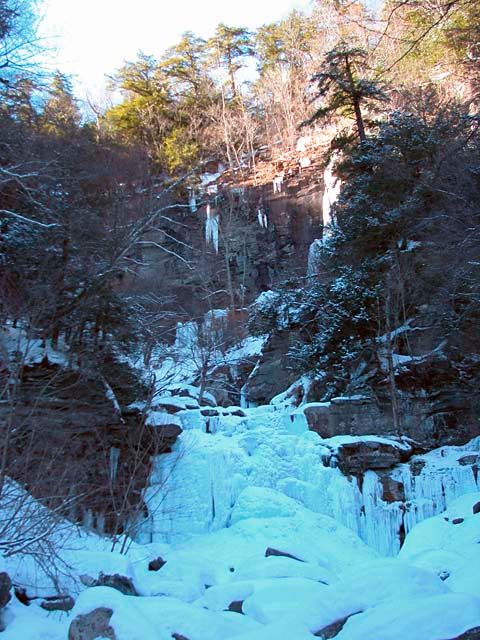
Winter view of Platte Clove's Bridal Veil Falls;
Catskills; NY
“Many people have been killed after falling and sliding off the edge. Especially in areas where there are pine needles. Dangerous conditions exist in many locations. The number of deaths over the years is staggering. Be overly cautious when in this region, and do not take un-necessary risk.”

- “Upper Platte Clove” page of Catskill Mountaineer website
I hesitated before deciding to investigate the unmarked spur of the Platte Clove Nature Preserve's Plattekill Falls Trail. Having recently read a bit about the geology and topography of the Catskill Escarpment, I knew that the preserve is located near the top of a deep ravine that tumbles suddenly down and eastward to meet the Hudson Valley (clove is the Dutch word for a mountain gorge). I’d also learned that each year a handful of foolhardy or unlucky hikers fall to their deaths on Platte Clove area trails. An online trail guide I’d browsed prior to the residency urged hikers to be “overly cautious.” Nevertheless, once I’d stepped off the main path and advanced a few steps down the spur, I was self-assured; I wouldn’t be one of 2012’s casualties. Prudent types like me don’t fall off cliffs.

Tuesday, February 14, 2012

Review In Brief: Kota Ezawa at Haines Gallery

Kota Ezawa
Still from "City of Nature"
2011
DVD, 4 minutes
Edition of 10
Kota Ezawa's rotoscoped animations of the O.J. Simpson verdict (2002), John F. Kennedy's assassination (2005), and the 2004 NBA "Malice at the Palace" brawl (2008) garnered the artist critical accolades, and deservedly so. Still, I'd wondered how effective Ezawa's stylish technique would be were he to reference less dramatic or famous footage. "City of Nature," originally commissioned for outdoor installation in New York City's Madison Square Park but currently on view at Haines Gallery, provided me with an answer.

Sunday, May 16, 2010

Susan Silas' Heroic Living


Susan Silas
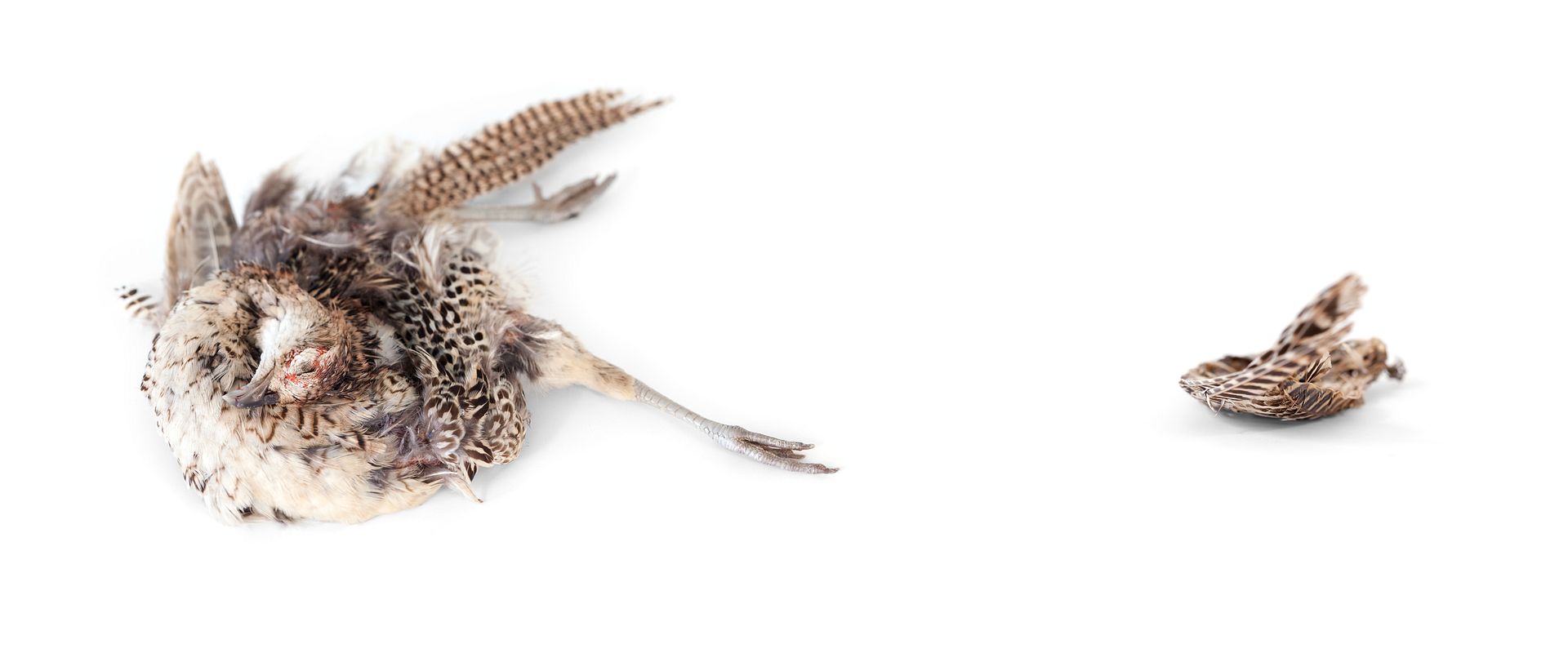
"found birds; 2000 - the present"
(Image 17 of 23 from the portfolio "eyes wide shut")
2010
Archival ink jet prints on Hahnemühle photo rag paper
22 x 17 inches

Until recently, I was unfamiliar with Susan Silas' artwork. She is perhaps best known for projects memorializing the Shoah, but it wasn't an awareness of her Holocaust work that led me to "Helmbrecht's Walk, 1998-2003." Instead, it was a photograph of a dead American kestrel that Silas emailed me in March.

I have only an inkling of what essay or artwork of mine inspired the artist to send me the image, but I'm grateful that she did. I shamelessly admit to being the sort who finds soulful beauty in images of death, and I was touched by the striking and contemplative photograph. A month after I received the picture, I visited Silas in her Brooklyn home, to look at prints from her "found birds" series. Still pondering her work a week after that visit, I headed to Hebrew Union College's Jewish Institute of Religion Museum, eager to compare what I saw and sensed in "found birds" to Susan's more easily classifiable (though by no means "easy") Shoah work.


Susan Silas
"found birds; 2000 - the present"
(Image 3 of 11 from the portfolio "what remains")
2010
Archival ink jet prints on Hahnemühle photo rag paper
20 x 48 inches

The HUC press release for "Helmbrecht's Walk" describes the project succinctly.
"On April 13, 1945, more than 700 women were forced to march 225 miles in 22 days from the Helmbrecht's Labor Camp, a small satellite unit of the Flossenburg Concentration Camp in Germany, to the Czech city of Volary. [...] During the course of this forced march the women were ill fed, inadequately clothed, denied shelter, and capriciously beaten. On the sixth day of the march, the non-Jewish prisoners were separated from the group, leaving the remaining 580 Jewish women to continue until May of 1945.

With determination and sensitivity, Silas traced the march in 1998 on the 53rd anniversary of the event by walking along the same path as the Helmbrecht's women for 22 days in Germany and the Czech Republic. She documented her journey in Helmbrecht's Walk, a collection of 48 archival color prints presented as an unbound book. [...] The images contextualized by Silas' daily commentary of her own experiences are coupled with news reports of event occurring elsewhere in the world on that same day in 1998. This juxtaposition, she says, functions 'to heighten our awareness of the fact that we are all presently witnesses to unspeakable events and extreme suffering for which we take no more responsibility than did many witnesses to the Holocaust.'"
Silas' project addresses the complicated relationship between place and time or, as cultural critic and historian Simon Schama's consideration of the topic framed it, "landscape and memory." When Silas conceived of the Helmbrecht's project, she believed (or maybe hoped) that walking the same path that the Helmbrecht's women had would allow her some intimate experience of or insight into the terrible march. In fact, this didn't prove so. Silas describes her walk as "relatively mundane and unexceptional." She continues, "My feet hurt. I get tired. [...] I found it more, rather than less difficult to understand how these women made this journey once I was out on the road."


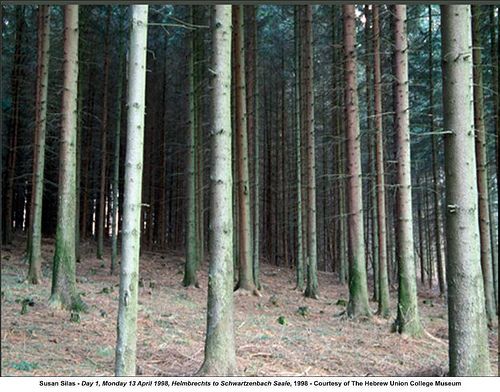
Susan Silas
"Helmbrecht's Walk, 1998 - 2003"
(Day 1, Monday 13 April 1998, Helmbrechts to Schwartzenbach Saale, 1998)
Archival ink jet prints on Hahnemühle photo rag paper

Yet many of the captions she includes with the photographs reference artists and thinkers such as Werner Herzog, who understand "walking as a sacrament." Such language calls to mind the Australian Aborigines' songlines, mnemonic stories that are spoken or sung as the Aborigine walks over the referenced terrain. In his marvelous book Spell of the Sensuous, David Abram relates a striking, relevant anecdote.
"A similar tale is told by [Bruce] Chatwin. He was traveling in a Land Cruiser with several friends, including an Aboriginal man nicknamed Limpy whom they were driving to a particular place on his songline. Limpy, whose clan Ancestor was the Native Cat, or tjipla (a small marsupial with a long, banded tail), had never been to this place along the Native Cat songline, yet he now wished to go there in order to see some distant relatives who were dying there. During the course of seven hours driving through the back country, bumping across shallow rivers and under gum trees, the Aboriginal man sat motionless in the front seat, squeezed between the driver, Arkady, and another passenger, except for a short burst of action when the truck crossed part of his songline. Later,
'[w]e came to the confluence of two streams: that is, we met the stream we had crossed higher up on the main road. This lesser stream was the route of Tjilpa Men, and we were joining it at right angles. As Arkady turned the wheel to the left, Limpy bounced into action. Again he shoved his head through both windows. His eyes rolled wildly over the rocks, the cliffs, the palms, the water. His lips moved at the speed of a ventriloquist's and, though them, came a rustle: the sound of wind through branches.

Arkady knew at once what was happening. Limpy had learnt his Native Cat couplets for walking pace, at four miles an hour, and we were traveling at twenty-five. Arkady shifted into bottom gear, and we crawled along no faster than a walker. Instantly, Limpy matched his tempo to the new speed. He was smiling. His head swayed to and fro. The sound became a lovely melodious swishing; and you knew that, as far as he was concerned, he was the Native Cat.'"
I believe that what was missing for Silas was a story line, the narrative informed by the landscape (and vice versa) that, among indigenous groups such as the dwindling Aboriginal population of Australia, is traditionally passed from generation to generation. In some respects, "Helmbrecht's Walk" is an attempt to locate such a story, an earnest effort to discover in the landscape the marks of what happened decades before. In our postmodern, peripatetic culture, nations and traditions do not generally fare well. In some respects, this is a positive development, as our tribal perspectives and prejudices erode into some variety of tentative, liberal pluralism. On the other hand, it's ever more difficult to feel confident about one's identity and how it relates to landscape, vocation, and nation.

My time with "Helmbrecht's Walk" confirmed my supposition, however, that Susan's art is not primarily interested in cultural identity or particular histories. Instead, she is most concerned with "the big questions." To one degree or another, all art wrestles with or reacts to these existential imponderables, but Susan's exploration is more focused and urgent than most. Fortunately, even though her work is preoccupied with mortality and meaning, she manages to avoid the pitfalls of such terrain; her work is neither macabre nor aestheticized to the point of anesthetization.


Susan Silas
"found birds; 2000 - the present"
(Image 1 of 21 from the portfolio "blackbird")
2010
Archival ink jet prints on Hahnemühle photo rag paper
22 x 17 inches

Two days after I visited "Helmbrecht's Walk," I read "Eudaimonia, existentialism, and the practice of medicine," an essay by Dr. Andrew Radu included in the Spring 2010 issue of The Pharos of Alpha Omega Alpha Honor Medical Society. In his essay, Dr. Radu describes the existentialist ideal of tragic optimism. He writes of it, "even in the face of imminent death, we have the ability to reevaluate life." He goes on:
"A crucial concept held by many existentialist philosophers is that of heroic living. All humans have the ultimate freedom to live boldly in the face of tragedy. Living with this concept makes attaining a goal of eudaimonia less important than simply striving to do so. [...] The concept of tragic optimism proposes that in a life that can be circumscribed by pain, guilt, and death, one should say 'yes to life in spite of everything.'"
Indeed, as I wrote in "Eudaimonia," a January 2009 essay that explored my then nascent optimism,
"Acknowledging our species' precarious position is not defeatist; on the contrary, accepting the inevitable nourishes the individual's desire to contribute. Faced with an impossibly difficult prospect, only individual effort can sustain us. As Albert Camus concluded in The Myth of Sisyphus, 'The struggle itself is enough to fill a man's heart. One must imagine Sisyphus happy.'"
The Shoah is bleak history, a subject watered by the blood of millions, and it is fertile soil for such "big questions." Silas' "found birds" remind us that so, too, is the striving and passing of a blackbird. The artist's reckoning with death is her own form of "heroic living."

Image credits: all artwork, courtesy Susan Silas

Friday, August 08, 2008

An Inner Untidiness Too Vast...

...to be tamed by secular means


Most professional art critics accept modernism's conceit that art progresses linearly, movement begetting movement. Their promulgation of this outmoded precept is surprising and disappointing.

Art, as with all other forms of cultural development, moves in random hiccups and circles. It resembles more the wanderings of a drunken homebody than modernism's straight line ideal.

In "Feeling Blue" (The New Yorker, August 4, 2008), Peter Schjeldahl's recent review of "After Nature," a group show currently installed at The New Museum, the critic observes "something...happening in artists' studios: a shift of emphasis, from surface to depth, and a shift of mood, from mania to melancholy, shrugging off the allures of the money-hypnotized market and the spectacle-bedizened biennials circuit." He goes on to declare that younger artists are assuming "a backward crouch preceding a forward leap" because "[a]bruptly, once-settled views and values have unsettled themselves and stalk the mind."

His suggestion that a loosely defined trend is indicative of imminent sea change is tidy and exciting but, like the notion that avant-gardism is central to a healthy culture, it is misguided. Many artists - including some of those participating in "After Nature" - have been making deep, melancholic work for years. The shift of emphasis is not in their studios, but instead on the curatorial front, where the administrators of the arts industry, themselves unable to shake off the modern canon and dreams of Life magazine covers, are responding to the media frenzy around all things "eco-": ecology and economy. How many open-calls for "green-themed" group shows have we seen of late? And how many new gallery or non-profit side-projects devoted to addressing "issues of the environment"? I'm buoyed by these developments, but the impetus is managerial and directorial; the artists embraced by these new shows and venues have, for the most part, been there all along.

Near the article's end, Schjeldahl calls for a hero. "What we want now is a major artist - a Manet, Picasso, Pollock, Warhol, or Beuys - who will manifest durable truths at the core of inevitable hypes and hyperboles. If none such appears, that will be a valuable datum. It will help us adjust to the happenstance that, once and finally, our particular civilization is spent." Ignoring the rhetorical overstatement, I appreciate the anxiety that Schjeldahl and other intellectuals feel. Amos Oz describes globalization as "a sort of infantilization of the entire human race." The prominent cultural historian Morris Berman argues in his book "The Twilight of American Culture" that most of what ails the contemporary world - social and economic inequality, xenophobia, declining resources and literacy, and a debilitating spiritual void - grows from our pandemic culture of superficiality and postmodern dullardism. Both Berman and Oz are right but they're also wrong. To characterize an inevitable process as infantile is itself infantile, and although the Enlightenment and it's fascist successor modernism both allowed for the championing of reason and so-called progress, the shrinking world is simply too complex for a strictly left-brained approach. It's proving difficult for our dualistic brains to accept that the good guys don't necessarily wear white.

But if Schjeldahl and the arts industry insist on a standard bearer for this flood of anxious melancholy, they needn't wait for one to appear. Werner Herzog, whose 1992 film "Lessons of Darkness" is included in "After Nature," is an influential hero to a great many younger artists, myself included. The German director and writer combines Manet's keen observation and social sensitivity with Pollock's violent, self-destructive embrace of the chthonian and Beuys' playful intellect and deep faith in the spiritual value of art. He is the "major artist" Schjeldahl calls for.

When I feel the poison mercury of misanthropy rise in me, I revisit this clip from the 1982 film "Burden of Dreams." Though Herzog's language is harsh, his observations are essentially celebratory. Sometimes, his comments are laughably bleak: "There is some sort of harmony; it is the harmony of overwhelming and collective murder." Even so, his tone, posture and face betray a wounded sensitivity.


Watching the excerpt, I'm reminded that other people are emotionally stirred by the terrible, indifferent beauty of nature's doings. I want to embrace Herzog and his complicated mess of a mind...and I'd wager that a great many other artists do, too.

Note: The title of the post is stolen from another contributor to The New Yorker: Don Chiasson wrote of T.S. Eliot possessing "an inner untidiness too vast to be tamed by ordinary secular means" in "Fire Down Below," a review of Les Murray's poetry in the June 11, 2007 issue.

Photo credit: Still from "Lessons of Darkness," 1992, Werner Herzog; Excerpt from "Burden of Dreams," 1982, Les Blank

Thursday, September 07, 2006

March of the Chaplinesque Lovebirds

Photobucket - Video and Image Hosting
Made cautious by all the fuss surrounding Luc Jacquet's 2005 documentary, "March of the Penguins," I elected to avoid the film during its theatrical run. Even the assurances of my co-workers - "Oh, you'll absolutely love it! It's right up your alley since you're so into animals." - only served to strengthen my sanction. When a film generates excessive buzz, especially of a vaguely politicized variety - in this case, much ink was spilled debating the socially conservative subtext of the documentary - I prefer to wait out the media storm, to let the reviews fade from my mind before heading to the rental store.

And so, on a blustery, wet Saturday, over a year after the film's release, I scanned the shelves of Astoria Video Express and settled on the image of an Emperor penguin looking down at its hungry chick. I sighed, thought about it for a moment and decided that I'd waited long enough. I did want to the see the film, after all, and even the blurbs boldly printed on the DVD case, snippets I usually ignore as creative collage work on the part of the studio, further whet my appetite. "Astonishing!," proclaimed David Ansen in Newsweek. "Riveting!," promised Stephen Holden, of the New York Times. And so, that evening, as Ernesto soaked the Tri-State area, I popped in "March of the Penguins," turned up the volume on my home stereo, and prepared to be riveted, astonished, and generally engaged.

Encouragingly, the film opens with some stunning aerial photography of Antartica's otherworldly landscape. (In fact, the film work throughout "March of the Penguins" is exceptional and cinematographers Laurent Chalet and Jerome Maison have been justly lauded.)

But then, not two minutes in, the first sign of trouble: "Based Upon the Story by Luc Jacquet," the credits read. Wait. Isn't this a documentary? What "story" are the credits referring to? There is, after all, a significant difference between documentary and fiction, even fiction inspired by real events. Shortly thereafter, Morgan Freeman's dulcet voice begins to describe the harsh conditions at the bottom of the world. After hearing only a few lines of Freeman's narration, I realize this is a film best suited to children. Freeman's genial reading brings to mind the cliche of the old, patriarch storyteller. There isn't necessarily anything wrong with this, but Freeman's lilting delivery too often sounds condescending.

But these issues are forgivable, minor faults. If National Geographic and Jacquet can produce an intelligent nature documentary that engages young viewers by framing the penguins' annual journey as a children's epic, then so be it. The world needs more children interested in the well-being of other species and the health of ecosystems at large.

Unfortunately, "March of the Penguins" is not an intelligent story pitched at a young audience. Jacquet supplies Freeman with an appalling script, one that manages to patronize both viewers of the film and the bird it ostensibly celebrates. A minute or so into the narration, Freeman says, "So, in some ways, this is a story of survival, a tale of life over death, but it's more than that really. This is a story about love." Sentimental clap-trap of this stripe is a staple of Disney-style animal documentaries(1), but I am surprised to see National Geographic associated with it. Why must so much natural history writing, particularly film narration, reduce the wonders of the natural world to cartoon significance, clumsy or cute approximations of human behavior? Whatever their reasons, the team behind "March of the Penguins" feeds viewers a canned narrative, replete with emotive musical selections and conservative film editing, tricks and techniques not foreign to an editor of daytime television or Hollywood romances. If we were to transplant ourselves to Antarctica and, in person, observe the mating ritual of an Emperor penguin pair, would we find the vaguely violent frenzy romantic? Would we "see it" in slow-motion, accompanied by a soothing a New Age soundtrack? When the chicks take their first, tentative steps, would we giggle as they stumble about the ice and hear in our heads some sweet, doodling tune? Probably not. These actions aren't funny or romantic for the participants and, unedited, they would not likely be so for us. Why not honor the arduous, annual journey of Aptenodytes forsteri and the marvel of the chick's birth and maturation without attaching our own assumptions and moral framework?

Before I'm written off by some readers as one more proponent of cold, hard science, I should point out that I am no less guilty of anthropomorphizing animals than anyone else.(2) The attribution of human characteristics and emotions to other species is an altogether natural activity. What's more, it is an important, even vital one. Zoomorphism and animal-human relationships, often sexual, are central to the myths of many cultures and religions, and, for time immemorial, we've understood the world via other animals just as we understand those species through ourselves. Lest we forget, we too are animals, and the words we use to describe our more abstract and profound emotions - love and grief, for example - are merely qualifications of deeply rooted drives, behavior observed in different measure throughout the animal kingdom. In other words, the temporary bond experienced by a mated Emperor penguin pair may not be entirely irrelevant to human marriage (or any other romantic union), but we should take care not to confuse the two. It's well and good to talk of love when considering a human couple - if not always accurate - but to project this word, our word, and all that we associate with it, onto another species is problematic. Firstly, it confuses viewers who know no better. Secondly, doing so is no different than projecting the assumptions and practices of one culture onto another. In short, it's ignorant, and reflects a laziness or a woeful lack of curiosity.

Again, I'm not advocating a prohibition of anthropomorphism. Disney - and other studios, particularly those specializing in animated features - has made a fortune appealing to our desire to anthropomorphize, both for laughs and pathos. Clearly, most people appreciate these sentimental takes and, although I feel such fictions more often reduce than celebrate, I don't want to get sidetracked attacking Disney. Disney doesn't claim that "Bambi" is an accurate portrayal of white-tailed deer (Odocoileus virginianus) behavior, nor do they argue that "The Lion King" provides a lesson in lion (Panthera leo) pride dynamics. Luc Jacquet, however, does claim that Emperor penguins are in love.

Curiously, when asked about the "family values" subtext of the film, the director balked, telling the San Diego Union Tribune that he intended no such message and that "it [is] intellectually dishonest to impose this viewpoint on something that's part of nature....You have to let penguins be penguins and humans be humans." I agree completely, but "March of the Penguins," whatever its stance on family values and gay marriage, does not "let penguins be penguins." In fact, the French version of the film - the original script Jacquet produced - goes so far as to include "dubbed" voices for different penguin characters. Charles Berling, Romane Bohringer, and Jules Sitruk speak as if they are father penguin, mother penguin, and chick. Instead of attaching Morgan Freeman's soothing narration about "family time" to a shot of a mated pair huddled about a young chick, Jacquet prefers to present the adult penguins whispering sweet nothings to one another and cooing approvingly of the product of their "lovemaking." That certainly isn't my idea of letting penguins be penguins!

As I sat through the closing credits of "March of the Penguins," I found myself recalling the emotional reaction I had to Werner Herzog's "Grizzly Man," a powerful film that wrestles with man's complicated relationship to other species and our own species' coping mechanisms. "Grizzly Man" was overlooked by the Academy Awards - indeed, the documentary was not even nominated - the same year "March of the Penguins" was awarded the golden statue. In fact, in terms of revenue, the French production is the second most popular documentary ever made. But I suppose I shouldn't be entirely surprised by the Academy's choice or any of the excessive praise lauded on Jacquet's "documentary." Most people prefer animals as cartoon proxies and are uncomfortable understanding them as flesh-and-blood relatives. Luc Jacquet threw out the slop - he is guilty of making a weak, if pretty film - but the rest of us marched to the trough to feed.

Photo credit: image ripped from the homepage of South African scientist, Neil Malan

(1) The most notable of these series, and the one most often subjected to academic consideration, is Disney's True-Life Adventure Series, which aired in the late 1940s.

(2) If you were a fly on the wall of my studio or apartment, you would witness lengthy conversations - note the word choice, as though they are two-sided - between my cat, Mister Misi, and myself. The same is true for my three snakes, Zuri, Sefu, and Kali. Given the rudimentary brain of a snake, the pythons certainly aren't engaged in any way with my rambling, but what matters is my involvement with them and my interpretation of their movements. The exchange is only as valuable as I make it, the communication abstract at best, but not absent. The relationship between pets and caretakers is largely defined by human projection and is one of many examples of healthy anthropomorphism. Lines can be crossed, however. When humans begin to clothe their dogs, for example, they cease relating to the animal as a fundamentally different creature and, in my opinion, do it a great disrespect. Each to his or her own, I suppose.