Showing posts with label criticism. Show all posts

Monday, January 30, 2012

Art From Goodland

The view from Meredith Trombles' Holiday Inn room; Goodland, Kansas

Yesterday, Bay Area artist and writer Meredith Tromble launched Art & Shadows, a new blog that received the 2011 Creative Capital/Warhol Foundation Arts Writer Grant in advance of its inception.

In her inaugural post, Tromble introduces several of the challenging questions she plans to ruminate on at Art & Shadows.
"As I look out towards the prairie from my hotel room, it seems right that this first Art & Shadows should come from Kansas, and from a small town. The questions I want to explore in this blog, questions about the art world and about what art is, how we know art when we see it, and what it means in our lives, are my questions in part because of where I grew up. I am passionately involved with contemporary art, but I've never gotten comfortable with the disconnect between art now and art here. For example, there's a lot of talk about 'community' in the works I encounter in my everyday life as an artist, writer, and teacher; but the thinking doesn't always seem to encompass the kind of community consciousness shared by the rural people who live here."
Perhaps I respond so positively to Tromble's Kansas hotel room musings because of my own rural upbringing -- I'm similarly uncomfortable with the disconnect she describes -- but I believe that the questions she raises are urgent and universal, and that they must be part of the general art conversation. If we approach them earnestly -- as objectively as our subjective realm permits, and with as little posturing as our egos will allow -- we could shape a sustainable and robust 21st century art world, one that might even incorporate both "art now" and "art here."

Image credit: Meredith Tromble, 2012

Friday, December 16, 2011

Rest in peace, Mr. Hitchens


"I personally want to ‘do’ death in the active and not the passive and to be there to look it in the eye and be doing something when it comes for me."

- Christopher Hitchens
Christopher Hitchens, like G.K. Chesterton, was one of the best polemicists of his day. Given his penchant for stridency, I frequently reacted against the moralistic lengths to which he took his arguments, but I was always impressed by his erudition and craft. He was a joy to read.

Also like Chesterton, Hitchens had unconfronted dragons; his robust ego and his tendency to bully intellectual inferiors (as he too often did when wearing his New Atheist hat) were significant shortcomings, but they didn't stop me from relishing his work.

Hitchens died yesterday of pneumonia, at the age of 62, after a prolonged fight with esophageal cancer. Writers and readers should lower their flags to half mast.

For a nice collection of Hitchens' essays, visit Tablet's roundup, "Just Enough Hitch, For A Day."

Addendum: I opened this brief eulogy by likening Hitchens to Chesterton. Two days ago, when I wrote the above, I didn't realize that one of Hitchens' final deadlines was a review of the new biography of Chesterton by Ian Ker. I learned this fact in the course of reading Ian McEwan's moving tribute to Hitchens in the New York Times. For those who, like me, mourn the loss of a keen, energetic spirit and intellect, I can't recommend the McEwan piece enough.

Image credit: ripped from Philebrity.com

Wednesday, December 14, 2011

Chesterton's Dragons


Brad Carroway
"Smaug the Magnificent"
“Fairy tales are more than true; not because they tell us that dragons exist, but because they tell us that dragons can be beaten.”

- G.K. Chesteron
I admire the English writer G.K. Chesterton's intellect and curiosity. Today, he's best known for his proverbs, but I appreciate his generalism no less. As his Wikipedia entry details, "[Chesterton's] prolific and diverse output included philosophy, ontology, poetry, plays, journalism, public lectures, and debates, literary and art criticism, biography, Christian apologetics, and fiction, including fantasy and detective fiction." (And I thought I had a catholic disposition!)

Chesterton was independent-minded enough to turn his incisive critique to any subject, including those he held dear, and thoughtful enough to engage in courteous debate with his antagonists (a trait today's intellectual leaders typically lack or deny).

Still, he wasn't perfect; some of his writing is flavored with antisemitism and, by many accounts, his strengthening religious convictions dulled his later criticism. Chesterton was right about the value of fairy tales, but too many brave knights ride off in search of dragons to slay, unmindful of the beasts within.

Image credit: ripped from Fine Art America

Friday, December 09, 2011

Coaching For Critics?


I recently read "My Disappointment Critic," a short essay by Jonathan Lethem in The Los Angeles Review of Books (November 7, 2011). I particularly appreciated the four quotations Letham prefaced his piece with. The first of these was drawn from "The Perils of Pauline," a consideration of celebrated film critic Pauline Kael's career by Renata Adler. In 1980, when Adler published the essay in The New York Review of Books, her dismissal of much of Kael's criticism divided readers. But whatever one makes of Adler's Kael-specific critique, the excerpt Lethem picked out is unassailable.
“The job of the regular daily, weekly, or even monthly critic resembles the work of the serious intermittent critic, who writes only when he is asked to or genuinely moved to, in limited ways and for only a limited period of time … What usually happens is that (the staff critic) writes for some time at his highest level: reporting and characterizing accurately … and producing insights, and allusions, which, if they are not downright brilliant, are apposite … What happens after a longer time is that he settles down. The simple truth — this is okay, this is not okay, this is vile, this resembles that, this is good indeed, this is unspeakable — is not a day’s work for a thinking adult. Some critics go shrill. Others go stale. A lot go simultaneously shrill and stale. A few critics, writing quietly and well, bring something extra into their work … Some staff critics quit and choose to work flat out again, on other interests and in intermittent pieces. By far the most common tendency, however, is to stay put and simply to inflate, to pretend that each day’s text is after all a crisis…”
How does a critic avoid going "shrill and stale"? Art bloggers, who often feel the need to write about the same "crisis" several times over the course of one day, are especially at risk.

A week before I read Adler's diagnosis of critical slump, I'd finished Atul Gawande's most recent New Yorker essay, "Personal Best." (Does anyone else wonder just how Gawande does it? He's a highly regarded surgeon, a professor, a staff writer for the New Yorker, a federal health-policy advisor, and just about 101 other things!) Gawande begins his essay by admitting that, as a surgeon, he'd reached cruising altitude.
"I’ve been a surgeon for eight years. For the past couple of them, my performance in the operating room has reached a plateau. I’d like to think it’s a good thing—I’ve arrived at my professional peak. But mainly it seems as if I’ve just stopped getting better. [...] Over time, you learn how to head off problems, and, when you can’t, you arrive at solutions with less fumbling and more assurance. After eight years, I’ve performed more than two thousand operations. [...] As I went along, I compared my results against national data, and I began beating the averages. My rates of complications moved steadily lower and lower. And then, a couple of years ago, they didn’t. It started to seem that the only direction things could go from here was the wrong one."
Gawande surmises that surgeons, like athletes and singers, could benefit from good coaching. To test the idea, he recruits a coach of his own.
"Since I have taken on a coach, my complication rate has gone down. It’s too soon to know for sure whether that’s not random, but it seems real. I know that I’m learning again. I can’t say that every surgeon needs a coach to do his or her best work, but I’ve discovered that I do. [...] In the past year, I’ve thought nothing of asking my hospital to spend some hundred thousand dollars to upgrade the surgical equipment I use, in the vague hope of giving me finer precision and reducing complications. Avoiding just one major complication saves, on average, fourteen thousand dollars in medical costs—not to mention harm to a human being. So it seems worth it. But the three or four hours I’ve spent with [my coach] each month have almost certainly added more to my capabilities than any of this."
So, I wonder, why not have coaches for critics, too? Certainly, a good editor is a kind of coach, and today every other comment-leaving reader seems to know what the critic could have done better and or how she got it wrong, but I'm thinking of another dynamic, a relationship that is more coaching specific. What if critics coached one another? For example, I could plow Critic X's work for flow, strength of argument, original thinking, and all the other elements we desire of critical writing, then provide X with a thoughtful response. X could do the same for Critic Y. These relationships would surely help the coached writers, but they'd also benefit the coaches. Acting as a bullshit detector and whip-cracker, the coach is likely to carry an invigorated critical capacity into his or her own writing.

Still, as Gawande points out, "the greatest difficulty...may simply be a profession’s willingness to accept the idea. The prospect of coaching forces awkward questions about how we regard failure." True, but our culture is also a invested in results, and good ones will change skeptical minds.

Image credit: Sylvester Stallone and Burgess Meredith as boxer and coach in "Rocky," United Artists, 1976

Monday, November 07, 2011

Jerry Saltz's "Clusterfuck Synchronicity"


Some folks love to grumble about Jerry Saltz. Whether it's his writing craft, his demeanor, or his decision to participate as a judge on Bravo's "Work Of Art" reality series, Saltz's haters always find something to bemoan. Whatever.

I don't know Jerry well, but I enjoy reading his reviews and I appreciated the two classes he taught at the School of Visual Arts. Saltz's proclivity for, in his words, "speak[ing] about art more directly and more often to anyone willing to listen [...] even if they didn't go to art-school or don't know the secret handshakes and lingo of the art world" distinguishes him from many of his professional counterparts. Admittedly, I'm biased by this populist attitude. As I wrote here a few months ago, "artists need to make art that connects to common human experience, and both artists and art writers need to communicate more effectively with the general audience." Saltz generally succeeds on that count, and he should be cheered for that achievement. But this very success often inspires his detractors because, in the eyes of some, fine art isn't meant to appreciated by the masses.

In the course of a recent interview with ArtInfo, Saltz expressed his disappointment with "the many who continually pooh-pooh art-galleries."
"For these complainers the art world is not good enough. Contemporary art is not up to their standards. They're always disappointed. I always want to say to these people, 'Go away. We can't help you.'"
The same goes for most of the Saltz haters, in my view. Go away. Help yourself. ("Most of," because a small minority of Saltz naysayers articulately and thoughtfully express their grievances and invest their energy in creating the type of criticism or point of view that they champion.)

The ArtInfo interview is short and worth a quick read. If you're a writer, some of Saltz's responses will be particularly resonant.
What's the most indispensable item in your office?
My doctor said, "You have almost no vitamin D in your system." I said, "Probably because over the last 12 years or so I barely go out of my house other than to see shows and buy deli coffee each evening to refrigerate for the following day." So, until my number comes in, the most important thing in my office is the picture window I sit next to all day, every day, and look at the world going by. 


Where are you finding ideas for your work these days?
I believe in a sort of clusterfuck synchronicity. I believe anything and everything I'm reading, seeing, thinking, or talking about has something to do with whatever I'm working on at that exact moment. I pay very careful attention to all of these things and use as much of it as possible. It is no longer possible for me to look at something and not think, "This has something to do with my work."
I especially like "clusterfuck synchronicity." Thank you, Jerry. If you write it, they will come...for better and for worse.

Photo credit: NBC Universal, Inc., 2010

Friday, August 19, 2011

Making More "Live Animals"


Two weeks ago, I presented a lecture at the Art College Center of Design, in Pasadena, California, titled "Aesthetics, Ethics, and Experience." It was my first attempt to respond to the question of how contemporary artists might connect the "fine arts" to society at large, and I drew from an array of sources, classical (Heraclitus; Aristotle) and contemporary (Dave Hickey; David Milch; Erik Reece), to constellate what I'd like to think Aristotle would have described as a virtuous way of being in the world (as an artist). After the lecture, one of the students remarked that it was the "most liberal arts style" approach she'd come across in art school. I appreciated her compliment, but it reminded me of the urgent need for more generalism in arts education.

As I often insist, there is a lot of beautiful and compelling artwork produced and exhibited today, but it generally lives apart from popular culture. We -- that is, those of us active in the fine arts -- are complicit in this ghettoization because we're content to carry on a conversation among ourselves. Moreover, because we've come to preference our tribe's voices over others, there is a surplus of insider commentary and critique passed off as art. Almost all of this work and wordiness is irrelevant to the world outside the ghetto walls and, because young artists are educated in this context, with little or no pedagogical emphasis on disciplines other than art theory, the art and commentary become, over time, increasingly provincial. The wellspring of this contemporary predicament is as old as modernism.

On the heels of co-curating "A Live Animal" with Selene Foster, I've been rereading John Dewey's brilliant Art & Experience essays (1934). Dewey writes, and I quote him at length because he articulates the crux of the problem so eloquently:
" [Art is today] isolated from the human conditions under which it was brought into being and from the human consequences it engenders in actual life experience. [...] Art is remitted to a separate realm, where it is cut off from that association with the materials and aims of every other form of human effort, undergoing, and achievement. A primary task is thus imposed upon one who undertakes to write upon the philosophy of the arts. This task is to restore continuity between the refined and intensified forms of experience which are works of art and everyday events, doings, and sufferings that are universally recognized to constitute experience.

[...] So extensive and subtly pervasive are the ideas that set Art upon a remote pedestal, that many a person would be repelled rather than pleased if told that he enjoyed his casual recreations, in part at least, because of their esthetic quality. The arts which today have most vitality for the average person are things he does not take to be arts: for instance, the movie, jazzed music, the comic strip, and, too frequently, newspaper accounts of love-nests, murders, and exploits of bandits. For, when what he knows as art is relegated to the museum and gallery, the unconquerable impulse towards experiences enjoyable in themselves finds such outlet as the daily environment provides.

[...] For the popular notion comes from a separation of art from the objects and scenes of ordinary experience that many theorists and critics pride themselves upon holding and even elaborating. The times when select and distinguished objects are closely connected with the products of usual vocations are the times when appreciation of the former is most rife and most keen. [...] Theory can start with and from acknowledged works of art only when the esthetic is already compartmentalized, or only when works of art are set in a niche apart instead of being celebrations, recognized as such, of the things of ordinary experience. Even a crude experience, if authentically an experience, if more fit to give a clue to the intrinsic nature of esthetic experience than is an object already set apart from any other mode of experience. [...The] trouble with existing theories is that they start from a ready-made compartmentalization, or from a conception of art that 'spiritualizes' it out of connection with the objects of concrete experience. The alternative, however, to such spiritualization is not a degrading and Philistinish materialization of works of fine art, but a conception that discloses the way in which these works idealize qualities found in common experience. Were works of art placed in a directly human context in popular esteem, they would have a much wider appeal than they can have when pigeon-hole theories of art win general acceptance.

[...] The sources of art in human experience will be learned by him who sees how the tense grace of the ball-player infects the onlooking crowd; who notes the delight of the housewife in tending her plants, and the intent of her goodman in tending the patch of green in front of the house; the zest of the spectator in poking the wood burning on the hearth and in watching the darting flames and crumbling coals."
Amen, Mr. Dewey...though I'd add that the "primary task" to "restore continuity between" works of art and the everyday is not only the obligation of the art writer; it is also incumbent upon the conscientious artist. Artists need to make art that connects to common human experience, and both artists and art writers need to communicate more effectively with the general audience.


I thought of Dewey's argument when watching a video of Scottish cyclist Danny MacAskill that was recently shared by a friend on Facebook. The video offers a more visceral (and therefore meaningful) aesthetic experience than most of the contemporary art I've viewed in the last weeks. An acrobat with his bike, Macaskill is Dewey's "live animal," "fully present, all there" because of he has honed his craft and is, as we often hear athletes put it, "in the zone."

Can contemporary fine art inspire people to exclaim, as one person did in the comments under my friend's Facebook posting of the Macaskill video, "That's crazy & beautiful!"? Can artists again enthuse the general audience?

I believe that we can, and I hope that I can one day have an opportunity to design (or help to design) an undergraduate or graduate art curriculum that prioritizes generalism and social responsibility.

Photo credit: photo of Danny MacAskill ripped from CyclePath Magazine

Tuesday, May 03, 2011

Wilde's Critic

“To the critic the work of art is simply a suggestion for a new work of his own, that need not necessarily bear any obvious resemblance to the thing it criticizes. The one characteristic of a beautiful form is that one can put into it whatever one wishes, and see in it whatever one chooses to see; and the Beauty, that gives to creation its universal and aesthetic element, makes the critic a creator in his turn, and whispers of a thousand different things which were not present in the mind of him who carved the statue or painted the panel or graved the gem.”

- Oscar Wilde, 1890
Were that every viewer approached art as Wilde's archetypal critic does!

Thursday, March 24, 2011

Communicating Art's Relevance (Or Not)


Science journalists have penned a profusion of articles about the scientific community's failure to communicate effectively with the general public. The articles bemoan how un- or misinformed Americans are about the science of vaccination, global climate change, mass extinction, and myriad other subjects. But the journalists don't blame the great unschooled for their ignorance; instead, they point the finger at scientists and, almost as often, at themselves. As a result, there are a growing number of journals, graduate programs, and institutions devoted to tackling the science literacy problem.

The aptly named Center for Communicating Science, at Stony Brook University, is one of these. It's mission is straightforward: "to enhance understanding of science by helping train the next generation of scientists and health professionals to communicate more effectively with the public." It's an uphill battle, but we must all hope that their efforts (and those of similar institutions or programs) succeed. Presuming (hopefully) that the majority of the world's states remain liberal democracies, the future health of the planet and our species may be contingent on a greater popular appreciation of science.

Although it is a matter of less urgency and consequence, the contemporary American art world should consider a comparable movement. We also need programs dedicated to training "the next generation of [curators and art] professionals to communicate more effectively with the public." I'm not being facetious. There are brilliant, sensitive art writers and curators working today, but they are a small minority who, despite their talents, generally fail to reach a popular audience. Just as so much good science is shrugged off (or even angrily rejected) by the public, so, too, with art. Most Americans see science as extraneous esoterica crafted by white-coated wonks. Similarly, contemporary art is seen as the province of effete Onanists devoid of "family values."

But the respective responses of the two realms to these ugly public perceptions is critically different. The scientific community has confronted the issue head-on, spilling ink, hosting panel discussions, and building programs. Whether or not this conscientious approach will change things for the better remains to be seen, but scientists and science academics can't be criticized for inaction. Should an art writer or organization assert, however, that negative popular sentiment indicates the art world is faltering, they won't receive donations for a new graduate program or institution dedicated to improving the art world's communication skills. In fact, many (if not most) professionals in the art world rankle at the suggestion that fine art should even consider appealing to the masses. They believe that popularity debases art because, in order to achieve it, the artist must cater to the interests and intellect of the lowest common denominator. This stance is obviously elitist but, more importantly, it's also defeatist. Shouldn't those of us who care about art's role in society strive to make it accessible to the general public? After all, unlike those skeptical of science, "Joe the Plumber" isn't the only one who dismisses contemporary art! The large majority of my college-educated friends -- scientific researchers, English professors, political journalists, doctors, lawyers, actors, musicians -- make no space for contemporary art in their lives. Contrary to the avant garde aspirations and claims of so many artists, curators, collectors, and critics, most of America views the contemporary art world as a cultural backwater; it has become functionally irrelevant (excepting its role as a luxury commodity market).

But the art world is not irrelevant; there is vital, inspiring contemporary artwork being produced, work that the public can be in dialogue with (and even without initiation into our art cult)! But the onus is on us, as representatives of the art world, to make a case for why fine art matters today. If curators and artists (or dealers writing press releases) can't express why an artwork or body of work is vital, then they need to ask themselves hard questions. Is this work really and truly meaningful? Is it made with intent to improve, in whatever way, the world (i.e., not intended merely as an exercise in critique)? Clinging to the myth of the avant garde is unacceptable unless the "vanguard" work is, in the view of the curator, artist, or dealer, essential. Art professionals shouldn't be making or promoting work that they can't make an impassioned case for and, in order to do so, they have to be able to speak about art intelligently and plainly.

I'm interested in hearing reader's thoughts on this subject. Barring the introduction of requisite communication courses in American art programs, what are some ways to begin to chip away at the wall between the art world and the rest of it? Can we be as relevant and respected as pop music or Hollywood, creative industries that produce both edifying brilliance and schlock, but that are not maligned by the general public? Can the American art world play as much of a role in the lives of citizens as does the European art world, an orbit in which the educated classes regularly visit galleries and recognize the names of prominent fine artists? What do you think?

Update: Jessica Palmer, ever erudite, remarks on this post at Bioephemera. I encourage readers to jump over to BioE for her take; Jessica is an artist, writer, and science communicator...though she wears other hats, too.

Photo credit: copyright 2009, Diane Wallace, ASU Art Museum

Sunday, January 31, 2010

The Logical Consequence

"'Art for art' is a tactical slogan, a necessary rebellion against philistine didacticism and political control. But pressed to its logical consequences, it is pure narcissism."

- George Steiner

Tuesday, March 24, 2009

Subjective Takes

On Paul Klee and Ali Banisadr

Paul Klee
"Ancient Sound, Abstract on Black"
1925
Oil on cardboard
15 x 15 inches
"The work probes me, reads me, asks me questions, makes demands. If we see and acknowledge this connection between ourselves and works of art, art isn't merely a distraction, it is a means by which we begin to understand ourselves. Marcel Proust wrote, 'In reality, every reader is, while he is reading, the reader of his own self.'"

-Dr. Alan Jones, Reimagining Christianity
This weekend, I pulled G. Di San Lazzaro's biography of Paul Klee off my bookshelf, hoping to draw some inspiration from reproductions of the artist's paintings and drawings. As I thumbed through the book, however, various passages caught my eye, and I ended up reading much of Lazzaro's account.

Lazzaro stresses Klee's desire to achieve a "purity of expression." The artist apparently characterized his art-making as a relationship with "the very heart of the Universe," and Lazzaro provides quotations from art historians and personal associates of Klee that further elucidate the artist's mystical motivation.
"For Klee art was always cast 'in the image of creation'...The artist rummages in Creation's property box. There is nothing which does not serve him, nothing which does not come into his game - art and its oldest remnants such as inscriptions, mosaics, Assyrian tablets, cracked pottery, imaginary ideograms, graffiti; nature with its various processes and chance effects - its striations, strata and maculations, the slow wear of time which in the thinnest fragment of rock imitates the work of the human hand. The hand, in its turn, Klee said, must be 'the instrument of a distant past.'"
-Pierre Volboudt, Kandinsky

"Klee's world is [not] grotesque but mystical...For Klee, as he said to me in 1919, art was not there to reproduce the visible but to render visible what lay hidden beyond the visual world. He remained faithful to this doctrine and brought its deep meaning to fruition until, after passing through many intermediary stages, he achieved in his pictorial world...essential beauty."
-Carola Giedion-Walker
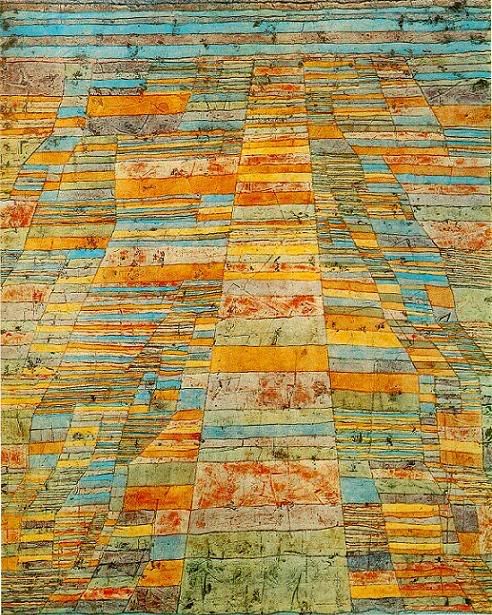
Yet, of the many 20th century artists that heroically championed the unconscious and the archaic, Paul Klee is perhaps the only one that your grandmother loves. Why? Because his paintings are colorful and inoffensive and, when not abstract, feature charming hieroglyphs, animals and stick figures.

Art writers most often describe Klee's work as "whimsical," "precious," even "child-like," but Klee disdained such mundane interpretations of his work. He dismissed "the legend of the childishness of my drawings" as the result of his attempts to "show man [not] as he is but as he might be."


Paul Klee
"Highways and Byways"
1929
Oil on canvas
32 5/8 x 26 3/8 inches


Contemplating the disparity between Klee's stated intention and the general reaction of his viewers, I recalled something that I wrote in the comments section of a recent post.
"Art is subjective...and I feel that a viewer's experience and interpretation of an artwork is as informative and vital as the intention and creation of the artist. It's a conversation."
In short, the viewer plays a substantiative role in the life of an artwork.

Does this mean that Klee was wrong to assert his mystical motivation in the face of popular resistance? Not necessarily. Many artists sense Klee's profound striving. Undoubtedly, Klee would have approved of Bridget Riley's assessment of his paintings as "the process of things coming into being" and, in my art taxonomy, he is more closely related to the mythically-inclined Mark Rothko than he is to the playful Alex Calder.

Nevertheless, the popular response to Klee's work can not be overlooked. Art is a conversation and, in the dialogue generated by Klee, the perspective of artists like myself or Riley is representative of a small minority.


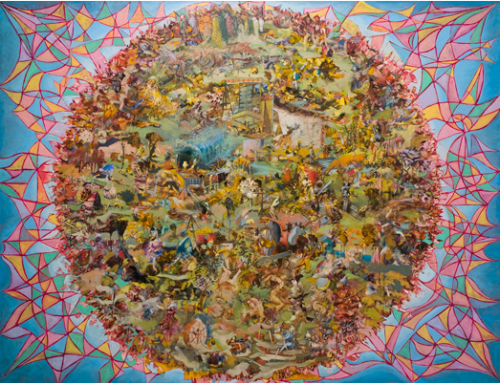
Ali Banisadr
"Target"
2008
Oil on linen
60 x 78 inches


A few months ago, I encountered the young painter Ali Banisadr's artwork for the first time. His riotous pseudo-abstractions compellingly communicate the distortions of violent conflict, yet the artist's all-over compositions also manage to effect a meditative state. Indeed, some of the works are mournfully elegiac. (His 2008 painting "Target" is perhaps the most obvious example; the picture acts as a Yantric focal point despite being dominated by a feral garden scene.)

Banisadr was born in Tehran, Iran, in 1976. His family lived in the city during the Iran-Iraq War and he states that "vivid memories of the bombings that...regularly occurred throughout his childhood" are a principal inspiration for the recent paintings. Banisadr's 2008 solo exhibition at Leslie Tonkonow Gallery received critical praise in a number of outlets, including The Brooklyn Rail, The New York Times, and jameswagner.com. Reviewers usually cited the same forebears and inspirations that the artist lists in the exhibition catalog.
"I want the viewers of my paintings to see history and human behavior at a macro level, by combining a great variety of influences that you can see close-up. Bosch, Brueghel, Persian minatures, memories, literature, history - I want to combine all of these things in my work. When you put all of this in the pot and stir, you create your own mythology."
Indeed, Banisadr combines these ingredients to excellent effect. Looking at the paintings, Banisadr's indebtedness to and admiration for the Dutch masters is immediately apparent, but so, too, is a great heave of ideological love and madness.

But one of Banisadr's paintings provoked an unexpectedly powerful association in this viewer, one that I'm sure Banisadr did not intend to stir into his eclectic pot. I'm fortunate to have neither fought in nor lived in the midst of war. Yet having grown up in the American South, I still identify the American Civil War as "my family's war." That association may seem disingenuous - the war was fought 150 years ago - but my homeground is marked by that terrible conflict in a way that the rest of the country is not. Gravestones in the small cemetery in the front yard of my childhood home speak to the pride Southerners had in their cause. Stonewall Jackson Kellam is among the dead buried in that cemetery. Kellam was a five-month-old baby when he died on October 3, 1868, just a few years after the close of the Civil War. His name honored Thomas "Stonewall" Jackson, the prominent Confederate general.

The Civil War colors Southern identity, and I am not immune. Although my paternal great-grandparents were a Hungarian Jew and Catholic seeking refuge and opportunity in Brooklyn, New York, the other seven branches of my family tree have deep roots in the United States, mostly Scots and Brits who immigrated in the 1600s. At least two of my great-great-grandfathers fought in the Civil War (one for the Confederacy, one for the Union), along with several of their brothers, and the records of their service are rather stirring. My great-great-grandfather Wesley Mayes Dance was fatally wounded several hundred yards away from the site of the "Crater" at Petersburg, Virginia. Wesley fought with The South of Dan Rebels, one of two Virginia regiments that held the Union advance at Petersburg until Southern reinforcements arrived. With bitter pride, I consider the fact that he and his fellow Confederates sealed the defeat of the Union attack on that day, thereby prolonging the war for many months.


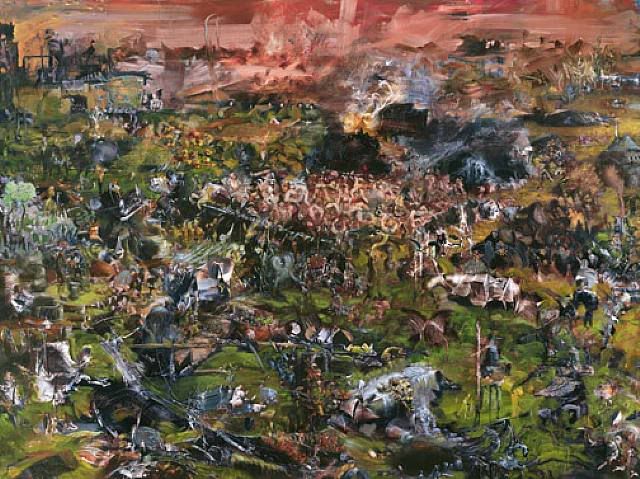
Ali Banisadr
"Amen"
2008
Oil on linen
50 x 66 inches


I don't often think about the Civil War, or even about my Southern identity, but in Leslie Tonkonow's gallery space, Ali Banisadr's painting "Amen" resonated for me, above all, as a picture of that history. I conceived of Banisadr's picture as a depiction of the Battle of Chancellorsville, one of the bloodiest, most frenzied contests in the war. The painting hums with electric life, yet is also a sad testament to our darker inclinations. I responded to the work with unsettling emotion; taking it in, my eyes stung with restrained tears.

As I departed the gallery, it occurred to me that I would be unable to write about the exhibition without raising my Civil War associations. I worried that this was too personal an experience to discuss, too private an interpretation to inform Banisadr's paintings for readers. If the artist didn't intend his paintings to conjure up Chancellorsville, how could I, in good faith, write about storied recollections of my great-great-grandfathers?

But as Proust reminds us, "in reality, every reader is, while he is reading, the reader of his own self." Artworks compel every viewer differently. More vitally, each individual comprehension of the artwork completes the piece anew. Klee's mystical intentions and Banisadr's Iranian memories are only part of the exchange. Art is, after all, a conversation, and a deeply satisfying one at that.

Image credits: Paul Klee reproductions ripped from Peplum and WebMuseum; Ali Banisadr reproductions ripped from artnet and Joann Kim's UpDownAcross

Tuesday, March 17, 2009

Art Connect "Extraordinary Art Blog" Series

I'm honored to report my selection as the third interviewee for Art Connect's "Extraordinary Art Blog" series. Read my interview with Managing Director Peter Cowling here.

Art Connect is a relatively new website that provides the valuable service of reviewing and cataloging art blogs. The blog reviews are terrifically helpful and the interview series is so far excellent. From the Art Connect site:
"In the process of compiling over 100 art blog profiles, and starting what will be an ongoing survey of the art blog scene, we accumulated a whole range of questions we wanted to investigate further. As a part of this series, we have explored the extraordinary growth of an art blog with Ruben Natal-San Miguel, from ARTmostfierce, how to produce extraordinary art critique with Catherine Spaeth, and providing extraordinarily cohesive coverage with Christopher Reiger from Hungry Hyaena."
The interview with Catherine Speath is of particular interest to me, given her defense of accessible, yet rigorous art writing. She writes,
"I do, however, take very strong objection to what you are referring to as 'dumbing down' when it is relied upon as uncritical fodder for the market. For this reason there is a very important role for the academy and the museum to uphold a place for scholarly research. But I have also seen some atrocious academic writing, produced by galleries especially, that relies upon a history of philosophical thought to dress something up for the market."
Ms. Spaeth also discusses the issue of online plagarism, particularly as it relates to bloggers. This issue is very important, and I hope that it will engender more conversation.

I encourage readers to check out the Art Connect interview series.

Monday, November 19, 2007

Lenore Malen and Jose Alvarez

Link over to the Artcal Zine to read an essay of mine, "Representations of the Occult: On Jose Alvarez and Lenore Malen."

I feel that both artists deserve more critical consideration. Visit Lenore Malen's site here, and learn more about Jose Alvarez here.

Tuesday, November 06, 2007

The Plagens Questions

Per the suggestion made by Kriston Capps, the writer/editor responsible for Grammar Police and a contributor to Washington's City Paper, I've below answered a number of questions originally posed by artist and former Newsweek critic Peter Plagens to Regina Hackett, Tyler Green, Jeff Jahn, Roberta Fallon & Libby Rosof, and Edward Winkleman as part of an Art In America round table discussion about the role of art blogs.

There's been a lot of hullabaloo about this topic of late, and I have some reservations about adding my voice to it. Still, I was flattered to be called out by Capps, and so figured I'd give it a go.

What's the purpose of your blog?

Although I created Hungry Hyaena with the rather modest goal of improving my critical writing skills, "purpose" isn't a word that I like in this context. I have no mission statement or fiscal goal. Initially, HH focused on environmental issues but, an artist, compulsive reader, and part-time space cadet, I found myself wanting to write about a wider range of subjects.

Over two years later, I've come to regard HH as a record of my creative inputs. That is to say, the collected poetry, ramblings, reviews, and photographs posted here are a sampling of the questions (and sometimes answers, transitory though they are) that consume the hours when I'm unable to be in the studio. As my father, a freelance writer, says, "I'm always writing, even when I'm chopping firewood or picking up mail at the post office." So it is with any creative person, I believe, and the scribbles in my notebooks that don't become drawings, paintings, or videos, often turn into blurbs or essays. My exhibition "reviews," too, are really projections of my own obsessions.

What are the boundaries of your blog?

I'll steal from Bill Gusky here. "Whatever interests me enough to write about at any given time."

Tyler has cited Joy Garnett's Newsgrist blog as doing a great job of "placing art within a sociocultural and political context." What I see on NewsGrist is a magazine-like interspersing of short profiles, exhibition reviews, op-ed pieces on how other people are covering things, and Village Voice–like political takes. But what does Tyler's comment mean to you, and why are blogs in general better positioned than print to do what he describes?

They aren't. Blogs are poorly positioned relative to "print." As mainstream print publications, particularly newspapers, begin to incorporate the op-ed blogging approach on their websites, I think unaffiliated blogs - that is, those not operating under the auspices of a corporation or conglomerate - will continue to lose an already fractured audience.

Yet blogs do have a leg up in at least one respect. Unaffiliated bloggers need not worry about copyright laws or other use restrictions and are therefore able to sample from a broad array of sources without obtaining permission via "the proper channels." As a proponent of Creative Commons, I find this promising. In time, perhaps, our major "print" sources will look more kindly on works (or reproductions) intended for the public domain. That may be the greatest legacy of the World Wide Web's early years; in any case, blogging highlights the possibilities.

I don't think the strength of Joy's blog has much to do with any of this, however. A newspaper blog could accomplish what Newsgrist does...if the moving forces at the paper were ready and willing to do so. But the larger media outlets remain reluctant to blur the imaginary line between art and politics because their advertisers are uncomfortable with erasing these distinctions. Let's face it, the majority of Americans are uncomfortable with that proposal, too. If a major newspaper began printing "Arts" articles alongside reports from its war correspondents or financial columns, the "sociocultural and political context" significance of art would be made available to a wider audience. At the very least, it would encourage a connecting of the dots. Sure, some of the best blogs, including Newsgrist, are doing this now, but art bloggers are kidding themselves if they believe they're being read by anyone but members of their own clique.

Why can't blogs go further, to the point where there's hardly any discernible difference between artist and critic/commentator, blog and work of art?

Like most of the bloggers who have answered this question before me, I think bloggers can and do "go further." In fact, as mentioned above, I view my "reviews" of other artists' work as part of my own creative output. They are extensions of my own ideas and concerns. In an Art World so determined to provide viewers with wall texts and artist statements, I don't see why a literate artist's blog shouldn't be considered part of their greater project.

What scope and degree of editorial control do you exercise over your blog?

All, I suppose, those I sometimes ask more tech-savvy friends for template assistance. I don't think I've ever credited them, however. My bad. (And the original title banner was designed by my friend, Frank Castaneda. )

What about posting comments from readers, and what about anonymity?

I invite comments and usually respond to all of them, even the toss-offs, but I don't often read the comments section of other blogs anymore. I used to...and I also used to comment much more often. Sometimes fantastic conversations take place in the comment section of, for example, Edward's blog, but usually I find that the exchanges are soon dominated by one or two belligerent voices. The conversations become boring as a result. It's a shame.

As for anonymous comments, I don't really care unless the individual becomes particularly nasty. Even then, they're entitled to say what they like, and to do so anonymously. I used to get angry when people posted something hateful, but now I generally find it amusing.

What's "trolling," and why don't some of you allow it?

The term refers to those anonymous commenters who flame you (to stand out) and do so with the intention of drawing you (and your other readers) to another site (via a provided link). It's annoying but, other than deleting the offending comment, I'm not sure I understand how bloggers prevent them. In any case, it rarely happens on a blog with as few readers as HH has.

Is trolling really so easily identified and universally bad? Is having posters register a solution?

I'm not really sure. I don't consider it particularly egregious if the comment made by the "troller" is at all relevant.

Of course, it's now considered a federal offense. Technically, then, no blogger should "allow" it, but I'm opposed to having posters/commencers register. This is a free and open forum, more or less, and should remain so.

What about liability coverage?

"Oh, brother!," exclaimed Charlie Brown.

What's the economic model of your blog?

HH is free and easy, and generates no revenue, although I recently began participating in an art blog experiment that may offer some slim returns. (See upper right, just below the banner.)

But as regular readers of HH know, my thoughts on income of any sort are complicated. Though I'm not a traditional socialist, I distrust free-market capitalism and, in an ideal world, I'd opt for an alternative social/economic structure. But ecology and economics are forever works in progress, so we'll see what happens...to HH. to the blogosphere at large, and to the rest of it.

How do you see your blog's relation to the established print art media?

My answer depends on the day.

At the moment, I feel that HH is something different from print art media, that it is a complement to my artwork, more art than art media.

Tomorrow I might feel that the blog is a complement to the art media.

Whatever. Has anyone seen Comet Holmes? I saw it over the W train in Queens tonight. It's bright enough to punch through even the city glow.

How do you attract readers/posters other than by word of mouth?

Actually, I don't much talk about the blog. When I started HH, I planned to have only a few friends as regular readers, but people started reading and returning.

But the HH "audience" remains small. On an average week, I'll have between 800 - 1500 readers. When I write a post that is linked by a more prominent blog(s), the numbers jump markedly.

In general, is blog art criticism more open and liberal, and print criticism more closed and conservative?

No, although sometimes bloggers are more slash-and-burn in their criticism, likely because they are less self-censorious (or less hemmed in by an editor).

Some people say that there's a dearth of art criticism at length on blogs. Is this true? If so, does it have more to do with reading on a computer in general, or with art criticism in particular?

I disagree with Bill Gusky's assessment that, "Blogs are fast and to the point. If you can't say it in a few paragraphs, it's not blog-worthy."

I often write long (some would say long-winded) essays for HH. As I said earlier, I'm reluctant to call it "art criticism," but the question still stands. Would I read such long posts on other blogs? Of course, though, if the essay is good, I'll print it. I know, I know...I'm a "green" hypocrite, but I can't stand reading on the computer. As Anthony Grafton wrote in a recent issue of The New Yorker, "the form in which you encounter a text can have a huge impact on how you use it." The principal reason that I print lengthy articles or posts is that I annotate most everything I read. If I find that the text is particularly satisfying, I save it in my ever-expanding files, into which I delve when looking for a reference to this or that subject. Reading an essay on the computer screen doesn't allow me to record my thoughts.

Also, I'm a paper sniffer. I can't make it through more than two pages without taking a moment to appreciate the paper's scent. There are a wide range of smells dependent on the age and the chemicals used in production.

So, I'm not at all surprised that some blog users don't want to read lengthy posts on the screen, but I see no reason why we shouldn't print them, excepting for the nagging eco-guilt. (At least print double-sided and recycle the paper.)

I wish I could say, as Kriston Capps did, that "I can't actually afford to write things on my blog that I could get paid to write." Then maybe I'd save longer posts for publication and get paid by the word, but I'm only rarely paid for what I write. If nothing else, the blog offers me a venue to "save" ramblings that would eventually be deleted during a computer hard drive cleaning.

Art magazines come out once a month. Newspaper art reviews usually appear once a week. Blogs appear more or less daily, and sometimes have updates by the hour. Do you think that the faster pace of blogs will start to affect the pace of art-making.

Absolutely not.

I'm not sure how one defines "the pace of art-making," anyway, but if it is accelerating, it is following the same cultural rivers that blogs are.

Tyler just said that there's more good art being made by more artists in more places than at any time in history. Is this true? And if so, what's the reason?

I think so, yes.

I'd point to four reasons: the "dialogue" is more international and culturally inclusive; "first-worlders" of a certain means are brought up to believe that they are each capable of achieving great things; there are more people on Earth than ever before; intense concentrations of wealth lead to greater luxury spending and art, as product, is luxury (even though it should not be, in spirit, impetus, or intention).

Reviewing those four reasons for the surplus of art making, the parallel between our contemporary standing and that of the late Roman Empire is apparent. Our over-extended "global economy" and "military industrial complex," too, will collapse. It will be curious to see what role artists play when, once again, we are called to task for the church(es) and warlord run states. What will Jeff Koons be in that world's memory? Will Damien Hirst's stunning skull be exalted, and for what reason?

Do blogs help correct the geographical bias in print art criticism, i.e., the tendency to think that most of the important stuff happens in New York or Los Angeles, and the difficulty of art outside those places to get national attention?

Do they help correct the bias? Yes, but only in the context of the blogosphere.

Do they help correct the tendency "to think that most of the important stuff happens in New York or Los Angeles?" For the people living outside of the cultural meccas, absolutely. In fact, part of the reason I began considering a move away from NYC is that I believed I could stay abreast of the art world via the blogs (much more so than by reading the major art magazines, most of which I have little interest in, in any case). Unfortunately, I think most people installed in either of those two cities still believe that anywhere else is no man's land, a faraway place off the cultural radar. This attitude might yet change. I hope so.

One index of a city's gravity as an art center is young artists—perhaps recent MFAs—from elsewhere coming to set up shop. Is that happening in Philadelphia and Portland?

I've heard that this is the case, particularly in Philly, Portland, Richmond (Virginia), Seattle, and Houston, but I can't really speak to it one way or the other.

Is there any constructively negative edge to your blogging and, if so, what is it?

I don't understand this question.

Let's throw something back into the mix: naked human ambition. Unknown bloggers want to be little bloggers; little bloggers want to be bigger bloggers; and bigger bloggers want to be called, as is Tyler's Modern Art Notes, "the most influential of all the visual-arts blogs" by the Wall Street Journal.

I don't think of myself as a blogger. I write stuff and post it on a blog because it is an easy mode of dissemination. Do I want my art (writing included) to reach an audience? Of course. Would I like that audience to be large? Yes. I make it to communicate, after all.

Where will your blog be in three to five years?

At the same URL if Blogger doesn't get bought out. Otherwise, dunno.

Wednesday, October 24, 2007

ArtCal Zine Review: Ugo Rondinone

My review of Ugo Rondinone's exhibition, "Big Mind Sky," is posted at the ArtCal Zine. (Click here to read.)

While you're there, I encourage you to read some of the other recent reviews and write-ups. The contributors are a good bunch and I'm hoping the zine might become a regular stop for art readers.