Showing posts with label awe. Show all posts

Sunday, January 20, 2013

"Private Frontiers" at Hosfelt Gallery

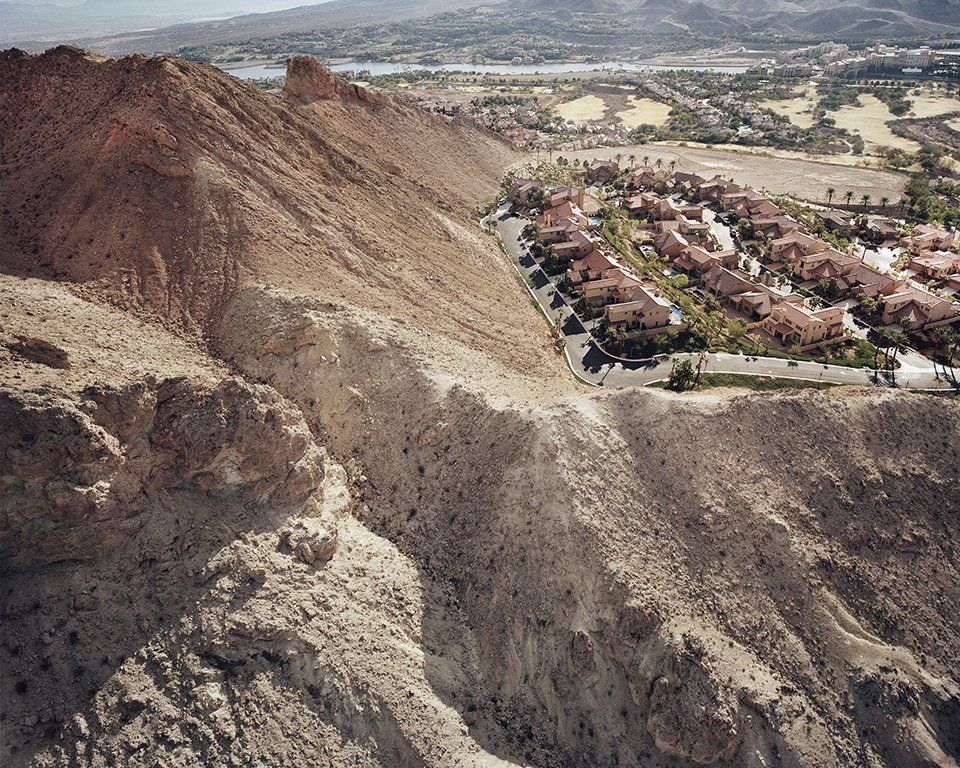
Michael Light
"Lake Las Vegas 2010-2012 20. 'Casa Palermo' Lake Las Vegas Homes Looking Southwest, Henderson, Nevada"
2010
Pigment print mounted on aluminum
40 x 50 inches
Edition of 5
I recently visited Hosfelt Gallery's impressive new space, currently home to "Private Frontiers," a two person show featuring works by Brooklyn-based painter Chris Ballantyne and San Francisco-based photographer Michael Light. According to the press release, the two artists "have been in dialogue for the past year to develop work that examines the human urge to stake territory and its more absurd manifestations on the American landscape." Whatever the specifics of the artists' conversation, Ballantyne's paintings are a terrific compliment to Light's large-format aerial photographs. Exhibited on their own in the expansive Hosfelt loft, Ballantyne's colorful and occasionally whimsical works would risk being swallowed up as bittersweet morsels. Hanging alongside Light's grand photographs, though, Ballantyne's modestly-sized pictures comport themselves especially well; their affability and humor endure, but undercurrents of earnestness and melancholy, too easily missed if exhibited on their own in so airy a space, are amply felt.

Tuesday, October 02, 2012

Picturing Awe

Frame from "Wind Map"
Martin Wattenberg and Fernanda Viegas

Last night, I attended the second presentation in this season's Art, Technology, and Culture Colloquium series at UC Berkeley. Martin Wattenberg and Fernanda Viegas, artists and researchers who often work as a team, presented "Visualization and the Joy of Revelation," an engaging survey of their greatest hits (to date) supplemented by tidbits about their process and working philosophy.

From the ATC listing:
"Fernanda Viegas and Martin Wattenberg explore the joy of revelation: the special electricity of seeing a city from the air, of hearing a secret, of watching a lover undress. Their medium is data visualization, a technology developed by computer scientists to extract insights from raw numbers. They'll show what happens when this technology is aimed at data sets that range from tropical storms to social networks, from arguments on Wikipedia to expressions of carnal desire."

Friday, August 10, 2012

Platte Clove Residency: John Muir and the View From the Precipice

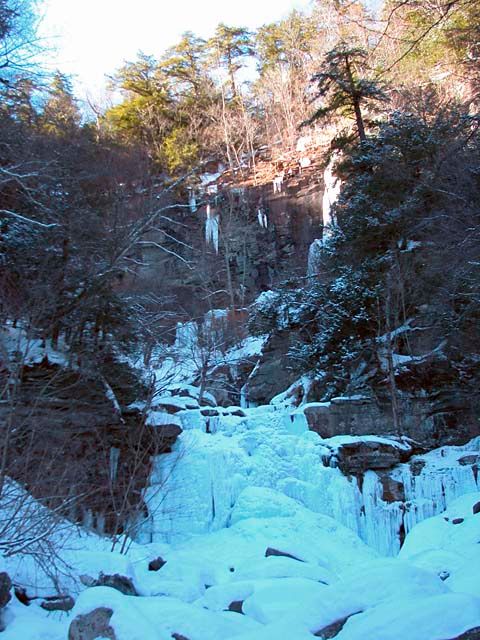
Winter view of Platte Clove's Bridal Veil Falls;
Catskills; NY
“Many people have been killed after falling and sliding off the edge. Especially in areas where there are pine needles. Dangerous conditions exist in many locations. The number of deaths over the years is staggering. Be overly cautious when in this region, and do not take un-necessary risk.”

- “Upper Platte Clove” page of Catskill Mountaineer website
I hesitated before deciding to investigate the unmarked spur of the Platte Clove Nature Preserve's Plattekill Falls Trail. Having recently read a bit about the geology and topography of the Catskill Escarpment, I knew that the preserve is located near the top of a deep ravine that tumbles suddenly down and eastward to meet the Hudson Valley (clove is the Dutch word for a mountain gorge). I’d also learned that each year a handful of foolhardy or unlucky hikers fall to their deaths on Platte Clove area trails. An online trail guide I’d browsed prior to the residency urged hikers to be “overly cautious.” Nevertheless, once I’d stepped off the main path and advanced a few steps down the spur, I was self-assured; I wouldn’t be one of 2012’s casualties. Prudent types like me don’t fall off cliffs.

Friday, February 10, 2012

Chris McCaw: Drawing Time

Chris McCaw
"Sunburned GSP#420 (Arctic Circle, Alaska)"
2010
Unique gelatin silver paper negative
12 x 20 inches
Chris McCaw created the arresting pictures on view in "Ride Into the Sun," the artist's winter 2011 solo show at Stephen Wirtz Gallery (San Francisco, CA), using an unconventional technique. The artist loads handcrafted view cameras as large as 30 x 40 inches with expired silver gelatin photographic paper, tilts the camera lenses skyward, and opens the shutters for hours. Even on cloudy days, the photo paper is soon overexposed. As time wears on, however, the light-sensitive chemicals that coat the paper are solarized, and the prints' tones are transmuted in curious ways. In many of McCaw's works, the sun appears as a dark, arcing streak and the landscape and sky as shades of grey. During some of McCaw's longer exposures, the sun's brilliance, laser-like, burns through the paper, tracing its progress as a charred tear.

Tuesday, January 24, 2012

Oh, Starlings!


A few months ago, a friend shared the above video with me. You might have seen or read about it before; it went "viral" late last year. The two friends who appear in the clip are treated to an intimate encounter with a large murmuration, or flock of European starlings. Murmurations of such substantial size are natural phenomena that, no matter how familiar, retain their capacity to inspire wonder, even awe. As one, the birds sweep and dance in an astonishing and fluid choreography; the rush of their wingbeats and many bodies pushing through the air produces a sound that accounts for the name. Because the audible component of a murmuration is impressive in its own right, I wish a version of the video were available without the hokey music, but the giddy joy that the canoeing friends experience is palpable, especially near the short film's end, when one of the women looks at the camera with marveling, wide eyes, and they both begin to laugh.

Friday, January 13, 2012

Big Sky Country

Christopher Saunders
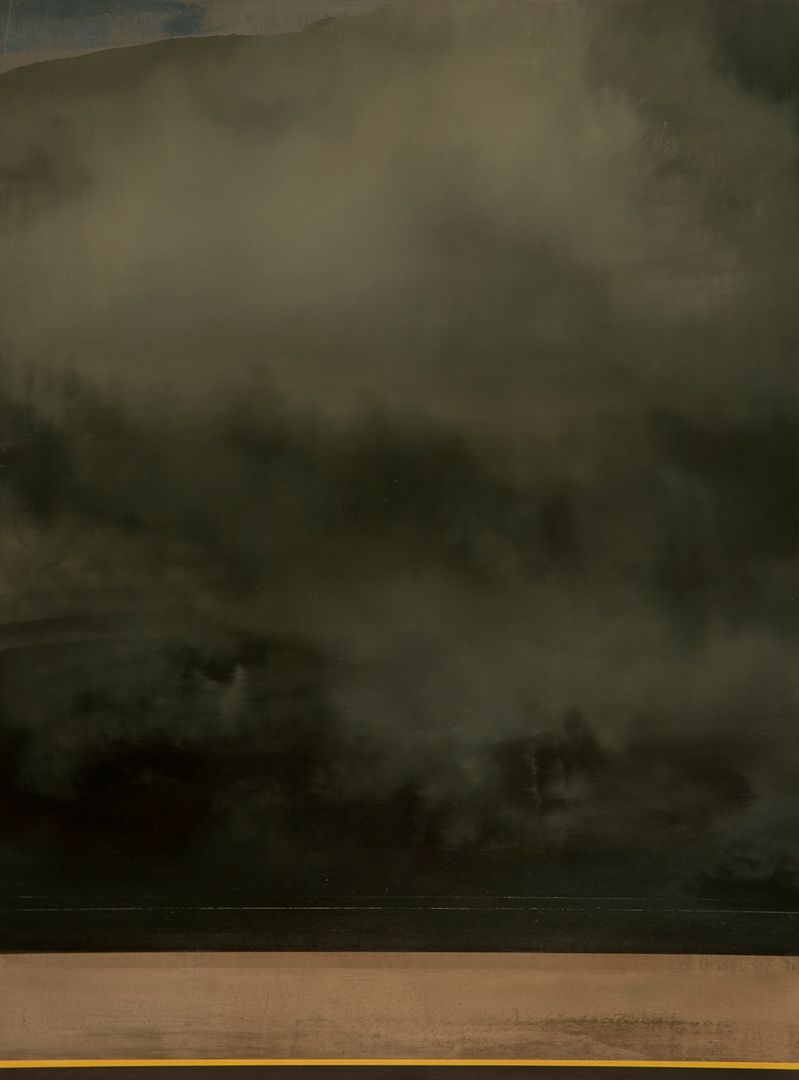
"Whitenoise no. 1"
2008
Oil on linen
24 x 18 inches

In a 2009 post about painter Christopher Saunders' "Whitenoise" series, I recounted philosopher Arthur Schopenhauer's hierarchy of aesthetic experience and connected it to Saunders' work.
"In his volume The World As Will and Representation (1818), Schopenhauer elucidated a scale of aesthetic experience. At one end of this spectrum, he described the 'Feeling of Beauty' as 'Light...reflected off a flower. (Pleasure from a mere perception of an object that cannot hurt [the] observer.)' At the other end of the spectrum, the philosopher positioned the 'Full Feeling of Sublime' and the 'Fullest Feeling of Sublime.' These categories are described, respectively, as 'Overpowering turbulent Nature. (Pleasure from beholding very violent, destructive objects.),' and 'Immensity of Universe's extent or duration. (Pleasure from knowledge of observer's nothingness and oneness with Nature.)'

Thursday, September 22, 2011

Kija Lucas' Stars & Pillows


NASA and the European Space Agency
"Hubble Ultra-Deep Field"
2004

Glow-in-the-dark star stickers dotted the ceiling of my childhood bedroom. Every night, before sleep, I marveled at the phosphorescent firmament. Over time, however, the stickers' charge diminished and the ceiling's constellations grew dim. Likewise, the burgeoning egocentrism of adolescence dulled my capacity for wonder; for years, I gave little consideration to the night sky. By the time I'd matured enough to be awed anew, adult life had carried me from rural locales to the electric glow of New York City, where all but the brightest celestial bodies were swallowed by our species' illumination.

Today, whenever I find myself in sparsely populated areas at night, I'm startled and humbled by the brilliance of the stars and my relative insignificance. The famous Hubble Ultra-Deep Field (HUDF) image evokes a similar awe. The HUDF was produced by compositing visual data from the Hubble Space Telescope, and the colorful result provided astronomers with a 13.2 billion-year-old picture of our universe. The orange, yellow, blue, and purple marks that spot the HUDF are primordial galaxies that formed shortly after the Big Bang. The photograph is attractive, but it appeals more to our imagination; it's capable of elating a viewer as much as the heavens can an enthusiastic amateur astronomer or glow-in-the-dark star stickers can a child. The incomprehensible grandeur of the cosmos is intoxicating.


Kija Lucas
"Origin Story No. 4"
2011
Silver gelatin prints, tape
30 x 40 inches

The HUDF came to mind as I admired Kija Lucas' "Origin Story No. 4," a photogram collage included in Root Division's "Introductions 2011" exhibition, the non-profit's annual survey of a dozen Bay Area emerging artists. Although the abstract imagery of "Origin Story" appears cosmic, the galaxies and gases of Lucas' picture are more earthly. The artist gathered dust from her studio floor, placed it on light-sensitive photo paper, and then exposed the paper. Afterward, she cut the resulting photograms into 2x2 inch squares and rearranged them; the seams of the collage create an unsteady grid, adding to the impression of an extraterrestrial survey. But the white-specks and smears might also be construed as microscopic lifeforms near the deep-sea floor, the products of a particle accelerator's "God-particle" collision, or documentation of activity in another sphere invisible to the human eye. The photogram's easy transition between the unfathomably vast (i.e., the universe) and the subatomic speaks to the mystical notion that scale is Ouroboros-like, that infinite travel "inward" (i.e., moving ever smaller) eventually leads to the infinitely large.


Kija Lucas
"Pillow No. 4"
2011
Archival pigment print
23 x 30 inches

Does Lucas intend "Origin Story No. 4" as a rumination on such matters? I don't know. But the artist also includes another body of work in "Introductions 2011" that invites a complimentary interpretation: a series of photographs of old pillows, presented specimen-like on black backgrounds. The pillows' patterned fabric, stained with mold and sweat, is testimony to their years of service. In the context of "Origin Story," it's hard not to think of these well-used pillows cradling the craniums of people transitioning between waking life and dream, a liminal state conducive to contemplative insight into the incomprehensible. Yet the beautiful photographs are also anthropological documents; Lucas treats mundane pillows as artifacts worthy of sustained consideration. What do they tell us about ourselves? What do the patterns mean: the fleur-de-lis, the crop of diamonds? Specific answers will be provided by viewers, but Lucas' overarching project attests to the human inclination to collect and interpret, to grope for understanding.


Kija Lucas
"Pillow No. 6"
2011
Archival pigment print
23 x 30 inches

Image credits: HUDF, courtesy of NASA; Kija Lucas images, courtesy the artist

Thursday, September 15, 2011

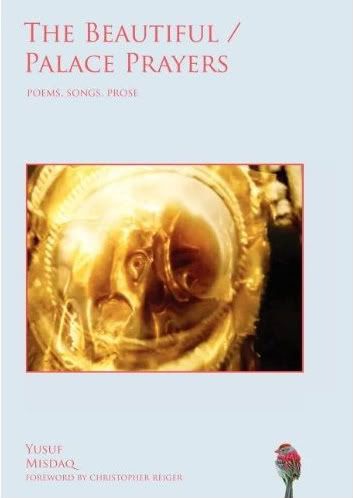
The Beautiful / Palace Prayers

OLD MOONS

Old moons now are dried and crusty
Brittle and as uninteresting as history is
To my fingers and lips.

And yet also, it cannot be denied
That each man
King of his home-throne
Misses something of eternity
When he chomps down on lamb chops
(Which are his reward
For winning the bread)

Each of us misplace the universe
And lose the word
When we get our desires
On plates before us.

There is a grain of rice on the table.
Around it, oil has bled
And spreads

In this way does our egodeath
Halo around us
  And puncture the beauty
    Of clouds
- Yusuf Misdaq

Two years ago this month, I highlighted the poet, musician, artist, and author Yusuf Misdaq's Palace Prayers project. August 21st - September 19th, 2009, was Ramadhan, and Misdaq, a practicing Muslim who, as I noted at the time, "shares my universalistic mystical inclination," created a new work of art for every day of the month-long fast and period of Muslim introspection.

Some months later, Misdaq invited me to contribute a forward to a book of his poetry, prose, and lyrics. That book, The Beautiful / Palace Prayers, was published this year. Visit Misdaq's website for more information.

+++++

"Dissolution Is The Whole Show"

When Yusuf invited me to contribute a foreword to The Beautiful / Palace Prayers, I was at first surprised. Although I enjoy reading poetry, my education in literature is wanting, and my tastes run to work that most "serious" critics and scholars deem pedestrian. Who am I to comment on this young artist's latest collection? With characteristic enthusiasm, however, Yusuf's invitation quelled my self-doubt, insisting that The Beautiful is made up of poems "for normal people who do not normally read poetry." Well, in that case, it is a privilege and a joy for this normal person to introduce a collection of poems, verse, and prose written "for normal people"!

        They are a good species.
        Clean and caring;
        Made mostly of water and forgiveness
              - from "The Beautiful"

Normal people are very much in need of poetry, and perhaps especially so today, when the art is generally neglected. Words are powerful entities, every one an invocation, yet we too often use them carelessly. Poetry, like prayer, can serve as a corrective, reminding us that words conjure meaning and that they have a felt, physical component. As critic and philosopher George Steiner writes, "the meanings of poetry and the music of those meanings...are also of the human body." Appropriately, Yusuf refers to the italicized and apparently random words that he includes in some of his poems as "body echoes." "Carbunkle. Crellis. / Pulse-if. peaces." or "Que Que" are not intelligible formulations but, when read aloud, they aren’t exactly jibberish either. They supply somatic meaning, as do the poems’ rhythms. Yusuf's strongest poetry or verse has a perceptible pulse; in some cases, I notice my head slowly bobbing as I read. This is not insignificant. Beat and rhythm are primal properties, manifestations of the infinite, unfathomable being within which we reside and of which we are composed.

        Echoes
        of the original
        Voice
        From the original
        Breath
              - from "Ramadhan 26"

Ludwig Wittgenstein insisted that earnest philosophers should "descend into primeval chaos and feel at home there" if they expect to produce worthy work. I extend the same requisite to artists. Yusuf draws pictures, makes films, and writes poems, novels, and songs, but he is, above all, a mystic. And mysticism, in its quest to directly experience elemental truths, necessitates Wittgenstein's appreciation of the primeval and the chaotic; ancient disorder is at the root of everything. In most cases, the mystical perspective is merely an uncommon one; mystics survey and respond to the same earthly, material realm that the rest of us do. But they disregard accepted classifications and train themselves to mindfully observe and reinterpret their surroundings. They locate the extraordinary in the mundane. As Henry David Thoreau, a 19th century mystic, lamented, "All this [splendor] is perfectly distinct to an observant eye and yet could easily pass unnoticed by most." Mystics reawaken their capacity for reflective wonder and, in doing so, experience a kind of rebirth into a vaster dimension of human experience.

        On perfect Spring mornings
        God puts a clear blue sky in our pockets
        Pats us a few times and says
        'On your way!'
              - from "The Merciful Cheerful"

So reborn into sublime beauty, mystics strive toward the transcendent. Both Wittgenstein and Thoreau can be described as transcendentalists; Yusuf qualifies, too. Like the two philosophers, he finds in his observations of the world cause for a fundamental optimism. Unlike them, his writing is generally informal and devoid of pretension. His poems give readers the impression of a devout Sufi Muslim happy at play in our waking, sensual dream. In the collection's title poem, Yusuf writes "Awake in this dream / Where abstract clouds calmly keep us. / Where birds secretly make love in public and / Give voice to the current of joy which / Slices through us in a day." Again, in "Back Amongst Men (Drowned)," he references this dreamed life: "Or as I have also interpreted it / .God is a laughing dream." No doubt, the poems’ author, laughing, singing, eyes wide and sparkling, would appear mad to many of his fellows. This is to their discredit. They have forgotten (or failed to learn) how to look. Mystics, like many philosophers and artists, are too easily dismissed as lunatic or eccentric. Yusuf's ability to see through the veil of our cultural forgetfulness informs his aesthetic imagination and invigorates his art.

        Silk veils, dark and weightless
        Are being removed from her countenance
        Time after Time

        Each day I ready myself to know her better
        Each day, closer
              - from "Wahad"

But not all that Yusuf observes is felicitous. The most biting poem included in The Beautiful, "Ramadhan 23: Only To Be With You And No-one Else," is a reaction against the politicization of Islam and a celebration of his intimate relationship with Allah. After rejecting the "bloody bridge builders / Shmoozers or politicians" and others who "come to the Mosque smiling in your suit," Yusuf writes, "I wish to be alone / And serious / And deeper in love / With the only one who ever matters." The striking seriousness of his personal communion with G-d is important; discipline is one of the central currents running through the poems included in The Beautiful. In “Waiting (A Song for Guitar),” Yusuf writes, “I do believe in magic but first you gotta work at it.” Hope and love, he reminds readers, are nurtured through dedicated ritual and practice.

        Understand, thee
        That tenderness comes not of softness
        But of a firmness
        And of a discipline

        Understand that of discipline
        -Say, the discipline of prayer-
        Comes an enjoyment of that same thing.
        Discipline to run breeds a love for running
        Discipline to practice ones instrument brings forth a love
        for playing it
        Discipline to speak good breeds a love of horses
        And love of all refined things
        Whatever you may find them to be.
              - from "Ramadhan 12: The Vows Revolve"

A visual artist, I appreciate the centrality of discipline in a life committed to aesthetics. Like Yusuf, though, I am also mystically inclined. Paintings, sculptures, and other hand-crafted objects are among my adored icons but, if I work at it, I can find occasion for worship in every place, in every form, in every moment. The European starling that paraded on the sidewalk in front of me this morning warranted exaltation. In his iridescent dream coat and brilliant yellow bill, I see cause for startling, smiling celebration. For some other pedestrians, the bird, a representative of a despised species, may be ignorable or irrelevant. For others, my viewing the starling as a manifestation of the Divine amounts to idolatry. So, too, might the dirty, discolored Queens sidewalk be deemed a cement calf by unimaginative or close-minded "believers." Yet, striding on such a sidewalk today, my thoughts range through eons of geologic time to consider the ancient rock and mud, precursors to and components of the concrete that I now tread upon, from which our kind eventually emerged on crude limbs as a gasping, fish-reptile thing.

        The salt-pepper sugar mills on this table look like planets.
        I want to know the word for planet in as many different
        languages as possible.
              - from "Celestial"

Doubtless some of those who consider themselves religious don't share my enthusiasm for our scaled, long-snouted ancestors. But I'm not concerned with narrow definitions of religion. I believe that humility, wonder, gratitude, and communion are the four pillars of genuine religious practice, and the mental stretching engendered by the work of scientists, philosophers, and artists is an integral part of any intellectually rigorous, honest religious life. And, love, too, is a bit like religion. The same four pillars are fundamental to it. As Douglas Thorpe writes, "[love] demands of us a new way of being in our old world." Religious mysticism is a love affair with The All. It's not always easy, but religious attunement can turn each day, each hour, or each instant, into "a new way of being." Reading Yusuf's poetry, I'm reminded that every step is a psalm, every directed gaze is a prayer.

        Dot-Dot-Purple and Palaces
        Says the starling in approximate translation.
        Star-Star-Chandeliers and
        Bread on the wind-ind-ind.
              - from "The Beautiful"

I'm also reminded that we both enjoy watching starlings.

- Christopher Reiger, May 1, 2010

Sunday, June 20, 2010

Moving Notice


HH will be quiet for a couple of weeks. In a few days, Elizabeth and I begin the drive west; as of July, I'll be a Californian resident.

I haven't known so heightened a degree of nervous anticipation since I sat on my hands in the passenger seat of my dad's Ford F-150 and, wide-eyed and gape-mouthed, emerged from the Holland Tunnel into Manhattan.

That New York City birth occurred more than ten years ago, but I recalled it earlier this week, as I bounced a four-and-a-half month old baby on my lap. Whenever the two of us made eye contact, the baby would smile toothless at me and drool on the chest of his Snagglesaurus onesie. Each time, though, his eyes would soon drift away from mine, his smile would open into an imperfect "O," and he'd stare, head lolling, at some other object of wonder.

I've got thirty-two years on the little guy, but I don't believe that my appreciation of the world is altogether dissimilar. Certainly, I slip into self-conscious, myopic modes (say, when I'm packing for a major move!), but much of each day is spent squinty-eyed happy or struck dumb by wonder. I don't drool as much as I used to, but the stupidly sublime fact of being wows and humbles me no less than it did way back when.

Despite the long hours and the relative monotony of Interstate driving, I look forward to crossing this spectacular land. Along with books on tape and downloaded lectures, Elizabeth and I will have a road trip playlist to listen to. I added Liz Phair's "Go West" to the tracks last night.
"Safe on the interstate
New York is 3,000 miles away [...]
I've closed my eyes and my bank account
And gone west, young man

Take off the parking brake
Go coasting into a different state
And I'm not looking forward to missing you."
And I'm not looking forward to missing you New York, but life rolls on and I keep on smiling.

Image credit: State flag of California, ripped from Wikipedia

Monday, March 15, 2010

The 'Raw Stuff'...Discussed

I submitted a version of "Different Takes on the Raw Stuff," my posted response to Peter Gabel's "A Call For Sacred Biologists," to Tikkun Magazine, and I'm pleased to report that my comments engendered an edifying conversation with the article's author.

The editors of Tikkun have posted an abridged version of my correspondence with Peter on Tikkun's blog, Tikkun Daily. I encourage folks to check it out, but I've also included two excerpts of Peter's "voice" below.
"If I could sum it up in a phrase, I would say that Christopher is committed to the idea that science and religion are both valid ways of knowing but they are separate ways, whereas I believe we have to move towards a unified approach to knowledge (the nature of which I’ll take up in a forthcoming issue of the magazine). I was happy to have such a reasonable conversation about a topic that arouses such passion."

"It seems that [Christopher has] two selves and two worlds, the mystic and the materialist, side by side, each in its domain. I’m very much in agreement that [his] stand on this is possible; nothing about science excludes a mystical and religious reality within which material reality and scientific knowledge of that material reality unfolds.

However, for me there is only one world, the spiritual-material, spirit enlivening material form. To take this world as an object therefore is to act on it and impoverish it, although sometimes for a noble and valuable purpose (western medicine!). But ultimately I am for reuniting knowledge with spirit as manifested in form, including restoring meaning/desire/intention to evolution (but not some perfect intelligent design)."
When it comes down to it, then, I don't think that Peter and I are in stark disagreement. To a large extent, I share his belief that my "two selves" are actually of a piece (i.e., the division of logos and mythos, or rational and irrational, is artificial), but I also contend that there are different ways of knowing or approaching the Whole (the Everything), and that these distinct ways of knowing can and should coexist, each bringing to the conversation their unique perspective.

Read the full exchange here. The Tikkun Daily post also features two recent drawings that aren't yet on my website.

Thursday, March 11, 2010

Different Takes on the Raw Stuff


Christopher Reiger
"submerged in his erotic mystification"
2009
Watercolor, gouache, sumi ink and marker on Arches paper
32 x 32 inches

I'm pleased to announce that one of my 2009 paintings, "submerged in his erotic mystification," is reproduced in the March/April 2010 issue of Tikkun Magazine. If you're unfamiliar with Tikkun, it's a west coast-based magazine founded by Rabbi Michael Lerner and dedicated to exploring the intersection of politics, spirituality, and culture. While it has Jewish roots (hence the magazine's name), it is an inter-faith publication with a diverse group of secular and religious contributors. The March/April issue includes a special section entitled "God and the 21st Century," featuring articles by seventeen writers, including the esteemed Rabbi Arthur Green, a scholar whose stripe of mystical panentheism resonates with my theological convictions.

My artwork accompanies one of the many articles included in "God and the 21st Century." Respected law critic Peter Gabel's "A Call For Sacred Biologists" explores the gulf between a strictly rational, scientific world view and that of, for lack of a better description, holistic panentheism. I allude to this same schism in my artist statement.
"[I]ncidentally, we've realized that the divide between the imagination and reason is unnatural. The English poet and critic, John Ruskin, alluded to this schism when he wrote of 'the broken harmonies of fact and fancy, thought and feeling, and truth and faith.' Indeed, although we today learn an increasing number of facts about Nature, we understand ourselves to be apart from it, and our experience of it is therefore less complete. My artwork is born of this apparent opposition."
Gabel's subject is near and dear to me, but his language unfortunately suggests that he has a deep-seated mistrust of, as he puts it, "the so-called 'scientific method'." (Italics mine.)

In the myopic, yet much ballyhooed skirmish between science and religion, I reside in the middle, as frustrated by the rabidly anti-religious as I am disturbed by and opposed to religious literalists and fundamentalists. Gabel, while not a religious literalist, uses language that apparently misunderstands scientific endeavor. For example, he insists that we need evolutionary biologists "who connect the sacred within themselves to the sacred dimension of what they observe." If he means that we need more leading scientists to openly discuss the awe and wonder they experience through their observation of the material world, he needn't worry. Many scientists are more than happy to wax poetic about the wonders of life and the universe; stand outs include Loren Eiseley, Carl Sagan, E.O. Wilson, Thomas Eisner, and Janna Levin. If, however, Gabel is suggesting that evolutionary biologists should champion mysticism, orthogenesis (1), or notions of "a master plan," he is expressing an essentially irrational and anti-scientific bias. Biologists must be vigilant to not allow spirituality to cloud their work. By all means, biologists can be deeply religious or spiritual people, but, for science to remain legitimate, the method and its language must be materialist and reductionist. (If scientific endeavor is mixed with mysticism, it becomes pseudo-science or, put another way, bunk.)

At the article's close, Gabel writes that "the theory of evolution [must] align itself with the truth that spirit and matter form an indissoluble unity." To the contrary, the theory of evolution needn't make any attempt to "align itself" with spirituality; it is its own truth, a scientific truth. As Rabbi Green writes in the same special section,
"I recognize fully and without regret that theology is an art, not a science. We people of faith have nothing we can prove; attempts to do so only diminish what we have to offer. We can only testify, but never prove."
Exactly right!

As I wrote on this blog in late 2008, in an essay about the artwork of Matthew Day Jackson,
"At their respective best, both science and religion (re)awaken or invigorate our capacity for wonder. Each makes use of a different approach, but they are complementary. As Albert Einstein famously said, 'Science without religion is lame. Religion without science is blind.' The late evolutionary biologist Stephen Jay Gould called the two 'non-overlapping magisteria' because good science trades in facts to explain material phenomena, whereas religion traffics in the unverifiable and the unobservable. Where science seeks to demystify, and to build on each subsequent revelation to learn more, religion aims to make sacred that which is taken for granted, to make the ordinary again extraordinary. Both, however, offer frameworks of engaging our astonishing existence and experience. Both are compelled by curiosity and wonder. As Gotthold Ephraim Lessing, the Enlightenment writer-philosopher, argued, if God held in one hand the Entire Truth and in the other the Eternal Pursuit of Truth, a good man will choose the latter. The same is true of authentic scientists and religious thinkers. The methodology and particulars may differ, but both science and religion are realms of the question. Although the popular conception of the scientist is the white-coated statistician ready to provide any and all answers, the caricature is misleading. It is 'normative in science to be not sure,' as Jessica Palmer put it doing the ScienceBlogs panel. Science, like religion, is a matryoshka doll, a series of questions nested within questions.

Gould considered art and philosophy magisteria unto themselves, but, unlike religion and science, each overlaps the other. Where these two overlapping sections meet, we find ourselves in the realm of what the artist-writer Paul Laffoley calls the mesoteric. In Laffoley's cosmology, the circle of religion, dealing as it does with questions of ultimate meaning, is dubbed the esoteric realm. The circle of science, focused on material truths and the observable world, he labels the exoteric realm. The mesoteric realms. art and philosophy, bridge the esoteric and exoteric. Whereas Gould posits that the magisteria of religion and science are nonoverlapping, I would argue that, where their circles meet, the membrane is permeable. This bleeding of one into the other represents the pinnacle of art and philosophy."
Rather than demand that science couch its truths in the language of the sacred or demand that religion dress its Truth in the language of scientist, why not understand each as complementary, distinct practice of awe? In a recent post on NPR's "Cosmos and Culture" blog, astrophysicist Adam Frank writes,
"I believe it is possible, and necessary, to see science and human spiritual endeavor through an alternative perspective. That perspective would acknowledge the truths each can reveal and avoid jealous comparison of those truths. [...] Our elemental encounter with the world, the raw stuff of experience, was just as vivid and strange to our ancestors as it is to us now if we are willing to pay attention. They felt awe and wonder beneath the dark weight of the night sky, in the deep quiet at the forest's edge or in the shock of infant's birth wail. Those experiences drove our ancestors, as [they drive] us, to an all important aspiration, a desire to draw closer to the source of that tremendous awe. That aspiration - what I call the Constant Fire - contains the original and braided roots of science and religion. [...] That aspiration is, for me, a road less traveled in the discussions of science and religion. If we were to follow it and to ask what is common, not in results about the world but in the deeply felt response to it, who knows where we might be led?"
Beautifully stated, Dr. Frank!

My rather particular problems with Gabel's article aside, the March/April issue of Tikkun includes excellent pieces by Rabbi Arthur Green, David Loy, Shaul Magid, and others.

(1) Like Gabel, I'm warm to Pierre Teilhard de Chardin's concept of orthogenesis, the "hypothesis that life has an innate tendency to move in a unilinear fashion," increasing in complexity. When people speak of "the universe becoming aware of itself," they are expressing an essentially teleological sentiment and, while many contemporary scientists will acknowledge that such a notion is possible, it is wholly unquantifiable and therefore not legitimate science. It is best classified as theology. It is important to note, however, that de Chardin was a Jesuit priest as well as a serious paleontologist and geologist. He did not believe the scientific method to be at odds with a sense of belonging, wonder, or, in his words, "the within of things." Rather, de Chardin recognized science as kin to the arts, philosophy, and theology; it is another tool for our species' exploration of the evolving universe we inhabit.

Tuesday, December 29, 2009

A Birthday Gift


Shell Beach; Sea Ranch, CA

On the morning of my 32nd birthday, I am sitting on the northern California coast, watching a great egret balance on a raft of dead sea grass. The grasses are held in suspension on the Pacific Ocean's surface by submerged kelp beds, and the white bird rises and falls atop the coastal surge, otherwise motionless as it awaits potential prey. A pair of brown pelicans glides north, just over the waves.

32 years on this Earth, and still I feel like I am opening my eyes for the first time.

Photo credit: Hungry Hyaena, 2009

Wednesday, December 02, 2009

Christopher Saunders' "Whitenoise"


Christopher Saunders
"Whitenoise no.8"
2009
Oil on linen
24 x 18 inches

A regular passenger on New York City's subway system, I'm grateful for the Metropolitan Transit Authority's "Poetry in Motion" and "Train of Thought" programs, efforts that repurpose subway advertising space as a showcase for poetry or significant quotations. This week, I noticed the German philosopher Arthur Schopenhauer's quotation, "Every man takes the limits of his own field of vision for the limits of the world." I appreciate the substance of Schopenhauer's cynical observation, but I would amend his statement. Certainly, too many men do take the limits of their field of vision for the limits of the world, but the truly reverent man does not mistake the two for the same. As the critic, author, poet, and essayist Wendell Berry describes it, "to feel reverence, to be reverent, is exactly to surrender the 'precious self.'" In surrendering the self, we accept our insignificance, we recognize the infinitesimal reach of our individual vision. And yet, counter intuitively, this same surrender of self also opens our field of vision to the infinite variety and scope of being; through negation, liberation.

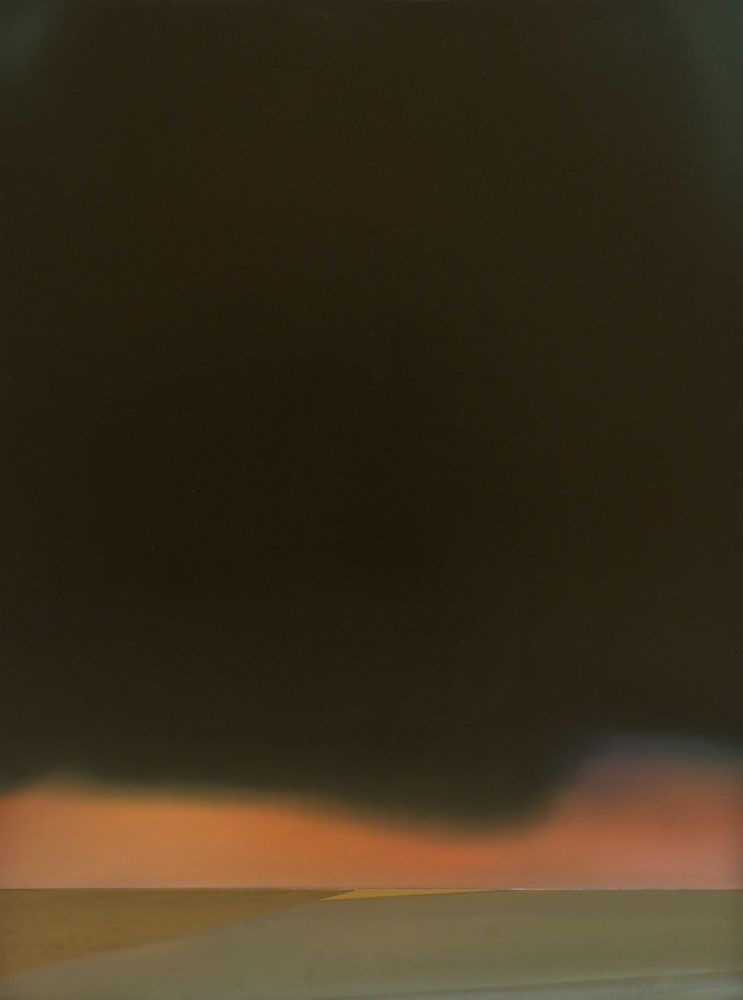
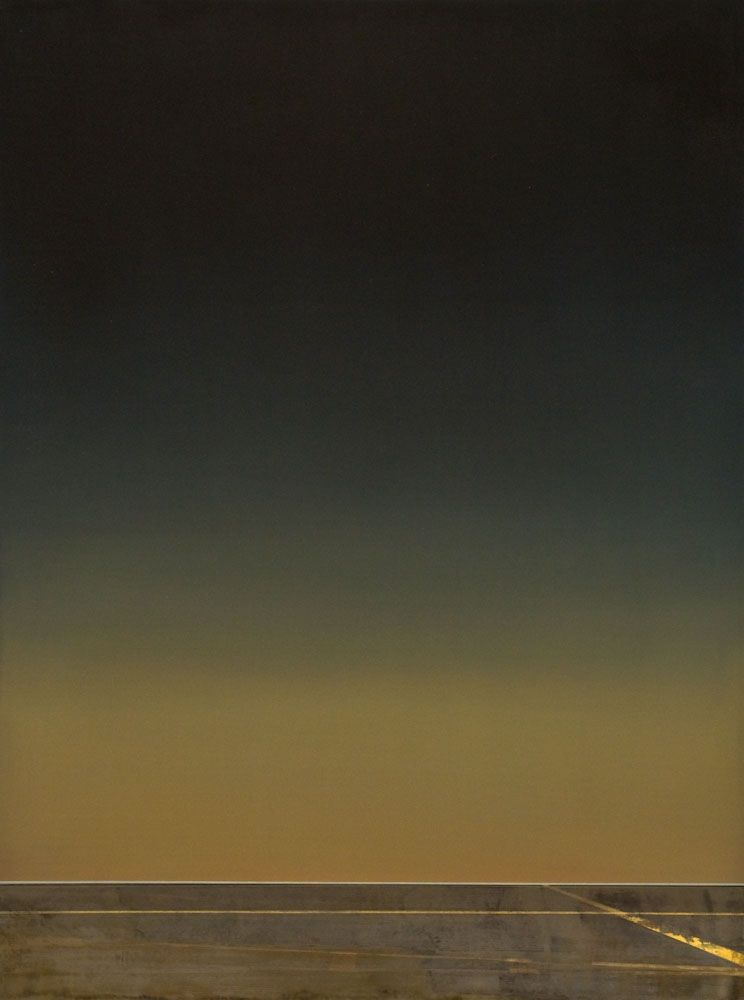
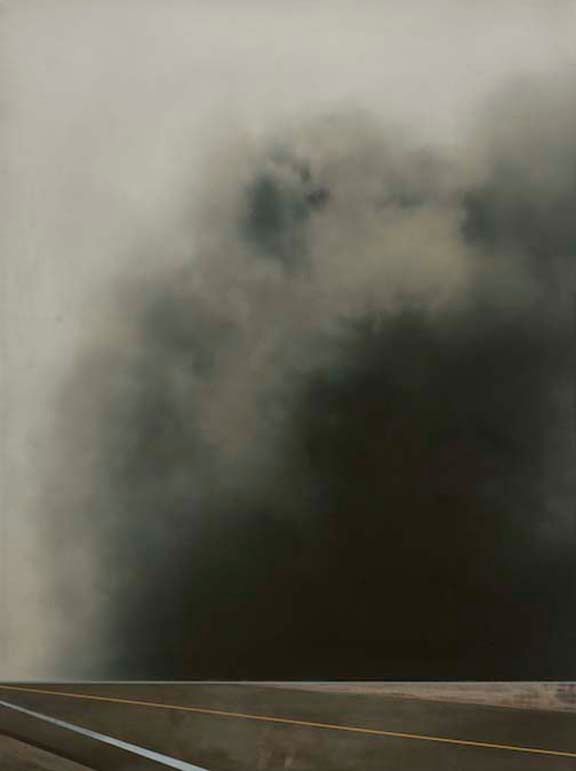
Schopenhauer and Berry again came to mind as I contemplated Christopher Saunders' "Whitenoise" paintings in LaViolaBank Gallery's group exhibition "Outside In." (1) Dark and cloudy skies dominate Saunders' vistas, and the horizon in these flatland pictures draws a conspicuous boundary between sky and earth. In "Whitenoise Suite no.4," an ominous storm front moves over a lonely stretch of highway; a pitch veil chases away a sunset in "Whitenoise Suite no.8"; and in "Whitenoise Suite no.9," a brooding twilight settles above a tarmac. There are echoes of Mark Rothko's luminous melancholy in Saunders' work, but his atmospheric paintings seem most akin to the Romantic landscapes of the 17th, 18th, and early 19th centuries.


Christopher Saunders
"Whitenoise no.9"
2009
Oil on linen
24 x 18 inches

Caspar David Friedrich is perhaps the most celebrated painter of the Sublime, and his "Wanderer above the Sea of Mist" (1818) is among the best known examples. The work pictures a well-dressed, solitary gentleman, his back to the viewer, positioned confidently atop a rocky crag as he surveys a vast, mountainous landscape that is mostly obscured by fog. Concurrent with Friedrich's work on the famous painting, his friend Carl Gustav Carus described Sublime experience in a passage that could well have been written in response to "Wanderer."
"Stand then upon the summit of the mountain, and gaze over the long rows of hills. Observe the passage of streams and all the magnificence that opens up before your eyes; and what feeling grips you? It is a silent devotion within you. You lose yourself in the boundless spaces, your whole being experiences a silent cleansing and clarification, your I vanishes, you are nothing. God is everything."
Carus' experience of the Sublime is, like Berry's reverence, a reduction or erasure of the self-conscious individual and a simultaneous opening of the individual to the wilderness within. His dramatic description brings us back to the moody Schopenhauer, who prescribed the Sublime as a remedy to his every man limits. In his volume The World As Will and Representation (1818), Schopenhauer elucidated a scale of aesthetic experience. At one end of this spectrum, he described the "Feeling of Beauty" as "Light...reflected off a flower. (Pleasure from a mere perception of an object that cannot hurt [the] observer.)" At the other end of the spectrum, the philosopher positioned the "Full Feeling of Sublime" and the "Fullest Feeling of Sublime." These categories are described, respectively, as "Overpowering turbulent Nature. (Pleasure from beholding very violent, destructive objects.)," and "Immensity of Universe's extent or duration. (Pleasure from knowledge of observer's nothingness and oneness with Nature.)" At the amplitude of "Fullest Feeling," then, Schopenhauer's aesthetic philosophy is reconciled with that of Carus and Berry.

Most modern humans (especially modern humans in the First World) are insulated from inclement weather. We fret over a rained-out ball game or beach party, but we rarely tremble before dark cloud heads; our appreciation of the elements is principally one of admiration, an aesthetic experience that resides near the middle of Schopenhauer's scale. But Saunders' landscapes provide viewers with a vantage point that repairs the reverent awe that we once felt before the expansive firmament. He does not include the rugged, mountainous imagery familiar to most artistic depictions of the Sublime. Instead he portrays clouds pushing over a featureless land, the violent potential of atmospheric flux readily observable at a distance. The clouds, vast, magnificent, menacing, dominate Saunders' compositions; they are the rough mountains of our inner wilderness. Despite the "Whitenoise" paintings' relatively small size, their effect is formidable. Before the strongest in the series, I stood quiet.


Christopher Saunders
"Whitenoise no.4"
2008
Oil on linen
24 x 18 inches

(1) Although Saunder's oil paintings preoccupied my imagination, related ideas are addressed by the work of other artists included in the "Outside In" exhibition. I also admired Diane Carr's fluid and evocative landscape paintings, Leighton Pierce's hypnotic video of a woman underwater, and Mira O'Brien's photographic floor installation.

Imaged credits: all Christopher Saunders' works, courtesy of the artist

Tuesday, November 24, 2009

Close Encounters

Three and a half months ago, I heralded the launch of The Endangered Species Print Project. Since then, the ESPP website has undergone a dramatic face lift and two new prints have been released.

Molly Schafer and Jenny Kendler, the project's founders, have also set up an ESPP blog. One of their recent ESPP blog posts intensified my already robust sense of wonder and reverence.

I'm fascinated by leopard seals (Hydrurga leptonyx). They're charismatic creatures, and beautiful, too. They are also brutal and fearsome. Their power, underwater grace, and remarkable jaws make them one of the world's supremely adapted predators. Watching documentary footage of a leopard seal hunting penguins, it's impossible not to marvel at the bloody ballet, even if you quietly mourn the death of the seal's popular and plump prey.

My "experience" of the leopard seal is all secondhand and mediated, yet I'm stricken with a quiet awe when I contemplate a film of the seal shadowing through its submarine realm. Imagine, then, how National Geographic photographer Paul Nicklen felt during his remarkable Antarctic encounter (and ensuing relationship) with a seal whose "head is twice as wide as a grizzly bear's head."

>

Please watch the video.

Oh, and think about investing in some ESPP prints for the holidays! If you do so, you'll be giving two gifts: a limited edition print to a happy recipient, and a financial boost to one of the worthy non-profit organizations working to protect endangered species and critical habitat.

Sunday, September 13, 2009

Kimmel Harding Nelson Residency: Day 7


The Ten Commandments on the front lawn of Otoe County Courthouse; Nebraska City

Attunement on a Sunday Morning

I'm a generalist. As such, I'm inclined to connect the dots between purportedly distinct realms of inquiry. It's impossible, of course, to conduct a truly holistic survey, but my crude efforts have led me to conceive of life - what we know of it, at least - as a component part of a vast, even infinite superorganism. I freely admit to finding value in mysticism, and this superorganism notion is readily dismissed by some scientists and scholars as mystical metaphysics, but science itself speaks to an integrity beyond human comprehension.

As Loren Eiseley describes it,
"[This is] one of life's strangest qualities - it's eternal dissatisfaction with what is, its persistent habit of reaching out into new environments and, by degrees, adapting itself to the most fantastic circumstances."
Eiseley was an anthropologist, and he claimed to be a man of "no religion." That may be so, but Eiseley's writing offers humility, wonder, gratitude, and communion in abundance. As I see it, those are the four pillars of religious practice. The fourth of these vital practices, communion, is alluded to by the very word "religion," from the Latin religare, meaning "to bind" or "to tie." Religious action aims to bind the individual to society and, in turn, to the greater whole.

For a decade, I proudly identified as an atheist and, by the measure of most religious people, my cosmology and metaphysics still qualify me as such. It occurs to me, on this Sunday morning, with Nebraska City's church parking lots at capacity, that many of this town's good Christians would reject my claim of religiosity, and not only because my practice rests on a Jewish foundation. My doctrine-less faith appreciates the stories of the Hebrew Tanakh, the Christian New Testament, and the Muslim Koran as parables, poetry, and anthropological artifacts. I read these books in the same way that I do the Tao Te Ching or Herakleitos; they are annotated, analyzed, interpreted, digested, then, in the fullness of time, returned to for a new understanding. But these collections are not my sacred texts. In the eyes of most religious believers, that disqualifies me from tribal membership. Thank G-d.


First Baptist Church; Nebraska City; September 2009
Sign reads, "Faith Removes Mountains Or Tunnels Through"

Still, I am a religious believer, in my way. My holy books are written by biologists and physicists, naturalist poets and essayists, as well as rabbis, ministers, and theologians. None of them is the word of an interventionist, judging god, even though all of them are necessarily part of a greater, unknowable whole, the aforementioned superorganism.

It doesn't matter what you call this organism. As essayist and literature professor Doug Thorpe writes in Rapture of the Deep, "Call it the sublime, call it the Tao, Om, or I AM; still the names don't hold." I most often call it The All, The No-thing, or Hashem, literally "The Name." In the Tanakh, when Moses asks the name of the Presence he has discovered in the burning bush, It replies, "Ehyeh asher ehyeh." "I will be who I will be," or "I will be that I will be." You can call It whatever you will, for It is you. It is also me. It is the sidewalk; It is the grass of the Otoe County courthouse lawn, on which Nebraska City authorities have installed a carved monument to the Ten Commandments, an act that approaches violation of Thomas Jefferson's shrewd "separation of Church and State"; and It is the ether connecting all of these.


Lutheran Church facade; Nebraska City; September2009

If the faith that has grown in me is dogmatic in some way, it is in its insistence on universalism. Literally translated, "universe" means "one turning." Our universe is just that, one breath, one round, one cycle. All that we know and all that we don't know, everything that we can imagine, is but an infinitesimal sliver of The All, one note of an eternal symphony. Even Herakleitos, ancient proponent of reason and science, turned to poetics when he contemplated ultimate meaning; "Nature loves to hide," he wrote. Interestingly, the Hebrew word for universe is olam, a derivative of alam, meaning "to conceal." Jewish mystics, like many of their Hindu, Sufi, and Christian counterparts, believe that God is hidden in the universe, an ineffable force that pervades every dimension, known and unknown.

Theoretical astrophysicists
now suggest that our universe is but one component part of a multiverse, requiring of us another Copernican shift; yet again, the superorganism is re-conceived. In that stretch of the mind are humility, wonder, gratitude, and communion. Science and philosophy, it seems, can also be religious.


Water tower; Nebraska City

So, yes, I'm a religious believer. Paintings, sculptures, and other hand-crafted objects are among my adored icons, but I find occasion for worship in every place, in every form, in every moment. The Monarch butterfly that flapped yoyo-like this morning in front of the KHN Center's kitchen window is worthy of exaltation. I recognize that, for some other viewer, the insect may be ignorable or irrelevant. For others, it is an idol. So, too, might the weathered brick of a downtown Nebraska City building be deemed a clay calf by unimaginative or close-minded "believers." Placing my palm on this brick today, though, my thoughts range through eons of geologic time to consider the primeval mud from which, eventually, we emerged as a gasping fish thing.

Doubtless some of the folks singing inside the walls of the Lutheran, Episcopalian, Catholic, Baptist, Presbyterian, and Methodist churches this morning don't share my enthusiasm for our scaley ancestors. But I'm not concerned with their narrow definition of religion or their selfish understanding of "truth." Although I no longer consider myself a materialist, I'm an unremitting idolater. To those that would condemn that impulse as sacrilegious, I offer Eiseley's reaction.
"People have occasionally written me harsh letters and castigated me for a lack of faith in man when I have ventured to speak of [..] some greater unity that lay incalculably beyond us. [...] They distrust, it would seem, all shapes and thoughts but their own. They would bring God into the compass of a shopkeeper's understanding and confine Him to those limits, lest He proceed to some unimaginable and shocking act - create perhaps as a casual afterthought, a being more beautiful than man. As for me, I believe nature capable of this, and having been part of the flow of the river, I feel no envy."
And I feel no envy, either. There is only dumbfounding, smiling celebration.

Love is, I think, a bit like religion. Humility, wonder, gratitude, and communion are requisite in both, and, as Thorpe puts it, love "demands of us a new way of being in our old world." Religion might be construed as a love affair with The All. It's not always easy, but religious attunement can turn each day, each hour, or each instant, into "a new way of being." Every step is a psalm, every directed gaze is a prayer. Truly, on the streets of Nebraska City this morning, I am an exuberant, enthusiastic mystic.

Photo credits: all photos, Hungry Hyaena, 2009

Thursday, September 10, 2009

Kimmel Harding Nelson Residency: Day 4


Oregon Trail Marker; Nebraska City

Manifest Destiny

On the eastern edge of Nebraska City's Central Avenue stands a simple cairn with a plaque, a monument to the Oregon Trail. The plaque reads, in part,
"Official Oregon Trail Marker: [...] overlaid branch of the Oregon Trail, 1849, from the steamboat landing thousands started westward to Pike's Peak, Salt Lake, California and Oregon."
My gaze drifts from this humble memorial to Central Avenue, Nebraska City's main thoroughfare. Today, automobiles move east and west on the two-laned, paved drag. 160 years ago, families traveling by covered wagon set west on a dirt path, intent on making a better life for themselves.

Just think of it; that was 160 years ago! The territories of the western United States were then largely unsettled by immigrants of European extraction. The notion of Manifest Destiny, the Providential assumption that all of North America belonged to a white, male God and, in turn, to His European sons and daughters, was only introduced in 1845. At the time, the American Civil War had yet to be fought, electricity had yet to be harnessed as a popular power source, and human flight was only a hopeful diagram in a sketchbook. 160 years is just three human lifetimes, a drop in history's bucket, a nearly invisible mark on the geologic timeline.


Nebraska City, circa 1860

As I scribble down these thoughts, a small slug moves over the concrete by my left foot. 300 million years ago, our human face was not so dissimilar from the slug's. As Loren Eiseley describes it in The Immense Journey, the steady march of time, whether surveying a span of 300 million or 160 years, is "life reaching out, [...] that magnificent and agelong groping [...] still in progress. [...] Content is a word unknown to life; it is also a word unknown to man."


Oregon Trail Marker and Central Avenue view; Nebraska City

The Windmill Shop

Early this morning, fellow KHN resident Manya Fox and I were granted access to the now closed Kregel Windmill Company shop, located on Central Avenue. For the most part, the shop's interior is just as the employees left it, a time capsule testament to the labor and ingenuity that allowed for the settling of the American west. As our gracious host put it with a grin, "Some people say the six gun settled the west, but it was really the windmill."

Early explorers, Lewis and Clark included, characterized the land that would become the Nebraska Territory as the "Great American Desert," an area unfit for human habitation. But, because of windmills, the plains would soon become some of the most fertile farming land in the United States. Homesteaders needed water to survive, of course, and the windmill was the only efficient way to draw water up from wells 100 feet deep. Wood and, later, metal blades were cut, shaped, and hammered in the Nebraska City shop, an outfit run by the "taskmaster" Kregel brothers, immigrants from Germany.

The brothers are dead now, the Windmill Company is closed and in need of preservation, and water-pumping windmills have, in most places, been replaced by electric pumps. Technology and livelihoods gone with, as it were, the wind.


Accounting desk; Kregel Windmill Company; Nebraska City

Or are they? Today, towering windmills of steel and aluminum, better known as turbines, are being erected the world over. These turbines are an effective means of energy collection that also offer promise of a thriving, low impact industry. In the windmill shop, as I admired a lathe built in the early 1860s, Eiseley's words echoed; the "magnificent and agelong groping" continues.

Beyond Manifest Destiny

Nebraska City's Morton-James Public Library has a small NASA exhibition on display now. As I shuffled around the library gallery this morning, I marveled that the Space Shuttle Orbiter, the "vehicle that carries the crew and payloads to and from Earth orbit," must reenter Earth's atmosphere and land without power. It "glides back to Earth and lands on a runway. [...] Careful guidance control is needed to assure that it is properly positioned to reach the desired landing site." This astonishing feat of engineering and science is made that much more impressive if we consider that it was first realized just 130 years after the homesteaders and pioneers disembarked from Nebraska City's steamboat landing.

To those individuals who emphasize humanity's bloody excesses and potentially catastrophic exuberance above all else, I can only express my bafflement. Truly, to study evolution and the progress of history and science is to be necessarily possessed by eudaimonia. What great feats are forthcoming? The sun is shining; the crickets and katydids are singing; the world is electric with possibility.


Refurbished blades; Kregel Windmill Company; Nebraska City

Photo credits: all photos, Hungry Hyaena, 2009; Nebraska City illustration, ripped from Richard Gehling's "The Pike's Peak Gold Rush"

Tuesday, August 25, 2009

The Most Fundamental Form of Passion


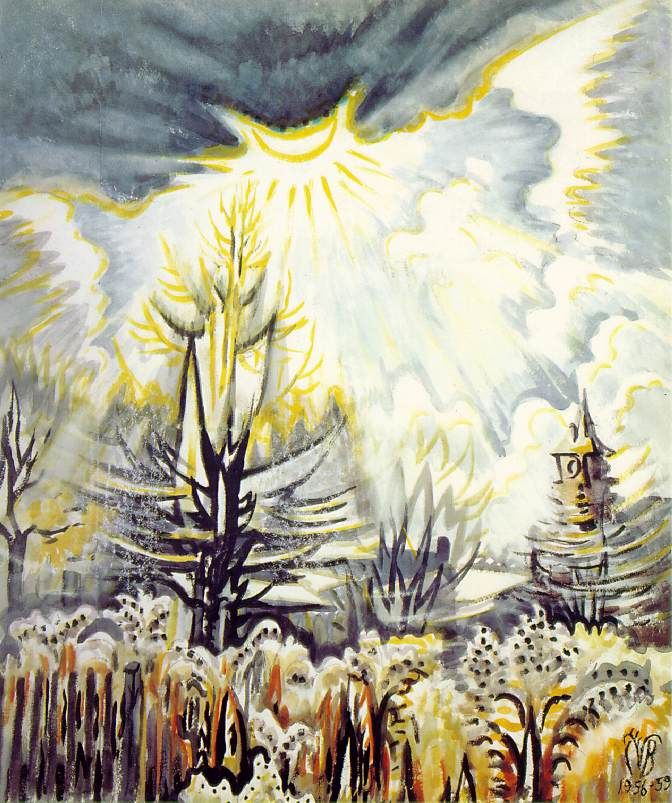
Charles Burchfield
"November Sun Emerging"
1956-59
Watercolor on paper
37 3/4 x 31 7/8 inches
"[How] can we account for that irresistible instinct in our hearts which leads us towards unity whenever and in whatever direction our passions are stirred? A sense of the universe, a sense of the all, the nostalgia which seizes us when confronted by nature, beauty, music - these seem to be an expectation and awareness of a Great Presence. [...] Resonance to the All - the keynote of pure poetry and pure religion. Once again: what does this phenomenon, which is born with thought and grows with it, reveal if not a deep accord between two realities which seek each other; the severed particle which trembles at the approach of 'the rest'?

We are often inclined to think that we have exhausted the various natural forms of love with a man's love for his wife, his children, his friends and to a certain extent for his country. Yet precisely the most fundamental form of passion is missing from this list, the one which, under the pressure of an involuting universe, precipitates the elements one upon the other in the Whole cosmic affinity and hence cosmic sense. A universal love is not only psychologically possible; it is the only complete and final way in which we are able to love."

- excerpt from The Phenomenon of Man, by paleontologist, geologist, philosopher, and Jesuit priest Pierre Teilhard de Chardin
Image credit:Burchfield image ripped from Mark Harden's Artchive

Saturday, July 25, 2009

At Dawn I Have Birds


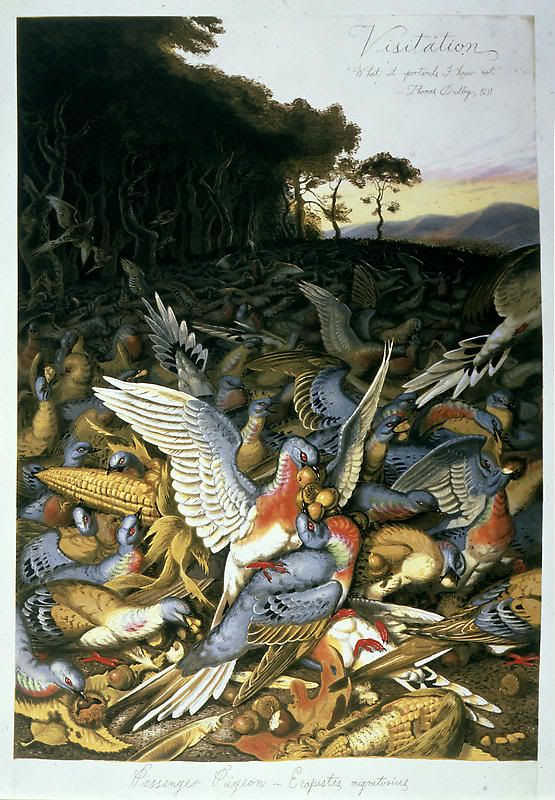
Walton Ford
"Visitation"
2004
Six color hardground and softground etching, aquatint, spit-bite aquatint, drypoint on Somerset Satin paper
44 x 30 7/8 inches


"Often, lately, the night is a cold maw
and stars the scattered white teeth of the gods,
which spare none of us. At dawn I have birds,
clearly divine messengers that I don't understand
yet day by day feel the grace of their intentions."

— from "Age Sixty-nine," by Jim Harrison

Image credit: ripped from the Paul Kasmin Gallery website

Saturday, April 18, 2009

Corey Arnold's Sea


Corey Arnold
"Gulf Crossing, Bering Sea, Alaska"
2007
Chromira C-print


Curiously, Sara Tecchia Roma's press release for Corey Arnold's solo exhibition, "Fish Work," describes the artist as "an Alaskan crab fisherman animated by a life long artistic project." I wonder, does Arnold identify as a fisherman first and a photographer second? Or perhaps the two occupations are inextricably tangled? Whichever designation Arnold prefers, his pictures evidence a daring spirit - an attribute I associate with Bering Sea fisherman, but rarely with fine art photographers - and an expert eye.

Arnold's photographs capture northern ocean landscapes and document the lives of men that harvest its depths. Most of his working fishermen pictures are handsome records of an uncommon life style, but they are undistinguished as works of art. Not so for Arnold's strongest images; when the photographer turns his lens on the water, he provides viewers with a glimpse of sublime wonder. His pictures humble us.

As the gallery press release states, viewers are reminded "not only of the beauty but also of the undeniable power that Nature holds against mankind." I'd amend that statement slightly. Nature doesn't work against mankind; its staggering violence is ambivalent, and humanity is a vital part of it.


Corey Arnold
"Bering Sea Birthday, Bering Sea, Alaska"
2006
Chromira C-print

Thursday, February 05, 2009

The Wonderful Worms


Jessica Palmer
is an artist, scientist and writer. Her blog Bioephemera combines these three vocations to consistently excellent effect. Her current series on the sometimes fractious relationship between art and science (or, more precisely, between artists and scientists) is worth checking out. (Part 1 is here. Part 2 is here. More posts in the series will follow.)

As regular HH readers know, I believe that the human animal depends on wonder and awe for psychological sustenance. These complicated, overlapping emotions impel curiosity, creativity and reverence and, in my estimation, science and religion "(re)awaken or invigorate our capacity [to experience] wonder."

Unfortunately, many thoughtful contemporaries disagree, often vehemently. They worry that we're losing wonder, and they accuse science (they often call it "scientism") of demystifying experience. These thinkers fear that science elucidates so thorough an explanation of the material world that scientists (and, in turn, society at large) believe only in the observable and the quantifiable. Metaphysics and transcendentalism are thus relegated to the intellectual dustbin, realms traveled only by the deranged, the fey or the weak-minded.

This worry is unfounded. Wonder can't be extinguished by revealing "the workings" of observed phenomena. Quite to the contrary! Even the most Cartesian of scientific explanations enhances our conception of the material world. In turn, that advanced understanding enriches our imaginative experience of both the material and the metaphysical.

To this point, a blurb in a recent issue of National Wildlife magazine entitled "The Science Behind 'Worm Grunting'" explains the once mysterious cause-and-effect relationship manipulated by "grunting."
"As recently as the 1960s, hundreds of people in the southeastern United States earned a living through a curious practice known as 'worm grunting': driving a stake into the ground, then rubbing the stake with a long piece of steel in order to produce a sound that, for reasons unknown, would drive hundreds of earthworms to the surface where they could be collected for bait. Now biologist Ken Catania of Vanderbilt University has found an explanation for the technique’s efficacy. Without realizing it, worm grunters were imitating the sounds made by worm-hungry moles digging through the earth. By observing both earthworms’ reactions to grunting and their response to the presence of eastern American moles, Catania found that the invertebrates rapidly pop to the surface when they detect the presence of a mole—or a grunter."
I've never gone grunting, but as a child of the southeastern United States, I've done my fair share of earthworm digging in preparation for afternoon pond fishing. I wish I'd known about grunting those years ago, and I'm very glad that I know about it now. I still fish every now and again, so I may yet have practical use for grunting. More importantly, I might also have occasion to educate children about grunting; a vital part of that teaching will be the astonishment the kids experience upon witnessing the worms' emergence. It ain't magic, but it's surefire enough to make this adult shake his head in believing disbelief. Another word for that? Wonder.

For more on grunting, check out this blog post.

Photo credit: Discovery blogs