Showing posts with label Diane Carr. Show all posts

Wednesday, December 02, 2009

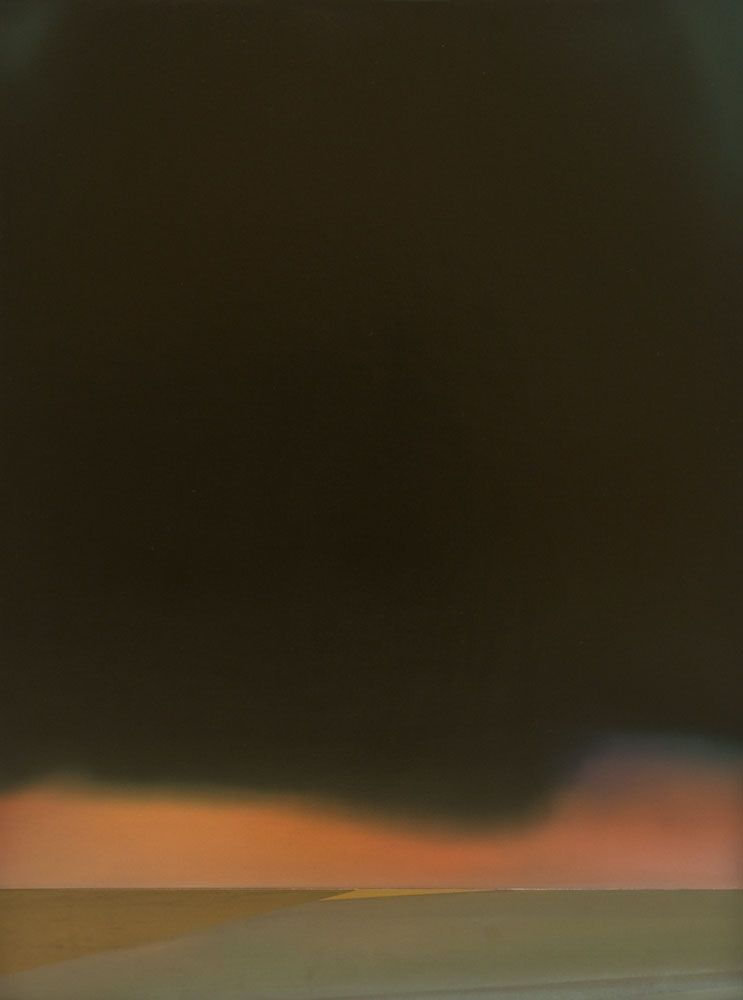
Christopher Saunders' "Whitenoise"


Christopher Saunders
"Whitenoise no.8"
2009
Oil on linen
24 x 18 inches

A regular passenger on New York City's subway system, I'm grateful for the Metropolitan Transit Authority's "Poetry in Motion" and "Train of Thought" programs, efforts that repurpose subway advertising space as a showcase for poetry or significant quotations. This week, I noticed the German philosopher Arthur Schopenhauer's quotation, "Every man takes the limits of his own field of vision for the limits of the world." I appreciate the substance of Schopenhauer's cynical observation, but I would amend his statement. Certainly, too many men do take the limits of their field of vision for the limits of the world, but the truly reverent man does not mistake the two for the same. As the critic, author, poet, and essayist Wendell Berry describes it, "to feel reverence, to be reverent, is exactly to surrender the 'precious self.'" In surrendering the self, we accept our insignificance, we recognize the infinitesimal reach of our individual vision. And yet, counter intuitively, this same surrender of self also opens our field of vision to the infinite variety and scope of being; through negation, liberation.

Schopenhauer and Berry again came to mind as I contemplated Christopher Saunders' "Whitenoise" paintings in LaViolaBank Gallery's group exhibition "Outside In." (1) Dark and cloudy skies dominate Saunders' vistas, and the horizon in these flatland pictures draws a conspicuous boundary between sky and earth. In "Whitenoise Suite no.4," an ominous storm front moves over a lonely stretch of highway; a pitch veil chases away a sunset in "Whitenoise Suite no.8"; and in "Whitenoise Suite no.9," a brooding twilight settles above a tarmac. There are echoes of Mark Rothko's luminous melancholy in Saunders' work, but his atmospheric paintings seem most akin to the Romantic landscapes of the 17th, 18th, and early 19th centuries.
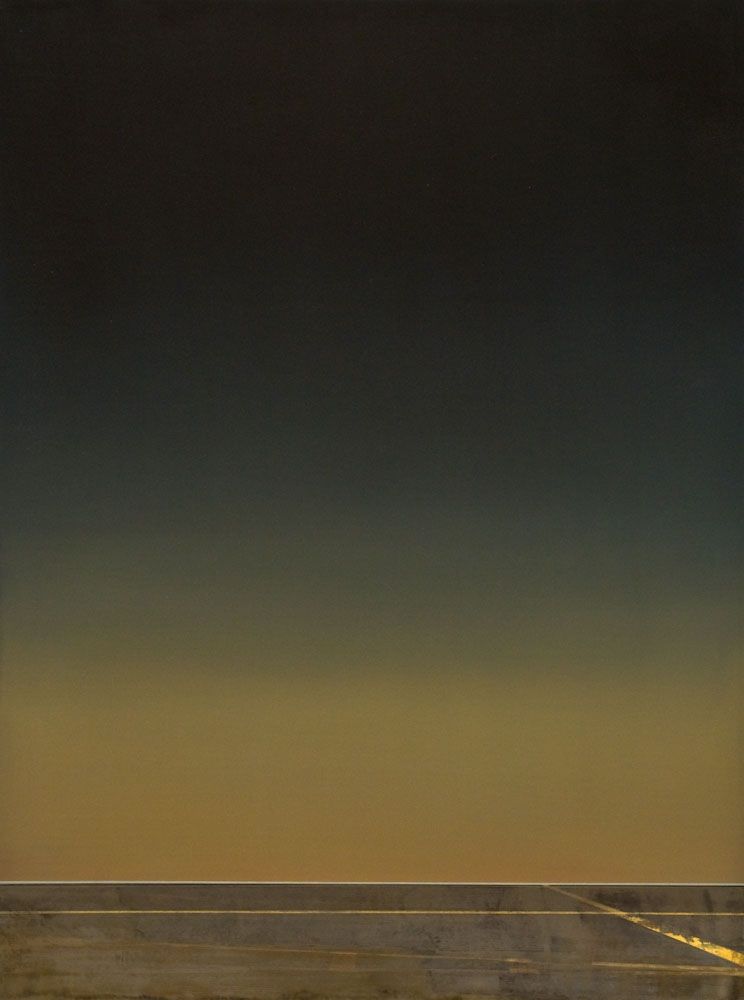

Christopher Saunders
"Whitenoise no.9"
2009
Oil on linen
24 x 18 inches

Caspar David Friedrich is perhaps the most celebrated painter of the Sublime, and his "Wanderer above the Sea of Mist" (1818) is among the best known examples. The work pictures a well-dressed, solitary gentleman, his back to the viewer, positioned confidently atop a rocky crag as he surveys a vast, mountainous landscape that is mostly obscured by fog. Concurrent with Friedrich's work on the famous painting, his friend Carl Gustav Carus described Sublime experience in a passage that could well have been written in response to "Wanderer."
"Stand then upon the summit of the mountain, and gaze over the long rows of hills. Observe the passage of streams and all the magnificence that opens up before your eyes; and what feeling grips you? It is a silent devotion within you. You lose yourself in the boundless spaces, your whole being experiences a silent cleansing and clarification, your I vanishes, you are nothing. God is everything."
Carus' experience of the Sublime is, like Berry's reverence, a reduction or erasure of the self-conscious individual and a simultaneous opening of the individual to the wilderness within. His dramatic description brings us back to the moody Schopenhauer, who prescribed the Sublime as a remedy to his every man limits. In his volume The World As Will and Representation (1818), Schopenhauer elucidated a scale of aesthetic experience. At one end of this spectrum, he described the "Feeling of Beauty" as "Light...reflected off a flower. (Pleasure from a mere perception of an object that cannot hurt [the] observer.)" At the other end of the spectrum, the philosopher positioned the "Full Feeling of Sublime" and the "Fullest Feeling of Sublime." These categories are described, respectively, as "Overpowering turbulent Nature. (Pleasure from beholding very violent, destructive objects.)," and "Immensity of Universe's extent or duration. (Pleasure from knowledge of observer's nothingness and oneness with Nature.)" At the amplitude of "Fullest Feeling," then, Schopenhauer's aesthetic philosophy is reconciled with that of Carus and Berry.

Most modern humans (especially modern humans in the First World) are insulated from inclement weather. We fret over a rained-out ball game or beach party, but we rarely tremble before dark cloud heads; our appreciation of the elements is principally one of admiration, an aesthetic experience that resides near the middle of Schopenhauer's scale. But Saunders' landscapes provide viewers with a vantage point that repairs the reverent awe that we once felt before the expansive firmament. He does not include the rugged, mountainous imagery familiar to most artistic depictions of the Sublime. Instead he portrays clouds pushing over a featureless land, the violent potential of atmospheric flux readily observable at a distance. The clouds, vast, magnificent, menacing, dominate Saunders' compositions; they are the rough mountains of our inner wilderness. Despite the "Whitenoise" paintings' relatively small size, their effect is formidable. Before the strongest in the series, I stood quiet.
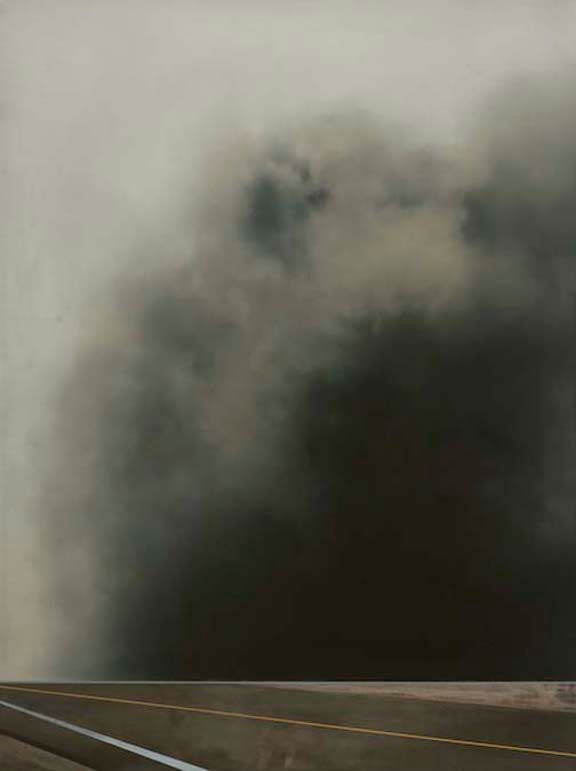

Christopher Saunders
"Whitenoise no.4"
2008
Oil on linen
24 x 18 inches

(1) Although Saunder's oil paintings preoccupied my imagination, related ideas are addressed by the work of other artists included in the "Outside In" exhibition. I also admired Diane Carr's fluid and evocative landscape paintings, Leighton Pierce's hypnotic video of a woman underwater, and Mira O'Brien's photographic floor installation.

Imaged credits: all Christopher Saunders' works, courtesy of the artist

Tuesday, October 24, 2006

"Out of This World" at PS122 Gallery


Amy Talluto
"Silver Pond/Montana"
2006
Oil on canvas
44 x 32 inches


"Out of This World," currently on view at PS122 Gallery, is a two-person exhibition featuring sculptures and photographs by Diane Carr and paintings by Amy Talluto. Although landscape is a principal subject matter for both Carr and Talluto, their approaches are distinct.


Diane Carr
"Forest Floor"
2006
Ink, paper, plastic, foam, resin
14 x 24 x 22 inches


Carr's sculptural vignettes depict woodland glades, starry ponds, icy slopes, or tree covered hillsides, but these pleasant scenics are fashioned of foam, plastic, resin, and painted paper. The brilliant, even startling colors Carr uses are at once poisonous and magical, acidic and jewel-like. Initially, viewers may want to plunge into these cartoon worlds just as they did their childhood day dreams, but there is an air of toxicity about Carr's sculptures. Like the beautiful poison dart frog, the works' vivid coloring seems to say, "Look, but don't touch."

The opening line of the poem "Son," by Brad Leithauser, states that "Memory buries its own." I recall this line as I consider Carr's landscapes. Her body of work is as concerned with memory and longing - otherwise known as nostalgia - as it is with the juxtaposition of natural and unnatural. How do we treat our buried memories? How do we fashion our memories to suit our purposes, or to fit our desired narrative? Likewise, how will we remember this moment? Carr's sculptures are elegies for moments past, but also for the present, reminders that what is will not be. Time, so far as we know, is unremitting.


Amy Talluto
"Pond"
2006
Oil on canvas
60 x 74 inches


Talluto's accomplished oil paintings can be deemed "traditional landscapes," but her choices suggest she is less interested in painting a pond per se, than she is in unfolding and interpreting that pond. Where one expects space to recede, for example, it might suddenly flatten, or perhaps the contour of a reflection lifts, causing the foreground to recede as our brain tries to force the imagery back where we feel it "should" reside. In some passages, the effect is vertiginous; if Talluto's paintings are a window onto another world, they frame a domain in which our brain and senses will are addled. By focusing on the riot of color and form, Talluto strives to reveal the animating force, that invisible weave that ties together all things.


Diane Carr
"Winter Forest"
2006
Ink, paper, foam, resin
24 x 22 x 16 inches


Admiring the work in "Out of This World," I think about the increasing number of artists who are returning to landscape. The reappearance of wild scenery in the contemporary gallery is a nod to our ever more domestic culture, one desperately in need of outside pictures for inside walls. What's more, the language many of these contemporary landscape artists use to describe their work is strikingly similar. I've described my recent paintings as "hallucinatory landscapes, sometimes foreboding, sometimes joyous, always ambivalent." In the press release for "Out of This World," Carr writes of her work, "the environments are sometimes peaceful and sometimes ominous in feeling and are a combination of what exists around us." Talluto states that her work is "sometimes bright, lush and flowering...sometimes dissonant, murky and foreboding." Elsewhere, Talluto says, "a shifting psychological mood pervades the group as a whole, moving between realms of magical fantasy, sparkling beauty, anxiety, and the sinister and mysterious." And that's just three of us! I've read many variations on this theme.

On the one hand, it's unremarkable. After all, Nature is ambivalent. Of course it will be "sometimes foreboding" and "sometimes peaceful." Duh. But the ambivalent language used by so many artists, myself included, signals the sublime. It describes landscape that "subverts order, coherence...bypasses the rational mind and concentrates directly on the emotions."(1) For most of the twentieth century, sublime landscape was deemed a goat, an unworthy cliche. Indeed, with a few notable exceptions, landscape artists of all persuasions have been held in low regard by the art world establishment for decades.

These are turbulent times, however, marked by anxiety and uncertainty. The promise of progress is now viewed with much skepticism and people again recognize the inevitability of cycles, and of growth and decay. Moreover, landscape art has a history of flourishing in countries during periods of intense colonialism. This proved true in China, Japan, and Rome many centuries past, and, within the last five hundred years, in Holland, France, Britain, and the United States. Perhaps today, as wars wage on, as nuclear weapons again proliferate, and as global, corporate colonialism becomes the zeitgeist, artists are returning to sublime landscape, to depictions of an ambivalent world that delights and inspires as surely as it destroys and awes.

"You lose yourself in boundless spaces, your whole being experiences a silent cleansing and clarification, your I vanishes, you are nothing, God is everything." That was written by Carl Gustav Carus, in his 1824 "Nine Letters on Landscape Painting." How the pendulum swings!

(1) Malcolm Andrews, Landscape and Western Art, Oxford University Press, 1999

Photo credit: all images courtesy the artists (unfortunately, the reproductions can not do justice to the luminosity of Carr's sculpture)