Showing posts with label ambivalence. Show all posts

Sunday, January 20, 2013

"Private Frontiers" at Hosfelt Gallery

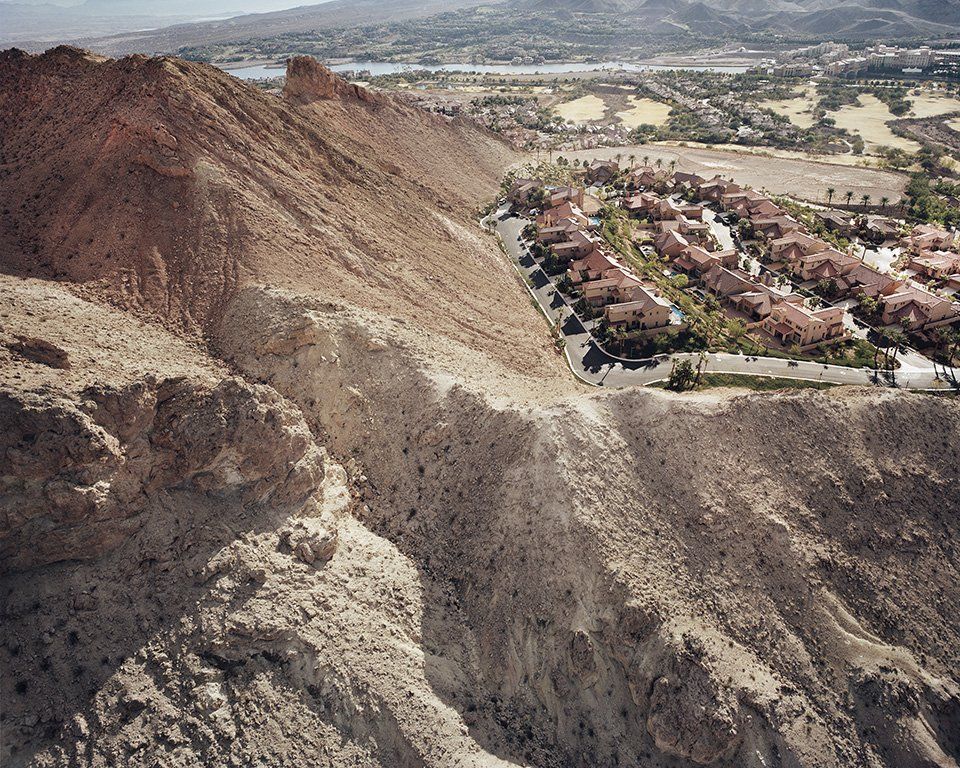
Michael Light
"Lake Las Vegas 2010-2012 20. 'Casa Palermo' Lake Las Vegas Homes Looking Southwest, Henderson, Nevada"
2010
Pigment print mounted on aluminum
40 x 50 inches
Edition of 5
I recently visited Hosfelt Gallery's impressive new space, currently home to "Private Frontiers," a two person show featuring works by Brooklyn-based painter Chris Ballantyne and San Francisco-based photographer Michael Light. According to the press release, the two artists "have been in dialogue for the past year to develop work that examines the human urge to stake territory and its more absurd manifestations on the American landscape." Whatever the specifics of the artists' conversation, Ballantyne's paintings are a terrific compliment to Light's large-format aerial photographs. Exhibited on their own in the expansive Hosfelt loft, Ballantyne's colorful and occasionally whimsical works would risk being swallowed up as bittersweet morsels. Hanging alongside Light's grand photographs, though, Ballantyne's modestly-sized pictures comport themselves especially well; their affability and humor endure, but undercurrents of earnestness and melancholy, too easily missed if exhibited on their own in so airy a space, are amply felt.

Friday, August 10, 2012

Platte Clove Residency: John Muir and the View From the Precipice

Winter view of Platte Clove's Bridal Veil Falls;
Catskills; NY
“Many people have been killed after falling and sliding off the edge. Especially in areas where there are pine needles. Dangerous conditions exist in many locations. The number of deaths over the years is staggering. Be overly cautious when in this region, and do not take un-necessary risk.”

- “Upper Platte Clove” page of Catskill Mountaineer website
I hesitated before deciding to investigate the unmarked spur of the Platte Clove Nature Preserve's Plattekill Falls Trail. Having recently read a bit about the geology and topography of the Catskill Escarpment, I knew that the preserve is located near the top of a deep ravine that tumbles suddenly down and eastward to meet the Hudson Valley (clove is the Dutch word for a mountain gorge). I’d also learned that each year a handful of foolhardy or unlucky hikers fall to their deaths on Platte Clove area trails. An online trail guide I’d browsed prior to the residency urged hikers to be “overly cautious.” Nevertheless, once I’d stepped off the main path and advanced a few steps down the spur, I was self-assured; I wouldn’t be one of 2012’s casualties. Prudent types like me don’t fall off cliffs.

Tuesday, February 14, 2012

Review In Brief: Kota Ezawa at Haines Gallery

Kota Ezawa
Still from "City of Nature"
2011
DVD, 4 minutes
Edition of 10
Kota Ezawa's rotoscoped animations of the O.J. Simpson verdict (2002), John F. Kennedy's assassination (2005), and the 2004 NBA "Malice at the Palace" brawl (2008) garnered the artist critical accolades, and deservedly so. Still, I'd wondered how effective Ezawa's stylish technique would be were he to reference less dramatic or famous footage. "City of Nature," originally commissioned for outdoor installation in New York City's Madison Square Park but currently on view at Haines Gallery, provided me with an answer.

Thursday, January 05, 2012

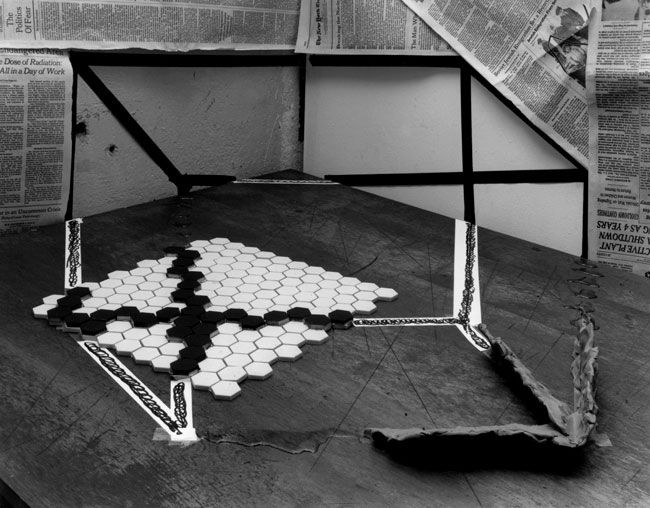
Zeke Cube

Zeke Berman
"Still Life With Necker Cube"
1979
16 x 20 inches

I've long celebrated -- even, in my idolatrous way, revered -- the Necker Cube, the familiar optical illusion created by Swiss crystallographer, Louis Necker. I regard the impossible cube as a symbol of life's push-pull ambivalence and contradiction.

Friday, January 14, 2011

Artifacts


Butt Johnson
"Various Video Game Controllers, Maps, and a Robotic Accessory"
2007
Ballpoint pen on paper
15 X 19 inches

It's been five years since I owned a video game console. It's been even longer since I abandoned myself to a game, a happy pastime (read: addiction) of my teens and early twenties. Just as I made a teenaged vow that I would always be knowledgeable about new music -- Damn it, I wouldn't be the adult who plays the same John Denver tape on the car stereo, day after day! -- I also promised myself that I'd always own a technologically sophisticated gaming system. Although I accepted the cruel fact that my body would age and degrade, I believed that I'd remain young at heart if I remained a serious gamer. In retrospect, this latter, already broken vow seems laughably naive. If I were still gaming (even casually), I'd be hard-pressed to juggle my art-making with my writing, my volunteer commitments with earning a living, my solitary "thinking time" with my relationship; where would gaming fit!?

In any case, artist Butt Johnson's drawing "Various Video Game Controllers, Maps, and a Robotic Accessory" strikes a nostalgic chord. Over the years, I've owned or used all of the controllers depicted (with the exception of the unfamiliar robot). Today, a little more than twenty-five years after the release of the tremendously popular Nintendo Entertainment System (NES) console, we consider the system's controller (top row, third from the right) an artifact of a bygone gaming era. And the Atari joystick? A fossil! It's curious to feel wistful about technology so recently outmoded.

On a tangentially related note, I recommend Nick Paumgarten's New Yorker profile of Shigero Miyamoto, one of the creative minds behind Nintendo's success and the creator of revolutionary games like Super Mario Bros., The Legend of Zelda, and Star Fox. He's also one of the idea men behind the industry-dominating Wii console. Like Paumgarten, I find it revealing that Miyamoto cites his active imagination and the outdoors as the foundation of his creative success.
"When Shigeru Miyamoto was a child, he didn’t really have any toys, so he made his own, out of wood and string. He put on performances with homemade puppets and made cartoon flip-books. He pretended that there were magical realms hidden behind the sliding shoji screens in his family’s little house. There was no television. His parents were of modest means but hardly poor. This was in the late nineteen-fifties and early nineteen-sixties, in the rural village of Sonobe, about thirty miles northwest of Kyoto, in a river valley surrounded by wooded mountains. As he got older, he wandered farther afield, on foot or by bike. He explored a bamboo forest behind the town’s ancient Shinto shrine and bushwhacked through the cedars and pines on a small mountain near the junior high school. One day, when he was seven or eight, he came across a hole in the ground. He peered inside and saw nothing but darkness. He came back the next day with a lantern and shimmied through the hole and found himself in a small cavern. He could see that passageways led to other chambers. Over the summer, he kept returning to the cave to marvel at the dance of the shadows on the walls.

Miyamoto has told variations on the cave story a few times over the years, in order to emphasize the extent to which he was surrounded by nature, as a child, and also to claim his youthful explorations as a source of his aptitude and enthusiasm for inventing and designing video games. The cave has become a misty but indispensable part of his legend, to Miyamoto what the cherry tree was to George Washington, or what LSD is to Steve Jobs. It is also a prototype, an analogue, and an apology -- an illuminating and propitious way to consider his games, or, for that matter, anyone else’s. It flatters a vacant-eyed kid with a joystick (to say nothing of the grownups who have bought it for him or sold it to him) to think of himself, spiritually, as an intrepid spelunker. The cave, certainly, is an occasion for easy irony: the man who has perhaps done more than any other person to entice generations of children to spend their playtime indoors, in front of a video screen, happened to develop his peculiar talent while playing outdoors, at whatever amusements or mischief he could muster. Of course, no one in the first wave of video-game designers could have learned the craft by playing video games, since video games didn’t exist until people like Miyamoto invented them. Still, there may be no starker example of the conversion of primitive improvisations into structured, commodified, and stationary technological simulation than that of Miyamoto, the rural explorer turned ludic mastermind."
My solitary, television-deprived childhood was akin to Miyamoto's, an enchanted, wondrous world of books and nature. That changed during my sixth grade year, when my parents purchased a television. A few years later, they presented me with a Nintendo console. For years after that purchase, I spent more time with a console controller in my hand than I did exploring or contemplating the world around me.

It's misguided to dismiss video games as artless or to condemn them as escapism, but I wonder whether my connection to natural history and my investment in ecology would be so concrete had my early, formative years included television and gaming. What if I'd been born eight years later, after the introduction of the NES and home computers?

I have a positive view
of humanity; an overview of our species' short history reveals a social animal that takes two steps forward for every step back. Technology is an essential part of this gradual and steady improvement. Psychologically, however, we're growing ever more distant from our fellow species; our contemporary songlines resonate more in the virtual world than in natural history. Technology is no less a part of that unfortunate development.

Image credit: ripped from Butt Johnson's website

Tuesday, November 10, 2009

Falling Down


In the wake of last Thursday's tragic shooting at Fort Hood, the American media have made much of Major Nidal Malik Hasan's religious affiliation and, more specifically, of his connection to a radical Muslim cleric based in Yemen.

Many voices on the right have touted Hasan's heinous actions as the latest evidence of Islam's corrupt and violent core. Most of the commentators on the left, by contrast, insist that Major Hasan was a victim of circumstance, and that his murderous rampage was precipitated by external pressures. Considering the left's reasoning, Michael Douglas's defense contractor turned urban vigilante in the 1993 film "Falling Down" comes to mind. At the time of that film's release, critic Roger Ebert wrote of it,
"What is fascinating about the Douglas character, as written and played, is the core of sadness in his soul. [...] There is no exhilaration in his rampage, no release. He seems weary and confused, and in his actions he unconsciously follows scripts that he may have learned from the movies, or on the news, where other frustrated misfits vent their rage on innocent bystanders."
There is salient insight in the left's response, but generally assessments on both the political left and right are ideological and reductionistic. Media pundits are involved in a fraught game of Pin the Tail on the Donkey. While the right-wing strives to pin the tail on Islam, left-wing pundits do what they can to prevent that stigma from sticking. Precious intellectual and creative energy is expended in the process; these commentators could instead provide a full accounting of what causes people to turn to religious extremism, or to extremism of any sort.

I especially appreciated, then, Dave Belden's "How Do We Understand Major Hasan?," an OpEd-style post at Tikkun Daily. I encourage folks to read it. Belden writes,
"Given that in all of our lives personal pain intersects with cultural narratives, then it is surely no surprise that for the killers it’s rarely ever a simple question of either a sick individual or a follower of extremist ideas. Timothy McVeigh was surely both when he bombed the Oklahoma Federal Building. To mention his personal pain is not to excuse him, but should give pause to all those who demonize others."
In response, I wrote in the comment section of Belden's post,
"In the media frenzy that passes for much contemporary news and politics, the humane aspects of most events or socio-political dynamics are generally overlooked. So, too, are the individuals involved reduced to caricatures and concepts. I wish I had some ideas as to how we, as a community, might address this ugly, dangerous spin. Alas…

As for David Brooks and [those to his right], I frequently marvel at their incomplete assertion that Muslim extremism is the culprit (at Fort Hood, in particular, but globally, too). Why not continue the diagnosis, revealing the imbalanced, immoral global system that produces extreme poverty, social and political disenfranchisement, and national/ethnic resentment/competition as the source of the tsoris that drives so many young men and women to embrace extremism (or, at least, adds to the appeal of a black-and-white, reductionist world view)?

Certainly religious extremism should be condemned and confronted, but addressing the root cause (which is also to address social justice globally) seems more sensible. But, were the conservative commentators to finger that root, they would implicitly condemn their own condemnation, as it, too, is born of a naive, black-hat-versus-white-hat construction of our volatile, shrinking world."
Photo credit: image ripped from Voice of America News

Thursday, September 17, 2009

Kimmel Harding Nelson: Day 11

As I began jotting down notes this morning, it occurred to me that many of the ideas I've been ruminating on during my time in Nebraska City were nicely tied together in an essay almost a year old. "Eric Beltz and 'The Good Land'," a response to artist Eric Beltz's Fall 2008 solo exhibition at Morgan Lehman Gallery, in New York City, raises questions of American exceptionalism, conservation, religion, and human conceptions of "wilderness."

I subscribe to the notion that every artist or academic has just one big idea that, over a career, appears in a variety of forms or expressions. Why not, then, revisit the Beltz essay in the context of the writing I've done at the KHN residency? It follows nicely on yesterday's post, and connects our American ecological dilemma to the arts, or at least to two artists' considerations of the dilemma, namely Beltz's and my own.

+++++


Eric Beltz
"By this Axe I Rule"
2008
Graphite on Bristol
27 1/2 x 23 inches

"All conservation of wildness is self-defeating, for to cherish we must see and fondle, and when enough have seen and fondled, there is no wilderness left to cherish."
-Aldo Leopold

The exquisitely rendered graphite drawings included in "The Good Land," Eric Beltz's recent exhibition at Morgan Lehman Gallery, are sophisticated responses to our American folkways and myths. As darkly funny as they are disarmingly earnest, the graphic works are both exhortations and critiques of our nation's inborn exceptionalism and romanticism.

Of particular interest to Beltz is our American relationship to landscape. In "By This Axe I Rule," a contemplative outdoorsman sits on a tree stump, ax in hand. The bodies of a white-tailed deer, a moose, an opossum, a raccoon and other animals are partially concealed by snow drifts at his feet; a turkey vulture is perched above, wings spread. The man bears a striking resemblance to renowned ecologist Aldo Leopold. The likeness may be coincidental, but is nonetheless pertinent. 2008 is the 60th anniversary of Leopold's death. Like Henry David Thoreau and John Muir, Leopold is a lodestar for many contemporary environmentalists. His "A Sand County Almanac," published posthumously in 1949, remains a critical conservation text.

Unlike Rachel Carson's "Silent Spring," the 1962 bestseller that catalyzed the modern environmental movement, Leopold's "Almanac" is not a call for corporate and federal responsibility. Although Leopold would surely support such measures, his book is principally concerned with our reforging an intimate connection to the landscape we inhabit. "We can be ethical only in relation to something we can see, feel, understand, love, or otherwise have faith in," he wrote.

It's noteworthy that Leopold's faith is not of the starry-eyed variety; his "land ethic" includes hunting, controlled burns, and other practices typically condemned by preservationists. Contrary to the romantic conception of wilderness, Leopold's ethic acknowledges that the tools invented by humans (the saws, shovels, axes, picks, and pitchforks that figure prominently in Beltz's drawings) are not simply cruel agents of mastery. Humans are animals and, as such, we are not apart, but rather a part of a complicated, messy ecology. No matter how we manipulate our environment, dominion remains a comforting delusion.

Yet most of us do not conceive of Nature in this way. Just as we distinguish between the self and the group, so too do we draw a hard-line distinction between humanity and the “natural world.” William Cronon, a respected, if controversial environmental historian, argues that we must alienate ourselves from Nature before it can be understood as something pristine, virgin, or more wild than ourselves. In his celebrated 1983 book, “Changes in the Land”, Cronon reveals the quixotic quality of preservationist impulse.
"If the nature of Concord [Massachusetts] in the 1850s - a nature which many Americans now romanticize as the idyllic world of Thoreau's own Walden - was as 'maimed' and 'imperfect' as he said, what are we to make of the wholeness and perfection which he thought preceded it? It is tempting to believe that when the Europeans arrived in the New World they confronted Virgin Land, the Forest Primeval, a wilderness which had existed for eons uninfluenced by human hands. Nothing could be further from the truth....the land was less virgin than it was widowed. Indians had lived on the continent for thousands of years, and had to a significant extent modified the environment to their purposes…The choice is not between two landscapes, one with and one without a human influence; it is between two human ways of living, two ways of belonging to an ecosystem."
The preservationists' dualistic attitude (i.e., Humanity vs. Nature) provides only simple answers to our complex questions. By contrast, Beltz’s allegorical drawings shirk simplistic moralizing in favor of contradiction, ambivalence and multiplicity. His scenes speak to an active communion with Nature, albeit one that includes suffering, death and a melancholy nod to the essential absurdity of existence. By turns, Beltz eulogizes, champions and satirizes Thoreau's self-sufficiency and Andrew Wyeth's rural romanticism.


Eric Beltz
"Hysteria"
2008
Graphite on paper
17 x 13 3/4 inches

Beltz critiques America's religious and economic landscape, as well. Four of his drawings comprise a series entitled “Back to Eden.” In each, a headless body clothed in overalls, workman boots ,and a shirt with rolled up sleeves – the uniform of the outdoorsman-farmer - is slumped in or alongside a pile of cut logs and other vegetation. Above each of these tableaus, Beltz has written one word, in cursive: Asthma; Hysteria; Cancer; Delirium.

Considering the series, I recall Adam Smith’s ignored admonition concerning the dangers of loosely regulated capitalism. Smith, the 18th century Scottish philosopher best known for his influential treatise "The Wealth of Nations," is canonized by contemporary capitalists for laying down the principals of free market economics, but he entertained doubts about and acknowledged the shadows cast by such a system.

"Power and riches," Smith wrote, "are immense fabrics, which it requires the labor of a life to raise, which threaten every moment to overwhelm the person that dwells in them, and which, while they stand, can protect him from none of the severer inclemencies of the season. They keep off the summer shower, not the winter storm, but leave him always as much and sometimes more exposed than before to anxiety, to fear and to sorrow, to diseases, to danger and to death." Smith’s misgivings were warranted. Contemporary life is rife with social ailments and, in combination with our alienation from Nature, secular capitalism is a principal causative factor.

Curiously, free market capitalism is close kin to Manifest Destiny, the divine doctrine of conquest and consumption. Capitalism is exported with no less zeal than our cruel spread west from the colonies. Harriet Beecher Stowe, the 19th century novelist best remembered as an outspoken proponent of abolition, wrote that America is "a nation specifically raised up by God to advance a cause of liberty and religion." She did not say “liberty of religion.” America was founded by Protestant fundamentalists fleeing religious persecution in Europe. Arriving on these contested shores, they took names like Ezekiel, Jacob, and Issac, and likened their journey to the Jewish Exodus from Egypt. These religious settlers are the forebears of a great many contemporary Americans.

Appropriately, Beltz’s drawings incorporate Biblical texts and his subjects are recognizable as America's founding fathers and God-fearing, anonymous farmers. But Beltz draws from a peculiarly American well, the proverbial melting pot. Each drawing is suffused with currents of Eastern philosophy and shamanism. His farmers and historical figures are also mystics. American philosophy is more plural than we care to admit, and Beltz's admixture of East and West, allegory and history, supernatural and natural is a fair reckoning. (American transcendentalism, for example, the philosophy so vital to Thoreau and Ralph Waldo Emerson, was a hybrid of Protestant Unitarianism, Romanticism, Hinduism, and European intellectualism.)


Eric Beltz
"Tree of the Evil Eagle"
2008
Graphite on paper
40 x 30 inches

Still, the Bible is the first book of the United States, and many Americans regard the Constitution and founding fathers with astonishing reverence (to the extent that, in some circles, the former is sacrosanct). But documents and philosophies are of a particular time. Guarded by strict interpreters, the Constitution of the United States can become as regressively dogmatic as any primary religious text. Without thoughtful interpretation of Constitutional scripture, the significance and relevance of the founding fathers' enterprise will wane.

But most Americans (politicians and citizens alike) are in the business of denying the inevitable, be it the death of a loved one, an unregulated economy, or an ideology. Rather than confront our heavy history (and with it our future), the United States cloaks itself in exceptionalism. We remove ourselves from a fact-based historical narrative so that the road to future success is understood as an unyielding continuation of the present, divinely-ordained course. Like the empires that rose and fell before us, America's clarity of vision is obscured by global power and a history that privileges mythic glory over fact. Because we make history, many of our leaders feel strongly that we don't need to know it. Moreover, the history we make is irreproachable because it is consecrated.

Yet the secular capitalist world view strives to replace religion and the supernatural with consumerism. Manifest Destiny Version 3.0 is not ordained by God so much as by the Almighty dollar. And the replacement worked, more or less. The secular capitalist model is today the global standard. But sociologists, anthropologists, and, now, some neuroscientists agree that the substitution is inadequate. This deficiency is most apparent in a religious nation like the United States, where fundamentalism and cultism, reactionary responses to the secular world, are thriving. Despite our founding fathers' dismissal of the New Testament's Book of Revelation (Thomas Jefferson described it as "the ravings of a maniac"), a 2002 CNN/Time magazine poll found that 59 percent of Americans believe the prophecies therein are real and that the gruesome judgment of the Second Coming is imminent. James Watt, former President Reagan's Secretary of the Interior, is among that majority. He famously stated that protecting our nation's natural resources was not a priority because Jesus Christ would return only "after the last tree is felled."

Yet some evangelical fundamentalists are more fair-minded. They focus instead on the Bible's call for stewardship, and argue that the success or failure of the environmental movement depends on which interpretation gains the upper hand. Will we embrace a dominionist or stewardship theology?

The crux of that question is the American notion of wilderness. Cronon writes, "the flight from history that is very nearly the core of wilderness represents the false hope of an escape from responsibility, the illusion that we can somehow wipe clean the slate...and return to the tabula rasa that supposedly existed before we began to leave our marks on the world...Non-use is not an option: to live in nature is to use and change it by our presence. The choice we face is not to leave no marks - that is impossible - but rather to decide what kinds of marks we wish to leave."


Eric Beltz
"The Good Land"
2008
Graphite on paper
30 x 40 inches

Beltz's meticulously rendered works don't offer any answers, but neither do they shrug off the dilemma. With a richly ironic sensibility and a sensitivity to the complexities of our national character and (natural) history, Beltz embraces our clusterfuck approach even as he skewers it. "The Good Land" is sublimely ambivalent.

Photo credit: all images ripped from the artist's website

Saturday, April 18, 2009

Corey Arnold's Sea


Corey Arnold
"Gulf Crossing, Bering Sea, Alaska"
2007
Chromira C-print


Curiously, Sara Tecchia Roma's press release for Corey Arnold's solo exhibition, "Fish Work," describes the artist as "an Alaskan crab fisherman animated by a life long artistic project." I wonder, does Arnold identify as a fisherman first and a photographer second? Or perhaps the two occupations are inextricably tangled? Whichever designation Arnold prefers, his pictures evidence a daring spirit - an attribute I associate with Bering Sea fisherman, but rarely with fine art photographers - and an expert eye.

Arnold's photographs capture northern ocean landscapes and document the lives of men that harvest its depths. Most of his working fishermen pictures are handsome records of an uncommon life style, but they are undistinguished as works of art. Not so for Arnold's strongest images; when the photographer turns his lens on the water, he provides viewers with a glimpse of sublime wonder. His pictures humble us.

As the gallery press release states, viewers are reminded "not only of the beauty but also of the undeniable power that Nature holds against mankind." I'd amend that statement slightly. Nature doesn't work against mankind; its staggering violence is ambivalent, and humanity is a vital part of it.


Corey Arnold
"Bering Sea Birthday, Bering Sea, Alaska"
2006
Chromira C-print

Wednesday, January 21, 2009

Sensation


The Chilean-born artist Marco Evaristti is best known for his 2000 work, "Helena." Inside Denmark's Trapholt Art Museum, Evaristti installed ten electric blenders, their power cords visibly connected to electrical outlets. He filled the blenders with fresh water and placed a live goldfish in each. Foolish, disturbed or sickly curious museum visitors might choose to turn on a blender, thereby taking the life of a goldfish. Two people did just that. Public outcry followed and law suits were brought against the artist and the museum.

When I first read about "Helena," I thought it a puerile stunt. Most artists, critics and viewers reacted similarly, but these condemnations and dismissals were perhaps what Evaristti sought. Because the piece attracted so much derision, "Helena" transformed a little known sensationalist into an international art circuit commodity.

In time, however, I forgot Evaristti's name...but I didn't forget about "Helena." Despite my initial censure of the work, the disdainful tone of those who condemned Evaristti forced me to revisit the controversy. After all, what had the artist or the museum director done wrong, really? Evaristti presented a scenario in which another person might harm the goldfish. He provided museum goers with the necessary tools to kill a fish, but he didn't encourage them to do so. Still, he was smeared by animal rights groups, religious organizations and artist collectives.

I believe that the outcry over "Helena" was so vitriolic because Evaristti positioned himself as a public moralist. The mirror was turned to face art viewers in a difficult moment, and we didn't like what we saw there. While I may not hold Evaristti's risky installation in high regard, it is the art world's angry response that worries me. Indeed, the protests and the criminal charges suggest that many people (perhaps the majority) lack faith in the moral fiber of their fellow man.

Do most people believe that ours is an innately murderous species? Do most of us feel that moral calculus is irrelevant when another person or power has pointed you to a certain, dark end? I can not (and do not) accept such pessimistic attitudes. If I were to hand you a frog and a bat, would you think it okay to play frog baseball? I doubt it. And what are we to make of the vast majority of automobile drivers, those of us that don't opt to direct our vehicle into pedestrians, bicyclists or road-crossing chickens?

As Evaristti put it, he aimed to create "a dilemma" in which people might "do battle with their conscience." Because the artist included no signs or other directives instructing museum visitors to turn on a blender or blenders, I do not believe that the fish killers could fall back on the Stanley Milgram defense; visitors were not "good Germans," recklessly obedient to some unseen authority. (Indeed, only two visitors have ever "flipped the switch," a nearly negligible minority of the work's many viewers/subjects.)

A more convincing criticism posits that the museum setting is one of institutionalized safety; visitors therefore feel that their turning on a blender will not, in fact, bring a goldfish to an untimely, gruesome end. This is a valid supposition, but I maintain that only visitors with a sick curiosity would cross that final threshold, committing to the loaded "What if I do this?" (Again, it is instructive that just two visitors went so far.)

Whatever you think of "Helena," Evaristti's most recent project ups the ante. The work is sure to generate plenty of negative publicity in the coming months...and, of course, that's exactly what the Denmark-based shock artist wants.

Saturday, November 22, 2008

Eric Beltz and "The Good Land"


Eric Beltz
"By this Axe I Rule"
2008
Graphite on Bristol
27 1/2 x 23 inches


"All conservation of wildness is self-defeating, for to cherish we must see and fondle, and when enough have seen and fondled, there is no wilderness left to cherish."
-Aldo Leopold


The exquisitely rendered graphite drawings included in "The Good Land," Eric Beltz's recent exhibition at Morgan Lehman Gallery, are sophisticated responses to our American folkways and myths. As darkly funny as they are disarmingly earnest, the graphic works are both exhortations and critiques of our nation's inborn exceptionalism and romanticism.

Of particular interest to Beltz is our American relationship to landscape. In "By This Axe I Rule," a contemplative outdoorsman sits on a tree stump, ax in hand. The bodies of a white-tailed deer, a moose, an opossum, a raccoon and other animals are partially concealed by snow drifts at his feet; a turkey vulture is perched above, wings spread. The man bears a striking resemblance to renowned ecologist Aldo Leopold. The likeness may be coincidental, but is nonetheless pertinent. 2008 is the 60th anniversary of Leopold's death. Like Henry David Thoreau and John Muir, Leopold is a lodestar for many contemporary environmentalists. His "A Sand County Almanac," published posthumously in 1949, remains a critical conservation text.

Unlike Rachel Carson's "Silent Spring," the 1962 bestseller that catalyzed the modern environmental movement, Leopold's "Almanac" is not a call for corporate and federal responsibility. Although Leopold would surely support such measures, his book is principally concerned with our reforging an intimate connection to the landscape we inhabit. "We can be ethical only in relation to something we can see, feel, understand, love, or otherwise have faith in," he wrote.

It's noteworthy that Leopold's faith is not of the starry-eyed variety; his "land ethic" includes hunting, controlled burns, and other practices typically condemned by preservationists. Contrary to the romantic conception of wilderness, Leopold's ethic acknowledges that the tools invented by humans (the saws, shovels, axes, picks, and pitchforks that figure prominently in Beltz's drawings) are not simply cruel agents of mastery. Humans are animals and, as such, we are not apart, but rather a part of a complicated, messy ecology. No matter how we manipulate our environment, dominion remains a comforting delusion.

Yet most of us do not conceive of Nature in this way. Just as we distinguish between the self and the group, so too do we draw a hard-line distinction between humanity and the “natural world.” William Cronon, a respected, if controversial environmental historian, argues that we must alienate ourselves from Nature before it can be understood as something pristine, virgin, or more wild than ourselves. In his celebrated 1983 book, “Changes in the Land”, Cronon reveals the quixotic quality of preservationist impulse.
"If the nature of Concord [Massachusetts] in the 1850s - a nature which many Americans now romanticize as the idyllic world of Thoreau's own Walden - was as 'maimed' and 'imperfect' as he said, what are we to make of the wholeness and perfection which he thought preceded it? It is tempting to believe that when the Europeans arrived in the New World they confronted Virgin Land, the Forest Primeval, a wilderness which had existed for eons uninfluenced by human hands. Nothing could be further from the truth....the land was less virgin than it was widowed. Indians had lived on the continent for thousands of years, and had to a significant extent modified the environment to their purposes…The choice is not between two landscapes, one with and one without a human influence; it is between two human ways of living, two ways of belonging to an ecosystem."
The preservationists' dualistic attitude (i.e., Humanity vs. Nature) provides only simple answers to our complex questions. By contrast, Beltz’s allegorical drawings shirk simplistic moralizing in favor of contradiction, ambivalence and multiplicity. His scenes speak to an active communion with Nature, albeit one that includes suffering, death and a melancholy nod to the essential absurdity of existence. By turns, Beltz eulogizes, champions and satirizes Thoreau's self-sufficiency and Andrew Wyeth's rural romanticism.


Eric Beltz
"Hysteria"
2008
Graphite on paper
17 x 13 3/4 inches


Beltz critiques America's religious and economic landscape, as well. Four of his drawings comprise a series entitled “Back to Eden.” In each, a headless body clothed in overalls, workman boots ,and a shirt with rolled up sleeves – the uniform of the outdoorsman-farmer - is slumped in or alongside a pile of cut logs and other vegetation. Above each of these tableaus, Beltz has written one word, in cursive: Asthma; Hysteria; Cancer; Delirium.

Considering the series, I recall Adam Smith’s ignored admonition concerning the dangers of loosely regulated capitalism. Smith, the 18th century Scottish philosopher best known for his influential treatise "The Wealth of Nations," is canonized by contemporary capitalists for laying down the principals of free market economics, but he entertained doubts about and acknowledged the shadows cast by such a system.

"Power and riches," Smith wrote, "are immense fabrics, which it requires the labor of a life to raise, which threaten every moment to overwhelm the person that dwells in them, and which, while they stand, can protect him from none of the severer inclemencies of the season. They keep off the summer shower, not the winter storm, but leave him always as much and sometimes more exposed than before to anxiety, to fear and to sorrow, to diseases, to danger and to death." Smith’s misgivings were warranted. Contemporary life is rife with social ailments and, in combination with our alienation from Nature, secular capitalism is a principal causative factor.

Curiously, free market capitalism is close kin to Manifest Destiny, the divine doctrine of conquest and consumption. Capitalism is exported with no less zeal than our cruel spread west from the colonies. Harriet Beecher Stowe, the 19th century novelist best remembered as an outspoken proponent of abolition, wrote that America is "a nation specifically raised up by God to advance a cause of liberty and religion." She did not say “liberty of religion.” America was founded by Protestant fundamentalists fleeing religious persecution in Europe. Arriving on these contested shores, they took names like Ezekiel, Jacob, and Issac, and likened their journey to the Jewish Exodus from Egypt. These religious settlers are the forebears of a great many contemporary Americans.

Appropriately, Beltz’s drawings incorporate Biblical texts and his subjects are recognizable as America's founding fathers and God-fearing, anonymous farmers. But Beltz draws from a peculiarly American well, the proverbial melting pot. Each drawing is suffused with currents of Eastern philosophy and shamanism. His farmers and historical figures are also mystics. American philosophy is more plural than we care to admit, and Beltz's admixture of East and West, allegory and history, supernatural and natural is a fair reckoning. (American transcendentalism, for example, the philosophy so vital to Thoreau and Ralph Waldo Emerson, was a hybrid of Protestant Unitarianism, Romanticism, Hinduism, and European intellectualism.)


Eric Beltz
"Tree of the Evil Eagle"
2008
Graphite on paper
40 x 30 inches


Still, the Bible is the first book of the United States, and many Americans regard the Constitution and founding fathers with astonishing reverence (to the extent that, in some circles, the former is sacrosanct). But documents and philosophies are of a particular time. Guarded by strict interpreters, the Constitution of the United States can become as regressively dogmatic as any primary religious text. Without thoughtful interpretation of Constitutional scripture, the significance and relevance of the founding fathers' enterprise will wane.

But most Americans (politicians and citizens alike) are in the business of denying the inevitable, be it the death of a loved one, an unregulated economy, or an ideology. Rather than confront our heavy history (and with it our future), the United States cloaks itself in exceptionalism. We remove ourselves from a fact-based historical narrative so that the road to future success is understood as an unyielding continuation of the present, divinely-ordained course. Like the empires that rose and fell before us, America's clarity of vision is obscured by global power and a history that privileges mythic glory over fact. Because we make history, many of our leaders feel strongly that we don't need to know it. Moreover, the history we make is irreproachable because it is consecrated.

Yet the secular capitalist world view strives to replace religion and the supernatural with consumerism. Manifest Destiny Version 3.0 is not ordained by God so much as by the Almighty dollar. And the replacement worked, more or less. The secular capitalist model is today the global standard. But sociologists, anthropologists, and, now, some neuroscientists agree that the substitution is inadequate. This deficiency is most apparent in a religious nation like the United States, where fundamentalism and cultism, reactionary responses to the secular world, are thriving. Despite our founding fathers' dismissal of the New Testament's Book of Revelation (Thomas Jefferson described it as "the ravings of a maniac"), a 2002 CNN/Time magazine poll found that 59 percent of Americans believe the prophecies therein are real and that the gruesome judgment of the Second Coming is imminent. James Watt, former President Reagan's Secretary of the Interior, is among that majority. He famously stated that protecting our nation's natural resources was not a priority because Jesus Christ would return only "after the last tree is felled."

Yet some evangelical fundamentalists are more fair-minded. They focus instead on the Bible's call for stewardship, and argue that the success or failure of the environmental movement depends on which interpretation gains the upper hand. Will we embrace a dominionist or stewardship theology?

The crux of that question is the American notion of wilderness. Cronon writes, "the flight from history that is very nearly the core of wilderness represents the false hope of an escape from responsibility, the illusion that we can somehow wipe clean the slate...and return to the tabula rasa that supposedly existed before we began to leave our marks on the world...Non-use is not an option: to live in nature is to use and change it by our presence. The choice we face is not to leave no marks - that is impossible - but rather to decide what kinds of marks we wish to leave."


Eric Beltz
"The Good Land"
2008
Graphite on paper
30 x 40 inches


Beltz's meticulously rendered works don't offer any answers, but neither do they shrug off the dilemma. With a richly ironic sensibility and a sensitivity to the complexities of our national character and (natural) history, Beltz embraces our clusterfuck approach even as he skewers it. "The Good Land" is sublimely ambivalent.

Photo credit: all images ripped from the artist's website

Friday, August 08, 2008

An Inner Untidiness Too Vast...

...to be tamed by secular means


Most professional art critics accept modernism's conceit that art progresses linearly, movement begetting movement. Their promulgation of this outmoded precept is surprising and disappointing.

Art, as with all other forms of cultural development, moves in random hiccups and circles. It resembles more the wanderings of a drunken homebody than modernism's straight line ideal.

In "Feeling Blue" (The New Yorker, August 4, 2008), Peter Schjeldahl's recent review of "After Nature," a group show currently installed at The New Museum, the critic observes "something...happening in artists' studios: a shift of emphasis, from surface to depth, and a shift of mood, from mania to melancholy, shrugging off the allures of the money-hypnotized market and the spectacle-bedizened biennials circuit." He goes on to declare that younger artists are assuming "a backward crouch preceding a forward leap" because "[a]bruptly, once-settled views and values have unsettled themselves and stalk the mind."

His suggestion that a loosely defined trend is indicative of imminent sea change is tidy and exciting but, like the notion that avant-gardism is central to a healthy culture, it is misguided. Many artists - including some of those participating in "After Nature" - have been making deep, melancholic work for years. The shift of emphasis is not in their studios, but instead on the curatorial front, where the administrators of the arts industry, themselves unable to shake off the modern canon and dreams of Life magazine covers, are responding to the media frenzy around all things "eco-": ecology and economy. How many open-calls for "green-themed" group shows have we seen of late? And how many new gallery or non-profit side-projects devoted to addressing "issues of the environment"? I'm buoyed by these developments, but the impetus is managerial and directorial; the artists embraced by these new shows and venues have, for the most part, been there all along.

Near the article's end, Schjeldahl calls for a hero. "What we want now is a major artist - a Manet, Picasso, Pollock, Warhol, or Beuys - who will manifest durable truths at the core of inevitable hypes and hyperboles. If none such appears, that will be a valuable datum. It will help us adjust to the happenstance that, once and finally, our particular civilization is spent." Ignoring the rhetorical overstatement, I appreciate the anxiety that Schjeldahl and other intellectuals feel. Amos Oz describes globalization as "a sort of infantilization of the entire human race." The prominent cultural historian Morris Berman argues in his book "The Twilight of American Culture" that most of what ails the contemporary world - social and economic inequality, xenophobia, declining resources and literacy, and a debilitating spiritual void - grows from our pandemic culture of superficiality and postmodern dullardism. Both Berman and Oz are right but they're also wrong. To characterize an inevitable process as infantile is itself infantile, and although the Enlightenment and it's fascist successor modernism both allowed for the championing of reason and so-called progress, the shrinking world is simply too complex for a strictly left-brained approach. It's proving difficult for our dualistic brains to accept that the good guys don't necessarily wear white.

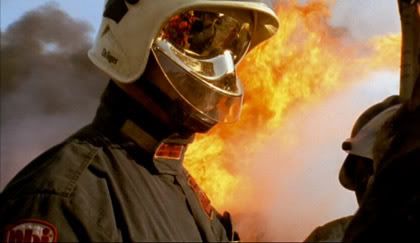
But if Schjeldahl and the arts industry insist on a standard bearer for this flood of anxious melancholy, they needn't wait for one to appear. Werner Herzog, whose 1992 film "Lessons of Darkness" is included in "After Nature," is an influential hero to a great many younger artists, myself included. The German director and writer combines Manet's keen observation and social sensitivity with Pollock's violent, self-destructive embrace of the chthonian and Beuys' playful intellect and deep faith in the spiritual value of art. He is the "major artist" Schjeldahl calls for.

When I feel the poison mercury of misanthropy rise in me, I revisit this clip from the 1982 film "Burden of Dreams." Though Herzog's language is harsh, his observations are essentially celebratory. Sometimes, his comments are laughably bleak: "There is some sort of harmony; it is the harmony of overwhelming and collective murder." Even so, his tone, posture and face betray a wounded sensitivity.


Watching the excerpt, I'm reminded that other people are emotionally stirred by the terrible, indifferent beauty of nature's doings. I want to embrace Herzog and his complicated mess of a mind...and I'd wager that a great many other artists do, too.

Note: The title of the post is stolen from another contributor to The New Yorker: Don Chiasson wrote of T.S. Eliot possessing "an inner untidiness too vast to be tamed by ordinary secular means" in "Fire Down Below," a review of Les Murray's poetry in the June 11, 2007 issue.

Photo credit: Still from "Lessons of Darkness," 1992, Werner Herzog; Excerpt from "Burden of Dreams," 1982, Les Blank

Tuesday, October 09, 2007

Gallery Report: September 26th, 2007

Paul Villinski at Morgan Lehman Gallery


Paul Villinksi
"Ardor"
2007
Found aluminum, wire, lead and soot
60 x 60 x 11 inches

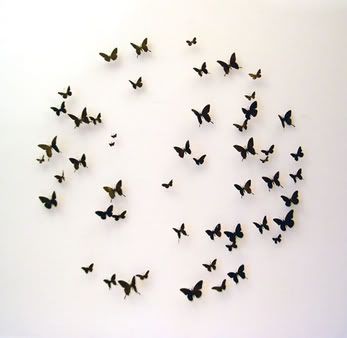
Morgan Lehman Gallery: Paul Villinski's solo outing, "metamorphosis," proves true the maxim that one can have too much of a good thing. The works Villinski includes - groupings of wall-mounted butterflies, "cut by hand from discarded aluminum cans," and a similar installation using vinyl LPs - are part of a series I was introduced to in July of 2006, when the artist included one sculpture, "Departure," in a summer group show at Morgan Lehman. At the time, I applauded Villinski's willingness to flirt with preciousness. I wrote, "[the sculpture] risks being dismissed as a one-note, kitsch celebration of reincarnation or transformation," but concluded that the work was stronger for taking that risk. "Departure" toed the line successfully, forcing the viewer to question his jaded mistrust of a sincere, simple gesture.

Unfortunately, when the gallery space includes only Villinski's butterfly sculptures, the work takes a sad tumble from sincerity into saccharinity. Butterflies, butterflies, everywhere! Even those visitors who rightly cling to the notion of the gallery as a cultural shrine will be forced to admit that an art gallery is first and foremost a boutique. This context undermines Villinski's labors. I left the show wishing I could view each sculpture apart from the rest because, on their own, they are quite nice.

+++++

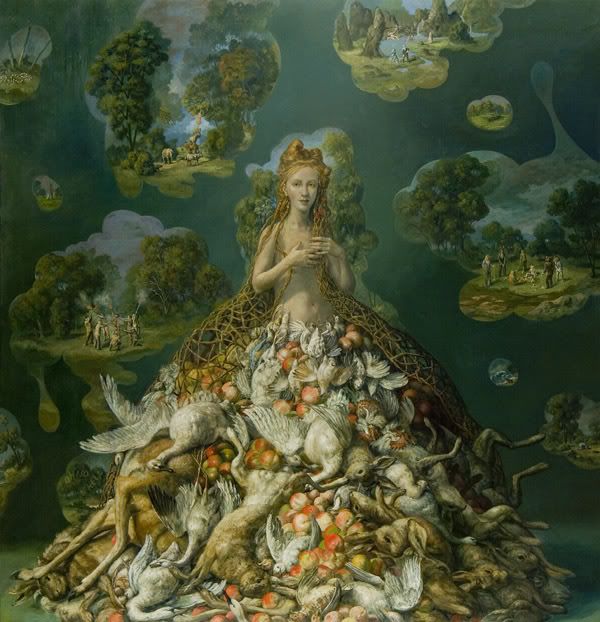
Julie Heffernan at P.P.O.W. Gallery


Julie Heffernan
"Self Portrait as Booty"
2007
Oil on canvas
68 1/2 x 65 inches

P.P.O.W.: Julie Heffernan's large, lush canvases are a treat for contemporary painting aficionados. The works on display in her current solo show, "Booty," at P.P.O.W., provide ample evidence of her virtuosity, but are psychologically off-putting.

The paintings function as contemporary Vanitas pictures. Heffernan replaces the oft-used laden table with naked women - all self portraits - and gone, too, are the hourglass and silverware. The works are less meditations on life's temporality than restrained celebrations of ego and excess.

The press release states that the figure "does not stoop under the weight of it all" and possesses "extraordinary grace," but that grace can also be interpreted as ambivalent disregard. Did these women achieve their position, or is this merely their circumstance? In either case, the women are obscene; at best, they are quiet collaborators and, more likely, queenly orchestrators, present-day scepter bearers lording over choked empires and rampant consumption. I am saddened - even made uncomfortable - by these pictures. The artist is looking out at us. We're implicated.

+++++

Daniel Rozin at bitforms gallery


Daniel Rozin
"Weave Mirror"
2007
768 laminated C-ring prints, motors, circuits, custom software and microcontroller
57 x 76 x 8 inches
Edition of 6

bitforms gallery: Daniel Rozin includes three interactive sculptures in "Fabrication," his third solo exhibition with bitforms gallery. One of these, "Snow Mirror," is relatively forgettable, but "Peg Mirror" and "Weave Mirror" may well prove to be among the most engaging works I will see this year.

As their titles suggest, all three of Rozin's computerized sculptures are unconventional mirrors, limning the viewer in plastic rings, wooden pegs, or digitized "snow." The "reflected" images are fragmented or wraith-like. The reflection offered by "Weave Mirror," for example, more closely resembles a shadow than the familiar face in the medicine cabinet mirror. This "other" shadow has a power that our own, neglected shadow no longer possesses. "The Shadow knows," the popular 1930s radio program reminded Americans, and "Weave Mirror" emphasizes our corporeality by summoning the confrontational vestige, a hi-contrast Doppelganger that stares back at us as it mimics.


Daniel Rozin
"Weave Mirror"
2007
768 laminated C-ring prints, motors, circuits, custom software and microcontroller
57 x 76 x 8 inches
Edition of 6

All of Rozin's "mirrors" are playfully mysterious, but "Weave Mirror" is especially so. I circled the construction, and approached its face from all angles, low and high, trying to figure out its whining, clacking workings. I felt I was in the presence of something special, something at once "new" and ancient, magical and mundane. It is remarkable, too, for the method of its magic. It breaks apart the "whole" to transformative effect: revelation through pixelation.

The back of "Weave Mirror" is a plexiglas panel under which all the gears and wires can be seen. Even though Rozin reveals the mechanics of the piece, you need to be a contemporary tinkerer, engineer, or programmer to understand what's happening behind Oz's curtain. For the rest of us, the work remains invested with magic, what Julian Dibbell, writing on contemporary technology, calls "the logic of the incantation." I am, admittedly, something of a technophobe, but Rozin's engineering has all the appeal of steampunk alternatives.

+++++

Photo credits: Villinski and Heffernan images ripped from gallery websites (only due to time constraints); "Weave Mirror" images, Hungry Hyaena, 2007

Thursday, July 12, 2007

Gallery Report: June 27, 2007

Part Three : The Absurd Whole


Michael Light
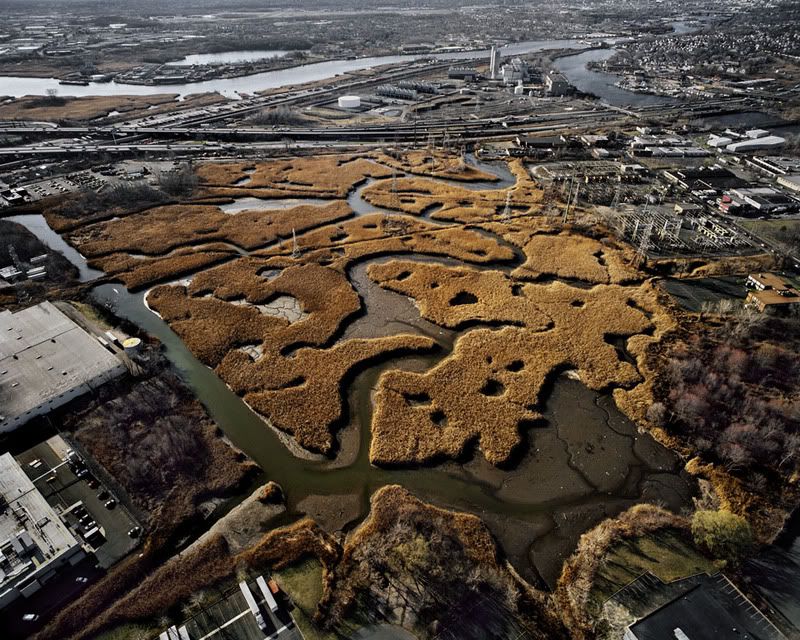
"Bellman's Creek Marsh in the Meadowlands, I-95 and Hackensack River Beyond, NJ, 2007"
2007
Pigment print on aluminum
24 x 30 inches (or 40 x 50 inches)


“The projects of human technology exist wholly within nature, evolving, like anthills, from a set of circumstances that they can neither invent nor transcend.”
-Lewis Lapham, Harper's Magazine (November 2000)

When an airline representative asks if I would prefer an aisle or window seat, I opt for the view. Cramped legs and bathroom trip niceties are a small price to pay. Peering through the reinforced panes as a young boy, I was afforded the perspective required to imaginatively connect a black-and-white aerial survey of my parents’ farm to my ground-level experience of those woods, fields, and marshes. I could at last identify the contours of a pond or stand of trees that I had explored on foot many times. This recognized correspondence thrilled me. A decade on, as a teenage pilot-in-training, I was too enamored of the panorama to mind the specifics of stall recovery procedure, and today all I really recall of the hours logged at the yoke is the exuberant joy I felt looking down on the thin peninsula of farmland separating the Chesapeake Bay from the Atlantic Ocean.

From above, we comprehend land as a cartographer; our mundane conceptions of scale and place are expanded. Michael Light's handsome, handmade Bookworks, on display at Hosfelt Gallery, celebrate this perspectival shift. The artist's books are comprised of aerial photographs shot "with a large-format camera from small, self-piloted aircraft and rented helicopters," each book a document of regional topography, settlement or industrialization. Many photographers aim to "[investigate] the complex landscapes of America," but the aerial aspect of Light's approach elevates his pictures; the images do provide an archaeological record of our culture's contemporary landscape, but the perspective - looking down or across the Earth's flesh from on high - nods to universal and geologic time.


Michael Light
"Deep Springs Valley at 500', 1600 hours, Big Pine, CA
2000
Pigment print on aluminum
24 x 30 inches (or 40 x 50 inches)


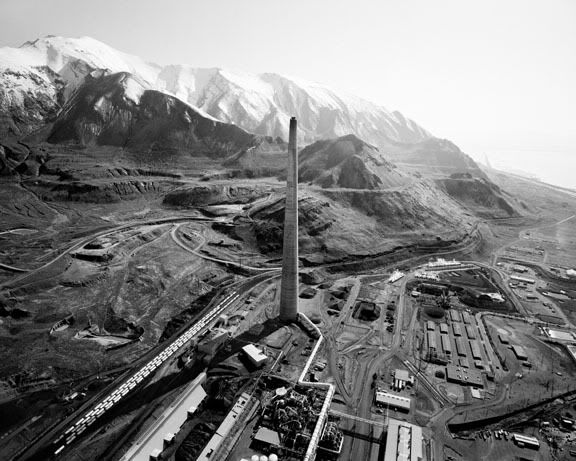
The artist states that he is seeking "certain sublimities and timelessnesses and continuities amidst what might commonly otherwise be considered 'wastescapes' or 'nonscapes'" and this search has resulted in the six photographic surveys on display at Hosfelt: "New York Harbor, 03.29.07"; "Rancho San Pedro, 04.28.06"; "Los Angeles, 02.12.04"; "Bingham Mine/Garfield Stack, 04.21.06"; "Some Dry Space, 2003"; "Los Angeles, 07.27.05". His bookworks encourage us to question conventional notions of natural and artificial, and also to consider these environments with respect to the full sweep of time and scale.

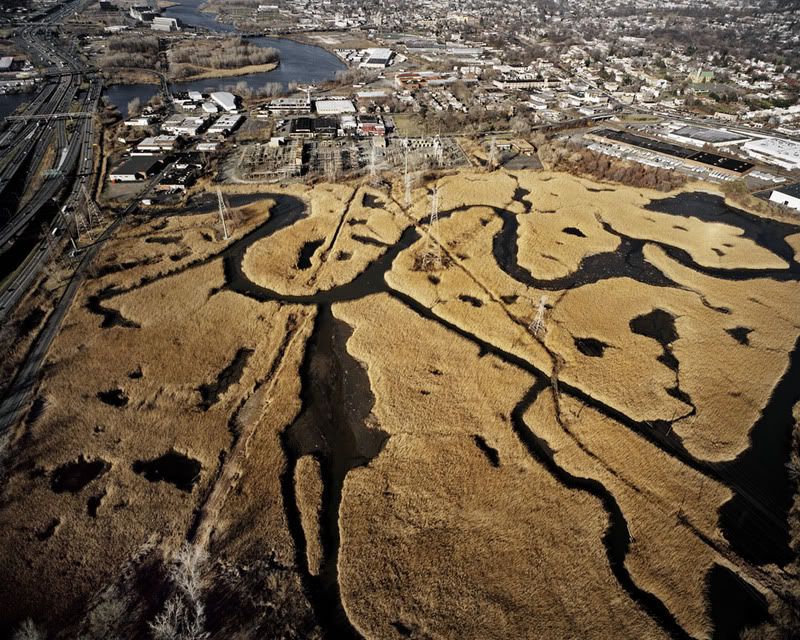
"New York Harbor, 03.29.07" is of particular interest to me, and not only because I currently call New York City home. Figuring prominently in this collection is the vast marsh of phragmites, roadways, spartina, telephone poles, landfills, radio towers, and cargo trailers known as the Meadowlands. This is complex terrain, literally and metaphorically. The Meadowlands possess a torn grandeur unrivaled even by the "virgin Nature" we revere in literature and film, on postcards and calendars. Without having traveled to the Grand Canyon, most people have an idea of what they would (or should) "feel" there. They have already experienced it on television.(1) Virgin Nature is neatly labelled and classified, packaged, marketed, and sold. The mess of the Meadowlands, by contrast, resists classification. It reminds us that real Nature - the evolving, ambivalent, often brutal Nature - includes man. Artist and writer John R. Quinn describes the Meadowlands in his book, Fields of Sun and Grass.
"Whether or not the meadows fill any sort of primal need for nature in the eyes of travelers who view them from the Turnpike, wilderness these broad, grassy plains surely are. For though defiled nearly to the utmost, they are yet filled with life - a complex, living biomass that has simply made the best of the industrial juggernaut that has all but overwhelmed it. The meadows have adapted, and endured. And in their own unique way they possess a living beauty that has not been obliterated."

Michael Light
"Bellman's Creek Marsh Looking North, I-95 and Overpeck Creek at Left, Ridgefield, NJ, 2007"
2007
Pigment print on aluminum
24 x 30 inches (or 40 x 50 inches)

Robert Smithson, another artist who, like Quinn, spent his childhood in northern New Jersey and much of his adult life in New York City, wrote, "Even the most advanced tools and machines are made of the raw matter of the earth." Smithson’s statement comes to mind as we speed along the New Jersey Turnpike, passing the industrial detritus that rises up from the reeds or settles into the mud. The tired metal towers, the cinder blocks, the coke bottles, and the discarded tires, the intricate refinery pipeworks, the fat garbage bags, the used condoms, the plastic milk cartons, and the rusty trunks -–all of these things may not be separated from the phragmites, the egret, the turtle, the otter, and the tern. Our existence is woven into past and present, as are the products of our being, a weave which may be dissected only by arrogance or ignorance. To dismiss the Meadowlands as a wasted landscape is to deny humanity. Even though the landscape's relative dearth of biodiversity should distress us. An honest assessment of the region's postmodern ecology and significance requires acceptance of ambiguity and contradiction. Light turns his lens on this heterogeneous landscape and others similarly complex.


Michael Light
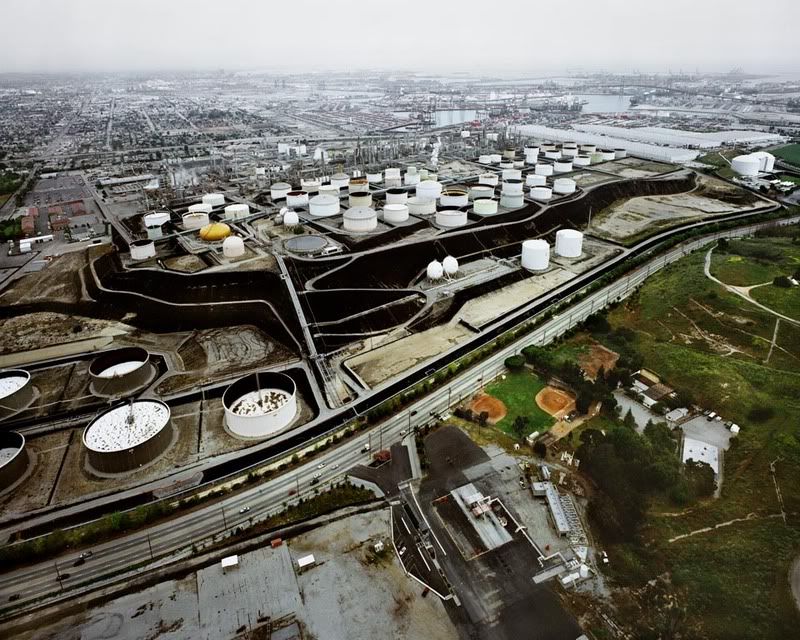
"Conoco Phillips Wilmington Refinery Looking South, 139,000 Daily Barrels, Terminal Island in Distance"
2006
Pigment print on aluminum
24 x 30 inches (or 40 x 50 inches)

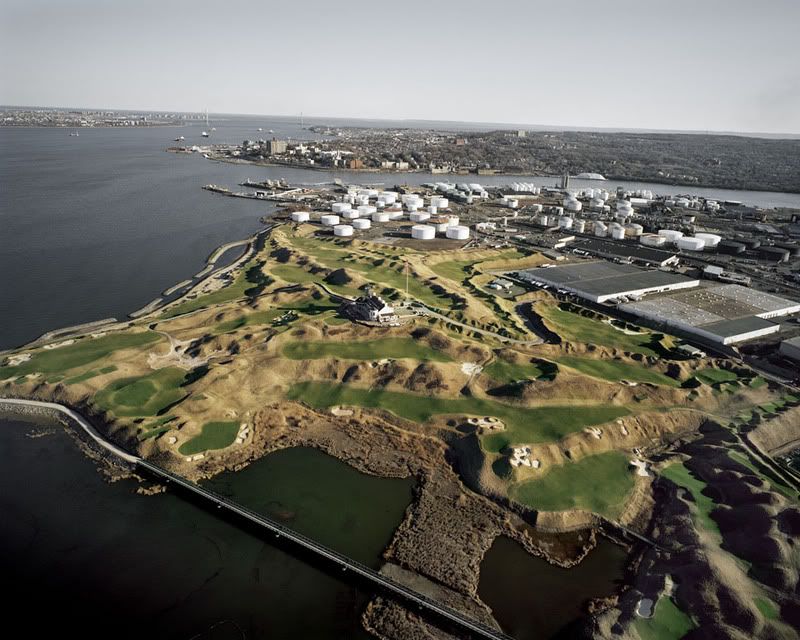
In "Conoco Phillips Wilmington Refinery Looking South, 139,000 Daily Barrels, Terminal Island in Distance," a photo included in the book, "Rancho San Pedro, 04.28.06," a community baseball diamond seems incongruous surrounded by the expansive industrial complex of the southern Los Angeles basin. "Bayonne Golf Club, Former Landfill With A $200,000 Initiation, Old Standard Oil Refinery Beyond, NJ, 2007" pictures one of the Meadowlands' many landfills, in this instance reclaimed as an exclusive club, a manufactured escape in a landscape dominated by what most of us would deem the more mean marks of manufacturing. But the relationship of one to the other is not so dual; this isn't merely attractive versus ugly, good versus bad, or natural versus artificial. Light's photographs remind us that, like the refinery, the golf course and, indeed, even the glacial channel, qualitative judgments are in forever in flux.


Michael Light
"Bayonne Golf Club, Former Landfill With a $200,000 Initiation, Old Standard Oil Refinery Beyond, NJ, 2007"
2007
Pigment print on aluminum
24 x 30 inches (or 40 x 50 inches)

Take, for example, my long-held presumption that Los Angeles is a town with no shared pulse or sense of community. "Los Angeles, 02.12.04" carries Light (and us with him) northward over the industrial sprawl of Long Beach to the grouping of towers that comprise the city's downtown. Monuments to things bought and sold, the tall buildings rise from the city's otherwise low profile, each labelled: BP, Citigroup, Paul Hastings. Moving northwest, Light flies by the hills of Hollywood, dotted with the precariously situated houses of the rich and famous. I've never had a particular urge to explore this city, but as I turned the substantial pages of Light's book, the seismic beauty, fragility, and violence of the landscape were readable. Los Angeles became a romantic notion, an ongoing, astonishing experiment. The prints highlight the tenuous hold humans have on the land and, more generally, on our fate.

There is something freeing in the contemplation of our inevitable annihilation. Christopher Cokinos wrote recently in Orion that viewing extinction as an inevitability (and, therefore, civilization as a temporary exception) "nurtures sanity." I agree. Some readers will undoubtedly feel that this attitude is pessimistic, even nihilistic, but, to the contrary, I believe acceptance of our absurd position nourishes a desire to contribute, to participate directly, even in small ways. Faced with an impossible prospect, it is individual effort and happiness that sustain us. As Albert Camus concluded in The Myth of Sisyphus, "The struggle itself is enough to fill a man's heart. One must imagine Sisyphus happy."


Michael Light
"Carson Sink at 1000', 1600 hours, Fallon, Nevada; July 2000"
2000
Pigment print on aluminum
24 x 30 inches (or 40 x 50 inches)

Each of us is part of a greater body. The rest of the material world is part of this body, too. I conceive of this corporate entity as a chaotic harmony. As I consider the pictures included in "Some Dry Space, 2003," serene portraits of one of the more severe, inhospitable ecosystems on our planet, I vacillate between macro and micro world interpretations. I recognize the desert landscape with its dunes, tracts, and other marks of the wind's work, yet the same photograph might also be seen as a cross section of a cell or a tissue slice. Contemplating this analogue, I find myself dusting off the childhood mindblower, “What if our universe, and everything we know, is contained within a marble in an alien universe?”(2)


Michael Light
"Bingham Mine/Garfield Stack, 04.21.06"
2006
Hand bound pigment prints, custom box
36 1/2 x 46 1/2 x 1 1/2 inches (open)

But such wonder shouldn't be limited to childhood. These desertscapes, like the spectacles within our bodies or the Hubble views of the vast beyond, present us with stunning beauty. For this reason, the scale of Light's bookworks is important. The viewer can take in the whole picture at once, thereby making it apprehensible and safe, but the book spreads are also large enough to be confrontational. The artist writes that he feels a "tempered awe" when taking these pictures. Remarkably, the bookworks succeed in translating that feeling.

I left Hosfelt Gallery thinking about the ultimate futility of the preservationist impulse. Time moves oblivious. Describing the tenuous state of Louisiana’s coastal wetlands, a civil engineer opined recently that many millions of dollars will be spent “to hold the line in the mud.” Indeed, our situation is literally and metaphorically futile, but Light's images remind us that our desire to hold that line, to preserve the landscape that shapes us (as we shape it in turn), is as natural as the change we react against. This absurd desire is itself part of the holistic landscape. As Howard Bloom wrote, "We are Nature incarnate."


Michael Light
"Garfield Stack, Oquirrh Mountains and Ancient Beach of Great Salt Lake"
2006
Pigment print on aluminum
24 x 30 inches (or 40 x 50 inches)

+++++

(1) And because people watch television indoors, the nature they witness becomes an irrelevant but entertaining outside experience, one external to or apart from contemporary living and ritual.

(2) This "deep thought" is presented well in the animated closing sequence of the comedy, "Men in Black." The camera draws back, out of our solar system and past countless others to reveal that the whole of our galaxy is contained within one marble. The marble is being used in an alien game of marbles, and each of the marbles used to play the game contains countless other solar systems and galaxies. Physically this makes little sense, but it nicely illustrates the scalar continuum.

Photo credits: All images courtesy the artist

Thursday, December 07, 2006

The Whiteness of the Whale

"Is it that by its indefiniteness it shadows forth the heartless voids and immensities of the universe, and thus stabs us from behind with the thought of annihilation, when beholding the white depths of the milky way? Or is it, that as in essence whiteness is not so much a color as the visible absence of color; and at the same time the concrete of all colors; is it for these reasons that there is such a dumb blankness, full of meaning, in a wide landscape of snows- a colorless, all-color of atheism from which we shrink?...And of all these things the Albino whale was the symbol. Wonder ye then at the fiery hunt?

- Herman Melville, Moby-Dick
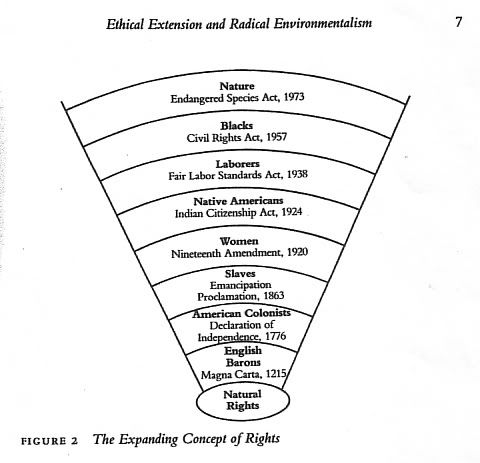
In a post entitled, "The Expanding Ethical Embrace" (March 2005), I expressed skepticism regarding Peter Joost's argument that humanity will adopt a moral code that grants other mammals, birds, reptiles, and even, eventually, bacteria, the same natural rights that we now reserve for ourselves (supposedly irrespective of race, sex, sexuality, or religion). I did not doubt the plausibility of Joost's prediction, but rather his assertion that this ethical evolution portended only happy returns. I wondered, if humans were to transcend the cruel machinations of biological determinism, wouldn't we, in effect, be killing ourselves with kindness? In Joost's neo-Eden, the human population would explode; the increased resource demands would inevitably lead to collapse (that is, if we didn't first find it in our reptilian spines to loathe "the other" as passionately as we have for time immemorial). Attractive though Joost's notion was, I remained ambivalent about the prospect.


Joost's prediction was recently called to mind when, reading Grist, an online environmental news journal, I stumbled upon a provocatively titled Gristmill thread initiated by Jason Scorse.  Many challenging questions are advanced in the dialogue generated by Scorse's "So, environmentalists support whaling?" Notable among them are:
- Is an environmentalist morally obligated to support animal rights?

- Are regulated, luxury hunts that fund conservation projects ethically or morally defensible?

- Are free enterprise and sustainable development mutually exclusive?

- Should the conservation and preservation camps be distinct from one another, promoting different agendas, or should they work together toward a compromised, common goal?
Scorse's answers to the above questions are 'Yes,' 'No,' 'Yes,' and 'Yes/No,' respectively. Yet any approximation of a complete answer to these questions requires some degree of ambiguity, and even contradiction.  Normally I find contradiction and ambivalence agreeable, because they edge closer to objective "truth" than any ideology might; in matters of environmental policy, however, the grey areas trouble me. Apparently, they trouble Scorse, too, as he jettisons nuance in favor of ideological certainty. Prompted to choose between ideology and reasonable pragmatism, I'm tempted to follow Scorse up the moral high road; the ideological path appears straight and true. But while moral certitude, the black hat/white hat conception of life and thought, is the path favored by activists and fundamentalists, I am made uncomfortable by it, particularly when it informs legislation.

Reasonable pragmatism, the preferred approach of post-Enlightenment thought, has its own problems, however. As Benjamin Franklin wrote of his vegetarian experiment(1), "so convenient a thing it is to be a reasonable creature, since it enables one to find or make a reason for everything one has a mind to do." Franklin's observation at once celebrates and skewers reason, revealing it to be a wholly relative enterprise. This chink in reason's armor is worrisome.

So what will it be? Are the complications and sacrifices of reasoned compromise better or more effective than ideology? Or do we have clearly defined "good guys" and "bad guys"?

Craig Nelson's recent biography of Thomas Paine serves as my subway reading these days, and I find the following observation relevant.
"Beginning with Franklin and Washington, every successful American leader would balance the pragmatic with the Utopian.  Where Franklin the master politician would be almost entirely pragmatic, Paine would be too fervidly Utopian in ways that would not just damage him financially, but imperil him physically... Paine would...always be too ardent with his religion of the lights, a Savonarola of reason and liberty, and as inept a political operator as any fervid Christian saint...The success or failure of any leader in U.S. history can be judged through his of her successes or failures at reaching the pragmatic Utopian paradox that remains at the heart of the American experiment."
Nelson's words ring true.  "The pragmatic Utopian paradox" is not uniquely American, but it is central to the American experience.  For confirmation, we need look no further than the glut of contemporary, progressive American politicians striving to develop a decidedly centrist track record, even as they contradict themselves (and their conscience) in doing so.  By contrast, it's easy to discard compromise and contradiction if you are a committed revolutionary, an individual willing to die for your cause, or a monkish loner operating in an intellectual/philosophical vacuum, as did Theodore Kaczynski.  Outside the D.C. beltway, ideologues are a dime a dozen, but exceptionally gifted ideological rhetoricians like Paine or King, Jr. make a sociopolitical impact only rarely.

Not surprisingly, many environmental activists are ideologues, Jason Scorse included.  To be fair, Scorse, a professor of environmental economics at the Monterey Institute, is not so much making a stump speech as he is asking a provocative question. From his "So, environmentalists support whaling?" post:
"I have tried to make what is essentially a straightforward case that environmentalism at its core is about respecting life and that separating this from our behavior towards individual living beings doesn't make much sense. Since many environmentalists reject this notion and insist that environmentalism only includes preserving biodiversity and promoting resource sustainability, this suggests that one of the defining elements of environmentalism no longer holds: an opposition to whaling...So are those who argue for the minimalist view of environmentalism willing to go on record in support of whaling and the killing of other advanced mammals?"
Money can do a lot in the way of protecting individual species and imperiled ecosystems.  Regulated hunting operations and animal farms, worldwide, generate substantial revenue, a healthy percentage of which is used to fund conservation measures.  For example, a buyer pays a tiger rancher (yes, they exist) an impressive sum - $40,000, say, sometimes much more - to obtain tiger parts for use in traditional Chinese medicines.  A substantial percentage of that price is then used for habitat preservation, conservation education, and tiger breeding programs.  It's a simple ethical equation; one animal's death results in improved species survival rates in the long-term (assuming that the habitat can be protected from the trespasses of our burgeoning human population). My short answer to Scorse's question, then, is 'Yes.' The more complete and complicated answer, though, leads down a rabbit hole of uncertainty.

To begin with, I find Scorse's moral framework - do unto your neighboring species as you would have done unto yourself - fundamentally agreeable. I'm troubled by the scalae naturae and other moral or physiological hierarchies. Because human life is, in my estimation, no more or less valuable than that of an earthworm (and, lest you mistake that statement for hyperbole, my inner ideologue assures you otherwise), the farming and killing of a tiger, no matter the result, is immoral. So, too, is the farming and killing for food of any animal species. In a truly enlightened world, then, we would witness a continued shift toward vegetarianism, sustainable consumption, and the extension of natural rights to other species. But the rate at which such values are adopted is of critical importance, and I feel Scorse is not at all pragmatic in his consideration of the real-world application of his moral imperative.  I fretted about this in the earlier post:
"From a strictly pragmatic perspective, morality is a denial of our existential [and by this I meant all species, not just human] sameness; like all other species, our principal drive is one of survival and propagation. Even our human urge to classify, as seen in the periodic table, clothing labels, and taxonomy, is a violent instinct, evolved to make us better able to ward off 'the other' and to flourish as hunter-gatherers, a lifestyle no longer suitable for our global, industrial species. [Therefore], it could be argued that [the] extension of human rights to all races, cultures, and creeds was but one more victory in our campaign to deny human nature.

But an inclusive, caring society, even if inconsistent, results in a population explosion and exaggerated life expectancies. Moreover, as our species’ requirements are increased, so are our demands on the environment. By embracing one another, we in fact make it more difficult for future generations to survive. When even more populations (in this case, other species) enter our moral and ethical peripheral vision, we will find ourselves facing a very interesting philosophical and pragmatic dilemma. Are we overloading of the circuitry?"
It seems clear that we would be "overloading of the circuitry," but there is a more immediate concern, one that does not bode well for Joost's expanding ethics: we have proven incompetent in our attempts to achieve parity among humans.

In the course of the Gristmill conversation, Scorse writes, "Thank goodness...humans aren't treated with the same level of abstract notions about 'sustainability' that you advocate that we subject every other living thing to."  Oh, but how we are! One need look no further than the morass of muddled litigation generated by today's vitriolic debates over abortion, civil rights, or assisted suicide to comprehend just how reluctant we are to treat fellow humans with the respect we reserve for ourselves and for our loved ones. As I wrote in March 2005, "one can barely imagine the ensuing cacophony when considering similar issues for sharks, birds, and turtles."

Ever since Homo sapiens adopted an agrarian lifestyle, we've been a top-down animal, a pyramid ladder of the very few haves and the countless have-nots.  I'm not altogether opposed to the felling of this pyramid in the name of populism and moral ideology (although, let's not kid ourselves punkers, anarchy ain't Utopia), but when similar tinkering and protest is extended to Nature, an entity of which we, as a species and complex-compound social beast, are but an insignificant part, we're not only risking collapse on a Mayan or Roman scale.  We're also gambling with the fate of the human species at large and, importantly, that of the many hundreds of thousands of species inextricably attached to us.  Those who herald the imminent expansion of our ethical embrace would do well to think on this.


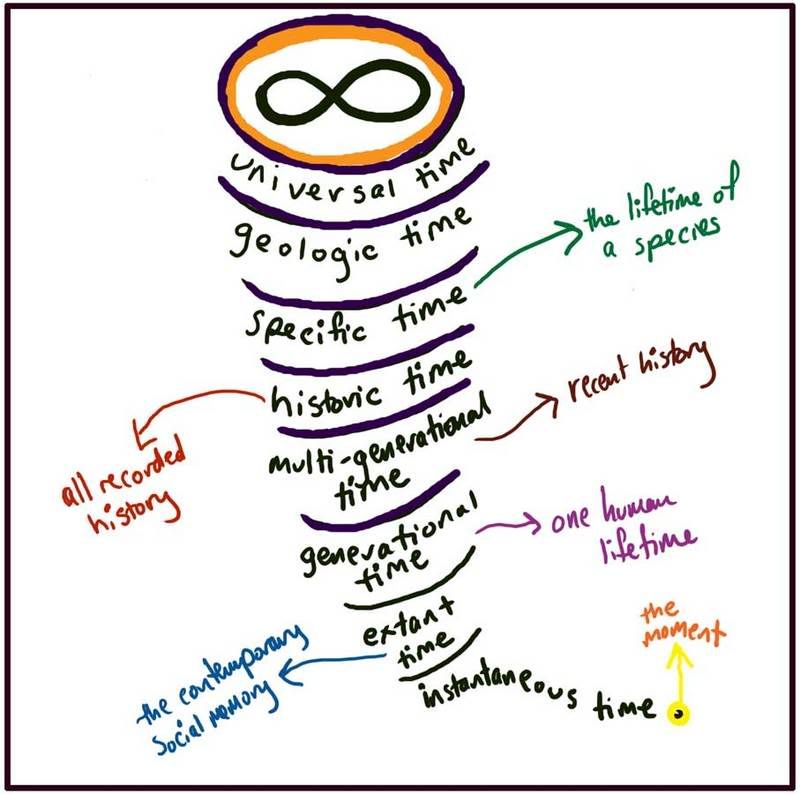
The natural algebra can not evolve apace with our ethical code. Believing this to be true, I suppose I'm something of a determinist. I don't doubt that Earth's carrying capacity will increase as we adopt more sustainable lifestyles, but such a change occurs in geologic time, not generational or historic time. E.O. Wilson, the celebrated Harvard entomologist, makes a similar, if distinct case in his landmark book, On Human Nature.
"Can the cultural evolution of higher ethical values gain a direction and momentum of its own and completely replace genetic evolution? I think not. The genes hold culture on a leash. The leash is very long, but inevitably values will be constrained in accordance with their effects on the human gene pool. The brain is a product of evolution. Human behavior - like the deepest capacities for emotional response which drive and guide it - is the circuitous technique by which human genetic material has been and will be kept intact. Morality has no other demonstrable ultimate function."
I'm inclined to agree...to a point. But what hand really holds the leash? Wilson assigns control to genes, our evolutionary chaperones. Genetics is indeed powerful, but the brain is as much a product of cultural evolution as it is physiological evolution. Therefore, I believe nurture can outpace nature at the societal level. In other words, genes have less control over moral and ethical evolution than Wilson would have us accept. In fact, it is the "eco," the greater whole - the Everything and the No-thing, from which we are inseparable - that grasps the leash. I trend toward the mystical here, but the skeptical scientists in the room can call this leashing by holistic natural law (as opposed to Wilson's evolutionary imperative).


Despite my attraction to the moralistic, and my belief that our ethical purview will inevitably expand, I must conclude that is necessary to distinguish between long-term aspiration and present policy. The American Civil Rights Movement may be portrayed as a historical artifact in high school text books, but racial prejudice and bigotry are no more history than is the Cold War. Our aims are ahead of our practice, and we should take care not to neglect incomplete cultural "mutations." Today being the anniversary of his death, take another listen to John Lennon's "Imagine." The words and images of artists are vital. Without them, our shared cultural imagination (or our memes) would be starved, but we shouldn't ride the moral high horse if it means we won't reach our destination. This is the critical distinction between morality and ethics.

Progress - if loosely defined as our stumbling effort toward the betterment of humanity and the world we belong to - is best served by pragmatic rationalism and a conservative code of ethics. As my father stressed to me from a young age, good economics - literally translated, "management of the household" - begins with good ecology - "study of the household." A promising future awaits humanity if we are imaginative enough to forge our ethics from the moral, the aesthetic, the ecological, and the pragmatic.

Turning to Bill Cronon's writing, as I so often do, and did when considering these ideas before:
"The choice we face is not to leave no marks – that is impossible – but rather to decide what kinds of marks we wish to leave."
So to Jason Scorse, and all ideologues: my heart is with you, but things simply aren't so clear as might like them to be.

Image credits: Ahab illustration by Sam Weber; ethics diagrams from Peter Joost's March 2005 New York Historical Society lecture; timeline diagram by Hungry Hyaena

(1) Franklin abandoned the diet eventually, as the smell of cooked seafoods, particularly fish, proved too much for his dietary resolve. No problem, though, as he was able to use reason to account for why fish were a viable exception!