Showing posts with label Thomas Jefferson. Show all posts

Wednesday, September 16, 2009

Kimmel Harding Nelson Residency: Day 10


Jefferson Sculpture
Lewis & Clark Visitors Center; Nebraska City

Naturalists, Puritans, and New Territories
"I think our governments will remain virtuous for many centuries; as long as there shall be vacant lands in any part of America. When they get piled upon one another in large cities, as in Europe, they will become corrupt."

- Thomas Jefferson, 1787
The American polymath Thomas Jefferson ranks highly in my pantheon of heroes. Yeoman farmer, architect, inventor, philosopher, naturalist, Virginia gentleman, and statesman, Jefferson defies easy classification. His political pragmatism and philosophy reflect his broad excavations, and the complex of sometimes contradictory ideas that Jefferson put down over the course of his long life allows his legacy to be fairly claimed by contemporary pundits of every stripe. His name and statements are marshaled to support causes across the political spectrum, including state's rights, internationalism, provincialism, gun control, the right to bear arms, unregulated capitalism, anarchy, secularism, and even the call for the United States to be officially deemed "a Christian nation." It is not, however, Jefferson's nuanced political philosophy that is responsible for his cultural ebb; he was a slave-owner and a patriarchal figure who decried "intellectual women." By today's standards, he was a deeply flawed man. But Jefferson died 183 years ago. It is wrongheaded to dismiss the whole of the man for latter-day sins. In any case, his accomplishments and legacy are profound.

Jefferson was irredeemably curious and hopeful. The man's hunger for knowledge and his faith that the human lot can forever be improved upon vitalize the Jeffersonian heritage. The Enlightenment-inspired, exuberant optimism of Benjamin Franklin, Joseph Priestley, Thomas Jefferson, and others in their mold watered the soil of American social, political, and technological revolution. And, as I wrote two days ago, "it's a happy wonder to contemplate [...] the maturation and proliferation of human technology." But at what price did so much "happy" change come?


Mandan Fort recreation
Lewis & Clark Visitors Center; Nebraska City

President Jefferson, in March of 1803, commissioned Captain Meriwether Lewis to lead the Corps of Discovery with William Clark. Jefferson obtained federal funding for the expedition on the grounds that, if successful, Lewis and Clark might "offer the most direct and practicable water communication across [the] continent for the purposes of commerce," but the president's principal interests were other. He wrote to Lewis,
"The object of your mission is to explore the Missouri River. [...] Objects worthy of notice will be the soil & face of the country, it's growth & vegetable productions, especially those not of the U.S.; the animals of the country generally, & especially those not known in the U.S., the remains or accounts of any which may be deemed rare or extinct; the mineral productions of every kind; but more particularly metals, limestone, pit coal, & saltpetre; salines & mineral waters, noting the temperature of the last, & such circumstances as may indicate their character; volcanic appearances; climate, as characterized by the thermometer, by the proportion of rainy, cloudy, & clear days, by lightening, hail, snow, ice, by the access & recess of frost, by the winds prevailing at different seasons, the dates at which particular plants put forth or lose their flower, or leaf, times of appearance of particular birds, reptiles or insects."
Historians suggest that the excitement Jefferson felt on the eve of this great expedition was quite real. His impetus was curiosity, not Puritan conquest.


Mt. Zion African Methodist Church yard
Mayhew Historic Village; Nebraska City

The Pilgrim settlers of this country had little curiosity about the natural history or native peoples of their "New World." William Bradford, five-time governor of Plymouth Colony from 1621 - 1657, described (what little he knew of) the North American continent as "a hideous and desolate wilderness." Jefferson, by contrast, wrote that "there is not a sprig of grass that shoots uninteresting to me." He saw the natural world as an Eden to be studied and, as author Erik Reece describes it, as "an antidote to the deadening forces" of civilization. For Jefferson, the notion of "God and country" was shaped by topography and the human place in it.

But Lewis and Clark's great voyage of discovery didn't simply educate Americans living east of the Appalachian spine about the continent's interior and western Edens. It paved the way for mass migration, mass slaughter, and mass industry. What happened on this vast continent parallels the greater history of mankind and, indeed, of all life.


Bison diorama
Lewis & Clark Visitors Center; Nebraska City

Historian Daniel Boorstin wrote in 1953 that, "the genius of American democracy comes not from any special virtue of the American people but from the unprecedented opportunities of this continent." Similarly, the remarkable evolution of the human ape, from tree-dweller, to hunter-gatherer, to agriculturist, to civilized man, comes from no special virtue of our species, but from the unprecedented opportunities of this Earth. One thing, as it were, led to another, and our species proved able and willing to exploit to the fullest extent. Loren Eiseley writes, in The Immense Journey,
"The stolen energy that would take man across the continents [as a hunter-gatherer] would fail him at last. The great Ice Age herds were destined to vanish. When they did so, another hand like the hand that grasped the stone by the river long ago would pluck a handful of grass seed and hold it contemplatively. In that moment, the golden towers of man, his swarming millions, his turning wheels, the vast learning of his packed libraries, would glimmer dimly there in the ancestor of wheat, a few seeds held in a muddy hand."
So it was with North America. The "meteoric, messy, and astonishing history" of the United States was fueled, above all, by a distinctly un-Jeffersonian conquest of the land's native peoples, animals, and resources.

Near the end of his sweeping ecological history of North America, The Eternal Frontier, Tim Flannery writes,
"During the nineteenth century, [...] the European Americans were developing a new economy. It was an economy based on systems of mass production and mass exploitation that needed enormous resources to operate. The key decade was 1880-90, for only then did European machinery become sophisticated enough to destroy the great herding and flocking species [the passenger pigeon, the American bison, and the Eskimo curlew]. Their enormous numbers provided an ideal teething rusk for an economic machine that would soon produce cars in the millions and hamburgers in the billions."
We devoured the continent.


Fake Prarie Dog burrows and mural
Lewis & Clark Visitors Center; Nebraska City

What allowed for this? What became of the Enlightened foresight of the founding minds? How did we move, in one hundred years, from Thomas Jefferson to Henry Ford? And could we have made such astounding, "happy" progress in human rights, suffrage, and science without surrendering to this demonic appetite? There is no tidy answer to these questions and, in any case, it's irresponsible to wade in what-might-have-been when you can instead strive toward what-yet-could-be. Still, the history perplexes.

Jefferson bemoaned the Christian scriptures' inclusion of miracles and the emphasis, in Christian doctrine, on the afterlife. Erik Reece explains in An American Gospel that Jefferson realized,
"the more Christian fundamentalism emphasizes that the kingdom of God awaits as a reward in the afterlife, the more it ignores [...] Jesus' teachings of how we should act while we inhabit this earthly realm. [...] The relevance of Christianity to most Americans has far more to do with the promise of eternal salvation from this world."
Jefferson's famous and sensible solution was to edit the Christian New Testament, deleting any and all miracles, including the Virgin Birth and the Resurrection. He called the result "The Life and Morals of Jesus of Nazareth." Today, the book is best known as "The Jefferson Bible." Perhaps, if more good Christians had followed their incarnate God's example and teachings in this life - the one that actually matters! - the west would have been settled in accord with the land. Unfortunately, most in our "Christian nation" don't know of Jefferson's earnest effort to save Christianity from other-worldly supernaturalism, from, as he called Puritanical ministers, "the soothsayers and necromancers."

Neither do most Americans know of Jefferson's effort to temper our faith in industrialism. Jefferson's agrarian dream for America was impossible; the United States was then and is now a burgeoning country, and true pastoralism can only ever be embraced on a small scale. But we would do well to remember Jefferson's vision, to remember that we are part of a greater system, and that the expiration date for America's frontier mentality, its faith in boldly going and exploiting, is past.

Despite our exceptionalist tendencies, our nation is like any other. Every nation is a tiny part of the greater superorganism, and every nation's story is a life cycle. The sprawling, arrogant United States is no longer an adolescent, and it can't afford to continue acting like one, to continue "lighting out for the territories." If we fail to mature, our reckless faith in what lies over the next mountain, in the future and in the afterlife, will prove our nation's undoing. It is faith in what exists here and now, in the place where we stand, that needs resurrection.


Missouri River Overlook
Lewis & Clark Visitors Center; Nebraska City

Most Americans are estranged from their own nature, as well as from the nature all around them. Reece writes,
"[We are estranged from] the sources of our food, the sources of our clothes, and the sources of the energy that run our homes. Beyond these basic needs, money and corporate influence have estranged us from our own government. Our isolation within suburban homes has estranged us from our neighbors and communities. [...] Cars have estranged us from our own bodies. [...] Our modern condition of estrangement has led us to live in ways that show a remarkable abdication of responsibility."
Reece proposes that Aldo Leopold's philosophy "carries us back into an ethic of responsibility." I agree.

Leopold, the godfather of modern conservation, inherited Jefferson's dream. Like Jefferson, he was a Romantic pragmatist, a type as well-suited to diplomacy as to conservation. Leopold acknowledged that resource use, like the economy, can be regulated thoughtfully, but the Romantic in Leopold was dismayed by the dark side of our equating land with money. He wrote,
"I suspect that the forces inherent in...economic evolution are not all beneficent. Like the forces inside our own bodies, they may become malignant, pathogenic. I believe that many of the economic forces inside the modern body-politic are pathogenic in respect to harmony with land."
He deemed his heroically optimistic response to the increasing pressures of population and market a "land ethic." Despite the difficulties of cultivating such an appreciation of the natural world in the twentieth century, Leopold persisted.
"That land is a community is the basic concept of ecology, but that land is to be loved and respected is an extension of ethics. [...] A land ethic, then, reflects the existence of an ecological conscience, and this in turn reflects a conviction of individual responsibility for the health of land. [...] We can be ethical only in relation to something we can see, feel, understand, love, or otherwise have faith in."
The American estrangement from land and from the rest of nature (including the dark, interior wilderness of the psyche) is redressed through cultivation of a land ethic. And, in so far as I am "happy" to contemplate the incredible rate of technological evolution, I am made happier still by the prospect of a mature, tempered America.


Vacant lot on Central Avenue; Nebraska City

This morning, I sat for a while and talked with an older gentleman in Long Home Coffee Shop, on Nebraska City's Central Avenue. A retired physicist, he expressed concern about the future of America and, more generally, of the human species. "It's all terribly depressing," he observed. "I have my good days and my bad," I concurred. "But the bleak pessimism is more rare than it was, just because it's unproductive." He nodded, and his heavy eyes seemed to say both, 'Thank goodness for the optimism of youth!' and 'Bloody damned fool!'

But I'm not a fool, and neither is he. An hour after we talked, as I sat at a table scribbling the notes that became this essay, he attended, in the back room of the coffee shop, a meeting regarding the construction of a community garden at the west end of town. The city has provided the group with a vacant lot, a local corporation will provide the initial revenue for construction, and the garden will be tended and managed by volunteers, providing food for those in need.

Now that, I contend, is positively Jeffersonian!

Photo credits: all photos, Hungry Hyaena, 2009

Sunday, May 17, 2009

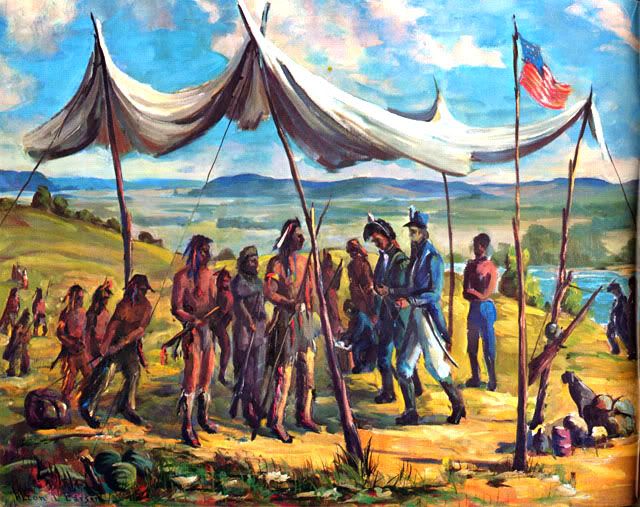
A Hermetically Sealed Worldview?


Alton L. Larsen
"Lewis and Clark"
Oil on canvas


I'm thrilled to announce that I've been accepted to the Kimmel Harding Nelson Center Artist Residency in Nebraska City, Nebraska. During the two week, September term, I plan to explore Nebraska City and the surrounding land with an eye toward the region's natural history, focusing particularly on the Lewis and Clark Expedition and the legacy of 19th century westward expansion. Most of my time will be spent outdoors, biking and walking around the town's trails, parks and historical sites. In the evenings, I'll use the provided studio space to conduct research, work on painting studies and drawings, and write essays relevant to the residency. (The essays will be posted here.)

I'm very much looking forward to my time in Nebraska, just as I'm eagerly anticipating an upcoming week of birding, herping and bumming about in Florida with two friends. My usually vigorous city disposition has withered in recent weeks, and I long for time in the woods, marshes or mountains. Saturday afternoon, taking a break from helping my girlfriend move some of her belongings, I sat on a stoop, attuned my breathing and appreciated the pompous sidewalk display of a pigeon courtier. A few minutes later, I trembled with a renewed sense of well-being as a curiously bronze House sparrow contemplated me (contemplating it).

These simple encounters with urban wildlife are a joy. I'm grateful for them. This week, however, the sparrows, pigeons, squirrels, starlings and gulls have only whet my appetite for time away from urban and suburban environs.

My sense of urban exile was exacerbated this afternoon, when I listened to a podcast of "The Thomas Jefferson Hour." Historian and Jefferson impersonator Clay Jenkinson described contemporary man's changing relationship to Nature.
"I've been flying over North Dakota lately and North Dakota is just one tiny little place at the top of the continent, but [...] between the Mississippi River and the west coast there is still a gigantic amount of unspoiled land. [...] It's still a pretty light industrial footprint. [...] Of course, you can see human presence there: power lines, contrails from airplanes, mines, vanity houses, ridgeline developments. [...] But [...] there is still a large amount of America [...] in which there are literally hundreds of national and state parks and national monuments and national forests and wildlife refuges which are permanently protected against gross economic, extractive development. [...] We have an enormous amount of Nature which has been designated, officially, by the will of the American people to be off-limits to certain types of activities. [...] I feel that that moment - which begins really with Yellowstone in 1872, but got it's big push from Theodore Roosevelt - that moment kind of culminated around 1975 or 1980 and, since then, there's been a kind of pulling back of national commitment to these issues.

And now there's a generation of people who are growing up with no particular interest in this. They're detached from it. They're a little bored with Nature. They don't want to go camping; they don't even want to go hiking. They only want to be on their iPod and their [...] computer, the Internet, and Facebook, and Twitter. [...] That's their mediation. That's how they see the world, [...] and they're bored with sitting around that campfire. [...] So as this happens, as we move into [...] this incredibly electronically mediated, post-literate, post-natural world, it's frightening to people that still believe that that was the glory of America.

I'm one of them! I believe that the national park system is America's greatest contribution to the world, or at least it's one of the top handful of contributions we've made. [...] The point I'm trying to make is, if the population [of the United States] is 330 million, there are about 300 million who don't care one iota for this, and they're very, very happy to eat their chicken in a hermetically sealed container and not know the first thing about where their lights come from and not care how the natural world works."
I wish that I could claim urbane sophistication, thereby dismissing Jenkinson's melancholy perspective as misguided nostalgia. But I can not. Even though I proclaim a long view optimism (and therefore acknowledge the absurdity of wishing for what once was), I feel that the ignorance of most First World citizens of the natural world is unpardonable. It is an insult not only to my naturalist's sensibility, but also to the philosophical, biological and cultural ground on which thoughtful humans stand (and build).

Despite my fondness for cosmopolitan politics and culture, in at least this respect, I sympathize with Thomas Jefferson's belief that cities are "pestilential to the morals, the health and the liberties of man." By further insulating us from our animal antecedence and the brute realities of Nature, cities slowly erode our practical call to stewardship.

Shortly after Jenkinson's podcast ended, a familiar voice interrupted my painting. I wasn't sure that I'd heard rightly over my headphones, so I peered out of the studio window for confirmation. Sure enough, a mourning dove was perched on the fire escape above me. Periodically, it uttered a nesting call, an abridged version of the plaintive call that many Americans are familiar with (whether or not they can identify the species responsible). I could see no mate or nest, but I'm delighted to learn of this new neighbor.

Unfortunately, this week's creeping cynicism makes me doubt if my human neighbors notice the birds. I hope that this brooding will soon pass. Pessimism does no one good.

Photo credit: image ripped from Blair Congregational Church United Church of Christ website

Friday, April 24, 2009

Of ideologues and pragmatists


Thomas Paine and Thomas Jefferson


A few months after the inauguration of President Barack Obama, many one-time "Yes we can" cheerleaders are grumbling and casting skeptical glances at Washington. Indeed, I've been disappointed by some of our new president's decisions, but I also accept his maneuvering as an unfortunate political reality.

Unlike his predecessor, Barack Obama realizes that the President of the United States should not operate as an ideologue. Of course, he (and some election year soon, she) could choose to embrace ideology over pragmatism but, in doing so, the Commander-in-Chief risks aligning himself with the sort of tyrannical autocracy that our leaders rhetorically (and routinely) condemn.

But political reality doesn't temper the poor reviews that Obama receives from many on the political left. Considering their critique of Obama's centrism, I recalled an earlier HH post. In "The Whiteness of the Whale," I wrote:
"Craig Nelson's recent biography of Thomas Paine serves as my subway reading these days, [and] I find the following observation relevant.
'Beginning with Franklin and Washington, every successful American leader would balance the pragmatic with the Utopian. Where Franklin the master politician would be almost entirely pragmatic, Paine would be too fervidly Utopian in ways that would not just damage him financially, but imperil him physically... Paine would...always be too ardent with his religion of the lights, a Savonarola of reason and liberty, and as inept a political operator as any fervid Christian saint...The success or failure of any leader in U.S. history can be judged through his or her successes or failures at reaching the pragmatic Utopian paradox that remains at the heart of the American experiment.'
Nelson's words ring true. 'The pragmatic Utopian paradox' is not uniquely American, but it is central to our American experience. For confirmation, we need look no further than the glut of contemporary, progressive American politicians striving to develop a decidedly centrist track record, even if they contradict themselves (and their conscience) in doing so. By contrast, it's easy to discard compromise and contradiction if you are a committed revolutionary or a monkish loner operating in an intellectual and philosophical vacuum."
Barack Obama qualifies as one of the "contemporary, progressive American politicians" I criticize in that excerpt. Yet, as I suggest in the same post, "outside the D.C. beltway, ideologues are a dime a dozen, but exceptionally gifted rhetoricians like Paine or King, Jr. emerge (and make [a legitimate political] impact) only rarely."

Yet even if the political impact of fringe ideology is negligible, those voices must be heard. Indeed, unpopular opinions are sometimes the most vital in a just democracy. There's a reason, after all, that liberals wring their hands when contemplating the censorship of bigoted hate speech. If you believe in the democratic fray, you're obligated to let all of society's individuals speak.

In a recent episode of the "The Thomas Jefferson Hour," historian and Jefferson impersonator Clay Jenkinson read and responded to the following Paine quotation.
'He that would make his own liberty secure, must guard even his enemy from oppression; for if he violates this duty, he establishes a precedent that will reach to himself.'
"This is how Paine would react to the Bush Administration for the past seven-and-a-half years. This is an answer to the Patriot Act, to the surveillances, to Guantanamo, to Abu Ghraib!"
Jenkinson's right. In fact, a great many of Paine's sentiments are as pertinent today as they were in the late 18th century, his abolitionist and proto-feminist writing especially so.

He may have made many political enemies in his day but, two hundred years after the turmoil of our nation's early ideological disputes, Thomas Paine's unwavering moralism aligns more closely with contemporary progressive attitudes than does Thomas Jefferson's political pragmatism. Compared to the public attitudes of the slave-owning and patriarchal Jefferson, Paine strikes the 21st century citizen as the more modern thinker and the more conscientious man.

Does it matter that Jefferson, in his private correspondence, agreed with Paine's abolitionist argument? From our vantage point (one of comfortable remove), no, it doesn't. What we consider, above all, is that Jefferson was a slave owner and that Paine was an outspoken abolitionist. 'Deeds, not creeds,' as the saying goes. But it's noteworthy that Paine was poor and unlanded, and therefore never in a position to own slaves. (Indeed, Paine was never in a position to give up slavery, power, or riches; essentially, his social standing cloistered him from temptation.) Nor was Paine a political figure; he could be strident because he didn't have to consider popular opinion or the practical effect of enacting reform.

Writing in his philosophical memoir An American Gospel: On Family, History, and the Kingdom of God, Erik Reece succinctly describes the democratic ideal to which I subscribe.
"Like [Walt] Whitman, John Dewey thought of the ideal American democracy as an 'organism,' a whole that is reflected in each of its parts - that is to say, in each individual citizen. ...As cells work together within an organism, Dewey believed individuals worked together within a good society to achieve 'a unity of will.' ...And because democracy is a social idea, it is also ethical by its very nature. Ethics, after all, begins with the realization that one is a social being and therefore part of a larger whole. A man living alone on an island requires no ethic. An aristocracy or a dictatorship could be run by only a few of its members. But the democratic organism needs all of its cells. And those cells must act simultaneously in their own interest and in the interest of the larger organism."
But Dewey was a pragmatist. Surely he realized that the democratic organism's ability to fight off infection of the malignant variety is not nuanced; the democratic immune system, if you will, acts to extinguish all radical cells. In other words, this organism is just as likely to rise up against outspoken abolitionists as it is against outspoken racists. And, indeed, history stands as a testament to this action.

Thomas Paine found an American and French populace eager to absorb his revolutionary and populist manifestos Common Sense and Rights of Man, but he was eventually ruined by his rational dismissal of Christian doctrine, The Age of Reason. His New York Citizen obituary read, "He had lived long, did some good and much harm." Much harm? Paine's progressive opinions about slavery and feminism didn't win him sustained popularity.

Jefferson, too, was a lightening rod in his day, provoking as much disdain as he did praise (especially from the Federalists and, in particular, Alexander Hamilton). But Jefferson was a savvy political operator, a master of Nelson's pragmatic Utopian paradox. Although he shared many of Paine's opinions, Jefferson did not draft legislation addressing those issues or even, because of his deism, allow his private correspondence to be made publicly available in his lifetime. Our third president carefully considered what the demos were and weren't ready to accept. Paine, the ideologue, simply didn't care.

So what will it be? Should an independent, liberal leaning citizen like myself wish for a revolutionary president, a Paine-like Obama less concerned with centrist politics, an Obama driven by moral conviction? Can I believe that such a president's radical agenda won't be consumed by the fires of reaction?

For my part, I trust that Obama is striving to foment as much progress as he safely can in our flawed, anti-intellectual democracy. I express my few disappointments by signing petitions for ads calling on Obama to address some of what I see as missteps but, above all, I'm proud of our country for electing an intelligent, disciplined and thoughtful man to the nation's highest office...and I remain optimistic.

Image credits: Thomas Paine portrait ripped from American History Guide and Thomas Jefferson portrait ripped from The World Union of Deists

Saturday, November 22, 2008

Eric Beltz and "The Good Land"


Eric Beltz
"By this Axe I Rule"
2008
Graphite on Bristol
27 1/2 x 23 inches


"All conservation of wildness is self-defeating, for to cherish we must see and fondle, and when enough have seen and fondled, there is no wilderness left to cherish."
-Aldo Leopold


The exquisitely rendered graphite drawings included in "The Good Land," Eric Beltz's recent exhibition at Morgan Lehman Gallery, are sophisticated responses to our American folkways and myths. As darkly funny as they are disarmingly earnest, the graphic works are both exhortations and critiques of our nation's inborn exceptionalism and romanticism.

Of particular interest to Beltz is our American relationship to landscape. In "By This Axe I Rule," a contemplative outdoorsman sits on a tree stump, ax in hand. The bodies of a white-tailed deer, a moose, an opossum, a raccoon and other animals are partially concealed by snow drifts at his feet; a turkey vulture is perched above, wings spread. The man bears a striking resemblance to renowned ecologist Aldo Leopold. The likeness may be coincidental, but is nonetheless pertinent. 2008 is the 60th anniversary of Leopold's death. Like Henry David Thoreau and John Muir, Leopold is a lodestar for many contemporary environmentalists. His "A Sand County Almanac," published posthumously in 1949, remains a critical conservation text.

Unlike Rachel Carson's "Silent Spring," the 1962 bestseller that catalyzed the modern environmental movement, Leopold's "Almanac" is not a call for corporate and federal responsibility. Although Leopold would surely support such measures, his book is principally concerned with our reforging an intimate connection to the landscape we inhabit. "We can be ethical only in relation to something we can see, feel, understand, love, or otherwise have faith in," he wrote.

It's noteworthy that Leopold's faith is not of the starry-eyed variety; his "land ethic" includes hunting, controlled burns, and other practices typically condemned by preservationists. Contrary to the romantic conception of wilderness, Leopold's ethic acknowledges that the tools invented by humans (the saws, shovels, axes, picks, and pitchforks that figure prominently in Beltz's drawings) are not simply cruel agents of mastery. Humans are animals and, as such, we are not apart, but rather a part of a complicated, messy ecology. No matter how we manipulate our environment, dominion remains a comforting delusion.

Yet most of us do not conceive of Nature in this way. Just as we distinguish between the self and the group, so too do we draw a hard-line distinction between humanity and the “natural world.” William Cronon, a respected, if controversial environmental historian, argues that we must alienate ourselves from Nature before it can be understood as something pristine, virgin, or more wild than ourselves. In his celebrated 1983 book, “Changes in the Land”, Cronon reveals the quixotic quality of preservationist impulse.
"If the nature of Concord [Massachusetts] in the 1850s - a nature which many Americans now romanticize as the idyllic world of Thoreau's own Walden - was as 'maimed' and 'imperfect' as he said, what are we to make of the wholeness and perfection which he thought preceded it? It is tempting to believe that when the Europeans arrived in the New World they confronted Virgin Land, the Forest Primeval, a wilderness which had existed for eons uninfluenced by human hands. Nothing could be further from the truth....the land was less virgin than it was widowed. Indians had lived on the continent for thousands of years, and had to a significant extent modified the environment to their purposes…The choice is not between two landscapes, one with and one without a human influence; it is between two human ways of living, two ways of belonging to an ecosystem."
The preservationists' dualistic attitude (i.e., Humanity vs. Nature) provides only simple answers to our complex questions. By contrast, Beltz’s allegorical drawings shirk simplistic moralizing in favor of contradiction, ambivalence and multiplicity. His scenes speak to an active communion with Nature, albeit one that includes suffering, death and a melancholy nod to the essential absurdity of existence. By turns, Beltz eulogizes, champions and satirizes Thoreau's self-sufficiency and Andrew Wyeth's rural romanticism.


Eric Beltz
"Hysteria"
2008
Graphite on paper
17 x 13 3/4 inches


Beltz critiques America's religious and economic landscape, as well. Four of his drawings comprise a series entitled “Back to Eden.” In each, a headless body clothed in overalls, workman boots ,and a shirt with rolled up sleeves – the uniform of the outdoorsman-farmer - is slumped in or alongside a pile of cut logs and other vegetation. Above each of these tableaus, Beltz has written one word, in cursive: Asthma; Hysteria; Cancer; Delirium.

Considering the series, I recall Adam Smith’s ignored admonition concerning the dangers of loosely regulated capitalism. Smith, the 18th century Scottish philosopher best known for his influential treatise "The Wealth of Nations," is canonized by contemporary capitalists for laying down the principals of free market economics, but he entertained doubts about and acknowledged the shadows cast by such a system.

"Power and riches," Smith wrote, "are immense fabrics, which it requires the labor of a life to raise, which threaten every moment to overwhelm the person that dwells in them, and which, while they stand, can protect him from none of the severer inclemencies of the season. They keep off the summer shower, not the winter storm, but leave him always as much and sometimes more exposed than before to anxiety, to fear and to sorrow, to diseases, to danger and to death." Smith’s misgivings were warranted. Contemporary life is rife with social ailments and, in combination with our alienation from Nature, secular capitalism is a principal causative factor.

Curiously, free market capitalism is close kin to Manifest Destiny, the divine doctrine of conquest and consumption. Capitalism is exported with no less zeal than our cruel spread west from the colonies. Harriet Beecher Stowe, the 19th century novelist best remembered as an outspoken proponent of abolition, wrote that America is "a nation specifically raised up by God to advance a cause of liberty and religion." She did not say “liberty of religion.” America was founded by Protestant fundamentalists fleeing religious persecution in Europe. Arriving on these contested shores, they took names like Ezekiel, Jacob, and Issac, and likened their journey to the Jewish Exodus from Egypt. These religious settlers are the forebears of a great many contemporary Americans.

Appropriately, Beltz’s drawings incorporate Biblical texts and his subjects are recognizable as America's founding fathers and God-fearing, anonymous farmers. But Beltz draws from a peculiarly American well, the proverbial melting pot. Each drawing is suffused with currents of Eastern philosophy and shamanism. His farmers and historical figures are also mystics. American philosophy is more plural than we care to admit, and Beltz's admixture of East and West, allegory and history, supernatural and natural is a fair reckoning. (American transcendentalism, for example, the philosophy so vital to Thoreau and Ralph Waldo Emerson, was a hybrid of Protestant Unitarianism, Romanticism, Hinduism, and European intellectualism.)


Eric Beltz
"Tree of the Evil Eagle"
2008
Graphite on paper
40 x 30 inches


Still, the Bible is the first book of the United States, and many Americans regard the Constitution and founding fathers with astonishing reverence (to the extent that, in some circles, the former is sacrosanct). But documents and philosophies are of a particular time. Guarded by strict interpreters, the Constitution of the United States can become as regressively dogmatic as any primary religious text. Without thoughtful interpretation of Constitutional scripture, the significance and relevance of the founding fathers' enterprise will wane.

But most Americans (politicians and citizens alike) are in the business of denying the inevitable, be it the death of a loved one, an unregulated economy, or an ideology. Rather than confront our heavy history (and with it our future), the United States cloaks itself in exceptionalism. We remove ourselves from a fact-based historical narrative so that the road to future success is understood as an unyielding continuation of the present, divinely-ordained course. Like the empires that rose and fell before us, America's clarity of vision is obscured by global power and a history that privileges mythic glory over fact. Because we make history, many of our leaders feel strongly that we don't need to know it. Moreover, the history we make is irreproachable because it is consecrated.

Yet the secular capitalist world view strives to replace religion and the supernatural with consumerism. Manifest Destiny Version 3.0 is not ordained by God so much as by the Almighty dollar. And the replacement worked, more or less. The secular capitalist model is today the global standard. But sociologists, anthropologists, and, now, some neuroscientists agree that the substitution is inadequate. This deficiency is most apparent in a religious nation like the United States, where fundamentalism and cultism, reactionary responses to the secular world, are thriving. Despite our founding fathers' dismissal of the New Testament's Book of Revelation (Thomas Jefferson described it as "the ravings of a maniac"), a 2002 CNN/Time magazine poll found that 59 percent of Americans believe the prophecies therein are real and that the gruesome judgment of the Second Coming is imminent. James Watt, former President Reagan's Secretary of the Interior, is among that majority. He famously stated that protecting our nation's natural resources was not a priority because Jesus Christ would return only "after the last tree is felled."

Yet some evangelical fundamentalists are more fair-minded. They focus instead on the Bible's call for stewardship, and argue that the success or failure of the environmental movement depends on which interpretation gains the upper hand. Will we embrace a dominionist or stewardship theology?

The crux of that question is the American notion of wilderness. Cronon writes, "the flight from history that is very nearly the core of wilderness represents the false hope of an escape from responsibility, the illusion that we can somehow wipe clean the slate...and return to the tabula rasa that supposedly existed before we began to leave our marks on the world...Non-use is not an option: to live in nature is to use and change it by our presence. The choice we face is not to leave no marks - that is impossible - but rather to decide what kinds of marks we wish to leave."


Eric Beltz
"The Good Land"
2008
Graphite on paper
30 x 40 inches


Beltz's meticulously rendered works don't offer any answers, but neither do they shrug off the dilemma. With a richly ironic sensibility and a sensitivity to the complexities of our national character and (natural) history, Beltz embraces our clusterfuck approach even as he skewers it. "The Good Land" is sublimely ambivalent.

Photo credit: all images ripped from the artist's website

Tuesday, February 05, 2008

Party Faithful

"If I could not go to heaven but with a party, I would not go there at all."
-Thomas Jefferson
A registered independent, I can't vote in New York State's closed primary today.

What sort of sense does this make in a democracy?