Showing posts with label Judaism. Show all posts

Thursday, September 12, 2013

The Sin of Being Realistic

In conjunction with the Jewish new year, I read a litany of "sins" we Jews must repent for on Yom Kippur. One of them had special resonance, both personally and universally.
"For the sin of being 'realistic' when our tradition calls upon us to transform reality."
I like the formulation, even if the "realist" in me balks at what remains unaddressed. After all, while it's certainly true that realism too often begets apathy and the maintenance of the status quo, it's also true that idealism sometimes begets rigid ideology and violence. Perhaps, then, tempered idealism is the best proposition, a virtue that will allow us to continue to struggle toward the horizon (and beyond)?

Whatever religion, philosophy, or ethic you subscribe to (or react against), our collective human aspiration calls on us to improve the lot of the whole. Here's to our keeping on keeping on, together.
View of Little Diamond Rim; Tonto National Forest; Arizona; August 2013

Photo credit: Christopher Reiger, 2013

Thursday, February 16, 2012

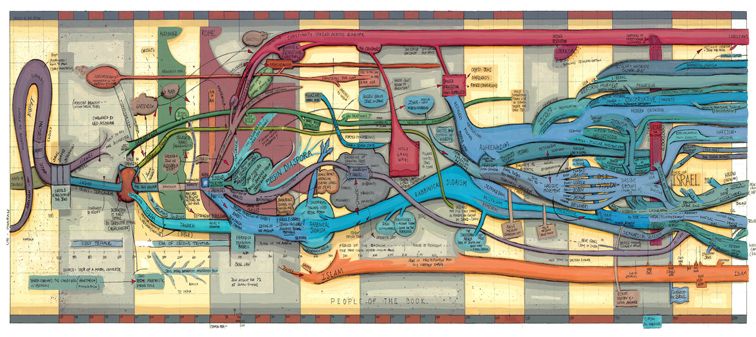
"Unreliable Narrator": Ward Shelley at Pierogi

Ward Shelley
"People of the Book"
2012
Oil and toner on mylar
36 x 75.5 inches
Writing about Ward Shelley's 2009 Pierogi Gallery exhibition, "Who Invented the Avant Garde - and other half-truths," I compared his colorful schematic paintings to taxonomic trees.
"[Shelley's] striking [...] paintings anatomize the development of intellectual and social streams within the humanities. The artist describes them as 'attempts to use real information to depict our understandings of how things evolve and relate to one another, and how this develops over time.'

In spirit as well as in appearance, then, Shelley's paintings are cousin to phylogenetic trees, the taxonomic diagrams that biologists use to denote evolutionary relationships among species. But, though Shelley's genealogies look like mappings of biological exuberance, the subjects of his brightly colored, illustrative works are not so scientific: Frank Zappa; Beat Generation writers; nodes of postmodern philosophy; modern art movements."
Aesthetically speaking, I liked every piece in the show, but the most edifying works were those that considered "significant, sweeping lineages," and I concluded the write-up with the hope that Shelley's lens would broaden.

Tuesday, September 27, 2011

Finding Unicorns


someguy
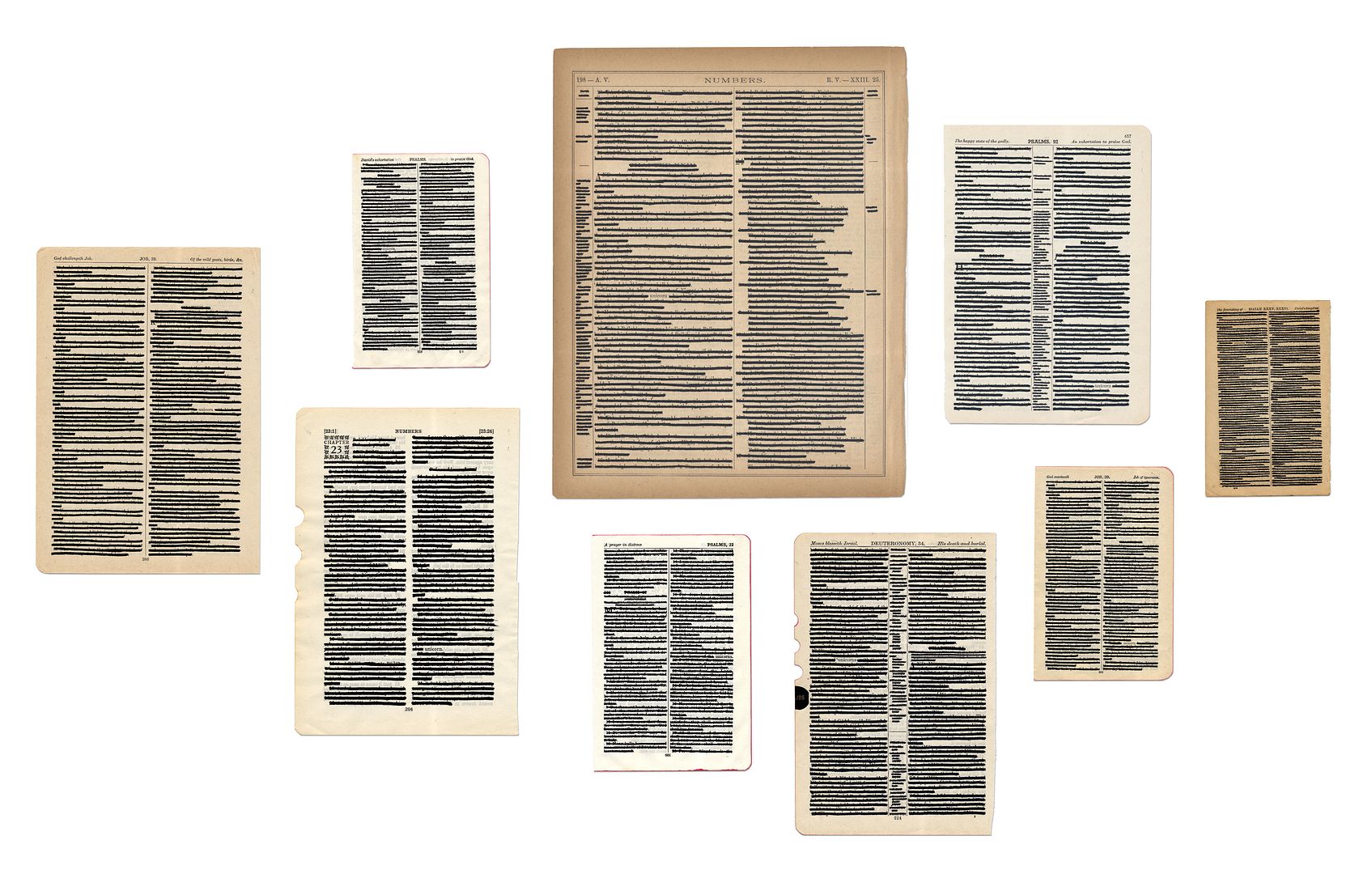
"9 Unicorns"
2011
Individual vintage bible pages

Large, juried shows are usually confused affairs. "Proof," the latest rendition of Southern Exposure's annual "entry-fee free juried exhibition of Northern California artists," is no exception. Of the 47 artworks (by as many artists), 5 pieces stand out: Kelly Falzone Inouye's "Tagging Sequence 1"; Robert Larkin's "Original Art"; Summer Mei Ling Lee's "Les preuves fatiguent la verite"; Kate Nartker's "West Main 1984"; and Someguy's "9 Unicorns."

"9 Unicorns," in particular, provided much to mull over. Someguy displays 9 pages from vintage Bibles; on each of these, all text except for the page heading and the word "unicorn" is blacked out. On his website, the artist states, "it's not commonly known, but the Bible mentions unicorns 9 times." I suspect that Someguy intends his handsomely presented editing job as a winking critique of religious literalism. By highlighting the occurrence of the word, the artist reminds viewers that mythological creatures populate the tome that literalists insist is non-fiction and most U.S. president-elects place their hands upon when they're sworn into office. Little girls notwithstanding, most of us are informed and sensible enough to dismiss unicorns as harmless hokum. Why, then, doesn't an overwhelming majority also view the Abrahamic narrative as an epic myth (i.e., fiction)?

Religious apologists point out that the Hebrew Bible makes no mention of unicorns. Instead, readers will find an ox, auroch, rhinoceros, or bison, depending on the edition. These more mundane creatures are indicated by the ancient Hebrew term re'em. The word was first translated as "unicorn" by the Greeks who, between 250 BCE and 100 CE, crafted the immensely important Septuagint, bringing the Hebrew scriptures to the Western world. Still, lest we too hastily ascribe an elevated rationality to the Jews of antiquity, scholars believe that re'em was not meant to describe an ordinary animal. The oral traditions of the Israelites and early Jews spoke of a powerful, monstrous auroch, a creature of gargantuan proportion, large enough to be mistaken for a mountain. Because they were unfamiliar with this monster bull, it's only sensible that the Greek translators and editors of the Septuagint substituted another fanciful creature, one better known to their audience; enter the unicorn.

Point being, the Bible, no matter the translation, is chock-a-block with fantasy. Most epic stories (and especially those with the staying power to warrant inclusion in a sacred narrative) are tall tales. Fictional or exaggerated narrative often pushes reality out of popular memory. The rhinoceros becomes a unicorn and the large crocodile becomes a dragon in the same way that the angler's fish grows through successive tellings; generations after the big mackerel was caught, it's Leviathan. But knowing how unicorns came to appear in some translations of the Bible doesn't justify easy dismissal of the sacred canon. Even for secular culture, the ancient stories are the closest approximation of universal myths, and they have much to offer readers with a critical bent -- much more, in fact, than they afford literalists.


someguy
Detail of "9 Unicorns"
2011
Individual vintage bible pages

But "9 Unicorns" isn't just about the relationship between religious texts and fairy tales; it's also a critique of our postmodern malady. Today, technology and globalization expose us to a heretofore unprecedented quantity of information. As a result, it's progressively more difficult to wrest fact from fiction. As the late Senator Daniel Patrick Moynihan quipped, "Everyone is entitled to their own opinions, but not their own facts." Disappointingly, most of us reject Moynihan's gospel, instead opting to go at our texts with a Sharpie, making of them whatever we wish. This willful shirking of intellectual responsibility is amply on display in the fractious debate about the meaning of the United States Constitution and the legacy of our "founding fathers." Benjamin Franklin, one of those very prophets, smartly observed, "so convenient a thing it is to be a reasonable creature, since it enables one to find or make a reason for everything one has a mind to do."

Someguy's "9 Unicorns" evidences our species' taste for selective reading, subjective "truths," and rationalizations. Ever more interconnected, such an unhealthy disposition can become dangerous. Someguy's piece is a visual fable of sorts, cautioning us to master our appetites.


someguy
Detail of "9 Unicorns"
2011
Individual vintage bible pages


Image credits: all someguy images, courtesy the artist

Thursday, February 03, 2011

Enter the Rabbit


A red rabbit for the Chinese New Year

Although New York City has a larger Chinese American population than does San Francisco, the Chinese New Year is a much bigger deal in Fog City than it is in the Big Apple. The Chinese American population in New York accounts for approximately 4.5% of the total population; in San Francisco, it constitutes close to 20%.

Like New York, San Francisco has ethnic enclaves that exaggerate these demographics. I live in a part of the city known as the Inner Sunset, located at the eastern edge of the expansive Sunset District. About half of the Sunset's population is Asian American, mostly of Chinese extraction. In an interview published in the current issue of San Francisco Arts Quarterly (SFAQ), celebrated Bay Area artist Barry McGee remarks that he dislikes the Sunset District because "it's foggy, and there's a big Asian population." The interviewer asks, "You don't like Asians?," and McGee replies, "[...]well it's not that I don't like Asians, but I don't like that many Asians, you know?" I presume that the half-Chinese McGee is joking, but his tongue-in-cheek comment speaks to our species' inborn, tribal orientation.

Curiously, while I'm acutely aware of how "out of place" I am in some ethnic neighborhoods, I've never felt incongruous or unwelcome in predominantly Chinese American communities. There are, of course, significant cultural differences - I'd almost certainly feel homesick and alien were I to live in Beijing or Shanghai for a time - but, unlike McGee, I think the substantial Asian American population is a feather in the Sunset's cap, and I was pleased to see a number of red lanterns and celebratory banners hanging from Sunset awnings yesterday morning.

Maybe, though, there is a more novel reason why I appreciate the Chinese New Year? As a would-be ger (or convert to Judaism), I also observe a new year that's not dictated by the Gregorian calendar. I made my New Year resolutions in early September, during the days preceding Rosh Hashanah, a period that saw no spike in gym memberships.

What is to be made of this hybrid identity of mine, especially in light of our increasingly universalistic aspirations? I'm a straight, white male, and my family tree has a preponderance of English and Scottish Protestants; in other words, like it or not, I was born "the man." Yet I am also, by means of the mystical and psychological process of conversion, a Jew (technically speaking, I'm almost one, mikveh pending). Although most of us associate ethnic identity with skin color or bloodline, ethnicity is by definition a stew of heritage, language, culture, and religion; it is compound. Thus, though I'm only 1/8 Jewish by blood (i.e., genetically or physiologically), I'm able to identify as wholly so (i.e., psychologically).

Because of this rewiring of my identity, I'm ever more appreciative and proud of the diverse makeup of the United States. Many Americans nurture a composite identity (e.g., Italian American, Japanese American, or, less specifically, African American). Although it's crucial that we must prioritize the shared aspect of these respective identities, we should also celebrate the differences. In other words, just as our membership in the family of humankind does not preclude our identifying as part of nations, clubs, or families, American peoplehood does not prohibit membership in particularistic communities, subsets of the greater national identity. Contrary to the well-intentioned, "all you need is love" promises of misguided ideologues, our nation's principal virtue may be it's appreciation for both the universal and the particular.

So, to my many Chinese American neighbors, and to the rest of our experimental nation, cheers to yet another Happy New Year!

Image credit: ripped from Sweety Petey Eco-friendly Baby Toys

Wednesday, February 17, 2010

Evolution Weekend


This past weekend, countless couples the world over celebrated Valentine's Day. Far fewer, however, marked Evolution Weekend 2010 on our calendars. I did not participate in any Evolution Weekend events this year; I hope to rectify that oversight next year, as the goals of the project are worthy and important.

From the project's website:
"Evolution Weekend is an opportunity for serious discussion and reflection on the relationship between religion and science. One important goal is to elevate the quality of the discussion on this critical topic - to move beyond sound bites. A second critical goal is to demonstrate that religious people from many faiths and locations understand that evolution is sound science and poses no problems for their faith. Finally, [...] Evolution Weekend makes it clear that those claiming that people must choose between religion and science are creating a false dichotomy. Through sermons, discussion groups, meaningful conversations and seminars, the leaders [of this effort] will show that religion and science are not adversaries."
To date, roughly 13,000 American Christian, Jewish, and Unitarian Universalist clergy have signed letters stating that evolution and religion are compatible. To some of us, this compatibility is a no-brainer, but for many intractable anti-religionists and literal-minded religious Americans, there can be no comfortable cohabitation. Both extremes are guilty of arrogance, thoughtlessness, or both.

Yet those of us in the middle might do well to take a lesson from the activist extremes. As Rabbi Robert Barr, of Congregation Beth Adam in Loveland, Ohio, said recently,
"It is amazing and disturbing that biblical literalists have been able to successfully challenge the concept of evolution and in doing so change how science is taught in school and [require] congregations and clergy to stand up and endorse an idea that is 150 years old. [...] Perhaps what has made the anti-evolution crowd most successful is their passion. While I disagree with them, I appreciate their energy and their commitment, and I want those of us who embrace science, modernity, and religion to be equally committed to our beliefs."
It's not enough to know that there needn't be conflict between the material and metaphysical. We must also speak truth to bigotry and ignorance.

Image credit: ripped from C95 FM website

Wednesday, December 16, 2009

Global Climate Justice Fast


350 Candle Vigil; Washington Square Park, NYC; December 2009

"How well we control our numbers, our appetites, and the efficiency with which we satisfy those appetites will ordain just how desperate the situation becomes. They are the battles for our time, as morally compulsory as the battles for civil rights or against totalitarianism."

- Bill McKibben, The End of Nature

The group gathered at the northern entrance of Washington Square Park last Friday evening was smaller than I'd anticipated. We were assembled for a candle vigil in conjunction with the United Nations Climate Change Conference in Copenhagen, Denmark, and 350.org, environmental activist Bill McKibben's project to increase global awareness of the environmental (and status quo) threats posed by the exacerbation of climate change due to anthropogenic influence.

The New York City vigil was one of hundreds of similar events happening around the world on December 11th. Given the date, the vigil was also a satisfying way to bring in Hanukkah, a holiday that, despite its complicated history, is essentially about standing up for the causes that you feel most strongly about, even in the face of overwhelming odds. Small though our Washington Square Park group may have been, then, I was upbeat and hopeful.

Tomorrow (Thursday, December 17th), there is more cause for hope. I'll be one of thousands (hopefully one of many thousands) of true cosmopolitans forgoing food as part of the Global Climate Justice Fast. Bill McKibben's organization is trying to spread the word from Copenhagen, but the easiest place to sign up is at the Climate Justice Fast website. The official statement of the fast participants reads:
"We will fast voluntarily, for one day on Thursday, in solidarity with the millions who have and could lose their lives to preventable and involuntary hunger, disease and conflict resulting from climate change.

We call on world leaders for a real climate deal now--a deal grounded in science and strong enough to get us back to 350 [parts per million]."
I urge HH readers to take action this season. The specifics of your engagement matters less than its spirit. As I wrote not long ago,
"If global warming isn't appealing to your still, small voice, get involved with political activism, volunteer at your local homeless shelter, pledge financial support to non-profit activist organizations working for causes that you feel strongly about; it doesn't matter what you do, but it does matter that you do something. Turn off the television, put down the tabloid. I beg this of you."
If you have the energy and spirit to take action in multiple ways, so much the better, but every little bit helps. We're all in this marvelous mess together.

Saturday, December 12, 2009

Sunset, Sunrise


Heron Hope sunset; November 2009

"Our destiny, our being's heart and home,
Is with infinitude, and only there;
With hope it is, hope that can never die,
Effort and expectation, and desire,
And something evermore about to be."

- William Wordsworth, The Prelude


"Indeed, from within the murkiness of human knowledge and experience, we rightly wonder, is there any room for theology as such - or has it gone the way of all heavenly things? Perhaps all that remains is some mode of natural piety, such as the shudder before the mortal mysteries (with Goethe), or the felt ecstasies of springtime (with Wordsworth). Surely this is a lot, and unsettles the mind from its human habitudes. But is there more?

[...] Like all matters human, theology must be grounded in earthly experience and understood from within its forms. The phenomenal world is all that we have. This is the sphere that lies before us in our everyday existence; it conditions the products of aesthetic perception; and it provides the sphere for theological experience and reflection.

[...] As natural beings we are, in the most elemental sense, coextensive with this realm: our bodies are composed of it, our stomachs take in and digest its matter, and we traffic with this world all our days until we die and are decomposed into its elements. [...] To more properly sense [the] unfolding of the Godhead into world-being, so to speak, or to perceive or intuit its penetrations therein, we must first return to our ordinary experiences."

- Michael Fishbane, Sacred Attunement: A Jewish Theology


Sunrise at Heron Hope; November 2009

Happy Hanukkah, folks.

Photo credits: Hungry Hyaena, 2009

Saturday, September 19, 2009

Again, into the gloaming

The spiral of time has come round on itself, slightly displaced from this point a year gone.

It is Rosh Hashanah today, the Jewish New Year, and I'm in a pensive mode. Below, I repost a selection from "Almost Twilight," last year's musing on autumn's advent, creative inspiration, twilight, crepuscular animals, hallucinogens, and reflection.

But, first, I'd like to highlight two projects relevant to the season.

- Yusuf Misdaq is an artist, poet, and musician who shares my universalistic mystical inclination. Almost a month ago, he began Palace Prayers, "the aim [of which] is to create a new work of art for every day of Ramadhan, 2009."

A blog-like site presents each day's original work. I encourage readers to visit. You can also listen to a National Public Radio interview with Yusuf here.

- New Yorker editor Ben Greenman has co-organized, with writer Nicola Behrman and Reboot's Amelia Klein, 10Q, a Yamim Noraim project for people of all faith (or lack of faith) backgrounds. From the website:
"10Q was inspired by the traditional ten days of reflection that occur between the Jewish holidays of Rosh Hashanah and Yom Kippur, a period of time that’s long been considered an opportunity to look at where you're at, where you've come from, and where you're heading. Whether you're Jewish or not, though, 10Q is a great way for anyone to look back at the year that’s past, look ahead at the year to come, and take stock. That’s a beautiful thing in any language."
Sign up here.

Shana tova!

+++++


"Darkness within darkness.
The gateway to all understanding."
-Lao tzu, "Tao Te Ching"

In New York, recent mornings have greeted us with a pleasant chilliness. Fall is almost here, and winter is just around the corner. For most folks, the prospect is daunting. Not so for me. Each year at this time, a bounce finds my step and I'm happily overwhelmed by a spate of ideas. I know, however, that the creative juices will before long transmute into keen brooding. Late fall and winter nurture a pensive mind.

When the afternoons darken and the mercury dips, I like to take bundled winter strolls through the streets of Manhattan or Queens. Other pedestrians hustle about, intent on achieving their respective indoor destinations, but I find my thoughts best served by a steady pace, one forgiving of some intentioned aimlessness. I spend these walks looking up to where the melancholic sky meets the buildings that scrape it, admiring the resilience of foraging House sparrows, taking note of the way traffic lights glow more brightly in crisp, cold air and marveling over the many lives that move around me. I like to think of this mindful meandering as a form of prayer, or perhaps a communion, and I treasure the insights that are sometimes happened upon.


Curious about the rites, beliefs, and texts of various religions (and particularly those of Judaism), I've been thinking this week about the coming high holy days. Next Monday is Rosh Hashanah, the first of Judaism's ten "days of awe," or Yamim Noraim. Like my winter walks, the Yamim Noraim are given over to contemplation. During the ten high holy days, an observant Jew should meditate on the actions of his last twelve months and, then, on Yom Kippur, the last of the "days of awe," fast and repent for any wrongdoing. In other words, a conscientious Jew begins the new year by reckoning with his past. Although Rosh Hashanah is only one of four Jewish New Years, each attached to a specific set of guidelines and meaning, I find the holiday's position with regard to the seasons of particular interest.

Considered the New Year for humans, animals, calendar calculation, and contracts, Rosh Hashanah arrives with the ploughing of summer into fall. If one considers fall equivalent to dusk and winter to night, then the Jewish New Year, like the Jewish day, begins at twilight in the northern hemisphere. The notion of a day extending from sunset to sunset runs slightly counter to the popular conception of morning time as a birthing, or spring, with the hours moving through summer at mid-day, fall in the evening, and finally into winter, night and death. But the Judeo-Christian tradition is pastoral, founded on an agricultural reckoning. It makes sense, then, that the day should end when the sun falls away. The new day begins with night; the beginning is darkness, a time when all man can do is rest and await the return of the sun's workable hours. In rural farming communities, this pattern holds today, though the blue glow of television has altered habits in even the most rustic counties. Still, the consummate urbanite Oscar Wilde's quip that "people in the country get up early because there's so much to do, [and] they go to bed early, because there's nothing to talk about" remains generally accurate.


Growing up in such a community, I learned early that if twilight is a conclusion for the farmer, it is a commencement for many other creatures. A patient hunter who remains in his deerstand as the final light retreats might see bats dart and dip in aerial pursuit of insects. He may also see an opossum, fox, raccoon, skunk, or even his intended quarry, deer, though it is not legal to shoot after the sun sets. Driving or biking on "backroads," these animals reveal themselves by reflecting light from a car's headlights or a bike's front beam. The tapetum lucidum, a layer of tissue behind the retina of crepuscular and nocturnal species, allows the animal to see better in near or total darkness, but this layer also produces eyeshine that discloses the creature's presence to human torch bearers. Depending on the species and the angle of approach, we can identify the animal by the color of its eyeshine: the white-yellow lights at knee height belong to the red fox; the orange orbs in the low branches of a tree are an opossum; the yellow beams tall over the road are white-tailed deer; the brilliant white spots that appear so near the ground expose a resting whippoorwill.

Imagine the shock of the early humans when they first noticed the glowing embers that moved just outside the reach of their warm firelight. The agricultural tribes that would become the people of the Torah, having abandoned much of their nomadic, hunter-gatherer roots, were particularly afraid of the dark, creeping world outside that circle of light. To be caught in the gloaming, away from a human settlement or encampment, was surely a terrifying possibility.

Indeed, the dark months, like those black, antediluvian nights, remain an ordeal for many people . But they can also be understood as a gateway opportunity. It is fitting, I think, that Jews begin their new year by taking stock, a formidable task if undertaken with thoroughness and honesty. I approached my experiences with hallucinogenic drugs in an analogous way; what most people would call a "bad trip," I viewed as an opportunity for introspection. 'Why has my brain created this awful idea?,' I asked myself. 'What does that tell me about my relationship to x or y, or about my fear of a, b, or c?' The cold, gloomy months, like bad trips, nightfall, and deep melancholy, can be challenging, even endangering, but in an increasingly mediated and accelerated world culture, the difficult passages are of premium value.


But whatever religious label I eventually pin to my lapel (or discard), periods of solemn self-examination are likely to remain a critical part of my identity and annual experience, and these have so far coincided with winter and come on the heels of a fall surge in the creative impulse. Although modernity misunderstands fall to be the beginning of an end, it is only another beginning. Shana tova umetukah, folks. My favorite season is moving in, and our shadows grow longer.

Photo credits: "Athens Park, Astoria," "Central Park, Manhattan," "Heron's Foot Moon, Virginia," "Branches," all by Christopher Reiger, 2007 and 2008

Sunday, September 13, 2009

Kimmel Harding Nelson Residency: Day 7


The Ten Commandments on the front lawn of Otoe County Courthouse; Nebraska City

Attunement on a Sunday Morning

I'm a generalist. As such, I'm inclined to connect the dots between purportedly distinct realms of inquiry. It's impossible, of course, to conduct a truly holistic survey, but my crude efforts have led me to conceive of life - what we know of it, at least - as a component part of a vast, even infinite superorganism. I freely admit to finding value in mysticism, and this superorganism notion is readily dismissed by some scientists and scholars as mystical metaphysics, but science itself speaks to an integrity beyond human comprehension.

As Loren Eiseley describes it,
"[This is] one of life's strangest qualities - it's eternal dissatisfaction with what is, its persistent habit of reaching out into new environments and, by degrees, adapting itself to the most fantastic circumstances."
Eiseley was an anthropologist, and he claimed to be a man of "no religion." That may be so, but Eiseley's writing offers humility, wonder, gratitude, and communion in abundance. As I see it, those are the four pillars of religious practice. The fourth of these vital practices, communion, is alluded to by the very word "religion," from the Latin religare, meaning "to bind" or "to tie." Religious action aims to bind the individual to society and, in turn, to the greater whole.

For a decade, I proudly identified as an atheist and, by the measure of most religious people, my cosmology and metaphysics still qualify me as such. It occurs to me, on this Sunday morning, with Nebraska City's church parking lots at capacity, that many of this town's good Christians would reject my claim of religiosity, and not only because my practice rests on a Jewish foundation. My doctrine-less faith appreciates the stories of the Hebrew Tanakh, the Christian New Testament, and the Muslim Koran as parables, poetry, and anthropological artifacts. I read these books in the same way that I do the Tao Te Ching or Herakleitos; they are annotated, analyzed, interpreted, digested, then, in the fullness of time, returned to for a new understanding. But these collections are not my sacred texts. In the eyes of most religious believers, that disqualifies me from tribal membership. Thank G-d.


First Baptist Church; Nebraska City; September 2009
Sign reads, "Faith Removes Mountains Or Tunnels Through"

Still, I am a religious believer, in my way. My holy books are written by biologists and physicists, naturalist poets and essayists, as well as rabbis, ministers, and theologians. None of them is the word of an interventionist, judging god, even though all of them are necessarily part of a greater, unknowable whole, the aforementioned superorganism.

It doesn't matter what you call this organism. As essayist and literature professor Doug Thorpe writes in Rapture of the Deep, "Call it the sublime, call it the Tao, Om, or I AM; still the names don't hold." I most often call it The All, The No-thing, or Hashem, literally "The Name." In the Tanakh, when Moses asks the name of the Presence he has discovered in the burning bush, It replies, "Ehyeh asher ehyeh." "I will be who I will be," or "I will be that I will be." You can call It whatever you will, for It is you. It is also me. It is the sidewalk; It is the grass of the Otoe County courthouse lawn, on which Nebraska City authorities have installed a carved monument to the Ten Commandments, an act that approaches violation of Thomas Jefferson's shrewd "separation of Church and State"; and It is the ether connecting all of these.


Lutheran Church facade; Nebraska City; September2009

If the faith that has grown in me is dogmatic in some way, it is in its insistence on universalism. Literally translated, "universe" means "one turning." Our universe is just that, one breath, one round, one cycle. All that we know and all that we don't know, everything that we can imagine, is but an infinitesimal sliver of The All, one note of an eternal symphony. Even Herakleitos, ancient proponent of reason and science, turned to poetics when he contemplated ultimate meaning; "Nature loves to hide," he wrote. Interestingly, the Hebrew word for universe is olam, a derivative of alam, meaning "to conceal." Jewish mystics, like many of their Hindu, Sufi, and Christian counterparts, believe that God is hidden in the universe, an ineffable force that pervades every dimension, known and unknown.

Theoretical astrophysicists
now suggest that our universe is but one component part of a multiverse, requiring of us another Copernican shift; yet again, the superorganism is re-conceived. In that stretch of the mind are humility, wonder, gratitude, and communion. Science and philosophy, it seems, can also be religious.


Water tower; Nebraska City

So, yes, I'm a religious believer. Paintings, sculptures, and other hand-crafted objects are among my adored icons, but I find occasion for worship in every place, in every form, in every moment. The Monarch butterfly that flapped yoyo-like this morning in front of the KHN Center's kitchen window is worthy of exaltation. I recognize that, for some other viewer, the insect may be ignorable or irrelevant. For others, it is an idol. So, too, might the weathered brick of a downtown Nebraska City building be deemed a clay calf by unimaginative or close-minded "believers." Placing my palm on this brick today, though, my thoughts range through eons of geologic time to consider the primeval mud from which, eventually, we emerged as a gasping fish thing.

Doubtless some of the folks singing inside the walls of the Lutheran, Episcopalian, Catholic, Baptist, Presbyterian, and Methodist churches this morning don't share my enthusiasm for our scaley ancestors. But I'm not concerned with their narrow definition of religion or their selfish understanding of "truth." Although I no longer consider myself a materialist, I'm an unremitting idolater. To those that would condemn that impulse as sacrilegious, I offer Eiseley's reaction.
"People have occasionally written me harsh letters and castigated me for a lack of faith in man when I have ventured to speak of [..] some greater unity that lay incalculably beyond us. [...] They distrust, it would seem, all shapes and thoughts but their own. They would bring God into the compass of a shopkeeper's understanding and confine Him to those limits, lest He proceed to some unimaginable and shocking act - create perhaps as a casual afterthought, a being more beautiful than man. As for me, I believe nature capable of this, and having been part of the flow of the river, I feel no envy."
And I feel no envy, either. There is only dumbfounding, smiling celebration.

Love is, I think, a bit like religion. Humility, wonder, gratitude, and communion are requisite in both, and, as Thorpe puts it, love "demands of us a new way of being in our old world." Religion might be construed as a love affair with The All. It's not always easy, but religious attunement can turn each day, each hour, or each instant, into "a new way of being." Every step is a psalm, every directed gaze is a prayer. Truly, on the streets of Nebraska City this morning, I am an exuberant, enthusiastic mystic.

Photo credits: all photos, Hungry Hyaena, 2009

Tuesday, September 08, 2009

Kimmel Harding Nelson Residency: Day 2


Iowa corn field

The Flying Nun

As our plane approached Omaha, Nebraska, I surveyed the irregular grid of rectangles and squares formed by western Iowa's country roads. Cumulus clouds cast dark shadows of punctuation over the vibrant greens, yellows, and siennas of the state's corn and soybean harvest.

I tend to think of our nation's industrialized monoculture as a rigid corporation of hundreds of thousands of acres of symmetrical fields, but, in practice, even agribusiness can only bend the land so much. At an altitude, one sees that our fields are as shaped by the extant topography as they are by human manipulation. Indeed, some of Iowa's fields, with their rounded edges and calligraphic plow lines, could, from the air, be mistaken for southeast Asian rice paddies.


Aerial view of western Iowa agriculture

My neighbor on the plane was a pleasant Benedictine sister. Dressed in full habit, she was en route to Norfolk, Nebraska, for an assembly of the world's Benedictine Monastic Missionaries. She works and resides in Namibia, Africa, assisting with education and HIV/AIDS prevention. I deeply appreciate the charitable activity and lifelong devotion of such missionaries, but I remain wary of the proselytizing component.

At several points in my conversation with the sister, I felt as though she was soft-selling her faith. She commended me on my given name, Christopher, explaining that I was named after the Catholic saint that supposedly carried the young Yeshua of Nazareth across a river. (Of course, that isn't quite right. The saint, if the man in fact existed, was named for his deed; the Greek word Christophoros translates as "bearer of Christ.") She was also happy to learn that my vocation, my calling, was art, and encouraged me to use my artwork to "usher in Christ's love everlasting." I replied with a noncommital "um hmm," and left it at that.

Perhaps because my response was ambiguous, she persisted. Inspired by my affinity for art, she recollected a visit she made to the Norman Rockwell Museum, where she viewed a sculpture by Rockwell's son, Peter. According to the nun, the sculpture featured a crucifix crowned by devil horns. The piece sounds wholly adolescent, but it evidently upset one of the nun's companions, who couldn't understand why the "symbol of all that is good" would be paired with "the symbol of all that is evil." The nun reassured her friend by pointing out that "at least Peter Rockwell isn't an atheist." She weighted the last word, and shook her head as she pronounced it. I'm not sure what element of the sculpture informed her confident conclusion about Rockwell's metaphysics, but her story made clear her negative feelings for those who doubt or deny her particular faith.

Some minutes after the Rockwell anecdote, she expressed pleasure at Pope Benedict XVI's decision to expand contemporary Catholic use of the Tridentine Mass, a Latin text that vilifies Jews. Considering the nun's clear dislike of atheists and her implied disapproval of non-Christian religious beliefs, I'm happy that I dodged any questions that, squarely answered, would have revealed something of my personal path from a Christian baptism, to agnosticism, to atheism, to my current exploration of and identification with panentheistic or panendeistic Judaism. Part of me was disappointed in myself for not confronting her ecumenical failure, but, frankly, I was more interested in looking out of the plane's window.


Auto repair yard on Central Avenue; Nebraska City

First Impressions of Nebraska City

If you define "city" as a settlement with a large population, Nebraska City is a misnomer. Compared to New York City, my home for almost a decade, Nebraska City is a population blip. New York City's population, estimated at 8.5 million, is 1,200 times Nebraska City's roughly 7,000 residents.

Shortly after we loaded the minivan with our bags and left the Omaha airport, Ron, the owner (and sole employee) of Tree City Taxi Service, said that most Kimmel Harding Nelson Center residents that come to Nebraska City from big cities experience some degree of culture shock. But, although I now live in New York City, I originally hail from Locustville, Virginia. Locustville's population was just 99 when I lived there, and I don't believe that the number has significantly increased or decreased in the years since. Compared to my hometown, Nebraska City is, as its name suggests, a veritable metropolis!


Closed store on Central Avenue; Nebraska City

In conversation with Ron, I gathered that the largest employer in Nebraska City, the American Meter Company, has recently laid off a significant number of its employees. Two other companies that the townspeople depend upon, Cargill Meat Solutions and Diversified Foods & Seasonings, are also facing cutbacks. As a result, many of Nebraska City's citizens are struggling to make ends meet. The economic woes are apparent on the town's main street; it seems as though every block on Central Avenue is home to at least one vacant storefront.

Ron also confirmed my assumption that white-tailed deer, turkey, carp, and channel catfish are major focal points of the region's outdoor recreation. He proudly told me that two of his granddaughters, decked out head-to-toe in camouflage gear, already accompany their dad deer hunting. The image of the camouflaged little girls made me smile, perhaps because I fondly recall the too-big camouflage outfits of my childhood.

Along with hunting and fishing, the major pastimes in eastern Nebraska are high school and college football. This afternoon, from the kitchen window of my residency apartment, I watched the middle school football team practice. I wondered if, compared to their coastal peers, a greater percentage of Nebraska's teenage athletes bank on athletic scholarships and dream of going pro. Many of the players' parents arrived early and watched them from the edge of the practice field.


View on 6th Street; Nebraska City

Photo credits: image of Iowa corn field, ripped from Iowa State website; image of western Iowa fields, ripped from Legacy By Design blog; all photographs of Nebraska City, Hungry Hyaena, 2009

Friday, August 21, 2009

A Practice of Naming


Christopher van Donkelaar
"Adam Naming the Animals"
Handmade pigments and mixed media
2008
"Praise to the first man who wrote down this joy clearly, for we cannot remain in love with what we cannot name."

- Robert Bly
A lover of etymology and taxonomy, one of my most cherished reference books is Arthur Frederick Gotch's Latin Names Explained: A Guide to the Scientific Classification of Reptiles, Birds and Mammals. In it, Gotch catalogs and dissects the scientific names of some 4,000 animal species. That number appears relatively insignificant when we consider that biologists estimate 25,000 species of bird, mammal, and reptile currently exist on Earth, but Gotch's record is so far unparalleled. Each entry provides the animal's common and scientific names, followed by an explication of the Latin and Greek and, sometimes, a blurb about the species' range and habitat.

For example, consider Gotch's entry on one of my very favorite North American snake species:
Copperhead Agkistrodon contortrix
agkistrodon (Gr) a fish-hook; odon (Gr) a tooth; a reference to the curved fangs, though of course they are not barbed; contorqueo (L) I twist, turn; contortus (L) full of turns, twisted; contortrix (L) one that is able to turn, twist. Inhabiting the south-eastern part of the USA including Florida. The top of the head is reddish brown.
Although the range information suggests that the copperhead is more confined to the southeastern United States than the species and subspecies actually are - they thrive in New York State, for example - Gotch's entry informs readers that the snake commonly called a copperhead is universally and technically named Fish-hook shaped tooth twister or, if you prefer, The Twisting One With Hook Shaped Teeth. Knowledge of this name allows me to appreciate the beautiful reptile from another angle.

But what's in a name, really?

Although I'm generally baffled by Biblical literalism, I appreciate the Genesis accounts of creation for their gratifying metaphor. In particular, I'm drawn to rabbinic and Jewish mystics' interpretations of the conjoined, aboriginal narratives. More so than their Christian counterparts, Jewish theologians and mystics endow language and names with ontological significance. The Hebrew alphabet is understood as a powerful code: the written word is creative potential, and the spoken word, procreative. The god of Genesis 1 creates neither with a wave of the hand nor by shaping raw material, but by speaking the world into being; annunciation and incantation are the means of creation. Because of the vocative nature of naming, observant Jews place great value on words and speech. (They are even prohibited utterance of the tetragrammaton, the four-letter Hebrew name of God, transliterated as Yahweh. Appropriately enough, the colloquial name for God is Hashem, or "the word.")

In Genesis 2, the creator god is anthropomorphized and physically involved with creation, shaping man and the other animals from earth. Yet the power of language and names remains significant in this account. God asks Adam, the first naked ape, to name all of the other animal species. That's no mean task, and apparently Adam died before he finished the job. His descendants, at least the taxonomists among them, are still working at the task of naming.

But even those individuals who do not share my affection for taxonomy will find value in a practice of observation and naming. As Carol Kaesuk Yoon writes in her recent New York Times paean to taxonomy, "Reviving the Lost Art of Naming the World,"
"Even when scads of insistent wildlife appear with a flourish right in front of us, and there is such life always — hawks migrating over the parking lot, great colorful moths banging up against the window at night — we barely seem to notice. We are so disconnected from the living world that we can live in the midst of a mass extinction, of the rapid invasion everywhere of new and noxious species, entirely unaware that anything is happening. Happily, changing all this turns out to be easy. Just find an organism, any organism, small, large, gaudy, subtle — anywhere, and they are everywhere — and get a sense of it, its shape, color, size, feel, smell, sound. Give a nod to Professor Franclemont and meditate, luxuriate in its beetle-ness, its daffodility. Then find a name for it. Learn science’s name, one of countless folk names, or make up your own. To do so is to change everything, including yourself. Because once you start noticing organisms, once you have a name for particular beasts, birds and flowers, you can’t help seeing life and the order in it, just where it has always been, all around you."
Beautiful. Let's name something.

See also "The Plant Whisperer," another brief HH essay considering similar ideas.

Image credit: van Donkelaar painting ripped from the Nurturing Faith website

Wednesday, July 29, 2009

What is the Prophetic Ideal?


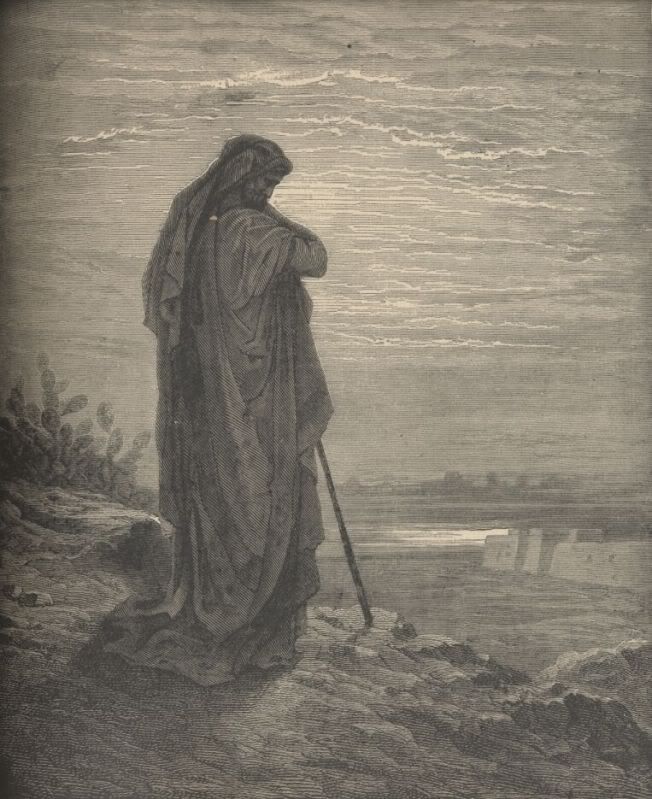
Gustave Dore
"The Prophet Amos"
1891
Engraving
"Let justice roll down like waters, and righteousness like an ever-flowing stream."

-Amos 5:24
In the Hebrew Tanakh, the colorful collection of history, anthropology, and mythology better known to Christians as the Old Testament, a number of the prominent prophets decry the institutionalization of Israelite religion. Elijah, Amos, Hosea, Isaiah, and Jeremiah proclaim instead the communal and, in some cases, individual experience of the one, true God. They maintain that God can be best experienced (and, as the ancient Israelites believed, best appeased) through one's devotion to those moral laws, or mitzvot, concerned with righteousness and social justice. These courageous and outspoken men also possess an enmity for the organized priesthood. They insist that the Israelites needn't centralize their worship at Solomon's Temple in Jerusalem, or at any of the other state worship shrines constructed within the kingdoms of Israel and Judah.

Not surprisingly, excepting the rare case when a prophet's ideology was deemed politically expedient, Israelite state leaders frowned on religious populism and the theocracy ignored the prophet's pleas. Typically, the trouble-making prophets were ostracized, expelled, or hunted as fugitives. Yet, ultimately, the prophets' voices proved appropriately prophetic.

For most of their history, Jews have lived in diaspora, their religious faith and identity rooted in a universalist foundation of scripture, theory, and law rather than any centralized site or body. In fact, most contemporary religious historians believe that the flowering of the relatively archaic and essentially polytheistic Israelite religion into Judaism follows the fall of Jerusalem to the Babylonians, in 587 BCE, and that this early, exilic manifestation of Judaism would undergo another upheaval and transformation after the destruction of the Second Temple by the Romans, in 70 CE. In essence, these scholars suggest that the Israelites (and, later, the Jews) had to forgo state power before the moral idealism of their religion could be actualized.

Accordingly, then, the muscular, modern state of Israel poses challenges to Jewish moral idealism. But contemporary Israeli Jews aren't alone in their wrestling with this challenge. Almost 2,500 years after the Hebrew prophets condemned top-down involvement in spiritual matters, liberal-minded, religious individuals of all stripes continue to struggle against blindly restrictive doctrinal authority.

I do not intend to suggest that adherence to dogma is necessarily a bad thing. Moral hand-wringing is a natural component of ethical decision-making, and traditional values of the sort upheld by religious authorities offer each of us a valuable point of reference. But what of contemporary conflicts between religious action and the religious institution? What of those cases in which the civil and moral codes of a religion suggest that the adherent to those codes should act in some way other than that dictated by the religious institution?

Laura Goodstein's recent New York Times article, "U.S. Nuns Facing Vatican Scrutiny" provides an excellent example. Goodstein writes,
"In the last four decades since the reforms of the Second Vatican Council, many American nuns stopped wearing religious habits, left convents to live independently and went into new lines of work: academia and other professions, social and political advocacy and grass-roots organizations that serve the poor or promote spirituality. A few nuns have also been active in organizations that advocate changes in the church like ordaining women and married men as priests."
What could possibly be wrong with nuns advocating for progressive social change!? While I respect those individuals who dedicate their life to religious contemplation, aren't the monks and nuns that work for God outside of monastery and convent walls the most exemplary of all religious adherents? Aren't those individuals striving for Thomas Merton's brand of religiously-inspired activism representative of the 13th century theologian and mystic Meister Eckhart's call for believers to "gratefully [return] all that God has bestowed [...] and, by that act of donation, enter the Godhead"? In the eyes of the Vatican, apparently not.
"The investigation was ordered by Cardinal Franc Rodé, head of the Vatican office that deals with religious orders. In a speech in Massachusetts last year, Cardinal Rodé offered barbed criticism of some American nuns 'who have opted for ways that take them outside' the church. [...] The [Vatcian's investigation] focuses only on nuns actively engaged in working in society and the church, not cloistered, contemplative nuns."
If the Vatican has spearheaded the investigation only because the Church seeks confirmation that American activist nuns are "attending Mass and keeping the sacraments," all well and good. After all, attending Mass and keeping the sacraments are obligations of religiously observant Catholics, and an individual who has devoted his or her life to the church should certainly be upholding these traditions. If, however, the Church intends to castigate or defrock otherwise devout, responsible nuns for pursuing religious behavior outside of the church, the Vatican officials should be ashamed of themselves.

As the Catholic theologian Walter Brueggemann wrote in The Prophetic Imagination, "The task of prophetic ministry is to nurture, nourish, and evoke a consciousness and perception alternative to the consciousness and perception of the dominant culture around us." For the Catholic nuns, as for the Hebrew prophets millennia before them, the dominant culture is that of their respective religious institutions, one of staid and comfortable orthodoxy. I'm not a Christian, but were I one, and especially if I were Catholic, I would be up in arms over the Vatican's sanctimonious oppression of those exceptional nuns and monks who actually paid attention to the substance of Jesus of Nazareth's memo.

Photo credit: ripped from Wikipedia

Thursday, July 02, 2009

Repairing America (and beyond)


Micanopy, Florida


While visiting central Florida last month, an acquaintance told me that all of her Gainesville co-workers are fans of Rush Limbaugh's radio punditry. On the highways around the small city, I saw countless pro-life billboards and a good number of "NObama" bumper stickers on passing pickup trucks. Although the city's populace supported Obama in the 2008 presidential election (as did the state), it was very clear that the city represents a blue dot in a red region.

Contemplating this red state mentality, I recalled Thomas Frank's "Lie Down for America," an excellent, if depressing article published in the April 2004 issue of Harper's Magazine. Frank dissected, in his words, "how the Republican Party sows ruin on the Great Plains."
"Whereas earlier forms of conservatism emphasized fiscal sobriety, the backlash mobilizes voters with explosive social issues - summoning public outrage over everything from busing to un-Christian art - which it then marries to pro-business economic policies. Cultural anger is marshaled to achieve economic ends.

[...] 'Rural America is pissed,' a small-town Pennsylvania man told a reporter from Newsweek. Explaining why he and his neighbors voted for George Bush, he said: 'These people are tired of moral decay. They're tired of everything being wonderful on Wall Street and terrible on Main Street.'"
The same Wall Street-Main Street dichotomy was trotted out by campaigning Republicans four years later, in 2008, to cast the GOP as the party of the people. But did the tactic really work? After all, Obama won the 2008 election. Aren't rural and Middle America coming around, realizing that the Republican party doesn't have their best interests in mind, even in those cases where the social issues of the Right more closely align with their values?

I hope so, but I wouldn't bet on it. Middle America will jab an angry finger at someone, and faithful Rush can't be the enemy. Our country is already waging a war against Islam, so we know that the Muslims are "against us," but they're not pulling America's economic strings. And, as a general rule, black folks don't have too much power, Obama not withstanding. But, wait a second...aren't there a lot of socialist Jews whispering in Obama's ear? Hell, isn't he related to a rabbi!?

The July 2009 issue of Harper's includes two disturbing poll results.
Chance that an American thinks 'the Jews' were moderately or very much to blame for the financial crisis: 1 in 4

Chance he or she thinks they were 'a little' to blame: 1 in 7
This is a shocking statistic! I wonder what percentage of Americans believe that "the Jews" are no more culpable than any other ethnic or religious group?

Oh, but that's a silly question! After all, "the Jews" are the denizens of Wall Street, and Main Street folk like Dubya and Rush don't like that sinful, unAmerican place. It should be clear to me that the current recession - when should we start calling it a depression? - is not the result of the unsustainable, myopic economic policies of the last sixty years (amped up by Ronald Reagan, but embraced by both Democrat and Republican administrations). It's instead the vast Zionist conspiracy! The socialist Jews have teamed up with the capitalist Jews to forge an unholy alliance, and they're running the global economy into the ground!

Would that I could laugh off such frightening ignorance. Unfortunately, the bigotry is not evidenced only on the Right. In fact, the same study cited in Harper's showed that the registered Democrat respondents were 12% more likely than responding Republicans to blame "the Jews" at moderate or higher levels. There is a time-tested, inverse relationship between economic performance and anti-Semitism, and this correlation isn't affected, evidently, by political affiliation.

The New York Times reports today that "U.S. Job Losses Rise and Unemployment Reaches 9.5%."
"The American economy lost 467,000 jobs in June [2009] and the unemployment rate edged up to 9.5 percent in a sobering indication that the most painful downturn since the Great Depression has yet to release its hold."
Things are going to get a lot worse for Middle America. Finger pointing does none of us any good (and certainly not the tiny Jewish minority in the United States).

Still, I remain optimistic. As I wrote in January,
"Call it Obamatism, call it naive idealism, call it what you will...but it's time to participate, to put aside our generation's infantilism and get to Aristotle's happy work. [...] We will pass through our challenging stage of human social development but, fraught as it is, the need for an active and immediate commitment to bettering our world's future is great."
Jews call that tikkun olam, repairing the world. Get to it, people!


Photo credit: Hungry Hyaena, 2009

Thursday, January 15, 2009
Coasts


Steep Ravine Trail, Mount Tamalpais, December 29th, 2009
"The deepest level of communication is not communication, but communion."
Elizabeth and I devoted the afternoon of my thirty-first birthday to striding down (and then huffing back up) the aptly named Steep Ravine Trail in Mount Tamalpais State Park. During our descent, we paused for a few minutes on a stocky wood footbridge spanning a shallow gully stream. I leaned against the bridge's handrail and appreciated the subtle play of sunlight on the forest's understory, then tilted my head far back to admire the towering canopy. A bird call punctuated the stream's casual susurration.

The impressive montane forest brought to mind a quotation I copied into one of my commonplace books some years ago. In his account of an interview with a Venezuelan native, the celebrated 19th century German naturalist Alexander von Humboldt claims that the Indian critiqued the Christian God of the European explorers and conquerors, observing, "Your god keeps himself shut up in a house as if he were old and infirm. Ours is in the forest and in the fields and on the mountains when the rain comes." Although no rain graced Mount Tamalpais this December 29th, the Indian's god was also mine.


Steep Ravine Trail, Mount Tamalpais, December 29th, 2009


Mount Tamalpais is located in southern Marin County, California, just north of San Francisco. The lush Douglas fir and redwood forests of the region are magical places. They served as inspiration for George Lucas's forested moon Endor and they call to mind the epic majesty of J.R.R. Tolkien's Middle-earth. (In fact, some "Star Wars" fans reasonably suggest that Lucas named his verdant moon in homage to Tolkien. Tolkien, a celebrated linguist and scholar, invented languages for his fantasy fiction and in the Quenya tongue, one of the elvish languages he created, the word for Middle-earth is Endor.)

Of all Tolkien's creatures, the elegant and noble elves of Lothlorien especially appealed to me when I first read "The Hobbit" and "The Lord of the Rings." The elves are wise, fair and gracious beings, but also wild, intimately attached to the world of the hunter and to Nature's ambivalent magic. Twenty years after my first reading of Tolkien's fantasy epic, I still proudly characterize myself as a Nature worshiper.

The economist and sociologist Max Weber famously said that the secularization of society and increasing specialization of methodological inquiry had led to a "disenchantment of the world." Indeed, they have, but Baruch Spinoza's brand of naturalistic pantheism allows for a happy marriage of the material and metaphysical worlds. The two spheres, like the taijitu's yin and yang, are complementary parts of a whole. Necessarily, then, exclusion or disparagement of one of these two realms is limiting.

Although the Enlightenment's separation of reason and imagination, and of science and religion, has yielded exemplary human achievements, it also alienates us from the integrated aggregate. We no longer conceive of the universe (or our experience of it) as coherent or unified; since at least the 17th century, the prevailing philosophical current is Cartesian, depicting the universe as a random assemblage of disparate parts. As a result, those individuals who, like the brilliant 19th century critic John Ruskin, strive to reconcile "the broken harmonies of fact and fancy, thought and feeling, and truth and faith" are considered naive or fey. Even Gershom Scholem, the renowned historian of Jewish mysticism, described his philosopher friend Walter Benjamin's work as "an often puzzling juxtaposition of the two modes of thought, the metaphysical-theological and the materialistic." I align myself with the philosophical dissidents because, like Ruskin and Benjamin, I feel that the material and metaphysical realms are locked in a harmonious, reciprocal relationship. Framed another way, I believe that the mundane is the sacred; I deny the divisive "and."
"My dear brothers and sisters, we are already one. But we imagine that we are not. So what we have to recover is our original unity."

Steep Ravine Trail, Mount Tamalpais, December 29th, 2009


That December evening, Elizabeth and I motored along Grizzly Peak's ridge line and, as the Pacific horizon took the sun, we admired the colorful strata deposited over San Francisco's hills, city lights and bay. Later, after a lovely dinner in Berkeley, we returned to Elizabeth's home and relaxed with her parents and brothers. It was a superlative day. Yet because I'm accustomed to spending my birthday in brooding solitude, it was also an exceptional one, and therefore I wasn't surprised when, driving to Grizzly Peak, I felt a twinge of regret.

To be sure, the day was nearly perfect, but I had to ignore the call issued by the deep blues and purples of twilight, an invitation to submerge myself in the gathering darkness. I remarked to Elizabeth that it felt very strange to observe my birthday without making space for rumination. We turned onto Grizzly Peak Boulevard. I watched the car's headlights rake across a stand of trees, frightening back the dark.


View of Berkeley and San Francisco Bay, December 29th, 2009


The Trappist monk Thomas Merton described his contemplative practice as "death for the sake of life." Merton may be guilty of rhetorical flourish, but one of contemplation's principal goals is the erasure of self or the death, if you will, of the self-conscious individual. I consider myself lucky; I once experienced release from the first-person, a rare gift in our culture of consumption and distraction. I consider those exceptional moments an ecstatic opening to The All, a glimpse of the integrated, infinite universe.

The word ecstasy is derived from the Greek word for "to stand out of place." On the dike at Heron's Foot, my conscious being was literally outside (or at least without) the self. For a time, the atoms, molecules, cells and organs that comprise "me" were undifferentiated from the greater web. Religious mystics usually refer to this variety of fundamental experience as "seeing God." That name bothers me less than it did in my militantly atheistic adolescence, but I prefer The All (or an apophatic counterpart, The Nothing) because the name possesses majesty and mystery but none of the unfortunate authoritarian baggage. Furthermore, the rituals of institutionalized religion and its "under God" subjects are no more or less valuable than the rituals of the heathen mystic. John Dewey's "live animal" might just as easily be awakened in the gropings of sex as in penitential prayer, and God is just as easily found in the forests of Mount Tamalpais as in the acolyte's cathedral. After all, there is nothing supernatural about ecstasy; it is only a mode of hyper awareness, a more immediate connection to the universe, or at least as much of one as our limited vessels can perceive.

Now, January already half gone, I sit at my day-job desk and look out on Manhattan's East River. The late afternoon sun's angled glow paints the 59th Street Bridge in peach-yellow and refracts off the west face of Citibank's glass obelisk in Queens. A herring gull flaps over Roosevelt Island and the river runs slack as it awaits the pull of outgoing tide. In "Rewriting Nature," an essay published in The New Yorker, Adam Gopnik wrote "[Charles] Darwin disenchanted believers in Heaven, but he reenchanted lovers of Earth."

I concur.
"What we have to be is what we are."

Office window view; East River, Roosevelt Island and Queens, January 2008


Note: all indented quotations, Thomas Merton

Photo credits: all images, Hungry Hyaena, 2008

Wednesday, November 05, 2008

Rothko's Darkness

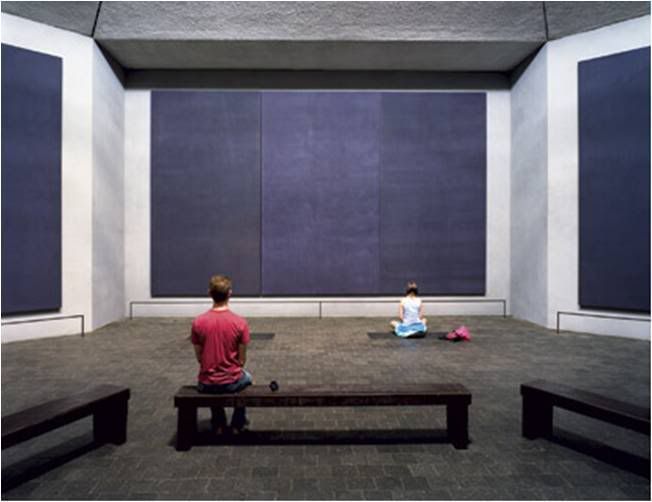
Interior photograph of Rothko Chapel, Houston, Texas
Completed 1971
"It is at once a reduction of the whole of the universe to the infinitesimal point of the anxious self and an absorption of the self in the eternal calm of the sea of being." 
-Rabbi Jacob B. Agus
In the September 26th edition of The Guardian Weekly, the opinionated British art critic Jonathan Jones describes his visit to Mark Rothko's chapel in Houston, Texas, as "a pilgrimage to the greatest marriage of art and architecture in the US." Jones worries, though, if the chapel is misunderstood, or even misused, by American visitors.

For the British critic, the Rothko chapel is "one of America's greatest and strangest monuments: a chapel created by a modern artist who had no religious beliefs." Jones is dismayed, then, to find that many visitors to the chapel are anything but irreligious.

Inside Rothko's master work, a fellow chapel-goer asks the critic if he sees in one of the over-sized paintings "the figure of Jesus Christ our Lord on the Cross?" Jones writes, "I look into the gigantic abstract work. It contains no images, Christian or otherwise."

Jones is clearly bemused that the chapel is today regarded by so many as a sacred space, and he chalks this interpretation up to our American religiosity.
"Locals use this place. They love it. They come not as tourists but to meditate, pray and talk sombrely. They see it as a religious place and the art as spiritual. It is called a chapel, and most Americans believe in God."
Jones feels Rothko would be similarly befuddled by the religious interpretation. The critic explains that Rothko designed the chapel to take "his pursuit of...the 'tragic' to its ultimate extreme" and that the artist "believed that all serious art was about death." Undoubtedly, Rothko had a fatalistic, deeply melancholic streak - he killed himself in 1970, one year before the chapel opened - but I'm not sure that the artist would, like Jones, bemoan the religious significance of his chapel.

A Russian Jewish immigrant, Rothko (originally named Marcus Rothkowitz) certainly didn't intend visitors to see Jesus Christ in his large canvases, but he was not, as Jones contends, a man "who had no religious beliefs." In fact, Rothko's father was an Orthodox Jew and the young Rothko spent time in Russian cheders before his 1913 emigration to the United States. After his family settled in Portland, Oregon, Rothko became active in the local Jewish community. Whether the future artist's connection to Judaism was principally cultural or spiritual, I do not know, but later in life he frequently described the making of his paintings as a religious experience.
Interior photograph of Rothko Chapel, Houston, Texas
Completed 1971

So what was Rothko thinking when he undertook the chapel project, and what did he intend the space to be? We can only speculate.

For his part, Jones asserts that the paintings act as doorways or portals. I agree, but the British critic insists that they are "portals of death." Jones sees the blackness of Rothko's chapel paintings as "utter desolation," blackness that shatters "any illusion of paradise." The chapel overall Jones describes as a "theatre of emptiness, death's antechamber, the self-expression of a suicide." He dismisses other interpretations, claiming that, if the Texas oil barons who commissioned the project understood more fully Rothko's deathly intentions, the chapel would not have been built.

But the blackness in Rothko's late works can also be understood as nothingness. Negative theology, more commonly referred to by the Latin via negativa, breaks down the word "nothingness" into "no-thing-ness." God, according to negative theology, is ineffable; literally, It, that is to say, God, is No Thing. As Lao tzu, author of the Tao Te Ching, wrote in that essential text, "The unnamable is the eternally real...Darkness within darkness. The gateway to all understanding."

This mystical conception of God or Being would be familiar to an educated Jew like Rothko. The Jewish Kabbalist notion of Ein Sof springs from a medieval Spanish Jew's exposure to Eastern philosophy. (Most historians agree that Moses de Leon, a prominent Spanish rabbi, composed the Zohar, the central text of Kabbalah, in the late 13th century. Some of these scholars argue that de Leon's work is a syncretic project, injecting tantra and other Eastern thought into the ever-evolving Jewish tradition.) Ein Sof, translated from Hebrew to English, literally means "there is no end." It is the unquantifiable, ambivalent and infinite energy that exists before, within and after the more mundane conception of God. The kabbalists, though, take their negative theology one step further. Ein Sof is the ineffable All, but Ayin, or "nothingness," is Ein Sof rendered finite. Some Jews consider Ayin the cosmic potential extant prior to the Big Bang.

Daniel Matt, a leading scholar of Kabbalah, writes in "God and the Big Bang":
"The paradox is that ayin embraces 'nothing' and 'everything.' This nothingness is oneness: undifferentiated, overwhelming the distinctions between things....This mystical nothingness is neither empty nor barren; it is fertile and overflowing, engendering the myriad forms of life. Medieval philosophers - Jewish, Christian and Muslim - had taught that God created the world 'out of nothing.' The mystics turn this formula on its head, reinterpreting it to mean that the universe emanated from divine nothingness."
For some religious individuals, concepts like Ayin and Ein Sof allow a point of entry. Rabbi Richard Rubenstein, a Jewish scholar and writer, speaks of God "as the Holy Nothingness." Detailing his turn from secularism to faith, he writes, I "replaced my atheistic nihilism with a mystical nihilism. To be all that there is, as God was in the beginning and will be in the end, is equivalent to being, so to speak, absolutely nothing. In the beginning, God dwelt in the womb of his own omnipotent nothingness." I love the contradictory nature of such a God!

Likewise, religious mystics of all persuasions believe that individuals must embrace darkness in order to find spiritual integrity. They must, as the prominent Rabbi Arthur A. Cohen put it, "...[surrender] to unknowing, [enter] the 'dark night' of which all mystics speak - a metaphor for the condition of desperate ignorance - and there [identify] a frail connection between the emptying of the self of all knowledge, the abandonment of knowledge, the perfect unknowing which enables the process of knowing to be renewed and the being whose existence renews. It is the passion of thought and the desire to know which presses us to the limit where thought cannibalizes itself in despair, where knowing ceases, where the emptying of the self is undergone and the fullness of God may commence."

Those chapel-goers who claim to see in Rothko's paintings Jesus Christ, Muhammad, Buddha, or any other religious hero are guilty of unimaginative literalism but, if their experiences are real, they are "seeing" through darkness into spirit. I believe that Rothko, an artist much invested in mythology and mysticism, would respect and even commend that.

Jones writes in The Guardian, "[The chapel] is not an austere, dead, modernist monument. It's a living chapel. People sing and play music. But maybe they should look around a bit more - because this is one of the most compelling rooms I have ever been in."

But why should these religious visitors have to stop worshipping, singing or otherwise participating in the work to take (what Jones considers) due notice of the room's quality? Given the power of the space, might not the room compel their behavior? Rothko insisted that he was no mere maker of abstract paintings. "If you are moved only by their color," the artist said of his mature works, "then you miss the point."

Photo credits: images ripped from HASTAC on Ning