Showing posts with label Rothko chapel. Show all posts

Sunday, November 14, 2010

Gallery Report, November 6th, 2010

On a beautiful fall Saturday, I visited a number of San Francisco's downtown galleries with Brian Friedman, a good friend and artist who was visiting the Bay Area from New York City. Although I'm very happily installed on the west coast, I haven't lived here long enough to establish close friendships, and I was impressed by how much I appreciated spending time with a friend with whom I'm so comfortable. Maybe I'm getting prematurely sentimental? Sentimental or not, I'm still a harsh judge of artwork, and most of what Brian and I viewed was unremarkable. Fortunately, there were a few exceptions.

+++++
"Narwhellian"
Seth Koen at Gregory Lind Gallery


Seth Koen
"Djiril"
2010
Wood
43.25 x 72 x 8.25 inches

Sculptor Seth Koen produces work that appeals in equal measure to my formal sensibility and my imagination. Viewers who prioritize craft will delight in Koen's refined and sensuous surfaces and formalists will applaud the forms' casual elegance. As playful as they are soulful, some wear knitted contraceptives or melt impossibly while others limn space's transcendental properties almost as effectively as a James Turrell light work.

My principal pleasure, though, is considering what the esoteric objects might represent or be. The artist avoids didacticism -- he shows instead of telling -- and the sculptures are more open-ended and interesting as a result. Are they abstracted totem animals, as the exhibition's title, "Narwhellian," might suggest? Are they instead the tools or ritual objects of some unknown, aboriginal population? Or are they sophisticated, conceptual responses to our contemporary political predicaments, another reading of the show's title? The answers, of course, are supplied by each viewer.


Seth Koen
"Medusa" and "Arachne"
2010
Wood / Wood and thread
63.5 x 5 x 7.75 inches
69 x 6 x 6 inches


+++++
"Incidental Objects"
Andy Goldsworthy at Haines Gallery


Andy Goldsworthy
"Hand hit site dust, Presidio Spire, October 2008"
2008
6 unique C-prints
16 x 16 inches, each

Could it be that Andy Goldsworthy is at last taken seriously? These days, I don't receive as much grief as I used to when I admit that I admire much of Goldsworthy's effort. Perhaps the self-conscious, punishing cool of conceptualism is finally beginning to wane, making room for artists who aspire to the sublime and wear their Romantic and mystical impulses like badges of honor? Whether or not Goldsworthy's work is taken seriously by his contemporaries, however, it is no less important. That's not to suggest that all (or even most) of the artist's output is particularly notable; nevertheless, when Goldsworthy connects, he produces profound and potent work.

A few gems are included in "Incidental Objects," his current show at Haines Gallery. The strongest work in the show is a series of photographs titled, "Hand hit site dust, Presidio Spire, October 2008." The photos document an unremarkable gesture captured in six frames; the artist smacks dry, dusty ground at the site where his "Presidio Spire" sculpture would later be constructed. By presenting the action in a Muybridge-style sequence, Goldsworthy invites the viewer to ruminate on the significance of the crude, abrupt mark-making; in so doing, he invests the unremarkable with significance or, as the exhibition's title terms it, the "incidental" is rendered radically full of meaning.

Few artists are so interested in getting dirty. Playing in the mud, Goldsworthy asks vital questions about our contemporary relationship to terrain, ritual, time, and natural processes. It's interesting, then, that video and photography, mediums we associate with an anthropological remove and even sterility, are the artist's most effective means of documentation and presentation.

+++++
"Recent Paintings"
Stephen Beal at George Lawson Gallery


Stephen Beal
"untitled"
2010
Acrylic, gouache, and graphite on wood panel
31.75 x 31.75 inches

In the Bay Area art community, Stephen Beal might be better known for his regional academic and managerial activity than for his artwork. Like many other working artists, Beal is a college professor, but he's also the active President of the California College of the Arts (CCA), a Board member of the Yerba Buena Center for the Arts, and Board President of the Creative Growth Art Center. Impressive and laudable though his contribution to Bay Area arts is, I'm pleased to report that his show of recent paintings at George Lawson Gallery proves he's an artist who "sunlights" as an arts administrator rather than an arts administrator who moonlights as an artist.

All of Beal's paintings hum and vibrate, and his brightly colored works crackle with energy; generally, however, his strongest pieces are understated, more Om than bug zapper. Admiring "untitled" (pictured above), Beal's repetitive, paced process calls to mind the meditative work of Agnes Martin. The finished, undulating picture, however, relates more to Mark Rothko's transcendental canvases. (Tweeting contemporary benefactors: "21st Century Chapel, Anyone?" But, until Daddy or Momma Warbucks steps forward to give Beal a permanent space to transform with his pictures, his work will transform one collector's wall at a time...and that's no incidental thing.)


Stephen Beal
"untitled (sb03)"
2010
Acrylic and graphite on wood panel
8 x 9 inches


Image credits: all images, courtesy the respective gallery websites

Wednesday, November 05, 2008

Rothko's Darkness

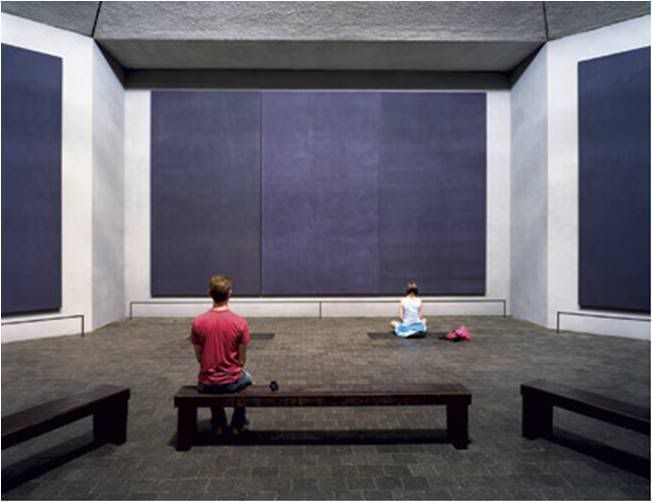
Interior photograph of Rothko Chapel, Houston, Texas
Completed 1971
"It is at once a reduction of the whole of the universe to the infinitesimal point of the anxious self and an absorption of the self in the eternal calm of the sea of being." 
-Rabbi Jacob B. Agus
In the September 26th edition of The Guardian Weekly, the opinionated British art critic Jonathan Jones describes his visit to Mark Rothko's chapel in Houston, Texas, as "a pilgrimage to the greatest marriage of art and architecture in the US." Jones worries, though, if the chapel is misunderstood, or even misused, by American visitors.

For the British critic, the Rothko chapel is "one of America's greatest and strangest monuments: a chapel created by a modern artist who had no religious beliefs." Jones is dismayed, then, to find that many visitors to the chapel are anything but irreligious.

Inside Rothko's master work, a fellow chapel-goer asks the critic if he sees in one of the over-sized paintings "the figure of Jesus Christ our Lord on the Cross?" Jones writes, "I look into the gigantic abstract work. It contains no images, Christian or otherwise."

Jones is clearly bemused that the chapel is today regarded by so many as a sacred space, and he chalks this interpretation up to our American religiosity.
"Locals use this place. They love it. They come not as tourists but to meditate, pray and talk sombrely. They see it as a religious place and the art as spiritual. It is called a chapel, and most Americans believe in God."
Jones feels Rothko would be similarly befuddled by the religious interpretation. The critic explains that Rothko designed the chapel to take "his pursuit of...the 'tragic' to its ultimate extreme" and that the artist "believed that all serious art was about death." Undoubtedly, Rothko had a fatalistic, deeply melancholic streak - he killed himself in 1970, one year before the chapel opened - but I'm not sure that the artist would, like Jones, bemoan the religious significance of his chapel.

A Russian Jewish immigrant, Rothko (originally named Marcus Rothkowitz) certainly didn't intend visitors to see Jesus Christ in his large canvases, but he was not, as Jones contends, a man "who had no religious beliefs." In fact, Rothko's father was an Orthodox Jew and the young Rothko spent time in Russian cheders before his 1913 emigration to the United States. After his family settled in Portland, Oregon, Rothko became active in the local Jewish community. Whether the future artist's connection to Judaism was principally cultural or spiritual, I do not know, but later in life he frequently described the making of his paintings as a religious experience.
Interior photograph of Rothko Chapel, Houston, Texas
Completed 1971

So what was Rothko thinking when he undertook the chapel project, and what did he intend the space to be? We can only speculate.

For his part, Jones asserts that the paintings act as doorways or portals. I agree, but the British critic insists that they are "portals of death." Jones sees the blackness of Rothko's chapel paintings as "utter desolation," blackness that shatters "any illusion of paradise." The chapel overall Jones describes as a "theatre of emptiness, death's antechamber, the self-expression of a suicide." He dismisses other interpretations, claiming that, if the Texas oil barons who commissioned the project understood more fully Rothko's deathly intentions, the chapel would not have been built.

But the blackness in Rothko's late works can also be understood as nothingness. Negative theology, more commonly referred to by the Latin via negativa, breaks down the word "nothingness" into "no-thing-ness." God, according to negative theology, is ineffable; literally, It, that is to say, God, is No Thing. As Lao tzu, author of the Tao Te Ching, wrote in that essential text, "The unnamable is the eternally real...Darkness within darkness. The gateway to all understanding."

This mystical conception of God or Being would be familiar to an educated Jew like Rothko. The Jewish Kabbalist notion of Ein Sof springs from a medieval Spanish Jew's exposure to Eastern philosophy. (Most historians agree that Moses de Leon, a prominent Spanish rabbi, composed the Zohar, the central text of Kabbalah, in the late 13th century. Some of these scholars argue that de Leon's work is a syncretic project, injecting tantra and other Eastern thought into the ever-evolving Jewish tradition.) Ein Sof, translated from Hebrew to English, literally means "there is no end." It is the unquantifiable, ambivalent and infinite energy that exists before, within and after the more mundane conception of God. The kabbalists, though, take their negative theology one step further. Ein Sof is the ineffable All, but Ayin, or "nothingness," is Ein Sof rendered finite. Some Jews consider Ayin the cosmic potential extant prior to the Big Bang.

Daniel Matt, a leading scholar of Kabbalah, writes in "God and the Big Bang":
"The paradox is that ayin embraces 'nothing' and 'everything.' This nothingness is oneness: undifferentiated, overwhelming the distinctions between things....This mystical nothingness is neither empty nor barren; it is fertile and overflowing, engendering the myriad forms of life. Medieval philosophers - Jewish, Christian and Muslim - had taught that God created the world 'out of nothing.' The mystics turn this formula on its head, reinterpreting it to mean that the universe emanated from divine nothingness."
For some religious individuals, concepts like Ayin and Ein Sof allow a point of entry. Rabbi Richard Rubenstein, a Jewish scholar and writer, speaks of God "as the Holy Nothingness." Detailing his turn from secularism to faith, he writes, I "replaced my atheistic nihilism with a mystical nihilism. To be all that there is, as God was in the beginning and will be in the end, is equivalent to being, so to speak, absolutely nothing. In the beginning, God dwelt in the womb of his own omnipotent nothingness." I love the contradictory nature of such a God!

Likewise, religious mystics of all persuasions believe that individuals must embrace darkness in order to find spiritual integrity. They must, as the prominent Rabbi Arthur A. Cohen put it, "...[surrender] to unknowing, [enter] the 'dark night' of which all mystics speak - a metaphor for the condition of desperate ignorance - and there [identify] a frail connection between the emptying of the self of all knowledge, the abandonment of knowledge, the perfect unknowing which enables the process of knowing to be renewed and the being whose existence renews. It is the passion of thought and the desire to know which presses us to the limit where thought cannibalizes itself in despair, where knowing ceases, where the emptying of the self is undergone and the fullness of God may commence."

Those chapel-goers who claim to see in Rothko's paintings Jesus Christ, Muhammad, Buddha, or any other religious hero are guilty of unimaginative literalism but, if their experiences are real, they are "seeing" through darkness into spirit. I believe that Rothko, an artist much invested in mythology and mysticism, would respect and even commend that.

Jones writes in The Guardian, "[The chapel] is not an austere, dead, modernist monument. It's a living chapel. People sing and play music. But maybe they should look around a bit more - because this is one of the most compelling rooms I have ever been in."

But why should these religious visitors have to stop worshipping, singing or otherwise participating in the work to take (what Jones considers) due notice of the room's quality? Given the power of the space, might not the room compel their behavior? Rothko insisted that he was no mere maker of abstract paintings. "If you are moved only by their color," the artist said of his mature works, "then you miss the point."

Photo credits: images ripped from HASTAC on Ning