Showing posts with label conservation. Show all posts

Saturday, January 04, 2014

"Project George"

Christopher Reiger
"Chelonoidis nigra abingdonii (memento mori)"
Archival inkjet print on bamboo paper8" x 10"2013
I've been swamped with various projects these last few months, and I'm very belatedly announcing the terrific project below. It officially launched in November 2013.

I'm honored to have a recent photograph featured as one of the two prints kicking off the tribute, and it's a treat to be in the good company of Jonathan Woodward.

Sunday, September 08, 2013

Bad Ideas For "America's Best Idea"

"In a soul-searching, head-scratching journey of its own, the agency that manages some of the most awe-inspiring public places is scrambling to rethink and redefine itself to the growing number of Americans who do not use the parks in the way that previous — mostly white — generations did. Only about one in five visitors to a national park site is nonwhite, according to a 2011 University of Wyoming report commissioned by the Park Service, and only about 1 in 10 is Hispanic — a particularly lackluster embrace by the nation’s fastest-growing demographic group.

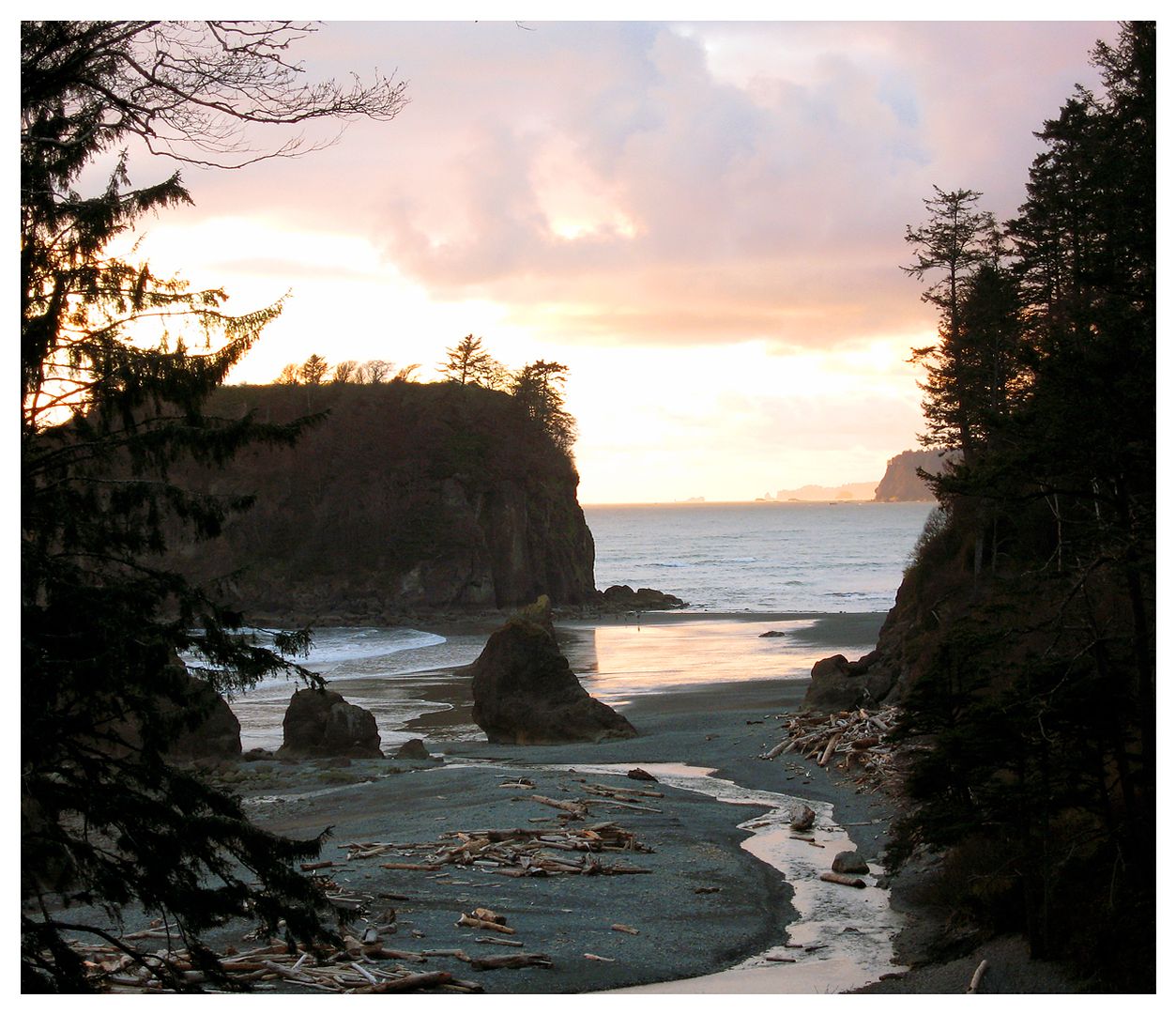
View of Ruby Beach, Olympic National Park
April 2008
[…] But the new effort goes further, to the question of how, and how much, the parks themselves must change to attract a fundamentally different audience. Wireless access, for example — still nonexistent in much of the Park Service universe — could divide older park visitors from minorities and young people, the so-called millennial generation, who want to share the experience live in social media with their peers.

'Boomers maybe want to get away, and millennials want to be connected; that changes how you use the space,' said Laura Swapp, REI’s director of diversity and inclusion. Music events could be another potential generational dividing line — peace and quiet versus entertainment — but would also draw the demographic the Park Service is after, Ms. Swapp said."

Here's hoping Jay-Z and Lady Gaga never perform on stages in Yellowstone or Yosemite.

Although I, too, would like to see more cultural and racial variety on our parks' trails, further developing the parks with WiFi towers and concert venues would be a myopic and ultimately fruitless move. Few areas of the American landscape afford us with the opportunity to "tune in" by tuning out, and the National Park Service should not fundamentally alter its mission in an effort to appeal to younger and more diverse demographics.

Instead, the NPS needs to celebrate the conservation heroes of color -- Majora Carter and Van Jones, for example, as well as the growing number of African American and Latino NPS rangers -- thereby providing role models for today's youth. Most importantly, we need more programs that get urban kids into our parks, encouraging them to recognize that these tracts belong to them. It's possible that their time afield without phone calls, Facebook, and Reddit will stay with them, appreciated, even if they're less than enthusiastic about the mosquito bites.

Photo credit: Christopher Reiger, 2008

Wednesday, October 17, 2012

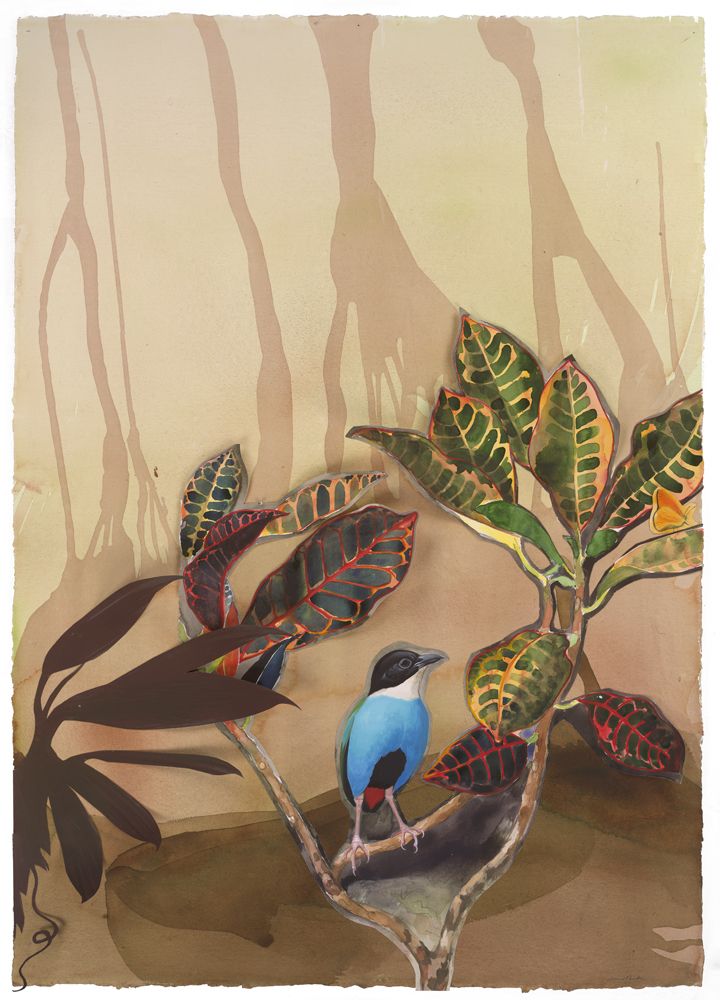
David Tomb's "Grand Birds"

David Tomb
"Azure-breasted Pitta"
2012
Painted papers with mixed media and partially pasted and or completely pasted on paper with mixed media
42 x 30 inches
"Grand Birds of the Philippines," David Tomb's current solo show at Electric Works, is deserving of a thoughtful review. Disappointingly, my writing time is limited this month and I can provide only a few observations.

Monday, September 24, 2012

In good company (and family)

Egon Schiele
"Woman Crouching"
1918
In a post that appeared here in August 2005, I touched on my longtime love of Egon Schiele's paintings and drawings. I wrote,
"[In my teens, as] I learned more about the work of twentieth century art world luminaries, I came to love the paintings of Egon Schiele, Max Beckmann, and Francis Bacon. My attraction to these three artists should have come as no surprise, but it would be several years before I realized what these three painters share: a bold, graphic approach to contour and color. They are illustrators' painters every bit as much as they are painters' painters; their work points to the absurdity of the distinction."
I still adore Schiele's figures and landscapes. Although I no longer refer to him as my favorite artist, he remains a major figure in my pantheon.

Imagine my delight, then, when I discovered this morning that Alice Jones, a young artist in New Zealand, cites Schiele and me as her favorite artists in a video Q&A she posted to her blog. (Thanks for the nod, Alice! I'm thrilled that my pictures speak to you.)

Sunday, November 27, 2011

Elisheva Biernoff's "Inheritance"


Elisheva Biernoff
"Inheritance"
2010
80 slides of endangered wilderness areas projected onto mist from a humidifier housed in a plywood and fabric enclosure

Environmental historian William Cronon argues that "only people whose relation to the land was already so alienated could hold up wilderness as a model for human life in nature, for the romantic ideology of wilderness leaves precisely nowhere for human beings actually to make their living from the land." I recalled Cronon's incisive critique of wilderness ideology as I pondered artist Elisheva Biernoff's "Inheritance," a compelling installation included in Eli Ridgway Gallery's recent group show, "Better A Live Ass Than A Dead Lion."

"Inheritance" was installed in a dark side gallery on Ridgway's lower level. A wall-mounted, carousel slide projector cast images of "endangered wilderness areas [...] onto mist from a humidifier housed in a plywood and fabric enclosure." The humidifier's fog billowed out of a television-sized opening cut into the plywood, and the projected photographs reflected by the haze were sometimes -- for an instant, when the mist was just so -- recognizable as landscapes, but rarely as specific environments or locations. Without the artist's accompanying list of "disappearing places," viewers couldn't know they were looking at Alaska's Tongass National Forest, Florida's Everglades, Brazil's Pantanal, China's Gobi Desert, or another of nearly 80 imperiled landscapes.


Elisheva Biernoff
"Inheritance"
2010
80 slides of endangered wilderness areas projected onto mist from a humidifier housed in a plywood and fabric enclosure

Biernoff's installation, which was also included in ProArts Gallery's 2010 "2 X 2 Solos" exhibition program (and, by virtue of its strength, will likely be a part of future exhibitions), is luminous and its effect almost ethereal, but unlike the meditative Light and Space works of James Turrell or Doug Wheeler, Biernoff's installation doesn't provide opportunity for reverie. The transitions between the images are abrupt, and marked by the noisy, mechanical advance of the slide carousel. Ka-jenk, Ka-jenk. Just as we begin to discern the vision roiling in the mist -- 'Is that a jungle? Perhaps a swamp?' -- we're jarred from our musing. Ka-jenk, Ka-jenk. Again, we endeavor to interpret the play of light and color in the vapor, and again: Ka-jenk, Ka-jenk! A contemplative inclination is foiled by the machine's relentless progress, and there's sly humor in Biernoff's frustration of our stubborn need to identify and classify; viewers can see the specters in the mist, but can't make much (if any) sense of them. Even so, we'll continue to plumb the rolling fog for clues.

Our ancestors assigned supernatural qualities to fluid media. They scried smoke to portend future events and viewed it as a vehicle of conveyance, capable of carrying the essence of a sacrifice to the god or spirits of a people. In "The Wizard of Oz," the face of the eponymous wizard appears to the protagonists in a cloud of reddish smoke, causing them to tremble in awe. Seeking a similar experience of wonder, many of the people who visit wilderness areas do so to behold nature's majesty. Their language is often reverent; they speak of the sublime and the transcendent. But what is a wilderness area, exactly? According to the United States Wilderness Act of 1964, wilderness is land that "generally appears to have been affected primarily by the forces of nature, with the imprint of man's work substantially unnoticeable [...that is] designated for preservation and protection in [its] natural condition." Unfortunately, the "imprint of man" is not always readily observable (consider the nuanced affects of climate change or the irradiated, if picturesque Red Forest that surrounds the decommissioned Chernobyl Nuclear Power Plant). More problematically, as Cronon makes clear, the Wilderness Act definition sets man apart from "the forces of nature." This latter move is a Romantic, naive impulse. All habitats are interconnected; even protected landscapes are affected by activities outside their boundaries. Moreover, because many refuges, parks, and wilderness areas are disconnected from other undeveloped lands, the flora and fauna living in these protected areas risk genetic isolation and face an increased risk of local extinction (e.g., the Florida panther and many other critically endangered species). Outside of the Wilderness Act and our collective imagination, then, there is no "original" or "virgin" landscape.

The dreamlike quality of Biernoff's installation is therefore appropriate. The notion of "wilderness" is as indefinite as the mirages the artist creates for us with light and vapor. Some fictions, though, are useful. If the dream of Eden compels us to be better stewards, it's all for the good. Yet Biernoff reminds us that we're more likely to avoid the pitfalls of ideology if we recognize wilderness is an illusion, that the specter before us is manufactured using a humidifier and an outmoded piece of technology. The artist presents us with the wizard's face, but also reminds us of the man behind the curtain.

Elisheva Biernoff's "Inheritance" was on view October 8 - November 5, 2011, at Eli Ridgway Gallery (172 Minna Street, San Francisco).


Elisheva Biernoff
"Inheritance"
2010
80 slides of endangered wilderness areas projected onto mist from a humidifier housed in a plywood and fabric enclosure

Image credits: "Inheritance" installation photographs, courtesy Eli Ridgway Gallery

Note: Due to carelessness, this write-up was originally published as a "Review In Brief." It's longer than the pieces in that series, however, and is no longer associated with it.

Saturday, September 24, 2011

Acknowledging Exceptionality

"As glass office and condominium towers have proliferated in the last decade, so, too, have calls to make them less deadly to birds. The San Francisco Planning Commission adopted bird-safety standards for new buildings in July, and this month that city’s Board of Supervisors will vote on making it law. Legislation is pending in Washington that would require many federal buildings to incorporate bird-friendly designs. The United States Green Building Council, a nonprofit industry group that encourages the creation of environmentally conscious buildings, will introduce a bird-safety credit this fall as part of its environmental certification process, called LEED."
- "A City of Glass Towers, and a Hazard for Migratory Birds," New York Times, September 14, 2011
I enjoyed reading "A City of Glass Towers, and a Hazard for Migratory Birds," a recent New York Times article about bird-building collision mortality. Lisa Foderaro's piece is a hopeful account of how a confluence of activism, technology, and regulation can improve the lot of animals, especially in cases where a particular species has been adversely affected by human development.

The comments that follow the article, however, are predominated by doom-and-gloom attitudes. A representative survey follows:
All that matters are people and every little whim. We're a doomed species.
-Karma Every Moment, NY, NY

The people who tell us that evolution and climate change are just unproved theories have no idea how life formed this planet since its inception and no understanding whatsoever of the role of extinction in maintaining the climate within habitable bounds when any one plant or animal breaks the equilibrium. They convinced me long ago that there is no future for my own children.
-Steve Bolger, NY, NY

Yet another example of the consequences of man's selfish and destructive behavior. So sad.
-agetibi, Carrboro, NC
No wonder over 50% of Americans polled by The Nature Conservancy caricatured environmentalists as preachy reactionaries. In the words of the Conservancy's Chief Scientist, Peter Kareiva, most people see members of the environmental movement as "misanthropic, anti-technology, anti-growth, dogmatic, purist, zealous, exclusive pastoralists." Unsurprisingly, this negative stereotype has led to a dwindling of the movement's ranks.

I consider myself an environmentalist, but I distinguish between preservation and conservation (placing myself in the latter camp) and, more critically, I believe that environmentalism needs to embrace a "can do" attitude. If the majority of my fellow Times readers identify as environmentalists, their comments suggest that they're a well-intentioned pox. Wholesale condemnation of our species is as wrongheaded and malignant as exclusive glorification. In order to decry humanity as a "selfish and destructive" brute, one must stubbornly overlook all the evidence to the contrary. I wrote about such oversight in an essay included in the catalog for "A Live Animal," a group show that Selene Foster and I co-curated at Root Division.
"Although 'deep ecologists' and animal rights activists bemoan conservation approaches that prioritize human interests, the fact remains that human beings are exceptional animals. Skeptics and naysayers need only consider our species' biological and imaginative success to find evidence of our unprecedented faculty. But of all our remarkable features and feats, among the most notable examples of humanity's anomalous nature is our interest in and empathy for other species. Although there is growing scientific agreement that some other species possess self-awareness and even a capacity for empathy -- whales, dolphins, elephants, and our ape relatives are especially interesting in this regard -- humans are the only animal striving to learn about and better the lot of other creatures and environments. It's true that we often prioritize short-term, anthropocentric interests and it's also clear that reckless human activity has contributed to dramatic climate change and the ongoing Holocene extinction (our geological epoch's staggering loss of biodiversity), but conservation efforts and legislation, as well as our burgeoning interest in sustainability, speak to another, more hopeful human impulse; we possess an innate ability to see ourselves in other animals and, in turn, to recognize our capability as their stewards and representatives."
In short, we're not all bad. If you believe that we are, then you're guilty of sapping our species' potential. Christopher Cokinos is excellent on this point. I've quoted his terrific "Consolations of Extinction" essay before; I'll do it again.
"Too much grief for the world means less energy to help it along. [When] you find yourself free of the poisons that too much angst can cultivate, then something marvelous happens. You can sense how very old the planet is, how very old life and death are, and you can keep going on, you can keep doing the work you do in this universe, feeling despair when you feel despair, feeling - amazing - joy when you feel joy."

Thursday, January 20, 2011

Surprise! Cats kill!


My cat, Mr. Misi, displays his inner killer

"Conspiracies Don't Kill Birds. People, However, Do.," the title of a recent piece in the New York Times declares. The article reports that US Fish & Wildlife research shows that "some of the biggest death traps" for songbirds in the United States are the jaws and claws of domestic and feral cats. The author dubs the USFWS finding "surprising," but it shouldn't be. Folks surprised by this report are either innocently ignorant of wildlife (and of the wild within the lives we've tenuously domesticated) or they willfully deny the ambivalent violence that animates so much life, cat, bird, and human included.

Read the NY Times piece, then revisit "i taut i taw a putty tat," an HH post from April 13, 2005, in which I discuss some of the realities of cat predation and make it clear that, though I'm a cat lover par excellence, our nation's songbirds, small mammals, and reptiles need us to stop playing favorites.

Photo credit: Hungry Hyaena, 2004

Wednesday, December 29, 2010

Relative Birthday Abundance


Tundra (or Whistler) swans; Heron Hope; Locustville, VA; December 2010

As an enthusiastic amateur naturalist living in New York City, I grew fond of the hearty, adaptive species that populated the boroughs' streets, parks, and waterfronts: pigeons and gulls, rats and red-tailed hawks, starlings and squirrels. When I felt out of step with my urban friends and neighbors, as I occasionally did, I found that watching the animals helped. Chittering around the base of a corner garbage can, the sparrows and starlings chastised me for moping. The herring gull's shrill shout over the East River exhorted me to shake off my self-conscious alienation. All of these species were part of my urban wildlife support network. Watching them reminded me to get on with the business of grateful L-I-V-I-N', no matter where I might be. Now that I live in San Francisco, a town with greater biodiversity than NYC, I'm happy to have Steller's jays, Brewer's blackbirds, and ravens keeping me company, too.

Today, however, my girlfriend and I are visiting my parents on the Eastern Shore of Virginia. Dumped on by the latest "snowpocalypse," we've been locked in for most of our visit. Not that I mind. Yesterday morning, I trudged through the snow drifts around my home ground, eyes squinted in the dazzling winter light. In the space of an hour, I saw thousands of snow geese rise noisily from a partially exposed barley field; turkey vultures sweep across the sky, scenting for an unfortunate victim of the biting weather; a woodcock flush from a hedge; coyote tracks that skirted a small cemetery; mouse tracks that emerged from under a snow-covered plow and lightly skipped across the snowfall's surface to a patch of open grass; a yellow-rumped warbler and a Carolina wren vying for position atop a perch; two tundra (or whistling) swans flying low overhead; Canada geese and green-winged teal gathered in the open water of the estuary; a cottontail peer from a tangle of grasses. It occurred to me, as I contemplated such abundance and diversity, that my urban wildlife support network, whatever its personal value, is but a shadow of what I witnessed this December morning.


Sunset; Heron Hope; Locustville, VA; December 2010

Last year, at this time, I wrote, "32 years on this Earth, and still I feel like I am opening my eyes for the first time." Now 33, that statement is no less true. Given my stubborn optimism, I presume that it will be true at 43, 53, or 83 (should I survive so long). Still, I wish that I could open my eyes to greater species diversity in the cities that I call home. We humans are an increasingly urban species, and we must take care not to forget about the world's collapsing biodiversity. It isn't just the country folks that benefit from it; we all do, whether we appreciate that fact or not.

All the same, I'm looking forward to hearing the belated birthday croaks from the ravens above the Inner Sunset.

Happy 2011, friends. May it be a rich, sweet, and happy year!


Snow Geese; Heron Hope; Locustville, VA; December 2010

Photo credit: Hungry Hyaena, 2010

Friday, December 03, 2010

Red Wolf ESPP Prints Released!


Christopher Reiger
"Constellation (Canis rufus)"
2010
Pen and sumi ink, gouache, and watercolor on Arches paper
15 x 12 inches

My 2010 drawing "Constellation (Canis rufus)" has been made into a limited edition print for the Endangered Species Print Project (ESPP). The drawing features the red wolf (Canis rufus), a critically endangered wolf species.

I wrote the following description of the red wolf and its plight for the ESPP website:
"The Red Wolf (Canis rufus) is a medium-sized North American canid, generally larger than a coyote but smaller than the gray wolf. As the common name suggests, red wolves often have reddish fur on and around their ears, neck, and legs. Like other wolves, the Red Wolf is a social species that lives in packs, groups typically comprised of a mated pair and their offspring (of multiple generations). Red Wolves are crepuscular predators, most active at dusk and at dawn. They prey on white-tailed deer, raccoons, opossums, rabbits, and rodents, but are also known to scavenge.

The Red Wolf once occupied a range that extended over the forests, swamps, and coastal plains of the southern and eastern areas of the United States, as far west as Texas and as far north as New York. As with most non-domesticated canines, however, the Red Wolf was vilified as a dangerous competitor of man (and, erroneously, a "man-eater"). These entrenched, negative attitudes gave rise to aggressive predator control campaigns; wolves were poisoned, shot, and trapped. This persecution was compounded by habitat loss and disease, taking a terrible toll on red wolf populations. By 1980, the species was extinct in the wild.

Today, though, there is good news. Thanks to several focused preservation and reintroduction programs, and especially to the efforts of the Point Defiance Zoo & Aquarium (PDZA) and the United States Fish & Wildlife Service (USFWS), in conjunction with programs like that at Mill Mountain Zoo, the Red Wolf is staging a small, isolated recovery. There are now approximately 100 wolves living wild in eastern North Carolina and up to 250 individuals in zoo-based captive breeding programs."
As per the ESPP model, this is a limited edition of 100 prints, the number determined by the featured animal's current wild population. The print measures 8 x 10 inches, and costs a mere $50.00. ALL proceeds from sale of the prints will be donated to the Port Defiance Zoo & Aquarium Red Wolf Recovery Program.

As I explain in the ESPP artist notes, my fascination with taxonomy increased my interest in researching this particular species:
"Ecology, wildlife biology, and natural history are subjects that I'm passionate about, and I'm especially intrigued by taxonomy, the classification of different species. The ever-evolving field's binomial nomenclature is chock-a-block with curious etymological backstories and, more importantly, taxonomists are endlessly debating species classification. Names change, species become subspecies (and vice versa), and protected animals become unprotected animals on what seems to be a month-to-month basis! The red wolf is no exception. It's an honor to produce an artwork that may, in some small way, help save a keystone predator from extinction and genetic isolation; I must admit, however, that I also planned to use the print as an excuse to learn more about the particulars of the red wolf taxonomic debate.

Some wildlife biologists insist that the red wolf's scientific name is Canis lupus rufus and that the animal is a subspecies of gray wolf (Canis lupus). Another camp, one that the US Fish & Wildlife Service concurs with, believes the wolf to be a species distinct from the gray wolf. It is their classification, Canis rufus, that I use in the species description above. Frankly, both groups make valid arguments; the different verdicts depend on whether the red wolf is classified according to the biological classification rule (i.e., if Wolf A can make viable pups with Wolf B, the two wolves belong to the same species) or the phenotypic/phylogenetic approach to classification, based on distinct physiological or genetic characteristics. Because the phenotypic/phylogenetic approach leads to a great many more species, it remains a source of contention within wildlife biologist communities and complicates conservation politics, for better and for worse.

Of primary importance, though, are the animals. Whether red wolves are ultimately deemed their own species or a subspecies of gray wolf, they're on the brink of extinction. There is ample cause for hope, however, and you can make that hope a little more concrete by purchasing a print!"
Visit the ESPP site to learn more and, during this holiday season, please consider helping the species by buying a print as a gift.

Sunday, September 05, 2010

ESPP at Chicago's Renegade Craft Fair


The Endangered Species Print Project will be exhibiting at the Renegade Craft Fair, taking place this September 11th and 12th, in Chicago.

Co-founders Jenny Kendler and Molly Schafer will be selling prints to raise funds for all of the fourteen species so far featured in ESPP prints, as well as some upcoming print subjects, including my red wolf (Canis rufus).

I'm pleased to report that, to date, the ESPP has raised $4,000 for critically endangered species, and hopes to raise another $6,000 at Renegade! If you're in or around the Windy City, please pay them a visit.

Wednesday, July 21, 2010

ESPP Anniversary


Molly Schafer
"Moldavian Meadow Viper"
2010
Archival giclee print (Edition of 2000)
8 x 10 inches

The Endangered Species Print Project recently celebrated their one year anniversary! To mark it, they released three new prints.

I'm especially fond of the two newly available limited editions created by the project's co-founders, Molly Schafer and Jenny Kendler...and I'm most drawn to the Moldavian Meadow Viper (Vipera ursinii ssp. moldavica). This, for three reasons: Molly rendered the animal beautifully; I adore serpents, and Molly evidently does, too; I have an irrational attachment to Hungary, since my paternal great-grandparents hail from the country, and sales of the print benefit the Hungarian Meadow Viper Conservation Center, a conservation organization based there.

Visit the ESPP site to see the other prints.

Image credit: Courtesy the Endangered Species Print Project

Wednesday, April 28, 2010

Revisiting the Steady State Economy

On the heels of not one, not two, but three Republican blockades of financial regulatory legislation in the U.S. Senate this week, I thought it worth reposting the below essay on the concept of a Steady State Economy. The essay was originally posted on HH in April 2005; five years later, there's only that much more reason for thoughtful, comprehensive reform.

+++


Environmentalism is becoming something of a religion. Those who subscribe to most or all of the tenants of the environmentalist doctrine are among the movement’s acolytes, composting and recycling, canvas bagging it and buying organic, living what they consider “healthier,” less “impactful” lives. A thoughtful environmentalist should recognize these actions to be sacraments grounded in a hybrid moral code. “I am doing my part to rectify the mess made by the sinners around me.” How persuasive is this feeling of self-worth and moral superiority? Like all religious conviction, it is undeniably powerful and fulfilling, but it comes at a cost. Too often this fetal “religion” ignores fact in favor of that which is deemed morally superior. For example, radical environmentalists demand a wilderness without humans, ignoring the fact that management (stewardship) is now an unfortunate necessity given our exuberant use of natural resources and our continued sprawl. Reason must enter into the equation. Thoughtful environmentalism of the secular variety is possible, as long as we don’t allow ourselves to become vain.

This brings me to the concept of the Steady State Economy.

I first heard wind of Brian Czech’s Center for the Advancement of the Steady State Economy (CASSE) project a year ago. My initial reaction was positive, though I feared support for the concept would be relegated to left-wing environmental groups of the “religious” variety. Surprisingly, I am hearing the term used with more frequency these days, sometimes by folks with little interest in preserving biodiversity or encouraging ecological sustainability.

I am a proponent of the philosophy (read this .pdf for an excellent summary). The front page of the CASSE website states:
Economic growth is an increase in the production and consumption of goods and services. It entails increasing population, per capita consumption, or both. Economic growth leaves a larger ecological footprint, causing civil strife and bringing nations into conflict.”
This simplifies, for the sake of dramatic impact, the arguments made by the economists behind the SSE. For me, the heart of the matter is touched on in the following selection.
“…Wildlife biologists know that a wide variety of social structures may produce stable populations. The same holds true for a steady state economy. For example, a steady state economy with long human life spans entails low birth and death rates. In our opinion this is preferable, within reason, to a steady state economy with short life spans, high birth rates, and high death rates. The same concept applies to capital and durable goods such as automobiles. We opine that a relatively slow flow of high-quality, long-lasting goods is preferable to a fast flow of low-quality, short-lived goods.”
The SSE will not take hold in the United States anytime soon, but in more socially-minded democracies, like Sweden or England, the approach is not so alien. The truth is, however, such a transition from market-driven capitalism to stability-driven capitalism is unlikely to occur unless the populous desires as much. In the United States, our stock market would require overhaul, making it “less of a casino,” by decreasing its volatility and demand for liquidity. This seems unlikely, especially in the immediate future. In fact, were the transition to begin today, the market would likely hemorrhage. Making things even more unattractive for the “powers that be,” implementation of the Steady State Economy requires, for countries like the United States, a marked decrease in Gross Domestic Product. As a result, I believe the SSE can not become a concrete reality in the foreseeable future, but that we should strive for it no less.

As the selection below suggests, there is much to be gained from the sustainable lifestyle.
“Nor would any cultural stagnation result from a steady state economy. John Stuart Mill (1806-1873), one of the greatest economists and political philosophers in history, emphasized that an economy in which physical growth was no longer the goal would be more conducive to political, ethical, and spiritual improvements.”
Ah, yes, ethical and spiritual improvement… So we’re back to individual action and lifestyle choices, rubbing shoulders with the “religious” environmentalists. Where do I sign up to feel superior to the rest of the heathens? I already recycle, canvas bag it, and eat only meat that I have caught or killed myself. I’m a few sacraments shy of donning a robe and shuffling off to the commune. Why shouldn’t I begin buying everything carefully and, in my own way, push for the adoption of the SSE at a local level?

Well, the truth is I should.

I self-consciously poke fun at the problematic aspects of environmentalism only because it is so close to my heart. I am not a religious man in the popular or traditional understanding of the word. Biology, anthropology, paleontology, history: these are my holy tomes. Yet I firmly believe that through careful consideration, research, and political pressure we can arrive at a more complete conservation ethic, one which addresses not only biodiversity and “wilderness” (my principal areas of interest), but also global poverty and human rights.

Photo credit: ripped from the World Food Programme website

Thursday, April 15, 2010

ESPP interview posted

In conjunction with the release of my Endangered Species Print Project Javan Rhinoceros print, ESPP co-founder Molly Schafer interviewed me this past weekend.

We chat about rhinos (of course), Albrecht Durer, wildlife illustrator Keith Brockie, and the religion-science relationship. I also share a Botswana lion story.

The interview is now posted on the ESPP blog. Read it here.

Friday, April 09, 2010

Javan Rhinoceros ESPP Prints Available


Christopher Reiger
"diminishing returns"
2010
Pen and sumi ink, gouache and watercolor on Arches paper
15 x 12 inches

My 2010 drawing "diminishing returns" has been made into a limited edition print for the Endangered Species Print Project. The drawing features the Javan Rhinoceros (Rhinoceros sondaicus), a species on the very brink of extinction.

From the ESPP website:
"The Javan, or Sunda, Rhinoceros, is one of five extant rhinoceros species. The species was once widespread throughout Asia but is today critically endangered. There are currently between 37 and 44 Javan Rhinos in Ujung Kulon National Park, in West Java Indonesia, and no more than 5 in Cat Tien National Park, in Vietnam. Sadly, with only two known populations in the wild and none in captivity, this rhino species may be the rarest large mammals on our planet."
As per the ESPP model, this is a limited edition of 49 prints, the number determined by the featured animal's current population. The print measures 8 x 10 inches, and costs a mere $50.00. ALL proceeds from sale of the prints will be donated to the International Rhino Foundation.

The drawing was something of a first for me. As I explain for the ESPP artist notes,
"Animals figure prominently in my drawings and paintings. Usually, however, there is plenty of photographic art scrap to use as source material. In the case of the Javan Rhinoceros, this is definitely not the case!

In order to minimize stress for the critically endangered rhino, researchers study the species via fecal sampling and camera traps; the animals are rarely encountered or observed. As a general rule, the Javan Rhino is wary of humans and retreats into dense forests when they sense our presence. When humans do approach, whether intentionally or by mistake, the Javan Rhino becomes aggressive and will often attack, stabbing with the incisors of its lower jaw while thrusting upward with its head. Of course, such wariness and aggression are good survival tactics, but it makes the rhinos extremely difficult to study. (Interestingly, some researchers contend that these behaviors are a recent adaptation to population stresses. Historical records indicate that the species was once more gregarious.)

Because so little photographic documentation is available, this drawing marked the first time I've had to work from both images and written descriptions. It was a very curious process, and I hope that I've done the Javan Rhino justice!"
Visit the ESPP site to learn more.

Thursday, March 18, 2010

Mixed Environmental News

In HH's early days, I often wrote about the health of marine ecosystems and the urgent need for more sustainable fisheries. While I no longer address these issues as frequently as I did at the project's outset, I'm every bit as invested in environmental and conservation causes. Thus, I find today's New York Times piece "UN Rejects Export Ban on Atlantic Bluefin Tuna" discouraging...but also slightly promising.

It's discouraging to read, because the news is generally bad:
"A U.S.-backed proposal to ban the export of Atlantic bluefin tuna prized in sushi was rejected Thursday by a U.N. wildlife meeting, with scores of developing nations joining Japan in opposing a measure they feared would devastate fishing economies. It was a stunning setback for conservationists who had hoped the 175-nation Convention on International Trade in Endangered Species, or CITES, would give the iconic fish a lifeline. They joined the proposal's sponsor Monaco in arguing that extreme measures were necessary because the stocks have fallen by 75 percent due to widespread overfishing.

'Let's take science and throw it out the door,' said Susan Lieberman, director of international policy with the Pew Environment Group in Washington. 'It's pretty irresponsible of the governments to hear the science and ignore the science. Clearly, there was pressure from the fishing interests. The fish is too valuable for its own good.'"
The report is also slightly promising, however, because the United States has again positioned itself as a proponent of conservation measures.
"Only the United States, Norway and Kenya supported the proposal outright. [...] The tuna defeat came hours after delegates rejected a U.S. proposal to ban the international sale of polar bear skins and parts, suggesting that economic interests at this meeting were trumping conservation.

The Americans argued that the sale of polar bears skins is compounding the loss of the animals' sea ice habitat due to climate change. There are projections that the bear's numbers, which are estimated at 20,000 to 25,000, could decline by two-thirds due by 2050 due to habitat loss in the Arctic."
The end result, then, is by no means a happy one...but what a welcome policy change from the days of Bush & Company!?

Note: This post also appears on the Endangered Species Print Project blog.

Tuesday, February 16, 2010

Endangered Species Condom Project


I'm happy to help spread word about The Center for Biological Diversity's terrific Endangered Species Condom Project. The organization is addressing human overpopulation in a novel, fun way.

Such approaches are vital to opening a floor for further discussion. Even though our species' population is a clear-and-present threat to hundreds of thousands of other species (as well as to the Earth's limited natural resources), population control remains a fiercely debated and sensitive subject.

From the CBD's press release:
"At 6.8 billion people, the human race is not only the most populous large mammal on Earth but the most populous large mammal that has ever existed. Providing for the needs and wants of this many people — especially those in high-consumption, first-world nations — has pushed Homo sapiens to absorb 50 percent of the planet’s freshwater and develop 50 percent of its landmass. As a result, other species are running out of places to live.

To help people understand the impact of overpopulation on other species, and to give them a chance to take action in their own life, the Center is distributing free packets of Endangered Species Condoms depicting six separate species: the polar bear, snail darter, spotted owl, American burying beetle, jaguar, and coquí guajón rock frog.

The beautifully designed packages, featuring clever slogans, are being distributed by a network of 3,000 volunteers ranging from ministers to grandmothers to healthcare providers to college students and biologists. The condoms will be handed out at concerts, bars, universities, spiritual groups, local events, and farmer’s markets. Along with two condoms, each package contains original artwork and information on the species, facts about overpopulation and the extinction crisis, and suggestions on how the human population can be stabilized."
I'm certainly no fan of the tribalistic and despicable practices of groups like Quiverfull, but the general population needs to be better educated about the dangers of overpopulation, too. I'll be distributing the condoms around New York City during the next two weeks.

If you know me, be sure to ask for one of the handsome packages, each of which is adorned with artwork by Molly Schafer or Jenny Kendler, of Endangered Species Print Project renown.

For more information on the Endangered Species Condom Project, please visit the website.

Tuesday, November 24, 2009

Close Encounters

Three and a half months ago, I heralded the launch of The Endangered Species Print Project. Since then, the ESPP website has undergone a dramatic face lift and two new prints have been released.

Molly Schafer and Jenny Kendler, the project's founders, have also set up an ESPP blog. One of their recent ESPP blog posts intensified my already robust sense of wonder and reverence.

I'm fascinated by leopard seals (Hydrurga leptonyx). They're charismatic creatures, and beautiful, too. They are also brutal and fearsome. Their power, underwater grace, and remarkable jaws make them one of the world's supremely adapted predators. Watching documentary footage of a leopard seal hunting penguins, it's impossible not to marvel at the bloody ballet, even if you quietly mourn the death of the seal's popular and plump prey.

My "experience" of the leopard seal is all secondhand and mediated, yet I'm stricken with a quiet awe when I contemplate a film of the seal shadowing through its submarine realm. Imagine, then, how National Geographic photographer Paul Nicklen felt during his remarkable Antarctic encounter (and ensuing relationship) with a seal whose "head is twice as wide as a grizzly bear's head."

>

Please watch the video.

Oh, and think about investing in some ESPP prints for the holidays! If you do so, you'll be giving two gifts: a limited edition print to a happy recipient, and a financial boost to one of the worthy non-profit organizations working to protect endangered species and critical habitat.

Thursday, September 17, 2009

Kimmel Harding Nelson: Day 11

As I began jotting down notes this morning, it occurred to me that many of the ideas I've been ruminating on during my time in Nebraska City were nicely tied together in an essay almost a year old. "Eric Beltz and 'The Good Land'," a response to artist Eric Beltz's Fall 2008 solo exhibition at Morgan Lehman Gallery, in New York City, raises questions of American exceptionalism, conservation, religion, and human conceptions of "wilderness."

I subscribe to the notion that every artist or academic has just one big idea that, over a career, appears in a variety of forms or expressions. Why not, then, revisit the Beltz essay in the context of the writing I've done at the KHN residency? It follows nicely on yesterday's post, and connects our American ecological dilemma to the arts, or at least to two artists' considerations of the dilemma, namely Beltz's and my own.

+++++


Eric Beltz
"By this Axe I Rule"
2008
Graphite on Bristol
27 1/2 x 23 inches

"All conservation of wildness is self-defeating, for to cherish we must see and fondle, and when enough have seen and fondled, there is no wilderness left to cherish."
-Aldo Leopold

The exquisitely rendered graphite drawings included in "The Good Land," Eric Beltz's recent exhibition at Morgan Lehman Gallery, are sophisticated responses to our American folkways and myths. As darkly funny as they are disarmingly earnest, the graphic works are both exhortations and critiques of our nation's inborn exceptionalism and romanticism.

Of particular interest to Beltz is our American relationship to landscape. In "By This Axe I Rule," a contemplative outdoorsman sits on a tree stump, ax in hand. The bodies of a white-tailed deer, a moose, an opossum, a raccoon and other animals are partially concealed by snow drifts at his feet; a turkey vulture is perched above, wings spread. The man bears a striking resemblance to renowned ecologist Aldo Leopold. The likeness may be coincidental, but is nonetheless pertinent. 2008 is the 60th anniversary of Leopold's death. Like Henry David Thoreau and John Muir, Leopold is a lodestar for many contemporary environmentalists. His "A Sand County Almanac," published posthumously in 1949, remains a critical conservation text.

Unlike Rachel Carson's "Silent Spring," the 1962 bestseller that catalyzed the modern environmental movement, Leopold's "Almanac" is not a call for corporate and federal responsibility. Although Leopold would surely support such measures, his book is principally concerned with our reforging an intimate connection to the landscape we inhabit. "We can be ethical only in relation to something we can see, feel, understand, love, or otherwise have faith in," he wrote.

It's noteworthy that Leopold's faith is not of the starry-eyed variety; his "land ethic" includes hunting, controlled burns, and other practices typically condemned by preservationists. Contrary to the romantic conception of wilderness, Leopold's ethic acknowledges that the tools invented by humans (the saws, shovels, axes, picks, and pitchforks that figure prominently in Beltz's drawings) are not simply cruel agents of mastery. Humans are animals and, as such, we are not apart, but rather a part of a complicated, messy ecology. No matter how we manipulate our environment, dominion remains a comforting delusion.

Yet most of us do not conceive of Nature in this way. Just as we distinguish between the self and the group, so too do we draw a hard-line distinction between humanity and the “natural world.” William Cronon, a respected, if controversial environmental historian, argues that we must alienate ourselves from Nature before it can be understood as something pristine, virgin, or more wild than ourselves. In his celebrated 1983 book, “Changes in the Land”, Cronon reveals the quixotic quality of preservationist impulse.
"If the nature of Concord [Massachusetts] in the 1850s - a nature which many Americans now romanticize as the idyllic world of Thoreau's own Walden - was as 'maimed' and 'imperfect' as he said, what are we to make of the wholeness and perfection which he thought preceded it? It is tempting to believe that when the Europeans arrived in the New World they confronted Virgin Land, the Forest Primeval, a wilderness which had existed for eons uninfluenced by human hands. Nothing could be further from the truth....the land was less virgin than it was widowed. Indians had lived on the continent for thousands of years, and had to a significant extent modified the environment to their purposes…The choice is not between two landscapes, one with and one without a human influence; it is between two human ways of living, two ways of belonging to an ecosystem."
The preservationists' dualistic attitude (i.e., Humanity vs. Nature) provides only simple answers to our complex questions. By contrast, Beltz’s allegorical drawings shirk simplistic moralizing in favor of contradiction, ambivalence and multiplicity. His scenes speak to an active communion with Nature, albeit one that includes suffering, death and a melancholy nod to the essential absurdity of existence. By turns, Beltz eulogizes, champions and satirizes Thoreau's self-sufficiency and Andrew Wyeth's rural romanticism.


Eric Beltz
"Hysteria"
2008
Graphite on paper
17 x 13 3/4 inches

Beltz critiques America's religious and economic landscape, as well. Four of his drawings comprise a series entitled “Back to Eden.” In each, a headless body clothed in overalls, workman boots ,and a shirt with rolled up sleeves – the uniform of the outdoorsman-farmer - is slumped in or alongside a pile of cut logs and other vegetation. Above each of these tableaus, Beltz has written one word, in cursive: Asthma; Hysteria; Cancer; Delirium.

Considering the series, I recall Adam Smith’s ignored admonition concerning the dangers of loosely regulated capitalism. Smith, the 18th century Scottish philosopher best known for his influential treatise "The Wealth of Nations," is canonized by contemporary capitalists for laying down the principals of free market economics, but he entertained doubts about and acknowledged the shadows cast by such a system.

"Power and riches," Smith wrote, "are immense fabrics, which it requires the labor of a life to raise, which threaten every moment to overwhelm the person that dwells in them, and which, while they stand, can protect him from none of the severer inclemencies of the season. They keep off the summer shower, not the winter storm, but leave him always as much and sometimes more exposed than before to anxiety, to fear and to sorrow, to diseases, to danger and to death." Smith’s misgivings were warranted. Contemporary life is rife with social ailments and, in combination with our alienation from Nature, secular capitalism is a principal causative factor.

Curiously, free market capitalism is close kin to Manifest Destiny, the divine doctrine of conquest and consumption. Capitalism is exported with no less zeal than our cruel spread west from the colonies. Harriet Beecher Stowe, the 19th century novelist best remembered as an outspoken proponent of abolition, wrote that America is "a nation specifically raised up by God to advance a cause of liberty and religion." She did not say “liberty of religion.” America was founded by Protestant fundamentalists fleeing religious persecution in Europe. Arriving on these contested shores, they took names like Ezekiel, Jacob, and Issac, and likened their journey to the Jewish Exodus from Egypt. These religious settlers are the forebears of a great many contemporary Americans.

Appropriately, Beltz’s drawings incorporate Biblical texts and his subjects are recognizable as America's founding fathers and God-fearing, anonymous farmers. But Beltz draws from a peculiarly American well, the proverbial melting pot. Each drawing is suffused with currents of Eastern philosophy and shamanism. His farmers and historical figures are also mystics. American philosophy is more plural than we care to admit, and Beltz's admixture of East and West, allegory and history, supernatural and natural is a fair reckoning. (American transcendentalism, for example, the philosophy so vital to Thoreau and Ralph Waldo Emerson, was a hybrid of Protestant Unitarianism, Romanticism, Hinduism, and European intellectualism.)


Eric Beltz
"Tree of the Evil Eagle"
2008
Graphite on paper
40 x 30 inches

Still, the Bible is the first book of the United States, and many Americans regard the Constitution and founding fathers with astonishing reverence (to the extent that, in some circles, the former is sacrosanct). But documents and philosophies are of a particular time. Guarded by strict interpreters, the Constitution of the United States can become as regressively dogmatic as any primary religious text. Without thoughtful interpretation of Constitutional scripture, the significance and relevance of the founding fathers' enterprise will wane.

But most Americans (politicians and citizens alike) are in the business of denying the inevitable, be it the death of a loved one, an unregulated economy, or an ideology. Rather than confront our heavy history (and with it our future), the United States cloaks itself in exceptionalism. We remove ourselves from a fact-based historical narrative so that the road to future success is understood as an unyielding continuation of the present, divinely-ordained course. Like the empires that rose and fell before us, America's clarity of vision is obscured by global power and a history that privileges mythic glory over fact. Because we make history, many of our leaders feel strongly that we don't need to know it. Moreover, the history we make is irreproachable because it is consecrated.

Yet the secular capitalist world view strives to replace religion and the supernatural with consumerism. Manifest Destiny Version 3.0 is not ordained by God so much as by the Almighty dollar. And the replacement worked, more or less. The secular capitalist model is today the global standard. But sociologists, anthropologists, and, now, some neuroscientists agree that the substitution is inadequate. This deficiency is most apparent in a religious nation like the United States, where fundamentalism and cultism, reactionary responses to the secular world, are thriving. Despite our founding fathers' dismissal of the New Testament's Book of Revelation (Thomas Jefferson described it as "the ravings of a maniac"), a 2002 CNN/Time magazine poll found that 59 percent of Americans believe the prophecies therein are real and that the gruesome judgment of the Second Coming is imminent. James Watt, former President Reagan's Secretary of the Interior, is among that majority. He famously stated that protecting our nation's natural resources was not a priority because Jesus Christ would return only "after the last tree is felled."

Yet some evangelical fundamentalists are more fair-minded. They focus instead on the Bible's call for stewardship, and argue that the success or failure of the environmental movement depends on which interpretation gains the upper hand. Will we embrace a dominionist or stewardship theology?

The crux of that question is the American notion of wilderness. Cronon writes, "the flight from history that is very nearly the core of wilderness represents the false hope of an escape from responsibility, the illusion that we can somehow wipe clean the slate...and return to the tabula rasa that supposedly existed before we began to leave our marks on the world...Non-use is not an option: to live in nature is to use and change it by our presence. The choice we face is not to leave no marks - that is impossible - but rather to decide what kinds of marks we wish to leave."


Eric Beltz
"The Good Land"
2008
Graphite on paper
30 x 40 inches

Beltz's meticulously rendered works don't offer any answers, but neither do they shrug off the dilemma. With a richly ironic sensibility and a sensitivity to the complexities of our national character and (natural) history, Beltz embraces our clusterfuck approach even as he skewers it. "The Good Land" is sublimely ambivalent.

Photo credit: all images ripped from the artist's website

Wednesday, September 16, 2009

Kimmel Harding Nelson Residency: Day 10


Jefferson Sculpture
Lewis & Clark Visitors Center; Nebraska City

Naturalists, Puritans, and New Territories
"I think our governments will remain virtuous for many centuries; as long as there shall be vacant lands in any part of America. When they get piled upon one another in large cities, as in Europe, they will become corrupt."

- Thomas Jefferson, 1787
The American polymath Thomas Jefferson ranks highly in my pantheon of heroes. Yeoman farmer, architect, inventor, philosopher, naturalist, Virginia gentleman, and statesman, Jefferson defies easy classification. His political pragmatism and philosophy reflect his broad excavations, and the complex of sometimes contradictory ideas that Jefferson put down over the course of his long life allows his legacy to be fairly claimed by contemporary pundits of every stripe. His name and statements are marshaled to support causes across the political spectrum, including state's rights, internationalism, provincialism, gun control, the right to bear arms, unregulated capitalism, anarchy, secularism, and even the call for the United States to be officially deemed "a Christian nation." It is not, however, Jefferson's nuanced political philosophy that is responsible for his cultural ebb; he was a slave-owner and a patriarchal figure who decried "intellectual women." By today's standards, he was a deeply flawed man. But Jefferson died 183 years ago. It is wrongheaded to dismiss the whole of the man for latter-day sins. In any case, his accomplishments and legacy are profound.

Jefferson was irredeemably curious and hopeful. The man's hunger for knowledge and his faith that the human lot can forever be improved upon vitalize the Jeffersonian heritage. The Enlightenment-inspired, exuberant optimism of Benjamin Franklin, Joseph Priestley, Thomas Jefferson, and others in their mold watered the soil of American social, political, and technological revolution. And, as I wrote two days ago, "it's a happy wonder to contemplate [...] the maturation and proliferation of human technology." But at what price did so much "happy" change come?


Mandan Fort recreation
Lewis & Clark Visitors Center; Nebraska City

President Jefferson, in March of 1803, commissioned Captain Meriwether Lewis to lead the Corps of Discovery with William Clark. Jefferson obtained federal funding for the expedition on the grounds that, if successful, Lewis and Clark might "offer the most direct and practicable water communication across [the] continent for the purposes of commerce," but the president's principal interests were other. He wrote to Lewis,
"The object of your mission is to explore the Missouri River. [...] Objects worthy of notice will be the soil & face of the country, it's growth & vegetable productions, especially those not of the U.S.; the animals of the country generally, & especially those not known in the U.S., the remains or accounts of any which may be deemed rare or extinct; the mineral productions of every kind; but more particularly metals, limestone, pit coal, & saltpetre; salines & mineral waters, noting the temperature of the last, & such circumstances as may indicate their character; volcanic appearances; climate, as characterized by the thermometer, by the proportion of rainy, cloudy, & clear days, by lightening, hail, snow, ice, by the access & recess of frost, by the winds prevailing at different seasons, the dates at which particular plants put forth or lose their flower, or leaf, times of appearance of particular birds, reptiles or insects."
Historians suggest that the excitement Jefferson felt on the eve of this great expedition was quite real. His impetus was curiosity, not Puritan conquest.


Mt. Zion African Methodist Church yard
Mayhew Historic Village; Nebraska City

The Pilgrim settlers of this country had little curiosity about the natural history or native peoples of their "New World." William Bradford, five-time governor of Plymouth Colony from 1621 - 1657, described (what little he knew of) the North American continent as "a hideous and desolate wilderness." Jefferson, by contrast, wrote that "there is not a sprig of grass that shoots uninteresting to me." He saw the natural world as an Eden to be studied and, as author Erik Reece describes it, as "an antidote to the deadening forces" of civilization. For Jefferson, the notion of "God and country" was shaped by topography and the human place in it.

But Lewis and Clark's great voyage of discovery didn't simply educate Americans living east of the Appalachian spine about the continent's interior and western Edens. It paved the way for mass migration, mass slaughter, and mass industry. What happened on this vast continent parallels the greater history of mankind and, indeed, of all life.


Bison diorama
Lewis & Clark Visitors Center; Nebraska City

Historian Daniel Boorstin wrote in 1953 that, "the genius of American democracy comes not from any special virtue of the American people but from the unprecedented opportunities of this continent." Similarly, the remarkable evolution of the human ape, from tree-dweller, to hunter-gatherer, to agriculturist, to civilized man, comes from no special virtue of our species, but from the unprecedented opportunities of this Earth. One thing, as it were, led to another, and our species proved able and willing to exploit to the fullest extent. Loren Eiseley writes, in The Immense Journey,
"The stolen energy that would take man across the continents [as a hunter-gatherer] would fail him at last. The great Ice Age herds were destined to vanish. When they did so, another hand like the hand that grasped the stone by the river long ago would pluck a handful of grass seed and hold it contemplatively. In that moment, the golden towers of man, his swarming millions, his turning wheels, the vast learning of his packed libraries, would glimmer dimly there in the ancestor of wheat, a few seeds held in a muddy hand."
So it was with North America. The "meteoric, messy, and astonishing history" of the United States was fueled, above all, by a distinctly un-Jeffersonian conquest of the land's native peoples, animals, and resources.

Near the end of his sweeping ecological history of North America, The Eternal Frontier, Tim Flannery writes,
"During the nineteenth century, [...] the European Americans were developing a new economy. It was an economy based on systems of mass production and mass exploitation that needed enormous resources to operate. The key decade was 1880-90, for only then did European machinery become sophisticated enough to destroy the great herding and flocking species [the passenger pigeon, the American bison, and the Eskimo curlew]. Their enormous numbers provided an ideal teething rusk for an economic machine that would soon produce cars in the millions and hamburgers in the billions."
We devoured the continent.


Fake Prarie Dog burrows and mural
Lewis & Clark Visitors Center; Nebraska City

What allowed for this? What became of the Enlightened foresight of the founding minds? How did we move, in one hundred years, from Thomas Jefferson to Henry Ford? And could we have made such astounding, "happy" progress in human rights, suffrage, and science without surrendering to this demonic appetite? There is no tidy answer to these questions and, in any case, it's irresponsible to wade in what-might-have-been when you can instead strive toward what-yet-could-be. Still, the history perplexes.

Jefferson bemoaned the Christian scriptures' inclusion of miracles and the emphasis, in Christian doctrine, on the afterlife. Erik Reece explains in An American Gospel that Jefferson realized,
"the more Christian fundamentalism emphasizes that the kingdom of God awaits as a reward in the afterlife, the more it ignores [...] Jesus' teachings of how we should act while we inhabit this earthly realm. [...] The relevance of Christianity to most Americans has far more to do with the promise of eternal salvation from this world."
Jefferson's famous and sensible solution was to edit the Christian New Testament, deleting any and all miracles, including the Virgin Birth and the Resurrection. He called the result "The Life and Morals of Jesus of Nazareth." Today, the book is best known as "The Jefferson Bible." Perhaps, if more good Christians had followed their incarnate God's example and teachings in this life - the one that actually matters! - the west would have been settled in accord with the land. Unfortunately, most in our "Christian nation" don't know of Jefferson's earnest effort to save Christianity from other-worldly supernaturalism, from, as he called Puritanical ministers, "the soothsayers and necromancers."

Neither do most Americans know of Jefferson's effort to temper our faith in industrialism. Jefferson's agrarian dream for America was impossible; the United States was then and is now a burgeoning country, and true pastoralism can only ever be embraced on a small scale. But we would do well to remember Jefferson's vision, to remember that we are part of a greater system, and that the expiration date for America's frontier mentality, its faith in boldly going and exploiting, is past.

Despite our exceptionalist tendencies, our nation is like any other. Every nation is a tiny part of the greater superorganism, and every nation's story is a life cycle. The sprawling, arrogant United States is no longer an adolescent, and it can't afford to continue acting like one, to continue "lighting out for the territories." If we fail to mature, our reckless faith in what lies over the next mountain, in the future and in the afterlife, will prove our nation's undoing. It is faith in what exists here and now, in the place where we stand, that needs resurrection.


Missouri River Overlook
Lewis & Clark Visitors Center; Nebraska City

Most Americans are estranged from their own nature, as well as from the nature all around them. Reece writes,
"[We are estranged from] the sources of our food, the sources of our clothes, and the sources of the energy that run our homes. Beyond these basic needs, money and corporate influence have estranged us from our own government. Our isolation within suburban homes has estranged us from our neighbors and communities. [...] Cars have estranged us from our own bodies. [...] Our modern condition of estrangement has led us to live in ways that show a remarkable abdication of responsibility."
Reece proposes that Aldo Leopold's philosophy "carries us back into an ethic of responsibility." I agree.

Leopold, the godfather of modern conservation, inherited Jefferson's dream. Like Jefferson, he was a Romantic pragmatist, a type as well-suited to diplomacy as to conservation. Leopold acknowledged that resource use, like the economy, can be regulated thoughtfully, but the Romantic in Leopold was dismayed by the dark side of our equating land with money. He wrote,
"I suspect that the forces inherent in...economic evolution are not all beneficent. Like the forces inside our own bodies, they may become malignant, pathogenic. I believe that many of the economic forces inside the modern body-politic are pathogenic in respect to harmony with land."
He deemed his heroically optimistic response to the increasing pressures of population and market a "land ethic." Despite the difficulties of cultivating such an appreciation of the natural world in the twentieth century, Leopold persisted.
"That land is a community is the basic concept of ecology, but that land is to be loved and respected is an extension of ethics. [...] A land ethic, then, reflects the existence of an ecological conscience, and this in turn reflects a conviction of individual responsibility for the health of land. [...] We can be ethical only in relation to something we can see, feel, understand, love, or otherwise have faith in."
The American estrangement from land and from the rest of nature (including the dark, interior wilderness of the psyche) is redressed through cultivation of a land ethic. And, in so far as I am "happy" to contemplate the incredible rate of technological evolution, I am made happier still by the prospect of a mature, tempered America.


Vacant lot on Central Avenue; Nebraska City

This morning, I sat for a while and talked with an older gentleman in Long Home Coffee Shop, on Nebraska City's Central Avenue. A retired physicist, he expressed concern about the future of America and, more generally, of the human species. "It's all terribly depressing," he observed. "I have my good days and my bad," I concurred. "But the bleak pessimism is more rare than it was, just because it's unproductive." He nodded, and his heavy eyes seemed to say both, 'Thank goodness for the optimism of youth!' and 'Bloody damned fool!'

But I'm not a fool, and neither is he. An hour after we talked, as I sat at a table scribbling the notes that became this essay, he attended, in the back room of the coffee shop, a meeting regarding the construction of a community garden at the west end of town. The city has provided the group with a vacant lot, a local corporation will provide the initial revenue for construction, and the garden will be tended and managed by volunteers, providing food for those in need.

Now that, I contend, is positively Jeffersonian!

Photo credits: all photos, Hungry Hyaena, 2009