Showing posts with label William Cronon. Show all posts

Sunday, November 27, 2011

Elisheva Biernoff's "Inheritance"


Elisheva Biernoff
"Inheritance"
2010
80 slides of endangered wilderness areas projected onto mist from a humidifier housed in a plywood and fabric enclosure

Environmental historian William Cronon argues that "only people whose relation to the land was already so alienated could hold up wilderness as a model for human life in nature, for the romantic ideology of wilderness leaves precisely nowhere for human beings actually to make their living from the land." I recalled Cronon's incisive critique of wilderness ideology as I pondered artist Elisheva Biernoff's "Inheritance," a compelling installation included in Eli Ridgway Gallery's recent group show, "Better A Live Ass Than A Dead Lion."

"Inheritance" was installed in a dark side gallery on Ridgway's lower level. A wall-mounted, carousel slide projector cast images of "endangered wilderness areas [...] onto mist from a humidifier housed in a plywood and fabric enclosure." The humidifier's fog billowed out of a television-sized opening cut into the plywood, and the projected photographs reflected by the haze were sometimes -- for an instant, when the mist was just so -- recognizable as landscapes, but rarely as specific environments or locations. Without the artist's accompanying list of "disappearing places," viewers couldn't know they were looking at Alaska's Tongass National Forest, Florida's Everglades, Brazil's Pantanal, China's Gobi Desert, or another of nearly 80 imperiled landscapes.


Elisheva Biernoff
"Inheritance"
2010
80 slides of endangered wilderness areas projected onto mist from a humidifier housed in a plywood and fabric enclosure

Biernoff's installation, which was also included in ProArts Gallery's 2010 "2 X 2 Solos" exhibition program (and, by virtue of its strength, will likely be a part of future exhibitions), is luminous and its effect almost ethereal, but unlike the meditative Light and Space works of James Turrell or Doug Wheeler, Biernoff's installation doesn't provide opportunity for reverie. The transitions between the images are abrupt, and marked by the noisy, mechanical advance of the slide carousel. Ka-jenk, Ka-jenk. Just as we begin to discern the vision roiling in the mist -- 'Is that a jungle? Perhaps a swamp?' -- we're jarred from our musing. Ka-jenk, Ka-jenk. Again, we endeavor to interpret the play of light and color in the vapor, and again: Ka-jenk, Ka-jenk! A contemplative inclination is foiled by the machine's relentless progress, and there's sly humor in Biernoff's frustration of our stubborn need to identify and classify; viewers can see the specters in the mist, but can't make much (if any) sense of them. Even so, we'll continue to plumb the rolling fog for clues.

Our ancestors assigned supernatural qualities to fluid media. They scried smoke to portend future events and viewed it as a vehicle of conveyance, capable of carrying the essence of a sacrifice to the god or spirits of a people. In "The Wizard of Oz," the face of the eponymous wizard appears to the protagonists in a cloud of reddish smoke, causing them to tremble in awe. Seeking a similar experience of wonder, many of the people who visit wilderness areas do so to behold nature's majesty. Their language is often reverent; they speak of the sublime and the transcendent. But what is a wilderness area, exactly? According to the United States Wilderness Act of 1964, wilderness is land that "generally appears to have been affected primarily by the forces of nature, with the imprint of man's work substantially unnoticeable [...that is] designated for preservation and protection in [its] natural condition." Unfortunately, the "imprint of man" is not always readily observable (consider the nuanced affects of climate change or the irradiated, if picturesque Red Forest that surrounds the decommissioned Chernobyl Nuclear Power Plant). More problematically, as Cronon makes clear, the Wilderness Act definition sets man apart from "the forces of nature." This latter move is a Romantic, naive impulse. All habitats are interconnected; even protected landscapes are affected by activities outside their boundaries. Moreover, because many refuges, parks, and wilderness areas are disconnected from other undeveloped lands, the flora and fauna living in these protected areas risk genetic isolation and face an increased risk of local extinction (e.g., the Florida panther and many other critically endangered species). Outside of the Wilderness Act and our collective imagination, then, there is no "original" or "virgin" landscape.

The dreamlike quality of Biernoff's installation is therefore appropriate. The notion of "wilderness" is as indefinite as the mirages the artist creates for us with light and vapor. Some fictions, though, are useful. If the dream of Eden compels us to be better stewards, it's all for the good. Yet Biernoff reminds us that we're more likely to avoid the pitfalls of ideology if we recognize wilderness is an illusion, that the specter before us is manufactured using a humidifier and an outmoded piece of technology. The artist presents us with the wizard's face, but also reminds us of the man behind the curtain.

Elisheva Biernoff's "Inheritance" was on view October 8 - November 5, 2011, at Eli Ridgway Gallery (172 Minna Street, San Francisco).


Elisheva Biernoff
"Inheritance"
2010
80 slides of endangered wilderness areas projected onto mist from a humidifier housed in a plywood and fabric enclosure

Image credits: "Inheritance" installation photographs, courtesy Eli Ridgway Gallery

Note: Due to carelessness, this write-up was originally published as a "Review In Brief." It's longer than the pieces in that series, however, and is no longer associated with it.

Thursday, September 17, 2009

Kimmel Harding Nelson: Day 11

As I began jotting down notes this morning, it occurred to me that many of the ideas I've been ruminating on during my time in Nebraska City were nicely tied together in an essay almost a year old. "Eric Beltz and 'The Good Land'," a response to artist Eric Beltz's Fall 2008 solo exhibition at Morgan Lehman Gallery, in New York City, raises questions of American exceptionalism, conservation, religion, and human conceptions of "wilderness."

I subscribe to the notion that every artist or academic has just one big idea that, over a career, appears in a variety of forms or expressions. Why not, then, revisit the Beltz essay in the context of the writing I've done at the KHN residency? It follows nicely on yesterday's post, and connects our American ecological dilemma to the arts, or at least to two artists' considerations of the dilemma, namely Beltz's and my own.

+++++


Eric Beltz
"By this Axe I Rule"
2008
Graphite on Bristol
27 1/2 x 23 inches

"All conservation of wildness is self-defeating, for to cherish we must see and fondle, and when enough have seen and fondled, there is no wilderness left to cherish."
-Aldo Leopold

The exquisitely rendered graphite drawings included in "The Good Land," Eric Beltz's recent exhibition at Morgan Lehman Gallery, are sophisticated responses to our American folkways and myths. As darkly funny as they are disarmingly earnest, the graphic works are both exhortations and critiques of our nation's inborn exceptionalism and romanticism.

Of particular interest to Beltz is our American relationship to landscape. In "By This Axe I Rule," a contemplative outdoorsman sits on a tree stump, ax in hand. The bodies of a white-tailed deer, a moose, an opossum, a raccoon and other animals are partially concealed by snow drifts at his feet; a turkey vulture is perched above, wings spread. The man bears a striking resemblance to renowned ecologist Aldo Leopold. The likeness may be coincidental, but is nonetheless pertinent. 2008 is the 60th anniversary of Leopold's death. Like Henry David Thoreau and John Muir, Leopold is a lodestar for many contemporary environmentalists. His "A Sand County Almanac," published posthumously in 1949, remains a critical conservation text.

Unlike Rachel Carson's "Silent Spring," the 1962 bestseller that catalyzed the modern environmental movement, Leopold's "Almanac" is not a call for corporate and federal responsibility. Although Leopold would surely support such measures, his book is principally concerned with our reforging an intimate connection to the landscape we inhabit. "We can be ethical only in relation to something we can see, feel, understand, love, or otherwise have faith in," he wrote.

It's noteworthy that Leopold's faith is not of the starry-eyed variety; his "land ethic" includes hunting, controlled burns, and other practices typically condemned by preservationists. Contrary to the romantic conception of wilderness, Leopold's ethic acknowledges that the tools invented by humans (the saws, shovels, axes, picks, and pitchforks that figure prominently in Beltz's drawings) are not simply cruel agents of mastery. Humans are animals and, as such, we are not apart, but rather a part of a complicated, messy ecology. No matter how we manipulate our environment, dominion remains a comforting delusion.

Yet most of us do not conceive of Nature in this way. Just as we distinguish between the self and the group, so too do we draw a hard-line distinction between humanity and the “natural world.” William Cronon, a respected, if controversial environmental historian, argues that we must alienate ourselves from Nature before it can be understood as something pristine, virgin, or more wild than ourselves. In his celebrated 1983 book, “Changes in the Land”, Cronon reveals the quixotic quality of preservationist impulse.
"If the nature of Concord [Massachusetts] in the 1850s - a nature which many Americans now romanticize as the idyllic world of Thoreau's own Walden - was as 'maimed' and 'imperfect' as he said, what are we to make of the wholeness and perfection which he thought preceded it? It is tempting to believe that when the Europeans arrived in the New World they confronted Virgin Land, the Forest Primeval, a wilderness which had existed for eons uninfluenced by human hands. Nothing could be further from the truth....the land was less virgin than it was widowed. Indians had lived on the continent for thousands of years, and had to a significant extent modified the environment to their purposes…The choice is not between two landscapes, one with and one without a human influence; it is between two human ways of living, two ways of belonging to an ecosystem."
The preservationists' dualistic attitude (i.e., Humanity vs. Nature) provides only simple answers to our complex questions. By contrast, Beltz’s allegorical drawings shirk simplistic moralizing in favor of contradiction, ambivalence and multiplicity. His scenes speak to an active communion with Nature, albeit one that includes suffering, death and a melancholy nod to the essential absurdity of existence. By turns, Beltz eulogizes, champions and satirizes Thoreau's self-sufficiency and Andrew Wyeth's rural romanticism.


Eric Beltz
"Hysteria"
2008
Graphite on paper
17 x 13 3/4 inches

Beltz critiques America's religious and economic landscape, as well. Four of his drawings comprise a series entitled “Back to Eden.” In each, a headless body clothed in overalls, workman boots ,and a shirt with rolled up sleeves – the uniform of the outdoorsman-farmer - is slumped in or alongside a pile of cut logs and other vegetation. Above each of these tableaus, Beltz has written one word, in cursive: Asthma; Hysteria; Cancer; Delirium.

Considering the series, I recall Adam Smith’s ignored admonition concerning the dangers of loosely regulated capitalism. Smith, the 18th century Scottish philosopher best known for his influential treatise "The Wealth of Nations," is canonized by contemporary capitalists for laying down the principals of free market economics, but he entertained doubts about and acknowledged the shadows cast by such a system.

"Power and riches," Smith wrote, "are immense fabrics, which it requires the labor of a life to raise, which threaten every moment to overwhelm the person that dwells in them, and which, while they stand, can protect him from none of the severer inclemencies of the season. They keep off the summer shower, not the winter storm, but leave him always as much and sometimes more exposed than before to anxiety, to fear and to sorrow, to diseases, to danger and to death." Smith’s misgivings were warranted. Contemporary life is rife with social ailments and, in combination with our alienation from Nature, secular capitalism is a principal causative factor.

Curiously, free market capitalism is close kin to Manifest Destiny, the divine doctrine of conquest and consumption. Capitalism is exported with no less zeal than our cruel spread west from the colonies. Harriet Beecher Stowe, the 19th century novelist best remembered as an outspoken proponent of abolition, wrote that America is "a nation specifically raised up by God to advance a cause of liberty and religion." She did not say “liberty of religion.” America was founded by Protestant fundamentalists fleeing religious persecution in Europe. Arriving on these contested shores, they took names like Ezekiel, Jacob, and Issac, and likened their journey to the Jewish Exodus from Egypt. These religious settlers are the forebears of a great many contemporary Americans.

Appropriately, Beltz’s drawings incorporate Biblical texts and his subjects are recognizable as America's founding fathers and God-fearing, anonymous farmers. But Beltz draws from a peculiarly American well, the proverbial melting pot. Each drawing is suffused with currents of Eastern philosophy and shamanism. His farmers and historical figures are also mystics. American philosophy is more plural than we care to admit, and Beltz's admixture of East and West, allegory and history, supernatural and natural is a fair reckoning. (American transcendentalism, for example, the philosophy so vital to Thoreau and Ralph Waldo Emerson, was a hybrid of Protestant Unitarianism, Romanticism, Hinduism, and European intellectualism.)


Eric Beltz
"Tree of the Evil Eagle"
2008
Graphite on paper
40 x 30 inches

Still, the Bible is the first book of the United States, and many Americans regard the Constitution and founding fathers with astonishing reverence (to the extent that, in some circles, the former is sacrosanct). But documents and philosophies are of a particular time. Guarded by strict interpreters, the Constitution of the United States can become as regressively dogmatic as any primary religious text. Without thoughtful interpretation of Constitutional scripture, the significance and relevance of the founding fathers' enterprise will wane.

But most Americans (politicians and citizens alike) are in the business of denying the inevitable, be it the death of a loved one, an unregulated economy, or an ideology. Rather than confront our heavy history (and with it our future), the United States cloaks itself in exceptionalism. We remove ourselves from a fact-based historical narrative so that the road to future success is understood as an unyielding continuation of the present, divinely-ordained course. Like the empires that rose and fell before us, America's clarity of vision is obscured by global power and a history that privileges mythic glory over fact. Because we make history, many of our leaders feel strongly that we don't need to know it. Moreover, the history we make is irreproachable because it is consecrated.

Yet the secular capitalist world view strives to replace religion and the supernatural with consumerism. Manifest Destiny Version 3.0 is not ordained by God so much as by the Almighty dollar. And the replacement worked, more or less. The secular capitalist model is today the global standard. But sociologists, anthropologists, and, now, some neuroscientists agree that the substitution is inadequate. This deficiency is most apparent in a religious nation like the United States, where fundamentalism and cultism, reactionary responses to the secular world, are thriving. Despite our founding fathers' dismissal of the New Testament's Book of Revelation (Thomas Jefferson described it as "the ravings of a maniac"), a 2002 CNN/Time magazine poll found that 59 percent of Americans believe the prophecies therein are real and that the gruesome judgment of the Second Coming is imminent. James Watt, former President Reagan's Secretary of the Interior, is among that majority. He famously stated that protecting our nation's natural resources was not a priority because Jesus Christ would return only "after the last tree is felled."

Yet some evangelical fundamentalists are more fair-minded. They focus instead on the Bible's call for stewardship, and argue that the success or failure of the environmental movement depends on which interpretation gains the upper hand. Will we embrace a dominionist or stewardship theology?

The crux of that question is the American notion of wilderness. Cronon writes, "the flight from history that is very nearly the core of wilderness represents the false hope of an escape from responsibility, the illusion that we can somehow wipe clean the slate...and return to the tabula rasa that supposedly existed before we began to leave our marks on the world...Non-use is not an option: to live in nature is to use and change it by our presence. The choice we face is not to leave no marks - that is impossible - but rather to decide what kinds of marks we wish to leave."


Eric Beltz
"The Good Land"
2008
Graphite on paper
30 x 40 inches

Beltz's meticulously rendered works don't offer any answers, but neither do they shrug off the dilemma. With a richly ironic sensibility and a sensitivity to the complexities of our national character and (natural) history, Beltz embraces our clusterfuck approach even as he skewers it. "The Good Land" is sublimely ambivalent.

Photo credit: all images ripped from the artist's website

Saturday, November 22, 2008

Eric Beltz and "The Good Land"


Eric Beltz
"By this Axe I Rule"
2008
Graphite on Bristol
27 1/2 x 23 inches


"All conservation of wildness is self-defeating, for to cherish we must see and fondle, and when enough have seen and fondled, there is no wilderness left to cherish."
-Aldo Leopold


The exquisitely rendered graphite drawings included in "The Good Land," Eric Beltz's recent exhibition at Morgan Lehman Gallery, are sophisticated responses to our American folkways and myths. As darkly funny as they are disarmingly earnest, the graphic works are both exhortations and critiques of our nation's inborn exceptionalism and romanticism.

Of particular interest to Beltz is our American relationship to landscape. In "By This Axe I Rule," a contemplative outdoorsman sits on a tree stump, ax in hand. The bodies of a white-tailed deer, a moose, an opossum, a raccoon and other animals are partially concealed by snow drifts at his feet; a turkey vulture is perched above, wings spread. The man bears a striking resemblance to renowned ecologist Aldo Leopold. The likeness may be coincidental, but is nonetheless pertinent. 2008 is the 60th anniversary of Leopold's death. Like Henry David Thoreau and John Muir, Leopold is a lodestar for many contemporary environmentalists. His "A Sand County Almanac," published posthumously in 1949, remains a critical conservation text.

Unlike Rachel Carson's "Silent Spring," the 1962 bestseller that catalyzed the modern environmental movement, Leopold's "Almanac" is not a call for corporate and federal responsibility. Although Leopold would surely support such measures, his book is principally concerned with our reforging an intimate connection to the landscape we inhabit. "We can be ethical only in relation to something we can see, feel, understand, love, or otherwise have faith in," he wrote.

It's noteworthy that Leopold's faith is not of the starry-eyed variety; his "land ethic" includes hunting, controlled burns, and other practices typically condemned by preservationists. Contrary to the romantic conception of wilderness, Leopold's ethic acknowledges that the tools invented by humans (the saws, shovels, axes, picks, and pitchforks that figure prominently in Beltz's drawings) are not simply cruel agents of mastery. Humans are animals and, as such, we are not apart, but rather a part of a complicated, messy ecology. No matter how we manipulate our environment, dominion remains a comforting delusion.

Yet most of us do not conceive of Nature in this way. Just as we distinguish between the self and the group, so too do we draw a hard-line distinction between humanity and the “natural world.” William Cronon, a respected, if controversial environmental historian, argues that we must alienate ourselves from Nature before it can be understood as something pristine, virgin, or more wild than ourselves. In his celebrated 1983 book, “Changes in the Land”, Cronon reveals the quixotic quality of preservationist impulse.
"If the nature of Concord [Massachusetts] in the 1850s - a nature which many Americans now romanticize as the idyllic world of Thoreau's own Walden - was as 'maimed' and 'imperfect' as he said, what are we to make of the wholeness and perfection which he thought preceded it? It is tempting to believe that when the Europeans arrived in the New World they confronted Virgin Land, the Forest Primeval, a wilderness which had existed for eons uninfluenced by human hands. Nothing could be further from the truth....the land was less virgin than it was widowed. Indians had lived on the continent for thousands of years, and had to a significant extent modified the environment to their purposes…The choice is not between two landscapes, one with and one without a human influence; it is between two human ways of living, two ways of belonging to an ecosystem."
The preservationists' dualistic attitude (i.e., Humanity vs. Nature) provides only simple answers to our complex questions. By contrast, Beltz’s allegorical drawings shirk simplistic moralizing in favor of contradiction, ambivalence and multiplicity. His scenes speak to an active communion with Nature, albeit one that includes suffering, death and a melancholy nod to the essential absurdity of existence. By turns, Beltz eulogizes, champions and satirizes Thoreau's self-sufficiency and Andrew Wyeth's rural romanticism.


Eric Beltz
"Hysteria"
2008
Graphite on paper
17 x 13 3/4 inches


Beltz critiques America's religious and economic landscape, as well. Four of his drawings comprise a series entitled “Back to Eden.” In each, a headless body clothed in overalls, workman boots ,and a shirt with rolled up sleeves – the uniform of the outdoorsman-farmer - is slumped in or alongside a pile of cut logs and other vegetation. Above each of these tableaus, Beltz has written one word, in cursive: Asthma; Hysteria; Cancer; Delirium.

Considering the series, I recall Adam Smith’s ignored admonition concerning the dangers of loosely regulated capitalism. Smith, the 18th century Scottish philosopher best known for his influential treatise "The Wealth of Nations," is canonized by contemporary capitalists for laying down the principals of free market economics, but he entertained doubts about and acknowledged the shadows cast by such a system.

"Power and riches," Smith wrote, "are immense fabrics, which it requires the labor of a life to raise, which threaten every moment to overwhelm the person that dwells in them, and which, while they stand, can protect him from none of the severer inclemencies of the season. They keep off the summer shower, not the winter storm, but leave him always as much and sometimes more exposed than before to anxiety, to fear and to sorrow, to diseases, to danger and to death." Smith’s misgivings were warranted. Contemporary life is rife with social ailments and, in combination with our alienation from Nature, secular capitalism is a principal causative factor.

Curiously, free market capitalism is close kin to Manifest Destiny, the divine doctrine of conquest and consumption. Capitalism is exported with no less zeal than our cruel spread west from the colonies. Harriet Beecher Stowe, the 19th century novelist best remembered as an outspoken proponent of abolition, wrote that America is "a nation specifically raised up by God to advance a cause of liberty and religion." She did not say “liberty of religion.” America was founded by Protestant fundamentalists fleeing religious persecution in Europe. Arriving on these contested shores, they took names like Ezekiel, Jacob, and Issac, and likened their journey to the Jewish Exodus from Egypt. These religious settlers are the forebears of a great many contemporary Americans.

Appropriately, Beltz’s drawings incorporate Biblical texts and his subjects are recognizable as America's founding fathers and God-fearing, anonymous farmers. But Beltz draws from a peculiarly American well, the proverbial melting pot. Each drawing is suffused with currents of Eastern philosophy and shamanism. His farmers and historical figures are also mystics. American philosophy is more plural than we care to admit, and Beltz's admixture of East and West, allegory and history, supernatural and natural is a fair reckoning. (American transcendentalism, for example, the philosophy so vital to Thoreau and Ralph Waldo Emerson, was a hybrid of Protestant Unitarianism, Romanticism, Hinduism, and European intellectualism.)


Eric Beltz
"Tree of the Evil Eagle"
2008
Graphite on paper
40 x 30 inches


Still, the Bible is the first book of the United States, and many Americans regard the Constitution and founding fathers with astonishing reverence (to the extent that, in some circles, the former is sacrosanct). But documents and philosophies are of a particular time. Guarded by strict interpreters, the Constitution of the United States can become as regressively dogmatic as any primary religious text. Without thoughtful interpretation of Constitutional scripture, the significance and relevance of the founding fathers' enterprise will wane.

But most Americans (politicians and citizens alike) are in the business of denying the inevitable, be it the death of a loved one, an unregulated economy, or an ideology. Rather than confront our heavy history (and with it our future), the United States cloaks itself in exceptionalism. We remove ourselves from a fact-based historical narrative so that the road to future success is understood as an unyielding continuation of the present, divinely-ordained course. Like the empires that rose and fell before us, America's clarity of vision is obscured by global power and a history that privileges mythic glory over fact. Because we make history, many of our leaders feel strongly that we don't need to know it. Moreover, the history we make is irreproachable because it is consecrated.

Yet the secular capitalist world view strives to replace religion and the supernatural with consumerism. Manifest Destiny Version 3.0 is not ordained by God so much as by the Almighty dollar. And the replacement worked, more or less. The secular capitalist model is today the global standard. But sociologists, anthropologists, and, now, some neuroscientists agree that the substitution is inadequate. This deficiency is most apparent in a religious nation like the United States, where fundamentalism and cultism, reactionary responses to the secular world, are thriving. Despite our founding fathers' dismissal of the New Testament's Book of Revelation (Thomas Jefferson described it as "the ravings of a maniac"), a 2002 CNN/Time magazine poll found that 59 percent of Americans believe the prophecies therein are real and that the gruesome judgment of the Second Coming is imminent. James Watt, former President Reagan's Secretary of the Interior, is among that majority. He famously stated that protecting our nation's natural resources was not a priority because Jesus Christ would return only "after the last tree is felled."

Yet some evangelical fundamentalists are more fair-minded. They focus instead on the Bible's call for stewardship, and argue that the success or failure of the environmental movement depends on which interpretation gains the upper hand. Will we embrace a dominionist or stewardship theology?

The crux of that question is the American notion of wilderness. Cronon writes, "the flight from history that is very nearly the core of wilderness represents the false hope of an escape from responsibility, the illusion that we can somehow wipe clean the slate...and return to the tabula rasa that supposedly existed before we began to leave our marks on the world...Non-use is not an option: to live in nature is to use and change it by our presence. The choice we face is not to leave no marks - that is impossible - but rather to decide what kinds of marks we wish to leave."


Eric Beltz
"The Good Land"
2008
Graphite on paper
30 x 40 inches


Beltz's meticulously rendered works don't offer any answers, but neither do they shrug off the dilemma. With a richly ironic sensibility and a sensitivity to the complexities of our national character and (natural) history, Beltz embraces our clusterfuck approach even as he skewers it. "The Good Land" is sublimely ambivalent.

Photo credit: all images ripped from the artist's website

Friday, January 05, 2007

On the Dike at Heron's Foot

Eating a Banana at Heron's Foot

“Rooting around on riverbanks and mountain slopes, we may be looking for that missing piece, or love, religion and the rest of it – whatever is missing in us – just as we so often are doing in the digging and rooting of sex.”
-Edward Hoagland, "Bears, Bears, Bears," 1973

I own 35 acres on the Atlantic edge of Virginia’s Eastern Shore, my childhood home. The property was originally purchased over thirty years ago by my father. It was then a fallow, frequently flooded soybean field separated from a sprawl of salt marsh and two brackish creeks by a faulty dike. My father’s conscientious stewardship (1) has since turned the acreage into a haven for wildlife and it is today protected by a Nature Conservancy Conservation Easement. In place of an unproductive field, the land now supports a mixed deciduous forest, two pine groves, a shallow water impoundment, and an extensive canal and fortified dike fringing the marsh, as well as some non-landform improvements, including a handsome, if humble bridge, a buried water control system, two hunting/photography blinds and two small docks.

My father refers to the land as “your property” and he relates to me news of recent or ongoing projects when we talk by phone. For example, he'll tell me, "I cut back some overgrown pines on your property this week, Christopher, and I'd like for you to let me know what you think of this surgery when you're next down." Until recently, though, I hadn't contemplated the significance of his appellation. In my estimation, "your property" meant only that I was the legal landowner, committed to paying the modest, annual property tax.

I blame my thoughtlessness on an earlier, biased relationship to the land. Although I spent many days on the property as a child – dove and duck hunting, planting trees, fishing in the canal, reinforcing the dike – I took it for granted. I dismissively referred to the area as "across the road" because the 35 acre parcel was set apart from Heron Hill, my father’s 250 acre farm, by a well-trafficked country thoroughfare. Heron Hill, so called because of the plentiful great blue herons, our family name (reiger is the Dutch and Middle Low German word for heron), and the homestead's relatively high elevation, literally rose above the low-lying, water-logged property "across the road." When my parents sold Heron Hill in the late 1990s, I was surprised that they held on to the marshy nodule, and even more surprised when they deeded it to me.

Fortunately, opinions change and attitudes evolve. Every winter I travel south to the Eastern Shore and, with each passing year, the property becomes more important to me. This is due, in part, to my having lived in New York City for seven years; the restorative powers of the outdoors are more profoundly felt.

Heron Foot Canal Bridge
View of canal bridge from northeast corner of dike

On my most recent trip, I walked “my property" with a camera. Often an interesting tree or shrub formation provides inspiration for a drawing or painting, and I take a snapshot for future reference. But after a short while, the photography became unimportant. Instead, I inspected animal sign. Three bald areas on the dike betrayed frequent use by white-tailed deer. Bucks displace the topsoil and fallen pine needles when they "scrape," a scent-marking behavior that requires the animal to rub his head and antlers on trees or the ground. I also studied the diggings of a raccoon (or fox) near the canal’s bank, and I spotted a little-used otter slide. The canal, home to a healthy largemouth bass and bluegill population and offering easy access to the marsh, is an inviting residence for a Northern river otter family.

To an outside observer, my activity would have appeared curious. I moved along the dike in a crouch, hopping-and-scurrying as I excitedly looked for further evidence of animal activity. The camera was now slung over my shoulder, and I gave no thought to picture taking. It was a windy morning and various bird calls – snow geese, black ducks, clapper rail, a belted kingfisher – blew to me from the marsh. A group of crows flapped just overhead, fussing about my presence. Thrilled by so much abundance and feeling totally at ease, I remained crouched in one place for a long while, staring at nothing in particular, just listening.

Sometime during this active meditation I lost track of myself. I remember, as if retracing a dream or excavating some buried memory, removing the camera and pawing at the dike. I wasn't looking for anything in particular. It was a purely sensuous experience; I was touching and seeing. And then suddenly I was rolling on the dike’s crest, pine straw clinging to my clothes.

When I "came to," I felt wild-eyed and crazy. I didn't even know where or, more alarmingly, who I was. It took several moments of looking around in mild panic before I recovered my bearings, my sense of self. I’m not sure how long the episode lasted. It was only after I snapped out of the experience that I was able to reflect on what led to my behavior.

I'm still uncertain what prompted it, but I do know this: for the first time, I fully belonged to “my property." For a spell (whether moments or minutes), there was no distinction between me and the rest of it. Afterwards, as is demanded by waking life, the experience was abstracted by reason. Yet something of the connection remains.

Dike View at Heron Foot
On back dike

What happened to me on the dike? Barring a neurodegenerative disease or serious head trauma, most people maintain their sense of self. Indeed, we are individuals, but healthy humans sometimes glimpse their multiplicity. Freud may have been subscribing to Occam’s razor – one should not increase, beyond what is necessary, the number of entities needed to explain any phenomenon - when he proposed that the human psyche is composed of three competing parts: the id, the ego, and the superego. As useful as Freud’s psychoanalytic scheme remains, recent research suggests that he vastly underestimated the number of components.

In a normally functioning brain, distinct, specialized areas, called modules, go about the business of identifying, translating, commanding, and so on, enabling each of us to feel that we are the person, the individual, reflected in the mirror. But as Steven Johnson reminds readers in “Mind Wide Open,” "we can experience the modularity of the brain more directly by taking drugs that throw a monkey wrench into its machinery, causing individual modules to take on a new autonomy (which is why people on drugs often feel as though they hear voices).” The auditory hallucinations, or “voices,” associated with ingestion of psilocybin, LSD, and other psychoactive drugs or substances are not really hallucinations, then. They are only the normally ignored commands, thoughts, and impulses of our multitudinous brain. Drug use, in essence, quiets our inner, censorious interpreter and allows us to eavesdrop on the brain's gabble. Necessarily, acceptance of the many-voiced brain raises difficult questions about the validity of the individual.

But I was sober on the dike that afternoon, and I heard no interior voices. To the contrary, I heard only what was outside me, the crows, the kingfishers, and the wind. Still, I lost all sense of self. I was, for a short time, effectively erased. If my "I" wasn't erased by the inner cacophony, the question remains; what happened to me?

Impoundment View (Over Canal) at Heron Foot
Looking over canal to the shallow water impoundment

In this heyday of advertising for pharmaceutical panaceas, we're well aware of how fragile our mind and body are. Last night, standing up after a workout, I pushed and poked at the muscle of my abdomen and at the fat of my lower back, trying to imagine how the different organs were embraced by the ribcage and lower spine. I swallowed and then burped, involuntarily. What an interesting machine!

Like the mind, the body is an aggregate. In turn, the human body is part of a larger organism, and this radiating expansion continues infinitely. Each of us is an insignificant figure in an unfathomably grand equation. This design may seem terrifying, but it doesn't have to be. Contemplation of that grand equation is nullifying but, metaphysically speaking, there is comfort in nullification. The “me” and "I" are spread out such that everything blends into one moment and body. Everyone accepts that each individual is a fraction of infinity, and as Daniel Matt, a scholar of Jewish mysticism, points out, "since infinity cannot be quantified, no matter how it is divided and subdivided, even a fraction of infinity is infinite." Conscious contemplation of this expansive nullification is the intellectual equivalent of Nirvana, a rational rejection of the individual in the name of the Whole.

With respect to practical environmental and social improvement, though, contemplation does us little good. Much of the world’s population is concerned with day-to-day survival; my First World musings are the product of insulation and relative privilege. Rumination and good intentions do little to alleviate injustice abroad or to stave off another species extinction. Yet my experience on the dike can't accurately be described as contemplative. I was not meditating or concentrating on any question when I lost all sense of self. My experience began, in effect, with an absence of thought that was spontaneous, washing over me as I was “rooting around,” as Hoagland puts it, on the dike.

Marsh View at Heron Foot
View of marsh from northeastern corner of dike at Heron's Foot

There is, fortunately, a counterpart to contemplation that offers some explanation for what occurred. In his 1943 landmark work on aesthetic theory, "Art As Experience," John Dewey writes:
"To grasp the sources of aesthetic experience it is...necessary to have recourse to animal life below the human scale. The activities of the fox, the dog, and the thrush may at least stand as reminders and symbols of that unity of experience which we so fractionize when work is labor, and thought withdraws us from the world. The live animal is fully present, all there, in all of its actions: in its wary glances, its sharp sniffings, its abrupt cocking of ears."
I'd like to think that my antics on the dike were those of the live animal. The self-conscious human was, like the camera, for a short time forgotten. The resulting realization that I was intimately tied to the land makes sense; the live animal is indivisible from the rest of it. This concept can be described in more concrete terms. For the live animal, conceptions of property as capital aren't applicable. Ownership as we understand it - taxes and fences - is meaningless without the socioeconomic contract; no one can own property if the currency of power, both literal and figurative, isn't supported by all participating players. Many animist cultures, most of them no longer with us, interpreted land and borders in this more equitable way.

To elucidate the Native-American concept of land ownership in his book, "Changes In The Land," environmental historian Bill Cronon distinguishes between natural and civil rights. The Puritan settlers believed in civil ownership, with strict boundary demarcation and control of all rights to resource consumption within a defined area, whereas the Native-Americans understood land as shared, like water. As a result, settlers often believed they were buying land from local tribe leaders while the Native-Americans instead understood the "deal" as a trade for shared hunting and fishing rights. For the Indians, these deals were "more a diplomatic exchange than an economic one." How does one sell land, after all, if no one possesses it to begin with?

Fred Bird Watching at Heron Foot
A friend birdwatches over the marsh at Heron's Foot

It's difficult to discard cultural mores. The assumptions we are raised with inform us at the most fundamental level, and property accumulation is for Westerners the ultimate measure of self worth. It's curious, then, that it took a temporary erasure, or warping, of self awareness (and, therefore, self assessment) for me to appreciate the land that (on paper) is attached to my name. Indeed, there is a world of difference between ownership and stewardship. The owner is a possessor, a member of a hierarchal system that determines an individual's societal value by calculating the market price of all their accumulated property. The steward is merely a manager, an agent of another. The conscientious landowner does not think of himself as a title holder first. He is a steward working for the land.

As Bill Cronon insists, true wildness is no more; all land will be marked by man, but we can decide what sort of signature we leave. Aldo Leopold, the beloved godfather of modern conservation, was among the first to write at length of the paradoxical, but vital relationship between the steward and the land. Leopold was a Romantic pragmatist(2), a type as well-suited to diplomacy as to conservation, and he was a proponent of hunting and controlled burning, complicated practices deemed wrongful by armchair environmentalists today. Resource use, like the economy, can be regulated thoughtfully (though it rarely is), but the Romantic in Leopold was dismayed by the dark side of our equating land with money.
"I suspect that the forces inherent in...economic evolution are not all beneficent. Like the forces inside our own bodies, they may become malignant, pathogenic. I believe that many of the economic forces inside the modern body-politic are pathogenic in respect to harmony with land."
He deemed his heroically optimistic response to the increasing pressures of population and market a "land ethic." Despite the difficulties of cultivating such an appreciation of the natural world in the twentieth century, Leopold insisted,
"That land is a community is the basic concept of ecology, but that land is to be loved and respected is an extension of ethics...A land ethic, then, reflects the existence of an ecological conscience, and this in turn reflects a conviction of individual responsibility for the health of land...We can be ethical only in relation to something we can see, feel, understand, love, or otherwise have faith in."
Prior to my experience on the dike last week, I lacked a land ethic. I appreciated my father's attachment to the land, but I did so from an intellectual remove. Slogging through the marsh mud with a canvas sack of duck decoys at nine years of age, I didn't think to myself, "This land is me." Returning home tired from middle school, I wasn't buoyed by any natural high when my father and I crossed the road to plant eight hundred small pine trees in fading light. But, rolling around on the dike this winter I understood something new. I felt as I imagine a first-time parent might when cradling a newborn. The experience shook me up.

Rereading bits of Leopold's "A Sand County Almanac" this week, I was struck by his explanation of what a land ethic entails. It "...simply enlarges the boundaries of the community to include soils, waters, plants, and animals, or collectively: the land." Is that what happened to me on the dike? Was I absorbed, for a few moments or minutes, as a live animal, into the greater community, into the integrated universe?

Back Dike at Heron Foot
Back dike at Heron's Foot

I very much doubt I will return to the Eastern Shore of Virginia to live. In fact, I'm looking northward, to Maine, as my disposition is more suited to cold weather and the rolling northwoods. All the same, I will keep the land in Virginia, and do my best to ensure the conservation easement is maintained and that the land is thoughtfully managed. I feel attached to the property in a way I never did before. I am responsible for the species which thrive there. Reciprocally, they are responsible for my well-being. Some readers will argue that this exchange is a selfish one, that the work a steward puts into the land is driven by pride and want of pleasure. I agree, but the pride and pleasure derived is akin to the satisfaction we feel upon completing a rigorous workout or after we introduce a child to a new idea. It satisfies because we are one body; in some cases what feels good to one person is good for the whole.

A few days after the dike incident, the property was properly named. I no longer refer to it as "across the road." The new name honors the original farm, of which the land was a small, but vital part. It also references the property's low elevation and, lamentably, my discovery of a dead great blue heron, feet bound together by knotted fishing monofilament, the day after I was embraced on the dike at Heron's Foot.

(1) The full story – or most of it, anyway – can be found in my father’s book "Heron Hill Chronicle."

(2) The realist in Leopold forced him to contemplate the greater ambition of conservation as most environmentalists will not. "All conservation," he wrote, "is self-defeating, for to cherish we must see and fondle, and when enough have seen and fondled, there is no wilderness left to cherish."

Young Pine Volunteers On Heron Foot Dike
Young pine tree volunteers on the dike at Heron's Foot

Photo credit: all images Hungry Hyaena, 2006 (More pictures from Heron's Foot can be found here.)

Thursday, December 07, 2006

The Whiteness of the Whale

"Is it that by its indefiniteness it shadows forth the heartless voids and immensities of the universe, and thus stabs us from behind with the thought of annihilation, when beholding the white depths of the milky way? Or is it, that as in essence whiteness is not so much a color as the visible absence of color; and at the same time the concrete of all colors; is it for these reasons that there is such a dumb blankness, full of meaning, in a wide landscape of snows- a colorless, all-color of atheism from which we shrink?...And of all these things the Albino whale was the symbol. Wonder ye then at the fiery hunt?

- Herman Melville, Moby-Dick
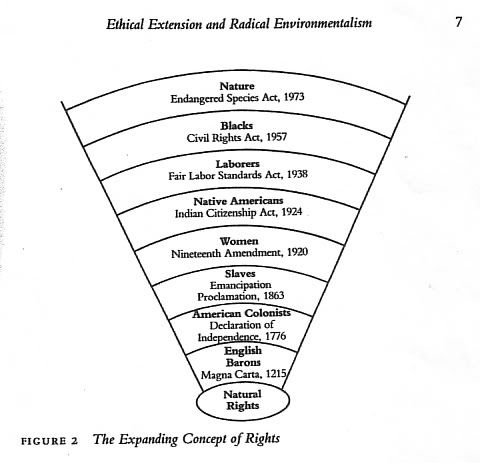
In a post entitled, "The Expanding Ethical Embrace" (March 2005), I expressed skepticism regarding Peter Joost's argument that humanity will adopt a moral code that grants other mammals, birds, reptiles, and even, eventually, bacteria, the same natural rights that we now reserve for ourselves (supposedly irrespective of race, sex, sexuality, or religion). I did not doubt the plausibility of Joost's prediction, but rather his assertion that this ethical evolution portended only happy returns. I wondered, if humans were to transcend the cruel machinations of biological determinism, wouldn't we, in effect, be killing ourselves with kindness? In Joost's neo-Eden, the human population would explode; the increased resource demands would inevitably lead to collapse (that is, if we didn't first find it in our reptilian spines to loathe "the other" as passionately as we have for time immemorial). Attractive though Joost's notion was, I remained ambivalent about the prospect.


Joost's prediction was recently called to mind when, reading Grist, an online environmental news journal, I stumbled upon a provocatively titled Gristmill thread initiated by Jason Scorse.  Many challenging questions are advanced in the dialogue generated by Scorse's "So, environmentalists support whaling?" Notable among them are:
- Is an environmentalist morally obligated to support animal rights?

- Are regulated, luxury hunts that fund conservation projects ethically or morally defensible?

- Are free enterprise and sustainable development mutually exclusive?

- Should the conservation and preservation camps be distinct from one another, promoting different agendas, or should they work together toward a compromised, common goal?
Scorse's answers to the above questions are 'Yes,' 'No,' 'Yes,' and 'Yes/No,' respectively. Yet any approximation of a complete answer to these questions requires some degree of ambiguity, and even contradiction.  Normally I find contradiction and ambivalence agreeable, because they edge closer to objective "truth" than any ideology might; in matters of environmental policy, however, the grey areas trouble me. Apparently, they trouble Scorse, too, as he jettisons nuance in favor of ideological certainty. Prompted to choose between ideology and reasonable pragmatism, I'm tempted to follow Scorse up the moral high road; the ideological path appears straight and true. But while moral certitude, the black hat/white hat conception of life and thought, is the path favored by activists and fundamentalists, I am made uncomfortable by it, particularly when it informs legislation.

Reasonable pragmatism, the preferred approach of post-Enlightenment thought, has its own problems, however. As Benjamin Franklin wrote of his vegetarian experiment(1), "so convenient a thing it is to be a reasonable creature, since it enables one to find or make a reason for everything one has a mind to do." Franklin's observation at once celebrates and skewers reason, revealing it to be a wholly relative enterprise. This chink in reason's armor is worrisome.

So what will it be? Are the complications and sacrifices of reasoned compromise better or more effective than ideology? Or do we have clearly defined "good guys" and "bad guys"?

Craig Nelson's recent biography of Thomas Paine serves as my subway reading these days, and I find the following observation relevant.
"Beginning with Franklin and Washington, every successful American leader would balance the pragmatic with the Utopian.  Where Franklin the master politician would be almost entirely pragmatic, Paine would be too fervidly Utopian in ways that would not just damage him financially, but imperil him physically... Paine would...always be too ardent with his religion of the lights, a Savonarola of reason and liberty, and as inept a political operator as any fervid Christian saint...The success or failure of any leader in U.S. history can be judged through his of her successes or failures at reaching the pragmatic Utopian paradox that remains at the heart of the American experiment."
Nelson's words ring true.  "The pragmatic Utopian paradox" is not uniquely American, but it is central to the American experience.  For confirmation, we need look no further than the glut of contemporary, progressive American politicians striving to develop a decidedly centrist track record, even as they contradict themselves (and their conscience) in doing so.  By contrast, it's easy to discard compromise and contradiction if you are a committed revolutionary, an individual willing to die for your cause, or a monkish loner operating in an intellectual/philosophical vacuum, as did Theodore Kaczynski.  Outside the D.C. beltway, ideologues are a dime a dozen, but exceptionally gifted ideological rhetoricians like Paine or King, Jr. make a sociopolitical impact only rarely.

Not surprisingly, many environmental activists are ideologues, Jason Scorse included.  To be fair, Scorse, a professor of environmental economics at the Monterey Institute, is not so much making a stump speech as he is asking a provocative question. From his "So, environmentalists support whaling?" post:
"I have tried to make what is essentially a straightforward case that environmentalism at its core is about respecting life and that separating this from our behavior towards individual living beings doesn't make much sense. Since many environmentalists reject this notion and insist that environmentalism only includes preserving biodiversity and promoting resource sustainability, this suggests that one of the defining elements of environmentalism no longer holds: an opposition to whaling...So are those who argue for the minimalist view of environmentalism willing to go on record in support of whaling and the killing of other advanced mammals?"
Money can do a lot in the way of protecting individual species and imperiled ecosystems.  Regulated hunting operations and animal farms, worldwide, generate substantial revenue, a healthy percentage of which is used to fund conservation measures.  For example, a buyer pays a tiger rancher (yes, they exist) an impressive sum - $40,000, say, sometimes much more - to obtain tiger parts for use in traditional Chinese medicines.  A substantial percentage of that price is then used for habitat preservation, conservation education, and tiger breeding programs.  It's a simple ethical equation; one animal's death results in improved species survival rates in the long-term (assuming that the habitat can be protected from the trespasses of our burgeoning human population). My short answer to Scorse's question, then, is 'Yes.' The more complete and complicated answer, though, leads down a rabbit hole of uncertainty.

To begin with, I find Scorse's moral framework - do unto your neighboring species as you would have done unto yourself - fundamentally agreeable. I'm troubled by the scalae naturae and other moral or physiological hierarchies. Because human life is, in my estimation, no more or less valuable than that of an earthworm (and, lest you mistake that statement for hyperbole, my inner ideologue assures you otherwise), the farming and killing of a tiger, no matter the result, is immoral. So, too, is the farming and killing for food of any animal species. In a truly enlightened world, then, we would witness a continued shift toward vegetarianism, sustainable consumption, and the extension of natural rights to other species. But the rate at which such values are adopted is of critical importance, and I feel Scorse is not at all pragmatic in his consideration of the real-world application of his moral imperative.  I fretted about this in the earlier post:
"From a strictly pragmatic perspective, morality is a denial of our existential [and by this I meant all species, not just human] sameness; like all other species, our principal drive is one of survival and propagation. Even our human urge to classify, as seen in the periodic table, clothing labels, and taxonomy, is a violent instinct, evolved to make us better able to ward off 'the other' and to flourish as hunter-gatherers, a lifestyle no longer suitable for our global, industrial species. [Therefore], it could be argued that [the] extension of human rights to all races, cultures, and creeds was but one more victory in our campaign to deny human nature.

But an inclusive, caring society, even if inconsistent, results in a population explosion and exaggerated life expectancies. Moreover, as our species’ requirements are increased, so are our demands on the environment. By embracing one another, we in fact make it more difficult for future generations to survive. When even more populations (in this case, other species) enter our moral and ethical peripheral vision, we will find ourselves facing a very interesting philosophical and pragmatic dilemma. Are we overloading of the circuitry?"
It seems clear that we would be "overloading of the circuitry," but there is a more immediate concern, one that does not bode well for Joost's expanding ethics: we have proven incompetent in our attempts to achieve parity among humans.

In the course of the Gristmill conversation, Scorse writes, "Thank goodness...humans aren't treated with the same level of abstract notions about 'sustainability' that you advocate that we subject every other living thing to."  Oh, but how we are! One need look no further than the morass of muddled litigation generated by today's vitriolic debates over abortion, civil rights, or assisted suicide to comprehend just how reluctant we are to treat fellow humans with the respect we reserve for ourselves and for our loved ones. As I wrote in March 2005, "one can barely imagine the ensuing cacophony when considering similar issues for sharks, birds, and turtles."

Ever since Homo sapiens adopted an agrarian lifestyle, we've been a top-down animal, a pyramid ladder of the very few haves and the countless have-nots.  I'm not altogether opposed to the felling of this pyramid in the name of populism and moral ideology (although, let's not kid ourselves punkers, anarchy ain't Utopia), but when similar tinkering and protest is extended to Nature, an entity of which we, as a species and complex-compound social beast, are but an insignificant part, we're not only risking collapse on a Mayan or Roman scale.  We're also gambling with the fate of the human species at large and, importantly, that of the many hundreds of thousands of species inextricably attached to us.  Those who herald the imminent expansion of our ethical embrace would do well to think on this.


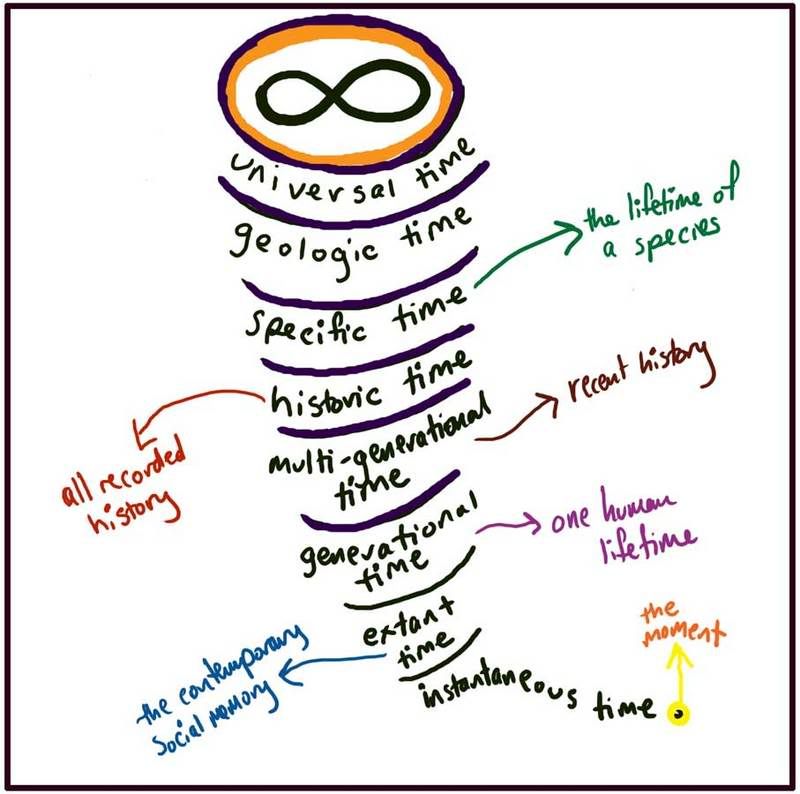
The natural algebra can not evolve apace with our ethical code. Believing this to be true, I suppose I'm something of a determinist. I don't doubt that Earth's carrying capacity will increase as we adopt more sustainable lifestyles, but such a change occurs in geologic time, not generational or historic time. E.O. Wilson, the celebrated Harvard entomologist, makes a similar, if distinct case in his landmark book, On Human Nature.
"Can the cultural evolution of higher ethical values gain a direction and momentum of its own and completely replace genetic evolution? I think not. The genes hold culture on a leash. The leash is very long, but inevitably values will be constrained in accordance with their effects on the human gene pool. The brain is a product of evolution. Human behavior - like the deepest capacities for emotional response which drive and guide it - is the circuitous technique by which human genetic material has been and will be kept intact. Morality has no other demonstrable ultimate function."
I'm inclined to agree...to a point. But what hand really holds the leash? Wilson assigns control to genes, our evolutionary chaperones. Genetics is indeed powerful, but the brain is as much a product of cultural evolution as it is physiological evolution. Therefore, I believe nurture can outpace nature at the societal level. In other words, genes have less control over moral and ethical evolution than Wilson would have us accept. In fact, it is the "eco," the greater whole - the Everything and the No-thing, from which we are inseparable - that grasps the leash. I trend toward the mystical here, but the skeptical scientists in the room can call this leashing by holistic natural law (as opposed to Wilson's evolutionary imperative).


Despite my attraction to the moralistic, and my belief that our ethical purview will inevitably expand, I must conclude that is necessary to distinguish between long-term aspiration and present policy. The American Civil Rights Movement may be portrayed as a historical artifact in high school text books, but racial prejudice and bigotry are no more history than is the Cold War. Our aims are ahead of our practice, and we should take care not to neglect incomplete cultural "mutations." Today being the anniversary of his death, take another listen to John Lennon's "Imagine." The words and images of artists are vital. Without them, our shared cultural imagination (or our memes) would be starved, but we shouldn't ride the moral high horse if it means we won't reach our destination. This is the critical distinction between morality and ethics.

Progress - if loosely defined as our stumbling effort toward the betterment of humanity and the world we belong to - is best served by pragmatic rationalism and a conservative code of ethics. As my father stressed to me from a young age, good economics - literally translated, "management of the household" - begins with good ecology - "study of the household." A promising future awaits humanity if we are imaginative enough to forge our ethics from the moral, the aesthetic, the ecological, and the pragmatic.

Turning to Bill Cronon's writing, as I so often do, and did when considering these ideas before:
"The choice we face is not to leave no marks – that is impossible – but rather to decide what kinds of marks we wish to leave."
So to Jason Scorse, and all ideologues: my heart is with you, but things simply aren't so clear as might like them to be.

Image credits: Ahab illustration by Sam Weber; ethics diagrams from Peter Joost's March 2005 New York Historical Society lecture; timeline diagram by Hungry Hyaena

(1) Franklin abandoned the diet eventually, as the smell of cooked seafoods, particularly fish, proved too much for his dietary resolve. No problem, though, as he was able to use reason to account for why fish were a viable exception!

Tuesday, April 19, 2005

Friends & Neighbors


Spring is here and, for many people living in the warmer regions of the United States, the changing weather means reptile encounters. I subscribe to several email newsgroups that deal with reptile and amphibian conservation. I'm regularly directed to articles, most published in local newspapers, describing “dangerous” meetings of man and cold-blooded beast. Sadly these encounters do not represent an increase in reptile populations, but rather further encroachment into reptile rich habitat by our own species. Each year, as the warmth draws the randy, hungry reptiles out of brumation (cold-blooded animals' period of dormancy), humans encounter them in garages and houses…even, Heaven forbid!, in our gated communities.

This morning, two articles. First, a blurb from southern Florida’s Sun-Sentinel tells of a US Fish & Wildlife agent bitten by an American alligator (Alligator mississippiensis) while trying to capture the animal in a Pompano Beach neighborhood. Two weeks ago, I read an article in the same paper (unfortunately, the article is too old to be accessed online) telling of another aggressive alligator caught in Weston, Florida. This hungry gator killed and consumed a dog in a “posh Weston community.” Below, I’ve excerpted some of the text from the article. (“Dog-killing Gator Caught,” by Andrew Ryan, 03/30/2005)
“Once the animal is under control, the hunter takes it to a processing plant where it is killed and turned into gator nuggets, wallets and other products. Officials say if they were to release the animal in the middle of the Everglades it might simply come back…As development pushes further into the Everglades, clashes with gators have increased. Since the state began keeping statistics in 1948, there have been 342 alligator attacks, killing 15 people…Wildlife officers field 15,000 calls about nuisance alligators each year, and Weston, on the edge of the Everglades, is a hot spot.”
On the edge of the Everglades? Hmmm… It seems to me folks who want to live in such locales should consider their own transgressions and come to terms with their neighbors. Of course this is rarely the case. Whether dealing with wildlife and human settlement conflicts or the gentrification of minority neighborhoods in urban areas, development usually wins out over balance or integration. The one encouraging spot in Ryan’s Sun-Sentinel piece was a sensible comment made by Florida wildlife commission spokesman Jorge Pino. "We are standing in an area that used to be Everglades. We have to find a happy medium." Are we ready to do so?

The second article is pulled from the Desert Dispatch, in southern California. It describes a similar problem in the town of Victorville. Instead of alligators, though, the locals are plagued by snakes, Mojave rattlesnakes (Crotalus scutulatus scutulatus), in particular. Alligators may stumble into settlement on occasion, but snakes are often attracted to development as they follow their keen smell to an abundance of prey. This winter, good rains have contributed to a banner year for vegetation and, in turn, rodents and lizards. Complicating matters, Victorville is experiencing a development boom. "Within the next year there will be 15,000 new homes up here, and when they are breaking ground they are breaking habitat and the snakes are coming out," said Vicki Telford, an amateur herpetologist.

Unfortunately, wildlife/human conflicts are not restricted to warm regions and cold-blooded creatures. Our continued sprawl forces suburbanites into close proximity with mountain lions (Puma concolor), black bears (Ursus americanus), grey wolves (Canis lupus), and many other predatory species looking for an easy meal at the fringe of human settlement.

This brings me to this article (“The Cat Came Back: Alpha predators and the New Wilderness,” by Peter Canby, Harper’s Magazine, March 2005), which I have been meaning to post for some time. Ostensibly a book review, the piece does more than offer straightforward critique. It pries intelligently into the contradictions and blind Romanticism of “wilderness” concepts, while simultaneously raising fair questions about our own exuberance.

Though I find myself more in David Quammen’s camp – his book, Monster of God, is reviewed – than in David Baron’s, both arguments are valid. Baron, in his book, The Beast in the Garden, focuses on contemporary humanity’s misunderstanding of Nature, suggesting we need to become a keystone species once again, taking responsibility for the lands we occupy. While I agree with this assessment, I find Baron patronizes conservation-minded individuals. Canby seems similarly irked by Baron and turns, as I do myself, to a better, more thoughtful proponent of meaningful re-integration, Bill Cronon.
“The theme of the artificiality of the wilderness around Boulder runs throughout The Beast in the Garden, as does the idea that by romanticizing this artificial wilderness and its supposed ‘naturalness,’ Boulder's citizens were shirking their responsibility to manage it properly and were refusing to understand their role in creating the conditions that had led to the return of cougars. But Baron seems so intent on maintaining his contrarian tone, so intent on gaining points at the expense of Boulder's ‘stuck in the sixties’ lifestyle, that the reader is advised to turn to William Cronon, one of Baron's sources, where these ideas are better developed.”
As I have mentioned in the past, I have a great deal of respect for Dr. Cronon’s writing and conservation philosophy. Throwing grenades at mountain lions, beheading snakes, and shooting alligators that approach homes are temporary solutions that ignore the root cause of the conflict. As Cronon has repeatedly made clear, it is high-time we re-examine our priorities and consider what best balances the equation. Increasingly, zones of concentrated human settlement – urban, not suburban – and zones of well-managed, connected “wildlands” seem the best solution.

Photo credit: A. Yanosky

Thursday, March 24, 2005

The Expanding Ethical Embrace


In conjunction with the New York Historical Society’s exhibition, "Audubon's Aviary," the NYHS, Nurture New York's Nature, and the NYC Audubon Society partnered to present a series of Audubon-related talks. During the second evening of presentations, entitled “The Fall and Resurrection of Nature in New York,” NYC Audubon Society member Peter Joost spoke of our evolving ethical paradigm. Over the last several hundred years, he argued, humans have become progressively more enlightened. Joost cited the political developments of 20th century America to prove his point: today, we consider every human equal, irrespective of race, sex or religion. (True, but our American “melting pot” is yet pervaded by racism, xenophobia and religious intolerance; I agree with the general thrust of Joost's thesis, but recognize that we must be vigilant if we are to preserve our liberal ethics.)

Mr. Joost also pointed out that, as humans continue to expand our ethical embrace, we are beginning to consider other species, especially our ape relatives, as equals or near equals. He foresees a societal shift towards vegetarianism and the adoption of a moral code which includes an increasing number of species. Presumably this shift won’t guarantee voting rights for horses, but the meat industry, hunting and animal research would all end. Perhaps a future Mosaic code will include the commandment, 'Do unto your neighboring species as you would have done unto you.'

All well and good...sort of. If our ethic/moral code expands to include animals, plants, and eventually bacteria, what role will conservation play? Some degree of manipulation is required to maintain the ecological status quo. Wildlife management works, in part, because we perceive ourselves as stewards of the land, a species situated slightly above the fray. If a US Fish & Wildlife biologist elects to burn a section of forest in order to encourage future growth and habitat restoration, he isn’t condemned. But his actions killed many insects and displaced other species! If every species’ rights are to be considered, management that today is laudable will be controversial; conservation biology would be further burdened by litigation.

But I am a realist, and so don't fret about the possibility of an over-extended ethical embrace. Morality is not born of humanity's existential sameness or some essential, animating goodness. Like all other animal species, humans evolved to survive and propagate; that is, we evolved to be winners. Even our predilection for classification - as seen in the periodic table, clothing labels and taxonomy - is innate, an evolved trait that better equips us to ward off “the other,” to proactively eliminate potential competition. But this us-and-them trait is no longer tenable in our interconnected world. It seems to me that the quickening of our ethical expansion in recent centuries corresponds to a wider worldview. Whereas once we were many, now we are one economy. If this is the case, isn't our extension of human rights to all races, cultures and creeds a victory in our campaign to deny human nature, a requisite improvement to the foundation of global socio-politics?

If this is so, our increasing capacity for compassion creates new problems. An inclusive, caring society, even if inconsistent, is attended by a population boom and longer life expectancy. By embracing one another, then, we also increase our species’ demands on the environment. When even more populations - in Joost's argument, other species - enter our moral peripheral vision, we will find ourselves facing a philosophical and pragmatic dilemma. Will our compassion overload the circuitry?

The idealist in me believes that our concept of conservation will be replaced by one more reconcilable with a Joost's inclusive ethical paradigm. After all, why should we strive to “manage” when we are but part of the environment ourselves? But the realistic answer to that question doesn't jive with Joost's ethics. We are part of the environment; as such, we are creatures adapted to live within a given range of environmental conditions. Sustainable conservation should not reject human needs. To the contrary, it must incorporate them.

Dr. William Cronon, a very intelligent writer and environmental historian writes,
“The nature we carry in our heads is as important as the nature that is all around us, because in fact the nature inside our heads is often the engine which drives our interactions with physical nature, transforming both ourselves and nature in the process….Non-use is not an option: to live in nature is to use and change it by our presence. The choice we face is not to leave no marks – that is impossible – but rather to decide what kinds of marks we wish to leave.”
I look forward to an age when humanity has extended its moral code to the other animals, but where does such a shift take us? The question is hypothetical and abstract. I am content to view it as an imponderable and this, I suppose, is why I am an artist rather than a philosopher or lawyer.

I scribbled notes as I listened to Joost, and I thought of Aldo Leopold. A hunter and conservationist, on the one hand, and a moralist and preservationist, on the other, Leopold embodied the contradiction at the heart of this question. Returning again to Cronon,
“Having spent his entire life as a manager of land and wildlife, [Leopold] knew all too well that wild nature will not long remain in the modern world without an active commitment on the part of human beings to manage it responsibly...and he knew that this task was far from easy….Knowing that he himself was manipulating wildness in the very act of protecting it gave him a powerful sense of the paradoxes such work entailed, and he was clear-eyed and unblinking in acknowledging these paradoxes. ‘All conservation of wildness,’ he wrote, ‘is self-defeating, for to cherish we must see and fondle, and when enough have seen and fondled, there is no wilderness left to cherish.’...His dream was for a world where large tracts of wilderness would be protected, but where wild things would thrive and be honored in many other places as well: in rural wood lots, in humble wetlands, in restored prairies, even in urban parks. Only so would people be reminded, regularly and in the most ordinary ways, of the larger community to which they belonged and on which their own lives depended.”
Will an expanding ethical embrace make Leopold’s dream more possible or will it serve instead to complicate matters, making our search for a sustainable, moral society a more Herculean task?