Showing posts with label Dewey. Show all posts

Friday, August 19, 2011

Making More "Live Animals"


Two weeks ago, I presented a lecture at the Art College Center of Design, in Pasadena, California, titled "Aesthetics, Ethics, and Experience." It was my first attempt to respond to the question of how contemporary artists might connect the "fine arts" to society at large, and I drew from an array of sources, classical (Heraclitus; Aristotle) and contemporary (Dave Hickey; David Milch; Erik Reece), to constellate what I'd like to think Aristotle would have described as a virtuous way of being in the world (as an artist). After the lecture, one of the students remarked that it was the "most liberal arts style" approach she'd come across in art school. I appreciated her compliment, but it reminded me of the urgent need for more generalism in arts education.

As I often insist, there is a lot of beautiful and compelling artwork produced and exhibited today, but it generally lives apart from popular culture. We -- that is, those of us active in the fine arts -- are complicit in this ghettoization because we're content to carry on a conversation among ourselves. Moreover, because we've come to preference our tribe's voices over others, there is a surplus of insider commentary and critique passed off as art. Almost all of this work and wordiness is irrelevant to the world outside the ghetto walls and, because young artists are educated in this context, with little or no pedagogical emphasis on disciplines other than art theory, the art and commentary become, over time, increasingly provincial. The wellspring of this contemporary predicament is as old as modernism.

On the heels of co-curating "A Live Animal" with Selene Foster, I've been rereading John Dewey's brilliant Art & Experience essays (1934). Dewey writes, and I quote him at length because he articulates the crux of the problem so eloquently:
" [Art is today] isolated from the human conditions under which it was brought into being and from the human consequences it engenders in actual life experience. [...] Art is remitted to a separate realm, where it is cut off from that association with the materials and aims of every other form of human effort, undergoing, and achievement. A primary task is thus imposed upon one who undertakes to write upon the philosophy of the arts. This task is to restore continuity between the refined and intensified forms of experience which are works of art and everyday events, doings, and sufferings that are universally recognized to constitute experience.

[...] So extensive and subtly pervasive are the ideas that set Art upon a remote pedestal, that many a person would be repelled rather than pleased if told that he enjoyed his casual recreations, in part at least, because of their esthetic quality. The arts which today have most vitality for the average person are things he does not take to be arts: for instance, the movie, jazzed music, the comic strip, and, too frequently, newspaper accounts of love-nests, murders, and exploits of bandits. For, when what he knows as art is relegated to the museum and gallery, the unconquerable impulse towards experiences enjoyable in themselves finds such outlet as the daily environment provides.

[...] For the popular notion comes from a separation of art from the objects and scenes of ordinary experience that many theorists and critics pride themselves upon holding and even elaborating. The times when select and distinguished objects are closely connected with the products of usual vocations are the times when appreciation of the former is most rife and most keen. [...] Theory can start with and from acknowledged works of art only when the esthetic is already compartmentalized, or only when works of art are set in a niche apart instead of being celebrations, recognized as such, of the things of ordinary experience. Even a crude experience, if authentically an experience, if more fit to give a clue to the intrinsic nature of esthetic experience than is an object already set apart from any other mode of experience. [...The] trouble with existing theories is that they start from a ready-made compartmentalization, or from a conception of art that 'spiritualizes' it out of connection with the objects of concrete experience. The alternative, however, to such spiritualization is not a degrading and Philistinish materialization of works of fine art, but a conception that discloses the way in which these works idealize qualities found in common experience. Were works of art placed in a directly human context in popular esteem, they would have a much wider appeal than they can have when pigeon-hole theories of art win general acceptance.

[...] The sources of art in human experience will be learned by him who sees how the tense grace of the ball-player infects the onlooking crowd; who notes the delight of the housewife in tending her plants, and the intent of her goodman in tending the patch of green in front of the house; the zest of the spectator in poking the wood burning on the hearth and in watching the darting flames and crumbling coals."
Amen, Mr. Dewey...though I'd add that the "primary task" to "restore continuity between" works of art and the everyday is not only the obligation of the art writer; it is also incumbent upon the conscientious artist. Artists need to make art that connects to common human experience, and both artists and art writers need to communicate more effectively with the general audience.


I thought of Dewey's argument when watching a video of Scottish cyclist Danny MacAskill that was recently shared by a friend on Facebook. The video offers a more visceral (and therefore meaningful) aesthetic experience than most of the contemporary art I've viewed in the last weeks. An acrobat with his bike, Macaskill is Dewey's "live animal," "fully present, all there" because of he has honed his craft and is, as we often hear athletes put it, "in the zone."

Can contemporary fine art inspire people to exclaim, as one person did in the comments under my friend's Facebook posting of the Macaskill video, "That's crazy & beautiful!"? Can artists again enthuse the general audience?

I believe that we can, and I hope that I can one day have an opportunity to design (or help to design) an undergraduate or graduate art curriculum that prioritizes generalism and social responsibility.

Photo credit: photo of Danny MacAskill ripped from CyclePath Magazine

Monday, February 08, 2010

Nathan Abels' "Natural Causes"

I wrote the following short essay for the exhibition catalog that accompanies Nathan Abels' "Natural Causes," currently on display at Rule Gallery, in Denver, Colorado.

+++++


Nathan Abels
"Sullen Roar"
Acrylic on panel
36 x 48 inches
2009

At the extent of the campfire's reach, we glimpse a shadowed form. Then it is gone. What is it that we saw there, at the light's limit? In that instant of vague apprehension, before our mind has had time to interpret the stimulus, we are John Dewey's "live animal," a creature "fully present, all there, in all of its actions: in its wary glances, its sharp sniffings, its abrupt cocking of ears." The "live animal" mode is often awakened by an alarming sight or sound, but it can also be brought on by a rush of emotion or any substantial sensual experience. If we remain attuned, "fully present," our nurtured sense of self may be blurred, even surrendered, and the scrim of conventional, acculturated understanding is ruptured. We recognize that transcendental mysteries and primordial presences are located in ordinary experience, and that our mundane perception of the material world is incomplete. We see the world anew, boundless and beautiful.

Nathan Abels' artwork is concerned with such transformative breakthroughs. Many of his works juxtapose the primeval with the temporal. "Wildfire" pictures the moon, our planet's celestial companion, serene above a raging forest fire, a violent agent of ecological transformation, both destructive and renewing. In "Sullen Roar," the lights of human infrastructure glow like our aforementioned campfire, but the riverside outpost is surrounded by an opaque darkness. Abels reminds us that the hum and pulse of human civilization amounts only to a footnote when considered within a more holistic context. Other works, such as "Passage" or "Half-Seeing," picture moments of potential rupture, opportunities for personal transfiguration. In "Passage," a spelunker slides on his back through a narrow section of cave. His headlamp illuminates the low ceiling. The confined space would make even the least claustrophobic among us uncomfortable, and the viewer senses the spelunker's powerlessness. Such an experience, like the wildfire, can be at once annihilative and regenerative. It is a subjugation of the self, a recognition of the infinitesimal reach of our individual vision, yet also an expansion of our vision to include the infinite variety and scope of being.


Nathan Abels
"Half-Seeing"
Acrylic on panel
36 x 48 inches
2010

Abels refers to his paintings and drawings as "visual pauses" in an otherwise "persistent turbulence." To be sure, our contemporary landscape is a turbulent one: industrialized, globalized, and digitized for maximal efficiency and consumption. We are so burdened by stimulation as to be deadened to the underlying reality of each moment and every place. Abels' "visual pauses" are a response to our routine mindlessness; the artist provides the viewer with opportunities to regain focus, to intuit the unfathomable in the worldly. His drawings and paintings are pictures of transitional experiences at the edge of known and unknown.


Nathan Abels
"Denouement"
Acrylic on panel
36 x 48 inches
2009

Image credits: courtesy the artist

Sunday, May 03, 2009

Walking with the wind


Tim Knowles
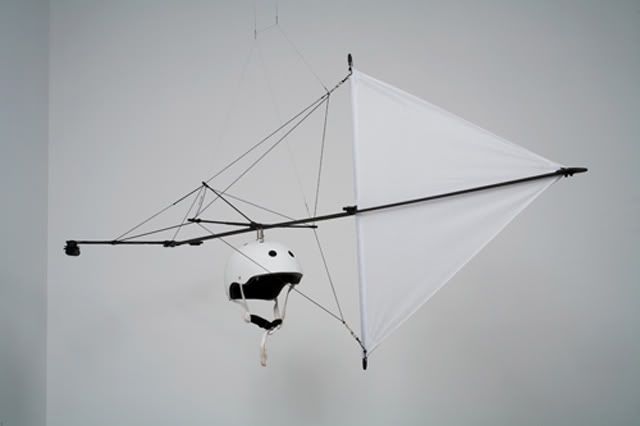
"Windwalk #2 - Charing Cross"
Helmet
2008


For his "Windwalk - 5 Walks from Charing Cross" project, artist Tim Knowles engineered a helmet with a sail-like wind vane, small video camera and GPS device, then wandered the streets of central London, his path determined solely by the wind. As Knowles crosses major thoroughfares, where the wind enters the wider channel via various tributaries, his path hitches and tacks erratically. If a gust of wind blows from the opposite direction, he spins about face, and he sometimes circles upon an earlier position.

In at least two of the videos that document his wind walks, Knowles is led into a cul de sac of swirling wind, where he finds himself temporarily trapped with light-weight street debris, including plastic bags and leaves. In these situations, or when he is directed into a wall, Knowles waits patiently for the wind to change direction and again grant him headway.

The artist Bernard Buffet wrote, "I prevent myself from thinking in order to be able to live." Although Buffet presumably referred to the particularly European struggle to persevere in a world shadowed by acute suffering and inhumane activity (he made the declaration in 1948, after an adolescence in occupied France), the statement can also be understood as an endorsement of Zen's "mind of no mind," or mushin no shin. Regardless of their geographic or religious provenance, meditative practices commonly encourage practitioners to banish thought from the mind so that they might experience transcendence or some heightened sense of being.

Similarly, the 20th century aesthetic theorists Alfred North Whitehead and John Dewey believed that there is a crucial distinction between the aesthetic and rational realms. Dewey argued that the aesthetic province is that of the "live animal" or unmediated, natural experience. In his landmark book Art As Experience, Dewey writes,
"Life goes on in an environment; not merely in it but because of it, through interaction with it. No creature lives merely under the skin; its subcutaneous organs are means of connection with what lies beyond its bodily frame, and to which, in order to live, it must adjust itself, by accommodation and defense but also by conquest. At every moment, the living creature is exposed to dangers from its surroundings, and at every moment, it must draw upon something in its surroundings to satisfy its needs. The career and destiny of a living being are bound up with its interchanges with its environment, not externally but in the most intimate way."
Elsewhere, Dewey states more plainly, "to grasp the sources of aesthetic experience it is necessary to have recourse to animal life below the human scale." The life Dewey describes, the realm of the "live animal" and of true aesthetic experience, is akin to Zen's mushin no shin.

The late Irish philosopher and poet John O'Donohue described dance as a reclamation of our animal nature. He wrote,
"When you walk into the mood of wind, it cleanses your mind and invigorates your body. It feels as if the wind would love you to dance...The body gives itself away playfully to the rhythm of the music; the burden of consciousness becomes suspended. For a while the innocence of the dance claims you completely as the mind relents and the body becomes its own celebration."
Knowles' "Windwalks" allow him access to the realm of Dewey's "live animal" and of O'Donohue's celebratory body; the artist relinquishes control by bypassing the brain's self-conscious helmsman. The wind meanders London's streets and Knowles follows; if he is the dancer, the wind is his choreographer. The artist is compelled by the wind's whim.

But, in allowing himself to be guided by an external force, Knowles doesn't simply provide viewers with an often humorous and poetic take on Dewey's philosophy of essential aesthetic experience. His "Wind Walks" resonate on several levels, and perhaps the most vital subtext is one of openness to new experience and new ideas.

Knowles provides us with a 21st century model of citizenship. He explores Charing Cross in a novel way; in doing so, he is provided with a fundamentally new appreciation for and knowledge of a seemingly familiar London neighborhood. In our rapidly globalizing world, we'd do well to emulate Knowles' willingness to look again for the first time. As T.S. Eliot wrote in his poem "Little Gidding,"
"We shall not cease from exploration
And the end of all our exploring
Will be to arrive where we started
And know the place for the first time."
"Windwalk - 5 Walks from Charing Cross" was seen in the Bitforms Gallery exhibition, "Tim Knowles and Pe Lang + Zimoun: Unpredictable Forms of Sound and Motion," recently on view in New York City.

Photo credits: images ripped from The Cyborg's Picnic and VVVORK

Friday, April 24, 2009

Of ideologues and pragmatists


Thomas Paine and Thomas Jefferson


A few months after the inauguration of President Barack Obama, many one-time "Yes we can" cheerleaders are grumbling and casting skeptical glances at Washington. Indeed, I've been disappointed by some of our new president's decisions, but I also accept his maneuvering as an unfortunate political reality.

Unlike his predecessor, Barack Obama realizes that the President of the United States should not operate as an ideologue. Of course, he (and some election year soon, she) could choose to embrace ideology over pragmatism but, in doing so, the Commander-in-Chief risks aligning himself with the sort of tyrannical autocracy that our leaders rhetorically (and routinely) condemn.

But political reality doesn't temper the poor reviews that Obama receives from many on the political left. Considering their critique of Obama's centrism, I recalled an earlier HH post. In "The Whiteness of the Whale," I wrote:
"Craig Nelson's recent biography of Thomas Paine serves as my subway reading these days, [and] I find the following observation relevant.
'Beginning with Franklin and Washington, every successful American leader would balance the pragmatic with the Utopian. Where Franklin the master politician would be almost entirely pragmatic, Paine would be too fervidly Utopian in ways that would not just damage him financially, but imperil him physically... Paine would...always be too ardent with his religion of the lights, a Savonarola of reason and liberty, and as inept a political operator as any fervid Christian saint...The success or failure of any leader in U.S. history can be judged through his or her successes or failures at reaching the pragmatic Utopian paradox that remains at the heart of the American experiment.'
Nelson's words ring true. 'The pragmatic Utopian paradox' is not uniquely American, but it is central to our American experience. For confirmation, we need look no further than the glut of contemporary, progressive American politicians striving to develop a decidedly centrist track record, even if they contradict themselves (and their conscience) in doing so. By contrast, it's easy to discard compromise and contradiction if you are a committed revolutionary or a monkish loner operating in an intellectual and philosophical vacuum."
Barack Obama qualifies as one of the "contemporary, progressive American politicians" I criticize in that excerpt. Yet, as I suggest in the same post, "outside the D.C. beltway, ideologues are a dime a dozen, but exceptionally gifted rhetoricians like Paine or King, Jr. emerge (and make [a legitimate political] impact) only rarely."

Yet even if the political impact of fringe ideology is negligible, those voices must be heard. Indeed, unpopular opinions are sometimes the most vital in a just democracy. There's a reason, after all, that liberals wring their hands when contemplating the censorship of bigoted hate speech. If you believe in the democratic fray, you're obligated to let all of society's individuals speak.

In a recent episode of the "The Thomas Jefferson Hour," historian and Jefferson impersonator Clay Jenkinson read and responded to the following Paine quotation.
'He that would make his own liberty secure, must guard even his enemy from oppression; for if he violates this duty, he establishes a precedent that will reach to himself.'
"This is how Paine would react to the Bush Administration for the past seven-and-a-half years. This is an answer to the Patriot Act, to the surveillances, to Guantanamo, to Abu Ghraib!"
Jenkinson's right. In fact, a great many of Paine's sentiments are as pertinent today as they were in the late 18th century, his abolitionist and proto-feminist writing especially so.

He may have made many political enemies in his day but, two hundred years after the turmoil of our nation's early ideological disputes, Thomas Paine's unwavering moralism aligns more closely with contemporary progressive attitudes than does Thomas Jefferson's political pragmatism. Compared to the public attitudes of the slave-owning and patriarchal Jefferson, Paine strikes the 21st century citizen as the more modern thinker and the more conscientious man.

Does it matter that Jefferson, in his private correspondence, agreed with Paine's abolitionist argument? From our vantage point (one of comfortable remove), no, it doesn't. What we consider, above all, is that Jefferson was a slave owner and that Paine was an outspoken abolitionist. 'Deeds, not creeds,' as the saying goes. But it's noteworthy that Paine was poor and unlanded, and therefore never in a position to own slaves. (Indeed, Paine was never in a position to give up slavery, power, or riches; essentially, his social standing cloistered him from temptation.) Nor was Paine a political figure; he could be strident because he didn't have to consider popular opinion or the practical effect of enacting reform.

Writing in his philosophical memoir An American Gospel: On Family, History, and the Kingdom of God, Erik Reece succinctly describes the democratic ideal to which I subscribe.
"Like [Walt] Whitman, John Dewey thought of the ideal American democracy as an 'organism,' a whole that is reflected in each of its parts - that is to say, in each individual citizen. ...As cells work together within an organism, Dewey believed individuals worked together within a good society to achieve 'a unity of will.' ...And because democracy is a social idea, it is also ethical by its very nature. Ethics, after all, begins with the realization that one is a social being and therefore part of a larger whole. A man living alone on an island requires no ethic. An aristocracy or a dictatorship could be run by only a few of its members. But the democratic organism needs all of its cells. And those cells must act simultaneously in their own interest and in the interest of the larger organism."
But Dewey was a pragmatist. Surely he realized that the democratic organism's ability to fight off infection of the malignant variety is not nuanced; the democratic immune system, if you will, acts to extinguish all radical cells. In other words, this organism is just as likely to rise up against outspoken abolitionists as it is against outspoken racists. And, indeed, history stands as a testament to this action.

Thomas Paine found an American and French populace eager to absorb his revolutionary and populist manifestos Common Sense and Rights of Man, but he was eventually ruined by his rational dismissal of Christian doctrine, The Age of Reason. His New York Citizen obituary read, "He had lived long, did some good and much harm." Much harm? Paine's progressive opinions about slavery and feminism didn't win him sustained popularity.

Jefferson, too, was a lightening rod in his day, provoking as much disdain as he did praise (especially from the Federalists and, in particular, Alexander Hamilton). But Jefferson was a savvy political operator, a master of Nelson's pragmatic Utopian paradox. Although he shared many of Paine's opinions, Jefferson did not draft legislation addressing those issues or even, because of his deism, allow his private correspondence to be made publicly available in his lifetime. Our third president carefully considered what the demos were and weren't ready to accept. Paine, the ideologue, simply didn't care.

So what will it be? Should an independent, liberal leaning citizen like myself wish for a revolutionary president, a Paine-like Obama less concerned with centrist politics, an Obama driven by moral conviction? Can I believe that such a president's radical agenda won't be consumed by the fires of reaction?

For my part, I trust that Obama is striving to foment as much progress as he safely can in our flawed, anti-intellectual democracy. I express my few disappointments by signing petitions for ads calling on Obama to address some of what I see as missteps but, above all, I'm proud of our country for electing an intelligent, disciplined and thoughtful man to the nation's highest office...and I remain optimistic.

Image credits: Thomas Paine portrait ripped from American History Guide and Thomas Jefferson portrait ripped from The World Union of Deists

Friday, January 05, 2007

On the Dike at Heron's Foot

Eating a Banana at Heron's Foot

“Rooting around on riverbanks and mountain slopes, we may be looking for that missing piece, or love, religion and the rest of it – whatever is missing in us – just as we so often are doing in the digging and rooting of sex.”
-Edward Hoagland, "Bears, Bears, Bears," 1973

I own 35 acres on the Atlantic edge of Virginia’s Eastern Shore, my childhood home. The property was originally purchased over thirty years ago by my father. It was then a fallow, frequently flooded soybean field separated from a sprawl of salt marsh and two brackish creeks by a faulty dike. My father’s conscientious stewardship (1) has since turned the acreage into a haven for wildlife and it is today protected by a Nature Conservancy Conservation Easement. In place of an unproductive field, the land now supports a mixed deciduous forest, two pine groves, a shallow water impoundment, and an extensive canal and fortified dike fringing the marsh, as well as some non-landform improvements, including a handsome, if humble bridge, a buried water control system, two hunting/photography blinds and two small docks.

My father refers to the land as “your property” and he relates to me news of recent or ongoing projects when we talk by phone. For example, he'll tell me, "I cut back some overgrown pines on your property this week, Christopher, and I'd like for you to let me know what you think of this surgery when you're next down." Until recently, though, I hadn't contemplated the significance of his appellation. In my estimation, "your property" meant only that I was the legal landowner, committed to paying the modest, annual property tax.

I blame my thoughtlessness on an earlier, biased relationship to the land. Although I spent many days on the property as a child – dove and duck hunting, planting trees, fishing in the canal, reinforcing the dike – I took it for granted. I dismissively referred to the area as "across the road" because the 35 acre parcel was set apart from Heron Hill, my father’s 250 acre farm, by a well-trafficked country thoroughfare. Heron Hill, so called because of the plentiful great blue herons, our family name (reiger is the Dutch and Middle Low German word for heron), and the homestead's relatively high elevation, literally rose above the low-lying, water-logged property "across the road." When my parents sold Heron Hill in the late 1990s, I was surprised that they held on to the marshy nodule, and even more surprised when they deeded it to me.

Fortunately, opinions change and attitudes evolve. Every winter I travel south to the Eastern Shore and, with each passing year, the property becomes more important to me. This is due, in part, to my having lived in New York City for seven years; the restorative powers of the outdoors are more profoundly felt.

Heron Foot Canal Bridge
View of canal bridge from northeast corner of dike

On my most recent trip, I walked “my property" with a camera. Often an interesting tree or shrub formation provides inspiration for a drawing or painting, and I take a snapshot for future reference. But after a short while, the photography became unimportant. Instead, I inspected animal sign. Three bald areas on the dike betrayed frequent use by white-tailed deer. Bucks displace the topsoil and fallen pine needles when they "scrape," a scent-marking behavior that requires the animal to rub his head and antlers on trees or the ground. I also studied the diggings of a raccoon (or fox) near the canal’s bank, and I spotted a little-used otter slide. The canal, home to a healthy largemouth bass and bluegill population and offering easy access to the marsh, is an inviting residence for a Northern river otter family.

To an outside observer, my activity would have appeared curious. I moved along the dike in a crouch, hopping-and-scurrying as I excitedly looked for further evidence of animal activity. The camera was now slung over my shoulder, and I gave no thought to picture taking. It was a windy morning and various bird calls – snow geese, black ducks, clapper rail, a belted kingfisher – blew to me from the marsh. A group of crows flapped just overhead, fussing about my presence. Thrilled by so much abundance and feeling totally at ease, I remained crouched in one place for a long while, staring at nothing in particular, just listening.

Sometime during this active meditation I lost track of myself. I remember, as if retracing a dream or excavating some buried memory, removing the camera and pawing at the dike. I wasn't looking for anything in particular. It was a purely sensuous experience; I was touching and seeing. And then suddenly I was rolling on the dike’s crest, pine straw clinging to my clothes.

When I "came to," I felt wild-eyed and crazy. I didn't even know where or, more alarmingly, who I was. It took several moments of looking around in mild panic before I recovered my bearings, my sense of self. I’m not sure how long the episode lasted. It was only after I snapped out of the experience that I was able to reflect on what led to my behavior.

I'm still uncertain what prompted it, but I do know this: for the first time, I fully belonged to “my property." For a spell (whether moments or minutes), there was no distinction between me and the rest of it. Afterwards, as is demanded by waking life, the experience was abstracted by reason. Yet something of the connection remains.

Dike View at Heron Foot
On back dike

What happened to me on the dike? Barring a neurodegenerative disease or serious head trauma, most people maintain their sense of self. Indeed, we are individuals, but healthy humans sometimes glimpse their multiplicity. Freud may have been subscribing to Occam’s razor – one should not increase, beyond what is necessary, the number of entities needed to explain any phenomenon - when he proposed that the human psyche is composed of three competing parts: the id, the ego, and the superego. As useful as Freud’s psychoanalytic scheme remains, recent research suggests that he vastly underestimated the number of components.

In a normally functioning brain, distinct, specialized areas, called modules, go about the business of identifying, translating, commanding, and so on, enabling each of us to feel that we are the person, the individual, reflected in the mirror. But as Steven Johnson reminds readers in “Mind Wide Open,” "we can experience the modularity of the brain more directly by taking drugs that throw a monkey wrench into its machinery, causing individual modules to take on a new autonomy (which is why people on drugs often feel as though they hear voices).” The auditory hallucinations, or “voices,” associated with ingestion of psilocybin, LSD, and other psychoactive drugs or substances are not really hallucinations, then. They are only the normally ignored commands, thoughts, and impulses of our multitudinous brain. Drug use, in essence, quiets our inner, censorious interpreter and allows us to eavesdrop on the brain's gabble. Necessarily, acceptance of the many-voiced brain raises difficult questions about the validity of the individual.

But I was sober on the dike that afternoon, and I heard no interior voices. To the contrary, I heard only what was outside me, the crows, the kingfishers, and the wind. Still, I lost all sense of self. I was, for a short time, effectively erased. If my "I" wasn't erased by the inner cacophony, the question remains; what happened to me?

Impoundment View (Over Canal) at Heron Foot
Looking over canal to the shallow water impoundment

In this heyday of advertising for pharmaceutical panaceas, we're well aware of how fragile our mind and body are. Last night, standing up after a workout, I pushed and poked at the muscle of my abdomen and at the fat of my lower back, trying to imagine how the different organs were embraced by the ribcage and lower spine. I swallowed and then burped, involuntarily. What an interesting machine!

Like the mind, the body is an aggregate. In turn, the human body is part of a larger organism, and this radiating expansion continues infinitely. Each of us is an insignificant figure in an unfathomably grand equation. This design may seem terrifying, but it doesn't have to be. Contemplation of that grand equation is nullifying but, metaphysically speaking, there is comfort in nullification. The “me” and "I" are spread out such that everything blends into one moment and body. Everyone accepts that each individual is a fraction of infinity, and as Daniel Matt, a scholar of Jewish mysticism, points out, "since infinity cannot be quantified, no matter how it is divided and subdivided, even a fraction of infinity is infinite." Conscious contemplation of this expansive nullification is the intellectual equivalent of Nirvana, a rational rejection of the individual in the name of the Whole.

With respect to practical environmental and social improvement, though, contemplation does us little good. Much of the world’s population is concerned with day-to-day survival; my First World musings are the product of insulation and relative privilege. Rumination and good intentions do little to alleviate injustice abroad or to stave off another species extinction. Yet my experience on the dike can't accurately be described as contemplative. I was not meditating or concentrating on any question when I lost all sense of self. My experience began, in effect, with an absence of thought that was spontaneous, washing over me as I was “rooting around,” as Hoagland puts it, on the dike.

Marsh View at Heron Foot
View of marsh from northeastern corner of dike at Heron's Foot

There is, fortunately, a counterpart to contemplation that offers some explanation for what occurred. In his 1943 landmark work on aesthetic theory, "Art As Experience," John Dewey writes:
"To grasp the sources of aesthetic experience it is...necessary to have recourse to animal life below the human scale. The activities of the fox, the dog, and the thrush may at least stand as reminders and symbols of that unity of experience which we so fractionize when work is labor, and thought withdraws us from the world. The live animal is fully present, all there, in all of its actions: in its wary glances, its sharp sniffings, its abrupt cocking of ears."
I'd like to think that my antics on the dike were those of the live animal. The self-conscious human was, like the camera, for a short time forgotten. The resulting realization that I was intimately tied to the land makes sense; the live animal is indivisible from the rest of it. This concept can be described in more concrete terms. For the live animal, conceptions of property as capital aren't applicable. Ownership as we understand it - taxes and fences - is meaningless without the socioeconomic contract; no one can own property if the currency of power, both literal and figurative, isn't supported by all participating players. Many animist cultures, most of them no longer with us, interpreted land and borders in this more equitable way.

To elucidate the Native-American concept of land ownership in his book, "Changes In The Land," environmental historian Bill Cronon distinguishes between natural and civil rights. The Puritan settlers believed in civil ownership, with strict boundary demarcation and control of all rights to resource consumption within a defined area, whereas the Native-Americans understood land as shared, like water. As a result, settlers often believed they were buying land from local tribe leaders while the Native-Americans instead understood the "deal" as a trade for shared hunting and fishing rights. For the Indians, these deals were "more a diplomatic exchange than an economic one." How does one sell land, after all, if no one possesses it to begin with?

Fred Bird Watching at Heron Foot
A friend birdwatches over the marsh at Heron's Foot

It's difficult to discard cultural mores. The assumptions we are raised with inform us at the most fundamental level, and property accumulation is for Westerners the ultimate measure of self worth. It's curious, then, that it took a temporary erasure, or warping, of self awareness (and, therefore, self assessment) for me to appreciate the land that (on paper) is attached to my name. Indeed, there is a world of difference between ownership and stewardship. The owner is a possessor, a member of a hierarchal system that determines an individual's societal value by calculating the market price of all their accumulated property. The steward is merely a manager, an agent of another. The conscientious landowner does not think of himself as a title holder first. He is a steward working for the land.

As Bill Cronon insists, true wildness is no more; all land will be marked by man, but we can decide what sort of signature we leave. Aldo Leopold, the beloved godfather of modern conservation, was among the first to write at length of the paradoxical, but vital relationship between the steward and the land. Leopold was a Romantic pragmatist(2), a type as well-suited to diplomacy as to conservation, and he was a proponent of hunting and controlled burning, complicated practices deemed wrongful by armchair environmentalists today. Resource use, like the economy, can be regulated thoughtfully (though it rarely is), but the Romantic in Leopold was dismayed by the dark side of our equating land with money.
"I suspect that the forces inherent in...economic evolution are not all beneficent. Like the forces inside our own bodies, they may become malignant, pathogenic. I believe that many of the economic forces inside the modern body-politic are pathogenic in respect to harmony with land."
He deemed his heroically optimistic response to the increasing pressures of population and market a "land ethic." Despite the difficulties of cultivating such an appreciation of the natural world in the twentieth century, Leopold insisted,
"That land is a community is the basic concept of ecology, but that land is to be loved and respected is an extension of ethics...A land ethic, then, reflects the existence of an ecological conscience, and this in turn reflects a conviction of individual responsibility for the health of land...We can be ethical only in relation to something we can see, feel, understand, love, or otherwise have faith in."
Prior to my experience on the dike last week, I lacked a land ethic. I appreciated my father's attachment to the land, but I did so from an intellectual remove. Slogging through the marsh mud with a canvas sack of duck decoys at nine years of age, I didn't think to myself, "This land is me." Returning home tired from middle school, I wasn't buoyed by any natural high when my father and I crossed the road to plant eight hundred small pine trees in fading light. But, rolling around on the dike this winter I understood something new. I felt as I imagine a first-time parent might when cradling a newborn. The experience shook me up.

Rereading bits of Leopold's "A Sand County Almanac" this week, I was struck by his explanation of what a land ethic entails. It "...simply enlarges the boundaries of the community to include soils, waters, plants, and animals, or collectively: the land." Is that what happened to me on the dike? Was I absorbed, for a few moments or minutes, as a live animal, into the greater community, into the integrated universe?

Back Dike at Heron Foot
Back dike at Heron's Foot

I very much doubt I will return to the Eastern Shore of Virginia to live. In fact, I'm looking northward, to Maine, as my disposition is more suited to cold weather and the rolling northwoods. All the same, I will keep the land in Virginia, and do my best to ensure the conservation easement is maintained and that the land is thoughtfully managed. I feel attached to the property in a way I never did before. I am responsible for the species which thrive there. Reciprocally, they are responsible for my well-being. Some readers will argue that this exchange is a selfish one, that the work a steward puts into the land is driven by pride and want of pleasure. I agree, but the pride and pleasure derived is akin to the satisfaction we feel upon completing a rigorous workout or after we introduce a child to a new idea. It satisfies because we are one body; in some cases what feels good to one person is good for the whole.

A few days after the dike incident, the property was properly named. I no longer refer to it as "across the road." The new name honors the original farm, of which the land was a small, but vital part. It also references the property's low elevation and, lamentably, my discovery of a dead great blue heron, feet bound together by knotted fishing monofilament, the day after I was embraced on the dike at Heron's Foot.

(1) The full story – or most of it, anyway – can be found in my father’s book "Heron Hill Chronicle."

(2) The realist in Leopold forced him to contemplate the greater ambition of conservation as most environmentalists will not. "All conservation," he wrote, "is self-defeating, for to cherish we must see and fondle, and when enough have seen and fondled, there is no wilderness left to cherish."

Young Pine Volunteers On Heron Foot Dike
Young pine tree volunteers on the dike at Heron's Foot

Photo credit: all images Hungry Hyaena, 2006 (More pictures from Heron's Foot can be found here.)