Showing posts with label relative scale. Show all posts

Sunday, January 20, 2013

"Private Frontiers" at Hosfelt Gallery

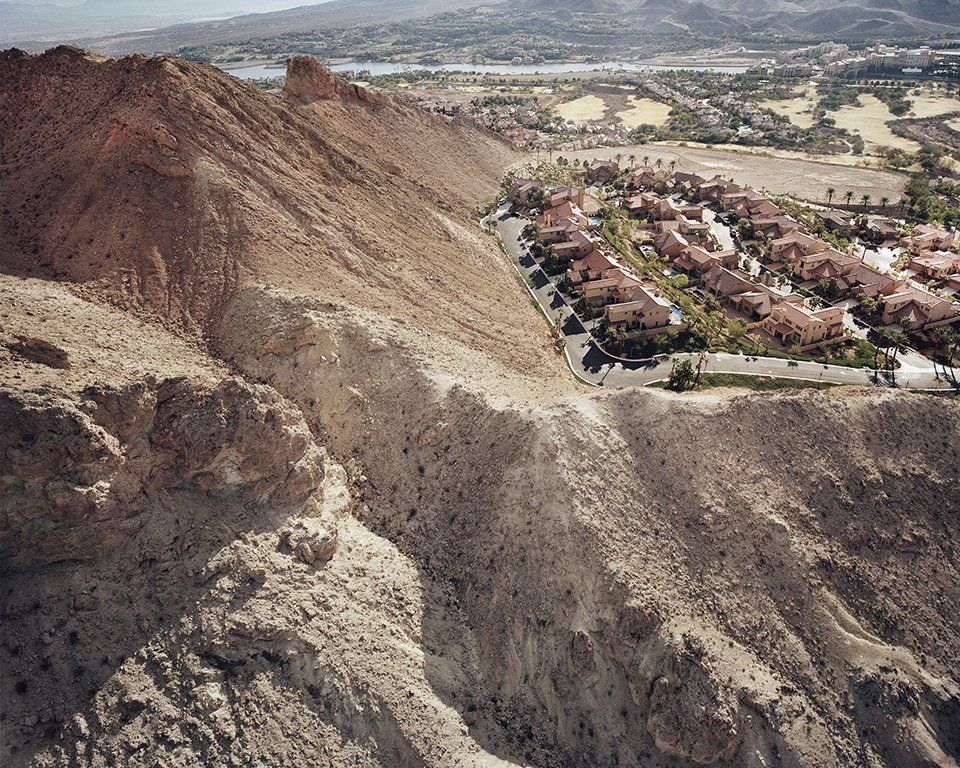
Michael Light
"Lake Las Vegas 2010-2012 20. 'Casa Palermo' Lake Las Vegas Homes Looking Southwest, Henderson, Nevada"
2010
Pigment print mounted on aluminum
40 x 50 inches
Edition of 5
I recently visited Hosfelt Gallery's impressive new space, currently home to "Private Frontiers," a two person show featuring works by Brooklyn-based painter Chris Ballantyne and San Francisco-based photographer Michael Light. According to the press release, the two artists "have been in dialogue for the past year to develop work that examines the human urge to stake territory and its more absurd manifestations on the American landscape." Whatever the specifics of the artists' conversation, Ballantyne's paintings are a terrific compliment to Light's large-format aerial photographs. Exhibited on their own in the expansive Hosfelt loft, Ballantyne's colorful and occasionally whimsical works would risk being swallowed up as bittersweet morsels. Hanging alongside Light's grand photographs, though, Ballantyne's modestly-sized pictures comport themselves especially well; their affability and humor endure, but undercurrents of earnestness and melancholy, too easily missed if exhibited on their own in so airy a space, are amply felt.

Friday, February 10, 2012

Chris McCaw: Drawing Time

Chris McCaw
"Sunburned GSP#420 (Arctic Circle, Alaska)"
2010
Unique gelatin silver paper negative
12 x 20 inches
Chris McCaw created the arresting pictures on view in "Ride Into the Sun," the artist's winter 2011 solo show at Stephen Wirtz Gallery (San Francisco, CA), using an unconventional technique. The artist loads handcrafted view cameras as large as 30 x 40 inches with expired silver gelatin photographic paper, tilts the camera lenses skyward, and opens the shutters for hours. Even on cloudy days, the photo paper is soon overexposed. As time wears on, however, the light-sensitive chemicals that coat the paper are solarized, and the prints' tones are transmuted in curious ways. In many of McCaw's works, the sun appears as a dark, arcing streak and the landscape and sky as shades of grey. During some of McCaw's longer exposures, the sun's brilliance, laser-like, burns through the paper, tracing its progress as a charred tear.

Thursday, September 22, 2011

Kija Lucas' Stars & Pillows


NASA and the European Space Agency
"Hubble Ultra-Deep Field"
2004

Glow-in-the-dark star stickers dotted the ceiling of my childhood bedroom. Every night, before sleep, I marveled at the phosphorescent firmament. Over time, however, the stickers' charge diminished and the ceiling's constellations grew dim. Likewise, the burgeoning egocentrism of adolescence dulled my capacity for wonder; for years, I gave little consideration to the night sky. By the time I'd matured enough to be awed anew, adult life had carried me from rural locales to the electric glow of New York City, where all but the brightest celestial bodies were swallowed by our species' illumination.

Today, whenever I find myself in sparsely populated areas at night, I'm startled and humbled by the brilliance of the stars and my relative insignificance. The famous Hubble Ultra-Deep Field (HUDF) image evokes a similar awe. The HUDF was produced by compositing visual data from the Hubble Space Telescope, and the colorful result provided astronomers with a 13.2 billion-year-old picture of our universe. The orange, yellow, blue, and purple marks that spot the HUDF are primordial galaxies that formed shortly after the Big Bang. The photograph is attractive, but it appeals more to our imagination; it's capable of elating a viewer as much as the heavens can an enthusiastic amateur astronomer or glow-in-the-dark star stickers can a child. The incomprehensible grandeur of the cosmos is intoxicating.


Kija Lucas
"Origin Story No. 4"
2011
Silver gelatin prints, tape
30 x 40 inches

The HUDF came to mind as I admired Kija Lucas' "Origin Story No. 4," a photogram collage included in Root Division's "Introductions 2011" exhibition, the non-profit's annual survey of a dozen Bay Area emerging artists. Although the abstract imagery of "Origin Story" appears cosmic, the galaxies and gases of Lucas' picture are more earthly. The artist gathered dust from her studio floor, placed it on light-sensitive photo paper, and then exposed the paper. Afterward, she cut the resulting photograms into 2x2 inch squares and rearranged them; the seams of the collage create an unsteady grid, adding to the impression of an extraterrestrial survey. But the white-specks and smears might also be construed as microscopic lifeforms near the deep-sea floor, the products of a particle accelerator's "God-particle" collision, or documentation of activity in another sphere invisible to the human eye. The photogram's easy transition between the unfathomably vast (i.e., the universe) and the subatomic speaks to the mystical notion that scale is Ouroboros-like, that infinite travel "inward" (i.e., moving ever smaller) eventually leads to the infinitely large.


Kija Lucas
"Pillow No. 4"
2011
Archival pigment print
23 x 30 inches

Does Lucas intend "Origin Story No. 4" as a rumination on such matters? I don't know. But the artist also includes another body of work in "Introductions 2011" that invites a complimentary interpretation: a series of photographs of old pillows, presented specimen-like on black backgrounds. The pillows' patterned fabric, stained with mold and sweat, is testimony to their years of service. In the context of "Origin Story," it's hard not to think of these well-used pillows cradling the craniums of people transitioning between waking life and dream, a liminal state conducive to contemplative insight into the incomprehensible. Yet the beautiful photographs are also anthropological documents; Lucas treats mundane pillows as artifacts worthy of sustained consideration. What do they tell us about ourselves? What do the patterns mean: the fleur-de-lis, the crop of diamonds? Specific answers will be provided by viewers, but Lucas' overarching project attests to the human inclination to collect and interpret, to grope for understanding.


Kija Lucas
"Pillow No. 6"
2011
Archival pigment print
23 x 30 inches

Image credits: HUDF, courtesy of NASA; Kija Lucas images, courtesy the artist

Saturday, July 25, 2009

At Dawn I Have Birds


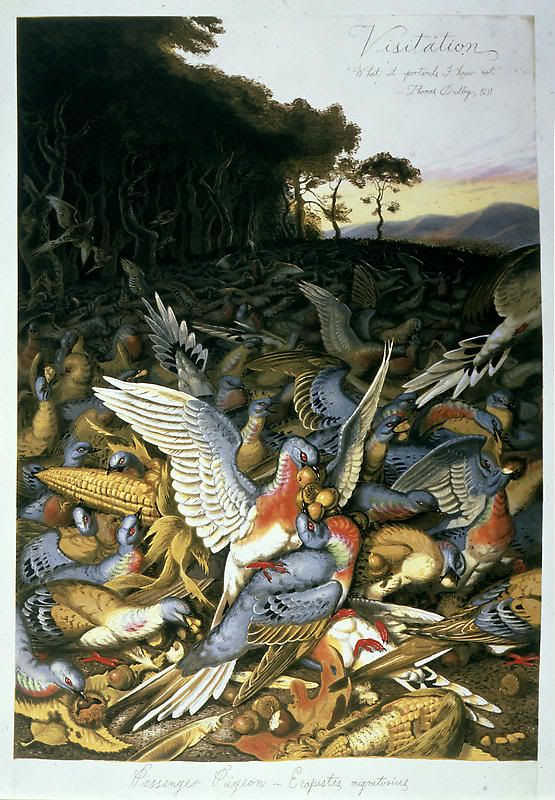
Walton Ford
"Visitation"
2004
Six color hardground and softground etching, aquatint, spit-bite aquatint, drypoint on Somerset Satin paper
44 x 30 7/8 inches


"Often, lately, the night is a cold maw
and stars the scattered white teeth of the gods,
which spare none of us. At dawn I have birds,
clearly divine messengers that I don't understand
yet day by day feel the grace of their intentions."

— from "Age Sixty-nine," by Jim Harrison

Image credit: ripped from the Paul Kasmin Gallery website

Monday, September 08, 2008

The Benefits of Flight-induced Relativism


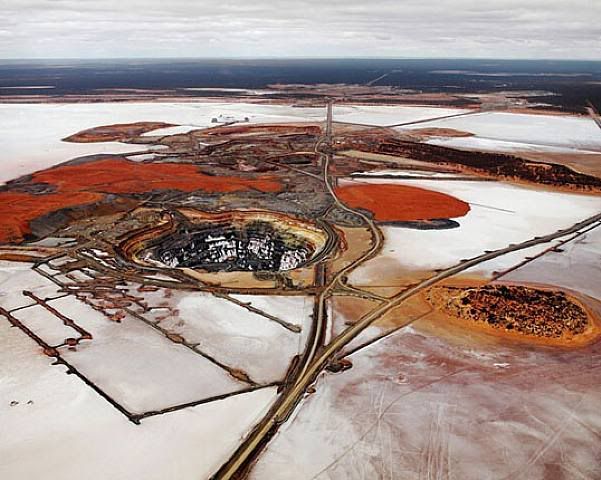
Edward Burtynsky
"Silver Lake Operations #2, Lake Lefroy, Western Australia"
2007
Digital chromogenic print
Dimensions variable

"From the height of ten thousand feet, the earth appears to the human eye as it appears to the eye of the camera; that is to say, all history is reduced to the accidents of nature. This has the salutary effect of making historical evils, like national divisions and political hatreds, seem absurd.
...
If the effects of distance between the observer and the observed were mutual, so that as the objects on the ground shrank in size and lost their uniqueness, the observer in the airplane felt himself shrinking and becoming more and more generalized, we should either give up flying or create heaven on earth."
-W.H. Auden

For more thoughts on altitude granted relativism, read my post, "The Absurd Whole," a response to an exhibition of Michael Light's photographs.

Photo credit: Burtynsky photograph ripped from artnet

Monday, June 23, 2008

Letters From The Inquisition


Michael McDevitt, friend and fellow artist, recently created a second blog project, Letters From The Inquisition.

Feel Free To Wander, Michael’s extant Blogger venture, remains active, but focuses on art updates and images of works produced in Michael’s Pioneer Square, Seattle, studio.

Letters, by contrast, is chock-a-block with gems like “Adventures In Tiny Land,” a post in which Michael muses on the awesome magic of cellular engineering.

I look forward to reading many more such “letters.”

Monday, March 31, 2008

I fly west to Seattle on Wednesday morning. The following week, I head south to San Francisco. I will return to NYC just before the middle of the month. I don't expect to be posting any new content while I am gone.

I leave you all with this profound tidbit, clipped from NewScientist magazine.

"In August, radio astronomers announced that they had found an enormous hole in the universe. Nearly a billion light years across, the void lies in the constellation Eridanus and has far fewer stars, gas and galaxies than usual. It is bigger than anyone imagined possible and is beyond the present understanding of cosmology. What could cause such a gaping hole? One team of physicists has a breathtaking explanation: 'It is the unmistakable imprint of another universe beyond the edge of our own,' says Laura Mersini-Houghton of the University of North Carolina at Chapel Hill."


The claim made by Mersini-Houghton is controversial, and totally without mathematical support. All the same, it seems to have turned a number of astrophysicist heads.

I find it oddly comforting that our universe might be pressed up against another, like a bowl of so many water balloons. After all, what are water balloons for?


Photo credit: "Calvin & Hobbes," by Bill Watterson

Saturday, October 20, 2007

Gallery Report: October 17th, 2007

Jill Greenberg at ClampArt


Jill Greenberg
"Untitled #7"
2006
Archival pigment print
Edition of 7
80 x 43 inches

ClampArt: Few animals possess more totemic significance than the bear. For many hunter-gatherer peoples, the bear was the supreme incarnation of Nature. But today our encounters with members of family Ursidae are contrived: we watch polar bears dully divert themselves in a zoo compound; our circuses doll up black bears in tutus and fezzes; we place cuddly, stuffed teddies in our infant's crib. Contemporary humans have enervated the animal, but the power of an enraged bear and her long, annual slumber are no less awesome or mysterious.

With "Ursine," Jill Greenberg gives these proud animals the celebrity treatment - the photographer specializes in the sort of hi-contrast, saturated images we see on billboards or in advertisement-thick glossies - but her photographs capture a range of expression in the faces and (pardon the pun) bearing of her subjects. The grizzly bear pictured in "Untitled #7" the strongest photograph in the exhibition, rears up his hind legs and lets loose a growl from a gaping, intimidating maw. Admiring those yellowed teeth, the moistened, fleshy lips, and the mottled tongue, I can almost smell the stench of being. No tutus for this fellow; this is the bear restored, a benevolent monster of the human unconscious.


Jill Greenberg
"Untitled #4"
2006
Archival pigment print
Edition of 7
43 x 50 inches

+++++

Patte Loper at Lyons Wier Ortt Gallery


Patte Loper
"We Had Pierced the Veneer of Outside Things and Scattered into a Diaspora of the Amazing"
2007
Oil on paper
80 1/2 x 58 inches

Lyons Wier Ortt Gallery: The paintings and drawings in Patte Loper's exhibition, "A New Way North," are technically commendable but lack emotional or intellectual substance. The flat, photographic color and ugly architecture featured in some works - "Glorious Predators of the Natural World," for example - are objectionable. To be fair, this may be the artist's intention. The press release informs readers that "Loper explores the pictorial and cultural intersection of glamour, modernism, cold war paranoia, and alienation." But Loper's work remains too indebted to the source material; no new life is breathed into these spaces or events through Loper's "appropriation and reproduction."

One painting, however, is exempt from such criticism. In fact, the strength of the exhibition's centerpiece, "We Had Pierced the Veneer of Outside Things and Scattered into a Diaspora of the Amazing," is what compels me to so harshly critique the other works Loper includes. "We Had Pierced..." outshines its siblings, much to their detriment.

In the painting, a large white-tailed deer (Odocoileus virginianus) rests atop a dark, Antarctic outcropping. In a glacial valley beyond, we see a partially snow-covered geodesic dome, presumably occupied (or once occupied) by human researchers. The title of the painting and the dome's construction call to mind the scientific optimism of the mid-20th century and the promise of the future. We now hold that promise in low regard and the optimism has evolved into unrestrained globalization, bringing with it the accelerated transport of contagions and so-called "invasive species," those creatures transplanted in new lands that are able to find a foothold, often displacing native niche specialists in the process.

The deer appears in all of Loper's works, included, according to the artist, "to interrupt narrative expectations," but in the case of "We Had Pierced..." the deer's presence raises questions about the work of the scientists below. Whoever lives (or lived) inside the dome "belongs" to this remote place now, as does the deer. This wasn't always so. The humans and the deer have come to this location (or were brought), and so the landscape is altered, but to what end? The slow groan of geology cradles the new inhabitants. All remains in flux. Loper's painting is a tribute to Nature's awesome compass and to our species' relative insignificance (both physical and temporal). It is as celebratory as it is ambivalent.

+++++

Keith Tyson at Pace Wildenstein


Keith Tyson
Detail of "Large Field Array"
2006 - 2007
Mixed media
Dimensions variable

Pace Wildenstein: Keith Tyson's "Large Field Array" is an exceptional work, deserving of many return visits. Though I have thought about the installation a great deal these last two days, everything I write fails to convey the work's dynamism.


Keith Tyson
Detail of "Large Field Array"
2006 - 2007
Mixed media
Dimensions variable

For all of its color, its scale, and its varied concepts, the viewing experience is a quiet, internalized one. "Large Field Array" is a polymath's revery, a virtually inexhaustible field of potential poetic connections. Tyson's worthy raison d'etre, the "joyful exploration of how everything in the world is connected," has impelled him to oversee a project that is much more than he could have hoped for. The European curator Hendrik Driessen is quoted in the gallery's press release, saying "it is a truly generous work of art." Indeed it is. In a more comprehensible, less globalized world, the work would be considered a masterpiece.

+++++

Photo credits: Jill Greenberg images courtesy ClampArt, New York City; Patte Loper image courtesy Lyons Wier Ortt; Keith Tyson images, Hungry Hyaena, 2007

Monday, October 15, 2007

Signals

"...it seems that something new is emerging on our planet. It is true that technical progress in modern times has linked men together like a complex nervous system. The means of travel are numerous and communication is instantaneous - We are joined together materially like the cells of a single body, but this body has as yet no soul. This organism is not yet aware of its unity as a whole. The hand does not yet know that it is one with the eye."

-Antoine de Saint-Exupéry, pilot and author of The Little Prince
Photo credit: Hungry Hyaena, 2007

Thursday, July 12, 2007

Gallery Report: June 27, 2007

Part Three : The Absurd Whole


Michael Light
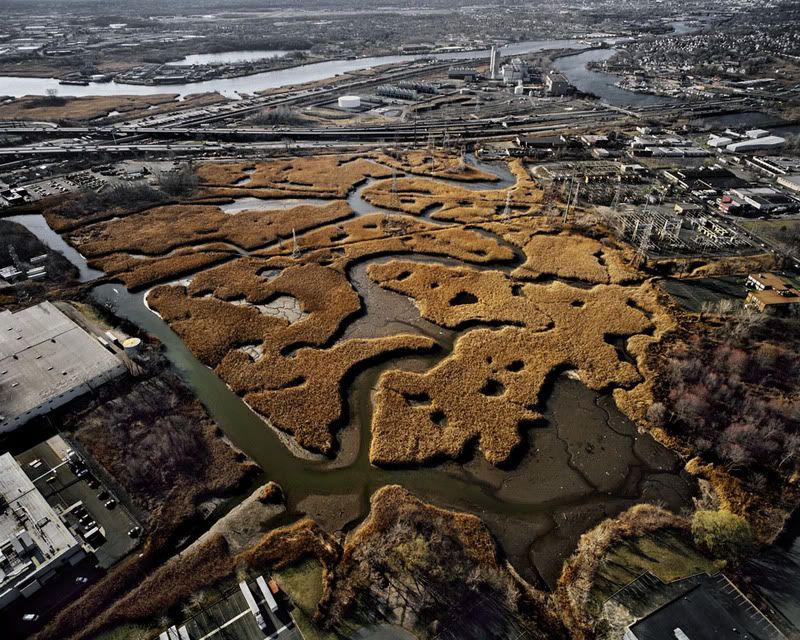
"Bellman's Creek Marsh in the Meadowlands, I-95 and Hackensack River Beyond, NJ, 2007"
2007
Pigment print on aluminum
24 x 30 inches (or 40 x 50 inches)


“The projects of human technology exist wholly within nature, evolving, like anthills, from a set of circumstances that they can neither invent nor transcend.”
-Lewis Lapham, Harper's Magazine (November 2000)

When an airline representative asks if I would prefer an aisle or window seat, I opt for the view. Cramped legs and bathroom trip niceties are a small price to pay. Peering through the reinforced panes as a young boy, I was afforded the perspective required to imaginatively connect a black-and-white aerial survey of my parents’ farm to my ground-level experience of those woods, fields, and marshes. I could at last identify the contours of a pond or stand of trees that I had explored on foot many times. This recognized correspondence thrilled me. A decade on, as a teenage pilot-in-training, I was too enamored of the panorama to mind the specifics of stall recovery procedure, and today all I really recall of the hours logged at the yoke is the exuberant joy I felt looking down on the thin peninsula of farmland separating the Chesapeake Bay from the Atlantic Ocean.

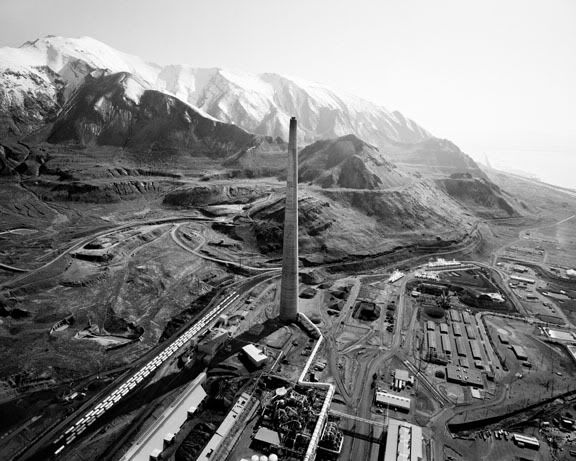
From above, we comprehend land as a cartographer; our mundane conceptions of scale and place are expanded. Michael Light's handsome, handmade Bookworks, on display at Hosfelt Gallery, celebrate this perspectival shift. The artist's books are comprised of aerial photographs shot "with a large-format camera from small, self-piloted aircraft and rented helicopters," each book a document of regional topography, settlement or industrialization. Many photographers aim to "[investigate] the complex landscapes of America," but the aerial aspect of Light's approach elevates his pictures; the images do provide an archaeological record of our culture's contemporary landscape, but the perspective - looking down or across the Earth's flesh from on high - nods to universal and geologic time.


Michael Light
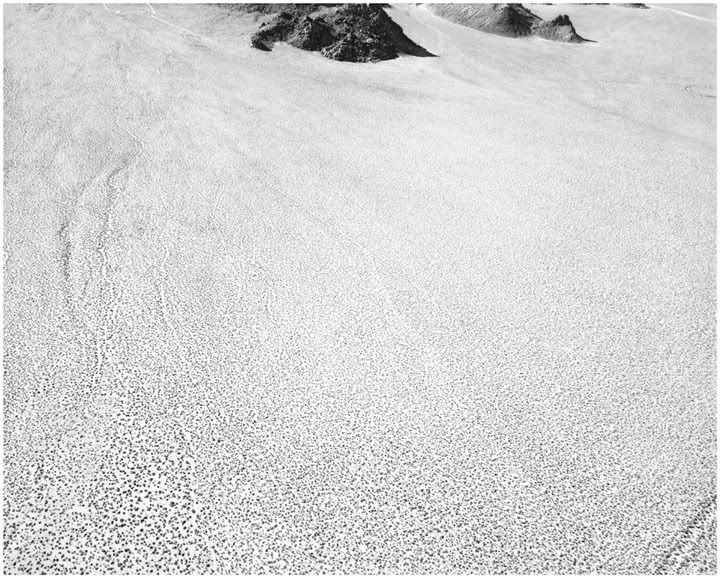
"Deep Springs Valley at 500', 1600 hours, Big Pine, CA
2000
Pigment print on aluminum
24 x 30 inches (or 40 x 50 inches)


The artist states that he is seeking "certain sublimities and timelessnesses and continuities amidst what might commonly otherwise be considered 'wastescapes' or 'nonscapes'" and this search has resulted in the six photographic surveys on display at Hosfelt: "New York Harbor, 03.29.07"; "Rancho San Pedro, 04.28.06"; "Los Angeles, 02.12.04"; "Bingham Mine/Garfield Stack, 04.21.06"; "Some Dry Space, 2003"; "Los Angeles, 07.27.05". His bookworks encourage us to question conventional notions of natural and artificial, and also to consider these environments with respect to the full sweep of time and scale.

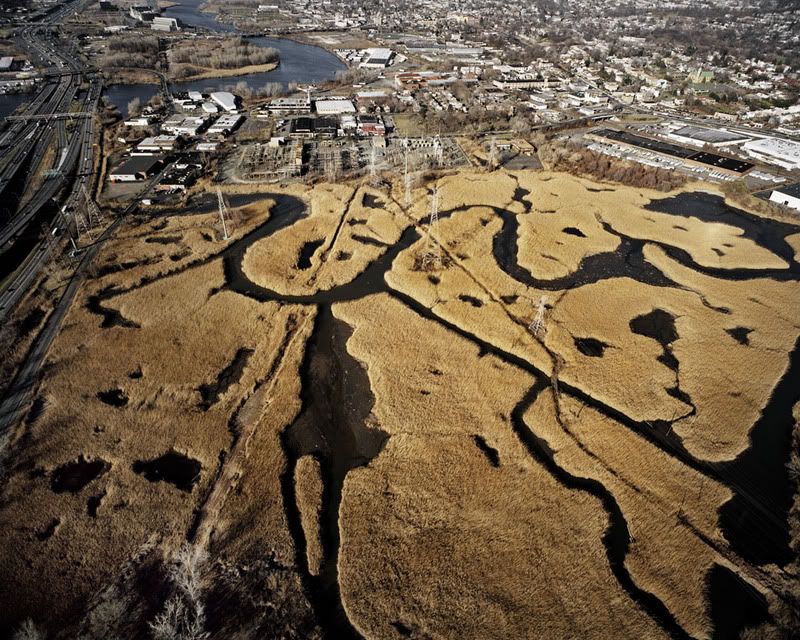
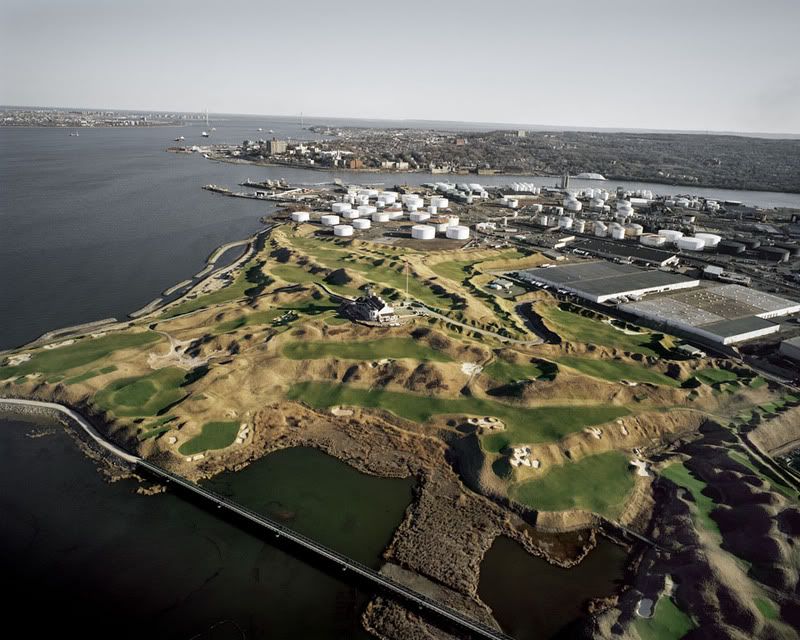
"New York Harbor, 03.29.07" is of particular interest to me, and not only because I currently call New York City home. Figuring prominently in this collection is the vast marsh of phragmites, roadways, spartina, telephone poles, landfills, radio towers, and cargo trailers known as the Meadowlands. This is complex terrain, literally and metaphorically. The Meadowlands possess a torn grandeur unrivaled even by the "virgin Nature" we revere in literature and film, on postcards and calendars. Without having traveled to the Grand Canyon, most people have an idea of what they would (or should) "feel" there. They have already experienced it on television.(1) Virgin Nature is neatly labelled and classified, packaged, marketed, and sold. The mess of the Meadowlands, by contrast, resists classification. It reminds us that real Nature - the evolving, ambivalent, often brutal Nature - includes man. Artist and writer John R. Quinn describes the Meadowlands in his book, Fields of Sun and Grass.
"Whether or not the meadows fill any sort of primal need for nature in the eyes of travelers who view them from the Turnpike, wilderness these broad, grassy plains surely are. For though defiled nearly to the utmost, they are yet filled with life - a complex, living biomass that has simply made the best of the industrial juggernaut that has all but overwhelmed it. The meadows have adapted, and endured. And in their own unique way they possess a living beauty that has not been obliterated."

Michael Light
"Bellman's Creek Marsh Looking North, I-95 and Overpeck Creek at Left, Ridgefield, NJ, 2007"
2007
Pigment print on aluminum
24 x 30 inches (or 40 x 50 inches)

Robert Smithson, another artist who, like Quinn, spent his childhood in northern New Jersey and much of his adult life in New York City, wrote, "Even the most advanced tools and machines are made of the raw matter of the earth." Smithson’s statement comes to mind as we speed along the New Jersey Turnpike, passing the industrial detritus that rises up from the reeds or settles into the mud. The tired metal towers, the cinder blocks, the coke bottles, and the discarded tires, the intricate refinery pipeworks, the fat garbage bags, the used condoms, the plastic milk cartons, and the rusty trunks -–all of these things may not be separated from the phragmites, the egret, the turtle, the otter, and the tern. Our existence is woven into past and present, as are the products of our being, a weave which may be dissected only by arrogance or ignorance. To dismiss the Meadowlands as a wasted landscape is to deny humanity. Even though the landscape's relative dearth of biodiversity should distress us. An honest assessment of the region's postmodern ecology and significance requires acceptance of ambiguity and contradiction. Light turns his lens on this heterogeneous landscape and others similarly complex.


Michael Light
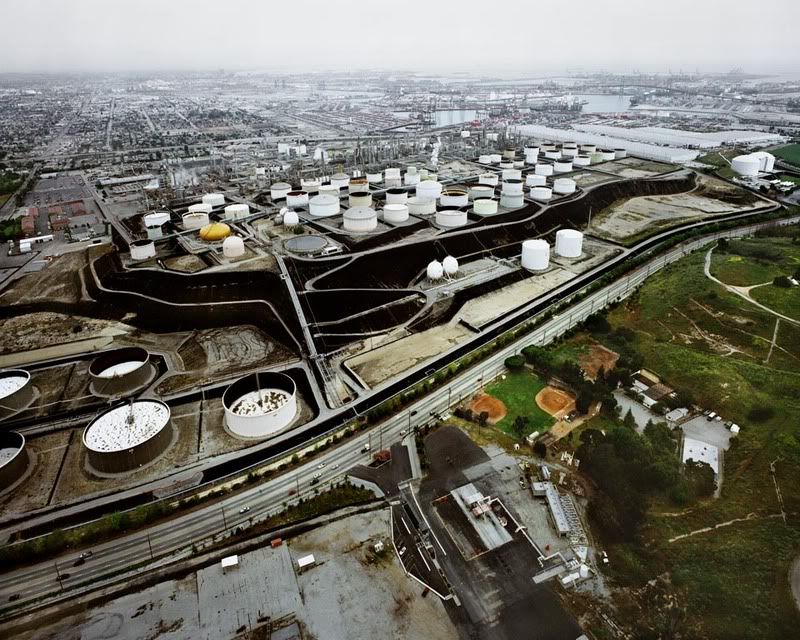
"Conoco Phillips Wilmington Refinery Looking South, 139,000 Daily Barrels, Terminal Island in Distance"
2006
Pigment print on aluminum
24 x 30 inches (or 40 x 50 inches)

In "Conoco Phillips Wilmington Refinery Looking South, 139,000 Daily Barrels, Terminal Island in Distance," a photo included in the book, "Rancho San Pedro, 04.28.06," a community baseball diamond seems incongruous surrounded by the expansive industrial complex of the southern Los Angeles basin. "Bayonne Golf Club, Former Landfill With A $200,000 Initiation, Old Standard Oil Refinery Beyond, NJ, 2007" pictures one of the Meadowlands' many landfills, in this instance reclaimed as an exclusive club, a manufactured escape in a landscape dominated by what most of us would deem the more mean marks of manufacturing. But the relationship of one to the other is not so dual; this isn't merely attractive versus ugly, good versus bad, or natural versus artificial. Light's photographs remind us that, like the refinery, the golf course and, indeed, even the glacial channel, qualitative judgments are in forever in flux.


Michael Light
"Bayonne Golf Club, Former Landfill With a $200,000 Initiation, Old Standard Oil Refinery Beyond, NJ, 2007"
2007
Pigment print on aluminum
24 x 30 inches (or 40 x 50 inches)

Take, for example, my long-held presumption that Los Angeles is a town with no shared pulse or sense of community. "Los Angeles, 02.12.04" carries Light (and us with him) northward over the industrial sprawl of Long Beach to the grouping of towers that comprise the city's downtown. Monuments to things bought and sold, the tall buildings rise from the city's otherwise low profile, each labelled: BP, Citigroup, Paul Hastings. Moving northwest, Light flies by the hills of Hollywood, dotted with the precariously situated houses of the rich and famous. I've never had a particular urge to explore this city, but as I turned the substantial pages of Light's book, the seismic beauty, fragility, and violence of the landscape were readable. Los Angeles became a romantic notion, an ongoing, astonishing experiment. The prints highlight the tenuous hold humans have on the land and, more generally, on our fate.

There is something freeing in the contemplation of our inevitable annihilation. Christopher Cokinos wrote recently in Orion that viewing extinction as an inevitability (and, therefore, civilization as a temporary exception) "nurtures sanity." I agree. Some readers will undoubtedly feel that this attitude is pessimistic, even nihilistic, but, to the contrary, I believe acceptance of our absurd position nourishes a desire to contribute, to participate directly, even in small ways. Faced with an impossible prospect, it is individual effort and happiness that sustain us. As Albert Camus concluded in The Myth of Sisyphus, "The struggle itself is enough to fill a man's heart. One must imagine Sisyphus happy."


Michael Light
"Carson Sink at 1000', 1600 hours, Fallon, Nevada; July 2000"
2000
Pigment print on aluminum
24 x 30 inches (or 40 x 50 inches)

Each of us is part of a greater body. The rest of the material world is part of this body, too. I conceive of this corporate entity as a chaotic harmony. As I consider the pictures included in "Some Dry Space, 2003," serene portraits of one of the more severe, inhospitable ecosystems on our planet, I vacillate between macro and micro world interpretations. I recognize the desert landscape with its dunes, tracts, and other marks of the wind's work, yet the same photograph might also be seen as a cross section of a cell or a tissue slice. Contemplating this analogue, I find myself dusting off the childhood mindblower, “What if our universe, and everything we know, is contained within a marble in an alien universe?”(2)


Michael Light
"Bingham Mine/Garfield Stack, 04.21.06"
2006
Hand bound pigment prints, custom box
36 1/2 x 46 1/2 x 1 1/2 inches (open)

But such wonder shouldn't be limited to childhood. These desertscapes, like the spectacles within our bodies or the Hubble views of the vast beyond, present us with stunning beauty. For this reason, the scale of Light's bookworks is important. The viewer can take in the whole picture at once, thereby making it apprehensible and safe, but the book spreads are also large enough to be confrontational. The artist writes that he feels a "tempered awe" when taking these pictures. Remarkably, the bookworks succeed in translating that feeling.

I left Hosfelt Gallery thinking about the ultimate futility of the preservationist impulse. Time moves oblivious. Describing the tenuous state of Louisiana’s coastal wetlands, a civil engineer opined recently that many millions of dollars will be spent “to hold the line in the mud.” Indeed, our situation is literally and metaphorically futile, but Light's images remind us that our desire to hold that line, to preserve the landscape that shapes us (as we shape it in turn), is as natural as the change we react against. This absurd desire is itself part of the holistic landscape. As Howard Bloom wrote, "We are Nature incarnate."


Michael Light
"Garfield Stack, Oquirrh Mountains and Ancient Beach of Great Salt Lake"
2006
Pigment print on aluminum
24 x 30 inches (or 40 x 50 inches)

+++++

(1) And because people watch television indoors, the nature they witness becomes an irrelevant but entertaining outside experience, one external to or apart from contemporary living and ritual.

(2) This "deep thought" is presented well in the animated closing sequence of the comedy, "Men in Black." The camera draws back, out of our solar system and past countless others to reveal that the whole of our galaxy is contained within one marble. The marble is being used in an alien game of marbles, and each of the marbles used to play the game contains countless other solar systems and galaxies. Physically this makes little sense, but it nicely illustrates the scalar continuum.

Photo credits: All images courtesy the artist

Tuesday, November 28, 2006

The images below are making email rounds; I thought I'd share them here. The presentation is a celebration of infinite expansion/progression, one exhalation of the universe's lungs.

It's difficult to make out the text in these low quality pics, but the text of the third image reads:
"Jupiter is about 1 pixel in size and Earth is invisible at this scale."
In the last:
"Sun is 1 pixel and Jupiter is invisible at this scale."
It's astonishing, in a calming, humbling kinda way.


Photo credit: thanks to a clever reader, I now know that these images come from rense.com, where you can view hi-res versions of these images.

Tuesday, June 20, 2006

Scale and Time On My Mind


I imagine many readers are already familiar with "The Powers of Ten," the simple, but profound short film produced by Charles and Ray Eames, of Eames design fame.

A few weeks ago, I posted "Vultures," a poem by Mary Oliver. As a throw away lead-in, I suggested that the poem could effectively replace my artist statement, communicating the ideas that I always write around. The subject of "Vultures," like so much of Oliver's work, is the rather messy process of "resurrection" via recycling (or what I prefer to term "reconstitution"). I die today to sustain that which will be tomorrow.

I've long been fascinated by death, compost, and their associated sauces. Much of my writing reflects this interest, but only rarely have I written about issues of scale. Initially scale and resurrection may seem disparate matters, but I believe that infinite regression, or travel within, leads to infinite progression, or travel without. Similarly, the reduction (or the extinguishing) of one life leads to another, new one (or many). With this in mind, "The Powers of Ten" is powerfully resonant.

Riffing on this idea, I recommend a listen to a recent episode of RadioLab. In it, co-host Jad Abumrad interviews Ann Druyan, Carl Sagan's widow and, along with him, one of the creators of the Voyager golden record, which I wrote about at some length here.

If you have some time to kill, watch "The Powers of Ten," and then listen to the RadioLab episode. They make for an exciting combo, and the Radiolab episode reaffirmed my belief that the golden record is "the culmination of modern art." What an arrogant, absurd, beautiful gesture?!

Thursday, March 30, 2006

Rid Of The Candiru

Thoughts On Four Shows

Image hosting by Photobucket
I conceive of the creative process as a wave, a series of crests and troughs.  The fertile upslope is indicative of possession by a duende, but is invariably followed by a usually unproductive, even terrible downslope.  This representation accurately describes my painting activity, but isn't applicable to my writing. Writing, for me, rarely involves a duende. Lately, I've come to think of my lexicographic compulsion as a candiru (Vandellia cirrhosa), the tiny, Amazonian fish species infamous for swimming up the anus, vagina, or urethra, wherein it erects spines to hold it in place while it enjoys a hearty blood meal. (Yeah, ouch.  In fact, the candiru is one of a very few vertebrate parasites that targets humans.)

Each of the four shows reviewed below "stuck" with me, demanding ink or, in my case, keyboard. I've been planning to write about two of these exhibitions for several weeks, but one or another shiny, neat thing caught my eye and off I went, galloping clumsy in pursuit. The longer I ignore the writing impulse, though, the more the candiru's spines dig in, insistent and maddening. By broadcasting the thoughts I can temporarily rid myself of the fish, and it is with great relief that I finally get this bunch of reviews "out."

+++++

New York Center for Arts and Media Studies:  NYCAMS, the physical manifestation of a course credit program affiliated with Bethel University, a mid-sized school located in St. Paul, Minnesota, occupies a stunning, seventh floor space not far from the Flatiron District. Judging by what I read online and my visit to "Paramnesiac Landscape," the group exhibition currently on display in the gallery area, the nascent program is already noteworthy.

I'm a sucker for the show's clever title.  "Paramnesia" is defined by Webster's New World Dictionary as a "distortion of memory with confusion of fact and fantasy" or the "same as deja-vu."  The exhibition's curator, Robin Reisenfeld, selected the nine participating artists because each "create[s] imaginary landscape worlds through the interplay of memory, fantasy, and recent scientific trends."  With the recent art world brouhaha over the role of curators - are they artists, orchestrators, or what? - Reisenfeld's thematic selection may appear too tidy for some folks, but it works well enough.  All the work in the show is good, but standouts are Daniel Zeller's drawings and paintings by Sarah Trigg and Cristi Rinklin.

Image hosting by Photobucket
Daniel Zeller
"Skim Level" (detail)
Ink on paper

Zeller's work has generated a fair amount of ink in the past couple of years, deservedly so.  His fine line drawings represent the best of two contemporary art world trends: obsessive drawing and pseudo-science.  On hand at NYCAMS are four of his fantastic, topographic renderings.  "Resistance Factor," a small ink and acrylic work, is quite handsome, suggestive of internal workings - a mapping of capillaries, perhaps - but also of pipelines on the color-coded mish-mash that is a United States Geological Survey chart.  Across the room, "Remedial Disfunction," one of the largest wall-works in the show, at 44 x 54 inches, is also one of the best.  Comprised almost entirely of punctuated pencil marks, the resulting image can "be" many things.  Initially, I understood the drawing to be an aerial view of crop circles but, within moments, I dismissed that association.  This landscape is ambivalent, at once exploited and in some state of repair; are we looking at the beginnings of resource extraction or delicate sutures on some undefined organ?  It doesn't matter.  Such interpretive vacillations are accurately described by Reisenfeld as "conflating the microscopic with the telescopic" and "explor[ing] the confluence of shifting realities and multiple levels of spatial and temporal stratums."  (Note: Unfortunately, the works described were not available for reproduction.  I've pictured another of Zeller's works above. Due to their detail, the web is unable to do them justice. It's a shame.)

Image hosting by Photobucket
Sarah Trigg
"Unintended Sculptures with Natural Disasters"
2006
Acrylic on Panel
30 x 40 inches

Less ambiguous, but no less preoccupied with the connection of interior to exterior, are the paintings of Sarah Trigg.  I was most drawn to "Unintended Sculptures with Natural Disasters," a medium-sized picture that depicts an active, tectonic landscape.  Trigg describes her work as "a biopsy," and this recent painting, a combination of aerial survey and traditional, "window" perspective, is bioptic, indeed. Like scientific figures published in a research journal, Trigg's paintings represent the support or data of an ongoing investigation.  In fact, I think of her work as geologic dermatology.  Standing in front of "Unintended Sculptures with Natural Disasters," I admire the pores and pustules of a vast and violent panorama.  Viewing geology in this light effectively humanizes, or at least anthropomorphizes, that which otherwise remains difficult to fathom. Aiding this proportional shift is the combination of formations (and deformations) that Trigg corrals.  By depicting so much dynamism in a relatively small area, she presents the viewer with a condensed time frame, millions of years of seismic activity caught in a frozen time lapse, a blink of the geologic eye rather than the human.  That Trigg achieves this push-pull dynamic without painting more ambiguous imagery is unusual, and laudable.

Image hosting by Photobucket
Cristi Rinklin
"Apparition"
2006
Acrylic and Oil on Dibond
36 x 30 inches

Cristi Rinklin's paintings belong to a related, but distinct genealogy. Rather than chart or map her subject matter, Rinklin aestheticizes it. Although her imagery could belong to the "without" - some of her densely layered, colorful forms recall Hubble telescope photographs of distant celestial bodies and events - it feels more inspired by worlds "within." Occasionally, Rinklin even includes a red curtain or some heavy fabric, leading viewers to believe we are looking behind or under - in other words, inward - to discover further mystery and wonder. Rinklin's structures - ornate and organic - are almost Gothic in nature, but also indebted to graffiti and cartooning. I get the feeling she admires these out-lying genres from a critical distance, though, and I'm tempted to describe Rinklin as a younger, more current sibling of Phillip Taaffe and Ross Bleckner. (Note: The two paintings Rinklin included in the the NYCAMS exhibition, one of which is pictured above, were promising, but I wasn't really sold until I visited her website.)

+++++

Image hosting by Photobucket
Fernanda Brunet
"LAAL-LA"
2006
Acrylic on linen
39.37 x 31.5 inches

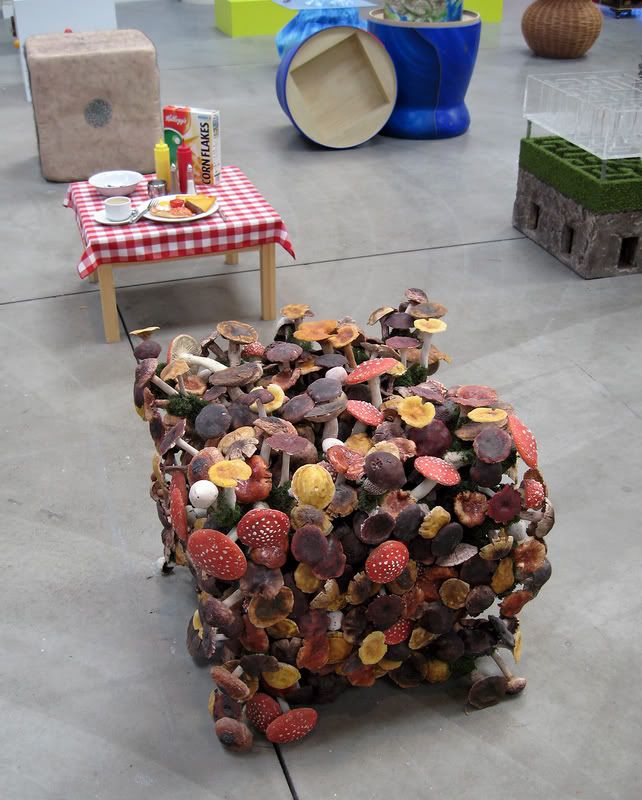
Galeria Ramis Barquet:  The work of Fernanda Brunet is undistinguished.  Her paintings belong to the now ubiquitous and often sexy super-flat aesthetic, but her floral explosions are so imminently digestable that, like fast food, viewers are apt to consume and forget.  Perhaps aware of this, Brunet has expanded her studio practice.  For her most recent solo effort at Galeria Ramis Barquet, "Happymania," she has included a number of bulbous fiberglass sculptures.  Occupying the gallery's main space, these forms resemble melting mushrooms and are covered with flowers of varying sizes and colors.  "Off the wall" they may be, but they suffer the same fate as Brunet's paintings.  (That said, it occurred to me that the sculptures would make great props in an uber-hip clothing store...for a month or so, anyway.  To sell to hipsters, you've got to "keep it fresh.")

Brunet's artwork aside, however, a line in the gallery's press release caught my eye.  "The artist has also incorporated typical Mexican kitsch decorative elements, such as pastel flowers made out of bread filling."  Reading the sentence, I stumbled over the writer's use of "Mexican kitsch."  In 2006, assigning specific examples of kitsch to one or another culture approaches meaninglessness.  Those rare holdouts not already absorbed into the global pastiche - and pastel flowers made of filling do not qualify - will soon be discovered by the All-Seeing Eye.  As a result, identifying the provenance of a kitsch element is a matter of cultural anthropology, useful only if the artist's intent is reclamation.

+++++

The Arsenal Gallery In Central Park: Somehow, I didn't know about this "gallery." (It's more of an open, institutional common room, crowded with cafeteria-like tables and surrounded by offices.) Given my love of all things natural history, I'm thrilled to learn of it, even belatedly. As the press release for "Rare Specimen: The Natural History Museum Show" explains, "the historic Arsenal building...was the first home of the American Museum of Natural History, from 1869 to 1877, before it moved to its current home on Manhattan's Upper West Side." (Happily, after poking about the Internets, I've learned that the NYC Department of Parks & Recreation accepts exhibition proposals. To that, I can only say, "WaWa WeWa!")

"Rare Specimen," curated by Clare Weiss, is an odd, almost arbitrary mix of nine artists, linked by a very general interest in natural history. For example, Mark Dion's "Cabinet of Curiosity" studies and Nicole Tschampel's brontosaurus project offer commentary on scientific subjectivity and the human desire to classify, while Karin Weiner's prosaic collages and Steve Mumford's oil painting of sleeping bears are more straightforward odes to the natural world. Eclectic exhibitions are fun, though, and this one coasts along well enough. "Rare Specimen" does, however, suffer for want of better examples of each artist's work; the show is filled with second-class citizens. "Bears," for example. is a good-looking painting, but alongside many of Mumford's other works, it leaves something to be desired. Other lesser works by established artists are on hand. Walton Ford's "Bangalore" etching is fine, but not outstanding - for the record, I still covet Ford's work, etching or otherwise, but barring an introduction and trade, this ain't in the cards - and Alexis Rockman's large "Hudson River" oil painting has outgrown the brush stroke - it falls apart at any distance. As a result, two of the lesser known artists steal the show.

Image hosting by Photobucket
Emilie Clark
"untitled (MT-P37)"
2005
Watercolor on paper
15 x 11 inches

Emilie Clark's work first appeared on my radar about a year ago. I wasn't sure what I thought of it, but after spending time with her small watercolors at the Arsenal, I'm sold. Individually, the pieces are hit-or-miss, but Clark's delicate touch is captivating; looking at the paintings, one senses her admiration for the plants she depicts. This is true even when her limnings flow into abstraction, a function, perhaps, of the medium, but also, seemingly, of her uncommon sincerity. Three works, in particular, are outstanding: "untitled (MT-P2)," "untitled (MT-P30)," and "untitled (MT-P37)," the last of which is pictured above.

Image hosting by Photobucket
Jeff Hoppa
"Captain Olson I"
2004
Graphite on paper
9 x 12.5 inches

Perhaps the most straightforward work included in the show, Jeff Hoppa's impressive graphite drawings of fossils are based on preliminary sketches he does at the American Museum of Natural History. After he has completed a number of these preparatory renderings, he returns to his studio to create finished drawings. Hoppa names the works after "the specimen's discoverer," but because he uses only his sketches as source material, filling in gaps "creatively," the end product is a mix of careful observation and invention, recalling the early days of natural history. The work - and Hoppa's process - reminds us of how interpretive our knowledge of the world is. Looking at the drawings, I think not just of specimen rooms, anthropology, and paleontology, but also of Albrecht Durer, unicorns, and mermaids. Hoppa's craft is well-honed and the results are beautiful.  I'm happy to have made the works' acquaintance.

Image hosting by Photobucket
Jeff Hoppa
"C. H. Sternberg I"
2004
Graphite on paper
12.5 x 9 inches

+++++

Image hosting by Photobucket
Simen Johan
"untitled #136"
2005
C-Print

Yossi Milo Gallery: I make a habit of filling small, hardcover sketchbooks with notes, cut-out images, and selected writings.  Every year or so, I exhaust the available space in one of these "commonplace books" and begin another.  Because so much tape and glue is used, the finished books sometimes burst at the seams.  I often return to swollen, earlier collections when I feel like taking a "thinking ramble."  One two-page spread might feature several quotations from an article about politics, more from an article on conservation, and the closing paragraph of a novel, along with random images from art magazines and a graffiti scribble of my own.  These apparently arbitrary arrangements lead to unexpected, curious associations (good grist for the mill), but they also offer a trip down memory lane.  What was I reading or preoccupied by six years ago?  What themes recur year after year?

Image hosting by Photobucket
Simen Johan
"untitled #86"
2000-2001
C-Print
44 x 44 inches

One of these sketchbooks features a stunning photograph on the inside cover, positioned just beneath a lovely Edward Hoagland quotation about the miracle of decomposition.  In the picture, a young boy, bicep bandaged as though he has just been immunized, inquisitively pokes at a pile of compost that is teeming with maggots, centipedes, and, strangely enough, Madagascar hissing cockroaches (Gromphadorhina portentosa).  I was immediately drawn to the photo when I came across it in the pages of Harper's Magazine.  It captures an essential part of my own early experience; time spent around the compost pile behind my dad's boat garage, contemplating the innumerable invertebrates that made their living there with a mixture of revulsion and fascination.  Carelessly, when I cut out the photograph and pasted it in the journal, I failed to note the photographer's name.  At the time, the image was important to me, but not the artist.

Image hosting by Photobucket
Simen Johan
"untitled #90"
2000-2001
C-Print
44 x 44 inches

But that's not the end of the story.  A year later, another image of a child, this one of a young, wild haired girl playing in the mud, was added to a different journal.  At the time, I didn't connect the two images, but I was drawn to them for the same reason.  I felt they were pieces of my past, representative of a late 20th century rural upbringing in which death and dirt are as formative as birthday cake and Nintendo.  Looking at the images, I felt the variety of melancholy joy that I described recently, the joy found in acceptance "of our inevitable decomposition."

Just last week, I learned that both photographs belong to a series entitled "Evidence of Things Unseen," by the young, Norwegian photographer, Simen Johan.  Only four or five years older than me, Johan has produced an impressive number of powerful, digitally-manipulated photographs.  His most recent body of work, "Until The Kingdom Comes," is uneven, but includes some work that I respond to viscerally.  This series of photographs foregrounds animals rather than children and childhood, appealing to our human longing for connections vanquished or ignored.  I spent a long while with the large prints at Yossi Milo Gallery.  Although the pictures work better with my glasses off - a function of my being too aware of the digital manipulation otherwise - the images are more emotionally resonant than most of what is on offer in Chelsea these days.  Johan is one step ahead of the digital photography pack.

Photo credit: Candiru line drawing via Queensland Department of Primary Industries website (uncredited); Daniel Zeller/Cristi Rinklin images, courtesy the respective artists and Robin Reisenfeld; Sarah Trigg image, courtesy the artist; Emilie Clark image, courtesy Artnet.com; Jeff Hoopa images via the artist's website; all Simen Johan images via the artist's website

Thursday, November 10, 2005

Dreaming of Release


Steve Mumford
"The AK-47 Round, Squad from Bravo Company takes cover during a nighttime patrol after a shot is fired nearby"
2003
Watercolor wash


Last night I dreamt that I was listening to dispatches from Iraq on the radio. By now we're all familiar with such reports: "A car bomb exploded in Fallujah today, killing three marines and injuring twelve civilians." But in my dream, I wasn't painting in my studio or cooking dinner in my kitchen while listening to the unhappy news. I was instead sitting on a second-story porch in Baghdad, with three Iraqis and an American soldier for company. In front of me, on the floor of the porch, rested a helmet. Instead of the standard steel pot, this helmet was formed from frosted glass. Realizing that it belonged to me, I anxiously wondered if all my body armor was equally delicate.

The radio reports of bombings and fire fights ran together endlessly. The Iraqi man to my right whittled at a bit of wood and one of his friends savored tea from a pot that sat on a small stool. From our elevated vantage point, I watched the bustle of Baghdad street life. Over the radio and the murmur of the people below, we could hear the crackle of approaching gun fire.

The dream was soaked in yellows, browns and whites, the muted colors of our western conception of the Middle East. Gradually, this monochromatic scheme clued me in to the unreality of the scene. This, I realized just before I awoke, isn't war. This is only me dreaming of reclaimed immediacy, a longing for direct engagement with my surroundings and the associated stretching of time experienced when the conscious being is forgotten and the animal acts alone.

I believe that the dream was inspired by three things. In the hour before I went to sleep, I admired a photograph of sculptor Joseph Zito's glass helmet in Art in America and, in the same magazine, read artist Dawn DeDeaux's account of her return to New Orleans one month after Hurricane Katrina. DeDeaux writes,
"Katrina is the indifferent manifestation of a weather pattern to be measured in centuries, not seasons. Thinking in such meteorological time, biblical scale and mythic proportion, contemporary art is the smallest speck of time, and I am wiped off the map."
I also spent some time yesterday thinking about my father's struggles with his current book project, an account of his two tours in Vietnam, his wartime work for the RAND corporation, and his experiences as a key translator of Vietnamese at the Paris Peace Talks. My father is the author of over thirty books, the majority of which deal with conservation and natural history. Some of these earlier books were long in coming, but none seemed so difficult as the current one. I'm convinced that the shift in subject matter is responsible.

I've rarely seen my father cry. Excusing tears brought on by the Hollywood dream machine, his recollections of Vietnam are usually responsible. "Over there," he sometimes found himself "in the shit," as Max Fisher would put it. Details are only reluctantly shared, but he saw some terrible things, both "on the ground" and in the control room. I've never pressed him for the whole truth, but I look forward to reading his story when the book is completed.

My father's negative experiences in Vietnam and his relatively leftist political leanings didn't stop him from encouraging me to enter the military, however. When I came of age, I gave the Army some thought - even though my father was a Navy man, I believed that I could more quickly become a trained helicopter pilot by entering the larger force - but ultimately decided service was not for me. I was not adrift; I knew that I wanted to be an artist and so concluded that the military would just delay my vocation. I finished undergraduate schooling never having joined ROTC, and I rarely second guess that decision.

But last night's dream points to an experiential void, one that sometimes haunts me in the city. In the country, at least, time spent outdoors, observing animal behavior and other natural phenomena, sustains my desire for immediacy. Furthermore, hunting, infrequent though the practice has become in my life, confirms that I am still alive, that I am still connected to the animal I murder, butcher and consume. (The move from country to city was added motivation to give up meat and fish - except that for which I am personally responsible.) Here in the city I am coddled, things feel "taken care of" and life becomes routine, punctuated only by late nights of inebriation. Silly errands take on unwarranted import in such a setting. Self importance is the order of the day and any sense of interconnectedness that one has cultivated evaporates, forcing many urbanites to turn to yoga or some other activity that might enable them to reconnect with real time.

I'm grateful that my day job is in a building which overlooks the East River. I can watch the wakes of passing ships slap at the reinforced perimeter of Roosevelt Island, pushing imperceptibly at the foundation, while the herring gulls circle and dip above, their predatory eyes on the look out for some scrap of thoughtlessly discarded food. This scene allows me a glimpse of the time scale that DeDeaux described, what she calls "meteorological time" or "mythic proportion." This moment is connected with the vast expanse.

When young men dream of war, they are entertaining thoughts of self destruction; more precisely, they dream of destroying the ego, wishing for it to be replaced by the group experience, by the animal drive, by the eyes of the hungry herring gull. This same erasure is achieved in times of crisis. That which is not of immediate relevance falls away, and the individual's decisions are dominated by the lower and mid brain, the portion residing at the top of the brain stem (including the amygdala, pons and medulla oblongata).

Recent events along the Gulf Coast of the United States and in Pakistan remind us of this reality. In her essay, "The Uses of Disaster," (published in Harper's Magazine) Rebecca Solnit addresses this precedence.
"This joy - this unspoken and perhaps unspeakable relief in disaster - also hints at an unfamiliar version of human nature...In his 1961 study, 'Disasters and Mental Health: Therapeutic Principles Drawn from Disaster Studies,' sociologist Charles Fritz asks an interesting question: 'Why do large-scale disasters produce such mentally healthy conditions?' One of the answers is that a disaster shakes us loose of ordinary time. 'In everyday life many human problems stem from people's preoccupation with the past and the future, rather than the present,' Fritz wrote. 'Disasters provide a temporary liberation from the worries, inhibitions, and anxieties associated with the past and the future because they force people to concentrate their full attention on immediate moment-to-moment, day-to-day needs.' This shift in awareness, he added, 'speeds the process of decision-making' and 'facilitates the acceptance of change.'"
I need not fight in a war - especially one that I am opposed to - to achieve such a shift in awareness, but living in the city does prioritize ego over the live animal.

I'm happy to be heading home for Thanksgiving this year. I look forward to taking a long walk and to being outside at first and last light.

Photo credit: reproduction of Steve Mumford's artwork ripped from Artnet.com

Tuesday, April 05, 2005

The Nihilistic Science Guy

“As a child, I would stand with my father on the beach in Delaware and stare at my shadow as the sun went down, watching it get longer and longer, infinitely long. When you understand how many stars are out there, more stars than there are grains of sand on the beach, you can think you’re just a speck orbiting a speck in the middle of specklessness. But there’s another way to look at it, which is that we have brains, and can use them to understand the universe. And I thought then that if I were out in space I could look back and see my shadow, the long shadow of little Bill.”

- Bill Nye, The New Yorker “Talk of the Town” (January 5, 2004)
I grew up two states south of Bill Nye, “The Science Guy,” and I less often considered sand on beaches than water molecules in the ocean, but I did spend many hours contemplating little things, real or imagined, awed by my relative enormity and, in turn, by my relationship to the greater, infinite expanse.

Some professional scientists poo-poo Nye. If pressed, these scientists admit that their disregard is rooted in his popular appeal and his “dumbing down” of science for mass consumption. I prefer to celebrate Nye for the same reasons.

My parents didn’t have a television when I was growing up, but when I visited a neighbor’s house and saw shows like "Sesame Street" or the "Electric Company," I was enthralled. Had “Bill Nye, The Science Guy" been aired when I was young, I'm sure that I would have loved it, and I'm sure that he would have further inflamed my love of science.

Interestingly, underneath Nye’s infectious excitement, he seems complicated. I find myself wondering what he thinks about after the studio lights are turned off. Is he defensively optimistic? Deeply pessimistic? What questions does he ask of himself? Of others? Does he avoid questions of personality or psychology, concentrating instead on that which he can safely externalize?

In the most recent issue of Wired, Nye is featured in "The Science Guy Grows Up," a short, five-question interview. When asked, "Science and comedy seem like strange bedfellows. How do you make serious science funny?," Nye responds:
“How can you make it not funny? Humor is everywhere, in that there’s irony in just about anything a human does. There’s all this PB&J: passion, beauty, and joy. But there’s also the futility of the whole thing. We’re just humans on this dying planet, and it doesn’t much matter what we do. We’re always setting up expectations, whether scientific or otherwise, and failing to meet them. That creates comedic tension. The more you find out about the world, the more opportunities there are to laugh it.”
Underneath all of his infectious excitement, then, Nye is something of a nihilist. Perhaps the lessons of science always reduce the human by presenting us relative to the rest of the mess. Maybe this, in part, contributes to the trend towards scientific specialization over generalism, allowing the scientist to avoid looking at the whole and thereby protecting her from potential crackup.

Photo credit: homepage of Zachary Alex Samuels, Cornell University