Showing posts with label Mary Oliver. Show all posts

Wednesday, September 09, 2009

Kimmel Harding Nelson Residency: Day 3


Grain Elevator; Nebraska City

Soundtrack

It's a treat to recognize voices that were once familiar enough to be taken for granted. After years of city living, my ears hunger for the soundtrack I knew in childhood.

Yesterday morning, the staccato lament of a mourning dove (Zenaida macroura) greeted me as I dressed. Later, standing beside an overgrown lot, I listened to the rasp-rattle-click of grasshoppers in the tall grass. Nearby, on the same block, the up-and-down whine of cicadas reverberated within me. At mid-day, as I explored the grassy fringes of a grain elevator operation on the western bank of the Missouri River, my progress scattered noisy grasshoppers, large and small, in every direction.

As I type this post, a male field cricket's (Gryllus pennsylvanicus) insistent plea sounds from a dark corner of the studio. I locate and playback a recording of the call on my laptop, hoping that the sound of another male suitor might draw the cricket out of the shadows for some Orthoptera fisticuffs. The aural lure fails, but I'm made happy by the attempt; the cricket cries for a mate and, with a keyboard click, I call back.

Life, I'm reminded by the persistent call of this cricket, and by the grasshoppers, the mourning dove, and the cicadas, is fleeting, yet rich and good. As Nebraska native, anthropologist, and author Loren Eiseley writes of "endlessly reiterated" frog calls,
"I suspect that to some greater ear than ours, man's optimistic pronouncements about his role and destiny may make a similar little ringing sound that travels a small way into the night."
Every creature's song is at once insignificant and grand. The middle school marching band is passing by my studio now, and the cricket and I are quiet.


Middle school marching band practice; Nebraska City

A Kettle of Vultures

Appropriately enough, as I walked past a mortuary two doors west of the KHN Center, I noticed seven turkey vultures circling low above the town. The night before, I'd read Lia Purpura's poetic essay "On Coming Back as a Buzzard" in the September/October issue of Orion. Given my dual love of natural history and language, I'm embarrassed to admit that, before reading Purpura's piece, I didn't realize that a group of vultures on the ground is called a "venue," and a group of vultures in flight is called a "kettle."

Watching the peaceful, unchoreographed aerial dance of this Nebraska City kettle, I recalled Mary Oliver's beautiful poem, "Vultures," as well as some of Purpura's essay, written from the perspective of a vulture.
"As a buzzard, I’d know the end of a thing is precisely not that. Things go on, in their way. My presence making the end a beginning, reinterpreting the idea of abundance, allowing for the ever-giving nature of Nature—I’d know these not as religious thoughts. It’s rather that, apportioned rightly, there’s always enough, more than enough. 'Nothing but gifts on this poor, poor earth,' says Milosz, who understood perfectly the resemblance between dissolve and increase. Rain scours and sun burns away excesses of form. And rain also seeds, and sun urges forth fuses of green."
"On Coming Back as a Buzzard" is a paean to reconstitution. How smart and satisfying to embrace the natural end as another corporeal beginning! I pray that my dead body will be saved from the poisonous excesses of a mortuary, that it will instead be wrapped in a simple cloth, laid in a simple wooden box, and buried without the insult of preserving chemicals and concealing makeup. I pray that the worms and the soil will consume me, will leech me and take me, so that my matter will become energy for other forms. I utter this prayer in silence as I look up at the dark birds.


Turkey vultures on roof; Harborton, VA

Elsewhere, Purpura writes,
"I'd love best the movement of stages and increments, to repeat 'this bank and shoal of time' while below me banks and shoals of a body went on welling/receding, rising and dropping. I'd be perched on a wire, waiting, ticking off not the meat reducing, but how what's left, like a dune, shifts and reconstitutes."
Even when alive, our bodies are forever in flux, forever "shift[ing] and reconstitut[ing]." After death, though, a profound reinterpretation and recycling of "self" takes place.

The biologists, writers, painters, and physicists who worship Nature are enthused by reconstitution because it is plain, profound truth. As the poet Galway Kinnell describes it in his terrific poem, "The Quick and the Dead," "the crawling of new life out of the old, which is what we have for eternity on earth."


St. Mary's Episcopal Church; Nebraska City
First Episcopal church in Nebraska; Founded 1857

But most folks, many of them good, kind people, don't share this enthusiasm for reconstitution. I presume, perhaps wrongly, that Nebraska City is home to many such individuals. On what grounds do I make this presumption? Firstly, it's a safe speculation anywhere in the world. Most humans prefer a supernatural view of afterlife. Secondly, Nebraska City is home to a good number of churches (nineteen, by my present count), and I make assumptions (sometimes wrong) about the stripe of belief held by the majority of American Christians. No doubt there are exceptions to the rule, but most of the religious Christians I know frown upon materialistic interpretations of life everlasting. Some go so far as to reject my panentheistic or panendeistic conceptions of morality and material being as heretical nonsense.

No matter; live and let die. I find the Christian notions of ascension and self-conscious afterlife ridiculous, and most Christians find my cherished reconstitution as a bit of larvae, a bit of root, a bit of this and that, grotesque and even offensive. Neither conception, though, prevents the individual from acting ethically, and that is, above all, what matters. As Purpura puts it,
"[The vulture] gets to reorder your thoughts about troves, to prove the spilled and shoveled-aside to be treasure. To reconfer notions of milk and honey, and how to approach the unbidden."
Put more explicitly, one man's materialistic mess is another man's milk and honey.

Photo credits: all photos, Hungry Hyaena, 2008, 2009

Tuesday, July 07, 2009

Rootedness


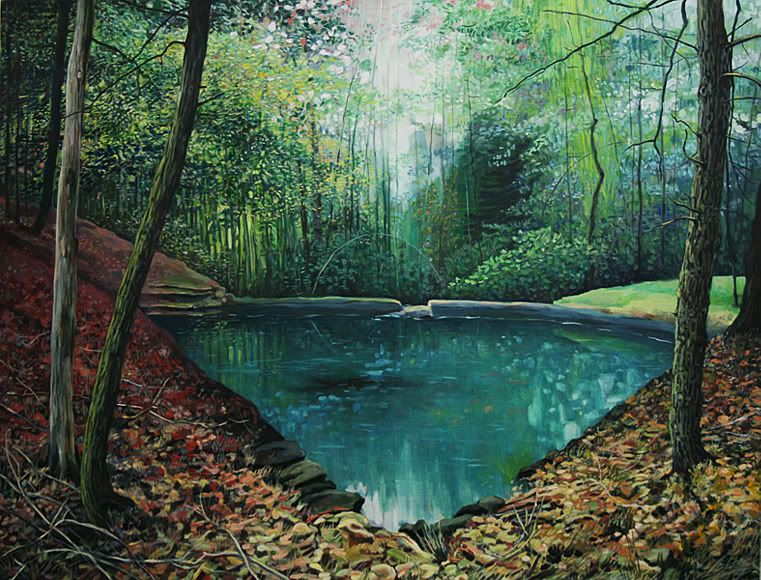
Amy Talluto
"Blue Pool"
2009
Oil on canvas
40 x 52 inches


Reading Mary Duenwald's recent New York Times article "The Land and Words of Mary Oliver, the Bard of Provincetown," I was particularly charmed by the following passage.
From time to time over what she has called her '40-year conversation' with Ms. Cook, [Ms. Oliver] or the couple together would go off to places like Sweet Briar, Va., and Bennington, Vt., where Ms. Oliver would teach poetry writing. But their home base was always Provincetown.

'People say to me: wouldn’t you like to see Yosemite? The Bay of Fundy? The Brooks Range?' she wrote in Long Life, a book of essays. 'I smile and answer, ‘Oh yes — sometime,’ and go off to my woods, my ponds, my sun-filled harbor, no more than a blue comma on the map of the world but, to me, the emblem of everything.'"
I'd like to accurately claim, as Oliver does, a deep familiarity with one landscape and ecology. Although I'm romantically rooted in the sulfurous soil of Virginia's coastal salt marshes, like many Americans, I've lived a relatively transient life, so far calling three states (and more houses or apartments than I can count on both hands) home. Still, the ascetic aspect of my temperament is moved by the notion of staying put, of refraining from travel in order to better cultivate continuity, peace of mind, and sense of place. The terms "provincial" and "parochial" have pejorative associations, but I believe there is a lot to be said for those individuals who appreciate their home ground as only a true local can.

If Oliver is right, rootedness is especially significant for artists. Reading some of Oliver's poetry last night, I rediscovered this early work, from 1963.

No Voyage

I wake earlier, now that the birds have come
And sing in the unfailing trees.
On a cot by an open window
I lie like land used up, while spring unfolds.

Now of all voyagers I remember, who among them
Did not board ship with grief among their maps?--
Till it seemed men never go somewhere, they only leave
Wherever they are, when the dying begins.

For myself, I find my wanting life
Implores no novelty and no disguise of distance;
Where, in what country, might I put down these thoughts,
Who still am citizen of this fallen city?

On a cot by an open window, I lie and remember
While the birds in the trees sing of the circle of time.
Let the dying go on, and let me, if I can,
Inherit from disaster before I move.

O, I go to see the great ships ride from harbor,
And my wounds leap with impatience; yet I turn back
To sort the weeping ruins of my house:
Here or nowhere I will make peace with the fact.

-Mary Oliver

Image credit: courtesy, the artist

Friday, August 24, 2007

Straight Talk

"I see you in all your seasons
making love, arguing, talking about God
as if he were an idea instead of the grass,
instead of the stars, the rabbit caught
in one good teeth-whacking hit and brought
home to the den."

- From "Straight Talk From Fox," by Mary Oliver
Photo credit: photo of little Perdido by Hungry Hyaena, 2007

Thursday, May 31, 2007

Old Mud Blood at the Banshee

"And I do not want anymore to be useful, to be docile, to lead
children out of the fields into the text
of civility, to teach them that they are (they are not) better
than the grass."

-Mary Oliver, excerpt from Rain, originally published in "New Poems"(1991 - 1992)
A year or so ago I met a friend for drinks at The Banshee on Manhattan's Upper East Side. Sitting next to us at the bar was a poet, in his early fifties, who had recently moved to New York from Los Angeles. Feeling uncharacteristically social (after sufficient lubrication), I got into a conversation with the man. He had experienced some critical success within west coast poetry circles but had grown frustrated with "the scene," and opted to try on NYC for size.

After a half-hour of talking, he announced, "Well this is really great. You're the first person I've met since moving that's really got me feeling like there is that creative pulse you always hear about New York." He insisted on giving me his card and asked for information on my website and future exhibitions. I've lived in New York long enough to view his gushing with some skepticism; still, I'd enjoyed the chat and exchanged information with him agreeably enough.

As the gentleman prepared to depart, he paused, cocked his head quizzically, and asked, "So who are your favorite contemporary poets?"

It was an easy question to answer. "At the moment I'm enjoying collections by Mary Oliver and Galway Kinnell. I've always..."

I couldn't finish my reply; the poet broke into a peal of laughter. I was understandably taken aback by this reaction. After regaining some semblance of self-control, he exclaimed, "And the whole time you had me thinking you knew good poetry from bad poetry. Mary Oliver is garbage. Kinnell is little better." I stared at him blankly. He laughed a little more, shook his head, and continued, "I mean, that's like me telling you that my favorite painters are Edward Hopper and Norman Rockwell. You'd be appalled. That's not even art! That's illustration!"

I wasn't quite sure what to say. I shrugged and finally said, "Well, I read a fair amount of poetry, so my landing on those two isn't just chance. I think they're good."

He appeared genuinely crestfallen. It was as though my bad taste sapped New York of the intellectual and creative energy he believed he had just become acquainted with. He may have pegged me for an appreciator of mundane poetry (guilty as charged, I suppose), but his explosive dismissal of Oliver and Kinnell, both gifted and rewarding poets, and his use of Hopper and Rockwell as parallels reveals inherited (or adopted) prejudice.

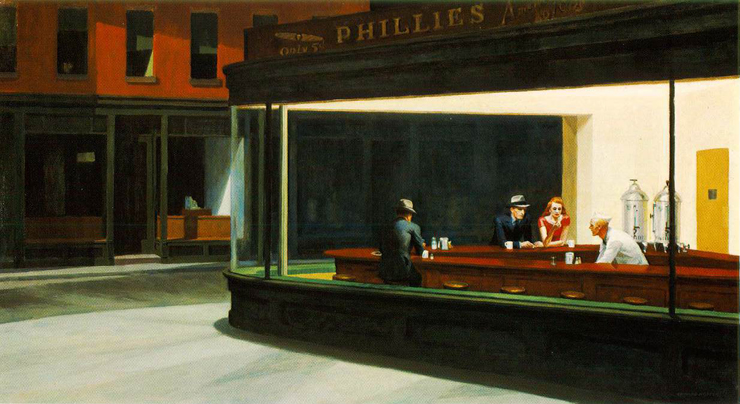
Hopper and Rockwell painted with reproduction in mind and, indeed, both worked as professional illustrators for a time; this being the case, labelling them illustrators isn't entirely inaccurate but, as Peter Schjeldahl wrote recently, "If 'Nighthawks' is an illustration, a kick in the head is a lullaby." Hopper and Rockwell aren't favorite artists of mine, but their work is not deserving of the lambasting it receives from so many art world experts. (The unintentionally comical Thomas Hoving, former director of the Metropolitan Museum of Art, comes to mind here. In the documentary, "Who The $#%& Jackson Pollock?," Hoving dismisses the opinion of someone outside the art establishment by wagging a finger and saying, “She knows nothing. I’m an expert. She’s not.”)

The truth is, many critics and connoisseurs build upon the existing scaffold of criticism and connoisseurship to such a degree that, generations down the line, their tower of opinions is an esoteric curiosity, shaky and too tall to be buttressed by the masses. I'm not suggesting that experts don't have a place nor that populist art is superior to "high" art, but merely that it is unfortunate that so many members of creative communities are eager to demonstrate their "expert" status by espousing those ideals or ideas most removed from the general consensus.

I sometimes struggle to explain Mary Oliver's value to non-believers. One acquaintance described Oliver as "the Thomas Kinkade of poetry." The comparison is ludicrous. Oliver writes of the "live animal," of a becoming with the natural world that impregnates experience with a meaning distinct from reason. Kinkade is the master of commodifying kitsch. They are worlds apart.

At any rate, I was all too happy to read Bioephemera's recent toast to Oliver. Cicada observes, "Some critics grumble that [Oliver] is insufficiently challenging or unsurprising, but she leans so heavily on the sense of wondrous recognition fed by nature, I wonder if a failure to be moved isn’t primarily a failure of that wonder-sense." Or, in the words of Oliver herself,
"I don't want you just to sit down at the table.
I don't want you just to eat, and be content.
I want you to walk out into the fields
where the water is shining, and the rice has risen.
I want you to stand there, far from the white tablecloth.
I want you to fill your hands with the mud, like a blessing."
-from Rice, "New Poems" (1991 - 1992)
Later in her post, Cicada describes the sense of belonging, if you will, that an Oliver poem provides. "...her poems make me feel rooted in humanity, grounded in my own body, aware of this lumpy, piecemeal tangle of cells which is somehow, miraculously, taking pleasure in language. Oliver’s poems are spiritual experiences for those who would not necessarily describe themselves as spiritual." But why take her word for it?

The Fish
The first fish
I ever caught
would not lie down
quiet in the pail
but flailed and sucked
at the burning
amazement of the air
and died
in the slow pouring off
of rainbows. Later
I opened his body and separated
the flesh from the bones
and ate him. Now the sea
is in me: I am the fish, the fish
glitters in me; we are
risen, tangled together, certain to fall
back to the sea. Out of pain,
and pain, and more pain
we feed this feverish plot, we are nourished
by the mystery.
-from "American Primitive" (1983)


I guess it's true that one man's "garbage" is....

Photo credit: Hungry Hyaena, 2002

Tuesday, June 20, 2006

Scale and Time On My Mind


I imagine many readers are already familiar with "The Powers of Ten," the simple, but profound short film produced by Charles and Ray Eames, of Eames design fame.

A few weeks ago, I posted "Vultures," a poem by Mary Oliver. As a throw away lead-in, I suggested that the poem could effectively replace my artist statement, communicating the ideas that I always write around. The subject of "Vultures," like so much of Oliver's work, is the rather messy process of "resurrection" via recycling (or what I prefer to term "reconstitution"). I die today to sustain that which will be tomorrow.

I've long been fascinated by death, compost, and their associated sauces. Much of my writing reflects this interest, but only rarely have I written about issues of scale. Initially scale and resurrection may seem disparate matters, but I believe that infinite regression, or travel within, leads to infinite progression, or travel without. Similarly, the reduction (or the extinguishing) of one life leads to another, new one (or many). With this in mind, "The Powers of Ten" is powerfully resonant.

Riffing on this idea, I recommend a listen to a recent episode of RadioLab. In it, co-host Jad Abumrad interviews Ann Druyan, Carl Sagan's widow and, along with him, one of the creators of the Voyager golden record, which I wrote about at some length here.

If you have some time to kill, watch "The Powers of Ten," and then listen to the RadioLab episode. They make for an exciting combo, and the Radiolab episode reaffirmed my belief that the golden record is "the culmination of modern art." What an arrogant, absurd, beautiful gesture?!

Monday, June 05, 2006

Reading Mary's Vultures

When I'm in the midst of a studio surge, essay ideas often gestate for months. Jotted notes and fragmented Word documents evidence my intention to write, but I find it difficult to commit. Reading, by contrast, remains an essential activity during these periods and, curiously, poetry often trumps prose, perhaps because it is more like visual art, more open and sensuous.

I've recently been enjoying collections of Mary Oliver and Czeslaw Milosz. Much of Oliver's work compliments my own. Reading her poems, I feel a reciprocated embrace; she often channels a wonderful existential experience. Frankly, if I could get away with submitting "Vultures" as my artist statement, I'd happily do so!
Vultures

Like large dark
lazy
butterflies they sweep over
the glades looking
for death,
to eat it,
to make it vanish,
to make of it the miracle:
resurrection. No one
knows how many
they are who daily
minister so to the grassy
miles, no one
counts how many bodies
they discover
and descend to, demonstrating
each time the earth’s
appetite, the unending
waterfalls of change.
No one
moreover,
wants to ponder it,
how it will be
to feel the blood cool,
shapeliness dissolve.
Locked into
the blaze of our own bodies
we watch them
wheeling and drifting, we
honor them and we
loathe them,
however wise the doctrine,
however magnificent the cycles,
however ultimately sweet
the huddle of death to fuel
those powerful wings.
Deceptively straight-forward, the poem will open, for readers of a certain disposition, to complex interpretation. For me, "Vultures" is an insightful tracing of a complicated relationship with religion and a paean to the contemplation of death and awesomeness of the universe's messy abundance.

Photo credit: "Soaring," painted by Andrew Wyeth (photograph by Ken Burris, for Shelburne Museum)