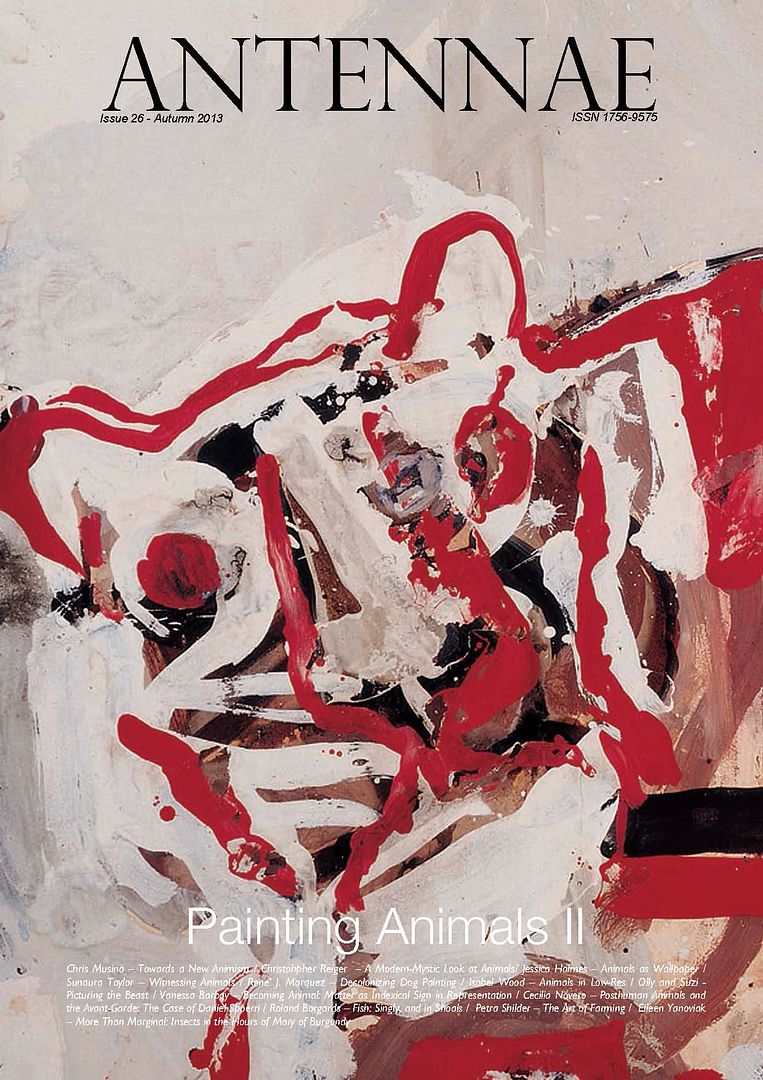
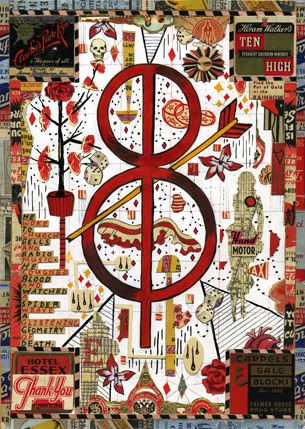
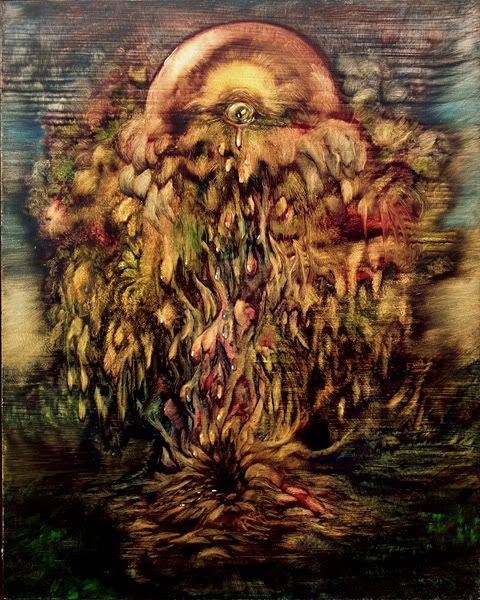
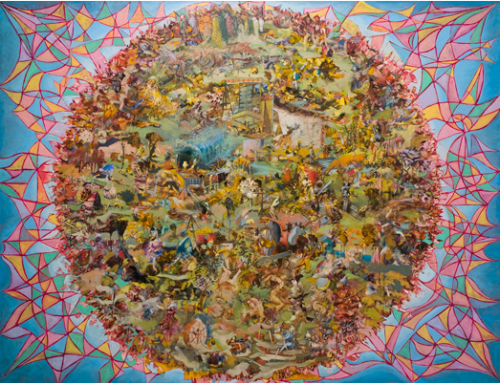
I'm pleased to announce that several of my paintings and drawings are featured in Issue #26 (Autumn 2013) of Antennae: The Journal of Nature In Visual Culture. Accompanying the images, the editors printed a statement I wrote about the featured body of work.
While I'm not currently working on that series -- my attention is more focused on the hybrid project I described in April -- I'm delighted to have my work appear in Antennae, a journal that, as an artist and writer preoccupied by all things "nature," I've long been a fan of.
Image credits:: Antennae, copyright 2013
Showing posts with label mysticism. Show all posts
Wednesday, September 25, 2013
Friday, October 26, 2012
The Mystics Downtown
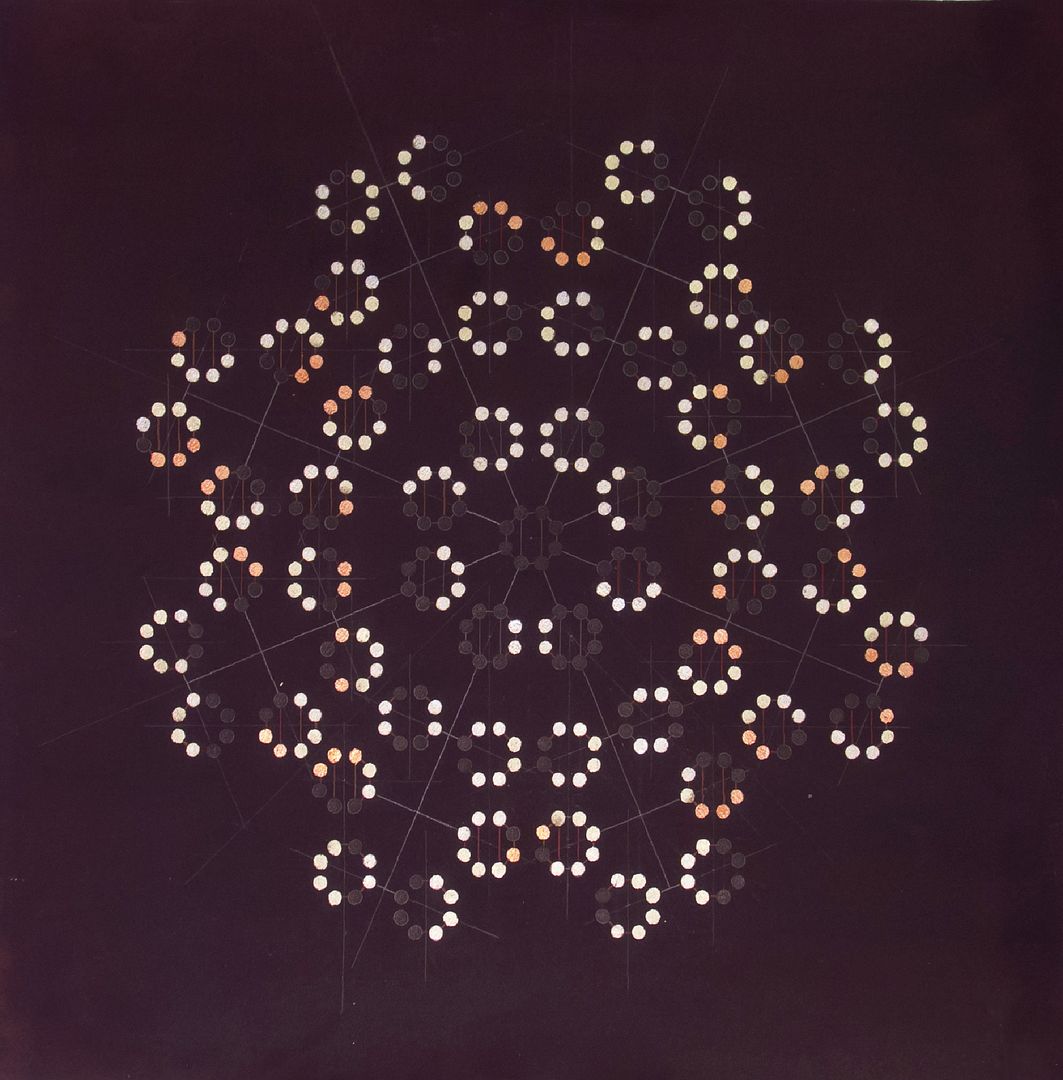
| Owen Schuh "Two Folds" 2012 Graphite, gold copper and silver leaf, and sumi ink on paper 32 x 32 inches |
+++++
"Uncharted," a handsome group show of works on paper at Cain Schulte Gallery, "explore[s] the concept of mapping as the visual and conceptual categorization and organization of relationships, systems, and interactions." Remarkably, the works included in "Uncharted" all relate well to one another (rare for a group show with such a broad theme), and the exhibition is compelling both visually and conceptually, but a few artists' contributions stand out.
Owen Schuh's "Two Folds" is an elegant diagram illustrating all of the possible ways a piece of paper can be folded in two. Schuh is a precise craftsman, and his circles and lines add up to a kind of mathematical sublime. Without the aid of the press release, I wouldn't have recognized what it is that Schuh has mapped, but that isn't necessarily a problem. "Two Folds" also works as an arcane design, calling to mind the complicated but specific hierarchies of, say, a Kabbalist. That Schuh has produced an image that is as readily associated with mathematics as it is esoteric mysticism shouldn't surprise; just ask your neighborhood theoretical astrophysicist to discuss notions of beauty.
Tuesday, November 29, 2011
Review In Brief: Lionel Bawden's "World of Surface"
"Flipside (II)"
2011
Colored Staedtler pencils, epoxy, and incralac on black Perspex shelves
12.25 x 5.25 x 3.5 inches
All of the sculptures exhibited in "The World of Surface," Australian artist Lionel Bawden's recent solo show at Frey Norris Gallery, are constructed using colored pencils. Bawden painstakingly epoxies the pencils together and carves them into a variety of colorful forms. Some of the resulting artworks pour off their wall-mounted shelves like melting candles. Others are small totems with geometric, mandala-like patterns that evoke Georgia O'Keefe's sensual flower paintings as well as the indigenous art forms of Bawden's native country.
"Flipside (II)" and "Gatekeeper (II)," the strongest works in the exhibition, belong to this latter type, and their kinship to Australian Aboriginal art forms like basket weaving and bark painting is manifest not only in their patterns and Bawden's consummate craftsmanship, but also in the sculptures' earnest desire to function as sacred objects, vehicles of meditation and trance.
"jewel linking (dense field)"
2011
Colored pencil & ink on paper
30 x 22 inches
Even viewers who dislike Bawden's work must acknowledge his skill, but the pencil sculptures' material novelty (their "neato" factor) risks their dismissal as schtick. Wisely, Bawden included 5 works on paper in "World of Surface." Although his drawings aren't as peculiar and interesting as his sculptures, Bawden's decision to enlist different materials in his exploration of repetitive processes is a good one. Each of these drawings features a honeycomb array of carefully rendered, multicolored hexagons. They're almost garish, and the imagery isn't particularly compelling, but Bawden is most concerned with creating a record of his patient handiwork, and the "World of Surface" pictures can be seen as a design-conscious riff on jail wall hash marks.
Lionel Bawden's "The World of Surface" was on view October 1 - November 26, 2011, at Frey Norris Gallery (161 Jessie Street, San Francisco).
"Gatekeeper (II)"
2011
Colored Staedtler pencils, epoxy, and incralac on black Perspex shelves
11.5 x 9.25 x 4.25 inches
Image credits: Lionel Bawden images, courtesy Frey Norris Gallery
Monday, June 27, 2011
Announcing "A Live Animal" Exhibition, Catalog, and Program
It's a thrill to announce that "A Live Animal," a large group exhibition that artist Selene Foster and I are co-curating, will be on view at San Francisco's Root Division in July 2011.
In addition to the opening reception for the exhibition (July 9), we will host an Evening of Presentation and Performance (July 19) in the new ODC Theater space, located just next door to Root Division. The EoPP features presentations relevant to the theme of "A Live Animal" by some of the participating artists, as well as scientists, dancers, and others.
I'm biased, of course, but "A.L.A." is a very strong show, and the sort of cross-disciplinary fare that I believe the art world needs more of. If you're in the Bay Area, please visit!
+++++

Detail of "Sharks," by Maria Lux
"A Live Animal" explores the relationship(s) between contemporary man and other animals, with a particular focus on the different lenses, be they mystical, scientific, or philosophical, through which we view other species.
ARTISTS:
Brandon Ballengee, Jeremiah Barber*, Joianne Bittle, Bethany Carlson, Karl Cronin, Donald Farnsworth, Todd Forsgren, Dana Harel, Nicole Jean Hill, Michael Kerbow, Anne Klint, Maria Lux, Jon Rappleye, Shelley Reed, Steven Rubin, Susan Silas, Deborah Simon, Sarah A. Smith, Kate Stirr*, Youngsuk Suh, Ryan Thompson, James Wendell, Gail Wight, and work from the Endangered Species Print Project
*Root Division Resident Artist
Opening Reception: Saturday, July 9, 7 to 10 pm
Exhibition Dates: July 7 - 30, 2011
Gallery Hours: Wednesdays - Saturdays, 2-6 pm (or by appointment)
AN EVENING OF PRESENTATION AND PERFORMANCE:
July 19, 2011, 7:30-9:30PM
ODC Theater, 3153 17th Street, SF, CA
EoPP PRESENTERS:
Chris Black: "Extinction Burst (last dance, last chance): A reanimation of lost movement"
Karl Cronin: "Kinetic Empathy"
Jeremiah Jenkins: "The Hunt"
Brian Null, Ph.D., "Examination of Animals, Examination of Self"
Georgeann O'Brien, Ph.D.: "Direct observation of sensory neuron regeneration in live zebrafish"
Christopher Reiger: "Introducing the Endangered Spcies Print Project"
Philip Ross: "Eating Bugs for Fun and For Profit"
Jon Sack, Ph.D.: "Bioelectric Venom"
Gail Wight: "Animal Animosity"
For more information about the "A Live Animal" EoPP, click here.
We're also producing a full-color exhibition catalog that includes original essays by Selene, me, and artist/writer Michael McDevitt.
In addition to the opening reception for the exhibition (July 9), we will host an Evening of Presentation and Performance (July 19) in the new ODC Theater space, located just next door to Root Division. The EoPP features presentations relevant to the theme of "A Live Animal" by some of the participating artists, as well as scientists, dancers, and others.
I'm biased, of course, but "A.L.A." is a very strong show, and the sort of cross-disciplinary fare that I believe the art world needs more of. If you're in the Bay Area, please visit!
+++++
"A Live Animal" explores the relationship(s) between contemporary man and other animals, with a particular focus on the different lenses, be they mystical, scientific, or philosophical, through which we view other species.
ARTISTS:
Brandon Ballengee, Jeremiah Barber*, Joianne Bittle, Bethany Carlson, Karl Cronin, Donald Farnsworth, Todd Forsgren, Dana Harel, Nicole Jean Hill, Michael Kerbow, Anne Klint, Maria Lux, Jon Rappleye, Shelley Reed, Steven Rubin, Susan Silas, Deborah Simon, Sarah A. Smith, Kate Stirr*, Youngsuk Suh, Ryan Thompson, James Wendell, Gail Wight, and work from the Endangered Species Print Project
*Root Division Resident Artist
Opening Reception: Saturday, July 9, 7 to 10 pm
Exhibition Dates: July 7 - 30, 2011
Gallery Hours: Wednesdays - Saturdays, 2-6 pm (or by appointment)
AN EVENING OF PRESENTATION AND PERFORMANCE:
July 19, 2011, 7:30-9:30PM
ODC Theater, 3153 17th Street, SF, CA
EoPP PRESENTERS:
Chris Black: "Extinction Burst (last dance, last chance): A reanimation of lost movement"
Karl Cronin: "Kinetic Empathy"
Jeremiah Jenkins: "The Hunt"
Brian Null, Ph.D., "Examination of Animals, Examination of Self"
Georgeann O'Brien, Ph.D.: "Direct observation of sensory neuron regeneration in live zebrafish"
Christopher Reiger: "Introducing the Endangered Spcies Print Project"
Philip Ross: "Eating Bugs for Fun and For Profit"
Jon Sack, Ph.D.: "Bioelectric Venom"
Gail Wight: "Animal Animosity"
For more information about the "A Live Animal" EoPP, click here.
We're also producing a full-color exhibition catalog that includes original essays by Selene, me, and artist/writer Michael McDevitt.
Friday, January 07, 2011
Jeffrey Simmons' Sacred Circles
"Apparent Horizon VI"
2010
Watercolor on paper
12.5 x 9 inches
If you're in the Bay Area this January, I encourage you to visit "Apparent Horizons," Jeffrey Simmons' solo show of watercolor paintings at Baer Ridgway. Most of the works on view feature "semi-transparent concentric circles [...] with subtle color variations between each light-hued ring." That description, taken from the gallery's press release, is perfectly accurate, but it fails to convey the other-worldly experience of Simmons' pictures. Radiant and diaphanous, the circles vibrate and murmur on the paper's surface. Calling to mind minimalist Buddhist mandalas or Hindu yantras, the paintings could well serve as objects of sacred utility, focal points for meditation and, for those who dabble in mysticism, gateways into the sublime.
"Apparent Horizon I"
2010
Watercolor on paper
15.75 x 11.25 inches
The Bear Ridgway press release describes Simmons' work as "painstakingly engineered." Indeed, like those of the mandala-making monk, the artist's processes require meticulous control. To produce the paintings, Simmons uses a rotating easel, situating his brush hand so that it remains stationary while the paper moves, turntable-like, beneath it. I get a kick out of knowing this; artists like to peer over one another's shoulders because we're as curious about the 'how' as we are enthused by the 'what.' When appreciating artwork, however, technique should be a secondary concern; if the machinations of the man behind the curtain are more important than the smoke and light show he endeavors to produce, he won't wear the wizard mantle for long. Happily, Simmons' shimmering, ethereal pictures prove him an adept; I look forward to seeing more of his work.
"Apparent Horizon III"
2010
Watercolor on paper
15.75 x 11.25 inches
Imaged credits: all images, courtesy Baer Ridgway Exhibitions
Monday, January 03, 2011
Karl Cronin's Experiencing Forms
"Populus tremuloides (Aspen)"
2009
In late November, I visited "Ecoarchive: Meditations on Time and Nature," a group show on view at Intersection for the Arts 5M, in San Francisco. All of the work included in the exhibition (on view through January 22, 2011) is intelligent and commendable, but I most appreciated Matthew Moore's video, "Lifecycles," Sam Easterson's video, "The Museum of Animal Perspectives," and Karl Cronin's video sampler of his "Somatic Natural History Archive."
I spent most of my time with Cronin's project. For his "Somatic Natural History Archive," Cronin aims to "document with his own body representational expressions of 10,000 U.S. plants and animals," an undertaking that the artist estimates will take 50 years to complete. To date, Cronin has made "expeditions" to Nashville (TN), Santa Fe (NM), Yosemite (CA), Raleigh (NC), Plainfield (MA), and the Grand Canyon, and he's earned the well-deserved support of the Santa Fe Art Institute, Movement Research, and the Puffin Foundation. The documents of his "representational expressions" are archived in the SNHA Catalogue, each labeled with the observed species' Latin name and common name (e.g., "Populus tremuloides (Aspen)").
"Awaiting identification"
2009
With so very many plants and animals to imitate (only 66 of the 10,000 have so far been cataloged online), it's not surprising that Cronin's earnest attempts are uneven; generally, I find his embodiment of plants more intriguing and successful than his animals, but even the less-realized "expressions" made me smile, giddily impressed by the artist's wonderfully quixotic efforts.
Importantly, however, Cronin's endeavor is not mere whimsy. The project may seem simple enough, but I'm certain that it provides the artist with a fundamentally new understanding of (and relationship with) the creatures he studies. Cronin first observes the plant or animal subject, then he perceives it physically, with his body. Watching the artist sway and lean with the breeze in a stand of a grass (an as yet unidentified species, perhaps related to switchgrass), it occurred to me that Cronin is something of a latter-day shaman. "Shaman" is a term abused by new-age prophets and their ranks of well-intentioned, but ill-informed followers, but the philosopher and cultural ecologist David Abram is one of a handful of writers who have given shamanism the thoughtful consideration that it deserves. As I watched Cronin channel a heron, Abram's definition of magic came to mind.
"We are human only in contact, and conviviality, with what is not human. [..] Magic is participating in a world of multiple intelligences with the intuition that every form one perceives - from the swallow swooping overhead to the fly on a blade of grass, and indeed the blade of grass itself - is an experiencing form, an entity with its own predilections and sensations that are very different from our own."In essence, magic is empathy with other "experiencing forms"; it's communion with other facets of the animate world. Happily, by documenting his work with video, Cronin allows the viewer to participate in the magic. I'm grateful for that.
"Caelifera sp. (Grasshopper)"
2009
Note: As a proud natural history geek, I was disappointed that Cronin titled the last of the three videos above "Caelifera sp. (Grasshopper)." In fact, the insect that Cronin imitates in this video is actually a katydid, a species more closely related to crickets than to grasshoppers. Still, while I presume Cronin will make the correction when he adds this video to the SNHA Catalogue, I don't envy him the task of trying to secure a definitive ID on many of the species he works with. Without the help of a entomology expert, he'll be hard pressed to determine the species of katydid in the video above.)
Image/artwork credit: all videos, courtesy Karl Cronin
Monday, March 15, 2010
The 'Raw Stuff'...Discussed
I submitted a version of "Different Takes on the Raw Stuff," my posted response to Peter Gabel's "A Call For Sacred Biologists," to Tikkun Magazine, and I'm pleased to report that my comments engendered an edifying conversation with the article's author.
The editors of Tikkun have posted an abridged version of my correspondence with Peter on Tikkun's blog, Tikkun Daily. I encourage folks to check it out, but I've also included two excerpts of Peter's "voice" below.
Read the full exchange here. The Tikkun Daily post also features two recent drawings that aren't yet on my website.
The editors of Tikkun have posted an abridged version of my correspondence with Peter on Tikkun's blog, Tikkun Daily. I encourage folks to check it out, but I've also included two excerpts of Peter's "voice" below.
"If I could sum it up in a phrase, I would say that Christopher is committed to the idea that science and religion are both valid ways of knowing but they are separate ways, whereas I believe we have to move towards a unified approach to knowledge (the nature of which I’ll take up in a forthcoming issue of the magazine). I was happy to have such a reasonable conversation about a topic that arouses such passion."When it comes down to it, then, I don't think that Peter and I are in stark disagreement. To a large extent, I share his belief that my "two selves" are actually of a piece (i.e., the division of logos and mythos, or rational and irrational, is artificial), but I also contend that there are different ways of knowing or approaching the Whole (the Everything), and that these distinct ways of knowing can and should coexist, each bringing to the conversation their unique perspective.
"It seems that [Christopher has] two selves and two worlds, the mystic and the materialist, side by side, each in its domain. I’m very much in agreement that [his] stand on this is possible; nothing about science excludes a mystical and religious reality within which material reality and scientific knowledge of that material reality unfolds.
However, for me there is only one world, the spiritual-material, spirit enlivening material form. To take this world as an object therefore is to act on it and impoverish it, although sometimes for a noble and valuable purpose (western medicine!). But ultimately I am for reuniting knowledge with spirit as manifested in form, including restoring meaning/desire/intention to evolution (but not some perfect intelligent design)."
Read the full exchange here. The Tikkun Daily post also features two recent drawings that aren't yet on my website.
Thursday, March 11, 2010
Different Takes on the Raw Stuff
"submerged in his erotic mystification"
2009
Watercolor, gouache, sumi ink and marker on Arches paper
32 x 32 inches
I'm pleased to announce that one of my 2009 paintings, "submerged in his erotic mystification," is reproduced in the March/April 2010 issue of Tikkun Magazine. If you're unfamiliar with Tikkun, it's a west coast-based magazine founded by Rabbi Michael Lerner and dedicated to exploring the intersection of politics, spirituality, and culture. While it has Jewish roots (hence the magazine's name), it is an inter-faith publication with a diverse group of secular and religious contributors. The March/April issue includes a special section entitled "God and the 21st Century," featuring articles by seventeen writers, including the esteemed Rabbi Arthur Green, a scholar whose stripe of mystical panentheism resonates with my theological convictions.
My artwork accompanies one of the many articles included in "God and the 21st Century." Respected law critic Peter Gabel's "A Call For Sacred Biologists" explores the gulf between a strictly rational, scientific world view and that of, for lack of a better description, holistic panentheism. I allude to this same schism in my artist statement.
"[I]ncidentally, we've realized that the divide between the imagination and reason is unnatural. The English poet and critic, John Ruskin, alluded to this schism when he wrote of 'the broken harmonies of fact and fancy, thought and feeling, and truth and faith.' Indeed, although we today learn an increasing number of facts about Nature, we understand ourselves to be apart from it, and our experience of it is therefore less complete. My artwork is born of this apparent opposition."Gabel's subject is near and dear to me, but his language unfortunately suggests that he has a deep-seated mistrust of, as he puts it, "the so-called 'scientific method'." (Italics mine.)
In the myopic, yet much ballyhooed skirmish between science and religion, I reside in the middle, as frustrated by the rabidly anti-religious as I am disturbed by and opposed to religious literalists and fundamentalists. Gabel, while not a religious literalist, uses language that apparently misunderstands scientific endeavor. For example, he insists that we need evolutionary biologists "who connect the sacred within themselves to the sacred dimension of what they observe." If he means that we need more leading scientists to openly discuss the awe and wonder they experience through their observation of the material world, he needn't worry. Many scientists are more than happy to wax poetic about the wonders of life and the universe; stand outs include Loren Eiseley, Carl Sagan, E.O. Wilson, Thomas Eisner, and Janna Levin. If, however, Gabel is suggesting that evolutionary biologists should champion mysticism, orthogenesis (1), or notions of "a master plan," he is expressing an essentially irrational and anti-scientific bias. Biologists must be vigilant to not allow spirituality to cloud their work. By all means, biologists can be deeply religious or spiritual people, but, for science to remain legitimate, the method and its language must be materialist and reductionist. (If scientific endeavor is mixed with mysticism, it becomes pseudo-science or, put another way, bunk.)
At the article's close, Gabel writes that "the theory of evolution [must] align itself with the truth that spirit and matter form an indissoluble unity." To the contrary, the theory of evolution needn't make any attempt to "align itself" with spirituality; it is its own truth, a scientific truth. As Rabbi Green writes in the same special section,
"I recognize fully and without regret that theology is an art, not a science. We people of faith have nothing we can prove; attempts to do so only diminish what we have to offer. We can only testify, but never prove."Exactly right!
As I wrote on this blog in late 2008, in an essay about the artwork of Matthew Day Jackson,
"At their respective best, both science and religion (re)awaken or invigorate our capacity for wonder. Each makes use of a different approach, but they are complementary. As Albert Einstein famously said, 'Science without religion is lame. Religion without science is blind.' The late evolutionary biologist Stephen Jay Gould called the two 'non-overlapping magisteria' because good science trades in facts to explain material phenomena, whereas religion traffics in the unverifiable and the unobservable. Where science seeks to demystify, and to build on each subsequent revelation to learn more, religion aims to make sacred that which is taken for granted, to make the ordinary again extraordinary. Both, however, offer frameworks of engaging our astonishing existence and experience. Both are compelled by curiosity and wonder. As Gotthold Ephraim Lessing, the Enlightenment writer-philosopher, argued, if God held in one hand the Entire Truth and in the other the Eternal Pursuit of Truth, a good man will choose the latter. The same is true of authentic scientists and religious thinkers. The methodology and particulars may differ, but both science and religion are realms of the question. Although the popular conception of the scientist is the white-coated statistician ready to provide any and all answers, the caricature is misleading. It is 'normative in science to be not sure,' as Jessica Palmer put it doing the ScienceBlogs panel. Science, like religion, is a matryoshka doll, a series of questions nested within questions.Rather than demand that science couch its truths in the language of the sacred or demand that religion dress its Truth in the language of scientist, why not understand each as complementary, distinct practice of awe? In a recent post on NPR's "Cosmos and Culture" blog, astrophysicist Adam Frank writes,
Gould considered art and philosophy magisteria unto themselves, but, unlike religion and science, each overlaps the other. Where these two overlapping sections meet, we find ourselves in the realm of what the artist-writer Paul Laffoley calls the mesoteric. In Laffoley's cosmology, the circle of religion, dealing as it does with questions of ultimate meaning, is dubbed the esoteric realm. The circle of science, focused on material truths and the observable world, he labels the exoteric realm. The mesoteric realms. art and philosophy, bridge the esoteric and exoteric. Whereas Gould posits that the magisteria of religion and science are nonoverlapping, I would argue that, where their circles meet, the membrane is permeable. This bleeding of one into the other represents the pinnacle of art and philosophy."
"I believe it is possible, and necessary, to see science and human spiritual endeavor through an alternative perspective. That perspective would acknowledge the truths each can reveal and avoid jealous comparison of those truths. [...] Our elemental encounter with the world, the raw stuff of experience, was just as vivid and strange to our ancestors as it is to us now if we are willing to pay attention. They felt awe and wonder beneath the dark weight of the night sky, in the deep quiet at the forest's edge or in the shock of infant's birth wail. Those experiences drove our ancestors, as [they drive] us, to an all important aspiration, a desire to draw closer to the source of that tremendous awe. That aspiration - what I call the Constant Fire - contains the original and braided roots of science and religion. [...] That aspiration is, for me, a road less traveled in the discussions of science and religion. If we were to follow it and to ask what is common, not in results about the world but in the deeply felt response to it, who knows where we might be led?"Beautifully stated, Dr. Frank!
My rather particular problems with Gabel's article aside, the March/April issue of Tikkun includes excellent pieces by Rabbi Arthur Green, David Loy, Shaul Magid, and others.
(1) Like Gabel, I'm warm to Pierre Teilhard de Chardin's concept of orthogenesis, the "hypothesis that life has an innate tendency to move in a unilinear fashion," increasing in complexity. When people speak of "the universe becoming aware of itself," they are expressing an essentially teleological sentiment and, while many contemporary scientists will acknowledge that such a notion is possible, it is wholly unquantifiable and therefore not legitimate science. It is best classified as theology. It is important to note, however, that de Chardin was a Jesuit priest as well as a serious paleontologist and geologist. He did not believe the scientific method to be at odds with a sense of belonging, wonder, or, in his words, "the within of things." Rather, de Chardin recognized science as kin to the arts, philosophy, and theology; it is another tool for our species' exploration of the evolving universe we inhabit.
Monday, February 08, 2010
Nathan Abels' "Natural Causes"
I wrote the following short essay for the exhibition catalog that accompanies Nathan Abels' "Natural Causes," currently on display at Rule Gallery, in Denver, Colorado.
+++++

Nathan Abels
"Sullen Roar"
Acrylic on panel
36 x 48 inches
2009
At the extent of the campfire's reach, we glimpse a shadowed form. Then it is gone. What is it that we saw there, at the light's limit? In that instant of vague apprehension, before our mind has had time to interpret the stimulus, we are John Dewey's "live animal," a creature "fully present, all there, in all of its actions: in its wary glances, its sharp sniffings, its abrupt cocking of ears." The "live animal" mode is often awakened by an alarming sight or sound, but it can also be brought on by a rush of emotion or any substantial sensual experience. If we remain attuned, "fully present," our nurtured sense of self may be blurred, even surrendered, and the scrim of conventional, acculturated understanding is ruptured. We recognize that transcendental mysteries and primordial presences are located in ordinary experience, and that our mundane perception of the material world is incomplete. We see the world anew, boundless and beautiful.
Nathan Abels' artwork is concerned with such transformative breakthroughs. Many of his works juxtapose the primeval with the temporal. "Wildfire" pictures the moon, our planet's celestial companion, serene above a raging forest fire, a violent agent of ecological transformation, both destructive and renewing. In "Sullen Roar," the lights of human infrastructure glow like our aforementioned campfire, but the riverside outpost is surrounded by an opaque darkness. Abels reminds us that the hum and pulse of human civilization amounts only to a footnote when considered within a more holistic context. Other works, such as "Passage" or "Half-Seeing," picture moments of potential rupture, opportunities for personal transfiguration. In "Passage," a spelunker slides on his back through a narrow section of cave. His headlamp illuminates the low ceiling. The confined space would make even the least claustrophobic among us uncomfortable, and the viewer senses the spelunker's powerlessness. Such an experience, like the wildfire, can be at once annihilative and regenerative. It is a subjugation of the self, a recognition of the infinitesimal reach of our individual vision, yet also an expansion of our vision to include the infinite variety and scope of being.

Nathan Abels
"Half-Seeing"
Acrylic on panel
36 x 48 inches
2010
Abels refers to his paintings and drawings as "visual pauses" in an otherwise "persistent turbulence." To be sure, our contemporary landscape is a turbulent one: industrialized, globalized, and digitized for maximal efficiency and consumption. We are so burdened by stimulation as to be deadened to the underlying reality of each moment and every place. Abels' "visual pauses" are a response to our routine mindlessness; the artist provides the viewer with opportunities to regain focus, to intuit the unfathomable in the worldly. His drawings and paintings are pictures of transitional experiences at the edge of known and unknown.

Nathan Abels
"Denouement"
Acrylic on panel
36 x 48 inches
2009
Image credits: courtesy the artist
+++++
"Sullen Roar"
Acrylic on panel
36 x 48 inches
2009
At the extent of the campfire's reach, we glimpse a shadowed form. Then it is gone. What is it that we saw there, at the light's limit? In that instant of vague apprehension, before our mind has had time to interpret the stimulus, we are John Dewey's "live animal," a creature "fully present, all there, in all of its actions: in its wary glances, its sharp sniffings, its abrupt cocking of ears." The "live animal" mode is often awakened by an alarming sight or sound, but it can also be brought on by a rush of emotion or any substantial sensual experience. If we remain attuned, "fully present," our nurtured sense of self may be blurred, even surrendered, and the scrim of conventional, acculturated understanding is ruptured. We recognize that transcendental mysteries and primordial presences are located in ordinary experience, and that our mundane perception of the material world is incomplete. We see the world anew, boundless and beautiful.
Nathan Abels' artwork is concerned with such transformative breakthroughs. Many of his works juxtapose the primeval with the temporal. "Wildfire" pictures the moon, our planet's celestial companion, serene above a raging forest fire, a violent agent of ecological transformation, both destructive and renewing. In "Sullen Roar," the lights of human infrastructure glow like our aforementioned campfire, but the riverside outpost is surrounded by an opaque darkness. Abels reminds us that the hum and pulse of human civilization amounts only to a footnote when considered within a more holistic context. Other works, such as "Passage" or "Half-Seeing," picture moments of potential rupture, opportunities for personal transfiguration. In "Passage," a spelunker slides on his back through a narrow section of cave. His headlamp illuminates the low ceiling. The confined space would make even the least claustrophobic among us uncomfortable, and the viewer senses the spelunker's powerlessness. Such an experience, like the wildfire, can be at once annihilative and regenerative. It is a subjugation of the self, a recognition of the infinitesimal reach of our individual vision, yet also an expansion of our vision to include the infinite variety and scope of being.
"Half-Seeing"
Acrylic on panel
36 x 48 inches
2010
Abels refers to his paintings and drawings as "visual pauses" in an otherwise "persistent turbulence." To be sure, our contemporary landscape is a turbulent one: industrialized, globalized, and digitized for maximal efficiency and consumption. We are so burdened by stimulation as to be deadened to the underlying reality of each moment and every place. Abels' "visual pauses" are a response to our routine mindlessness; the artist provides the viewer with opportunities to regain focus, to intuit the unfathomable in the worldly. His drawings and paintings are pictures of transitional experiences at the edge of known and unknown.
"Denouement"
Acrylic on panel
36 x 48 inches
2009
Image credits: courtesy the artist
Saturday, January 23, 2010
Quantity or Quality?
"Passage"
2009
Acrylic on Panel
24 × 48 inches
"The world we inhabit is not, in this sense, a determinate set of objective processes. It is our larger flesh, a densely intertwined and improvisational tissue of experience. It is a sensitive sphere suspended in the solar wind, a round field of sentience sustained by the relationships between the myriad lives and sensibilities that compose it. We come to know more of this sphere not by detaching ourselves from our felt experience, but by inhabiting our bodily experience all the more richly and wakefully, feeling our way into deeper contact with other experiencing bodies, and hence with the wild, intercorporeal life of the Earth itself.David Abram's essay "The Air Aware" eloquently expands on ideas that I attempt to present succinctly in my artist statement. Brevity is difficult, however, for those of us who are preoccupied with the exciting interchange of anthropology, ecology, ethology, phenomenology, and theology.
[...]
In truth, it’s likely that our solitary sense of inwardness (our experience of an interior mindscape to which we alone have access), is born of the forgetting, or repressing, of a much more ancient interiority that was once our common birthright: the ancestral sense of the surrounding earthly cosmos as the voluminous inside of an immense Body, or Tent, or Temple.
[...]
Experiential qualities once felt to be proper to the surrounding terrain—feeling-tones, moods, the animating spirits-of-place known to reside in particular wetlands and forests—all lost their home with the dissolution of the enclosing, wombish character of the pre-Copernican cosmos. Such qualities now had no place in the surrounding world, itself newly conceived as a set of objects connected by purely external, mechanical relationships: a world of quantities. Unlike quantities, qualities are fluid, mercurial realities arising from the internal, felt relations between beings. Qualities—these ephemeral and fluid powers—require at least a provisional sense of enclosure to hold them. When they could no longer be contained by the visible world (no longer encompassed and held within the curved embrace of the spheres), these ambiguous, ever-shifting qualities quit the open exteriority of the physical surroundings, taking refuge within the new interiority of each person’s 'inner world.' Henceforth they would be construed as merely subjective phenomena."
- David Abram, "The Air Aware", Orion Magazine, September/October 2009
It's interesting, then, that the work of visual artists who explore this conceptual terrain is often quietly awesome. Interesting...and yet so natural.
"Whitenoise Suite no.6"
2009
Oil on linen
24 x 18 inches
Image credits: both painting reproductions, courtesy the artists
Wednesday, January 13, 2010
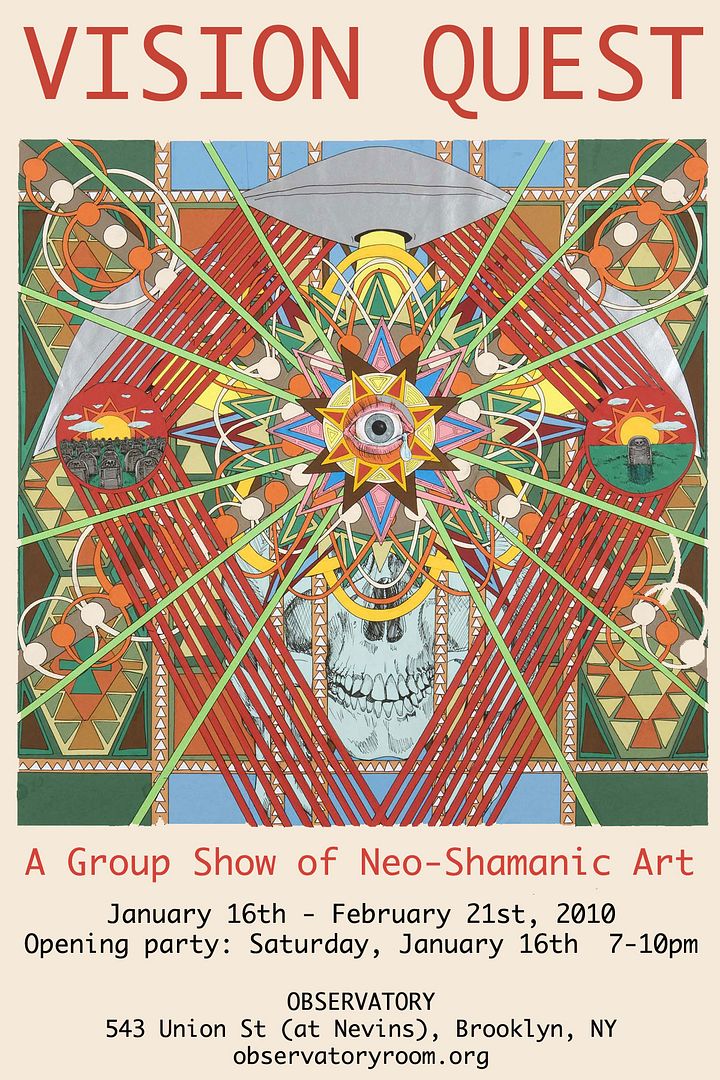
"Vision Quest"
I am delighted to announce that one of my 2007 paintings, "a cruel and beautiful faraway place," is included in "Vision Quest,' a group show curated by the celebrated artist/art blogger/musician Pam Grossman. The exhibition will be on view at Observatory, in Gowanus, Brooklyn, NY.
The opening is this coming Saturday, January 16th, from 7-10pm. The reception will surely be a lovely way to start your Saturday evening, but if you can't make it, I hope that you'll have an opportunity to visit the show while it's on view (through February 21st). Full exhibition details and the press release follow.
+++++
"VISION QUEST – A Group Show of Neo-Shamanic Art"
Observatory
543 Union Street (at Nevins)
Brooklyn, NY 11215
On View: January 17th– February 21st, 2010
Opening: Saturday, January 16th, 2010, 7-10pm
Gallery Hours: Thursdays & Fridays 3-6pm; Saturdays & Sundays 12-6pm
OBSERVATORY and Phantasmaphile's Pam Grossman are proud to kick off 2010 with VISION QUEST, a group show of neo-shamanic art, on view from January 16th through February 21st.
A healer, a medicine (wo)man, a guide: the shaman is a figure who interfaces with nature magic and the invisible world at large, for the betterment of the tribe. Fluent in the language of symbols, and a perennial student of plant wisdom, the shaman is also a translator – bringing back messages from a place veiled thick with leaves, bones, smoke, ghosts.
This journey to the other side – to the innerside – is not just a flowery promenade of song and trance; of friendly animal spirits and ancestral reunions. For while this land is rife with vibrant, variegated beauty, it can also be a danger zone. Images of decapitation and dismemberment abound - though ultimately act as portents for personal transformation and rebirth. This shadowy terrain is trod only by those brave enough to encounter whatever may be found along the way, as each sojourn is mysterious, thoroughly unpredictable, and entirely individual. However, the results of the trip often prove invaluable, as the traveler returns armed with knowledge that will in turn illuminate and repair the community, and fortify his or her own soul.
While the role of the shaman has traditionally been fulfilled by experienced elders in indigenous groups spanning culture and time, VISION QUEST posits that our artists fit the bill as well. Today, with more of us living in an urban jungle rather than a real one, it has become all the more important to figure out ways to internalize the lessons of nature: its growth, its brilliant bloom, its death. And in an age of digitization and distraction, of wire vines and humming screens, it’s no wonder we long for deeper, more sensory experiences of self - with all of its darkness and divinity.
As such, each piece in VISION QUEST explores the archetype of the shamanic voyage, using the tools of paint, pencil, or paper in lieu of fire, flower, feather. Taken together this work represents a full spectrum of what it means to go underground and out of body; to go there and come back again, perhaps just a little bit wiser or, at the very least, more wide awake.
PARTICIPATING ARTISTS
Jesse Bransford
William Crump
Scott Gursky
Juliet Jacobsen
Ashley Lande
Adela Leibowitz
Jason Leinwand
Christopher Mir
Joe Newton
Herbert Pfostl
Christopher Reiger
Christine Shields
Erika Somogyi
Jessie Rose Vala
Image credit: Jason Leinwand "Accepting Fear Rather Than Trying to Understand It"
Saturday, December 12, 2009
Sunset, Sunrise
"Our destiny, our being's heart and home,
Is with infinitude, and only there;
With hope it is, hope that can never die,
Effort and expectation, and desire,
And something evermore about to be."
- William Wordsworth, The Prelude
"Indeed, from within the murkiness of human knowledge and experience, we rightly wonder, is there any room for theology as such - or has it gone the way of all heavenly things? Perhaps all that remains is some mode of natural piety, such as the shudder before the mortal mysteries (with Goethe), or the felt ecstasies of springtime (with Wordsworth). Surely this is a lot, and unsettles the mind from its human habitudes. But is there more?
[...] Like all matters human, theology must be grounded in earthly experience and understood from within its forms. The phenomenal world is all that we have. This is the sphere that lies before us in our everyday existence; it conditions the products of aesthetic perception; and it provides the sphere for theological experience and reflection.
[...] As natural beings we are, in the most elemental sense, coextensive with this realm: our bodies are composed of it, our stomachs take in and digest its matter, and we traffic with this world all our days until we die and are decomposed into its elements. [...] To more properly sense [the] unfolding of the Godhead into world-being, so to speak, or to perceive or intuit its penetrations therein, we must first return to our ordinary experiences."
- Michael Fishbane, Sacred Attunement: A Jewish Theology
Happy Hanukkah, folks.
Photo credits: Hungry Hyaena, 2009
Sunday, September 13, 2009
Kimmel Harding Nelson Residency: Day 7
Attunement on a Sunday Morning
I'm a generalist. As such, I'm inclined to connect the dots between purportedly distinct realms of inquiry. It's impossible, of course, to conduct a truly holistic survey, but my crude efforts have led me to conceive of life - what we know of it, at least - as a component part of a vast, even infinite superorganism. I freely admit to finding value in mysticism, and this superorganism notion is readily dismissed by some scientists and scholars as mystical metaphysics, but science itself speaks to an integrity beyond human comprehension.
As Loren Eiseley describes it,
"[This is] one of life's strangest qualities - it's eternal dissatisfaction with what is, its persistent habit of reaching out into new environments and, by degrees, adapting itself to the most fantastic circumstances."Eiseley was an anthropologist, and he claimed to be a man of "no religion." That may be so, but Eiseley's writing offers humility, wonder, gratitude, and communion in abundance. As I see it, those are the four pillars of religious practice. The fourth of these vital practices, communion, is alluded to by the very word "religion," from the Latin religare, meaning "to bind" or "to tie." Religious action aims to bind the individual to society and, in turn, to the greater whole.
For a decade, I proudly identified as an atheist and, by the measure of most religious people, my cosmology and metaphysics still qualify me as such. It occurs to me, on this Sunday morning, with Nebraska City's church parking lots at capacity, that many of this town's good Christians would reject my claim of religiosity, and not only because my practice rests on a Jewish foundation. My doctrine-less faith appreciates the stories of the Hebrew Tanakh, the Christian New Testament, and the Muslim Koran as parables, poetry, and anthropological artifacts. I read these books in the same way that I do the Tao Te Ching or Herakleitos; they are annotated, analyzed, interpreted, digested, then, in the fullness of time, returned to for a new understanding. But these collections are not my sacred texts. In the eyes of most religious believers, that disqualifies me from tribal membership. Thank G-d.
Sign reads, "Faith Removes Mountains Or Tunnels Through"
Still, I am a religious believer, in my way. My holy books are written by biologists and physicists, naturalist poets and essayists, as well as rabbis, ministers, and theologians. None of them is the word of an interventionist, judging god, even though all of them are necessarily part of a greater, unknowable whole, the aforementioned superorganism.
It doesn't matter what you call this organism. As essayist and literature professor Doug Thorpe writes in Rapture of the Deep, "Call it the sublime, call it the Tao, Om, or I AM; still the names don't hold." I most often call it The All, The No-thing, or Hashem, literally "The Name." In the Tanakh, when Moses asks the name of the Presence he has discovered in the burning bush, It replies, "Ehyeh asher ehyeh." "I will be who I will be," or "I will be that I will be." You can call It whatever you will, for It is you. It is also me. It is the sidewalk; It is the grass of the Otoe County courthouse lawn, on which Nebraska City authorities have installed a carved monument to the Ten Commandments, an act that approaches violation of Thomas Jefferson's shrewd "separation of Church and State"; and It is the ether connecting all of these.
If the faith that has grown in me is dogmatic in some way, it is in its insistence on universalism. Literally translated, "universe" means "one turning." Our universe is just that, one breath, one round, one cycle. All that we know and all that we don't know, everything that we can imagine, is but an infinitesimal sliver of The All, one note of an eternal symphony. Even Herakleitos, ancient proponent of reason and science, turned to poetics when he contemplated ultimate meaning; "Nature loves to hide," he wrote. Interestingly, the Hebrew word for universe is olam, a derivative of alam, meaning "to conceal." Jewish mystics, like many of their Hindu, Sufi, and Christian counterparts, believe that God is hidden in the universe, an ineffable force that pervades every dimension, known and unknown.
Theoretical astrophysicists now suggest that our universe is but one component part of a multiverse, requiring of us another Copernican shift; yet again, the superorganism is re-conceived. In that stretch of the mind are humility, wonder, gratitude, and communion. Science and philosophy, it seems, can also be religious.
So, yes, I'm a religious believer. Paintings, sculptures, and other hand-crafted objects are among my adored icons, but I find occasion for worship in every place, in every form, in every moment. The Monarch butterfly that flapped yoyo-like this morning in front of the KHN Center's kitchen window is worthy of exaltation. I recognize that, for some other viewer, the insect may be ignorable or irrelevant. For others, it is an idol. So, too, might the weathered brick of a downtown Nebraska City building be deemed a clay calf by unimaginative or close-minded "believers." Placing my palm on this brick today, though, my thoughts range through eons of geologic time to consider the primeval mud from which, eventually, we emerged as a gasping fish thing.
Doubtless some of the folks singing inside the walls of the Lutheran, Episcopalian, Catholic, Baptist, Presbyterian, and Methodist churches this morning don't share my enthusiasm for our scaley ancestors. But I'm not concerned with their narrow definition of religion or their selfish understanding of "truth." Although I no longer consider myself a materialist, I'm an unremitting idolater. To those that would condemn that impulse as sacrilegious, I offer Eiseley's reaction.
"People have occasionally written me harsh letters and castigated me for a lack of faith in man when I have ventured to speak of [..] some greater unity that lay incalculably beyond us. [...] They distrust, it would seem, all shapes and thoughts but their own. They would bring God into the compass of a shopkeeper's understanding and confine Him to those limits, lest He proceed to some unimaginable and shocking act - create perhaps as a casual afterthought, a being more beautiful than man. As for me, I believe nature capable of this, and having been part of the flow of the river, I feel no envy."And I feel no envy, either. There is only dumbfounding, smiling celebration.
Love is, I think, a bit like religion. Humility, wonder, gratitude, and communion are requisite in both, and, as Thorpe puts it, love "demands of us a new way of being in our old world." Religion might be construed as a love affair with The All. It's not always easy, but religious attunement can turn each day, each hour, or each instant, into "a new way of being." Every step is a psalm, every directed gaze is a prayer. Truly, on the streets of Nebraska City this morning, I am an exuberant, enthusiastic mystic.
Photo credits: all photos, Hungry Hyaena, 2009
Labels:
atheism,
awe,
Christianity,
eudaimonia,
generalism,
humanity,
humility,
Judaism,
Loren Eiseley,
mystery,
mysticism,
nature,
Nebraska City,
religion,
romantic inclination,
science,
spirituality,
wonder
Tuesday, August 25, 2009
The Most Fundamental Form of Passion
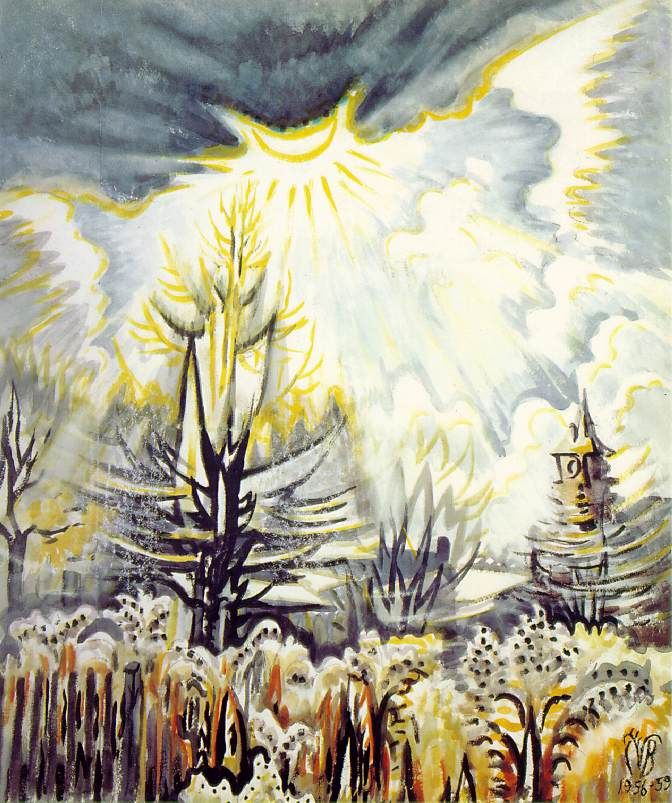
"November Sun Emerging"
1956-59
Watercolor on paper
37 3/4 x 31 7/8 inches
"[How] can we account for that irresistible instinct in our hearts which leads us towards unity whenever and in whatever direction our passions are stirred? A sense of the universe, a sense of the all, the nostalgia which seizes us when confronted by nature, beauty, music - these seem to be an expectation and awareness of a Great Presence. [...] Resonance to the All - the keynote of pure poetry and pure religion. Once again: what does this phenomenon, which is born with thought and grows with it, reveal if not a deep accord between two realities which seek each other; the severed particle which trembles at the approach of 'the rest'?Image credit:Burchfield image ripped from Mark Harden's Artchive
We are often inclined to think that we have exhausted the various natural forms of love with a man's love for his wife, his children, his friends and to a certain extent for his country. Yet precisely the most fundamental form of passion is missing from this list, the one which, under the pressure of an involuting universe, precipitates the elements one upon the other in the Whole cosmic affinity and hence cosmic sense. A universal love is not only psychologically possible; it is the only complete and final way in which we are able to love."
- excerpt from The Phenomenon of Man, by paleontologist, geologist, philosopher, and Jesuit priest Pierre Teilhard de Chardin
Friday, August 21, 2009
A Practice of Naming
Christopher van Donkelaar
"Adam Naming the Animals"
Handmade pigments and mixed media
2008
"Praise to the first man who wrote down this joy clearly, for we cannot remain in love with what we cannot name."A lover of etymology and taxonomy, one of my most cherished reference books is Arthur Frederick Gotch's Latin Names Explained: A Guide to the Scientific Classification of Reptiles, Birds and Mammals. In it, Gotch catalogs and dissects the scientific names of some 4,000 animal species. That number appears relatively insignificant when we consider that biologists estimate 25,000 species of bird, mammal, and reptile currently exist on Earth, but Gotch's record is so far unparalleled. Each entry provides the animal's common and scientific names, followed by an explication of the Latin and Greek and, sometimes, a blurb about the species' range and habitat.
- Robert Bly
For example, consider Gotch's entry on one of my very favorite North American snake species:
Copperhead Agkistrodon contortrixAlthough the range information suggests that the copperhead is more confined to the southeastern United States than the species and subspecies actually are - they thrive in New York State, for example - Gotch's entry informs readers that the snake commonly called a copperhead is universally and technically named Fish-hook shaped tooth twister or, if you prefer, The Twisting One With Hook Shaped Teeth. Knowledge of this name allows me to appreciate the beautiful reptile from another angle.
agkistrodon (Gr) a fish-hook; odon (Gr) a tooth; a reference to the curved fangs, though of course they are not barbed; contorqueo (L) I twist, turn; contortus (L) full of turns, twisted; contortrix (L) one that is able to turn, twist. Inhabiting the south-eastern part of the USA including Florida. The top of the head is reddish brown.
But what's in a name, really?
Although I'm generally baffled by Biblical literalism, I appreciate the Genesis accounts of creation for their gratifying metaphor. In particular, I'm drawn to rabbinic and Jewish mystics' interpretations of the conjoined, aboriginal narratives. More so than their Christian counterparts, Jewish theologians and mystics endow language and names with ontological significance. The Hebrew alphabet is understood as a powerful code: the written word is creative potential, and the spoken word, procreative. The god of Genesis 1 creates neither with a wave of the hand nor by shaping raw material, but by speaking the world into being; annunciation and incantation are the means of creation. Because of the vocative nature of naming, observant Jews place great value on words and speech. (They are even prohibited utterance of the tetragrammaton, the four-letter Hebrew name of God, transliterated as Yahweh. Appropriately enough, the colloquial name for God is Hashem, or "the word.")
In Genesis 2, the creator god is anthropomorphized and physically involved with creation, shaping man and the other animals from earth. Yet the power of language and names remains significant in this account. God asks Adam, the first naked ape, to name all of the other animal species. That's no mean task, and apparently Adam died before he finished the job. His descendants, at least the taxonomists among them, are still working at the task of naming.
But even those individuals who do not share my affection for taxonomy will find value in a practice of observation and naming. As Carol Kaesuk Yoon writes in her recent New York Times paean to taxonomy, "Reviving the Lost Art of Naming the World,"
"Even when scads of insistent wildlife appear with a flourish right in front of us, and there is such life always — hawks migrating over the parking lot, great colorful moths banging up against the window at night — we barely seem to notice. We are so disconnected from the living world that we can live in the midst of a mass extinction, of the rapid invasion everywhere of new and noxious species, entirely unaware that anything is happening. Happily, changing all this turns out to be easy. Just find an organism, any organism, small, large, gaudy, subtle — anywhere, and they are everywhere — and get a sense of it, its shape, color, size, feel, smell, sound. Give a nod to Professor Franclemont and meditate, luxuriate in its beetle-ness, its daffodility. Then find a name for it. Learn science’s name, one of countless folk names, or make up your own. To do so is to change everything, including yourself. Because once you start noticing organisms, once you have a name for particular beasts, birds and flowers, you can’t help seeing life and the order in it, just where it has always been, all around you."Beautiful. Let's name something.
See also "The Plant Whisperer," another brief HH essay considering similar ideas.
Image credit: van Donkelaar painting ripped from the Nurturing Faith website
Wednesday, July 29, 2009
What is the Prophetic Ideal?
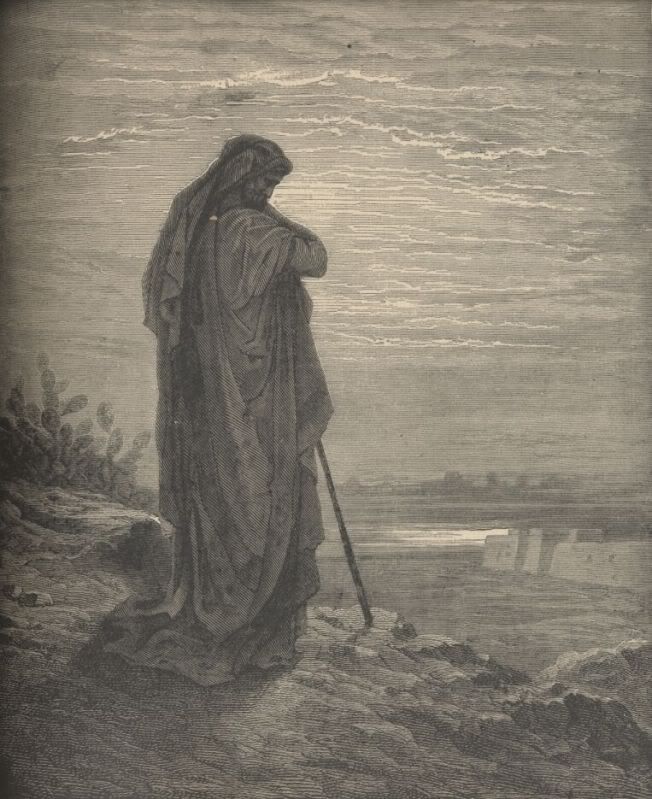
"The Prophet Amos"
1891
Engraving
In the Hebrew Tanakh, the colorful collection of history, anthropology, and mythology better known to Christians as the Old Testament, a number of the prominent prophets decry the institutionalization of Israelite religion. Elijah, Amos, Hosea, Isaiah, and Jeremiah proclaim instead the communal and, in some cases, individual experience of the one, true God. They maintain that God can be best experienced (and, as the ancient Israelites believed, best appeased) through one's devotion to those moral laws, or mitzvot, concerned with righteousness and social justice. These courageous and outspoken men also possess an enmity for the organized priesthood. They insist that the Israelites needn't centralize their worship at Solomon's Temple in Jerusalem, or at any of the other state worship shrines constructed within the kingdoms of Israel and Judah."Let justice roll down like waters, and righteousness like an ever-flowing stream."
-Amos 5:24
Not surprisingly, excepting the rare case when a prophet's ideology was deemed politically expedient, Israelite state leaders frowned on religious populism and the theocracy ignored the prophet's pleas. Typically, the trouble-making prophets were ostracized, expelled, or hunted as fugitives. Yet, ultimately, the prophets' voices proved appropriately prophetic.
For most of their history, Jews have lived in diaspora, their religious faith and identity rooted in a universalist foundation of scripture, theory, and law rather than any centralized site or body. In fact, most contemporary religious historians believe that the flowering of the relatively archaic and essentially polytheistic Israelite religion into Judaism follows the fall of Jerusalem to the Babylonians, in 587 BCE, and that this early, exilic manifestation of Judaism would undergo another upheaval and transformation after the destruction of the Second Temple by the Romans, in 70 CE. In essence, these scholars suggest that the Israelites (and, later, the Jews) had to forgo state power before the moral idealism of their religion could be actualized.
Accordingly, then, the muscular, modern state of Israel poses challenges to Jewish moral idealism. But contemporary Israeli Jews aren't alone in their wrestling with this challenge. Almost 2,500 years after the Hebrew prophets condemned top-down involvement in spiritual matters, liberal-minded, religious individuals of all stripes continue to struggle against blindly restrictive doctrinal authority.
I do not intend to suggest that adherence to dogma is necessarily a bad thing. Moral hand-wringing is a natural component of ethical decision-making, and traditional values of the sort upheld by religious authorities offer each of us a valuable point of reference. But what of contemporary conflicts between religious action and the religious institution? What of those cases in which the civil and moral codes of a religion suggest that the adherent to those codes should act in some way other than that dictated by the religious institution?
Laura Goodstein's recent New York Times article, "U.S. Nuns Facing Vatican Scrutiny" provides an excellent example. Goodstein writes,
"In the last four decades since the reforms of the Second Vatican Council, many American nuns stopped wearing religious habits, left convents to live independently and went into new lines of work: academia and other professions, social and political advocacy and grass-roots organizations that serve the poor or promote spirituality. A few nuns have also been active in organizations that advocate changes in the church like ordaining women and married men as priests."What could possibly be wrong with nuns advocating for progressive social change!? While I respect those individuals who dedicate their life to religious contemplation, aren't the monks and nuns that work for God outside of monastery and convent walls the most exemplary of all religious adherents? Aren't those individuals striving for Thomas Merton's brand of religiously-inspired activism representative of the 13th century theologian and mystic Meister Eckhart's call for believers to "gratefully [return] all that God has bestowed [...] and, by that act of donation, enter the Godhead"? In the eyes of the Vatican, apparently not.
"The investigation was ordered by Cardinal Franc Rodé, head of the Vatican office that deals with religious orders. In a speech in Massachusetts last year, Cardinal Rodé offered barbed criticism of some American nuns 'who have opted for ways that take them outside' the church. [...] The [Vatcian's investigation] focuses only on nuns actively engaged in working in society and the church, not cloistered, contemplative nuns."If the Vatican has spearheaded the investigation only because the Church seeks confirmation that American activist nuns are "attending Mass and keeping the sacraments," all well and good. After all, attending Mass and keeping the sacraments are obligations of religiously observant Catholics, and an individual who has devoted his or her life to the church should certainly be upholding these traditions. If, however, the Church intends to castigate or defrock otherwise devout, responsible nuns for pursuing religious behavior outside of the church, the Vatican officials should be ashamed of themselves.
As the Catholic theologian Walter Brueggemann wrote in The Prophetic Imagination, "The task of prophetic ministry is to nurture, nourish, and evoke a consciousness and perception alternative to the consciousness and perception of the dominant culture around us." For the Catholic nuns, as for the Hebrew prophets millennia before them, the dominant culture is that of their respective religious institutions, one of staid and comfortable orthodoxy. I'm not a Christian, but were I one, and especially if I were Catholic, I would be up in arms over the Vatican's sanctimonious oppression of those exceptional nuns and monks who actually paid attention to the substance of Jesus of Nazareth's memo.
Photo credit: ripped from Wikipedia
Saturday, July 25, 2009
At Dawn I Have Birds
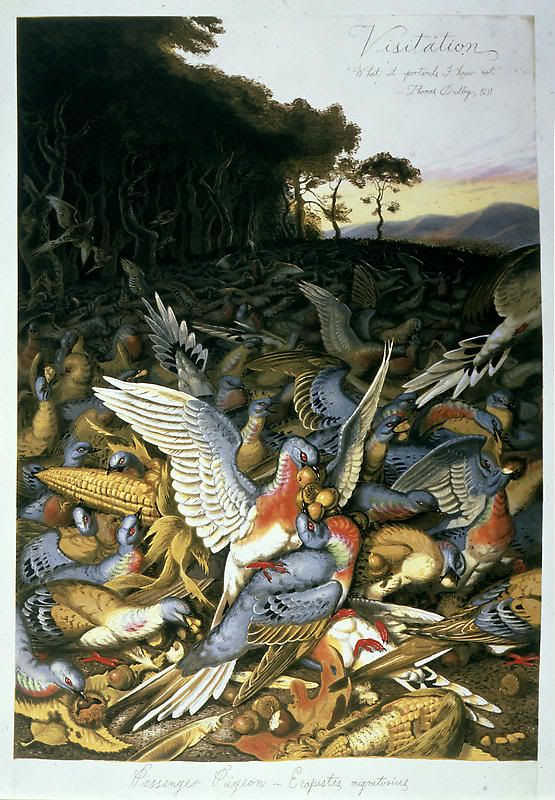
"Visitation"
2004
Six color hardground and softground etching, aquatint, spit-bite aquatint, drypoint on Somerset Satin paper
44 x 30 7/8 inches
"Often, lately, the night is a cold maw
and stars the scattered white teeth of the gods,
which spare none of us. At dawn I have birds,
clearly divine messengers that I don't understand
yet day by day feel the grace of their intentions."
— from "Age Sixty-nine," by Jim Harrison
Image credit: ripped from the Paul Kasmin Gallery website
Wednesday, May 20, 2009
Tony Fitzpatrick's "Big Rock Candy Mountain"
Tony Fitzpatrick
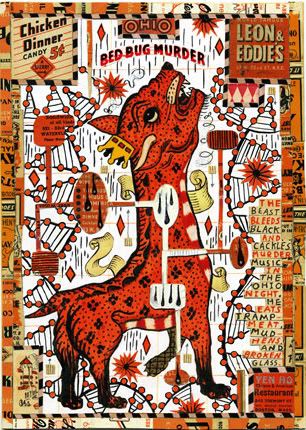
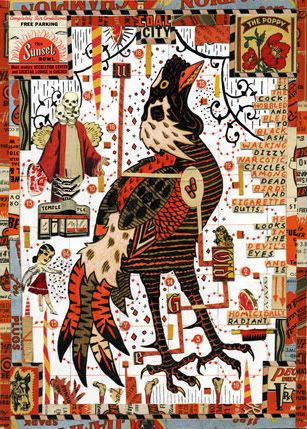
"The Orange Beast"
2009
Drawing and collage
10.5 x 7.5 inches
The Chicago-based artist and poet Tony Fitzpatrick participated in Dieu Donne Papermill's 2006 Lab Grant Residency. "Big Rock Candy Mountain," an outstanding exhibition of the collages Fitzpatrick produced during his Lab Grant term, is currently on display in Dieu Donne's exhibition space.
Fitzpatrick's collages incorporate text, print advertisements, handmade paper and drawings. In medium and manner, Fitzpatrick's collages are more coarse relatives of Fred Tomaselli's beautiful resin works. Tomaselli's pictures are dominated by images from nature and evoke the rarified realm of etherial contemplation and transcendental yearning. Although Fitzpatrick's pictures are similarly sacramental, his iconography is wide-ranging and kitsch, drawing principally from post-war suburban and urban culture. His works are as informed by the American taste for consumer ephemera as they are by Calvinist, fire-and-brimstone theology and old-fashioned hard luck. If Tomaselli's works are the ecstatic offerings of a universalistic mystic, Fitzpatrick's are the esoteric assemblages of a struggling hermit poet; his striking collages might be pulled from a latter-day illuminated manuscript.
Tony Fitzpatrick
"The Red Road"
2009
Drawing and collage
7.5 x 10.5 inches
Like his imagery, the poetic texts that Fitzpatrick pastes into his collages speak to complex, even contradictory impulses. They are at once banging proclamations and maudlin laments. Consider the text from "Coal City Cock Fighter."
"It is the cock, hobbled and bled to black ash, walking dizzy narcotic, circles among dead birds and cigarette butts. He looks in the Devil's eyes and is homicidally radiant."The press release describes Fitzpatrick's works as "visual poems, reflecting on matters of place, history, and sense of being." The "place [and] history" of Fitzpatrick's imagery are specific to America. His collages are nuanced portraits of the schizophrenic exuberance and religious sensibility that informed American perspectives in the middle of the 20th century (and that generally continue to shape our politics and character in the post-millennial world).
"Big Rock Candy Mountain" closes this Friday, May 22nd.
Tony Fitzpatrick
"Coal City Cock Fighter"
2009
Drawing collage
10.5 x 7.5 inches
Image credits: Tony Fitzpatrick, courtesy Dieu Donne Papermill
Saturday, May 09, 2009
Andre Ethier
"Untitled"
2008
Oil on masonite
20 x 16 inches
Compared to his previous New York City outing (Derek Eller Gallery, May 2007), the imagery in André Ethier's current solo show is a relative disappointment. Fortunately, there are several strong works, of which the untitled painting pictured above is the most outstanding representative. As I wrote in 2007, "at his best, [Ethier is] something of a latter-day, irreligious Blake."
Tuesday, March 24, 2009
Subjective Takes
On Paul Klee and Ali Banisadr

Paul Klee
"Ancient Sound, Abstract on Black"
1925
Oil on cardboard
15 x 15 inches
Lazzaro stresses Klee's desire to achieve a "purity of expression." The artist apparently characterized his art-making as a relationship with "the very heart of the Universe," and Lazzaro provides quotations from art historians and personal associates of Klee that further elucidate the artist's mystical motivation.
Art writers most often describe Klee's work as "whimsical," "precious," even "child-like," but Klee disdained such mundane interpretations of his work. He dismissed "the legend of the childishness of my drawings" as the result of his attempts to "show man [not] as he is but as he might be."

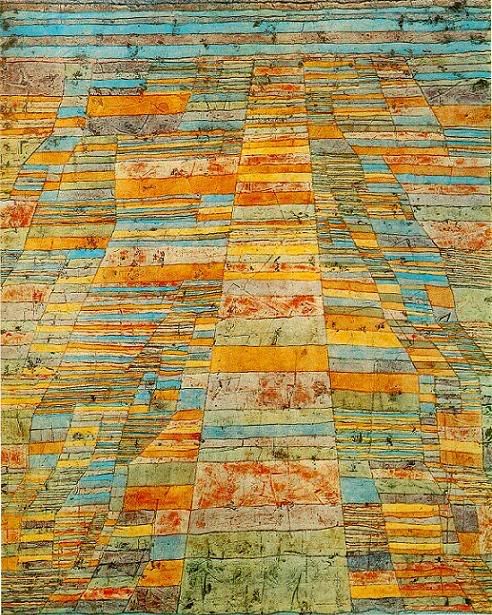
Paul Klee
"Highways and Byways"
1929
Oil on canvas
32 5/8 x 26 3/8 inches
Contemplating the disparity between Klee's stated intention and the general reaction of his viewers, I recalled something that I wrote in the comments section of a recent post.
Does this mean that Klee was wrong to assert his mystical motivation in the face of popular resistance? Not necessarily. Many artists sense Klee's profound striving. Undoubtedly, Klee would have approved of Bridget Riley's assessment of his paintings as "the process of things coming into being" and, in my art taxonomy, he is more closely related to the mythically-inclined Mark Rothko than he is to the playful Alex Calder.
Nevertheless, the popular response to Klee's work can not be overlooked. Art is a conversation and, in the dialogue generated by Klee, the perspective of artists like myself or Riley is representative of a small minority.

Ali Banisadr
"Target"
2008
Oil on linen
60 x 78 inches
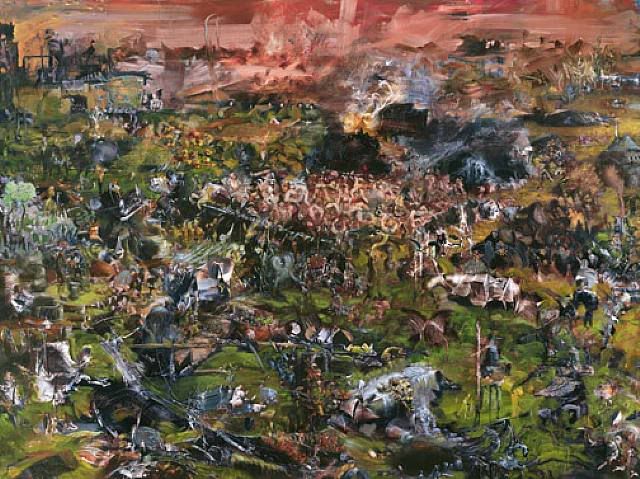
A few months ago, I encountered the young painter Ali Banisadr's artwork for the first time. His riotous pseudo-abstractions compellingly communicate the distortions of violent conflict, yet the artist's all-over compositions also manage to effect a meditative state. Indeed, some of the works are mournfully elegiac. (His 2008 painting "Target" is perhaps the most obvious example; the picture acts as a Yantric focal point despite being dominated by a feral garden scene.)
Banisadr was born in Tehran, Iran, in 1976. His family lived in the city during the Iran-Iraq War and he states that "vivid memories of the bombings that...regularly occurred throughout his childhood" are a principal inspiration for the recent paintings. Banisadr's 2008 solo exhibition at Leslie Tonkonow Gallery received critical praise in a number of outlets, including The Brooklyn Rail, The New York Times, and jameswagner.com. Reviewers usually cited the same forebears and inspirations that the artist lists in the exhibition catalog.
But one of Banisadr's paintings provoked an unexpectedly powerful association in this viewer, one that I'm sure Banisadr did not intend to stir into his eclectic pot. I'm fortunate to have neither fought in nor lived in the midst of war. Yet having grown up in the American South, I still identify the American Civil War as "my family's war." That association may seem disingenuous - the war was fought 150 years ago - but my homeground is marked by that terrible conflict in a way that the rest of the country is not. Gravestones in the small cemetery in the front yard of my childhood home speak to the pride Southerners had in their cause. Stonewall Jackson Kellam is among the dead buried in that cemetery. Kellam was a five-month-old baby when he died on October 3, 1868, just a few years after the close of the Civil War. His name honored Thomas "Stonewall" Jackson, the prominent Confederate general.
The Civil War colors Southern identity, and I am not immune. Although my paternal great-grandparents were a Hungarian Jew and Catholic seeking refuge and opportunity in Brooklyn, New York, the other seven branches of my family tree have deep roots in the United States, mostly Scots and Brits who immigrated in the 1600s. At least two of my great-great-grandfathers fought in the Civil War (one for the Confederacy, one for the Union), along with several of their brothers, and the records of their service are rather stirring. My great-great-grandfather Wesley Mayes Dance was fatally wounded several hundred yards away from the site of the "Crater" at Petersburg, Virginia. Wesley fought with The South of Dan Rebels, one of two Virginia regiments that held the Union advance at Petersburg until Southern reinforcements arrived. With bitter pride, I consider the fact that he and his fellow Confederates sealed the defeat of the Union attack on that day, thereby prolonging the war for many months.

Ali Banisadr
"Amen"
2008
Oil on linen
50 x 66 inches
I don't often think about the Civil War, or even about my Southern identity, but in Leslie Tonkonow's gallery space, Ali Banisadr's painting "Amen" resonated for me, above all, as a picture of that history. I conceived of Banisadr's picture as a depiction of the Battle of Chancellorsville, one of the bloodiest, most frenzied contests in the war. The painting hums with electric life, yet is also a sad testament to our darker inclinations. I responded to the work with unsettling emotion; taking it in, my eyes stung with restrained tears.
As I departed the gallery, it occurred to me that I would be unable to write about the exhibition without raising my Civil War associations. I worried that this was too personal an experience to discuss, too private an interpretation to inform Banisadr's paintings for readers. If the artist didn't intend his paintings to conjure up Chancellorsville, how could I, in good faith, write about storied recollections of my great-great-grandfathers?
But as Proust reminds us, "in reality, every reader is, while he is reading, the reader of his own self." Artworks compel every viewer differently. More vitally, each individual comprehension of the artwork completes the piece anew. Klee's mystical intentions and Banisadr's Iranian memories are only part of the exchange. Art is, after all, a conversation, and a deeply satisfying one at that.
Image credits: Paul Klee reproductions ripped from Peplum and WebMuseum; Ali Banisadr reproductions ripped from artnet and Joann Kim's UpDownAcross
"Ancient Sound, Abstract on Black"
1925
Oil on cardboard
15 x 15 inches
"The work probes me, reads me, asks me questions, makes demands. If we see and acknowledge this connection between ourselves and works of art, art isn't merely a distraction, it is a means by which we begin to understand ourselves. Marcel Proust wrote, 'In reality, every reader is, while he is reading, the reader of his own self.'"This weekend, I pulled G. Di San Lazzaro's biography of Paul Klee off my bookshelf, hoping to draw some inspiration from reproductions of the artist's paintings and drawings. As I thumbed through the book, however, various passages caught my eye, and I ended up reading much of Lazzaro's account.
-Dr. Alan Jones, Reimagining Christianity
Lazzaro stresses Klee's desire to achieve a "purity of expression." The artist apparently characterized his art-making as a relationship with "the very heart of the Universe," and Lazzaro provides quotations from art historians and personal associates of Klee that further elucidate the artist's mystical motivation.
"For Klee art was always cast 'in the image of creation'...The artist rummages in Creation's property box. There is nothing which does not serve him, nothing which does not come into his game - art and its oldest remnants such as inscriptions, mosaics, Assyrian tablets, cracked pottery, imaginary ideograms, graffiti; nature with its various processes and chance effects - its striations, strata and maculations, the slow wear of time which in the thinnest fragment of rock imitates the work of the human hand. The hand, in its turn, Klee said, must be 'the instrument of a distant past.'"Yet, of the many 20th century artists that heroically championed the unconscious and the archaic, Paul Klee is perhaps the only one that your grandmother loves. Why? Because his paintings are colorful and inoffensive and, when not abstract, feature charming hieroglyphs, animals and stick figures.
-Pierre Volboudt, Kandinsky
"Klee's world is [not] grotesque but mystical...For Klee, as he said to me in 1919, art was not there to reproduce the visible but to render visible what lay hidden beyond the visual world. He remained faithful to this doctrine and brought its deep meaning to fruition until, after passing through many intermediary stages, he achieved in his pictorial world...essential beauty."
-Carola Giedion-Walker
Art writers most often describe Klee's work as "whimsical," "precious," even "child-like," but Klee disdained such mundane interpretations of his work. He dismissed "the legend of the childishness of my drawings" as the result of his attempts to "show man [not] as he is but as he might be."
"Highways and Byways"
1929
Oil on canvas
32 5/8 x 26 3/8 inches
Contemplating the disparity between Klee's stated intention and the general reaction of his viewers, I recalled something that I wrote in the comments section of a recent post.
"Art is subjective...and I feel that a viewer's experience and interpretation of an artwork is as informative and vital as the intention and creation of the artist. It's a conversation."In short, the viewer plays a substantiative role in the life of an artwork.
Does this mean that Klee was wrong to assert his mystical motivation in the face of popular resistance? Not necessarily. Many artists sense Klee's profound striving. Undoubtedly, Klee would have approved of Bridget Riley's assessment of his paintings as "the process of things coming into being" and, in my art taxonomy, he is more closely related to the mythically-inclined Mark Rothko than he is to the playful Alex Calder.
Nevertheless, the popular response to Klee's work can not be overlooked. Art is a conversation and, in the dialogue generated by Klee, the perspective of artists like myself or Riley is representative of a small minority.
"Target"
2008
Oil on linen
60 x 78 inches
A few months ago, I encountered the young painter Ali Banisadr's artwork for the first time. His riotous pseudo-abstractions compellingly communicate the distortions of violent conflict, yet the artist's all-over compositions also manage to effect a meditative state. Indeed, some of the works are mournfully elegiac. (His 2008 painting "Target" is perhaps the most obvious example; the picture acts as a Yantric focal point despite being dominated by a feral garden scene.)
Banisadr was born in Tehran, Iran, in 1976. His family lived in the city during the Iran-Iraq War and he states that "vivid memories of the bombings that...regularly occurred throughout his childhood" are a principal inspiration for the recent paintings. Banisadr's 2008 solo exhibition at Leslie Tonkonow Gallery received critical praise in a number of outlets, including The Brooklyn Rail, The New York Times, and jameswagner.com. Reviewers usually cited the same forebears and inspirations that the artist lists in the exhibition catalog.
"I want the viewers of my paintings to see history and human behavior at a macro level, by combining a great variety of influences that you can see close-up. Bosch, Brueghel, Persian minatures, memories, literature, history - I want to combine all of these things in my work. When you put all of this in the pot and stir, you create your own mythology."Indeed, Banisadr combines these ingredients to excellent effect. Looking at the paintings, Banisadr's indebtedness to and admiration for the Dutch masters is immediately apparent, but so, too, is a great heave of ideological love and madness.
But one of Banisadr's paintings provoked an unexpectedly powerful association in this viewer, one that I'm sure Banisadr did not intend to stir into his eclectic pot. I'm fortunate to have neither fought in nor lived in the midst of war. Yet having grown up in the American South, I still identify the American Civil War as "my family's war." That association may seem disingenuous - the war was fought 150 years ago - but my homeground is marked by that terrible conflict in a way that the rest of the country is not. Gravestones in the small cemetery in the front yard of my childhood home speak to the pride Southerners had in their cause. Stonewall Jackson Kellam is among the dead buried in that cemetery. Kellam was a five-month-old baby when he died on October 3, 1868, just a few years after the close of the Civil War. His name honored Thomas "Stonewall" Jackson, the prominent Confederate general.
The Civil War colors Southern identity, and I am not immune. Although my paternal great-grandparents were a Hungarian Jew and Catholic seeking refuge and opportunity in Brooklyn, New York, the other seven branches of my family tree have deep roots in the United States, mostly Scots and Brits who immigrated in the 1600s. At least two of my great-great-grandfathers fought in the Civil War (one for the Confederacy, one for the Union), along with several of their brothers, and the records of their service are rather stirring. My great-great-grandfather Wesley Mayes Dance was fatally wounded several hundred yards away from the site of the "Crater" at Petersburg, Virginia. Wesley fought with The South of Dan Rebels, one of two Virginia regiments that held the Union advance at Petersburg until Southern reinforcements arrived. With bitter pride, I consider the fact that he and his fellow Confederates sealed the defeat of the Union attack on that day, thereby prolonging the war for many months.
"Amen"
2008
Oil on linen
50 x 66 inches
I don't often think about the Civil War, or even about my Southern identity, but in Leslie Tonkonow's gallery space, Ali Banisadr's painting "Amen" resonated for me, above all, as a picture of that history. I conceived of Banisadr's picture as a depiction of the Battle of Chancellorsville, one of the bloodiest, most frenzied contests in the war. The painting hums with electric life, yet is also a sad testament to our darker inclinations. I responded to the work with unsettling emotion; taking it in, my eyes stung with restrained tears.
As I departed the gallery, it occurred to me that I would be unable to write about the exhibition without raising my Civil War associations. I worried that this was too personal an experience to discuss, too private an interpretation to inform Banisadr's paintings for readers. If the artist didn't intend his paintings to conjure up Chancellorsville, how could I, in good faith, write about storied recollections of my great-great-grandfathers?
But as Proust reminds us, "in reality, every reader is, while he is reading, the reader of his own self." Artworks compel every viewer differently. More vitally, each individual comprehension of the artwork completes the piece anew. Klee's mystical intentions and Banisadr's Iranian memories are only part of the exchange. Art is, after all, a conversation, and a deeply satisfying one at that.
Image credits: Paul Klee reproductions ripped from Peplum and WebMuseum; Ali Banisadr reproductions ripped from artnet and Joann Kim's UpDownAcross
Subscribe to:
Posts (Atom)