Showing posts with label morality. Show all posts

Tuesday, November 27, 2012

Heide Hatry's Provocative Flowers

Heide Hatry is not a household name, but the New York-based German artist's reputation is blossoming. She has smartly positioned herself at the intersection of the art world and popular culture and, as a result, is of particular interest to me, convinced as I am that the fine arts need mass reach (if not necessarily mass appeal -- see Thomas Kinkade) in order to play the vital cultural role they're intended to.

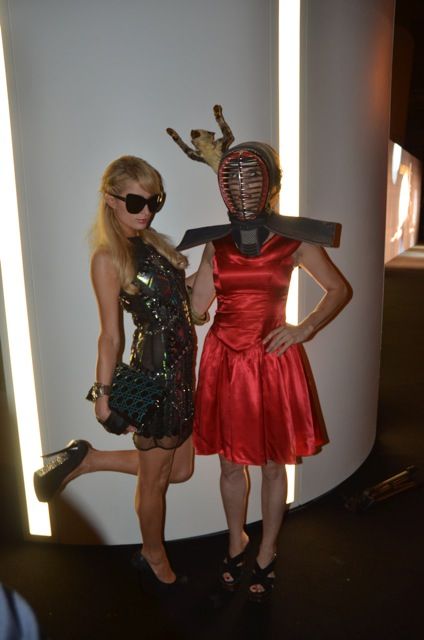
Heide Hatry, right, with Paris Hilton at the Guggenheim Museum
In September, Hatry performed "Schrodinger's Cat" at Lady Gaga's Guggenheim Museum perfume launch. Although Gaga's arty public appearances and carefully cultivated persona evidence how readily pop culture co-opts and/or draws inspiration from the fine arts, most people view Gaga as a pop star, not an artist. Hatry, on the other hand, is always identified as the latter, so when she is photographed rubbing shoulders with the likes of Paris Hilton or her work is written about by the scientist and popular writer Steven Pinker, I'm heartened. The art world isn't usually so accessible.

Naysayers might dismiss Hatry as the art world equivalent of a shock jock, insisting the popular attention she has received is only the result of her pushing our buttons. Certainly provocation plays a part, but Hatry has so far managed to balance titillation with thoughtful questions. (Arguably, Damien Hirst managed to do the same for a time...before he jumped the preserved shark.)

Wednesday, September 22, 2010

The RSA's "21st Century Enlightenment"


Sure, the video is 11 minutes long, well over the too-long-to-watch mark for readers casually trolling the blogosphere, but it's worth bookmarking and saving for later. (In fact, I encourage you to watch it on YouTube or the RSA website, as the resolution is better than that of the above embed.)

The ideas articulated are vital and might provide some solace for those of you who, like so many of my friends, suffer from political apocalypse syndrome! Moreover, the animation is terrific and the narrator, like the Royal Society for the Encouragement of the Arts (RSA), is British, satisfying the Anglophile in all of us.

Enjoy.

(Thanks to Michael McDevitt for turning me on to this RSA video.)

Friday, June 11, 2010

Rescuing Hokget and Everybody Else


Several months ago, I read "The Problem With Human Compassion," an excerpt from Shankar Vedantam's book The Hidden Brain, printed in the February 19th issue of The Week. I include a lengthy selection here.
"On March 13, 2002, a fire broke out in the engine room of an oil tanker about 800 miles south of Hawaii. The fire moved so fast that the Taiwanese crew did not have time to radio for help. Eleven survivors and the captain’s dog, a terrier named Hokget, retreated to the tanker’s forward quarters with supplies of food and water.

[...] Drawn by wind and currents, the Insiko got within 220 miles of Hawaii. It was spotted by a cruise ship, which rescued the crew. But as the cruise ship pulled away, a few passengers heard the sound of barking.

The captain’s dog had been left behind on the tanker. A passenger who heard the barking dog called the Hawaiian Humane Society in Honolulu. [...] The Society alerted fishing boats about the lost tanker and soon media reports began appearing about Hokget.

[...] Money poured in to fund a rescue. Donations eventually arrived from 39 states and four foreign countries. One check was for $5,000. 'It was just about a dog,' Pamela Burns, president of the Hawaiian Humane Society, told me. 'This was an opportunity for people to feel good about rescuing a dog. People poured out their support. A handful of people were incensed. These people said, ‘You should be giving money to the homeless.’' But Burns thought the great thing about America was that people were free to give money to whatever cause they cared about, and people cared about Hokget.

The problem with a rescue was that no one knew where the Insiko was. The U.S. Coast Guard estimated it could be anywhere in an area measuring 360,000 square miles. Two Humane Society officers set off into the Pacific on a tugboat. The Society paid $48,000 to a private company called American Marine to look for the ship.

[...] The U.S. Coast Guard had said it could not use taxpayer money to save the dog, but under the guise of training exercises, the called the U.S. Navy began quietly hunting for the Insiko.

[...] Human beings from around the world came together to try to save a dog. The vast majority of people who sent in money would never personally see Hokget. It was, as Pamela Burns suggested to me, an act of pure altruism and a marker of the remarkable capacity human beings have to empathize with the plight of others.

There are a series of disturbing questions, however: Eight years before the Hokget saga began, the same world that showed extraordinary compassion for a dog sat on its hands as hundreds of thousands of human beings were killed in the Rwandan genocide.

The philosopher Peter Singer once devised a dilemma that highlights a central contradiction in our moral reasoning. If you see a child drowning in a pond—and you would ruin a fine pair of shoes worth $200 if you jumped into the water—would you save the child or save your shoes? Most people react incredulously to the question; obviously, a child’s life is worth more than a pair of shoes. But if this is the case, Singer asked, why do large numbers of people hesitate to write checks for $200 to a reputable charity that could save the life of a child halfway around the world—when there are millions of children who need our help?

The answer is that our moral responsibilities feel different in these situations; one situation feels visceral, the other abstract. We feel personally responsible for one child, whereas the other is one of millions who need help - there are many people who could write that check.

[...] The brain is simply not very good at grasping the implications of mass suffering. Americans would be far more likely to step forward if only a few people were suffering or a single person were in pain. Hokget did not draw our sympathies because we care more about dogs than people; she drew our sympathies because she was a single dog lost on the biggest ocean in the world. [...] We are best able to respond when we are focused on a single victim."
Vedantam and Singer are correct; we humans act more compassionately when we are able to put a face to a cause, yet too many faces dull our response.

I've noticed such a benumbing in myself recently, an unexpected consequence of my transitioning from New York City to San Francisco. Both cities have substantial homeless populations, but panhandling in San Francisco is far more common. My street charity policy, modeled on the approach of a rabbi I heard lecture, is simple enough: I give change to any panhandler who says that he or she will use the money for food (or cites hunger as their reason for begging). I don't give change to those individuals requesting money for any other reason. In New York City, confronted with a few beggars each day, I typically gave change two or three times every week. In San Francisco, however, beggars ask for handouts on every other block, and a good number of them say that they're hungry. If I hold to my standard, I'll give change two or three times a day, if not more often! Shamefully, I've noticed that I've almost ceased giving during my visits to San Francisco.

This is a personal failure that I must address. Each of those many faces is an individual, a single person in need, despite the fact that their larger numbers and concentration counter-intuitively make them relatively anonymous or invisible. The rabbi's rule should be no less applicable in San Francisco than it is in New York. I'm confronted, then, with more need, and I must respond in kind; a hungry person is a hungry person.

But what about a hungry dog? Is Vedantam right to suggest that the thousands of people who contributed money to the Hokget search did not "care more about dogs than people"? Not exactly.

Our species' evolved, inborn behaviors haven't made our adaptation to the globalized world easy. In fact, it seems that contemporary humans are increasingly suspicious of other humans, especially of those outside our respective tribe, whereas animals (and perhaps especially dogs) are seen as uncomprehending innocents. I don't mean to suggest that no one cares about miners trapped in a coal mine, but it's clear that the little girl trapped in a well sells more newspapers, and that the little dog trapped on an abandoned tanker not only sells newpapers, but also inspires a flood of unsolicited donations and generates public outcry.
"Facing intense public pressure to save Hokget, government officials concluded that asking the Navy to sink the tanker—750 miles from Hawaii and drifting away from the distant U.S. mainland—posed unacceptable environmental risks. The Coast Guard finally agreed to access $250,000 in U.S. taxpayer funds to recover the Insiko. It wasn’t officially called an animal-rescue effort. Instead it was authorized under the Oil Spill Liability Trust Fund, based on the argument that if the aimless Insiko managed to drift westward for 250 straight miles, it might run aground on Johnston Atoll and harm marine life.

[...] On April 26, nearly a month and a half after the dog’s ordeal began, the tugboat’s crew found the Insiko and boarded the tanker. Hokget was still alive, hiding in a pile of tires. [...] Hokget arrived in Honolulu on May 2 and was greeted by crowds of spectators, a news conference, banners welcoming her to America, and a red Hawaiian lei."
What a marvelously strange species we are!? I applaud our ability to extend compassion to other animals (we're one of handful of species that have demonstrated such empathic ability), but I wonder at our brains' curious moral calculus.

I suppose all I can do is begin with myself, and humbly pledge to keep my pockets filled with coins.

Image credit: ripped from Corbis Images

Friday, May 14, 2010

"What Makes Art Prophetic?"

"Prophetic artists ask, 'What stories need telling now?' They see that to survive the crisis in democracy, to achieve humane and sustainable community, we need the capacity to put ourselves in the other's place and make choices driven by more than crude self-interest; and the social imagination to envisage new solutions to stubborn social problems. We need stories that draw the connections between public choices and actual human lives, stories that cultivate awareness and compassion.

Empathy and social imagination cannot be learned through intellect alone. Through film, theater, dance, music, literature, and visual art, through sharing our stories of resourcefulness and resilience, through sharing our own creativity, human beings have always learned to know and care for each other, to strengthen our communities and to face down challenges.

[...] No one can guarantee that we will get what we want. All we can do is discover what ignites our passion, offer up our best efforts in its service, and surrender to the processes that have produced so many astounding surprises in the course of human history. As every artist knows, the pleasure is in the doing, at least as much as the result."
-Arlene Goldbard

Wednesday, April 28, 2010

Revisiting the Steady State Economy

On the heels of not one, not two, but three Republican blockades of financial regulatory legislation in the U.S. Senate this week, I thought it worth reposting the below essay on the concept of a Steady State Economy. The essay was originally posted on HH in April 2005; five years later, there's only that much more reason for thoughtful, comprehensive reform.

+++


Environmentalism is becoming something of a religion. Those who subscribe to most or all of the tenants of the environmentalist doctrine are among the movement’s acolytes, composting and recycling, canvas bagging it and buying organic, living what they consider “healthier,” less “impactful” lives. A thoughtful environmentalist should recognize these actions to be sacraments grounded in a hybrid moral code. “I am doing my part to rectify the mess made by the sinners around me.” How persuasive is this feeling of self-worth and moral superiority? Like all religious conviction, it is undeniably powerful and fulfilling, but it comes at a cost. Too often this fetal “religion” ignores fact in favor of that which is deemed morally superior. For example, radical environmentalists demand a wilderness without humans, ignoring the fact that management (stewardship) is now an unfortunate necessity given our exuberant use of natural resources and our continued sprawl. Reason must enter into the equation. Thoughtful environmentalism of the secular variety is possible, as long as we don’t allow ourselves to become vain.

This brings me to the concept of the Steady State Economy.

I first heard wind of Brian Czech’s Center for the Advancement of the Steady State Economy (CASSE) project a year ago. My initial reaction was positive, though I feared support for the concept would be relegated to left-wing environmental groups of the “religious” variety. Surprisingly, I am hearing the term used with more frequency these days, sometimes by folks with little interest in preserving biodiversity or encouraging ecological sustainability.

I am a proponent of the philosophy (read this .pdf for an excellent summary). The front page of the CASSE website states:
Economic growth is an increase in the production and consumption of goods and services. It entails increasing population, per capita consumption, or both. Economic growth leaves a larger ecological footprint, causing civil strife and bringing nations into conflict.”
This simplifies, for the sake of dramatic impact, the arguments made by the economists behind the SSE. For me, the heart of the matter is touched on in the following selection.
“…Wildlife biologists know that a wide variety of social structures may produce stable populations. The same holds true for a steady state economy. For example, a steady state economy with long human life spans entails low birth and death rates. In our opinion this is preferable, within reason, to a steady state economy with short life spans, high birth rates, and high death rates. The same concept applies to capital and durable goods such as automobiles. We opine that a relatively slow flow of high-quality, long-lasting goods is preferable to a fast flow of low-quality, short-lived goods.”
The SSE will not take hold in the United States anytime soon, but in more socially-minded democracies, like Sweden or England, the approach is not so alien. The truth is, however, such a transition from market-driven capitalism to stability-driven capitalism is unlikely to occur unless the populous desires as much. In the United States, our stock market would require overhaul, making it “less of a casino,” by decreasing its volatility and demand for liquidity. This seems unlikely, especially in the immediate future. In fact, were the transition to begin today, the market would likely hemorrhage. Making things even more unattractive for the “powers that be,” implementation of the Steady State Economy requires, for countries like the United States, a marked decrease in Gross Domestic Product. As a result, I believe the SSE can not become a concrete reality in the foreseeable future, but that we should strive for it no less.

As the selection below suggests, there is much to be gained from the sustainable lifestyle.
“Nor would any cultural stagnation result from a steady state economy. John Stuart Mill (1806-1873), one of the greatest economists and political philosophers in history, emphasized that an economy in which physical growth was no longer the goal would be more conducive to political, ethical, and spiritual improvements.”
Ah, yes, ethical and spiritual improvement… So we’re back to individual action and lifestyle choices, rubbing shoulders with the “religious” environmentalists. Where do I sign up to feel superior to the rest of the heathens? I already recycle, canvas bag it, and eat only meat that I have caught or killed myself. I’m a few sacraments shy of donning a robe and shuffling off to the commune. Why shouldn’t I begin buying everything carefully and, in my own way, push for the adoption of the SSE at a local level?

Well, the truth is I should.

I self-consciously poke fun at the problematic aspects of environmentalism only because it is so close to my heart. I am not a religious man in the popular or traditional understanding of the word. Biology, anthropology, paleontology, history: these are my holy tomes. Yet I firmly believe that through careful consideration, research, and political pressure we can arrive at a more complete conservation ethic, one which addresses not only biodiversity and “wilderness” (my principal areas of interest), but also global poverty and human rights.

Photo credit: ripped from the World Food Programme website

Wednesday, February 03, 2010

"Inherited Purpose and Pattern"


William Kentridge
Still from "History of the Main Complaint"
Animation
1996

I enjoyed reading Calvin Tomkins' recent profile of William Kentridge ("Lines of Resistance," The New Yorker, January 18, 2010). Tomkins includes some fascinating details about Kentridge's background and family, and I especially appreciated some of the remarks made by the artist. The following quotation was particularly resonant.
"[Working in South Africa,] I was aware of Joseph Beuys - Beuys and his honey pump, which was supposed to be political art. But politics is not spreading honey around the main building at the Documenta art exhibition. It's putting electrodes on people's testicles, locking them up, putting them in fear of their lives."
Kentridge acknowledges his South African perspective (the artist was born into a state of apartheid and is today living through its often grim aftermath), but his observation also speaks to the general disconnect between so much 20th century fine art and "the real world."

Both modernism and postmodernism prioritize iconoclasm and individual achievement over "a system of inherited purpose and patterns."(1) It's thoughtless to dismiss the sibling -isms (both offer valuable insights and fundamentally inform our contemporary world), but the march of globalization is revealing the societal impotence of the philosophies. Absent "inherited purpose" and narrative, postmodern community is soulless, a mere facade. One of many casualties, the artist is but a mote in a vast and turbulent sea of competing sentiments and ideologies. Graphic design and advertising occupy the popular position once given to fine art, but, excellent though some of both may be, these are commodity driven disciplines; as such, they can make no genuine claim to political or moral coherence.

Still, I don't believe that we should bemoan our station as the end of the line. Globalization is in its infancy, and the 21st century will likely see a new concept of cosmopolitan citizen emerge, one that could usher in an era of shared mythos. Back to the future, so to speak.

(1) This definition of pre-modern art is drawn from Adam Gopnik's fantastic essay, "Van Gogh's Ear." (The New Yorker, January 4, 2010)

Saturday, January 09, 2010

The Art Community and Common Sense


Ryan Trecartin
"I-BE AREA"
2007
"Everybody gets so much information all day long that they lose their common sense."

- Gertrude Stein
We're a week-and-a-half into 2010, and I'm hoping that the din produced by so much fin-de-decade media will soon die down. It's no secret that we citizens of the United States (and all other essentially "Americanized" peoples) are principally defined by our consumption. What's more, after decades of adaptation to the consumer role, we've become so fond of the talk surrounding our consumer products that the consumer reviews themselves have become another kind of consumable. Regrettably, this is no less true in the arts.

I've made a contrarian effort this year to avoid most of the "Top" lists and their Op-Ed equivalents, but I've not been totally chaste. The diviners of social, political, or cultural trends have been working furiously to meet their deadlines, and the surplus of art-related stock-taking is in large part responsible for the dearth of new HH content. Anything that I write here will only add to the pervasive and stupefying hubbub; it is further distraction from the business of life well-lived.

And yet, here I sit, writing this post. Like all the other commentators, I'm guilty of editorializing and contextualizing that which is better meditated upon individually or mulled over with our loved ones. And I'm guilty of adding one more perspective to the countless millions already vocalized, furthering the unfortunate and wrong-headed belief that subjectivity reigns. What I'm engaging in, then, is dangerous. While post-modern notions of relativism are valid and philosophically valuable, our globalized culture must strive to sort, such that we can, the wheat from the chaff. That is to say, in a time of increasing cross-cultural interaction, the need for some consensus, some agreed upon hierarchy of moral, ethical, and aesthetic value, is acute. It is a dangerous and exciting era; as such, it is a good time to be a artist.

I agree with Roberta Smith's contention that "the years 2000 to 2009 saw the emergence of a tremendous number of really good, interesting, promising artists." My list of "really good" artists, however, is very different from hers, and Ryan Trecartin, one of the artists that the New York Times' critic celebrates in her recent article, "Make Room for Video, Performance and Paint," is definitely not on it. I don't know Trecartin personally, and he may be a well-meaning, pleasant enough person, but his artwork is poisonously self-absorbed. In this respect, at least, Smith is right to assert that he is an important representative of the decade past. The art world, and especially that of New York City, the community to which I'm most attached, has seen an explosion of navel gazing.

To be fair, most artists engage in some level of narcissism. At the end of the 1990s, when I was in my early twenties, I had puerile aspirations to produce "art videos" of my ejaculating penis (paging Sterling Ruby), and my paintings were dominated by angst-ridden self-portraits and hyper-sexualized imagery. The few paintings of that period that survive are today stacked in my parents' Virginia garage, partly covered by a plastic tarpaulin and years of accumulated mouse shit and winter-killed wasp corpses. Such is the fate of personal history. Serpent-like, we periodically shed our skins and move on, hopefully a little more wise. Some of us, however, put our sheddings and bruises on display, mistaking personal exposure for bravery. Indeed, in some contexts it is brave, but when the sharing is marshalled in service of a cult of personality, it is a celebration of individual dysfunction. And when such exhibitionism is mistaken for art, it is an indication of critical and cultural dysfunction.

Believing that art is fundamental to humanity, and that it is transformative and sacred, I don't accept Freud's famous contention that the artist is a neurotic who seeks to attenuate or postpone confrontation of his or her mature psyche. In fact, for most of our species' tenure, the role of the artist was precisely the opposite; we were called upon to ground our brethren is real experience, be it material or metaphysical. Yet Freud's categorization accurately describes much of the juvenalia that passes for contemporary art. Certainly, we artists should be embarrassed by this trend, but you can't kill the messenger, as the saying has it; Trecartin and others creating hysterical or megalomaniacal artworks are reflections of the dominant (and apparently yet ascendant) iCulture. It is instead the critics and the gallerists, the purveyors of taste, that should be most ashamed of themselves.

Essayist, critic, and philosopher George Steiner is far more intelligent and incisive than I, so I include a pastiche of pertinent excerpts from his 1989 book, Real Presences.
"The usages and values predominant in the consumer societies of the West today [are] the secondary and the parasitic[...]. Literate humanity is solicited daily by millions of words, printed, broadcast, screened, about books which it will never open, music it will not hear, works of art it will never set eyes on. A perpetual hum of aesthetic commentary, of on-the-minute judgments, of pre-packaged pontifications, crowds the air. Presumably, the greater part of art-talk or literary reportage, of music reviews or ballet criticism, is skimmed rather than read, heard but not listened to. None the less, the effect is antithetical to that visceral, personal encounter[...]. There is little 'ingestion'; it is the 'digest' that prevails.

[...]

The journalistic vision sharpens to the point of maximum impact every event, every individual and social configuration; but the honing is uniform. Political enormity and the circus, the leaps of science and those of the athlete, apocalypse and indigestion, are given the same edge. Paradoxically, this monotone of graphic urgency anaesthetizes. The utmost beauty or terror are shredded at close of day. We are made whole again, and expectant, in time for the morning edition.

[...]

Two principal impulses energize the American spirit: immanence and egalitarianism. The crux of American time is now. The past matters in direct reference to its usability in and by the present. [...] No other culture has so dignified the immanent. [...] Poets, novelists, choreographers, painters of the most derivative or passing interest, are made the object of seminars and dissertations, of undergraduate lectures and post-doctoral research. The axioms of the transcendent in the arts of understanding and of judgment [...] are invested in the overnight."
Steiner, I presume, frowns on the Top Ten lists and "best of the decade" summaries as much as I do. I also believe that he would dismiss as "derivative or [of] passing interest" most (though not all) of the artists that Smith praises in her article. The cultural longevity of most on Smith's list is questionable, certainly alongside the likes of Alec Soth, Bill Viola, Matthew Day Jackson, Omer Fast, or Tom Uttech, all contemporary artists crafting intelligent and soulful artworks.

Smith writes, at the article's close, "In all, we are confronted with the distinct possibility that quantity and quality may not be so mutually exclusive after all. More means more better." That's very true. But more also means more bad, of course, which is why we today have an urgent need for critics, curators, and gallerists who, like Steiner and Donald Kuspit, are willing to reside outside the community, to avoid political entanglements, and to judge, sometimes harshly. To those critics, artists, and gallerists already plugged in, let's begin this decade, this arbitrary but useful marker in our human journey, with a renewed commitment (a resolution, if you prefer) to be more rigorous, contemplative, and socially committed. The art world, like the world at large, needs fixing, and responsible action is the only thing for it.

Happy Twenty-Ten. Here's hoping that it's healthy and auspicious.

Image credit: Ryan Trecartin, 2007

Wednesday, December 16, 2009

Global Climate Justice Fast


350 Candle Vigil; Washington Square Park, NYC; December 2009

"How well we control our numbers, our appetites, and the efficiency with which we satisfy those appetites will ordain just how desperate the situation becomes. They are the battles for our time, as morally compulsory as the battles for civil rights or against totalitarianism."

- Bill McKibben, The End of Nature

The group gathered at the northern entrance of Washington Square Park last Friday evening was smaller than I'd anticipated. We were assembled for a candle vigil in conjunction with the United Nations Climate Change Conference in Copenhagen, Denmark, and 350.org, environmental activist Bill McKibben's project to increase global awareness of the environmental (and status quo) threats posed by the exacerbation of climate change due to anthropogenic influence.

The New York City vigil was one of hundreds of similar events happening around the world on December 11th. Given the date, the vigil was also a satisfying way to bring in Hanukkah, a holiday that, despite its complicated history, is essentially about standing up for the causes that you feel most strongly about, even in the face of overwhelming odds. Small though our Washington Square Park group may have been, then, I was upbeat and hopeful.

Tomorrow (Thursday, December 17th), there is more cause for hope. I'll be one of thousands (hopefully one of many thousands) of true cosmopolitans forgoing food as part of the Global Climate Justice Fast. Bill McKibben's organization is trying to spread the word from Copenhagen, but the easiest place to sign up is at the Climate Justice Fast website. The official statement of the fast participants reads:
"We will fast voluntarily, for one day on Thursday, in solidarity with the millions who have and could lose their lives to preventable and involuntary hunger, disease and conflict resulting from climate change.

We call on world leaders for a real climate deal now--a deal grounded in science and strong enough to get us back to 350 [parts per million]."
I urge HH readers to take action this season. The specifics of your engagement matters less than its spirit. As I wrote not long ago,
"If global warming isn't appealing to your still, small voice, get involved with political activism, volunteer at your local homeless shelter, pledge financial support to non-profit activist organizations working for causes that you feel strongly about; it doesn't matter what you do, but it does matter that you do something. Turn off the television, put down the tabloid. I beg this of you."
If you have the energy and spirit to take action in multiple ways, so much the better, but every little bit helps. We're all in this marvelous mess together.

Friday, November 06, 2009

A Bitter Ode to Hermes

Anatomy of a Creative Funk


Christopher Reiger
"Mannequin"
2009
Pen and sumi ink, gouache, watercolor and marker on Arches paper
15 1/4 x 15 1/2 inches

I apologize for the lack of regular HH content. Writing is as much a part of my creative process as is art-making, and, for weeks now, I've been creatively out-of-sorts. Fairly or not, I attribute this bout of artistic malaise to my solo show.

Visual artists often speak of the funk that descends when a solo show is on view. My first solo exhibition, "Mongrel Truth," at Brooklyn's AG Gallery, gave rise to minimal tsoris, but "Some Species of Song" has played havoc with my head. I've little or no inclination to write, and I've had to force myself to work on studies for future paintings and drawings.

I've heard many explanations for the funk put forward. Most often, artists will say something along the lines of "the batteries need to recharge." That seems natural enough, but, why, I wonder, does this requisite recharge always seem to coincide with a solo show?

I discussed my condition with a writer friend, and her hypothetical explanation of the solo show funk is convincing, at least with respect to my experience of the malady. She contends that, before the solo show, the artist works happily in the studio because he is fully present in his creative labor. In this "process mode," the artist understands the artwork and the art-making as an extension of self, a soulful and intimate activity. Once the artwork is displayed in a commercial gallery, however, the artist must conceive of the artwork anew. In the "product mode," the art is commodified and abstracted, effectively reduced to paper currency, worthless without social consensus. In transitioning from studio space to market space, the artist has crossed over a Hermetic boundary, leaving behind the eroticism of Eros for the commercial quantification of Hermes.

I've quoted from and alluded to Lewis Hyde's fascinating book The Gift before; it's again pertinent. Hyde's foundational position is that all art is a ceremonial gift, that the creative act is part of a free and open dialogue of spiritually nourishing exchange. Once the market commodifies art, however, "a part of the [artist's] self is inhibited and restrained," and the greater community suffers for it. Sadly, this inhibition and incompleteness is, in our capitalistic world view, assumed to be natural; the artist's worth is counted in coinage rather than spirit. One manifestation of this corruption appears in notions of gender.
"[T]he nineteenth century saw a decline in faith coincide with the remarkable success of a secular, mercantile, and entrepreneurial spirit. The story has been told many times. By the end of the century, to be 'self-made' in the market, or to have successfully exploited the natural gifts of the New World, were the marks of a Big Man, while attention to inner life and the community (and to their subtle fluids - religion, art, and culture) was consigned to the female sphere. The division of commerce by gender still holds. As a character in Saul Bellow's novel Humboldt's Gift remarks in regard to creative artists, 'To be a poet is a school thing, a skirt thing, a church thing.' In a modern, capitalist nation, to labor with gifts (and to treat them as gifts, rather than exploit them) remains a mark of the female gender."
Considering muscular capitalism, Hyde calls Hermes the most contemporary of the Greek pantheon. He is the god of the self-made man, the trafficker in goods, pure and soiled.
"Hermes is an amoral connecting deity. When he's the messenger of the gods he's like the post office: he'll carry love letters, hate letters, stupid letters, or smart letters. His concern is the delivery, not what's in the envelope. He wants money to change hands, but he does not distinguish between the just price and a picked pocket. [...] Hermes can't be trusted, of course. The say 'he either leads the way or guides astray.' [...] In a Hermetic mood we will make a hundred intellectual connections only to find, when we check them with a less restless god, that ninety-nine of them are useless.

Homer tells us that Zeus gave Hermes 'an office...to establish deeds of barter amongst men throughout the fruitful earth,' and he has done his job well. He may be the twentieth century's healthiest Greek god. He is present wherever things move quickly without regard to specific moral content, in all electronic communication, for example, or in the mails, in computers and in the stock exchange (especially in international money markets)."
Indeed, the amorality of global capitalism was spectacularly revealed in the recent hemorrhaging of the financial markets. Still, as a people, we've given ourselves to the worship of Hermes, and we champion the good news that he carries over the bad. The art market is no exception. There are, of course, some very positive aspects of the contemporary art market, just as there are some wonderful individuals participating in it, but a dark cloud shadows all contemporary commerce...and luxury commerce, in particular.

In a short passage, mid-way through the book, Hyde offers readers a striking condemnation of the contemporary art market.
"The more we allow such commodity art to define and control our gifts, the less gifted we will become, as individuals and as a society. The true commerce of art is a gift exchange, and where that commerce can proceed on its own terms we shall be heirs to the fruits of gift exchange: in this case, to a creative spirit whose fertility is not exhausted in use, to the sense of plentitude which is the mark of all erotic exchange, to a storehouse of works that can serve as agents of transformation, and to a sense of an inhabitable world - an awareness, that is, of our solidarity with whatever we take to be the source of our gifts, be it the community or the race, nature, or the gods. But none of these fruits will come to us where we have converted our arts to pure commercial enterprises."
I hope that my charitable sales model can, in some small way, act as a corrective to the market's distortions, and serve as inspiration for other artists. We are empowered to change the system. We only need to become enthusiastic about doing so.

Image credit: Christopher Reiger, 2009

Friday, October 23, 2009

Imagine


"On October 24th, Israelis, Palestinians, and Jordanians will gather around the Dead Sea to form giant human numbers: Israelis will form a 3, Palestinians a 5, and Jordanians a 0. An aerial photograph will link them together to form the number 350."
Cynics and "realists" will dismiss some of the international events taking place tomorrow as naive, idealistic flights of fancy. I suggest that we instead celebrate them as exactly that!

Human imagination is a marvelous adaptive development, one that grants us "flights of fancy" that can, in fact, change the world. The naive, idealistic innovation of one age is the accepted reality of the following age.

This morning, I repeat yesterday's appeal. Get involved, however and wherever you can!

Photo credit: Photo ripped from the 350.org Flickr photostream

Thursday, October 22, 2009

Acting Out (Peacefully) Against the Culture of Competition


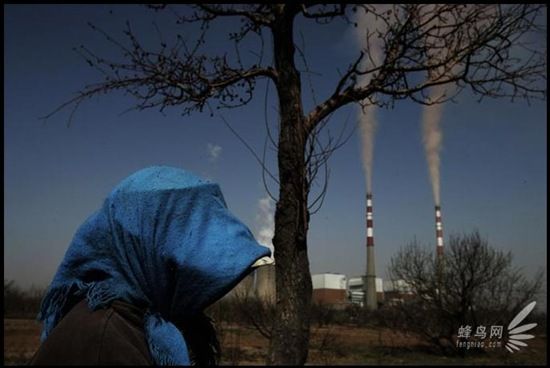
Shizuishan Industrial district in Ningxia. Residents cover themselves against the falling dust when going outside.
April 22, 2006

This Saturday, October 24th, I'll join a mob of peaceful activists and march across the Brooklyn Bridge, from Manhattan to Brooklyn, in hopes of further raising public awareness about the reality of climate change and the need for a comprehensive international climate treaty. The march is associated with 350.org's Day of Action.
"350.org is an international campaign dedicated to building a movement to unite the world around solutions to the climate crisis--the solutions that science and justice demand. Our mission is to inspire the world to rise to the challenge of the climate crisis—to create a new sense of urgency and of possibility for our planet. Our focus is on the number 350--as in parts per million, the level scientists have identified as the safe upper limit for CO2 in our atmosphere. But 350 is more than a number--it's a symbol of where we need to head as a planet. [...] This December, world leaders will meet in Copenhagen, Denmark to craft a new global treaty on cutting emissions. The problem is, the treaty currently on the table doesn't meet the severity of the climate crisis—it doesn't pass the 350 test. In order to unite the public, media, and our political leaders behind the 350 goal, we're harnessing the power of the internet to coordinate a planetary day of action on October 24, 2009. We hope to have actions at hundreds of iconic places around the world - from the Taj Mahal to the Great Barrier Reef to your community - and clear message to world leaders: the solutions to climate change must be equitable, they must be grounded in science, and they must meet the scale of the crisis."
350.org was founded by author and environmentalist Bill McKibben and, although some legitimate philosophical criticisms of the project have been raised, I feel strongly that the organization's mission is vital.


Due to long-term consumption of water contaminated by industrial waste, 50 people have cancer and cerebral thrombosis in Kang village of Linfen City, Shanxi Province..
64-year-old Wang Baosheng has fester wounds all over his body, and must sleep sitting, face down on the edge of the bed each day.
July 10, 2005

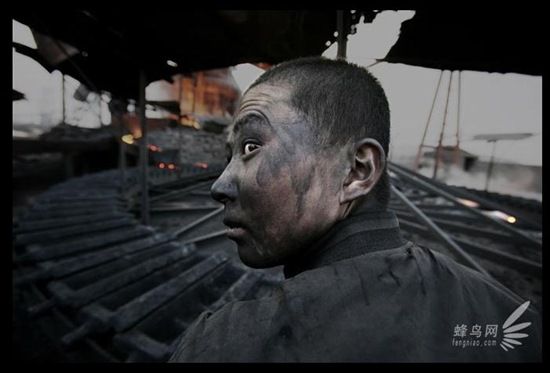
Should you doubt the urgent need for an international climate treaty that demands accountability and systemic change, or should you remain skeptical of the human influence on atmospheric carbon levels, I encourage you to take a look at the distressing pictures that ChinaHush recently published. Photographer Lu Guang's series "Pollution in China" is a testament to the cruel realities of the international, industrial market.

In his book-length essay Life Is A Miracle, the author, poet, essayist, and critic Wendell Berry describes the global, capitalist world view as,
"one culture of division and dislocation, opposition and competition, which is to say the culture of colonialism and industrialism. This culture has steadily increased the dependence of individuals, regions, and nations upon larger and larger collective economies at the same time that is has thrown individuals, regions, and nations into a competitiveness with one another that is limitlessly destructive and demeaning."
The "collateral damage" caused by this monstrous steam engine is not limited to elevated carbon levels, and its poisons don't just affect the dispossessed or the politically and economically powerless.

Nicholas Kristoff reminds us, in a recent New York Times OpEd piece, that the staggering number of "deformed frogs and intersex fish [found in or near United States' waters] — not to mention the growing number of deformities in newborn boys — should jolt us."
"In the Potomac watershed near Washington, male smallmouth bass have rapidly transformed into 'intersex fish' that display female characteristics. This was discovered only in 2003, but the latest survey found that more than 80 percent of the male smallmouth bass in the Potomac are producing eggs. Now scientists are connecting the dots with evidence of increasing abnormalities among humans, particularly large increases in numbers of genital deformities among newborn boys. [...] Apprehension is growing among many scientists that the cause of all this may be a class of chemicals called endocrine disruptors. They are very widely used in agriculture, industry and consumer products. Some also enter the water supply when estrogens in human urine — compounded when a woman is on the pill — pass through sewage systems and then through water treatment plants."
Herpetologists have been sounding the alarm for years, but the policy makers are warm in the pockets of the immoral corporations and the populace, by and large, prefers to escape in celebrity pregnancy updates and corporate-owned sporting events. Amphibians were the ignored canary in the coal mine. Now many animal families (ours included) are paying a terrible price, one that we can not yet fully appreciate.


Henan Anyang iron and steel plant’s sewage flowed into Anyang River. March 25, 2008

Still, it's not too late to stand up to the "culture of colonialism and industrialism." Visit 350.org. Find out how to get involved in the effort. If global warming isn't appealing to your still, small voice, get involved with political activism, volunteer at your local homeless shelter, pledge financial support to non-profit activist organizations working for causes that you feel strongly about; it doesn't matter what you do, but it does matter that you do something. Turn off the television, put down the tabloid. I beg this of you.


Breathing large amounts of dust into their lungs, people become sick after working here for 1-2 years. Most of these migrant workers come from area of poverty.
April 10, 2005

Photo credits: all photographs, Lu Guang; ripped from ChinaHush

Thursday, September 17, 2009

Kimmel Harding Nelson: Day 11

As I began jotting down notes this morning, it occurred to me that many of the ideas I've been ruminating on during my time in Nebraska City were nicely tied together in an essay almost a year old. "Eric Beltz and 'The Good Land'," a response to artist Eric Beltz's Fall 2008 solo exhibition at Morgan Lehman Gallery, in New York City, raises questions of American exceptionalism, conservation, religion, and human conceptions of "wilderness."

I subscribe to the notion that every artist or academic has just one big idea that, over a career, appears in a variety of forms or expressions. Why not, then, revisit the Beltz essay in the context of the writing I've done at the KHN residency? It follows nicely on yesterday's post, and connects our American ecological dilemma to the arts, or at least to two artists' considerations of the dilemma, namely Beltz's and my own.

+++++


Eric Beltz
"By this Axe I Rule"
2008
Graphite on Bristol
27 1/2 x 23 inches

"All conservation of wildness is self-defeating, for to cherish we must see and fondle, and when enough have seen and fondled, there is no wilderness left to cherish."
-Aldo Leopold

The exquisitely rendered graphite drawings included in "The Good Land," Eric Beltz's recent exhibition at Morgan Lehman Gallery, are sophisticated responses to our American folkways and myths. As darkly funny as they are disarmingly earnest, the graphic works are both exhortations and critiques of our nation's inborn exceptionalism and romanticism.

Of particular interest to Beltz is our American relationship to landscape. In "By This Axe I Rule," a contemplative outdoorsman sits on a tree stump, ax in hand. The bodies of a white-tailed deer, a moose, an opossum, a raccoon and other animals are partially concealed by snow drifts at his feet; a turkey vulture is perched above, wings spread. The man bears a striking resemblance to renowned ecologist Aldo Leopold. The likeness may be coincidental, but is nonetheless pertinent. 2008 is the 60th anniversary of Leopold's death. Like Henry David Thoreau and John Muir, Leopold is a lodestar for many contemporary environmentalists. His "A Sand County Almanac," published posthumously in 1949, remains a critical conservation text.

Unlike Rachel Carson's "Silent Spring," the 1962 bestseller that catalyzed the modern environmental movement, Leopold's "Almanac" is not a call for corporate and federal responsibility. Although Leopold would surely support such measures, his book is principally concerned with our reforging an intimate connection to the landscape we inhabit. "We can be ethical only in relation to something we can see, feel, understand, love, or otherwise have faith in," he wrote.

It's noteworthy that Leopold's faith is not of the starry-eyed variety; his "land ethic" includes hunting, controlled burns, and other practices typically condemned by preservationists. Contrary to the romantic conception of wilderness, Leopold's ethic acknowledges that the tools invented by humans (the saws, shovels, axes, picks, and pitchforks that figure prominently in Beltz's drawings) are not simply cruel agents of mastery. Humans are animals and, as such, we are not apart, but rather a part of a complicated, messy ecology. No matter how we manipulate our environment, dominion remains a comforting delusion.

Yet most of us do not conceive of Nature in this way. Just as we distinguish between the self and the group, so too do we draw a hard-line distinction between humanity and the “natural world.” William Cronon, a respected, if controversial environmental historian, argues that we must alienate ourselves from Nature before it can be understood as something pristine, virgin, or more wild than ourselves. In his celebrated 1983 book, “Changes in the Land”, Cronon reveals the quixotic quality of preservationist impulse.
"If the nature of Concord [Massachusetts] in the 1850s - a nature which many Americans now romanticize as the idyllic world of Thoreau's own Walden - was as 'maimed' and 'imperfect' as he said, what are we to make of the wholeness and perfection which he thought preceded it? It is tempting to believe that when the Europeans arrived in the New World they confronted Virgin Land, the Forest Primeval, a wilderness which had existed for eons uninfluenced by human hands. Nothing could be further from the truth....the land was less virgin than it was widowed. Indians had lived on the continent for thousands of years, and had to a significant extent modified the environment to their purposes…The choice is not between two landscapes, one with and one without a human influence; it is between two human ways of living, two ways of belonging to an ecosystem."
The preservationists' dualistic attitude (i.e., Humanity vs. Nature) provides only simple answers to our complex questions. By contrast, Beltz’s allegorical drawings shirk simplistic moralizing in favor of contradiction, ambivalence and multiplicity. His scenes speak to an active communion with Nature, albeit one that includes suffering, death and a melancholy nod to the essential absurdity of existence. By turns, Beltz eulogizes, champions and satirizes Thoreau's self-sufficiency and Andrew Wyeth's rural romanticism.


Eric Beltz
"Hysteria"
2008
Graphite on paper
17 x 13 3/4 inches

Beltz critiques America's religious and economic landscape, as well. Four of his drawings comprise a series entitled “Back to Eden.” In each, a headless body clothed in overalls, workman boots ,and a shirt with rolled up sleeves – the uniform of the outdoorsman-farmer - is slumped in or alongside a pile of cut logs and other vegetation. Above each of these tableaus, Beltz has written one word, in cursive: Asthma; Hysteria; Cancer; Delirium.

Considering the series, I recall Adam Smith’s ignored admonition concerning the dangers of loosely regulated capitalism. Smith, the 18th century Scottish philosopher best known for his influential treatise "The Wealth of Nations," is canonized by contemporary capitalists for laying down the principals of free market economics, but he entertained doubts about and acknowledged the shadows cast by such a system.

"Power and riches," Smith wrote, "are immense fabrics, which it requires the labor of a life to raise, which threaten every moment to overwhelm the person that dwells in them, and which, while they stand, can protect him from none of the severer inclemencies of the season. They keep off the summer shower, not the winter storm, but leave him always as much and sometimes more exposed than before to anxiety, to fear and to sorrow, to diseases, to danger and to death." Smith’s misgivings were warranted. Contemporary life is rife with social ailments and, in combination with our alienation from Nature, secular capitalism is a principal causative factor.

Curiously, free market capitalism is close kin to Manifest Destiny, the divine doctrine of conquest and consumption. Capitalism is exported with no less zeal than our cruel spread west from the colonies. Harriet Beecher Stowe, the 19th century novelist best remembered as an outspoken proponent of abolition, wrote that America is "a nation specifically raised up by God to advance a cause of liberty and religion." She did not say “liberty of religion.” America was founded by Protestant fundamentalists fleeing religious persecution in Europe. Arriving on these contested shores, they took names like Ezekiel, Jacob, and Issac, and likened their journey to the Jewish Exodus from Egypt. These religious settlers are the forebears of a great many contemporary Americans.

Appropriately, Beltz’s drawings incorporate Biblical texts and his subjects are recognizable as America's founding fathers and God-fearing, anonymous farmers. But Beltz draws from a peculiarly American well, the proverbial melting pot. Each drawing is suffused with currents of Eastern philosophy and shamanism. His farmers and historical figures are also mystics. American philosophy is more plural than we care to admit, and Beltz's admixture of East and West, allegory and history, supernatural and natural is a fair reckoning. (American transcendentalism, for example, the philosophy so vital to Thoreau and Ralph Waldo Emerson, was a hybrid of Protestant Unitarianism, Romanticism, Hinduism, and European intellectualism.)


Eric Beltz
"Tree of the Evil Eagle"
2008
Graphite on paper
40 x 30 inches

Still, the Bible is the first book of the United States, and many Americans regard the Constitution and founding fathers with astonishing reverence (to the extent that, in some circles, the former is sacrosanct). But documents and philosophies are of a particular time. Guarded by strict interpreters, the Constitution of the United States can become as regressively dogmatic as any primary religious text. Without thoughtful interpretation of Constitutional scripture, the significance and relevance of the founding fathers' enterprise will wane.

But most Americans (politicians and citizens alike) are in the business of denying the inevitable, be it the death of a loved one, an unregulated economy, or an ideology. Rather than confront our heavy history (and with it our future), the United States cloaks itself in exceptionalism. We remove ourselves from a fact-based historical narrative so that the road to future success is understood as an unyielding continuation of the present, divinely-ordained course. Like the empires that rose and fell before us, America's clarity of vision is obscured by global power and a history that privileges mythic glory over fact. Because we make history, many of our leaders feel strongly that we don't need to know it. Moreover, the history we make is irreproachable because it is consecrated.

Yet the secular capitalist world view strives to replace religion and the supernatural with consumerism. Manifest Destiny Version 3.0 is not ordained by God so much as by the Almighty dollar. And the replacement worked, more or less. The secular capitalist model is today the global standard. But sociologists, anthropologists, and, now, some neuroscientists agree that the substitution is inadequate. This deficiency is most apparent in a religious nation like the United States, where fundamentalism and cultism, reactionary responses to the secular world, are thriving. Despite our founding fathers' dismissal of the New Testament's Book of Revelation (Thomas Jefferson described it as "the ravings of a maniac"), a 2002 CNN/Time magazine poll found that 59 percent of Americans believe the prophecies therein are real and that the gruesome judgment of the Second Coming is imminent. James Watt, former President Reagan's Secretary of the Interior, is among that majority. He famously stated that protecting our nation's natural resources was not a priority because Jesus Christ would return only "after the last tree is felled."

Yet some evangelical fundamentalists are more fair-minded. They focus instead on the Bible's call for stewardship, and argue that the success or failure of the environmental movement depends on which interpretation gains the upper hand. Will we embrace a dominionist or stewardship theology?

The crux of that question is the American notion of wilderness. Cronon writes, "the flight from history that is very nearly the core of wilderness represents the false hope of an escape from responsibility, the illusion that we can somehow wipe clean the slate...and return to the tabula rasa that supposedly existed before we began to leave our marks on the world...Non-use is not an option: to live in nature is to use and change it by our presence. The choice we face is not to leave no marks - that is impossible - but rather to decide what kinds of marks we wish to leave."


Eric Beltz
"The Good Land"
2008
Graphite on paper
30 x 40 inches

Beltz's meticulously rendered works don't offer any answers, but neither do they shrug off the dilemma. With a richly ironic sensibility and a sensitivity to the complexities of our national character and (natural) history, Beltz embraces our clusterfuck approach even as he skewers it. "The Good Land" is sublimely ambivalent.

Photo credit: all images ripped from the artist's website

Saturday, September 12, 2009

Kimmel Harding Nelson Residency: Day 6


Cincinnati House; Nebraska City

Working Papers

The Cincinnati House is a charming craft, candle, and home goods store, located not far from the KHN Center. On Friday afternoon, I purchased some Nebraska City postcards there and, at the register, struck up a pleasant conversation with the proprietress. She moved to Nebraska City and opened the boutique after retiring from a career in Omaha.

Upon learning that my time at the residency is principally given to musings on American and natural history, she announced with a smile, "If you're interested in history, you might like to know that this building used to be a brothel." I allowed as how, yes, I would like to know more about that history, and she provided me with the abridged version.

Although the narrative's specifics were not especially titillating, the Cincinnati House story did cause me to wonder why historical prostitution, unlike its present day trade or the institution of slavery, is so often romanticized or discussed with a wink and a smile? This fact seems especially odd considering that, were genealogical records better kept and people more honest, a significant percentage of European Americans would have one or more "working girls" in their family tree.

After bidding the owner a good afternoon, I made my way to the door. Hung on the wall nearby the exit, I noticed a framed license for prostitution, an artifact of the building's 19th century function.


Soybean field; Nebraska City

Suspicious Activity

Living in New York City, I sometimes forget that my not owning a vehicle is patently un-American. New York City's exemplary public transportation system makes carlessness possible (even preferable), and I'm fond of long walks, in any case.

Most Nebraska City residents, by contrast, aren't fond of walking and the town's plentiful dogs aren't accustomed to walkers. I was hounded, yesterday afternoon, as I tramped about the town's eastern edge in search of attractive river views. I walked on city streets or, where it exists, the lonely sidewalk, and I didn't trespass on private property. Still, although dogs failed to chase or bark at any of the passing cars or pickup trucks, they accosted me with sometimes intimidating territorial displays. At least one of the other KHN residents has experienced similar canine antagonism, and I've concluded that the dogs are alarmed, above all, by our unorthodox mode of locomotion.

Similarly, the town's human residents seem a bit suspicious of walkers. I feel, making my way from place to place, as though I shouldn't let my eyes linger on an open garage door or lawn ornament, lest I appear to be "casing the joint." If not burglary, what other reason would I have for walking?


Missouri River landing; Nebraska City

Photo credits: all photos, Hungry Hyaena, 2009

Wednesday, July 29, 2009

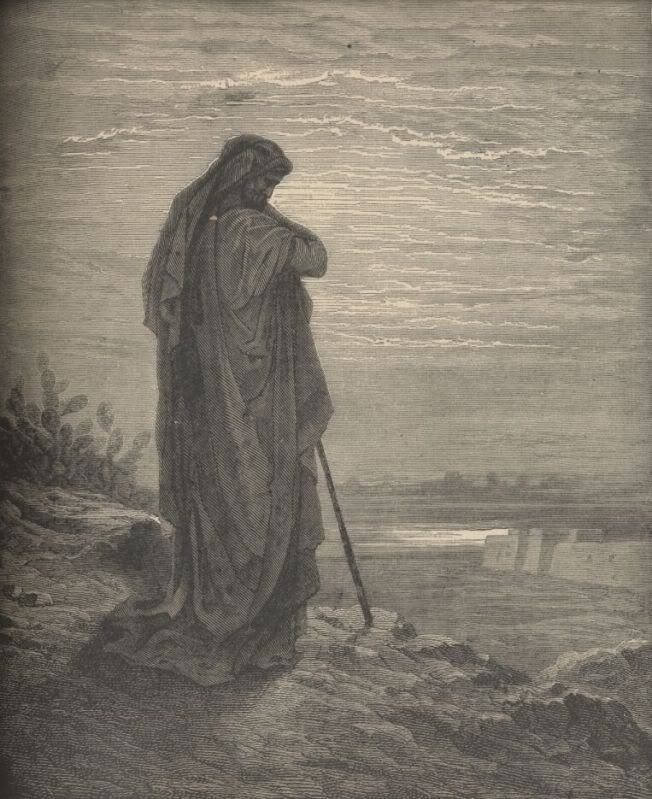
What is the Prophetic Ideal?


Gustave Dore
"The Prophet Amos"
1891
Engraving
"Let justice roll down like waters, and righteousness like an ever-flowing stream."

-Amos 5:24
In the Hebrew Tanakh, the colorful collection of history, anthropology, and mythology better known to Christians as the Old Testament, a number of the prominent prophets decry the institutionalization of Israelite religion. Elijah, Amos, Hosea, Isaiah, and Jeremiah proclaim instead the communal and, in some cases, individual experience of the one, true God. They maintain that God can be best experienced (and, as the ancient Israelites believed, best appeased) through one's devotion to those moral laws, or mitzvot, concerned with righteousness and social justice. These courageous and outspoken men also possess an enmity for the organized priesthood. They insist that the Israelites needn't centralize their worship at Solomon's Temple in Jerusalem, or at any of the other state worship shrines constructed within the kingdoms of Israel and Judah.

Not surprisingly, excepting the rare case when a prophet's ideology was deemed politically expedient, Israelite state leaders frowned on religious populism and the theocracy ignored the prophet's pleas. Typically, the trouble-making prophets were ostracized, expelled, or hunted as fugitives. Yet, ultimately, the prophets' voices proved appropriately prophetic.

For most of their history, Jews have lived in diaspora, their religious faith and identity rooted in a universalist foundation of scripture, theory, and law rather than any centralized site or body. In fact, most contemporary religious historians believe that the flowering of the relatively archaic and essentially polytheistic Israelite religion into Judaism follows the fall of Jerusalem to the Babylonians, in 587 BCE, and that this early, exilic manifestation of Judaism would undergo another upheaval and transformation after the destruction of the Second Temple by the Romans, in 70 CE. In essence, these scholars suggest that the Israelites (and, later, the Jews) had to forgo state power before the moral idealism of their religion could be actualized.

Accordingly, then, the muscular, modern state of Israel poses challenges to Jewish moral idealism. But contemporary Israeli Jews aren't alone in their wrestling with this challenge. Almost 2,500 years after the Hebrew prophets condemned top-down involvement in spiritual matters, liberal-minded, religious individuals of all stripes continue to struggle against blindly restrictive doctrinal authority.

I do not intend to suggest that adherence to dogma is necessarily a bad thing. Moral hand-wringing is a natural component of ethical decision-making, and traditional values of the sort upheld by religious authorities offer each of us a valuable point of reference. But what of contemporary conflicts between religious action and the religious institution? What of those cases in which the civil and moral codes of a religion suggest that the adherent to those codes should act in some way other than that dictated by the religious institution?

Laura Goodstein's recent New York Times article, "U.S. Nuns Facing Vatican Scrutiny" provides an excellent example. Goodstein writes,
"In the last four decades since the reforms of the Second Vatican Council, many American nuns stopped wearing religious habits, left convents to live independently and went into new lines of work: academia and other professions, social and political advocacy and grass-roots organizations that serve the poor or promote spirituality. A few nuns have also been active in organizations that advocate changes in the church like ordaining women and married men as priests."
What could possibly be wrong with nuns advocating for progressive social change!? While I respect those individuals who dedicate their life to religious contemplation, aren't the monks and nuns that work for God outside of monastery and convent walls the most exemplary of all religious adherents? Aren't those individuals striving for Thomas Merton's brand of religiously-inspired activism representative of the 13th century theologian and mystic Meister Eckhart's call for believers to "gratefully [return] all that God has bestowed [...] and, by that act of donation, enter the Godhead"? In the eyes of the Vatican, apparently not.
"The investigation was ordered by Cardinal Franc Rodé, head of the Vatican office that deals with religious orders. In a speech in Massachusetts last year, Cardinal Rodé offered barbed criticism of some American nuns 'who have opted for ways that take them outside' the church. [...] The [Vatcian's investigation] focuses only on nuns actively engaged in working in society and the church, not cloistered, contemplative nuns."
If the Vatican has spearheaded the investigation only because the Church seeks confirmation that American activist nuns are "attending Mass and keeping the sacraments," all well and good. After all, attending Mass and keeping the sacraments are obligations of religiously observant Catholics, and an individual who has devoted his or her life to the church should certainly be upholding these traditions. If, however, the Church intends to castigate or defrock otherwise devout, responsible nuns for pursuing religious behavior outside of the church, the Vatican officials should be ashamed of themselves.

As the Catholic theologian Walter Brueggemann wrote in The Prophetic Imagination, "The task of prophetic ministry is to nurture, nourish, and evoke a consciousness and perception alternative to the consciousness and perception of the dominant culture around us." For the Catholic nuns, as for the Hebrew prophets millennia before them, the dominant culture is that of their respective religious institutions, one of staid and comfortable orthodoxy. I'm not a Christian, but were I one, and especially if I were Catholic, I would be up in arms over the Vatican's sanctimonious oppression of those exceptional nuns and monks who actually paid attention to the substance of Jesus of Nazareth's memo.

Photo credit: ripped from Wikipedia

Friday, June 05, 2009

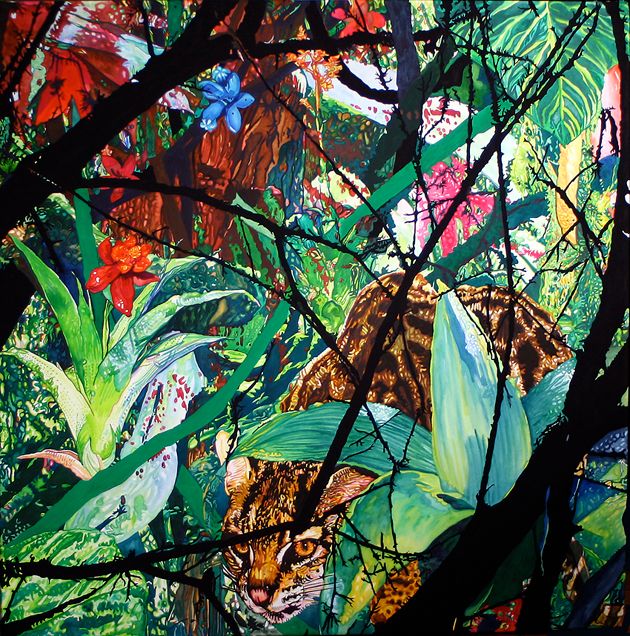
Ocelots at the Gate!


Christopher Reiger
"between meaning and material (h.H.R.)"
2007
Watercolor, gouache, graphite and marker on Arches paper
32 x 32 inches


Diminutive yet captivating, the ocelot (Leopardus pardalis) is my favorite cat species. I've only appreciated the beautiful feline on film and in photographs, but am nonetheless impressed to near reverence. I delight in the animal; I marvel at his dappled coat as he passes through dense foliage and I am humbled by her grace and cunning gaze.

Years ago, when working at a eco-tourism tent camp on Costa Rica's Osa Peninsula, I had the privilege of tracking an ocelot's nighttime doings along a Pacific beach that abuts a steep jungle mountain. I didn't discover the cat, but I took great pleasure in tracing the cat's movements, and I was deeply grateful for the opportunity to commune with the creature, even in so simple a fashion.

It is with great distress, then, that I consider the plight of the ocelot and other species in the Lennox Foundation Southmost Preserve, a 1,034-acre preserve located at the southern tip of Texas. As proposed by the United States Department of Homeland Security, the Mexico-U.S. border fence will pass through the center of this preserve, up to a mile-and-a-half north of the actual border. Three quarters of the preserve will thereafter be inaccessible by employees of the Nature Conservancy, the organization that currently manages the property. Because the Nature Conservancy refused the USDHS buy out, they are being sued by our federal government.

In her Nature Conservancy Magazine article "Don't Fence Me Out," Jennifer Winger writes:
"Once known as the Wild Horse Desert, south Texas may support more wildlife per acre than any other habitat in North America. And although the Rio Grande Valley itself has lost more than 95 percent of its wildlife habitat, Southmost Preserve is a shining exception: Its lands and waters provide habitat for endangered species such as jaguarundis and ocelots, as well as indigo snakes, Texas tortoises and migratory birds.

But recently, this valuable habitat has been threatened by an 18-foot-tall concrete and steel fence proposed by the Department of Homeland Security. Most of the proposed 670-mile-long border fence, with segments from California to West Texas, has already been constructed, but the section slated to cut through the Conservancy’s land is on hold, pending the outcome of a legal battle.

...If the fence is built, nearly 700 acres — 75 percent of the preserve — would be trapped in a no-man’s-land between the fence and the Rio Grande, including all preserve facilities and the home of the preserve manager. The proposed fence would effectively cut off access to the native plant nursery, which is critical to reforestation efforts throughout south Texas. Additionally, the fence would sever a critical corridor for wildlife, as it could block animals from accessing protected areas to the north and freshwater resources to the south."
Contemplating the myopic vision of the USDHS, I recalled an earlier HH post that questioned that morality of building a border fence. In light of this recent news from Texas, I've decided to republish "Border (Bio)diversity (of opinion)" today.

+++++


The Robert Smithson in me is bemused by international borders, particularly those boundaries that are not physically demarcated, lines that exist only in cartography and our collective political imagination. Last night, I contemplated a striking black-and-white photograph of the Mexico-U.S. border. The image was dominated by a rural "vehicle barrier" fence (similar to the one shown above), far removed from an official border checkpoint or crossing. In the desert of the American Southwest, this fence draws an arbitrary line in wire and steel.

It struck me as an emblem of humanity's absurdly tenuous existence, a reminder that our species is an insignificant mote in an incomprehensibly tremendous weave. As the artist Carl Buell wrote in the comments section of a recent HH post,
"With every change in sea level and shoreline, with the raising or eroding of every mountain range, with every changing weather pattern, life spreads out as it can and comes into contact with new environments, opportunities and hazards...As I get older (than dirt), I find myself starting to think like the hills themselves. Some day after eroding and washing out to sea, I’ll be a hill again."
Indeed, each of us (and, eventually, our species) will be reconstituted, and our arbitrary borders, those lines in the mud of space-time, will be erased. In this respect, the border fence is a healthy reminder of our existential folly, but it also reveals humanity's darker inclinations. We build fences, after all, to divide "us" from "them," the demonized "other."

The photograph that inspired this post was printed in the most recent issue of Wildlands Connection, the Wildlands Project newsletter. It accompanied an article about wildlife bottlenecks at the Mexico-U.S. border. The Wildlands Project's mission is to create vast, uninterrupted linkages, known as wildlife corridors, that will extend from Canada into Mexico (on the Rockies spine) and from Canada into Florida (on the Appalachian spine). The U.S.-Mexico border fence is a major obstacle to the organization's first goal.

Yet physical barricades are but one of the obstacles that ambitious conservationists face. Consider wildlife trade legislation that protects species in one country, but not another, adjacent nation. If strict laws prohibit the trapping or hunting of a species in China, for example, but not in neighboring Mongolia, is the Chinese legislation effectively addressing species welfare (particularly when Chinese citizens are paying top dollar to have the killed contraband imported)? Similar issues haunt conservation efforts the world over.

The humanitarian and social concerns that ethically-minded conservationists must take into account present a more nuanced hurdle. Environmental groups in the European Union are warring with one another about how best to create the legislative and physical infrastructure necessary for sustainable energy development. How can you raise thousands of wind turbines without hindering bird migration, ruining aesthetics, or plopping towers in the backyards of folks too poor and disenfranchised to protest?

If the various interest groups in the EU, one of the most environmentally progressive governing bodies in the world, are at odds, is it realistic to expect conservation to become a truly supra-national affair? After all, the EU's concerns are petty alongside those of the southern hemisphere. Whereas Europe is a sprawl of cultivated landscape relatively lacking in biodiversity, the "Third World" represents the usually disastrous meeting of remarkable biodiversity and an exploding human population. Impressed by our terrible example, the citizens of these nations emulate the unsustainable behavior of the "First World." In order to counter the detrimental environmental effects of Third World industrialization, international legislation will face increasingly substantial challenges. The supra-national bodies can create laws, but can we enforce these laws without wielding the colonial sceptre? More critically, can we conserve biodiversity and healthy ecosystems without subjugating the rights of the humans that call the Third World home?

These questions bring me to "Climate of Fear," a recent book by the eloquent Nigerian poet, essayist and Nobel Laureate, Wole Soyinka. Though Soyinka is writing about humanity's attempt to cope with terrorism, his political thrust is applicable to all realms, and his message is clarion.
"The gray zones of moral definitions where relativity reigns and remote cause are evoked to justify the abhorrent will continue to haunt certain casts of mind. The rest will insist on the primacy of an ethical will, one that dictates that some deeds demand to be judged within an identifiable and shared moral universe, however restricted...The ethical will is the redeeming assertion that, even when all other considerations of social conduct are subjected to the fortuitous, one, an ethical core, remains inviolate."
All of our fences fail. Perhaps we should recognize in that certainty both an entropic truth and an implicit morality. Within the context of this "shared moral universe," we are impelled to remove artificial barriers, whether they are constructed to stem the natural tide of human migrations or to protect us from our enemies. No matter the justification for the boundaries we draw, they are immoral inventions. And man, it is said, is the moral animal.

Photo credit: ripped from Kris Eggle's website