Showing posts with label meat. Show all posts

Tuesday, November 27, 2012

Heide Hatry's Provocative Flowers

Heide Hatry is not a household name, but the New York-based German artist's reputation is blossoming. She has smartly positioned herself at the intersection of the art world and popular culture and, as a result, is of particular interest to me, convinced as I am that the fine arts need mass reach (if not necessarily mass appeal -- see Thomas Kinkade) in order to play the vital cultural role they're intended to.

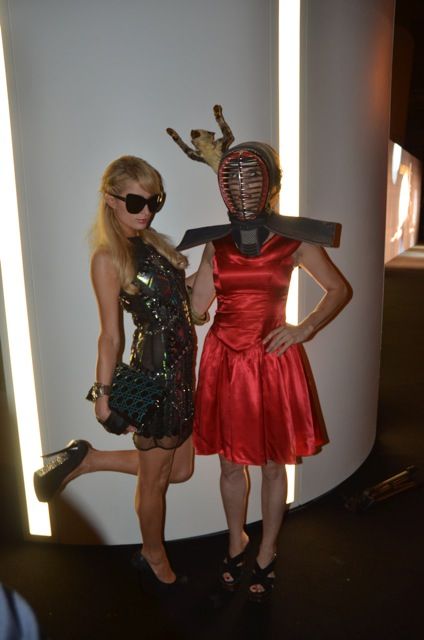
Heide Hatry, right, with Paris Hilton at the Guggenheim Museum
In September, Hatry performed "Schrodinger's Cat" at Lady Gaga's Guggenheim Museum perfume launch. Although Gaga's arty public appearances and carefully cultivated persona evidence how readily pop culture co-opts and/or draws inspiration from the fine arts, most people view Gaga as a pop star, not an artist. Hatry, on the other hand, is always identified as the latter, so when she is photographed rubbing shoulders with the likes of Paris Hilton or her work is written about by the scientist and popular writer Steven Pinker, I'm heartened. The art world isn't usually so accessible.

Naysayers might dismiss Hatry as the art world equivalent of a shock jock, insisting the popular attention she has received is only the result of her pushing our buttons. Certainly provocation plays a part, but Hatry has so far managed to balance titillation with thoughtful questions. (Arguably, Damien Hirst managed to do the same for a time...before he jumped the preserved shark.)

Friday, June 12, 2009

An Ocean Ethic


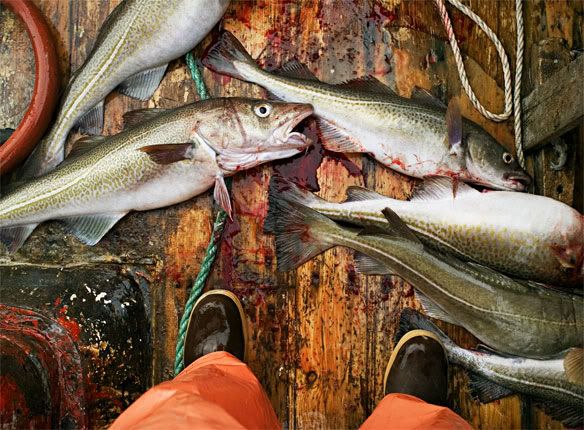
Corey Arnold
"Torsken"
2007
Chromira C-print

The son of an avid saltwater fisherman, many of my summer days were spent offshore. Departing the Wachapreague, Virginia, docks at 5 AM, the sky broke pink as my father carefully piloted his Boston Whaler through the salt marsh channels. Upon reaching the ocean inlet, we'd begin a thirty or forty mile run toward the sun-soaked eastern horizon. By 8 AM, we'd be trolling for yellowfin and bluefin tuna, dolphin ("mahimahi"), amberjack, or various mackerel species. If that technique proved unsuccessful (or if my father's fishy hunches proved wrongheaded), we'd move west, closer to shore, so that we could bottom-fish for black sea bass, spot, and weakfish over scuttled World War II ships and defeated German U-boats.

Compared to my father, I was unenthusiastic about salt-water fishing. I much preferred fishing on a pond, fly or spin casting into "honey holes," those storied pockets where the giant largemouth bass, perch and bluegill dwell. The relative solitude and meditative character of freshwater fishing appeals to my temperament. I associate the leisurely activity with the soft-spoken stroke of the canoe paddle; the rhythmic, almost ritualized casting of a fly or lure; the temperate spring breezes that lick my bare forearms as they do the banks' willow and maple trunks; the ecstatic chatter of a kingfisher. Above all, I associate it with a sense of universal benevolence. This, in stark contrast to fishing offshore, where Nature's benevolence is tempered by ambivalent and awesome forces.

Still, I enjoyed being on the open ocean. I loved the bounce and glide of my father's Whaler as it motored over the Atlantic chop, and I was delighted by the otherworldliness of ocean life: shadowy hammerheads passing through depth-piercing sun rays; dolphins propelling themselves skyward to get a better look at us; the surprising company of terns and gulls so far from land; loggerhead sea turtles basking on the ocean's surface; hundreds of cownose rays flying just beneath the water's surface. These images, and many others, stay with me. The ocean is a mysterious, thrilling place.

Sadly, it is also a threatened place. The most dire reports forecast that the ocean's fish species will be depleted by mid-century. If that should come to pass, the commercial seafood industry will no longer be viable and, more seriously, our world's biodiversity and ecological integrity will have been dealt an awful blow. Because of my latter day hunter-gatherer approach to fish and meat consumption, the only shellfish I consume are those few blue crabs and clams that I pull from the Eastern Shore's tidal estuaries. I rarely fish these days, so fish species are off my menu altogether.

Food writer Mark Bittman would likely approve of my vegetarian-unless-I-kill-or-catch-it ethic. In a recent New York Times article, "Loving Fish, This Time With the Fish in Mind" (June 9, 2009), Bittman argues for a more conscientious approach to seafood.
"In the meantime, I'm careful. I don’t make excuses, like 'There's cod in the market, so someone is catching it somewhere,' or 'If I don't buy it, someone else will,' or 'This chef serves local food, so he must serve sustainable fish.' If I’m going to eat fish, it must be consciously and thoughtfully.

My approach - which I readily admit is a work in progress and is as imperfect as my approach to all foods - goes something like this:

- I don’t buy or order the common fish I can easily keep in mind as being super-troubled — most cod, for example, or bluefin tuna, most species of shark and skate. When in doubt, I move on.

- With rare exceptions, I don't buy or order farm-raised fish, except clams and oysters. Farmed mussels and shrimp don’t seem to come with egregious environmental consequences, but neither tastes like much, either.

- I don’t eat fish as often as I once did. (I don’t promote eating it as I once did, either.)

- And I keep re-evaluating these 'rules,' and thinking about them. The 'safe' lists are difficult to understand, impossible to remember and change frequently. When the fishing of a species is well managed, it can recover and become sustainable. When it's not, the stocks of that fish disappear, sometimes quickly.

I’m probably not going to stop eating fish. And fortunately I don’t have to, since there are species that have never been depleted - squid and mackerel, for example - and those that have recovered, like haddock and Maine lobster.

It’s improbable that I’ll eat in a perfectly sustainable manner, even though I probably eat one-third as much fish as I did a few years ago. I’m trying not to let perfect become the enemy of good, and I’m trying to find a place that feels comfortable. That place is to see eating fish as a treat. I won’t eat it daily or in huge quantities, but occasionally, with appreciation. The days of 'see it/eat it' are gone."
Every educated eater should do the same, and each of us should strive to educate ourselves further. It's the ethical thing to do.

Time and evolution will march on, heedless of our nostalgic and preservationist impulses, but their ambivalence doesn't mean we've license to shrug and capitulate to the selfish wonts of the average consumer. Future generations should bear witness to the wonderful abundance that we have known and, to a lesser degree, still know. If we eat with an open mind and heart, perhaps that can be so.

Image credit: photograph by Corney Arnold; ripped from the artist's website

Monday, April 13, 2009

Being Prey


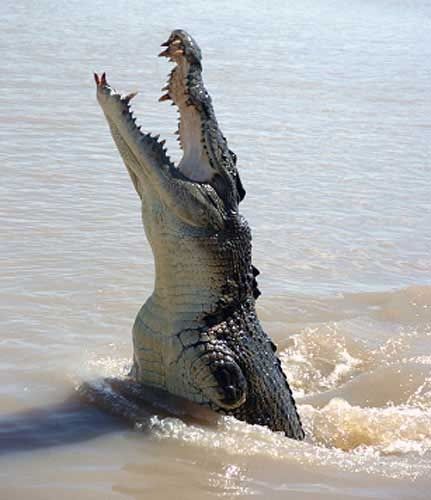
"The bank now presented a high, steep face of slippery mud. The only obvious avenue of escape was a paper bark tree near the muddy bank wall. I made the split second decision to leap into its lower branches and climb to safety. I steered [the canoe] to the tree and stood up to jump. At the same instant, the crocodile rushed up alongside the canoe, and its beautiful, flecked golden eyes looked straight into mine.

Perhaps I could bluff it, drive it away, as I had read of British tiger hunters doing. I waved my arms and shouted, 'Go away!' The golden eyes glinted with interest. I tensed for the jump and leapt. Before my foot even tripped the first branch, I had a blurred, incredulous vision of great toothed jaws bursting from the water. Then I was seized between the legs in a red-hot pincer grip and whirled into the suffocating wet darkness."
Val Plumwood, an Australian feminist and environmental activist who died last year, describes a nearly fatal attack by a saltwater crocodile (Crocodylus porosus) in her 2000 essay "Being Prey."

In 1985, in Australia's Kakadu National Park, Plumwood's canoe was repeatedly struck by the crocodile until, capsize imminent, she attempted escape into an overhanging tree. Her attempt failed; the croc took Plumwood underwater and "death rolled" her three times. Incredibly, Plumwood survived the attack. Once she'd managed to surmount the steep bank, her injuries forced her to crawl almost two miles before a park ranger found her.

The terrifying experience inspired Plumwood to ponder the frayed relationship between humanity and the rest of the animal kingdom. In the course of doing so, she questioned the usual motivation for adopting a vegetarian diet.
"Although I had been a vegetarian for some ten years before the encounter with the crocodile and remain one today, this knowledge makes me wary of the kind of uncontextualized foundation for vegetarianism that suggests that predation is either a negligible anomaly or an unredeemable ethical deficiency in the ecosystem. The presentation of the food chain as a (potentially) peaceful order ideally subject to nonviolent reconfiguration leads ultimately toward the thoroughly anti-ecological position that the earth is ethically improved by the elimination of predation."
I couldn't agree more. Similar thinking inspired me, five years ago, to become a vegetarian unless I kill or catch the animal myself. Predation is natural, even when we are the prey.

Photo credit: ripped from Virgin Media

Tuesday, March 03, 2009

Trusting Our Gut


"Sunday Cockfight at Madrid"
Wood engraving, originally published in Harper's Weekly
September 1873

Nature teaches beasts to know their friends.
-"Coriolanus" (Act II, Scene I), William Shakespeare
Human beings are exceptional among the social beasts in that our moral and ethical values are forever evolving. Educated, progressive individuals today consider all humans inherently equal, irrespective of race, sex, religion or nationality. Unfortunately, prejudice doesn't die easy, and bitter conflict remains a fact of life. Still, cultural anthropologists note that humanity has with time extended its ethical embrace from family to tribe, tribe to region, region to nation, nation to race, and race to species. In other words, bigoted outliers excepted, humanity is becoming ever more compassionate. It is notable and lamentable, however, that our animal brethren remain largely ignored. Nevertheless, I remain hopeful that humanity will transcend anthropocentrism.

My optimism is muddied, however, by articles like "Exhibition with Disturbing Videos of Animals Leads to Protests in Italy." This NY Times report deals with a controversial video installation by the French-Algerian artist Adel Abdessemed. In a matter of days, an Italian judge will determine whether or not the installation can be legally displayed in Turin. Abdessemed included two shocking videos in the installation: "Don't Trust Me," a loop documenting the sledgehammer slaughter of six Mexican farm animals; and "Usine," a video of scorpions, snakes, spiders, roosters and dogs fighting for human entertainment. Both videos were filmed in Mexico, where bludgeoning of "meat animals" is standard practice and animal fights are still legal.

Because Italian law prohibits animal fighting, the courts might fairly rule that "Usine" should not be shown to the public because it encourages illegal activity. But what of the bludgeoning in "Don't Trust Me"? Can a court rule that video documentation and display of a common practice violates the law?

In many countries, sledgehammers are still the primary method of stunning and killing an animal before it is butchered. The cow, horse, goat or other "meat animal" is roundly struck with the heavy hammer on the cranium. If the initial blow is misplaced, the animal will be struck again. In the United States, the Humane Slaughter Act stipulates that a captive bolt pistol is used to drive a pressurized bolt into the animal's brain. The pistol is more consistent than a sledgehammer, but the intended effect is the same.

Abdessemed's videos merely document a brutal step in the omnivore's food cycle. He is not, then, as so many activists assert, "someone who mistreats animals." Rather, he is someone who documents socially sanctioned mistreatment of animals.

Last year, vociferous protest from animal rights groups shut down a showing of "Don't Trust Me" at the San Francisco Art Institute. According to the San Francisco Chronicle, the "Art Institute canceled the panel discussion and the exhibition...[due to] unnumbered threats of violence from animal rights activists and possibly from others." Many of these outraged, threat-making individuals did not have all the facts; some of them even insisted that the artist killed the animals himself, in the name of art. But a comment by a reader of Ingrid's San Francisco Blog makes clear what most upset San Franciscans.
"I don’t want to see it (I prefer my meat in nice little packages in the store freezer), and if it is too disturbing or shocking to the sensibilities of the community, then the community should ask that the exhibit be removed."
It comes as no surprise that people don't like to be disturbed or shocked, but the commenter's preference for "meat in nice little packages" is irrelevant; that nicely presented meat comes from a living animal that was killed for human consumption. By buying the packaged meat, the consumer is implicated in the "processing" of the animal. Moreover, if she denies her connection to the animal's life and death, the meat-eater engages in irrational and immoral thinking. Were the omnivores that called for the closing of Abdessemed's SFAI exhibition compelled by shame?

And what of the threat-making animal rights activists? Excluding the individuals that erroneously believed Abdessemed was "killing the animals for art," I don't see the sense in their wanting to close the SFAI exhibition. Shouldn't they want to promote it, instead? After all, "Don't Trust Me" is cousin to videos produced by People for the Ethical Treatment of Animals (PETA) and other animal rights groups that document inhumane slaughterhouse practices. PETA hopes that these videos will inspire outrage against the meat industry and encourage vegetarianism. Why should Abdessemed's videos upset this interest group?

My reaction to Abdessemed's work is like my response to Marco Evaristti's provocative installations and performances. I agree with their detractors: the work is generally "little more than a publicity stunt to generate buzz." But if buzz gets people talking about our contemporary moral dilemmas, is that cause enough to embrace the provocateur?

Image credit: ripped from Wikipedia

Wednesday, January 16, 2008

Two Exceptions Taken

"My own experience is that the more we study art, the less we care for nature. What art really reveals to us is nature's lack of design, her curious crudities, her extraordinary monotony, her absolutely unfinished condition. Nature has good intentions, of course, but, as Aristotle once said, she cannot carry them out."
-Oscar Wilde

Wilde produced so many clever, insightful passages, but now and again he comes off as an arrogant buffoon. (On the plus side, the quote suggests that Wilde, were he still with us, would not be a proponent of Intelligent Design...so there's that.)

+++++

"Violence and brutality aside, if you were ever unsure of how ridiculous hunting can seem in modern terms, [artist] Angela Singer spells it out. Singer has explored the notion of the hunt and its trophies for a number of years and while her subjects explicitly reference the idea, her process pointedly undermines the esteem of hunting for trophy.

Trophy hunting in New Zealand does not have the social prowess as in Britain, but is still very much a red-blooded sport. It represents a regressive urge to connect with the natural and instinctive animal self and is emblematic of macho stereotypes of man-as-hunter."
-Anna Jackson, writing on the sculptures of Angela Singer in NY Arts

Really, Anna, we should talk. I have a feeling you might rethink your characterization of hunters and hunting...or at least allow for some anomalies.

Knee-jerk, reductive reactions to any complex subject are frustrating. I'm assuming that Jackson is a vegetarian; if not, she should have acknowledged this contradiction. She also embraces the now common stereotype of the hunter as a trophy hound. Certainly, the majority of hunters will mount at least one of their animal kills (whether head, rack or whole hide), but a great many find the idea repugnant, and are instead concerned with the meal and the experience.

But Jackson characterizes that experience as "regressive." Is connecting with the "natural" and "instinctive animal self" a bad thing? What of shitting, sex, and the feeling that possesses you in those (hopefully) rare moments when your life is in imminent danger? What of meditation or "spiritual" ecstasy?

I'm not a typical proponent of hunting; my views on the "issue" are nuanced and often contradictory, but when a person calls hunting "ridiculous" and "regressive" without explaining their perspective, my hackles rise.

Friday, January 04, 2008

Field To Table

I killed and ate one duck during my annual winter trip to the Eastern Shore. It's become a tradition...though "ritual" is perhaps a better word for it.

A vegetarian otherwise, my days of frequent hunting and fishing outings are gone, but the process of killing, preparing and consuming fish, fowl or flesh remains important to me. Once familiar to all, the steps involved are now considered foreign (even low) by the majority of contemporary meat eaters.

I have written on this subject several times before; rather than reiterate the same ideas, I thought I'd post some pictures of the process.

+++++


Lucy, a yellow Labrador Retriever, carries the fallen duck back to the blind.

+++++


Dead hen American black duck (Anas rubripes), on the left, and a hen mallard (Anas platyrhynchos), shot by a hunting companion, laid on the dock before the cleaning begins.

(My father and I make every effort to avoid shooting black ducks. The species experienced a gradual population decline in recent decades. Fortunately they are now rebounding in the Atlantic Flyway. Still, I would prefer to kill a mallard, but on this particular morning I failed to correctly identify the species as it winged past. It wasn't until Lucy retrieved the bird that I realized my mistake with a groan. Sadly, most duck hunters don't pick-and-choose species at all. Indeed, many hunters are no better at distinguishing species "on the wing" than your average urbanite.)

+++++


Ducks after plucking.

+++++


Ducks following gutting. The heads, wings and innards have been removed, and the heart of the black duck saved (on pan). The heart of the mallard had been mostly destroyed by the shot and could not be saved.

(When I was young, the duck liver could also be saved and eaten, but environmental pollutants have led biologists to discourage the consumption of internal organs.)

+++++


My hand following the gutting, a shockingly beautiful reminder of what meat consumption entails. I'm baffled by people who find such images disturbing yet continue to eat meat. They are the very definition of unreasonable and irresponsible.

(This isn't to suggest that I condemn contradiction. Indeed, I embrace it, but logic wins out in this case. If you find an act (any act) reprehensible or grotesque, how can you, with a clear conscience, ask it of someone else?)

+++++


Cleaned birds on pan, readied for rinsing and final preparations. Note how much more fat the mallard (bird on bottom) has than the black duck.

(Anas rubripes is considered a "wilder" or "gamier" species and, in my estimation, the meat tastes better for it.)

+++++


Me, cleaning and picking off remaining pin feathers.

+++++


The two ducks are now ready to be cooked. I ate the black duck that same evening. It was delicious.

+++++


My irreverent father sometimes says, half jokingly, "Make sure you finish everything on your plate. It died for your sins." In the days of environmental footprint quizzes, carbon trading programs, and hybrid automobiles, most western eating habits could fairly be deemed hedonistic. My annual kill, then, is sacramental. I "sin," if you will, so that I might reconfirm my decision, five years ago, to stop eating meat unless I am personally responsible for the killing involved in bringing meat to the table.

I'm not a true moralist, however. I realize that there is no universal code of ethics - only that which we, as individuals or societies, project onto others - but I do wish more people would consider their individual impact on the lives and environment of the animals we share this planet with, and depend upon for physical and emotional sustenance.

Photo credit: All images, Hungry Hyaena, 2007

Tuesday, March 20, 2007

Brian Lesteberg


Brian Lesteberg
"Fallen Doe, Voltaire, ND, 2003"
C-Print
40 x 32 inches

I was introduced to photographer Brian Lesteberg's terrific "Raised To Hunt" series via Alec Soth's blog. Regular readers of HH will likely know about my connection to hunting and fishing; although I usually carry a camera instead of gun these days, hunting continues to inform my life and philosophy, even living in New York City. Most art viewers, no matter their background, will appreciate Lesteberg's handsome photographs for their marriage of compositional simplicity and compelling content, but those of us who recognize the visceral moments Lesteberg has captured are, I believe, moved in a more fundamental way.


Brian Lesteberg
"Bradley, Sheridan County, ND, 2003"
C-Print
40 x 32 inches

Although my favorite image in the series is "Fallen Doe, Voltaire, ND, 2003," "Bradley, Sheridan County, ND, 2003" is more closely tied to my own experience. In the fall of 2005, I wrote about a flight of Canada geese passing south over my apartment in Astoria, Queens. The birds' calls triggered memories of Thanksgiving morning goose hunts.
"[These] could well be descendants of Canadas I hunted years ago, lying on my back in a cold-hardened, fallen corn field with a 12-gauge Browning over-and-under heavy on my chest. Looking down from several thousand feet, a group of geese would spot our decoy spread and begin a long, beautiful pitch to us, a pitch that might last many minutes and, for some of the birds, would be their last. Hours later, a cooked goose would emerge from the oven, dressed and ready for Thanksgiving dinner. My family never ate turkey."

Brian Lesteberg
"Dad Field Dressing a Goose , McClusky, ND, 2001"
C-Print
40 x 32 inches
Lesteberg's work has the same poetic resonance as Alessandra Sanguinetti's pictures; both photographers are evidently attached to the processes and rituals they document, but they allow themselves enough remove to open up their work to interpretion.


Brian Lesteberg
"Hoof Track with Blood, Voltaire, ND, 2003"
C-Print
40 x 32 inches


Photo credit: all images courtesy Brian Lesteberg

Thursday, April 20, 2006

Undoing The Gordian Knot

Michael Pollan, Hunting, and The Rest Of It

Image hosting by Photobucket
"The fact that you cannot come out of hunting feeling unambiguously good about it is perhaps what should commend the practice to us....If I've learned anything about hunting and eating meat, it's that it's even messier than the moralist thinks. Having killed a pig and...now looking forward (if that's the word) to eating that pig, I have to say there is a part of me that envies the moral clarity of the vegetarian, the blamelessness of the tofu eater. Yet part of me pities him too. Dreams of innocence are just that; they usually depend on a denial of reality that can be its own form of hubris."
-Michael Pollan, "The Modern Hunter-Gatherer"
I'm always pleased when I come across an article that clearly conveys a concept I have been striving to articulate with limited success, so I'm indebted to a co-worker for bringing to my attention Michael Pollan's (relatively) recent essay, "The Modern Hunter-Gatherer," in The New York Times Magazine (March 26, 2006). Pollan, the author of The Botany of Desire, Second Nature, and, most recently, The Omnivore's Dilemma, is a sensitive, thoughtful proponent of hunting. But whereas most writers who wax poetic about the hunt are guilty of romanticizing and simplifying what is, in fact, quite messy(1), Pollan argues that the hunter can not be a moralist. Rather "the grown-up hunter, the uneasy hunter...recognizes the truth" that resides in contradiction, or, as Robert Kimber put it in his excellent Living Wild & Domestic, "the uncompromising romantic has to compromise with the realist."

Image hosting by Photobucket

Before I continue, however, let me provide some background explanation of why Pollan's piece strikes a chord. As I wrote in my March 2005 essay, "Hunting JFK,"
"I consider myself a conscientious hunter. I eat no meat, including fish, unless I catch it or kill it myself. I kill only a few animals a year and catch only ten or so fish. I live on a vegetarian diet otherwise, aiming to minimize my contribution to the environmental degradation wrought by the meat [and fishing] industr[ies]. I will hunt only those species biologists deem to have 'surplus' populations, such as white-tailed deer (does only), mallard ducks (drakes only), cottontail rabbits."
Environmental degradation was not Pollan's principal motivation, but his reasons for picking up a rifle and heading into the woods of northern California to stalk and kill a feral pig (Sus scrofa), an introduced species descended from the European wild hog, are no less significant. The son of "one of the world's great indoorsmen," Pollan had never hunted. He "had long felt that, as a meat eater, [he] should, at least once, take responsibility for the killing that eating meat entails. [He] wanted, for once in [his] life, to pay the full karmic price of a meal." That Pollan should feel this way is admirable. Most well-educated Westerners are now too timid, too cloaked in denial, to address such base issues. Turning again to Kimber, "If the step from hunter to herdsman-plowman was the first great step in the process of alienation from nature and self, then surely the step from herdsman-plowman to city dweller, driver of combines, and feedlot engineer has all but completed that process."

All contemporary omnivores - the vast majority of humans - are necessarily implicated in the grisly business of meat "manufacture." The pork chop on the plate is more than a tasty entree; it was recently a living animal. After stunning, assuming that process goes smoothly, the pig's throat is slit by machine (or man) and the viscera is spilt before meat preparation begins. Every pig-eater who prefers to cast such realities from her mind is afraid of more than blood and gore or even the potential for undue suffering on the part of the animal. She is, above all else, afraid of confronting her own mortality. If, on the other hand, you know what it's like to kill a fellow creature, you consume flesh with full knowledge of what brings the food to the table: execution. Pollan suspects as much, even if he remains suspicious of the "ecstatic" language used by the likes of Ortega y Gasset and Hemingway.(1)

Pollan's account of the boar hunt makes for good reading, but his consideration of the aftermath is especially excellent. He struggles with his confused, intense reaction to the shooting and dressing, a polite term for gutting, of the large animal.
"...the rest of the organs tumbled out onto the ground in a heap, up from which rose a stench so awful it made me gag. This was not just the stink of pig wastes but those comparatively benign smells compounded by an odor so wretched and ancient that death alone could release it. I felt a wave of nausea begin to build in my gut. The clinical disinterest with which I had approached the whole process of cleaning my pig collapsed all at once: this was disgusting."
My upbringing was very different from Pollan's. I grew up assisting in the gutting and preparation of dove, quail, duck, deer, rabbit, squirrel, and other animals. As I told a Scrawled correspondent in a recent interview,
"Some of my early memories are, quite literally, bloody...As a child pondering the blood of a slain animal, I was deeply moved, at once overwhelmed with sorrow, and energized by the realization that the neon red glowing on my trembling hands was spilt life. The more familiar I became with death, the more tied to life I felt. It was an introduction to 'the Circle of Life,' even if it wasn't at all what Disney force-fed us."
Pollan draws similar conclusions, but because his is a new experience, he searches for an explanation where those us accustomed to death do not. This search begins with an examination of his nausea.
"...[W]hat was this attack of revulsion all about, anyway? Disgust, I understood, is one of the the tools humans have evolved to navigate the omnivore's dilemma - the elemental question of what we should and should not eat. The emotion alerts us to things we should not ingest, like rotten meat or feces. And surely that protective reflex figured in what I was feeling as I beheld these viscera, which no doubt did contain microbes that could sicken me. Our sense of disgust, as Steven Pinker has written, is 'intuitive microbiology.'"
Pollan's revulsion is the product of our animal hard-wiring. Routine killing and butchering may arrest or weaken this disgust - repetition dulls all sensation - but it remains an inevitable reaction. Like it or not, we are genetically adapted to the Pleistocene lifestyle Hemingway pined for. Pollan may cope well enough in modern-day California, making a living from selling words, but he still becomes ill at the sight of undesirable innards and, when hunting, turns into what he calls "alert man"(2), a more aware animal, one making full use of its senses. Ever conscientious, though, Pollan probes further and discovers something more than genetic coding in his violent revulsion.
"...there had to be more to it than that, and later, when I did some reading on disgust, I acquired a better idea what else might underlie my revulsion. Paul Rozin, a cultural psychologist at the University of Pennsylvania, points out that many of the things that disgust people do come from animals — bodily fluids and secretions, decaying flesh, corpses. Beyond the sanitary reasons for avoiding certain parts and products of animals, these things disgust us, Rozin suggests, because they confront us with the reality of our own animal nature. So much of the human project is concerned with distinguishing ourselves from beasts that we seem strenuously to avoid things that remind us that we are beasts, too — animals that urinate, defecate, copulate, bleed, die, stink and decompose...Exactly why we would strive so hard to distance ourselves from our animality is a large question, but surely the human fear of death figures in the answer."
Ah, yes, and so we arrive again at existential fear and the reason most folks prefer to distance themselves from the killing of the animals they consume. To "[pay] the full karmic price of a meal," Pollan must not only execute the pig, but also own up to the deed. Coming to terms with killing is far more challenging than pulling a trigger.
"What disgusted me about 'cleaning' the animal was just how messy — in every sense of the word — the process really was, how it forced me to look at and smell and touch and even to taste the death, at my hands, of a creature my size that, on the inside at least, had all the same parts and probably looked very much like me. The line between human and animal I could discern here, gazing into that carcass, was nowhere near sharp...In this, I decided, was one of the signal virtues of hunting: it puts large questions about who we and the animals are, and the nature of our respective deaths, squarely before the hunter, and while I'm sure there are many hunters who manage to avoid their gaze, that must take some doing."
For years I've tried to express as much so simply, but I tend to talk around the core of the matter, relying heavily on co-opted constructs and borrowed phrases. Even when I do feel I'm in the ballpark, most folks still willing to listen dismiss my attempts as little more than morbid rambling. After all, I live in New York City and, as far as most people know, eat a strict vegetarian diet. Why am I interested in championing hunting? What sense does that make? Pollan's remarks on the "signal virtues of hunting," particularly the difficult questions raised by the killing of other animals, suggest an answer.

One sometimes hears hunters - the more literary among them, anyway - say, "I kill to have hunted; I do not hunt to kill." This hackneyed comment refers principally to the heightened sense of immediacy and awareness alluded to earlier. Pollan likens this sense to a marijuana high; in fact, it is merely our inborn predatory instinct at work. But while there is certainly much to be said for the act of hunting itself, it is the killing that for me remains the essential existential experience. The hunt allows us to access our rarely used programming, to make full use of our special abilities, but the kill is like a Zen koan, a Gordian knot undone only by willful ignorance or reliance on moral certitude.

As Pollan suggests, avoiding the animal gaze "must take some doing." To approach a fallen animal, a creature you have just killed, is difficult but transfiguring. In the glazing eyes of the dead beast, you confront your own mortality. Terrifying though this may seem, I associate these moments with a profound sense of oneness with the natural world. In accepting responsibility for the brutal deed and recognizing my connection to the slain animal, my ego is reduced. There is an exhalation of the isolated, confused experience of contemporary life, and an inhalation of the universal(3). Dr. Morris Berman's analogy is pertinent: the experience removes the respectful hunter from the vertical, hierarchical world view and allows him to reside as part of the horizontal stretch, if only for a spell.

Unfortunately, I'm no stranger to the so-called "hero shot," the photograph of a hunter standing or kneeling behind a freshly killed animal. (In the case of smaller game, like rabbit or duck, the hunter proudly displays the creature in his hands.) It's a simple enough composition, dull and undistinguished: hunter, weapon, and prey. Usually the hunter smiles broadly. Open any contemporary "hooks-and-bullets" magazine and you'll find these images on most every page. I've never cared for these photos but, because my father is an outdoor writer, I've grown accustomed to his requests for such pictures. These days, article sales depend on the quality of the accompanying photographs as much as they do the writing, so I dutifully pose and do my best to muster a smile. Judging by my father's regular appeal - "C'mon, Christopher. Let's see a happy face. Look like you're enjoying yourself." - I don't often succeed. Why should I smile? I've just killed an animal. I'm spacey and contemplative. I'd prefer to be left alone, given adequate time to commune with the creature I have killed, minus the backslapping and the misdirected camaraderie. The experience is special, certainly, but not celebratory or joyous.

Image hosting by Photobucket


Apparently, most hunters do not suffer such brooding thoughts. Even Pollan, despite describing his emotions in the first moments after killing his boar as "surging and confused," admits to feeling proud and "unambiguously happy." It isn't until he sees the photograph of himself "kneeling on the ground behind a pig the side of whose head has erupted in blood," "one proprietary hand" placed "on the dead animal's flank," that he realizes how strange his happiness is.
"The man is looking into the camera with an expression of unbounded pride, wearing an ear-to-ear grin that might have been winning, if perhaps incomprehensible, had the bloodied carcass sprawled beneath him been cropped out of the frame. But the bloodied carcass was right there, front and center, and it rendered that grin - there's no other word for it - obscene. I felt as if I had stumbled on some stranger's pornography....No one should ever see this."
Some of the more seasoned hunters I know will write off Pollan's reaction as silly, indicative of a weakness borne of liberal ("sissified") elitism and a life removed from the realities of nature. There is some truth to that, surely, but what of their own unwillingness to consider the situation completely? They are just as guilty of ignoring the knot's complexity; they opt to "undo" it with denial's blade. As I see it, the ignorance of the prideful "sport" hunter is equivalent to that of the staunch anti-hunter(4).

And that brings me to an obvious distinction; Michael Pollan and I are not typical hunters. In fact, the more used to the predominantly vegetarian diet I become - it's been several years since I ate meat regularly - the less often I will hunt or fish in the future; maybe one day I will stop altogether, instead concentrating on a backyard vegetable garden. I am familiar already with the gravity of killing and the associated ego erasure. Given the power of that experience, it will always inform my art making, my writing, and the way I live my life. The insight may, like a tattoo, fade with time, but it will not disappear. Pollan, too, is unsure if he will hunt again, despite only having done so once. I am sympathetic, even if I feel he should try other forms of hunting before abandoning the practice altogether. We - and I mean all of us, not just hunters - need more voices like his, voices that challenge the intellectual hegemony of dullardism, on both the Left and Right. There are no simple answers to complex questions, and there are only so many times the Gordian knot can be cleaved by ignorance or denail.

For more, visit this interview with Michael Pollan.

Photo credits: Gordian Knot image ripped from homepage of Matthew Cadwallader; boar hunt photos ripped from Southeastern Outdoors and Suwannee River Ranch websites

+++++

(1) "I recognize this kind of prose: hunter porn. And whenever I've read it in the past, in Hemingway and Ortega y Gasset and all those hard-bitten, big-bearded American wilderness writers who still pine for the Pleistocene, it never failed to roll my eyes. I never could stomach the straight-faced reveling in primitivism, the barely concealed bloodlust, the whole macho conceit that the most authentic encounter with nature is the one that comes through the sight of a gun and ends with a large mammal dead on the ground..." ("The Modern Hunter-Gatherer," The New York Times Magazine, March 26, 2006)

(2) "Nothing in my experience has prepared me for the quality of this attention. I notice how the day's first breezes comb the needles in the pines, producing a sotto voce whistle and an undulation in the pattern of light and shadow tattooing the tree trunks and the ground. I notice the specific density of the air. But this is not a passive or aesthetic attention; it is a hungry attention, reaching out into its surroundings like fingers, or nerves. My eyes venture deep into thickets my body could never penetrate, picking their way among the tangled branches, sliding over rocks and around stumps to bring back the slenderest hint of movement. In the places too deeply shadowed to admit my eyes, my ears roam at will, returning with the report of a branch cracking at the bottom of a ravine, or the snuffling of a. . .wait: what was that? Just a bird. Everything is amplified. Even my skin is alert, so that when the shadow launched by the sudden ascent of a turkey vulture passes overhead I swear I can feel the temperature momentarily fall." ("The Modern Hunter-Gatherer," The New York Times Magazine, March 26, 2006)

(3)Although some friends tell me they have achieved a similar sensation while practicing yoga, I have not. There have been instances of immediacy, moments when, while in the midst of a yoga session, I feel a vital connection to the world around me, but these experiences are exceptional and, what's more, absent any sense of mortality. Yoga has granted me a connection, but it hasn't erased all sense of self.

(4)"I've looked at Angelo's pictures again, trying to figure out why they should have shamed me so. I realize it isn't the killing it records that I felt ashamed of, not exactly, but the manifest joy I seemed to be feeling about what I'd done. This for many people is what is most offensive about hunting - to some, disgusting: that it encourages, or allows, us not only to kill but also to take a certain pleasure in killing. It's not as if the rest of us don't countenance the killing of tens of millions of animals every year. Yet for some reason we feel more comfortable with the mechanical killing practices, out of view and without emotion, by industrial agriculture." ("The Modern Hunter-Gatherer," The New York Times Magazine, March 26, 2006)

Thursday, January 26, 2006

CO2 Carnivores and My Semen


I recommend the following Guardian Weekly article. I'm tempted to write a longer response to Jonathon Porritt's "Hard facts to swallow," but I've made clear my perspectives regarding the ecological value of a vegetarian or vegan diet before. Porritt, the Programme Director of Forum for the Future and Chairman of the UK Sustainable Development Commission, doesn't tell readers anything new, but he highlights new studies and research which confirm that a shift to a global "meat-lite" diet will do more to reduce carbon emissions than strict mileage standards and the like.
"'Stop eating meat' is unlikely to be the favourite slogan of the new Stop Climate Chaos coalition. Even 'eat less meat' might not go down too well, even though Compassion in World Farming has produced an utterly compelling explanation - in their report, Global Benefits of Eating Less Meat - of why this really is the way forward.

[...] Food isn't 'just another commodity', it is the foundation of personal wellbeing and is inextricably interwoven into a nation's culture, character and land use. In that regard, farming and food production embody a set of skills and capabilities on which the long-term security of any nation still ultimately depends.

[...] Modelling [the food production] variables is a policy-maker's worst nightmare, but they absolutely cannot be ignored. Unfortunately, they barely [figure in most government plans], which seek to persuade...readers that there is no alternative but to accelerate the globalisation of the food economy. 'Complete self-sufficiency' is summarily dismissed, as if anyone is out there arguing for complete self-sufficiency anyway. What [ecologists] are arguing for might be termed 'cost-effective self-reliance', as a hedge against the growing threat of widespread ecological and social disruption - food security seen in terms of land use, quality, sustainability and food safety, not just temporary availability and access...And that means policies that do not leave our farmers gratuitously disadvantaged by overseas producers who care little for the state of the environment or animal welfare; policies that actively promote local sourcing, obliging our retailers to be as smart and creative about local supply chains as they are about global supply chains; policies that set out systematically to reduce carbon intensity in food production and distribution; policies that build on the excellent work already achieved through the public sector food procurement initiative, and the development of new agri-environment measures. It also means a rather different vision, acknowledging up front that a sustainable future for the UK depends on securing a thriving rural economy, and that this, in turn, depends on keeping sustainable food production absolutely at the heart of the rural economy."
Being a country boy at heart, and having grown up surrounded by neighbors who made, and still make, their living from the land and the ocean, I champion the push for sustainable, local economies. The sustainability movement, for lack of a better label, is gaining much public support in the U.K. and throughout northern Europe, but these progressive attitudes often conflict with the development schemes and aspirations of so-called "Third World" countries; furthermore, carbon cutbacks and vegetarian diets certainly won't find favor in the great, red dragon that is China's burgeoning economy. That said, I believe significant in-roads can be made in the United States and Canada, particularly in New England and the Pacific Northwest, where the foundations for sustainable, local economies are already in place.

+++++

On another note, a bit of uber awkward hilarity. As his father did for him, my dad regularly sends me newspaper or science journal clippings he thinks I may find of interest. Occasionally, he'll annotate the articles. As I read through a recent package of these clippings this morning, I came across an article on sperm donors and their progeny. Across the top of the page, my father had written the following.
"Your mom wants you to start selling your semen. A) You're too bright and handsome to let your semen go to waste. B) Mom can now use the Internet to find out who her grandchildren are. Grandchildren at last!"
Uumm....okay. I don't embarrass easily, but I'm sure I blushed. I know why my parents feel this way, but still...

Beginning in my early twenties, I made it known that I don't want children of my own and that I don't plan to marry. When pressed about this choice, I allowed that if I were to blindly stumble into a long-term, settled relationship, adoption would be my ticket to the parenting roller coaster. Mind you, I don't condemn procreation off hand. As I see it, one child per couple is fine - even two, if you want to push it - and I am genuinely happy for those friends and acquaintances who are proud parents, but I'm something of an extremist when it comes to my own actions.

This note from my pops suggests that my parents, after years of dismissing my stance on such matters as a temporary one, a product of misguided, youthful idealism, have accepted that I really do feel this way...and they are not happy about it. And so they tell me now that my semen (I know it's accurate, dad, but c'mon....I really don't want to think about my mom discussing 'Christopher's semen'!) must not go to waste! Every time I think about the note, I start laughing. Life is absurd.

Photo credit: www.equine-reproduction.com

Saturday, August 06, 2005

Processing Plants And Psychology


A proponent of meat-lite or vegetarian diets, I sometimes feel resented by meat-eating family members, friends, and acquaintances. Their resentment may be the result of a guilty conscience, a conviction that vegetarian diets are unhealthy, or some combination of the two. But because it takes a long while to explain my personal approach, and because quiet examples are better than loud ones, I don't expend a lot of breath defending my diet. In fact, I'm irritated by vegetarians who make a fuss about their choice, say hateful things about meat-eaters, or make a morality play out of every public meal. This Washington Post piece, though, describes an aspect of the meat industry that gets little attention, even from "fundamentalist" vegetarians and animal rights activists.

The work conditions faced by meat packing employees are deplorable. Better monitoring of work place practices and of the psychological needs of the employees is needed. The psychological stresses of meat industry employment are too often overlooked. Although I'm comfortable butchering my own meat (and feel that every meat-eater should be required to gut and prepare at least one of each species they plan to consume in the course of their lifetime), the assembly line approach of the meat industry can skew one's relationship with death. As the Washington Post article mentions, workers must use "caustic chemicals and high-powered hoses to remove blood, bone and gristle from moving machinery parts." The caustic chemicals are dangerous, of course, but what of the folks who spend all day living amongst the gore-covered machinery? For them, does death cease to be death?

The region of Virginia where I spent my youth supported many chicken farms and several large-scale "processing" plants belonging to Perdue, Holly Farms and Tyson. The stench emanating from these plants - the smell of excrement and rotting guts - drew apocalyptic flocks of gulls. Likewise, the minimum wage jobs drew a steady line of ashen-faced employees who, in order to cope in such a work environment, ceased to view chickens as life forms. The bird was reduced to mere product. Such a corrosion of moral and ethical reasoning signals, in my mind, a critical breakdown in our understanding of humanity's place in the world.

A reduced demand for meat would gradually vacate most of these jobs. Yes, that's "bad for the economy," but what's bad for the economy isn't always bad for our spirit.

Photo credit: The Baltimore Sun

Thursday, July 21, 2005

More Bad Science: Grazing Regulations


Two days ago, I highlighted recent reports released by Public Employees for Environmental Responsibility (PEER) and the Union of Concerned Scientists (UCS). These reports detailed the Bush administration's manipulation of research related to offshore fisheries. This morning, I received more bad news.

Biologists from the Environmental Protection Agency (EPA) and the United States Fish and Wildlife Service (USFWS) warned the U.S. Bureau of Land Management (BLM) that new livestock grazing regulations are detrimental to wildlife populations and water systems.(1) These warnings first landed on the desks of BLM officials last year, when the BLM requested professional critiques of the proposed regulations.

Concerned about the impact of these new regulations on wildlife, the USFWS issued a 15-page formal report, stating that the new rules could "have profound impacts on wildlife resources." When the document was completed, the three western regional USFWS directors requested an audience with the BLM. None was granted. The comments were submitted anyway, but the USFWS received no reply.

According to the BLM, the comments were ignored because they were in draft form and therefore "did not represent the agency's official position." Tom Gorey, spokeman for the BLM, asks, "Where is the official Fish and Wildlife position? We've never seen it."

Perhaps the BLM filed it in the waste basket? The USFWS claims they followed federal submission protocol; if so, there is no good reason that the document should have been ignored. Steve Williams, ex-director of the USFWS, stated, "The fact that the process didn't follow through, and the comments of the service and other agencies weren't able to be incorporated, that does bother me. We take the time to put the comments together."

The EPA focused on potential water contamination, suggesting that the new regulations would make it much more difficult to act should contamination occur. It may come as a surprise, but apparently the scientists at the BLM agreed with both the EPA and the USFWS. Unfortunately, their written assessments were edited by folks in Washington. The changes were not subtle.
"The original environmental analysis warned that the new rules would have a 'significant adverse impact' on wildlife, but the scientists' language was altered to read that the grazing regulations were 'beneficial to wildlife.'"
From adverse to beneficial? Wow. The White House sure waves its magic wand with impunity. Even though one of the BLM's biologists calls the "final product a 'whitewash,'" the BLM seems unfazed.
"Bureau officials said editing and review were standard. Further, they said the new grazing rules changed existing policy relatively slightly and said the regulations more fairly balanced the needs of plants, wildlife, water and other resources with the rights of ranchers to use public land."
Sounds great, doesn't it? If only it were true. For more on the new plan, you can read the BLM factsheet.

(1) A distressing primer for those readers unfamiliar with the impact of grazing regulations (and most of us on the eastern seaboard are): Over 50% of all United States land (excepting Alaska) is used for agriculture and cattle grazing. According to the United States Department of Agriculture (USDA), 56% of all agricultural lands are used to produce beef. In other words, over half of all agricultural land in this country is grazing land. As such, the impact of cattle grazing is staggering; the regulations associated with the practice are of vital importance to ecosystem maintenance. (Giving up meat - particularly beef - would not only free many millions of acres for the Conservation Reserve Program, but also allow the 90% of crops currently grown to feed animals destined for slaughter to be instead consumed by humans, significantly reducing world hunger.)

Photo credit: Box "R" Ranch

Friday, June 24, 2005

I've Got Some Explaining To Do

“Conservation is also about choices in our daily lives. It’s not only about how we commute to work but whether we choose to commute at all. It’s about what kind of fabrics we wear and what kind of beverage containers we buy. It’s even about the kind of heating we have in our homes.”

-George Reiger, “Heron Hill Chronicles”
My recent “Where’s the Beef?” post inspired a reader to send me an email that, using unnecessarily harsh language, made explicitly clear his opinion that my diet is nonsensical and unethical. Each to his or her own; I suppose I should turn the other cheek, so to speak, but the reader's invective makes me think that I should better elucidate my choices.

My diet's principal motivation is environmental and rational. I prohibit meat consumption unless I have hunted or fished the creature myself. The water and land use problems associated with industrial meat farming can not be ignored. More strict federal regulation of grazing, feeding and watering practices would no doubt ameliorate their negative impact, but such legislative salves can not eliminate the fundamental environmental challenges posed by large-scale, commercial meat production. According to the USDA, growing crops for farm animals requires nearly half of the U.S. water supply and 80% of its agricultural land! Those are astounding (and very troubling) numbers. The steep decline in offshore fish populations makes poorly regulated commercial fishing ecologically untenable, as well. Surf and turf consumption is therefore unethical. There's no other way to put it.

The ethical call may sound Sisyphean to many of us, but every individual should be compelled (by his or her conscience) to do what they can to mitigate our negative impact. Certainly, as my angry reader points out, plastics (made from oil) are ubiquitous, industrial dairy farms are responsible for environmental problems, and cotton, the base ingredient of my wardrobe, is the among the world's most environmentally destructive crops. While it is difficult for me to avoid consuming plastic products, cotton clothing and milk, I can (and do) take simple steps to avoid these items as much as possible. An increasing percentage of my wardrobe is now hemp or synthetic (also problematic, but not as bad as cotton) and I buy only soy or organic dairy products. If, however, I’m dining at a restaurant that doesn’t offer such alternatives, I won’t refuse the cheese that I'm served. Without retreating to ascetic life, each of us must pick our battles after considering the facts, and I believe that industrialized meat production is among the most serious threats to the world’s environment and to human rights.

Peter Singer, the Australian philosopher, ethicist, and author of “Animal Liberation,” sums up my dietary habits well.
The Peter Singer suggested diet:

- replace animal flesh with plant foods
- replace factory farm eggs with free-range eggs if you can get them; otherwise avoid eggs
- replace the milk and cheese you buy with soymilk, tofu, or other plant foods, but do not feel obliged to go to great lengths to avoid all food containing milk products
It may seem surprising that Singer, a father of the contemporary animal rights movement, should serve as a guideline for a hunter and fisherman. Though animal rights concerns wasn't the principal motivation for my shift to vegetarianism, I do consider such moral considerations integral to my mongrel philosophy.

A moral hunter aims to make every kill as humane as he (and, increasingly, she) possibly can. Unfortunately, even the best hunters will sometimes make a poor shot, and I am deeply disturbed by the long minutes spent tracking a wounded deer or the quiet, slow-motion gasps of a mourning dove as I squeeze the last breaths from its small breast.

Like humans, critically wounded animals go into shock. The endorphin rush associated with serious physical trauma prevents neurons from communicating normally and, as a result, one feels little, if any, pain. The dying animal enters a trance-like state in the final moments. This accounts for the military medical field practice of treating screaming soldiers before the wounded fighters that quietly stare off into space; if a wounded soldier is quiet, he or she has suffered only minor injury or is beyond medicine.

Crippled animals, like screaming, wounded soldiers, are often suffering a great deal. Their body is programmed for survival; the neurons let the pain “scream” to make sure that the animal knows where the source is. I used to believe that wounded non-human animals felt the same amount of pain as wounded humans, but I now fear they may feel more. Unable to reason what has happened to them, the stress of the experience must be that much greater. That I have been responsible for such awful moments in the life of another creature is a terrible reality, but I do feel better about facing such realities myself, rather than entrusting them to underpaid laborers half a continent away.

Even anti-hunters (many of whom continue to eat meat, a ludicrous fact!) sometimes find themselves in similarly distressing situations. A motorist that strikes an animal while driving is morally obligated to put the injured animal out of its misery or attempt to assist it.(1) Those drivers that opt to drive away, shirking responsibility and doing their best to evict the incident from their mind, are acting in a morally weak fashion. As I see it, it's no less irresponsible than a human "hit-and-run," for which convicted individuals often go to jail.

Simply put, it is immoral to allow a suffering animal a slow, perhaps agonizing death after having caused it direct harm. Increasingly, people I talk to claim that their benevolence prevents them from extinguishing the pained creature's life. In fact, they're often horrified by the suggestion that they kill it. My thinking that they should is, in their eyes, barbaric. These individuals are victims of their own good intentions, lies designed to make their little world more comfortable. I have no patience for such people; I disdain them as I do the “trophy hunter” or the violent environmental activist.

As Rien Poortvliet, the Dutch author and painter, wrote in his excellent picture book, “Dogs,”
“Some people would rather see you fool around with an animal than put it out of its misery…a little artificial leg here, a plastic duck bill there, and if necessary, wheels attached to it – anything is better than dead. ‘No, I couldn’t do that!’ Well, what good is that to a cat in pain, run over by a car? It is sometimes such an ‘animal lover with clean hands’ who drives on. I know those types who say, ‘How can you possibly shoot a roebuck?’ But where does that fur coat, that snakeskin bag, come from? She doesn’t care. You also mustn’t bother her with stories of where real cutlets and chicken breasts come from. She has never struck one animal.”
No matter how bloody and miserable the driver's responsibility to brain a raccoon with a tire iron, wringing the neck of bluebird, or snapping the spine of a house cat is, it must be done.

Doing so has left me shaken up for days. I once came upon an eastern box turtle (Terrapene carolina carolina) that someone had run over. The shell was cracked and internal organs had been forced out of the gaps, but the turtle struggled on, attempting to make it to the other side of the road. Familiar with basic turtle anatomy, I realized that this reptile was doomed. I did what had to be done. I cried while doing it. If that makes me less of a man, I could care less.

It may seem illogical to some readers that I can be a compassionate, ethical person and a hunter. Indeed, there is some conflict. As a result, I hunt less with each passing year (maybe seven times in the last two years) and I've become more interested in pursuing only those quarry I know that I am likely to kill cleanly. Deer and other ungulates, for example, are animals that I am comfortable continuing to hunt, as my rifle marksmanship is good. As my shotgun ability continues to decline (the less often you do it, the worse you become), bird hunting becomes less tenable. I loathe knowing that I may “knock down” a bird and be forced to chase the terrified duck, dove, quail, pheasant or goose to end its life in a brutal fashion. Yet I also realize that death via disease, starvation or “natural” predation is equally awful. Such is Nature’s way, but few of Nature’s actions contribute to real degradation of the environment, even if they can sometimes pose a threat to biodiversity.

(1) If the animal seems as though it is not seriously injured, please take it to your local veterinarian. Having worked in a veterinary clinic, I know that most good vets are excited to have curious patients brought to them. During my short time at the clinic, we received a hawk and an owl that had been struck by cars. Both recovered and were eventually released.

Photo credit: a.sanpal.co.jp; no credit given on site

Monday, June 20, 2005

Where's The Beef?


Mikhail, over at Dirt and Soundwaves, brought the ludicrous quote below to my attention.
"I was sitting eating lunch the other day with a coworker, and all of a sudden she goes, 'Ug, why do you only have lettuce and tomato on your sandwich.' I replied quickly that I was a vegetarian. She breaks into a huge smile and loudly declares, 'Me too!' ... while eating a roast beef sandwich. I was too awestruck to speak again."
Well, okay then.

Admittedly, my own dietary restrictions are unusual – no meat unless I kill (and preferably butcher) the fish, fowl, or mammal myself – but I'm still surprised every time someone assumes that I'll eat purchased fish or shellfish. "Are you vegan or something?," they'll ask when they learn that I do not.

Perhaps I shouldn’t be surprised by their assumption. A few months ago, I read in the British scientific journal, Nature, that an astounding 20% of the United Kingdom’s population claims to be vegetarian. I was impressed and encouraged, but a poll that I read more recently explains Nature's high figure. Apparently, nearly 75% of "vegetarians" in the UK eat fish, 50% eat chicken, and 25% eat red meat once a week or more. Evidently the roast beef sandwich girl's imbecilic take on vegetarianism is a common one!

Simply put, a vegetarian diet is that of an herbivore. An herbivore doesn’t eat fish or chicken and certainly doesn’t opt for the occasional sirloin. I realize that some people, especially teens, become vegetarian to be “part of something” while forging an identity, but why must the word be bastardized in the process? If you desire to distinguish yourself in this way, simply say you eat red meat less often than most people do, but don’t claim to be a vegetarian. When I traced my genealogy back three generations, I come across a Hungarian Jewish great-grandfather. Technically, then, I'm 1/8 Jewish (genetically), but I can't claim to be a good Jewish boy! How, then, can part-time meat eaters label themselves vegetarian, especially on a census?

I suppose I need to ask myself that question before I direct it at others. My own dietary rules are somewhat paradoxical, so in conversation or prose I take great care NOT to label myself a true vegetarian. I always write or say, “I’m a strict vegetarian unless I catch or kill the creature myself.” (By the way, I’d love suggestions for a descriptive term I could use, as the above statement is a mouthful.) On a census, though, there is no such category. What should I mark down? In my case, I think I would check the vegetarian box, especially considering I eat meat once in a blue moon (only once or twice a year). Obviously, I’m one of the guilty group here, but I do think that my case is something of an exception. I will never buy flesh again; if I eat it, I’ve killed it. I doubt that more than 1% of UK respondents, if that, checked the box for the same reasons I would.

In any event, my frustration boils down to my being a stickler for language evolution. I think it fantastic that 20% of the UK population is eating less meat, but I can't forgive their abuse of the word "vegetarian."

Tuesday, March 08, 2005

Hunting JFK


I occasionally irritate friends by highlighting their environmental transgressions. It's only fair, then, that they should return the favor by challenging me to defend hunting.

I consider myself a conscientious hunter. I eat no meat, including fish, unless I catch it or kill it myself. I kill only a few animals a year and catch fewer than ten fish. Otherwise, I live on a vegetarian diet, aiming to minimize my contribution to the environmental degradation wrought by the meat industry. Moreover, I hunt only species biologists deem to have "surplus" populations, such as white-tailed deer (and, then, only does), mallard ducks (only drakes), cottontail rabbits, and some species of squirrel.

Unfortunately, there are also surplus "trash hunters," and I will defend neither their ignorance nor their abuse of the hunter's ethical contract (see my post on the New Jersey black bear season). For me, hunting is a reasonable and thoughtful activity, not at all at odds with being "green."

Laughing, drinking beer, telling dirty jokes and tall tales - all of these things are associated with the "hunting tradition," but I wince when I witness such self-consciously masculine behavior in the field. The dealing of death is no laughing matter. I will gladly share "good times" over the resulting meat meal, but the activity of hunting is, for me, a time of inner quiet and outer awareness. The camaraderie should take place before or after the hunt; save the stories for the grill or a winter evening football broadcast, but do not offend the sanctity (and gravity) of the hunt with such boorish behavior.

I'm therefore disturbed by the word "sport" when it is applied to hunting or fishing. "An active pastime or endeavor" is one of the given definitions of "sport" and, in this application, it accurately describes a range of activities, including hunting, fishing, rock climbing, or basketball. But "sport" is more closely associated with balls and strikes than with bag limits. In my own (undistinguished) athletic career, more than one coach told me to "have fun out there" and reminded me that "to excel at the game, you gotta enjoy it." But the killing of an animal is no "game" and, though the hunt can be considered enjoyable, "fun" isn't the word I would use. In fact, the experience is often deeply emotional and distressing.

But let's be honest, I could give up meat altogether and never again have to convince anti-hunters that white-tailed deer hunting benefits the environment or that I honor and admire the creatures that I kill. Why do I continue to do it, then? I must admit that a significant part of the appeal of hunting is existential. Those first difficult moments after you execute a large ungulate are transfiguring; your own mortality is highlighted and a sense of oneness with the natural world preoccupies you. Your intimate connection to the brutal deed, and to the slain animal, reduces the ego, opening you to a more universal experience of the universe. To use Dr. Morris Berman's analogy, the experience removes the respectful hunter from the vertical worldview and allows him to reside as part of the horizontal stretch, if only for a few hours. My love and respect for the natural world is rooted in the time I have spent outdoors, but particularly in the time that I've spent hunting. Birdwatching, a pastime I enjoy a great deal, might afford me an encounter with wonder, but hunting always seizes and wraps me in the beautiful, ambivalent mess that is the Everything. It is hunting, above all, that humbles my spirit, and makes me profoundly grateful for life, in every sense.

Three news items have me thinking about hunting and death today. SWORDS, robotic killing machines, have made headlines recently. The United States military will begin using these death toys in Iraq later this year. Last week, reading an issue of Outdoor Life Magazine, I came across this article on remote-control hunting. This morning, on my subway ride to work, I read that the makers of the videogame, "JFK Reloaded", are offering a $100,000 prize to the gamer that can most convincingly re-create the 1963 Dallas assassination of President John Kennedy.

There is a common thread. "JFK Reloaded" allows us to kill a digital Kennedy as often as we like, trying to make that "perfect shot." To enjoy such a game, where the target is not a faceless "enemy" but instead a well-known person who was assassinated relatively recently, the gamer must abstract (or even debase) his or her sense of morality. Our culture, as any religious zealot will tell you, is experiencing a moral schism. Murder, even for our soldiers in Iraq, is becoming an abstraction. From fist to blade, blade to spear, spear to arrow, arrow to bullet, bullet to...what? How can you describe a system whereby the man-boy assassinating a digital JFK on the computer screen might as well be gunning down Iraqis with a SWORD or slaughtering a big buck on a Texas game farm? For that matter, is not the murder of the pixel proxy similar to the pricking of a Voodoo doll? A clear association is made by the gamer; the digitized image on the screen - your quarry - represents a flesh-and-blood human. But when you pull the plastic trigger and assassinate JFK, that's that. You can turn off the gaming console and hit the sack. No police will show up at your door. No posttraumatic stress disorder will accompany your return to civilian life. No bang. Just a click.

The disconnect between animal and meat on the plate is but part of the problem; with every passing month, the disconnect between hand and killing becomes more ingrained in our culture and, as I see it, such a trend does not bode well for empathy. With less empathy and compassion in the world, abstraction of the "other," already a natural inclination, becomes that much more easy. Terribly, this leads to more violence.

Photo credit: Titled Forum Project

Sunday, March 06, 2005

Wow, I'm Stuffed!

News of a food waste study conducted by Dr. Timothy Jones (University of Arizona) made the media rounds in December of 2004, but I only recently stumbled upon an ABC News interview transcript. It's worth checking out.

When asked why Americans waste so much food, Dr. Jones replies,
"The core reason, and it's all the way through from the farms to the retail industry to the household, is that Americans have lost touch with food. We have been away from the farm for so long that it's not something that we consciously think about, it's just there."
Growing up, I was taught to thoroughly clean my plate and to serve only what I could finish (as a child I broke this second rule often, but we all have a learning curve).

Living in New York City, however, I frequently see people leave meat on the bone and rice on the plate. Sometimes people only pick at their meal, leaving 3/4 of the food to be trashed. Such behavior saddens me deeply. It goes hand-in-hand with our ignorant attitudes about meat consumption. Unfortunately, such perspectives are not limited to urban areas; they've spread out from our cities and infected the country at large.

I've excerpted two powerful quotes from the interview below.
"A classic example of this [sort of waste] is where you'd be having dinner with a household and then they'd have a big plate of spaghetti and meat balls and they're sitting there dumping this into the garbage telling you they don't waste food. If you asked them if they waste food you actually get that they waste less than one half of one percent, when actually they waste about thirty times that amount but they don't know it."

"In fact, you could probably feed most of Europe with what gets lost in the United States...if we simply cut the amount of food loss in this country in half...it would pump as much money into the economy as George Bush's proposed tax cut, so that would be pretty phenomenal...But the ramifications back to the environment would be you would cut pesticides, herbicides, fertilizer and soil depletion down by 10% alone, probably the biggest impact ever - the biggest positive impact - on the environment that you could think of."
If you would like to see the Environmental News Network article from November 2004, click here.