Showing posts with label brain. Show all posts

Thursday, April 25, 2013

Hannah Addario-Berry: Brain Food/Music

Hannah Addario-Berry


Cello Bazaar, the cello-centric monthly music series founded and directed by BAASICS.3: The Deep End performer and presenter Hannah Addario-Berry, is named after its principal venue, Bazaar Cafe. The Richmond District coffee shop and event space is not far from Hannah's home, and Selene and I met her there on a particularly warm San Francisco morning to discuss her contribution to The Deep End program.

Hannah describes herself as "a fierce advocate of the music of today," and, like Selene and me, she is passionate about exposing a wide audience to that which she cares about; in her case, that's music and food. Along with Cello Bazaar, Hannah founded and runs Locaphonic, an organization dedicated to "connect[ing] Bay Area residents with our local musicians, food, and culinary artists, promoting sustainable livelihoods for artists and farmers and uniting our community through food and music."

Wednesday, April 17, 2013

Leeza Doreian & Creativity Explored

Leeza Doreian at work in her West Oakland studio
A few weeks ago, Selene and I met BAASICS.3: The Deep End presenter Leeza Doreian at her home in West Oakland. She and her partner, John, an artist, furniture maker, and contractor, have lived in the house for three years, and are remodeling it in their limited spare time. Shortly after moving to the Bay Area from Brooklyn five years ago, Leeza began working at Creativity Explored, a Mission-based non-profit organization dedicated to "provid[ing] artists with developmental disabilities the means to create, exhibit, and sell their art."

We sat around Leeza's dining room table, chatting, admiring reproductions of artwork, and sipping coffee in a brightly lit room that opens to her backyard; the liquid warble of a House finch punctuated our conversation. Leeza suggested that Creativity Explored and similar organizations -- Creativity Explored, Creative Growth, and NIAD Art Center are all Bay Area organizations dedicated to working with artists with developmental and/or physical disabilities, and all three were founded by Florence and Elias Katz -- aim to help people "access their own abilities."

Thursday, April 11, 2013

Dr. Walter Freeman III's chaos and creativity

Dr. Walter J. Freeman
"One profound advantage chaos may confer on the brain is that chaotic systems continually produce novel activity patterns. We propose that such patterns are crucial to the development of nerve cell assemblies that differ from established assemblies. More generally, the ability to create activity patterns may underlie the brain's ability to generate insight and the 'trials' of trial-and-error problem solving."

- Walter J. Freeman

On a sunny Tuesday morning when most of the University of California, Berkeley student body was away from campus for Spring Break, Selene and I had the pleasure of visiting Dr. Walter Freeman in his Donner Lab office. He provided us with a simple introduction to neurodynamics -- brain waves are a "special kind of noise," he explained -- before expounding on the theoretical outgrowth of his neuroscience research. Many of Walter's conclusions about the workings of the brain have an unexpected antecedent, the philosophy of the 13th century theologian, St. Thomas of Aquinas (Walter prefers the Italian formulation, Tommaso, so I will use it here).

Sunday, April 07, 2013

Dr. Indre Viskontas and the reshuffled brain

Dr. Indre Viskontas with the the "Painted Ladies"
A couple of weeks ago, Selene and I met Dr. Indre Viskontas for coffee in the Fillmore District. Although Indre's BAASICS.3: The Deep End presentation, "Release from Inhibition: The creative impulse in patients with dementia," draws primarily on her neuroscience research experience, she is a scientist and an artist. She earned a PhD from UCLA as well as a Master of Music degree from the San Francisco Conservatory of Music, where she now serves on the faculty.

In the course of our conversation, we learned how Indre's experiences as co-host of OWN's Miracle Detectives buttressed her commitment to secular humanism, and about several exciting art and music projects she's currently working on. Mostly, though, we learned about the research Indre did into the workings of creativity in patients with frontotemporal dementia.

Friday, April 05, 2013

Seeing Through the Story

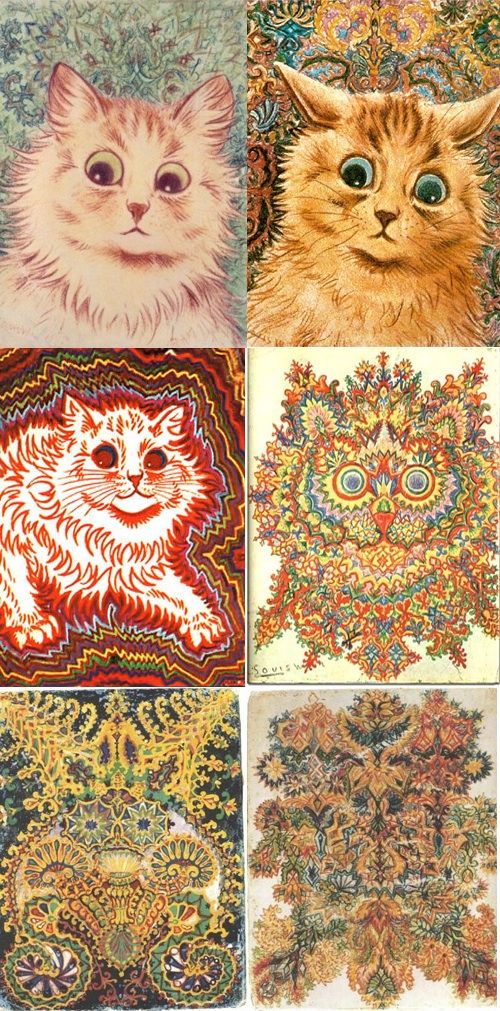
Six paintings of cats by Louis Wain, shown as a group to illustrate their increasingly abstract and electric nature, attributed to his suffering from schizophrenia

When I was eighteen, I had a passionate argument with my father about my life's priorities. I insisted that producing good art mattered above all else. Because I was a teenager who still boiled down everything to causative choices, I declared that I would happily die destitute if doing so meant I'd produce a few revelatory works in my lifetime. My father angrily dismissed my stance as romantic and foolish, but I held my ground (as is the wont of eighteen-year-old ideologues), and proclaimed that I'd sooner kill myself than create artwork for money or popular acclaim.

Friday, June 11, 2010

Rescuing Hokget and Everybody Else


Several months ago, I read "The Problem With Human Compassion," an excerpt from Shankar Vedantam's book The Hidden Brain, printed in the February 19th issue of The Week. I include a lengthy selection here.
"On March 13, 2002, a fire broke out in the engine room of an oil tanker about 800 miles south of Hawaii. The fire moved so fast that the Taiwanese crew did not have time to radio for help. Eleven survivors and the captain’s dog, a terrier named Hokget, retreated to the tanker’s forward quarters with supplies of food and water.

[...] Drawn by wind and currents, the Insiko got within 220 miles of Hawaii. It was spotted by a cruise ship, which rescued the crew. But as the cruise ship pulled away, a few passengers heard the sound of barking.

The captain’s dog had been left behind on the tanker. A passenger who heard the barking dog called the Hawaiian Humane Society in Honolulu. [...] The Society alerted fishing boats about the lost tanker and soon media reports began appearing about Hokget.

[...] Money poured in to fund a rescue. Donations eventually arrived from 39 states and four foreign countries. One check was for $5,000. 'It was just about a dog,' Pamela Burns, president of the Hawaiian Humane Society, told me. 'This was an opportunity for people to feel good about rescuing a dog. People poured out their support. A handful of people were incensed. These people said, ‘You should be giving money to the homeless.’' But Burns thought the great thing about America was that people were free to give money to whatever cause they cared about, and people cared about Hokget.

The problem with a rescue was that no one knew where the Insiko was. The U.S. Coast Guard estimated it could be anywhere in an area measuring 360,000 square miles. Two Humane Society officers set off into the Pacific on a tugboat. The Society paid $48,000 to a private company called American Marine to look for the ship.

[...] The U.S. Coast Guard had said it could not use taxpayer money to save the dog, but under the guise of training exercises, the called the U.S. Navy began quietly hunting for the Insiko.

[...] Human beings from around the world came together to try to save a dog. The vast majority of people who sent in money would never personally see Hokget. It was, as Pamela Burns suggested to me, an act of pure altruism and a marker of the remarkable capacity human beings have to empathize with the plight of others.

There are a series of disturbing questions, however: Eight years before the Hokget saga began, the same world that showed extraordinary compassion for a dog sat on its hands as hundreds of thousands of human beings were killed in the Rwandan genocide.

The philosopher Peter Singer once devised a dilemma that highlights a central contradiction in our moral reasoning. If you see a child drowning in a pond—and you would ruin a fine pair of shoes worth $200 if you jumped into the water—would you save the child or save your shoes? Most people react incredulously to the question; obviously, a child’s life is worth more than a pair of shoes. But if this is the case, Singer asked, why do large numbers of people hesitate to write checks for $200 to a reputable charity that could save the life of a child halfway around the world—when there are millions of children who need our help?

The answer is that our moral responsibilities feel different in these situations; one situation feels visceral, the other abstract. We feel personally responsible for one child, whereas the other is one of millions who need help - there are many people who could write that check.

[...] The brain is simply not very good at grasping the implications of mass suffering. Americans would be far more likely to step forward if only a few people were suffering or a single person were in pain. Hokget did not draw our sympathies because we care more about dogs than people; she drew our sympathies because she was a single dog lost on the biggest ocean in the world. [...] We are best able to respond when we are focused on a single victim."
Vedantam and Singer are correct; we humans act more compassionately when we are able to put a face to a cause, yet too many faces dull our response.

I've noticed such a benumbing in myself recently, an unexpected consequence of my transitioning from New York City to San Francisco. Both cities have substantial homeless populations, but panhandling in San Francisco is far more common. My street charity policy, modeled on the approach of a rabbi I heard lecture, is simple enough: I give change to any panhandler who says that he or she will use the money for food (or cites hunger as their reason for begging). I don't give change to those individuals requesting money for any other reason. In New York City, confronted with a few beggars each day, I typically gave change two or three times every week. In San Francisco, however, beggars ask for handouts on every other block, and a good number of them say that they're hungry. If I hold to my standard, I'll give change two or three times a day, if not more often! Shamefully, I've noticed that I've almost ceased giving during my visits to San Francisco.

This is a personal failure that I must address. Each of those many faces is an individual, a single person in need, despite the fact that their larger numbers and concentration counter-intuitively make them relatively anonymous or invisible. The rabbi's rule should be no less applicable in San Francisco than it is in New York. I'm confronted, then, with more need, and I must respond in kind; a hungry person is a hungry person.

But what about a hungry dog? Is Vedantam right to suggest that the thousands of people who contributed money to the Hokget search did not "care more about dogs than people"? Not exactly.

Our species' evolved, inborn behaviors haven't made our adaptation to the globalized world easy. In fact, it seems that contemporary humans are increasingly suspicious of other humans, especially of those outside our respective tribe, whereas animals (and perhaps especially dogs) are seen as uncomprehending innocents. I don't mean to suggest that no one cares about miners trapped in a coal mine, but it's clear that the little girl trapped in a well sells more newspapers, and that the little dog trapped on an abandoned tanker not only sells newpapers, but also inspires a flood of unsolicited donations and generates public outcry.
"Facing intense public pressure to save Hokget, government officials concluded that asking the Navy to sink the tanker—750 miles from Hawaii and drifting away from the distant U.S. mainland—posed unacceptable environmental risks. The Coast Guard finally agreed to access $250,000 in U.S. taxpayer funds to recover the Insiko. It wasn’t officially called an animal-rescue effort. Instead it was authorized under the Oil Spill Liability Trust Fund, based on the argument that if the aimless Insiko managed to drift westward for 250 straight miles, it might run aground on Johnston Atoll and harm marine life.

[...] On April 26, nearly a month and a half after the dog’s ordeal began, the tugboat’s crew found the Insiko and boarded the tanker. Hokget was still alive, hiding in a pile of tires. [...] Hokget arrived in Honolulu on May 2 and was greeted by crowds of spectators, a news conference, banners welcoming her to America, and a red Hawaiian lei."
What a marvelously strange species we are!? I applaud our ability to extend compassion to other animals (we're one of handful of species that have demonstrated such empathic ability), but I wonder at our brains' curious moral calculus.

I suppose all I can do is begin with myself, and humbly pledge to keep my pockets filled with coins.

Image credit: ripped from Corbis Images

Sunday, May 15, 2005

Hung-over and Thinking


For the most part, New York City’s subways are subterranean, but some lines in the outer boroughs are elevated. The Queensbound N/W subway line emerges from under the East River and rises over the rooftops before turning north up 31st Street to Astoria, where I live.

Yesterday, as white sunlight made unnecessary the green fluorescent glow of the subway car lighting, I looked up from my magazine and noticed a young Colombian boy playing with his father’s cell phone. Standing by a window, the boy had selected the phone’s camera mode and was captivated by the cityscape, pixilated and bleached, as it cruised by on the phone's small viewfinder.

'There is something here,' I thought. Is this a nice metaphor for our First World disconnect, I wondered? Does a preference for a digitized interpretation of the world suggest a break with the unmediated rest of it? Is the child really exhibiting such a preference or is this cigar just a cigar? For that matter, is the “real” world anything more than a neurological interpretation itself, our own personal computer translating strings of chemical 1s and 0s?

Suddenly, I found myself recalling something Antoine de Saint-Exupery, author of The Little Prince, wrote in 1945.
“It seems to me that something new is in formation on our planet. The material progress of modern times has indeed linked mankind by a sort of nervous system. The contacts are innumerable. The communications are instantaneous. We are materially bound like the cells of the same body. But this body does not yet have a soul. This organism has not yet grown conscious of itself. The hand does not feel itself a part with the eye.”
His observation still rings true today, at least to psuedo-luddites like myself.

Hung over and splintered, my mind made a seemingly disparate connection between the Exupery quote and a poem I wrote five or six years ago.
Sunset is chilly
on the shores of Southampton,
the water creeping closer
to the foundations of second or third homes.
Hiding in a tangled mass
of beached seagrass,
the tiny coffins of unborn skates
catch our attention.
Tearing open one of the leathery wombs,
a yolk falls into my palm.
Still attached, still feeding,
is a squirming embryo.

Next morning now,
The clouds heavy with rain
sag and burst like
too full mammaries.
The rain chases my train
to New York City.
The father reached over and pried the phone out of the boy’s hands. The boy looked up in protest before turning his attention to his shoes.

Photo credit: 1995-2001, Chao-Hwa Che

Wednesday, March 09, 2005

Autism and the Amygdala

Image hosted by Photobucket.com

Check out this interesting article on autism in The Guardian today. It discusses 26 year-old Daniel Tammet, an autistic savant not unlike the character, Raymond, in the film "Rain Man."

Debates about the evolutionary history of autism rage on. What sort of adaptive advantage is offered by autism? Some sociologists and biologists argue it can serve certain individuals well, given the right environment and social structure. Others contend that it is strictly maladaptive. The neuroscience of the condition - the role of the left and right hemispheres and the enhanced or retarded activity in various brain modules - is also curious: much advantage is gained, but at a substantial cost.

Simon Baron-Cohen, director of the Autism Research Center at Cambridge University, has designed a test to determine your Autism Quotient. The higher the number, the more likely you are to be autistic. With a score of 27, I'm apparently approaching the autistic range, but as Baron-Cohen reminds us, even those who score above a 32 - the assigned autistic marker (the average score is 16.4) - can function normally in society.

The test, writes Steven Johnson (author of the very readable Mind Wide Open), is more of a measure of your amygdala sensitivity. As I mentioned in the "Do Fish Feel Pain and What Of It?" post, the amygdala is responsible for the flight-or-fight response and empathy. The higher the number, the more dulled the influence of the amygdala.