Showing posts with label outsider. Show all posts

Friday, April 05, 2013

Seeing Through the Story

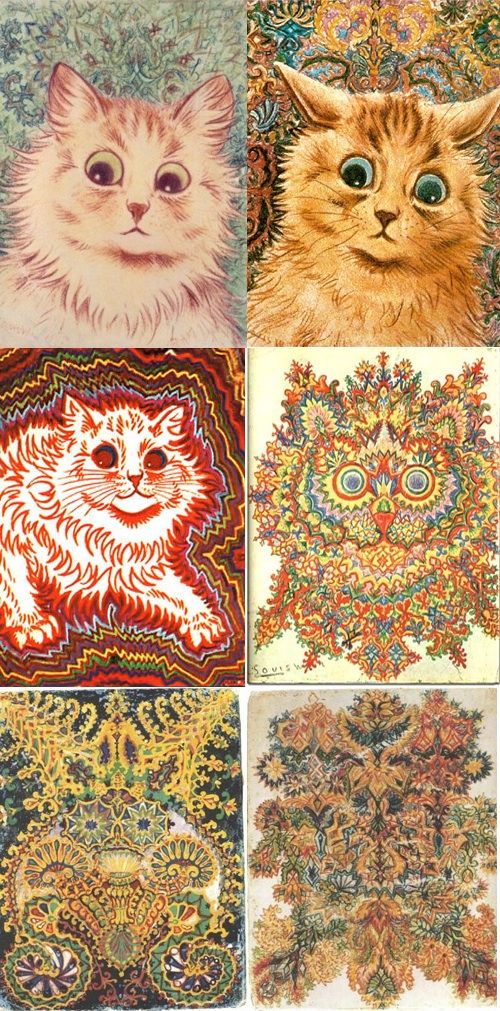
Six paintings of cats by Louis Wain, shown as a group to illustrate their increasingly abstract and electric nature, attributed to his suffering from schizophrenia

When I was eighteen, I had a passionate argument with my father about my life's priorities. I insisted that producing good art mattered above all else. Because I was a teenager who still boiled down everything to causative choices, I declared that I would happily die destitute if doing so meant I'd produce a few revelatory works in my lifetime. My father angrily dismissed my stance as romantic and foolish, but I held my ground (as is the wont of eighteen-year-old ideologues), and proclaimed that I'd sooner kill myself than create artwork for money or popular acclaim.

Tuesday, January 10, 2012

Her Colorful Obliteration

Yayoi Kusama
"Obliteration Room"
2011-12
Yayoi Kusama calls herself an "obsessive artist." Indeed, she's obsessed with polka dots; her paintings, sculptures, and constructed environments are almost always speckled with them. But Kusama's singular commitment to circles and pattern isn't her only "outsider artist" qualification. Since the mid-1970s, the artist has voluntarily committed herself to a Tokyo mental hospital, where she continues to create new work.


I recalled this last fact when I first saw photographs of Kusama's "Obliteration Room," an installation included in her "Look Now, See Forever" solo exhibition at Australia's Queensland Art Gallery of Modern Art. "Obliteration Room" began as a completely whitewashed interior space. The room's couches, bookshelves, kitchen table, cupboards, house plants, and piano were all colorless. When the museum exhibition opened, colorful stickers were distributed to installation visitors, and children were especially encouraged to cover whatever they pleased. Over time, the whitewashed installation has exploded in vibrant color, its once discernible space transformed into a perception-warping experience. The room, as the installation's title predicted, has been obliterated.

Sunday, August 09, 2009

The Castle Builder


This past December, a co-worker and fellow artist, Adam Ogilvie, turned me on to this terrific 5-minute video. Entitled "Bishop's Castle," the short is a well-edited introduction to Jim Bishop, an under-known contemporary artist.

Working alone on weekends (and four weekdays during the summer), the high school dropout and iron worker has constructed the eponymous Bishop's Castle in the Rocky Mountains, just outside the tiny, central Colorado town of Beulah. He began the project in 1969. At the time, he only intended to build a stone cabin, but, forty years later, that cabin has grown into an incongruous marvel.

In the first two minutes of the video, Jim Bishop seems the very picture of Outsider art heroism. Bishop works for ego and for "the glory of God." He characterizes his efforts as those of an honorable "peon," and his astonishing creation is, as he puts it, a "one-man project, donation box basis." The artist is justifiably proud of his remarkable accomplishment. Bishop's castle is not a funded public art project, yet it's far more impressive than Christo's Central Park "Gates" or Eliasson's "Waterfalls."

Not surprisingly, the castle's construction has been fraught with legal battles (over insurance, material use, and zoning) and even tragedy. In 1988, Bishop's four-year-old son, Roy, was killed at the castle site, apparently crushed by a tree that Bishop felled. One of the castle's towers is named after Roy, and Bishop says that he will inter his son's ashes there.

A rough-worn, charismatic man, Bishop tosses off memorable quips: "Engineering without money is ingenuity."; "I'm building this for myself. Basically, I'm an egotist." Early on in the short, his rugged individualist act is endearing but, as the video advances, a darker side of Bishop is revealed. He begins to rant about our nation's eroding morals and the assault on our civil liberties. Although his convictions are not entirely without merit, his attacks on big government seem increasingly irrational. Near the video's end, he shouts from one of the castle's towers, seemingly possessed by a God-given vitriol. "I'm about to pass out. I'm getting...I'm....I just gotta get the blood in the right place now. Get that camera rolling! I'm doing work! I benefit everybody!...I'm the anti-devil!" Come again?

Still, like Jean Dubuffet, I believe that (with the exception of Sunday painters) those artists wiling away in obscurity, whatever their reasons, are often producing exceptionally exciting work. Bishop is one such outsider, and his astonishing project deserves more attention.

Photo credit: ripped from Milewalker's Flickr photostream

(Note: A slightly different incarnation of this post originally appeared on the blog, Letters From the Inquisition.)

Sunday, January 20, 2008

Lee Baxter Davis at Clementine Gallery


Lee Baxter Davis
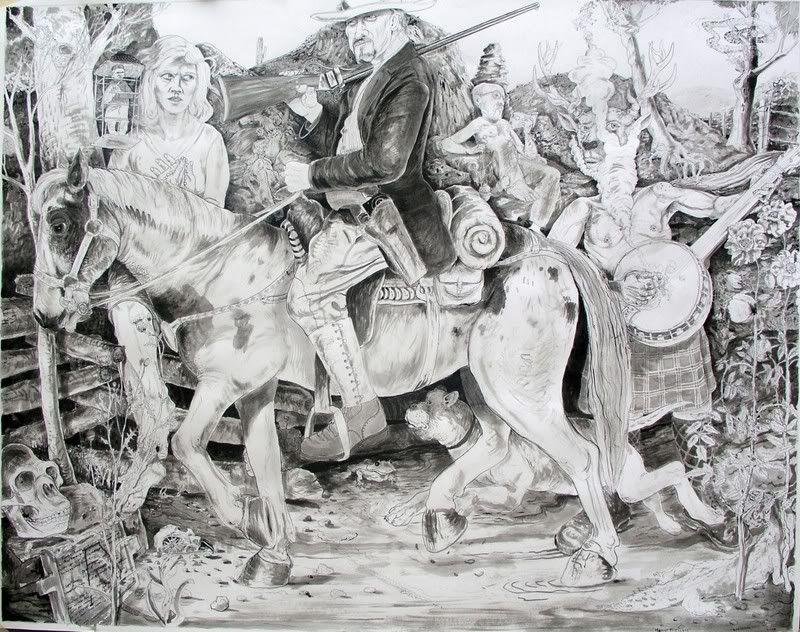
"Man of the West"
2007
Pen, ink and wash on paper
44 X 56 inches


Two years ago, in an essay contrasting Lee Baxter Davis's work with that of his former student, Trenton Doyle Hancock, I characterized Hancock's Mounds saga as a "packaged experience" and described Davis' coarse visions as the unadulterated output of a "reclusive alchemist." I intended the critique not as a denigration of Hancock, whose work I generally admire, but rather as a celebration of Davis and other artists of his kind, productive at society's fringe. Industry success for Davis, a retired art professor now working as an assistant pastor of St. William the Confessor Catholic Church in Greenville, Texas, has been a long time coming, and I'm happy that Clementine Gallery is making space for his powerful, under-appreciated work.

Davis' allegorical drawings - layered, raging, and libidinous - are messy, almost psychotic pictures, and his characters are possessed of that peculiarly American madness that drives us ever west to spread the gospel of Manifest Destiny, Jesus and Adam Smith.

There is a Cormac McCarthy brutality and ugliness to Davis' figures, all of whom have either abandoned compassion in favor of machismo and promises of what-might-be or appear resigned to a Hobbesian existence. Yet the over-arching lesson of Davis' pictures is a gracious one; ashes to ashes, dust to dust, let us not forget where we came from (and where we are going) as we ride on.


Lee Baxter Davis
"Out West (Rousseau & Cleopatra)"
2007
Pen, ink and wash on paper
40 X 21 1/2 inches


Photo credits: Davis images courtesy Clementine Gallery

Saturday, April 29, 2006

Progeny


Trenton Doyle Hancock
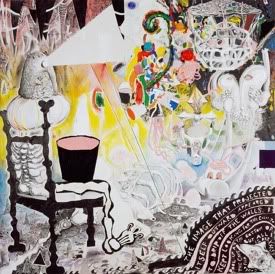
"Las Luces, Looses, and Losses"
2005
Mixed media on canvas
60 3/4 X 60 3/4 X 4 inches

An inordinate amount of Trenton Doyle Hancock buzz was generated and disseminated this February and March. Hoping the coverage would die down and/or that my recollection of it would dim, I put off a visit to Hancock’s recent solo effort, "In The Blestian Room," at James Cohan Gallery, for as long as I could. Galleries aren't in the business of humoring persnickety calendar demands, however, and I found myself studying Hancock's handiwork with the hoopla still on my mind.(1)


Trenton Doyle Hancock
"In The Blesstian Room"
2005
Mixed media on canvas
90 x 108 x 6 inches

Clearly, I’m a biased viewer, but I found "In The Blestian Room" disappointing. My dissatisfaction is rooted in suspicion of motive, not, as one might assume, in aesthetics. That is to say, while some of Hancock's decisions - attaching studio detritus to the paintings, for example - seem self-conscious, fraught denotations of race, attitude, or spontaneous process, I was more disturbed by the sense that Hancock is dangerously close to becoming an art world personality. That is to say, his work seems calculated, more akin to Warhol than Darger or Dubuffet. Hancock turns his uncouthness into a commodity. As Donald Kuspit writes, "The artist outsider is well rewarded in our society - so long as he is an insider in art society."(2)


Trenton Doyle Hancock
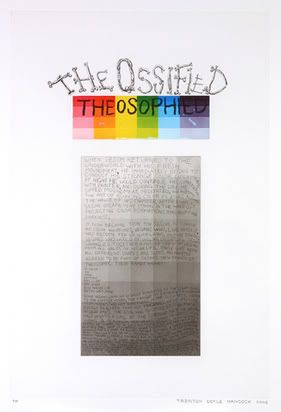
“The Ossified Theosophied, (Title Page)”
2005
Color etching, Edition of 35
19 1/2 X 25 inches

Hancock's use of narrative scaffolding seems more like a marketing tactic than an essential ingredient in the artist's process. While it is not uncommon for contemporary artists to invent a cosmology on which to base a body of work - Matthew Ritchie is a notable example - most keep the details of their created worlds largely private. Hancock, by contrast, not only cooked up the Mounds saga, a picaresque epic with vaguely religious resonance, he also makes sure viewers know about it. “In The Blestian Room” includes a limited edition print (see above) that amounts to little more than a sloppy, hand-written chapter of the chronicle. Hancock is making up the story as he goes along – this, at least, is how it is presented to the viewer – giving it the appeal of a zany soap opera. (What is Sesom up to now? Come find out! What will he get into next? What crazy characters will he meet tomorrow? Will we witness a great war between the Mounds and the Vegans? You'll have to wait until the next installment/exhibition! Don’t miss it, ‘cuz the art world doesn’t do Tivo!)

Before I continue, it should be noted that I cheer for those making art away from established cultural centers; I enjoy comic books, graphic novels, and cartoons(3); I hold dear much fantasy and myth, from Kipling's "Just So Stories" and Aesop's Fables to The Lord of the Rings; I am fascinated by religious narrative and the clever weaving of historical "fact" with spiritual rendering in such tellings. Given this laundry list of likes, I expected to find a confederate in James Cohan Gallery. What I discovered instead was calculation.


Lee Baxter Davis
"Family Tree"
2005
Ink, watercolor & collage
36 x 44 inches

What's more, Hancock’s still unrecognized debt to the artist who spawned him, Lee Baxter Davis, raises eyebrows. If I were not already an admirer of Davis, I very much doubt I would know of their relationship. The CUE Art Foundation recently exhibited about twenty of Davis’s drawings and paintings. Long overdue, the show was the artist’s first in New York. Early in the associated press release, the writer draws attention to Davis' influential role.
“A regional icon, Davis’ thirty-years of teaching printmaking and drawing at East Texas State University (now called Texas A & M, Commerce) has influenced the careers of some of his very prized students including exhibition curator, Gary Panter, along with Whitney Biennial artists Trenton Doyle Hancock, Robyn O’Neil, and Christian Schumann, among others.”
An Internet search for “Lee Baxter Davis” turns up little, whereas “Trenton Doyle Hancock” nets many relevant articles and websites. In pieces about Hancock, the names William Blake, Hieronymus Bosch, Philip Guston, Max Ernst, and Gary Panter are repeatedly cited as influences, but Davis is nowhere credited. This is a curious oversight, the result of Davis' being a relative unknown in the New York art world. Closer to home - his home - he looms large.
"In the 1970s, The Lizard Cult was a vaguely derogatory term applied to East Texas State University (as it was known then)'s Art Professor Lee Baxter Davis and many of his most talented students. It was called that because so much of their work closely approximated his - rife with comic sensibility, lush textures and lurid details....Once viewed with condescension, The Lizard Cult has not only grown up, many of Davis' students have prospered and become regionally and nationally prominent." (J R Compton, "Lee Baxter Davis and The Lizard Cult Grows Up," Dallas Arts Review)
With the exception of Gary Panter, Davis' celebrated proteges are all much younger (by thirty or more years, typically) and, therefore, more attractive (for the moment) to the youth-obsessed art market. Furthermore, whereas Davis is a retired art professor now working as an assistant pastor of St. William the Confessor Catholic Church in Greenville, Texas, his former students manage to bridge the divide between "living and working" in Texas and, well, living in Texas. In other words, though Hancock and O'Neil still live in the state (Paris and Houston, respectively), they have attached themselves to the larger art world in a way that Davis has not. Why, one wonders, have so many of Davis' students achieved art world success while he remains a regional icon? In part, the answer lies with the man himself, with a desire to remain unrecognized, but I can't shake the sense that a more perverse process is also at work.


Lee Baxter Davis
"Big Bear"
2005
Pen, ink, watercolor & collage
21" x 29 inches

In his recent indictment of postmodern art, The End of Art, Kuspit describes two artist archetypes. The first is a "reclusive alchemist struggling to purify the dross of everyday reality," and the second, an "entertainer representing a mass audience's everyday wishes." Although Kuspit argues that the monkish model is exclusively modern and, today, extinct, this is not the case; both are alive and well. As a general rule, however, it is the second type, those interested in "having an audience that will make them popular, giving them the celebrity and charisma they believe they are entitled to as artists," that finds success in the art world.

Lee Baxter Davis is the very picture of Kuspit's reclusive alchemist. Not only are his paintings alchemical, but his lifestyle and approach to art-making fit the bill, too.
"Like a hermit practicing his art in millennia past, Davis is isolated. He has chosen to separate himself from society, locating his studio, home and family life far from the hustle and bustle of Dallas, Houston, San Antonio, or Austin. Davis finds peace and purity of existence in the quietude of a rural existence. Instead of reaping and sowing the land for its hearty edibles, he reaps and sows the earth for intellectual nourishment. It is a type of sustenance that could only come from the coupling of separation and deliberation - from self-willed banishment to the silent wilds of a life found deep in the nowhere lands of Texas." (Charissa N. Terranova, "Alchemist of Imagination," ARTL!ES, Issue 43)
Furthermore, Davis is as invested in (or consumed by) his contemplation of philosophy, religion, and pop culture as he is the local environment.
"Growing up in the small towns of Texas, Davis' boyish pursuits included immersing himself within the complex sagas told by great Southern writers, the harrowing poems of Edgar Allen Poe, and a dizzying array of post WWII popular comic books and newspaper strips such as BlackHawk, Pogo Possum, and Mad Magazine. Largely raised by his Methodist minister grandfather, and having read the bible since childhood, Davis has long harbored a deep-rooted fascination with the more mysterious elements of faith...Believing laughter and prayer to be close to the same thing, he creates illusions whose idiosyncrasies harbor nervous fits of laughter as buffers against existential angst."(Gary Panter, "Lee Baxter Davis," CUE Art Foundation press release)


Davis' layered pastiche is, for him, a metaphysical search, one that ties vulgar realities to marvelous visions, the profane to the sacred. Viewers - western viewers, in particular - will recognize many of the embedded symbols, but they must interpret the work subjectively, nurturing their own hybrid narrative. Thus, something approaching the intrinsic alchemy of the making - Davis' journey - is experienced by the viewer. To an extent this is true of all visual art, but Davis' symbolic content elevates the exchange.

Hancock's Mounds fiction, on the other hand, is altogether different. Viewers must learn about the Mounds before the narrative becomes meaningful. We are given a choice: disregard the mythology and treat the work as illustrative reverie, or become an initiate of Hancock, learning the magic words, the symbols, and the gestures. In essence, Hancock offers viewers a cult of personality. Davis allows us a subjective experience by drawing on shared myth; Hancock gives us an opportunity to participate in his manufactured, flimsy one.

Yet the son has surpassed the father, at least in terms of renown. Hancock is more savvy than Davis. Whether by virtue of his nature or the waving of an agent's wand, he presents us with the "high art" version of an "outsider"/low-brow aesthetic. His awareness of the supposed division between these two orbits is clear. For many, this makes the work more easy to digest, but also more intelligent and contemporary. For others, myself included, that awareness results in self-conscious painting, work that excels at distraction and affirmation, but fails to address universal experience. Many critics (many friends) disagree, arguing that Hancock melds rich narrative, magic, superstition, faith, and popular culture to produce an original experience, a distinct and contemporary remix. But the father's artwork suggests that same union is less an artistic assertion of individuality than a way of life, an approach allowing us to cope with and consider deeply disturbing axioms.


Lee Baxter Davis
"Sideshow"
2005
Pen, ink & collage
28" x 20 inches

(1) Museum exhibitions have a longer lifespan, allowing the details of the 2006 Whitney Biennial coverage, for example, to fade before I finally visit (in late May).

(2) Donald Kuspit, The End of Art, Cambridge University Press, 2004

(3) In fact, I feel Hancock is better served when he sticks to comics - there were some strong pages on display in the rear gallery - and the like. His book, "Me A Mound," is a far more interesting artifact that his paintings or prints, though it, too, suffers for a certain amount of ostentation.

Photo credits: All images ripped from James Cohan Gallery and CUE Art Foundation websites

Thursday, December 08, 2005

Inside Out

Image hosted by Photobucket.com
If you're familiar with the contemporary art world, you've heard the term, Outsider Art. Grandma Moses, Henry Darger and Adolf Wolfi all qualify as outsiders because they lack formal training or because they produced their work in isolation from the art community of their day. Wikipedia tells us,
"[Outsiders are] self-taught or naive art makers who were never institutionalized.[1] Typically, those labeled as Outsider Artists have little or no contact with the institutions of the mainstream art world, they often employ unique materials or fabrication techniques; much Outsider Art illustrates extreme mental states, unconventional ideas, or elaborate fantasy worlds."
Given the above interpretation, many grandmothers - not just Moses - can be dubbed Outsider Artists. Their choice of subject matter need not be fantastic. Their professional psychiatric evaluation need not be damning. In fact, as defined above, the term is rather nebulous; we can safely lump together the uncredentialed, the insane, the fey and the fringe.

Some critics argue for a return to a more refined definition, one more closely associated with Adolf Wolfi and Jean Dubuffet, the prominent 20th century artist who championed Art Brut. Dubuffet defined Art Brut as "those [art]works created from solitude and from pure and authentic creative impulses...where the worries of competition, acclaim and social promotion do not interfere." Dubuffet's Art Brut rubric can not then be extended to Grandma Moses, who after being discovered experienced a meteoric rise in the art world. Henry Darger, however, by day steady in his janitorial routine and by night immersed in his violent and voluptuary fairy world, passes muster.

Despite potential confusion, I prefer the more open-ended use of the term, Outsider Artist, because the barrier between Outsider and Insider, if you will, is semi-permeable. In my opinion folk artists, renowned decoy carvers, wildlife artists, Sunday painters and unrecognized "street" artists are all Outsiders. But there is another, less acknowledged class of art world outsider. This caste is part of the art world, but, unwilling to participate in reindeer games, they are the Insider Outsider Artists.

In "Homer's Wars," (The New Yorker, October 31, 2005) Adam Gopnik suggests that Winslow Homer's reputation suffered because the artist "withdrew from the world." In fact, Homer did not flee the world. He only moved to Prout's Neck, Maine, so that he could spend more time outdoors. But by leaving New York City, the artist left art world social circles behind. Elsewhere in the article, Gopnik makes clear this tie between locale and art world relevance. "If [the contemporary art world is] to return [Homer] to the command of American art, it might be as a more urbane and cosmopolitan figure than he is usually allowed to be, an artist first and an American second." In other words, Gopnik feels that it's high time the art world admit Homer into the pantheon of beloved artistic forefathers, the painter's rural transgressions forgiven, his proclivity for "outdoor scenes" overlooked. For most of the nearly one hundred years since his death, Winslow Homer has been an Insider Outsider and now, at last, he is being considered for full-scale embrace.

Lee Bontecou is a similar, but more recent example. After achieving prominence in the 1960s, she moved from New York City to rural Pennsylvania and soon vanished from the art world radar. Until the recent MOMA-QNS retrospective, she was happy in obscurity, teaching and making art away from the noise, the parties and the intrigue.

And so I finally arrive at the inspiration for this post, David Rimanelli's "On The Ground: New York" article in the December 2005 issue of ArtForum. Rimanelli is a gifted writer; I enjoyed reading his thoughts on the New York art world, circa 2005. Unfortunately, the "sceneterism" he celebrates is easy to abhor. Rimanelli identifies Gavin Brown, the now prominent New York dealer, and the gallery scene Brown built, as an impetus for sea change. "[Gavin] Brown, who moved to New York from London in 1988, succeeded in delivering to New York more than another neutral exhibition space; he created a situation that encouraged partying, louche behavior, and fuck-you antics." Rimanelli admits that "much of [the Gavin Brown's Enterprise] scenester mayhem was inescapably juvenile, and you probably met more assholes than charmers," but he still seems enthused, even energized, by the current rebirth of art world sceneterism. He writes, "Live Through This: New York in the Year 2005...is without doubt my favorite art book of the year...[though] the enterprise inevitably fictionalizes its subjects. That's why the extensive party pics and fucked-upness pics - dirty, sexy, fashionable, stupid, drunk, druggy - serve the overall project as much as the sections devoted to individual artists."

In the past two years, I attended several openings at Rivington Arms, the upstart gallery on the Lower East Side, where, as Rimanelli puts it, "there was no shortage of [Lower East Side] hipster mayhem...as the crowds of would-be beautiful-and-damned kids spilled out of the exceedingly modest space and into the street, leading to frequent visits from the police." Kicking off an evening of excess with an opening can be fun, but these events, like the evenings themselves, blend together; if you've been to twenty LES openings, you've been to them all. Openings are parties for the artists and their friends but, as any art world player will tell you, they are principally opportunities to network. For some artists, however, the social component of an art career is tedious and even painful. After six years of New York thrills, I admire most (and identify with) the artist who tells me she plans to skip out on an opening to get work done in the studio.

Unfortunately, staying close to the studio is not the preferred way to make it in the art world today. You're as likely to be "discovered" ripping rails off the shirtless bodies of passed out mates in LES bathrooms as you are via shows and word of mouth. Again turning to Rimanelli, "Deitch Projects, on Grand Street in SoHo, remains the grandest thoroughfare for the transmission of young scenesterism to collectors, curators, and museums...Deitch's critics usually suggest that he is the avatar of the vampire-dealer leeching the energies of young, untried, even unworthy artists and repackaging them as chattels for the demon market." I don't know Jeffrey Deitch. I doubt I'd even recognize him. I've had my arm throttled by excited friends as they whisper-shout into my ear, "Oh, there's Deitch! Jeffrey Deitch is just behind you!," but who gives a shit, really? In those situations it's all I can do to focus on my beer and breathe through any emerging social anxiety. I don't know enough about the man to agree or disagree with the critical characterization of Deitch that Rimanelli describes, but the "demon market," attended by myriad pressures, is very real.

Several artist-teachers in graduate school told me that I'm the sort of artist who "makes it" - if ever; better knock on wood, here - only after the bottom of the art market falls out, when the scenesters have returned to 9-to-5 jobs and the fashion magazines cease featuring young painters in designer labels. Perhaps they are right. Perhaps the financial excess of the moment - at least in the art world - led to our consumptive, fuck-all posturing. Perhaps the slow-burn artists will reappear after the art world stops flocking south to Miami or north to Skowhegan for sex, drugs, good gossip and cash money. But I doubt it. After all, "making it" is forever a combination of talent, luck and working it (or good connections). This recipe remains constant, true even in the financially lean times or those oft-cited "good ol' days." Furthermore, contrary to so much popular opinion, the slow-burn artists are with us today; some of them are cleverly disguised as scenesters, perhaps, but they are there.

Until you actually start down the road to art world embrace, then, you remain an Insider Outsider, no matter the parties you go to or the company you keep. Honestly, I don't consider it an altogether unattractive position. Then again, we all want to make a living at what we enjoy - or what we've been burdened with - so the desire of the Insider Outsider to be an Insider can work against her desire to remain self sufficient, unencumbered by the latest art world bullshit. After all, too much jockeying for position, as opposed to art making, can turn everything inside out.

Photo credit: photograph by Dash Snow, represented by Rivington Arms

[1] Given that we also associate mental instability with the term institution, I find it amusing that Outsider Artists are those "who were never institutionalized," particularly because those of us who have survived educational institutions can make a convincing argument that it is itself damning. Frances Stark's description of the graduate school situation in Los Angeles is exemplary. "We have no fewer than nine art schools in the region with competitive MFA programs, meaning that every year an average of about 180 (mostly) young artists complete their studies. So every two years LA churns out 360 degreed individuals - and that makes for a massive circle. That vastness doesn't even account for the city's cadre of legendary artist-teachers, who are in the business of exhaling those circles like so many dissipating smoke rings...Who can deny that fits of nostalgia occasionally prompt us to long for smaller circles, for times when connecting and creating ties was somehow more organic?"

Wednesday, August 03, 2005

Art World Ennui


My parents claim that I was wearing Winnie-the-Pooh pajamas when I first declared my artistic ambition. Asked by some house guests what I planned to be when I grew up, I supposedly replied, "Either a fireman or a cartoonist." Because memories easily merge with myth (especially when your father is a writer), I'm reasonably sure that this anecdote is apocryphal. Nevertheless, it reflects a truth; early on, I was determined to make pictures for a living.

I was twelve years-old when I created my first published strip. "Porky's Paradise," an adolescent homage to Berkeley Breathed's "Bloom County," was printed weekly in the Eastern Shore News. Six years later, my last strip, "Hangin' In There," appeared regularly in the William & Mary Flat Hat. This college humor strip detailed the mundane anxieties of a long-haired undergraduate with a penchant for combat boots and flannel.

Although "Hangin' In There" was created during my freshman year of college, my career goals had by then shifted. I'd become more interested in comic books and graphic novels, and I was most excited by "The Mole" and "Raccoon-Man," comic book series that I'd begun working on in my senior year of high school. Although only my close friends read these comics (offering lukewarm reactions), I was nonetheless convinced that I was destined for a lucrative career with Marvel, D.C. or Image. At William & Mary, I helped T Campbell, later the creator of "Fans" and a major success in the world of web comics, found and edit Unstrung Fiction, the college's first publication dedicated to the graphic novel.

Focused on sequential story-telling, it wasn't until my junior year of college that my priorities shifted again. I decided to become a painter. In retrospect, I think this decision sprung from my preference for illustrating "moments" rather than weaving narratives.

One can not suddenly abandon their influences, however, and I had a hard time with the exclusionary attitudes of "fine artists." My early moves into this hallowed domain were crude exercises, essential cartoons in oil paint. When asked by art instructors to name my artistic influences, I'd name Bill Watterson, Berkeley Breathed, and Todd McFarlane, while my classmates recited unfamiliar, European names.

Gradually, though, as I learned more about the work of twentieth century art world luminaries, I came to love the paintings of Egon Schiele, Max Beckmann and Francis Bacon. My attraction to these three artists should have come as no surprise, but it would be several years before I realized what these three painters share: a bold, graphic approach to contour and color. They are illustrators' painters every bit as much as they are painters' painters; their work points to the absurdity of the distinction.

My embrace of the graphic approach would raise the ire of my art professors. "Illustrator" was then, and to some extent remains, a four letter word in the art world. Once I was ensconced in the New York scene, the prejudice against "illustrative" works was even more apparent. If you weren't making installations, videos, sculpture or conceptual work, you were fighting uphill to find an audience. The intellectual insecurity that fed this unfortunate bias was largely a holdover from the confused nineties and an influx of young artists raised on comics and animation would soon breathe some vitality back into the increasingly insular art world.

I was perfectly positioned to take advantage of this sea change. I guess I did, too, for a hot second. As I explained in "Of Fairy Tales and Flights of Fancy," though, I tired of painting colorful, imagined wonderlands; it didn't feel wholly comfortable and, more importantly, it felt a little thoughtless or arbitrary. My current body of work is very satisfying, but I again find myself out of sync with art world preferences.

Art Forum, one of the better art magazines available, is usually a pleasure to flip through. Despite my loathing of most contemporary art writing, I even enjoy some of the articles and reviews published in its pages. The principal appeal of Art Forum, though, lies in its dimensions and heft; it presents the "reader" with lots of big pictures. The magazine is to artists what Cosmo might be to a teenage fashion queen, a collection of images you can hate, love or be decidedly ambivalent about. Also like Cosmo, Art Forum is comprised mainly of advertisements, though all of these are for galleries or shows. I dog-ear many pages in each issue and later look up the gallery or artist(s) online.

Lately, however, I've been marking only a few pages. My time spent with the magazine is no longer satisfying and, as I flip through each issue, I find myself wondering what the point is. Most of the artwork is irrelevant alongside the "real" issues of the day. Obviously, artistic likes and dislikes are subjective, but what I deal with now is best described as art world ennui. Such a position might be more understandable if I were a hugely successful, late career artist, an individual tired of the superficial art market, but I'm what they call an "emerging" artist, the equivalent of a Triple-A ball player waiting for his chance to get called to the big show, yet I already find much of the art world intensely boring, frivolous and irrelevant. If I wasn't so happy with my own work and, more importantly, so convinced that there is an awful lot of excellent work being produced by countless others, I would call this feeling an artistic crisis.

Fortunately, it is nothing of the sort. It is simply the realization that, while I do want to make a living from my artwork and therefore need to connect myself to this world, I will probably always remain at the fringes. This will surely make my career a less remarkable one, but I hope it keeps me more sane and gives me the leeway to flee New York and live in a community where I feel I can play a vital role, contributing to local conservation projects and involving myself in local governance/leadership.

Wednesday, June 08, 2005

Of Fairy Tales and Flights of Fancy

“The show suggests that artists are connected to events in the outside world but have little sense of what to do about them, other than to create artworks that incorporate their frustration, rage, apprehension or sense of the absurdity of contemporary life.”
- Eleanor Heartney, Art in America, review of “Greater New York, 2005
Who would condemn a child for having an active imagination? In contemporary western culture, most parents celebrate the fantasy lives of their children (or at least tolerate them), no matter how consuming they may be. This is for the good; a rich, imagined world often leads to greater curiosity about the world we inhabit. There are, however, some legitimate concerns for those children who appear to withdraw into fantasy too much, those who exhibit a tendency for escapism. These kids can be spotted at an early age. I should know.

As an only child who grew up in a rural farming village, my interaction with other children was limited to the school day and the rare overnight visit to a friend's house. My father, an unabashed workaholic, kept me occupied with field chores and wildlife conservation projects on most weekends. Our house had no television, the upshot of which was that I won most every reading competition until I reached 6th grade (the year -- holy of holies! -- a television arrived). I turned to books and invention for entertainment. The fields and forests were places of extraordinary mystique, vast plains teeming with bison and Indians or thick, dangerous woods with thieves and bizarre creatures lurking behind every tree. The pond shoreline represented a potential aquatic dinosaur attack, forcing me to walk just so to avoid detection.

But the fun didn’t stop at nightfall. No, if anything, the level of “make-believe” only increased once I was forced indoors. I would stage plays in my bedroom, becoming the voice of a stuffed animal perched on the windowsill and that of the angry, invisible dinosaur, the evil step-mother, the diminutive Lego man on the shelf, and so on and so on. (For some reason, many of these epic plays resulted in a raccoon puppet ripping open my throat. Of course, I was then re-animated as a rabid monster that would stalk the room’s perimeter, hunting imagined company.)

Despite my protests, it wasn’t at all inappropriate then that some kids called me Christopher Robin. I was tremendously uncomfortable in most social situations and I really didn’t trust any of my peers. During recess, I was the kid who retreated to a corner of the playground and talked to myself or played with blades of grass, imagining I don’t know what. It was also not surprising that cartoons, comic books, and drawing soon dominated my life outside of chores and schoolwork. I was every elementary school teachers’ dream, the quiet kid who scores well and gets placed in all the advanced classes, but shows no sign of ego or contempt. In fact, I was just oblivious to most of what was happening around me. I had no idea what interested most of my classmates. I didn’t listen to popular music until the sixth grade and most of my pop culture understanding was garnered from the pages of MAD Magazine. I knew what a phenomenon Michael Jackson was, but I'd never heard his music.

None of this mattered to me, however. I remained an essentially happy kid. I just shut out everything except my drawing, reading, and my fantasies. I'd learned how to tune out without ever having tuned in. Fortunately, the years have been kind to me and, rather than go the way of the Unabomber, I’ve become a reasonably well-adjusted member of society, if still something of a loner who likes to draw, read, and write.

It is with increasing urgency, though, that I view so much art produced by my contemporaries, artists in their twenties and thirties. An uncredited New Yorker writer describes this work as, “gloomy, craft-spun, fairy-tale escapism endemic among young East Coast artists.” A visit to Greater New York, 2005, a survey of artists living or working in New York City at P.S.1, will illustrate just how prevalent this mode has become. Fully 40% of the work on display fits the bill, and while the majority of these are paintings or drawings, a number of videos and installations belong to the same impetus. We are a generation uncertain and intimidated. Rather than engage and participate, we have opted to wear the escapist smile, retreating into the worlds of Alice and the Little Prince. Is it enough to express ourselves in this way? Do these cryptic fairy-tales or self-abusive efforts communicate anything more than immediate frustration? After all, it was largely my social incompetence which drove me to chase monsters around dark living rooms. How much different is this display?

These currents aren't isolated to the eastern seaboard of the United States, though. Admittedly, the majority of young West Coast artists still seem to be preoccupied with abstraction and pretty pictures, but the dystopian fairy-tales are being createed by artists not just from across the United States, but also via imports from Japan, Europe, Iceland, and elsewhere. Peter Schjeldahl recently wrote of Takashi Murakami’s curatorial effort, “Little Boy: The Arts of Japan’s Exploding Subculture,”
“[The included work] suggests a certain pathology: rapturous defeatism, perhaps, that justifies youths who don’t grow up.”
It seems as though an entire generation -- global, not just Japanese -- has been forced into perpetual adolescence by the atom bomb that is our modern condition?

At the turn of the century, very few people knew anything about Henry Darger, the reclusive painter/janitor from Chicago who spent the bulk of his solitary life working on a series of collage-like, narrative drawings depicting the history of the Vivian Girls. The currents of the art world, circa the late 1990s, were such that Darger was considered an “outsider” when this term still meant, “Hold him at arm’s length, please.” By 2002, the year I graduated from art school, “outsider” was no longer a bad word. Books on Henry Darger could be found in the window of any Barnes & Noble in town and my own fantasical paintings were receiving admiring attention from curators and dealers. In fact, in 2004, two of my paintings were included in a group show with works by Henry Darger and a number of other contemporary painters who can readily be lumped into the "fairy-tale escapism" camp, including Inka Essenhigh or the currently red-hot Dana Schutz.

This shift in art world tastes had little to do with curatorial sensibility. There were simply too many young artists working in this vein for the movers and shakers to ignore the trend. The compulsive, “outsider” approach of Darger had become, long after his obscure death, standard issue gallery fare. Whether or not one would call it a “movement,” as I have heard some people discuss, is irrelevant. It happened and is continuing to gain momentum. The meaning and the value are for time, the critics, and the public, if they ever come back to contemporary art, to determine.

One has to wonder, though, what sort of work we are dealing with. Darger, as I mentioned above, was almost completely solitary. He attended church daily, made his income as a janitor, and returned to a cramped, disaster of an apartment to continue work on his epic Vivian Girls saga and the associated paintings. He never received any artistic training to speak of. This stands in stark contrast to most of the artists on hand at P.S.1. Not only are we dealing with a return to youthful escapism, but the return is a conscious decision, one being made by folks who have Master’s degrees, iPods, and Friendster accounts. Would Darger have been eager to discuss the latest EP or hit up the late night bar scene? The main difference between those lost souls like Darger and the average art world fantasist of today is a conscious decision. I decided to work as though I were an advanced child, turning inward and looking for my own little haven via the painting process. Darger just did it; for him there was no asking "What happens if I do it this way?"

Despite my enjoying much of the work I see at P.S.1 and throughout Chelsea, I have moved on from such preoccupations in my own studio. Perhaps I felt the room was too crowded with escapists, but most of the decision is a result of my tiring of helplessness. Sure, shit sucks right now, but I don’t feel I can just turn on the rock n’ roll and drift away. I'm excited about my current body of work, even though it has thus far received only lukewarm response; everyone points to the work of two years ago and says, “Now that was really something.” Yes, it was “something” and I still enjoy the paintings, but it ain’t what I’m making now and there are over three thousand other artists, if not many more, weaving similarly self-absorbed fairy-tales out there. Every week, I learn of another terrific young artist working in this vein; I’m rooting for all of them. For my part, though, I’ll head off to my studio and make paintings about the relationship between man and beast, or as some academics call it, anthrozoology. There aren’t as many rocket ships, dinosaurs, or indians populating these works, but I’m still smiling, even if no longer blonde.

Photo credit: Painting by Henry Darger, circa 1960s