"And I do not want anymore to be useful, to be docile, to leadA year or so ago I met a friend for drinks at The Banshee on Manhattan's Upper East Side. Sitting next to us at the bar was a poet, in his early fifties, who had recently moved to New York from Los Angeles. Feeling uncharacteristically social (after sufficient lubrication), I got into a conversation with the man. He had experienced some critical success within west coast poetry circles but had grown frustrated with "the scene," and opted to try on NYC for size.
children out of the fields into the text
of civility, to teach them that they are (they are not) better
than the grass."
-Mary Oliver, excerpt from Rain, originally published in "New Poems"(1991 - 1992)
After a half-hour of talking, he announced, "Well this is really great. You're the first person I've met since moving that's really got me feeling like there is that creative pulse you always hear about New York." He insisted on giving me his card and asked for information on my website and future exhibitions. I've lived in New York long enough to view his gushing with some skepticism; still, I'd enjoyed the chat and exchanged information with him agreeably enough.
As the gentleman prepared to depart, he paused, cocked his head quizzically, and asked, "So who are your favorite contemporary poets?"
It was an easy question to answer. "At the moment I'm enjoying collections by Mary Oliver and Galway Kinnell. I've always..."
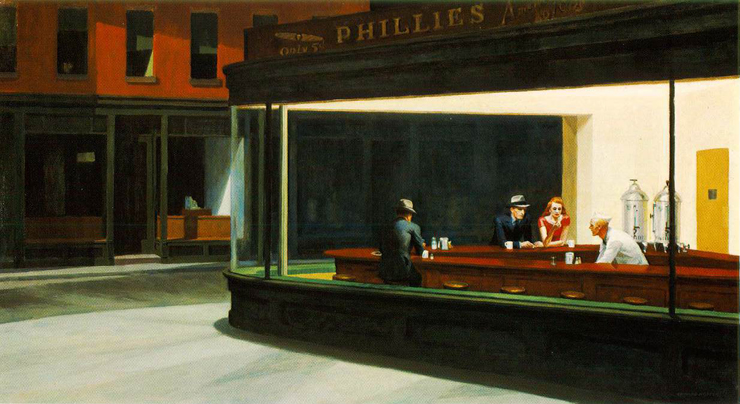
I couldn't finish my reply; the poet broke into a peal of laughter. I was understandably taken aback by this reaction. After regaining some semblance of self-control, he exclaimed, "And the whole time you had me thinking you knew good poetry from bad poetry. Mary Oliver is garbage. Kinnell is little better." I stared at him blankly. He laughed a little more, shook his head, and continued, "I mean, that's like me telling you that my favorite painters are Edward Hopper and Norman Rockwell. You'd be appalled. That's not even art! That's illustration!"
I wasn't quite sure what to say. I shrugged and finally said, "Well, I read a fair amount of poetry, so my landing on those two isn't just chance. I think they're good."
He appeared genuinely crestfallen. It was as though my bad taste sapped New York of the intellectual and creative energy he believed he had just become acquainted with. He may have pegged me for an appreciator of mundane poetry (guilty as charged, I suppose), but his explosive dismissal of Oliver and Kinnell, both gifted and rewarding poets, and his use of Hopper and Rockwell as parallels reveals inherited (or adopted) prejudice.
Hopper and Rockwell painted with reproduction in mind and, indeed, both worked as professional illustrators for a time; this being the case, labelling them illustrators isn't entirely inaccurate but, as Peter Schjeldahl wrote recently, "If 'Nighthawks' is an illustration, a kick in the head is a lullaby." Hopper and Rockwell aren't favorite artists of mine, but their work is not deserving of the lambasting it receives from so many art world experts. (The unintentionally comical Thomas Hoving, former director of the Metropolitan Museum of Art, comes to mind here. In the documentary, "Who The $#%& Jackson Pollock?," Hoving dismisses the opinion of someone outside the art establishment by wagging a finger and saying, “She knows nothing. I’m an expert. She’s not.”)
The truth is, many critics and connoisseurs build upon the existing scaffold of criticism and connoisseurship to such a degree that, generations down the line, their tower of opinions is an esoteric curiosity, shaky and too tall to be buttressed by the masses. I'm not suggesting that experts don't have a place nor that populist art is superior to "high" art, but merely that it is unfortunate that so many members of creative communities are eager to demonstrate their "expert" status by espousing those ideals or ideas most removed from the general consensus.
I sometimes struggle to explain Mary Oliver's value to non-believers. One acquaintance described Oliver as "the Thomas Kinkade of poetry." The comparison is ludicrous. Oliver writes of the "live animal," of a becoming with the natural world that impregnates experience with a meaning distinct from reason. Kinkade is the master of commodifying kitsch. They are worlds apart.
At any rate, I was all too happy to read Bioephemera's recent toast to Oliver. Cicada observes, "Some critics grumble that [Oliver] is insufficiently challenging or unsurprising, but she leans so heavily on the sense of wondrous recognition fed by nature, I wonder if a failure to be moved isn’t primarily a failure of that wonder-sense." Or, in the words of Oliver herself,
"I don't want you just to sit down at the table.Later in her post, Cicada describes the sense of belonging, if you will, that an Oliver poem provides. "...her poems make me feel rooted in humanity, grounded in my own body, aware of this lumpy, piecemeal tangle of cells which is somehow, miraculously, taking pleasure in language. Oliver’s poems are spiritual experiences for those who would not necessarily describe themselves as spiritual." But why take her word for it?
I don't want you just to eat, and be content.
I want you to walk out into the fields
where the water is shining, and the rice has risen.
I want you to stand there, far from the white tablecloth.
I want you to fill your hands with the mud, like a blessing."
-from Rice, "New Poems" (1991 - 1992)
The first fish
I ever caught
would not lie down
quiet in the pail
but flailed and sucked
at the burning
amazement of the air
and died
in the slow pouring off
of rainbows. Later
I opened his body and separated
the flesh from the bones
and ate him. Now the sea
is in me: I am the fish, the fish
glitters in me; we are
risen, tangled together, certain to fall
back to the sea. Out of pain,
and pain, and more pain
we feed this feverish plot, we are nourished
by the mystery.
-from "American Primitive" (1983)
I guess it's true that one man's "garbage" is....
Photo credit: Hungry Hyaena, 2002