Showing posts with label intelligent design. Show all posts

Friday, June 27, 2008

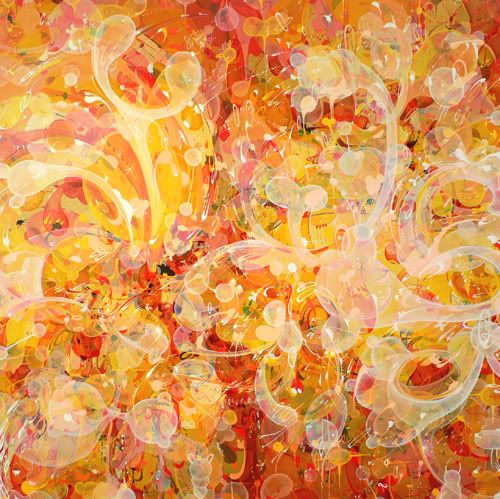
Aurora Robson's "Shebang"


Aurora Robson
"Shebang"
2007
Oil on panel
36 x 36 inches


There are at least seven strong works included in Gallery Satori's "Unreal City" exhibition (on view through July 27th). Among others, I was engaged by Jeremiah Teipen's basement smoke and light show ("Nothing, and everything"), Carlos Roque's aural-sculpture ("Sonic Architecture"), and two of Ha Rhin Kim's acrylic on mylar works, but Aurora Robson's "Shebang" resonated intensely.


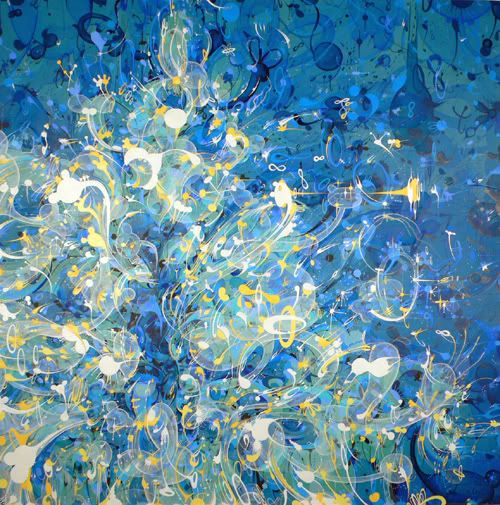
Aurora Robson
"Polaris"
2007
Oil on panel
36 x 36 inches


The saturated color, layered surface and energetic, sensuous arabesques bring to mind the work of Brazilian painter Beatriz Milhazes, but where Milhazes is content to dwell in decoration, Robson embraces a more experiential magic, one that springs from an awareness of the ether.


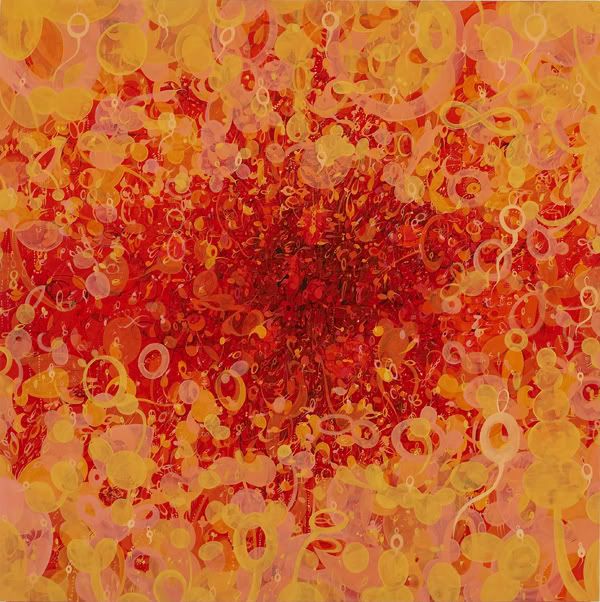
Aurora Robson
"47 Society"
2006
Oil on panel
24 x 24 inches


Hers is a physicist's sensiblity; the exuberance I felt in the presence of "Shebang" is the same I feel when I think hard on spacetime or abiogenesis.

Standing with the painting, I recalled something I'd recently read in Harper's Magazine. The following text is excerpted from "The Devil's Delusion: Atheism and Its Scientific Pretensions," by David Berlinksi.
"'Faith' it is said in Hebrews 11:1, 'is the substance of things hoped for, the evidence of things not seen.'...If religious belief places the human heart in the service of an unseen world, the serious sciences have since the great revolution of the seventeenth century done precisely the same thing....

The universe in its largest aspect is the expression of curved space and time. Four fundamental forces hold sway. There are black holes and various infernal singularities. Particles pop out of quantum fields. Elementary particles appear either as bosons or fermions. The fermions are divided into quarks and leptons. Quarks come in six varieties, but they are never seen, confined as they are within hadrons by a force that perversely grows weaker at short distances and stronger at distances that are long. There are six leptons in four varieties. Depending on just how things counted, matter has as its fundamental constituents twenty-four elementary particles, together with a great many fields, symmetries, strange geometrical spaces, and forces that are disconnected at one level of energy and fused at another, as well as at least a dozen different forms of energy, all of them active.

This is not an ontology that puts one in mind of a longshoreman's view of the material world. It is remarkably baroque, and it is promiscuously catholic."

Such baroque catholicism is the stuff of theoretical science, but it is also the stuff of good art.


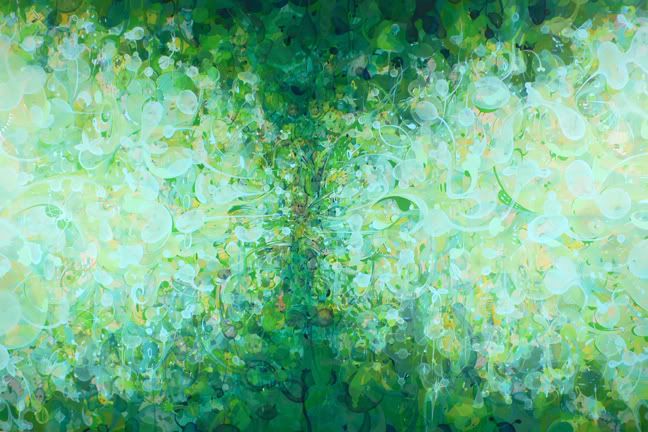
Aurora Robson
"Diasporalia"
2006
Oil on canvas on panel
72 x 108 inches


Note: David Berlinski is a proponent of Intelligent Design. I made clear my stance on his position in an earlier post, but I see no reason to dismiss all of his ideas because we disagree with specifics.

Photo credits: Aurora Robson images ripped from her website

Thursday, March 23, 2006

Do You Feel Lucky, Pan sapiens?


There are a lot of reasons to be baffled by the renewed attacks on the theory of evolution(1), but I'm particularly bemused by the denialists' contention that the theory is a dangerous dogma. It's true that there's no shortage of dull-witted biologists who can be too stubborn in their pronouncements, as unwilling to consider a dissenting perspective as the loudest denialist(2), but any scientist worth her salt - or, for that matter, any informed, reasonable individual - realizes that the theory of evolution is, itself, evolving. Sure, some scientists can be dogmatic, but the theory in question is not a dogma. It is adaptable.

When most of us hear the word, evolution, crude caricatures of chimpanzees, Neanderthals, and walking fish-reptiles come to mind. Sometimes, we may even think of diagrammed cell division or an eukaryote propelling itself by means of rudimentary flagella. Yet rarely, if ever, do we consider change at the molecular level. Biophysicists Harold Morowitz, of George Mason University, and Eric Smith, of the Santa Fe Institute, do exactly that, suggesting that a "central set of chemical reactions has been in place since life's earliest moments about four billion years ago." Journalist Joel Achenbach explains the Morowitz/Smith hypothesis in a recent National Geographic piece, "The Origin of Life...Through Chemistry."
"These reactions involve just 11 small carbon molecules, such as citric and acetic acids, very ordinary stuff that would have been abundant on the young Earth. Those 11 molecules could have played a role in other chemical reactions that led to the development of such biomolecules as amino acids, lipids, sugars, and eventually some kind of genetic molecule such as RNA."
What makes the hypothesis so fascinating, though, is the suggestion that survival of the fittest or, more accurately, natural selection, occurs at the molecular level. Acenbach clarifies: "Some types of molecular chains outcompeted other molecular chains for the planet's resources, and gradually they led to the type of molecules that life depends upon - all this before the first living thing oozed forth." Wow! It seems obvious, really. Of course molecules compete in the same way genes do.

Unmentioned in the Geographic article is the divide between Millerites, evolutionary biologists who stand by Stanley Miller's mid-twentieth century hypothesis that life began at surface level, when electricity, atmospheric gases, and water interacted in such a way as to form the oft-mentioned biotic soup, and ventists, the scientists who feel such a soup was more likely arrived at on the ocean's floor, a by-product of interactions involving pressure and heat near hydrothermal vents. (I prefer to think of the two perspectives as the Frankenstein approach (electricity) and the oven hypothesis (hydrothermal) and, although I remain uncertain of which I "support," when the two camps duke it out the Frankenstein approach always seems to be forced back against the ropes.) Morowitz and Smith are ventists. Will their molecular metabolism hypothesis, viable both on the surface and under the sea, come under fire from Millerites because they are "the enemy"?

Such language - "duke it out," "the enemy" - is hyperbolic, but most folks would be shocked by how nasty the debates in the halls of evolutionary biology can become. Whatever impression the more extreme denialists seek to convey (e.g., Darwin was a blasphemer who today inspires countless secularists, marching in lockstep, to carry on his unholy work), the theory of evolution is anything but settled. Darwin's theories provide a spring board, an introduction, but are not fast. As with most revolutionary science, Darwin's ideas raise a host of questions.

One of these questions, in particular, has plagued biologists ever since Darwin's theory was first published. Commonly referred to as the "paradox of evolution," it asks, how can we reconcile evolutionary variation - all the shapes, colors, sizes, etc. - with the limited number of structures and systems all species share? The two readily observable realities seem contradictory: unlimited diversity produced by a limited system. Marc Kirschner, chair of the Systems Biology Department at Harvard Medical School, recently proposed a novel answer, facilitated variation. I turn to Robin Marantz Henig's article, "Resolving Evolution's Greatest Paradox," in the March/April 2006 issue of New York Academy of Sciences Update.
"Kirschner used an analogy borrowed from the kindergarten classroom to explain how his and Gerhart's theory differs from evolutionary theory up to this point. Traditionally, he said, biologists have compared life to a lump of modeling clay, 'incredibly plastic, and able—due to the accrual of many small changes—to go in any direction.' But this is the wrong metaphor, he said. In truth, life is more like a bunch of Lego blocks. As with Legos, the basic building blocks of biology are rigid and quite similar to one another, but 'there is a large variety of structures that can be assembled from similar parts.'

Another way of looking at it, Kirschner said, is to try to imagine trying to get a monkey to write the word 'MONKEY.' You could do so by giving the monkey a pen and paper, but that would never work—all you'd get would be 'random lines and scratches.' But if you gave him a typewriter, then you might be getting somewhere. It would take a very long time (Kirschner calculated about ten years, typing at the rate of one keystroke per second round-the-clock), but the monkey would eventually produce all six letters in the right order, because the typewriter restricts the results of his physical actions—always letters instead of scribble-scrabble. 'Letters have at least a chance to be useful,' Kirschner said. 'Most pen scratches do not.'

If, instead of a typewriter, the monkey was pounding on a computer keyboard programmed with an automatic spelling corrector, the time it would take for him to type out the word 'MONKEY' would be reduced dramatically, from ten years to probably less than a single day. 'More constraint equals more useful outcomes,' Kirschner said."
OK. That's clear, but how can the spell checker analogy account for so much complexity and variation?
"Complexity in multicellular organisms—changes and refinements in beak shape, pigmentation, jaw structure, limb formation—can be explained, he said, by forces involved in 'changing the time and extent of a process rather than creating a new process.'...[This] helps account for the surprising fact that the human genome isn't much bigger than the genome of a frog or a fruit fly. The vast differences among these organisms are accounted for not by number of genes, he said, but by how the genes are expressed...In other words, the gene itself doesn't have to be different; what changes is the timing or location of the gene's expression."
Beautiful! One need look no further than the gestation of a human embryo to get a sense of how facilitated variation works, each step recalled and repeated, generation after generation, the species' genome receiving new information all the while. The same "program" is "running" inside frog eggs or the squirrel's womb.

Still, it's important to note that facilitated variation is but a piece of the ever-changing puzzle, no more or less important than punctuated equilibrium or the notion of spandrels. Moreover, though a lovely marriage of genetics and natural selection, Kirschner's theory is less applicable when considering a restricted time line.

"Global Warming Fuels Speedy Evolution," a piece by Larrry O'Hanlon (Discovery News), provides readers with a number of recent, documented cases of dramatic changes in animal phylogeny. Within the past seven years, the cane toad (Bufo marinus) population in Australia - an introduced, destructive species - has evolved longer legs, an adaptation that has made the species considerably more mobile, enabling them to more quickly expand away from the introduction point. Longer legs equals more ground covered which, in turn, means access to virgin territory and plentiful food. In short, further colonization. Not surprisingly, some native Australian snake species viewed the new arrivals as prey. After swallowing the amphibians, however, these reptiles would ingest the toad's toxin and - pardon the pun - croak. Amazingly, in the same seven-year window, these snake species have, via natural selection, developed smaller jaws, thereby preventing them from eating the toads and ingesting the toxin. All this change in seven years and across several unrelated species!

Invasive species aren't the only reason for accelerated, or rapid evolution, as it is officially called. Global warming (better termed climate change) is a prime mover, too.
"Research on toads, frogs, salamanders, fish, lizards, squirrels, and plants are all showing evidence that some species are attempting to adapt to new conditions in a time frame of decades, not eons, say biologists. What's more, one of the biggest reasons for all this evolution right now may be that human-induced changes to climate and landscapes give species few other options....The first known case of a mammal responding genetically to warmer climate warming is the red squirrel of the Yukon Territory. Canadian scientists have discovered that red squirrels are giving birth about 18 days earlier than their great-grandmothers. It's the early squirrel that gets the nut, after all: natural selection in action. 'Climate change is going to be a massive agent of evolution,' said ecologist and rapid evolution researcher David Skelly of Yale University."
Rapid evolution provides more evidence for the punctuated equilibrium hypothesis, suggesting that, when need be, species have the ability to adapt much more quickly than paleontologists, geneticists, and evolutionary biologists originally believed possible. The gaps in the fossil record, so often highlighted by denialists as proof of evil-ution's failings, are easily accounted for when we observe, in the space of just one decade, significant phylogenetic changes within a given population.

All of these observations and new hypotheses are very exciting to me, but I realize a portion of the folks reading Hungry Hyaena, maybe even the majority, find this round-up rather esoteric. I thought it only sensible, then, to wrap up by bringing evolution closer to home or, in this case, closer to man. Biologist Soojin Yi (Georgia Institute of Technology, Atlanta) recently confirmed that both species of chimpanzee (Pan troglodytes and Pan paniscus) are more closely related to humans than previously assumed. In fact, as I've argued often, it looks as though the taxonomy will have to be changed. Homo sapiens will no longer be alone in the genus; Homo troglodytes and Homo paniscus will soon be joining our private party!

I hope this announcement will provide a reality check for our unfathomable human hubris, but, as incredibly happy as I am about it, I'm not altogether satisfied about where it will lead. As I see it, humans should move genus, not chimpanzees. Our species should be dubbed Pan sapiens. In other words, we should willingly discard our crown and step down to join the great unwashed, honest at last when regarding our reflection. I'm not alone in feeling this way. Andrew Rambaut, an evolutionary biologist at Oxford University, says, "It seems a bit human-centric to want to put chimps into the 'Homo' genus and not reclassify humans as 'Pan.'" Jared Diamond, the acclaimed author of Guns, Germs, and Steel and, more recently, Collapse, wrote an excellent, lesser known book in 1991, titled, The Third Chimpanzee, in which, among innumerable salient points, he suggested we do away with the arbitrary Homo delineation. After all, every ape relies on the same damned spell checker.

(1) Some folks refer to intelligent design as "the fourth wave" of resistance. The first wave of opposition dates back to the 1860s, when the theory was nascent and controversial. The second wave, during the 1920s, culminated with the Scopes Trial. Then, in 1987, the Supreme Court ruled against mandatory teaching of creation science - Edwards v. Aguillard - effectively putting an end to the third wave.

(2) Reading "Evolution In Action" (Sid Perkins, Science News, Feb. 25, 2006), I was struck by the us-versus-them tone prevalent throughout the article. The reactionary posturing of some scientists - and, in this case, a science journalist - can take on a disturbing tone: "From 2001 through 2003, anti-evolution activity was reported in 40 states." Anti-evolution activity? Reported? The witch-hunt has begun!

Photo credit: Ripped from brainfuel.tv

Wednesday, December 14, 2005

Linkage

I don't have time to write much today, but I thought I would provide a few links, all of which merit a looksee. In case you're a reader from a particular camp, though, I've broken these down into three categories:

For the artsy-fartsy readers:

Read the latest Art Fag City post, a review of/reaction to last week's The Believer Event at P.S.1. I disagree with some of AFC's ideas - most vehemently with the notion that "there has never been a time where civilizations wanted to be reminded of their mortality" - but there is a lot of good grist for the mill in the post.

Also, check out Winkleman's post on purity in photography. The subject explodes in several directions, all of interest, in the Comments section. This is yet one more example of a Winkleman post turning into a enjoyable, insightful forum. Good stuff.

For the science mavens:

I highly recommend this post at Vitriolic Monkey. In it, Devo proposes a novel way to integrate Intelligent Design into our high school biology curriculum. His solution is sure to produce a why-didn't-I-think-of-that moment in any self-respecting science nerd.

And for the conservationists and environmentalists:

I encourage readers interested in debating the morality and ethics of hunting to visit Sphere. Tom Andersen writes about the hunting of white-tailed deer (Odocoileus virginianus) in Darien, Connecticut. He summarizes the correlative relationship between suburban sprawl and increasing deer populations, the connection of wealth and private landownership, and the often wide gap between sustainable practice and the average hunter's approach. All of this is a few short paragraphs!

Thursday, July 14, 2005

Cross-purposing

A couple of weeks ago, I wrote "Silly Rabbit, Tricks Are For Kids," a post exploring my reaction to intelligent design. I wrote then,
"No biology teacher tells his or her students that evolution is proof of God's absence and many respected evolutionary biologists are devout Christians. Faith is a matter of individual choice, not biology class...I have no real beef with I.D. when it isn’t claiming to be a science. The notion that the universe must have been fashioned by a higher being is not new and is one many people, particularly Americans, still hold dear. I see no reason why this should change. However, such 'theories' belong in religious schools or the family living room, not in the biology classroom."
Last night, a good friend of mine told me that his father, the dean of Grace Cathedral in San Francisco, had written a letter to the New York Times in response to the recent article, "Leading Cardinal Redefines Church's View on Evolution" (front page, July 9). I decided to post the letter here.

In a more eloquent and succinct fashion, Reverend Alan Jones communicates something of what I was attempting to say in my post.
"To the Editor:

Cardinal Christoph Schönborn muddies the waters with his statement concerning evolution. The issue is that both 'believers' and 'scientists' tend to trespass on each other's turf.

When a scientist says or implies that life is without meaning, that's trespassing. When a believer claims that 'intelligent design' is scientific, he has stepped over the line. Both start with presuppositions that cannot be proved.

As a believer, I take on faith that there is intelligent design. The scientific evidence tells us that while it cannot be proved, it isn't unreasonable to believe so.

How much longer are we going to be talking at cross-purposes?

(Very Rev.) Alan Jones
San Francisco, July 9, 2005"
While Reverend Jones and I may feel differently about intelligent design, we are both banking on faith. Those folks, like Cardinal Schonborn, who continue to argue over the scientific validity of I.D. or evolution's place in the church are missing the point.

Tuesday, June 21, 2005

Silly Rabbit, Tricks Are For Kids

Image hosted by Photobucket.com
I just finished reading a recent Los Angeles Times article by P.J. Huffstutter, entitled “Evolution Hearings Under Way.” In it, Huffstutter describes the Topeka, Kansas intelligent design hearings and the associated scientific boycotts. Two quotes jumped out at me.
“There are alternatives [to the theory of evolution]. Children need to hear them. We can’t ignore that our nation is based on Christianity – not science.

-Kathy Martin, member Kansas State Board of Education

“Part of our overall goal is to remove the bias against religion that is in our schools. This is a scientific controversy that has powerful religious implications.”

-William Harris, chemist and witness speaking in favor of changing the Kansas curriculum to mandate the teaching of intelligent design
Scientists – excepting those on the fringe, like Harris - have boycotted these hearings, believing that their presence would only strengthen the case for intelligent design. Debating the legitimacy of I.D., they worry, will suggest that the "theory" is worth scientists’ time, lending the movement credence in the public eye. Yet the absence of scientists has given I.D. proponents a different sort of ammunition: taunting.

“Are [the scientists] afraid to show up? Are they afraid to defend themselves?,” asks Brian Sandefur of the Intelligent Design Network. After all, even Pennsylvanian Republican senator Rick Santorum has called intelligent design “a legitimate scientific theory.” Who better to distinguish sound science from hokum? (Perhaps nobody; Santorum was responsible for adding an amendment to the No Child Left Behind Act that requires public school biology teachers to raise questions about “the continuing controversy” over evolutionary theory. Fortunately, this amendment was removed before the act was signed into law.)

But what exactly is this continuing controversy? The vast majority of scientists worldwide (over 95%) accept the theory of evolution as the primary springboard for investigation into the formation of life on Earth. The theory doesn’t deny the existence of God or demand that we all practice eugenics anymore than the theory of gravity insists we hurl ourselves out of skyscrapers. Simply put, there is no scientific controversy.

There is, however, plenty of social debate. The Wedge Document of the Discovery Institute, a west coast think-tank and the principal bastion of I.D. rhetoric, claims that Darwin fathered “a materialistic conception of reality” that has “infected virtually every area of our culture.” Apparently, the American majority didn’t get the memo. As H. Allen Orr points out in his fantastic article, “Devolution” (The New Yorker, May 30, 2005), the “eighty percent of Americans [who] say that God either created human beings in their present form or guided their development” is responsible for all the noise. As a country, we still don’t want to believe that we evolved from monkeys, much less burbling blobs of pond scum.

Many of these Americans may be surprised to learn that the two men behind the popularization of I.D. have different notions of what exactly intelligent design is and both accept that Homo sapiens were once, at an earlier stage in our development, pond scum. I won’t go into detail about the flawed pseudo-science of Michael J. Behe, a biochemist at Lehigh University, and Dr. William A. Dembski of Baylor University – I highly recommend the Orr article as it describes and evaluates the I.D. arguments in a wonderfully comprehensible way – but it is worth noting that Behe has admitted that his arguments against the theory of evolution were “sloppy”(1) and Dembski’s methodology was dismissed by the very mathematicians whose work he relied on to debunk Darwin’s theories in the first place(2), forcing Dembski to backtrack, claiming that he “never argued that the N.F.L. theorems provide a direct refutation to Darwinism,” even though he had done exactly that.

The two men also have differing philosophical viewpoints. Behe believes an intelligent creator designed the first cells, and then Darwinian evolution accounted for everything that follows. Dembski believes Darwinian evolution totally absurd, and that the intelligent creator “programmed design into the…early universe” and this design “then unfolded through the long course of evolutionary time, as microbes slowly morphed into man.” Both men accept evolution, in other words, but only if it is directed by a divine hand or set in motion by an omnipotent creator.

Why then should I.D. be taught in the classroom? No biology teacher tells his students that evolution is proof of God's absence and many respected evolutionary biologists are devout Christians. Faith is a matter of individual choice, not biology class.

The furor in Kansas, though, is about whether or not biology class should include "faith based" instruction. I.D. has been hijacked by a growing right-wing, Christian agenda. Behe and Dembski considered Darwinian evolution, decided it was too messy and uncertain, and chose instead to promote the magic wand approach. "Look! The bunny isn’t in the hat anymore. Ooooooooo!" Conservative fundamentalists recognized this wave of the wand as a chance to make gains for their cause. By tapping into societal doubt, they have succeeded beyond expectation. It is they, not the I.D. proponents, who are the real force behind the assault on science education.

Intelligent design, no matter how one dresses it up, boils down to a refutation (based in fear) of random mutation. I.D. proponents insist that nothing is random, ultimately, because God is behind the curtain, pulling the levers and pushing the buttons. “Hard” science doesn’t aim to throw back the curtain and expose the fraud, but it does demand that our body of knowledge progress based on the scientific method, not mere conjecture. I.D. proponents can make the rabbit vanish by marrying philosophy to pseudo-science, but who can’t? When asked to make an argument for intelligent design in an accepted, scientific fashion, the rabbit stays put and the illusion is spoiled.

I have no beef with I.D. when it isn’t claiming to be science. The notion that the universe must have been fashioned by a higher being is not new and it is one many people, particularly Americans, still hold dear. I see no reason why this should change, even if I do not believe in a Creator myself. However, such 'theories' belong in religious schools and the family living room, not in the biology classroom.

(1) “I quite agree that my argument against Darwinism does not add up to a logical proof.”

(2) “[Dembski’s use of the theorems was] fatally informal and imprecise.” (David Wolpert, physicist)

Photo credit: Plusmagic.co